

The Sandler Method for Cold Calling: Every Script You Need
Monday morning. You finished Sandler training last week, you're fired up, you pick up the phone - and blank. You know you're supposed to find pain, use an up-front contract, reverse objections. But what do you actually say?
That's the gap SalesScripter's CEO nailed years ago: Sandler tells you what to do but not what to say. Sandler's own blog post on cold calling doesn't include a complete script. This guide does. Every word, scripted out, ready for tomorrow's dials.
Here's the context: dial-to-meeting rates dropped to roughly 2.3% in recent benchmarks, down from 4.82% just one year prior. This framework is built for a world where prospects are over-called and under-impressed. (If you want a broader outbound playbook, start with these sales prospecting techniques.)
Where Cold Calling Fits in Sandler
David Sandler's full system - the Sandler Submarine - has seven compartments: Bonding & Rapport, Up-Front Contract, Pain, Budget, Decision, Fulfillment, and Post-Sell. Cold calling lives in steps 1-2, with elements of step 3. You're building rapport, setting expectations, and surfacing enough pain to earn a meeting. You're not selling anything on the call.
That distinction matters more than most reps realize. The moment you pitch features on a cold call, you've left Sandler territory and entered "please hang up on me" territory.
The 4-Step Cold Call Framework
Every step below includes a script you can use verbatim. Whether you've been through formal Sandler sales training or you're self-taught, this framework gives you a repeatable structure that actually holds up under pressure. (If you’re still building fundamentals, this cold calling for beginners guide pairs well with Sandler.)
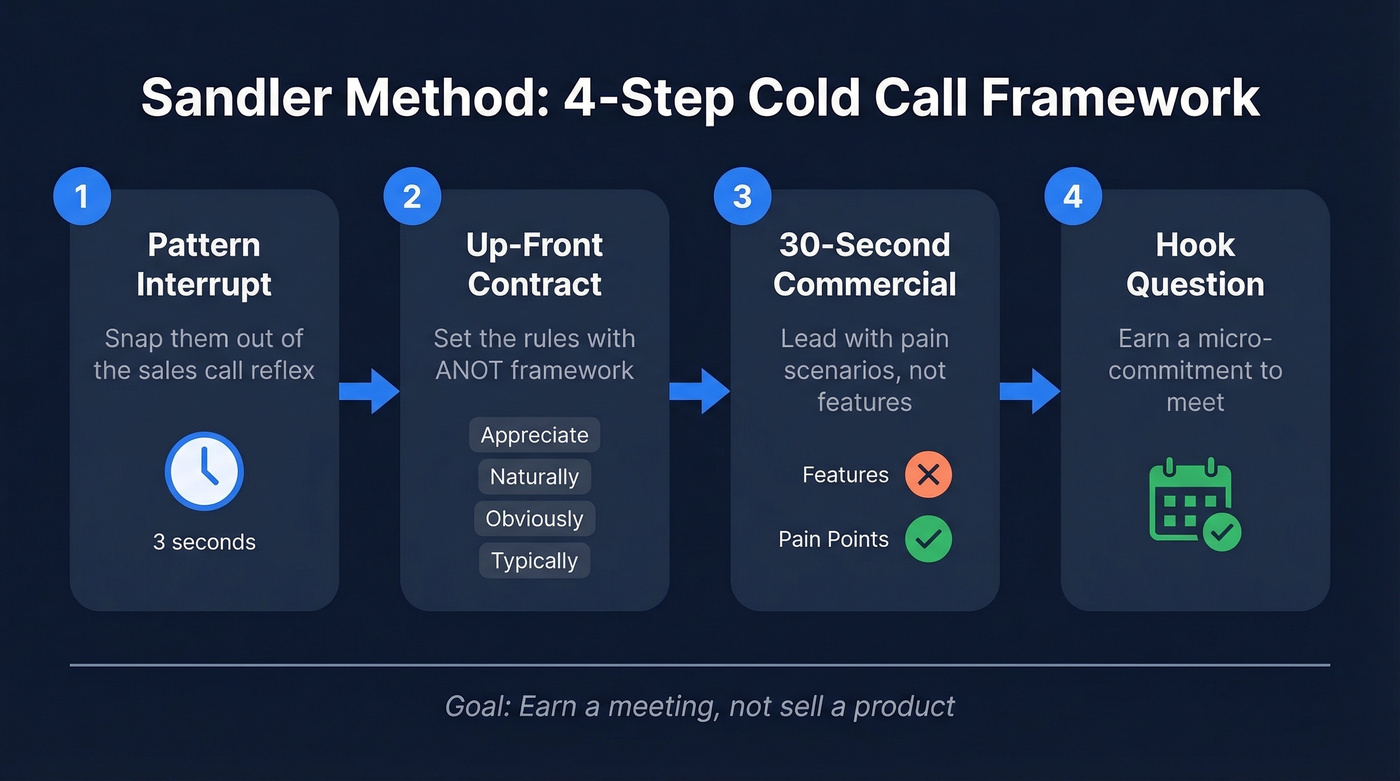
Step 1: Pattern Interrupt
Prospects decide to hang up within about 3 seconds. The pattern interrupt snaps them back before the "another sales call" reflex fires.
Four openers that work:
"Is this [Name]?" (wait) "John Rosso. Sandler Training." (pause)
"Hi [Name], this is [Your Name]. I know you weren't expecting my call." (pause)
"Hi [Name], this is a cold call - want to hang up or give me 30 seconds?"
"It sounds like you might already have a solution in place - is this even worth exploring?" (Negative Reverse Selling - works especially well with skeptical buyers)
The self-aware opener is polarizing. We've seen it work best with director-level and above prospects who respect directness. The key across all four: deliver with peer-to-peer tonality. Confident, not aggressive. Calm, not cheerful. You're an equal, not a supplicant.
Tonality matters more than the exact words. The most common cold calling mistake is sounding like you're reading - which kills any opener instantly, no matter how clever the script. (For more on handling the emotional side of dialing, see cold call rejection.)
Step 2: Up-Front Contract
Once you've got their attention, set the rules with the ANOT framework:
- Appreciate - thank them for the moment
- Naturally - acknowledge they'll have questions
- Obviously - state you'll have questions too
- Typically - describe how this usually works
Compressed for a cold call, it sounds like this:
"Let me tell you why I'm calling, and you can tell me whether or not we should chat. Is that fair?"
Roughly 9 out of 10 prospects respond positively to that line. Giving the prospect explicit permission to say "no" actually increases your chances of getting to "yes." It drops their guard because you're not pushing. This is one of the most effective Sandler principles you can internalize: the more freedom you give the prospect to leave, the more likely they are to stay.
Step 3: 30-Second Commercial
Most reps blow this by pitching too early - launching into company history and feature lists when the prospect hasn't expressed a single problem. The Sandler 30-second commercial is built entirely around pains, not features.
"We're [company]. We're definitely not the right fit for everybody. But typically, when organizations start working with us, it's because one of two things is going on. Either they have a lot in their pipeline but not enough is closing... or they actually have a difficult time getting those opportunities into the pipeline in the first place."
Notice the "definitely not the right fit for everybody" line - that's the Sandler takeaway. Telling the prospect you might NOT be right for them is counterintuitive, but it drops resistance instantly. And notice the structure: two pain scenarios, zero features. Successful cold calls tend to have reps talking around 55% of the time, so keep this tight and pivot fast. (If you want more ready-to-steal positioning, pull from these sample elevator pitches.)
Step 4: Hook Question
The hook transitions from your monologue to their engagement. You're after a micro-commitment - a meeting - not a sale.
"I'm curious - does any of that resonate with what you're experiencing?"
"Which of those situations sounds more familiar?"
If they bite, you've earned the right to go deeper. If they don't, you've lost nothing. Either way, you stayed in control of the conversation without being pushy.

The Sandler method only works if you're calling the right person at a real number. Prospeo gives you 125M+ verified mobile numbers with a 30% pickup rate - 3x higher than ZoomInfo. Stop burning your best pain funnel questions on gatekeepers and voicemail boxes.
Dial decision-makers directly and put your Sandler training to work.
The Pain Funnel: Questions That Uncover Real Problems
When a cold call goes well enough to dig deeper, these eight questions move from surface-level to emotional pain:
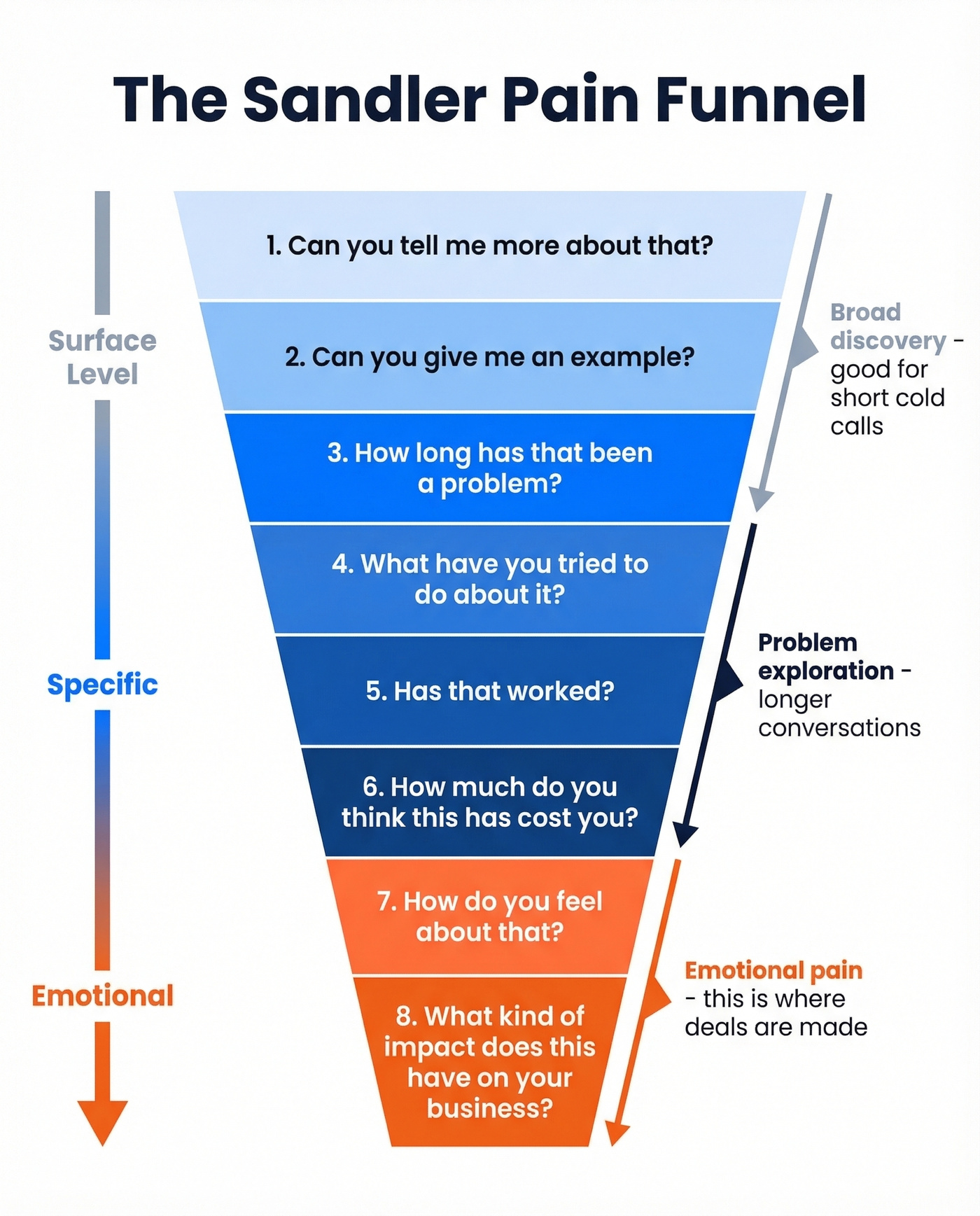
- "Can you tell me more about that?"
- "Can you give me an example?"
- "How long has that been a problem?"
- "What have you tried to do about it?"
- "Has that worked?"
- "How much do you think this has cost you?"
- "How do you feel about that?"
- "What kind of impact does this have on your business?"
The sequence matters more than the exact wording - adapt the questions to your style, but keep the progression from broad to specific to emotional. Not every cold call goes deep enough for all eight. On a 90-second call, you'll hit two or three. That's fine. The funnel is a tool, not a checklist, and forcing all eight questions into a short call will make you sound like an interrogator rather than a peer. (For a wider set of options beyond Sandler, use these discovery questions.)
Objection Handling: The Sandler Reverse
Sandler's reversing technique answers a question with a question. Three steps: Stroke (disarm), Repeat (buy time), Question (redirect). Tonality is everything - the same words delivered with curiosity land completely differently than words delivered with aggression.
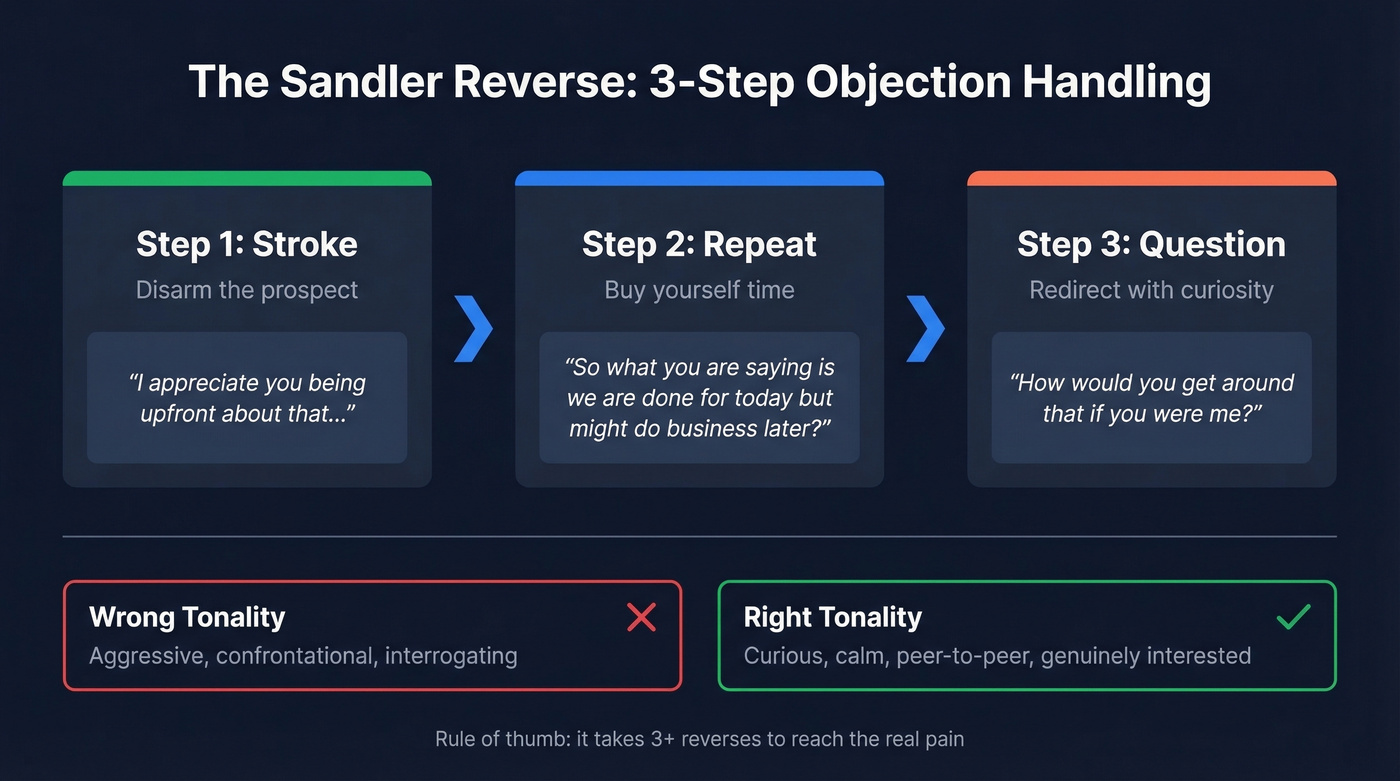
Here's the technique applied to the classic "call me back in 3 months" stall. The consensus on r/sales is that this exchange sounds too aggressive on paper but works surprisingly well in practice:
Prospect: "Call me back in 3 months."
You: "So we're done for today but we might do business in the future - is that what you're saying?"
Prospect: "Yes."
You: "OK, so here's my problem. Typically when people ask for a call back, they're hoping the salesman forgets and never calls them back. Is that what you're hoping for?"
Prospect: "No, now just isn't a good time."
You: "But in 3 months you still won't know or trust me. Fair?"
Prospect: "Yes."
You: "So how would you get around that if you were me?"
The prospect closes themselves on the meeting. Let's be honest - this takes practice. The first few times you try it, you'll feel awkward. That's normal. The rule of thumb: it takes 3+ reverses to get to the real pain. Short reverses work too - when a prospect trails off, just say "And?" to pull the next layer out. (If you’re systematizing this across a team, build it into your cold calling system.)
Your Script Isn't the Bottleneck
Here's what nobody in Sandler training talks about: connect rates sit at 3-10%, and it takes 18+ dials to reach a single prospect. Once you actually reach someone, 60-65% of conversations convert to a next step. The bottleneck isn't your script. It's whether the phone rings.
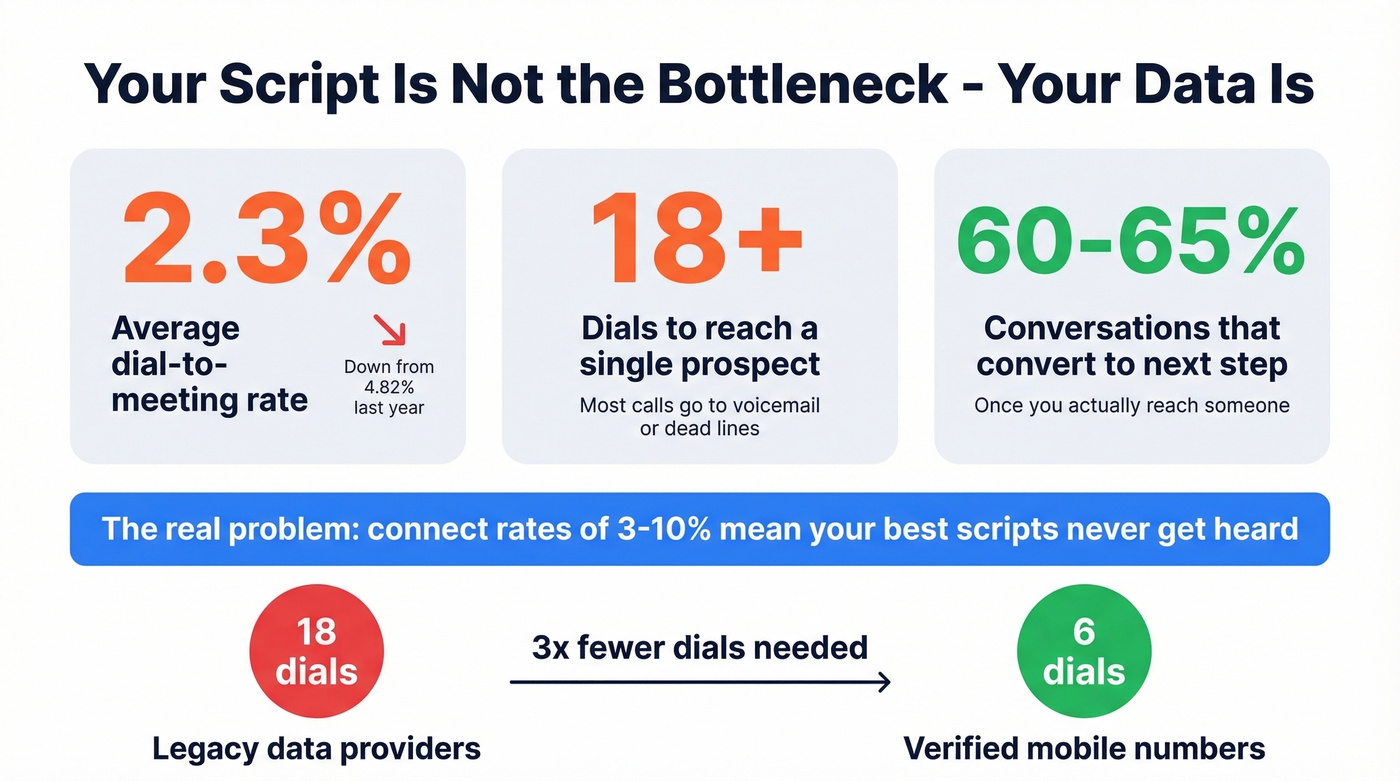
The Sandler framework assumes you're calling a real person at a real number. If your data is stale, you're burning dials on voicemails and dead lines. We ran into this ourselves - our team found that switching from a legacy provider to Prospeo's 125M+ verified mobile numbers cut the average dials-to-conversation from 18 down to about 6, thanks to a 30% pickup rate and data refreshed every 7 days instead of the industry-standard 6 weeks. (If you’re evaluating providers, compare options in our best sales prospecting databases roundup.)
Skip this section if your connect rates are already above 15%. But if you're averaging single digits, the problem isn't your Sandler technique - it's your phone list. (You can also tighten list quality with data enrichment services before you dial.)
A 2.3% dial-to-meeting rate means every bad number wastes your sharpest Sandler scripts. Prospeo's data refreshes every 7 days - not every 6 weeks - so you're calling prospects at numbers that actually ring. 98% email accuracy. 125M+ verified mobiles. At $0.01 per lead, the data never bottlenecks your pipeline again.
Stop perfecting scripts for contacts that don't pick up.
FAQ
Sandler vs. SPIN Selling for Cold Calls?
SPIN Selling uses four structured question categories and frames problems logically across all four. Sandler drills deeper into one problem through progressive emotional layers via the Pain Funnel. For cold calling specifically, Sandler's pattern interrupt and up-front contract give you a stronger opening structure than SPIN provides. Use SPIN for longer discovery calls; use Sandler for cold opens.
Does This Work for SDRs?
Absolutely. SaaS SDRs actively use up-front contracts and pain-first openers on cold calls. You don't need the full Pain Funnel on a 90-second call. Stick to the 4-step sequence: Pattern Interrupt, Up-Front Contract, 30-Second Commercial, Hook Question. The biggest variable for SDRs isn't technique - it's whether you're dialing verified direct numbers or burning time on switchboards.
Do You Need Formal Training?
No. The core cold calling framework is well-documented and learnable from guides like this one, plus Sandler's own resources. Formal Sandler training adds coaching, role-play practice, and accountability - but the scripts and structure are right here. What matters most is internalizing the pain funnel questions and practicing them until they feel conversational rather than scripted. Record yourself. Listen back. Cringe. Improve. That loop beats any certification.