

The Sandler Sales Methodology: Scripts, Steps, and When It Actually Works
A rep runs a flawless demo. The prospect says "this looks great, let me loop in my team." Then silence. Two follow-ups. A "let's circle back next quarter." Then nothing.
84% of sales reps missed quota last year, and a huge chunk of that failure traces back to one problem: reps who pitch before they qualify. The Sandler sales methodology was built to fix exactly that - and after decades of use, it's still one of the most practical frameworks for reps tired of chasing ghosts.
Quick version: Sandler works best for SMB and mid-market deals with one or two decision-makers and short sales cycles. If you're selling enterprise to buying committees, pair it with MEDDIC's rigor. The single most valuable Sandler concept is The Pain Funnel - adopt that even if you ignore everything else. Sandler's 9-month Sales Mastery training typically runs around $6-7K. Start with this guide before committing cash.
What Is the Sandler Selling System?
David Sandler developed this system in 1967 after years of frustration with the high-pressure, always-be-closing culture that dominated sales floors. His method emerged as a low-pressure, consultative framework that puts the salesperson in control of discovery - not through closing tricks, but through disciplined qualification and honest conversations. The core philosophy is simple: stop chasing prospects who aren't going to buy, and stop pitching before you understand pain.
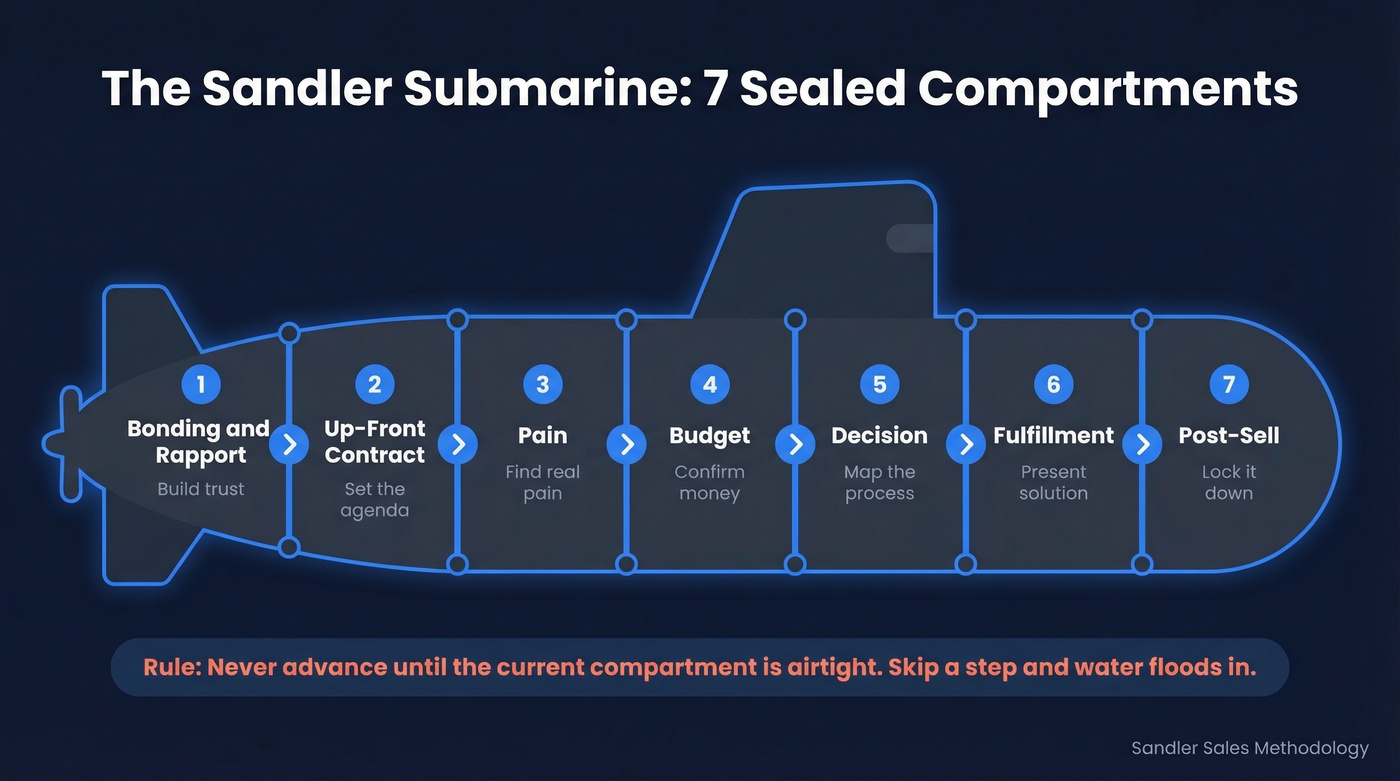
The best metaphor for understanding the framework is the submarine. Each of the seven steps is a sealed compartment - you move through them sequentially, and you don't advance until the current compartment is airtight. Skip a step, and water floods in. If you haven't confirmed budget, you don't present. If you haven't identified real pain, you don't discuss solutions.
This runs counter to how most reps are trained. Traditional sales says: build rapport, present features, handle objections, close. Sandler flips it. The prospect should be convincing you that they're worth your time, not the other way around. A 70/30 listening-to-talking ratio is a core guideline - if you're doing most of the talking, you're doing it wrong.
The 7 Steps of the Sandler Selling System
Bonding and Rapport
This isn't small talk about the weather. Sandler-style rapport means matching the prospect's communication style and establishing genuine human connection before any business discussion. The goal is to lower defenses so the prospect speaks honestly about problems.
- "How'd you end up in this role?"
- "What's keeping your team busy this quarter?"
Up-Front Contract
This is Sandler's most distinctive move - and the one worth adopting immediately. Before every meeting, you set a mutual agreement on what'll happen: the agenda, the time, and the possible outcomes - including "no." It eliminates ambiguity and gives both sides permission to be direct.
- "Here's what I'd like to cover in the next 30 minutes. Does that work for you?"
- "At the end of this, it's totally fine to say this isn't a fit. Can we agree on that?"
Pain
This is the engine of the entire system. You're not asking about "challenges" - you're digging into specific, quantifiable, emotionally resonant pain. The Pain Funnel gets its own deep section below, so here's the short version: layer your questions from surface to business impact to personal stakes. Don't move on until the prospect has articulated why this problem matters to them, not just their company.
If you want a broader library of discovery prompts, see our discovery questions guide.
Budget
Here's where Sandler diverges sharply from most frameworks. You discuss money before you present. A practitioner on r/sales compared Sandler to NEPQ and called out budget handling as a key difference - with NEPQ-style approaches, prospects ghosted after price surfaced because budget friction was never addressed upfront.
- "Give me a range for what you'd be comfortable investing in solving this."
- "Have you set aside budget for this, or would we need to build a case?"
Decision
Who decides, how they decide, and when. Sandler reps push for clarity on the decision process before presenting anything. That same practitioner described pushing for a decision the same day as the presentation - not as pressure, but as a natural outcome of having already confirmed pain, budget, and authority.
- "Walk me through how your team typically makes a decision like this."
- "Who else needs to weigh in before you can say yes or no?"
If you're selling into committees, it helps to separate the technical buyer vs economic buyer early.
Fulfillment
Only now do you present your solution - and only the parts that map directly to the pain you've uncovered. This isn't a feature dump. It's a targeted demonstration connecting each capability to a specific problem the prospect already told you about. If you find yourself demoing features the prospect didn't ask about, you skipped a compartment.
For a tighter demo flow, use a product demo checklist so you don’t drift into feature dumping.
Post-Sell
Buyer's remorse is real, especially in B2B. Post-sell reinforces the decision and inoculates against competitors who'll swoop in during the implementation gap. Run through this before ending the call:
- Confirm the decision and restate the pain it solves
- Walk through exact next steps and timelines
- Ask what might come up internally that could slow things down
- Address competitor outreach directly: "If someone reaches out between now and kickoff, what would you tell them?"
The Pain Funnel: Scripts That Work
The Pain Funnel is the single technique most worth stealing from Sandler, even if you use a completely different framework. In our experience, the emotional stage is where most reps bail - they're uncomfortable asking "how do you feel about that?" - but that's the question that closes deals.
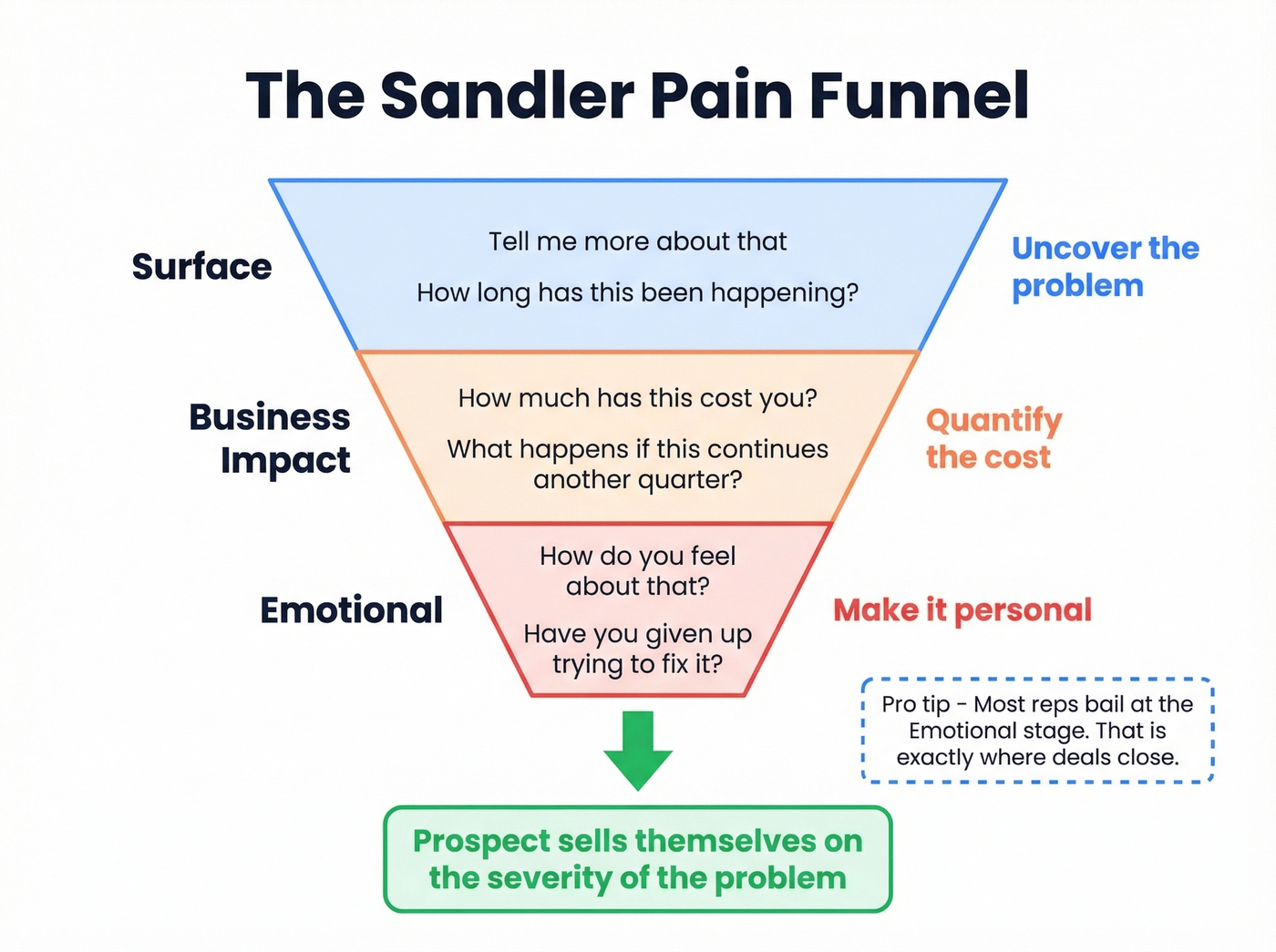
| Stage | Purpose | Example Questions |
|---|---|---|
| Surface | Uncover the problem | "Tell me more about that." / "How long has this been happening?" |
| Business Impact | Quantify the cost | "How much has this cost you?" / "What happens if this continues another quarter?" |
| Emotional | Make it personal | "How do you feel about that?" / "Have you given up trying to fix it?" |
Here's what a compressed Pain Funnel exchange actually sounds like:
Rep: "You mentioned your team's spending too much time on manual data entry. Tell me more about that."
Prospect: "Yeah, our reps are probably spending two hours a day just updating records."
Rep: "Two hours a day across how many reps? What does that cost you in lost selling time?"
Prospect: "Twelve reps. So... probably 24 hours a day of selling time, gone."
Rep: "And you've been dealing with this for how long?"
Prospect: "About a year."
Rep: "How do you feel about that? A year of lost productivity with no fix in sight?"
Notice the rep doesn't pitch. Not once. They let the prospect talk themselves into the severity of the problem. MeetRecord found that 88% of sales reps see significant improvement in their strategy after implementing Sandler techniques. When prospects articulate their own pain, they sell themselves.
Negative Reverse Selling
This is the most misunderstood Sandler technique. Negative reverse selling uses reverse psychology to get a prospect to either say "no" faster or defend their need and move forward. It's designed to break through what Sandler calls "Hope Island" - that purgatory of endless deferrals where the prospect says "call me back" or "email me the deck" but never actually commits.
If you’re stuck in endless “checking in,” these sales follow up templates can help you stay direct without sounding needy.
Here's a concrete script. The prospect has been vague and noncommittal for two calls:
Rep: "Based on what you've told me, it sounds like this might not be the right fit for you right now. Is it fair for me to assume that's the case?"
Two things happen. Either the prospect agrees - and you've saved yourself weeks of chasing - or they push back: "No, actually, we do need this. Here's why..." Now they're selling you, which is exactly where Sandler wants the dynamic.
A sub-technique called strip-lining works similarly. You deliberately pull back enthusiasm to draw the prospect forward - like letting line run before setting the hook. The hardest prospect in Sandler's framework isn't the hostile one - it's the neutral one, the person with zero emotional involvement. Negative reverse selling gets them in motion.
Look, this technique is easy to butcher. Applied clumsily, it comes off as rude. Use it selectively, with genuine warmth in your tone, and only after you've built real rapport. It's a scalpel, not a sledgehammer.
When Sandler Works (and When It Doesn't)
| Use Sandler When... | Skip Sandler When... |
|---|---|
| SMB/mid-market SaaS (under ~$20K ARR) | Enterprise deals with 6+ month cycles |
| One or two decision-makers | 5+ stakeholder committees |
| Short sales cycles | Technical evaluations requiring deep POCs |
| Professional services, consulting | Highly regulated procurement |
| Founder-led sales | Large teams needing complex pipeline mgmt |
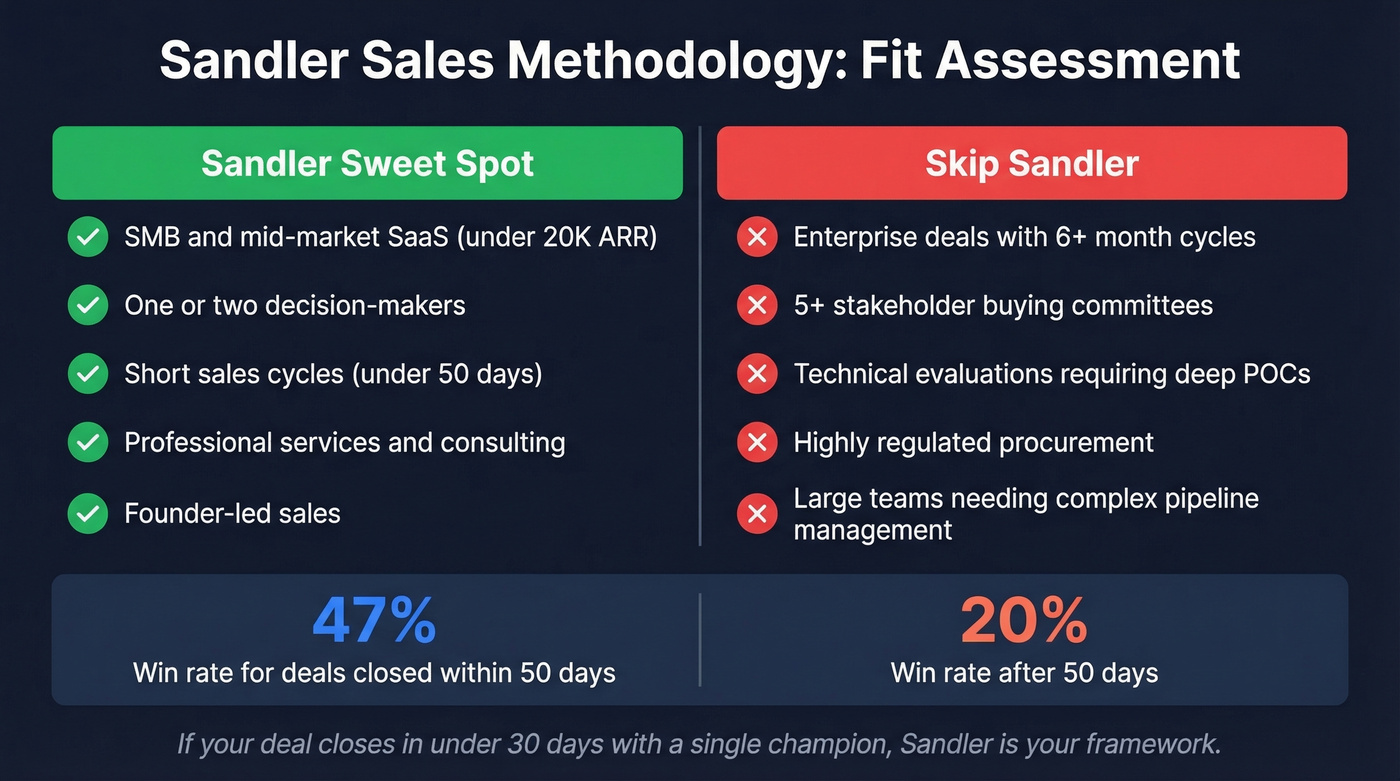
The data backs the cycle-length point: deals closed within 50 days show a 47% win rate, compared to roughly 20% after that threshold. Sandler's entire architecture - qualify early, surface budget fast, push for clean decisions - is optimized for short-cycle selling.
One founder's account illustrates the sweet spot perfectly: a founder-led EdTech SaaS company selling $8-10K ARR deals used the framework to set upfront agendas, check budget and authority early, and disqualify low-intent prospects. Fewer demos, faster decisions, higher close rates. That's the lane where Sandler dominates.
Where it breaks down is enterprise. When you're selling a $350K deal to a telecom with a seven-month cycle and a buying committee of eight, you need MEDDIC's rigor around economic buyers, metrics, and decision processes. Sandler's submarine compartments assume a relatively linear conversation with one or two people - not a multi-threaded political negotiation. (If you’re in that world, start with enterprise B2B sales fundamentals.)
Our take: Most sales teams don't actually need a full methodology. They need three things - a Pain Funnel, an up-front contract habit, and the discipline to disqualify early. Sandler packages those three things well, but if your average deal closes in under 30 days with a single champion, you can steal those concepts without buying the whole system.

The Pain Funnel only works if you reach the right person. Prospeo's 300M+ verified profiles with 30+ filters - including buyer intent, job changes, and headcount growth - let you skip the gatekeepers and land directly on decision-makers. 98% email accuracy means your Sandler-qualified pipeline stays clean.
Stop perfecting your Pain Funnel on prospects who were never going to buy.
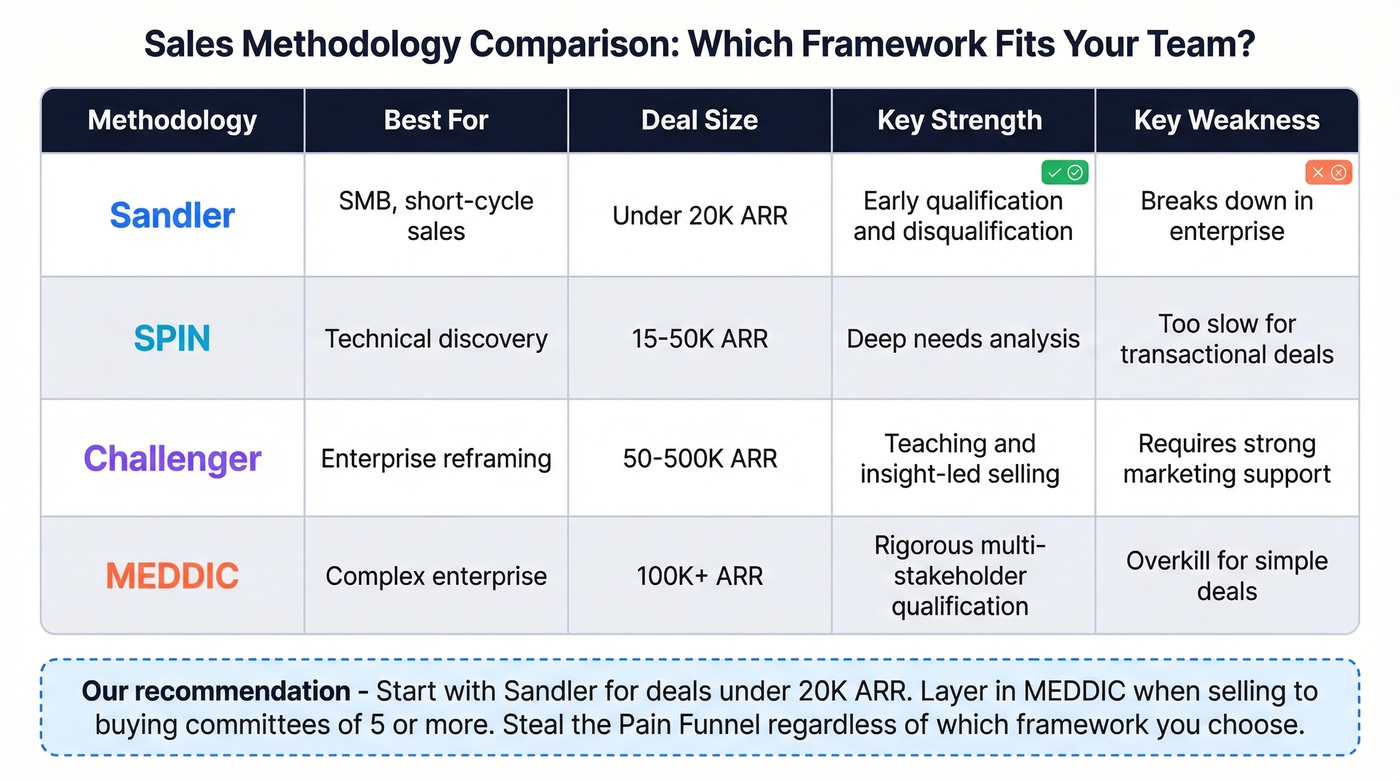
Sandler vs. SPIN vs. Challenger vs. MEDDIC
| Methodology | Best For | Deal Size | Key Strength | Key Weakness |
|---|---|---|---|---|
| Sandler | SMB, short-cycle | Under $20K ARR | Early qualification | Breaks in enterprise |
| SPIN | Technical discovery | $15-50K ARR | Deep needs analysis | Slow for transactional |
| Challenger | Enterprise reframing | $50K+ ARR | Teaching/insight-led | Requires strong content |
| MEDDIC | Complex enterprise | $50-500K+ ARR | Deal control | Overkill for SMB |
| NEPQ | Budget-sensitive | Varies | Emotional connection | Weak budget handling |
For context on research depth: SPIN was built on 35,000+ sales calls across 20+ countries over 12 years. Challenger came from CEB's study of 6,000+ reps and drove $65M in contract value and a 17% sales increase at Xerox. Sandler is practitioner-developed from 1967 with decades of iterative refinement but no single landmark study behind it.
We've tested all four frameworks across different deal sizes, and the decision tree is straightforward. Under $20K with one or two decision-makers? Start with Sandler. For $20-100K deals with formal procurement, MEDDIC gives you the qualification rigor you need. Selling transformation to enterprise executives who don't know they have a problem? Challenger's reframing approach is the right tool. Deeply technical discovery where the prospect needs to articulate their own problem before you can solve it? SPIN's question framework is unmatched.
If you want a more structured qualification layer for complex deals, start with MEDDIC sales qualification and keep Sandler for call control.
NEPQ is the emerging alternative worth watching - it emphasizes emotional connection and neuroscience-based questioning. But based on practitioner experience, its budget handling is a real weakness. Prospects ghost after pricing surfaces because the framework doesn't address money early enough. Sandler's upfront budget conversation solves that specific problem.
What Sandler Training Actually Costs
For a methodology built on up-front contracts, the fact that Sandler doesn't publish pricing is ironic. Here's what we know from practitioners and market data:
| Format | Estimated Cost | Duration |
|---|---|---|
| Sales Mastery (individual) | $6,000-$7,000 | 9 months |
| Team packages (per rep) | ~$1,500-$3,000 | Varies |
| Online certification | ~$500-$1,500 | Self-paced |
Challenger workshops typically run $5-15K per team, and MEDDIC certifications fall in a similar range. Sandler's nine-month program is more expensive per person but includes ongoing reinforcement - and most methodology training is forgotten within 90 days without it.
If your employer's paying, the nine-month program is worth it. If you're paying out of pocket, start with free resources and this guide before committing $7K.
Does Sandler Actually Work?
Sandler's own 2023 benchmark survey of 300+ respondents - mostly SMBs under $50M revenue - shows meaningful improvement over time: 55% of teams hit 50%+ of quota, up from 48% in 2019. 63% reported having the right people in the right roles, a 23-point jump from 2019.
Encouraging numbers, but the gaps are real. About one-third of respondents said ongoing manager coaching is less than effective. Another third rated manager training before taking the role as inadequate. And 36% said sales and marketing alignment is less than effective.
The methodology works, but only when the surrounding infrastructure - coaching, management, alignment - supports it.
Broader industry data reinforces Sandler's core thesis. Deals closed within 50 days carry a 47% win rate; after 50 days, that drops to roughly 20%. The entire design - qualify hard, surface budget early, push for decisions - is engineered to keep deals inside that high-conversion window. The methodology doesn't magically make bad deals close. It makes bad deals die faster so reps can focus on the ones that will.
How to Implement Sandler on Your Team
Don't try to roll out all seven steps at once. Here's a phased approach that actually sticks:
Weeks 1-2: Train exclusively on the Pain Funnel. Every rep should be able to run a three-stage pain conversation from memory. Role-play daily. Record calls and review them as a team.
Weeks 3-4: Add Up-Front Contracts to every meeting. This is the easiest habit to build and the fastest to show results.
Month 2+: Layer in the full seven-step framework on live calls. Mastering all seven compartments takes repetition, so track adherence in your CRM by adding custom fields for each stage - Salesforce and HubSpot both support this with minimal configuration. (If you need a refresher on CRM options, see these examples of a CRM.)
Ongoing: Weekly call reviews focused on the 70/30 ratio. If a rep's talking more than 30% of the time, they're not running Sandler. Reps already spend only a third of their time actively selling - don't let bad contact data eat into that further.
Quick Call Scorecard
Rate each call 1-5 on these four criteria during weekly reviews:
| Criteria | What "5" Looks Like |
|---|---|
| Up-Front Contract set | Clear agenda, time, outcomes agreed |
| Pain quantified | Dollar amount or time cost stated |
| Budget confirmed | Range given before any demo |
| 70/30 ratio maintained | Rep talked 30% or less of the call |
Your tech stack matters here. Conversation intelligence tools like Gong or Chorus let you measure talk ratios and question quality at scale. Your CRM tracks pipeline stages. But upstream of all that, you need clean contact data - Sandler's seven steps assume you're already talking to the right person at the right company. If your reps are burning time chasing bounced emails and wrong numbers, no methodology will save them. Tools like Prospeo (98% email accuracy, 125M+ verified mobile numbers, 7-day data refresh cycle) keep reps focused on running the process instead of hunting for valid contact information.
If you’re building a modern outbound stack around this, start with sales prospecting techniques and then pick the right SDR tools for execution.
Sandler's Budget step fails when you're pitching to the wrong title. Prospeo surfaces verified direct dials (125M+ mobiles, 30% pickup rate) and emails for the actual budget holders - at $0.01 per email. No contracts, no sales calls required.
Reach budget holders directly instead of chasing referrals through gatekeepers.
The Case Against Sandler
A popular thread on r/sales argues that Sandler, Challenger, MEDDIC, and BANT all converge on the same fundamentals: need, budget, stakeholders, timeline. The frameworks are just different packaging for the same core skills. There's truth to that.
The bigger risk is what one commenter called "teaching a triple-option offense before they know how to tackle." Organizations sometimes force the methodology on reps who haven't mastered basic discovery or active listening. The framework becomes a crutch rather than an accelerant.
There's also the 1967 problem. Sandler was designed for one-on-one selling. Modern B2B increasingly involves buying committees, asynchronous evaluation, and multi-threaded engagement. The submarine metaphor assumes a linear path, but real enterprise deals are messier than that - a prospect's CFO jumps in at stage five with questions you thought you'd settled at stage four, and suddenly you're back in the budget compartment whether you like it or not.
Let's be honest: the Sandler sales methodology is powerful in its lane. The mistake is applying it outside that lane. Use it for SMB and mid-market deals with short cycles and clear decision-makers. Pair it with MEDDIC for complex deals. And steal the Pain Funnel regardless of what framework you officially follow.
FAQ
What are the 7 steps of the Sandler Selling System?
Bonding and Rapport, Up-Front Contract, Pain, Budget, Decision, Fulfillment, and Post-Sell - followed sequentially so budget and decision are addressed before any presentation. These seven compartments ensure reps never demo before fully qualifying a prospect.
Is Sandler training worth the cost?
The nine-month Sales Mastery program runs $6,000-$7,000 and includes ongoing reinforcement, which most competing certifications lack. Worth it if your employer pays. If you're out of pocket, the Pain Funnel and Up-Front Contract alone can improve close rates without certification.
How is Sandler different from Challenger or MEDDIC?
Sandler's optimized for shorter cycles with one or two decision-makers and deals under $20K ARR. Challenger reframes how enterprise buyers think about their problems. MEDDIC qualifies complex deals with multiple stakeholders. Over $50K with committees, use MEDDIC or Challenger instead.
What is the Sandler Pain Funnel?
A three-stage questioning framework moving from surface problems to quantified business impact to personal emotional stakes. It lets prospects articulate the severity of their own pain before you pitch - the single most transferable technique in the entire system.
What tools help implement Sandler effectively?
Three layers: a CRM with custom Sandler stage fields (Salesforce or HubSpot), a conversation intelligence tool like Gong for measuring talk ratios, and a data platform like Prospeo for verified emails and direct dials so reps start every conversation with the right person.