

How to Scale a Sales Team Without Burning Cash or Killing Morale
Your two best AEs are crushing quota, so you hire four more - and pipeline actually goes down. Ramp takes longer than expected, your CRM fills with garbage, and suddenly your CAC ratio looks like a horror movie. This story plays out constantly because teams scale headcount before they scale process.
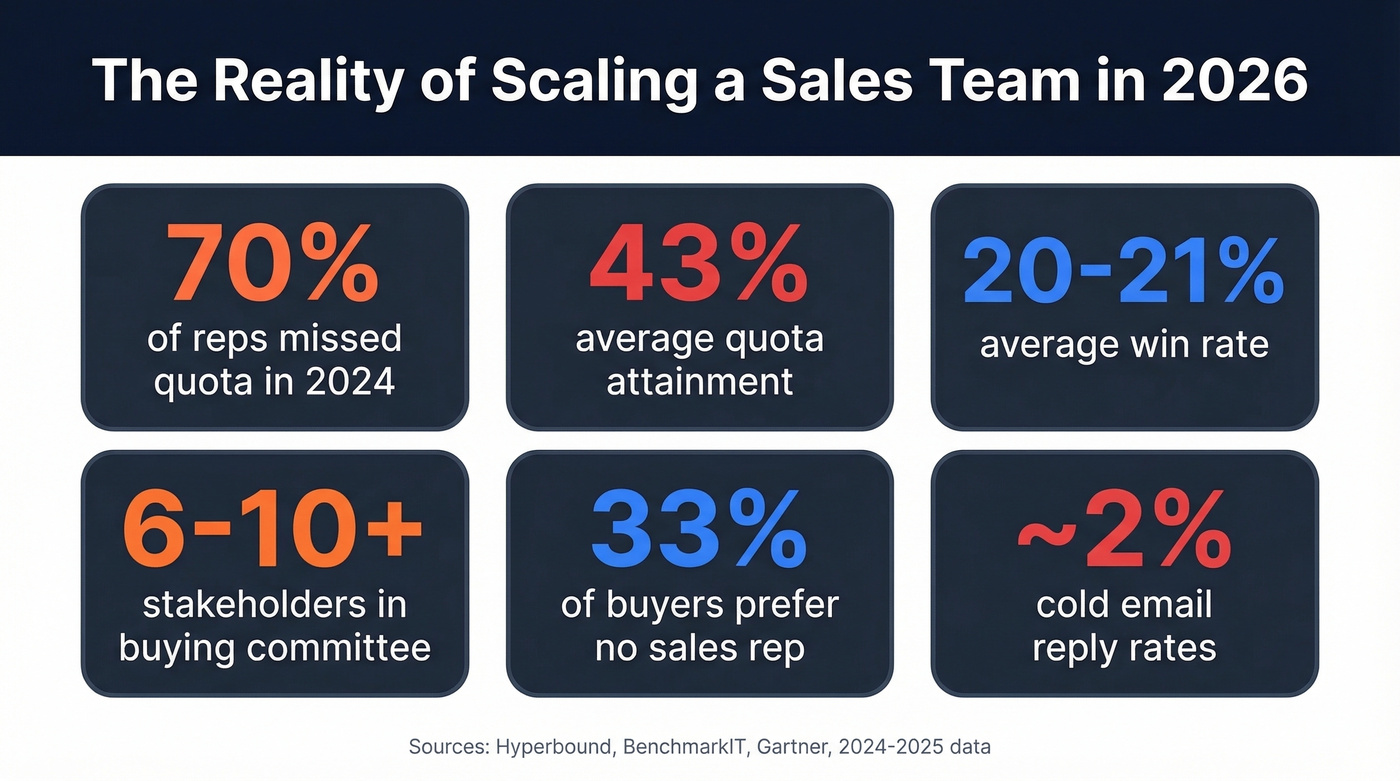
The numbers are brutal: 20% of SaaS companies never get past $1M ARR. 40% stall before $3M. 60% never pass $10M. 80% never reach $30M. The companies that break through aren't hiring faster - they're hiring smarter, with repeatable processes and clean data underneath everything. Up to 70% of reps missed quota in 2024, and among those who did sell, average attainment hovered around 43%. You're not scaling into a friendly market. You're scaling into a headwind.
The Short Version
- Don't hire until your process is repeatable. If non-founders can't close at 60%+ of the founder's rate, you don't have a scalable motion yet.
- Hire in pairs, never solo. One rep gives you anecdotes. Two give you data.
- Structure by sales cycle length and deal size. Full-cycle reps for short deals, assembly line or pods for everything else.
- Set financial guardrails. The median CAC ratio is $2.00 per $1 of new ARR - know your number before you add headcount.
- Fix your data before scaling headcount. Bad contacts destroy rep morale and domain reputation faster than any hiring mistake.
Why Sales Team Growth Is Harder Now
The playbook that worked in 2019 - hire SDRs, blast cold emails, book demos - doesn't hold up anymore.
| Benchmark | Number |
|---|---|
| Reps hitting quota (2023) | 28% |
| Avg. quota attainment (late 2024) | ~43% |
| Average win rate | 20-21% |
| Buying committee size | 6-10+ stakeholders |
| B2B interactions that are digital | 80% |
| Buyers who prefer seller-free | 33% (44% among millennials) |
| Channels buyers use | ~10 (up from 5 in 2016) |
The buyer has shifted. They spend just 17% of their buying time meeting with suppliers, research across 10 channels before talking to a rep, and a third would prefer to buy without talking to anyone at all.
On the outbound side, the consensus on r/sales and r/coldemail is grim: cold emails pull ~2% reply rates, connection requests get ignored, and ads burn budget with low conversion. The tactics that still work - enrichment-powered personalization, short Loom audits instead of cold pitches, founder-led content - are harder to scale by definition. Build your hiring plan around these numbers, not the 2019 playbook.
The Repeatability Test
The most expensive mistake in sales isn't a bad hire. It's growing a team before you have a repeatable process.
Salesforce's early scaling decisions are instructive here. They focused exclusively on deals that could close within 30 days, used a 30-day trial to bound the sales cycle, and said no to any deal that required travel to close. These constraints weren't limitations - they were the repeatability test. By Year 2, they had 400%+ growth because the machine worked before they scaled it.
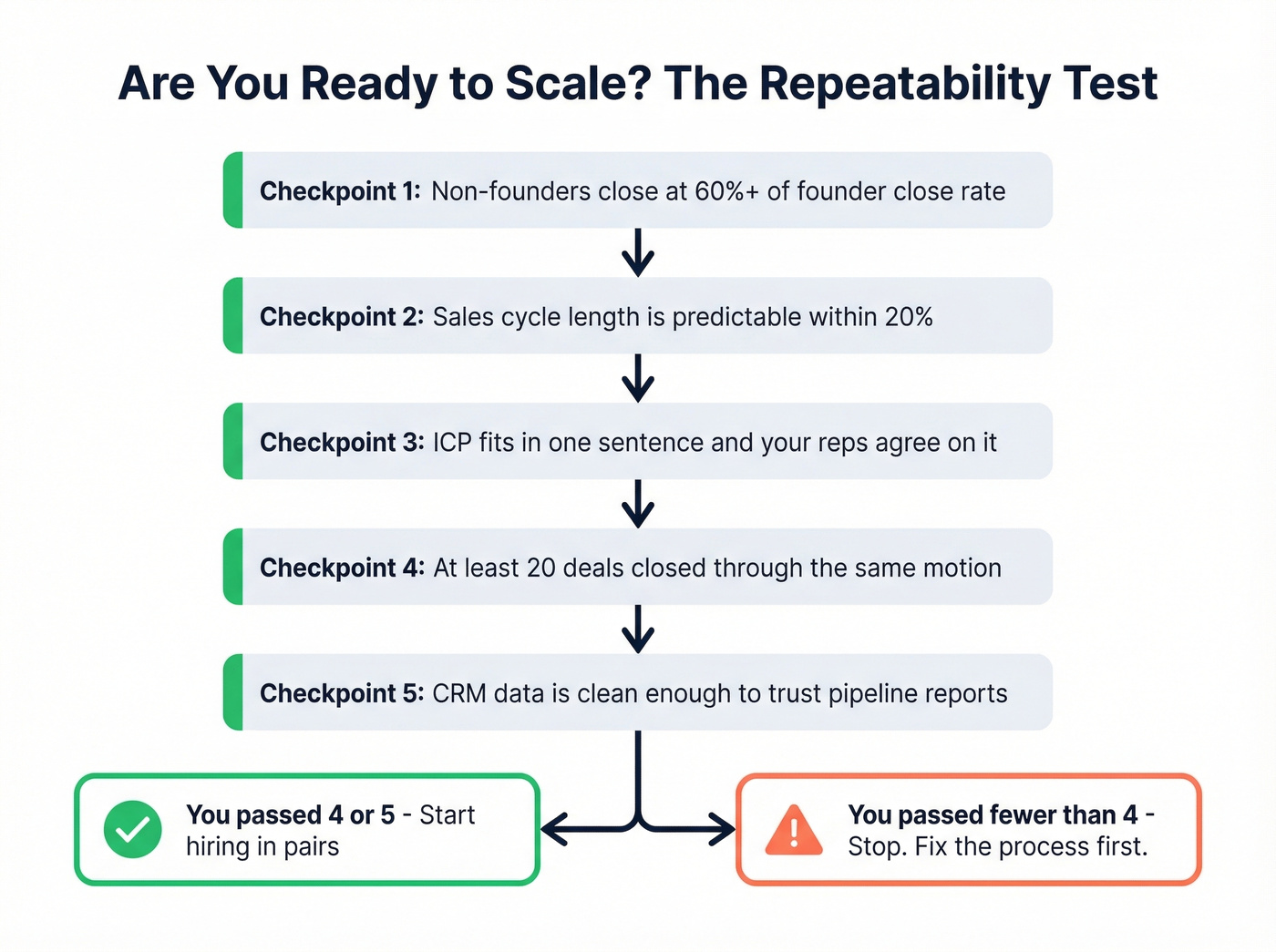
If you can't check at least four of these five boxes, stop hiring and fix the process:
- Non-founders can close deals at 60%+ of the founder's close rate
- Your sales cycle length is predictable within a 20% range
- You can articulate your ICP in one sentence - and your reps agree on it
- You've closed at least 20 deals through the same motion
- Your CRM data is clean enough that you trust your pipeline reports
Skip these and every new hire amplifies the dysfunction.
Who to Hire and When
Hiring by ARR Stage
Role sequencing matters as much as the roles themselves. Based on Sloane Staffing's stage-by-stage framework:
| ARR Stage | Key Hires | Notes |
|---|---|---|
| $0-$1M | SDR/BDR + AE | Founder still closing; optional part-time ops |
| $1M-$5M | Expand SDRs, add Sales Ops, add CSM | Sales Director to build playbooks |
| $5M-$20M | Scale AEs, add Enablement, VP Sales | Segment by vertical/region; consider RevOps |
| $20M+ | Regional leaders, CRO, specialized teams | Strategic/mid-market/enterprise splits |
The critical mistake after crossing $1M ARR is hiring a VP of Sales too early. A VP before you've proven the motion with 3-5 reps usually means you're outsourcing product-market fit to someone who can't solve it. Add a Sales Director to build playbooks first. The VP comes after $3M-$5M ARR, when you need someone to scale what already works.
Scalable Sales Team Structures
Three models dominate, and the right one depends on your sales cycle and deal size.
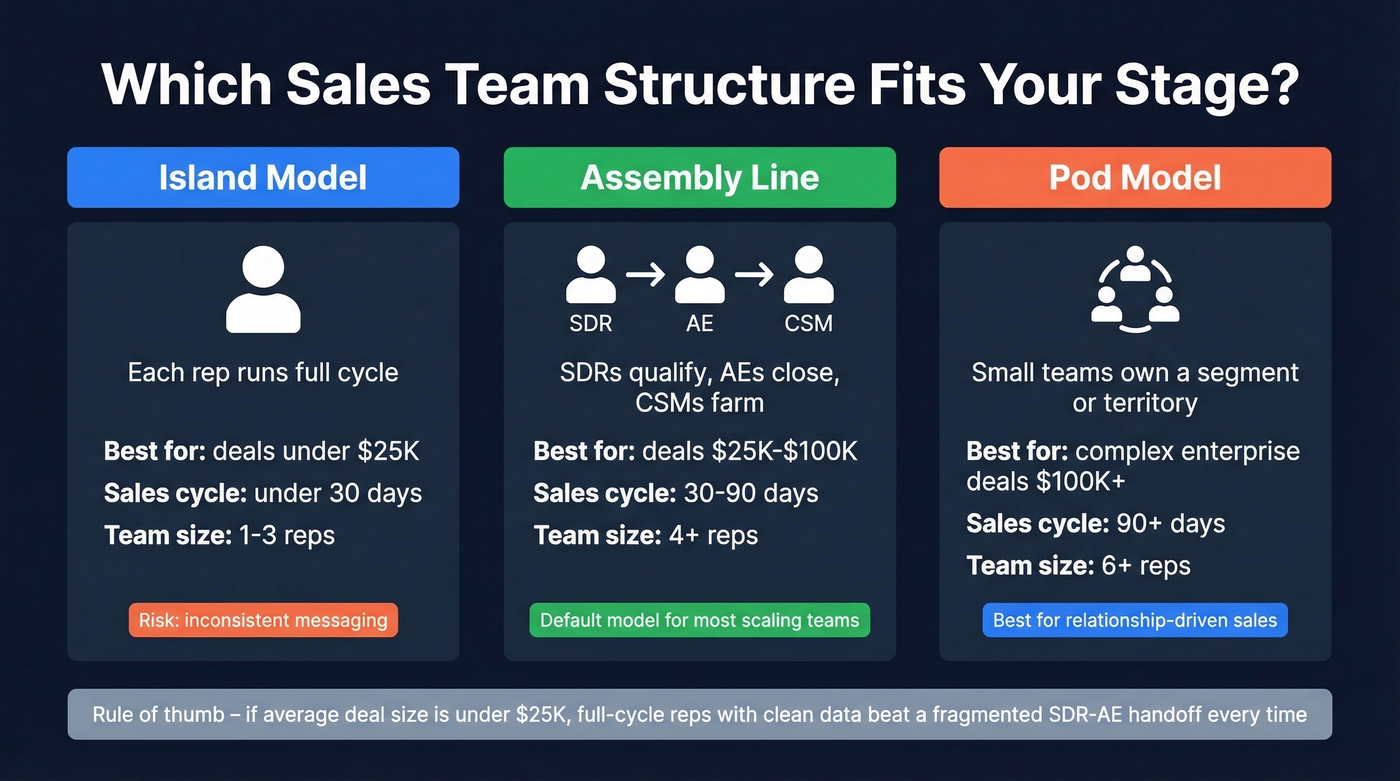
The island model has each rep running the full cycle - best for simple products with sales cycles under 30 days and deals under $25K. The risk is inconsistent messaging and no specialization. The assembly line (SDRs qualify, AEs close, CSMs farm) creates predictability and lets you measure each stage independently, making it the common default once you have 4+ reps. The pod model groups small collaborative teams that own a segment or territory; pods compete with each other, which drives accountability, and work best for complex sales where customer relationships matter.
Here's the thing: if your average deal size is under $25K, you almost certainly don't need the assembly line model yet. Full-cycle reps with clean data will outperform a fragmented SDR-AE handoff at that deal size every time.
The "Hire in Pairs" Rule
Never hire a single rep. Ever.
One rep who fails tells you nothing - was it the person or the process? One rep who succeeds tells you nothing either - maybe they got lucky with territory or timing. Two reps give you a comparison set: peer learning, healthy competition, and actual data on whether your process works. If both struggle, the process is broken. If one thrives and one doesn't, you've got a coaching problem, not a systems problem. This distinction saves months of misdiagnosis.
And when one of those reps isn't working out by month three, make the hard call. Carrying underperformers during rapid expansion poisons culture faster than an empty seat does.
Comp Plans That Scale
| Role | Pay Mix | OTE Range | Ramp Schedule | Variable Trigger |
|---|---|---|---|---|
| SDR/BDR | 70:30 or 80:20 | $55K-$80K | 50/75/100% (mo 1-3) | Meetings booked/qualified |
| AE (SMB) | 50:50 | $90K-$140K | 25/50/75/100% (mo 1-4) | Closed-won revenue |
| AE (Mid-Market) | 50:50 | $130K-$200K | 25/50/75/100% (mo 1-4) | Closed-won revenue |
| CSM | 80:20 | $75K-$110K | Full quota by month 3 | NRR / expansion |
Two non-negotiable rules: never cap commissions, and always include accelerators above 100% quota. A rep who hits 150% should earn disproportionately more - that's how you retain top talent during a scale-up. Capped commissions punish your best performers and encourage sandbagging. If you're worried about comp costs at 150% attainment, your problem is quota-setting, not compensation design.

Bad data is the silent killer of sales team scaling. Every garbage contact burns rep confidence, tanks domain reputation, and inflates your CAC. Prospeo's 98% email accuracy and 7-day refresh cycle mean new hires prospect with contacts that actually connect - not bounce.
Fix your data before you scale your headcount.
Ramp New Reps in Weeks, Not Months
Based on Highspot's onboarding benchmarks, good looks like this: first qualified meeting within 9 days of completing onboarding, certification in 21 days, first closed-won deal in 32 days, and 6 out of 7 new hires hitting 100% quota by month 4.
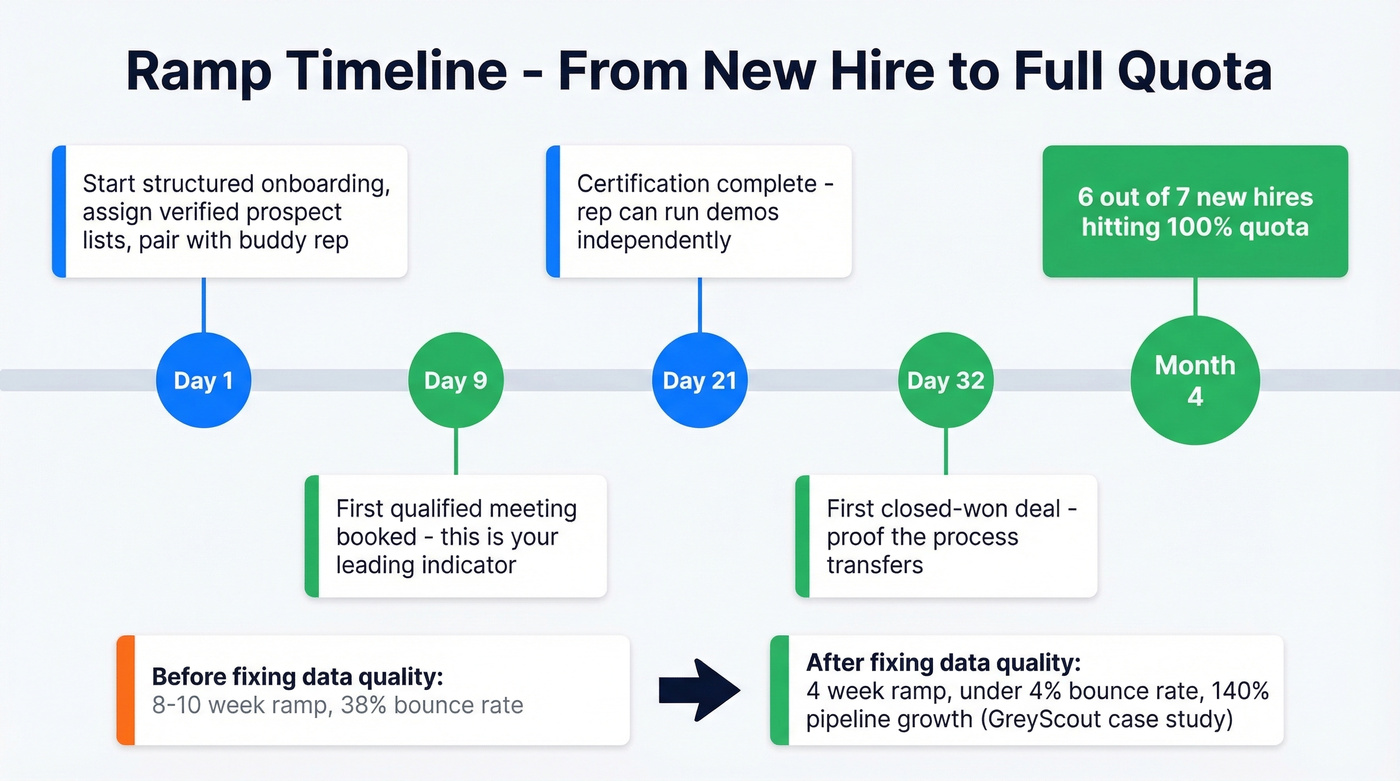
Those numbers aren't fantasy. GreyScout doubled their sales team from 2 to 5 reps and cut ramp time from 8-10 weeks to 4 weeks by fixing their data quality and building a structured onboarding sequence. Bounce rate dropped from 38% to under 4%, and pipeline grew 140%.
This matters because up to 50% of sales go to the first vendor to respond. Speed-to-lead is a scaling advantage, and reps stuck cleaning bad data can't move fast. Structure weekly deal reviews in small groups - peer-to-peer teaching scales better than manager-led training and forces reps to articulate their process.
If you want a simple onboarding backbone, use a 30-60-90 day plan with measurable milestones.
Invest in Managers First
Your managers are the bottleneck, not your reps.
Only 32% of organizations provided sales manager-specific training in the last year. That's staggering when you consider that managers are the primary lever for rep performance. One stat that should reshape how you think about coaching: for deals over $50K, multi-threading - engaging multiple stakeholders on the buying side - boosts win rates by 130%. Closed-won deals have roughly 2x the buyer contacts compared to lost deals. Managers need to coach this behavior explicitly because it doesn't happen naturally, especially with junior reps who default to single-threading their champion.
Add a sales manager before you add a fifth rep. Always.
Build a Stack That Doesn't Break
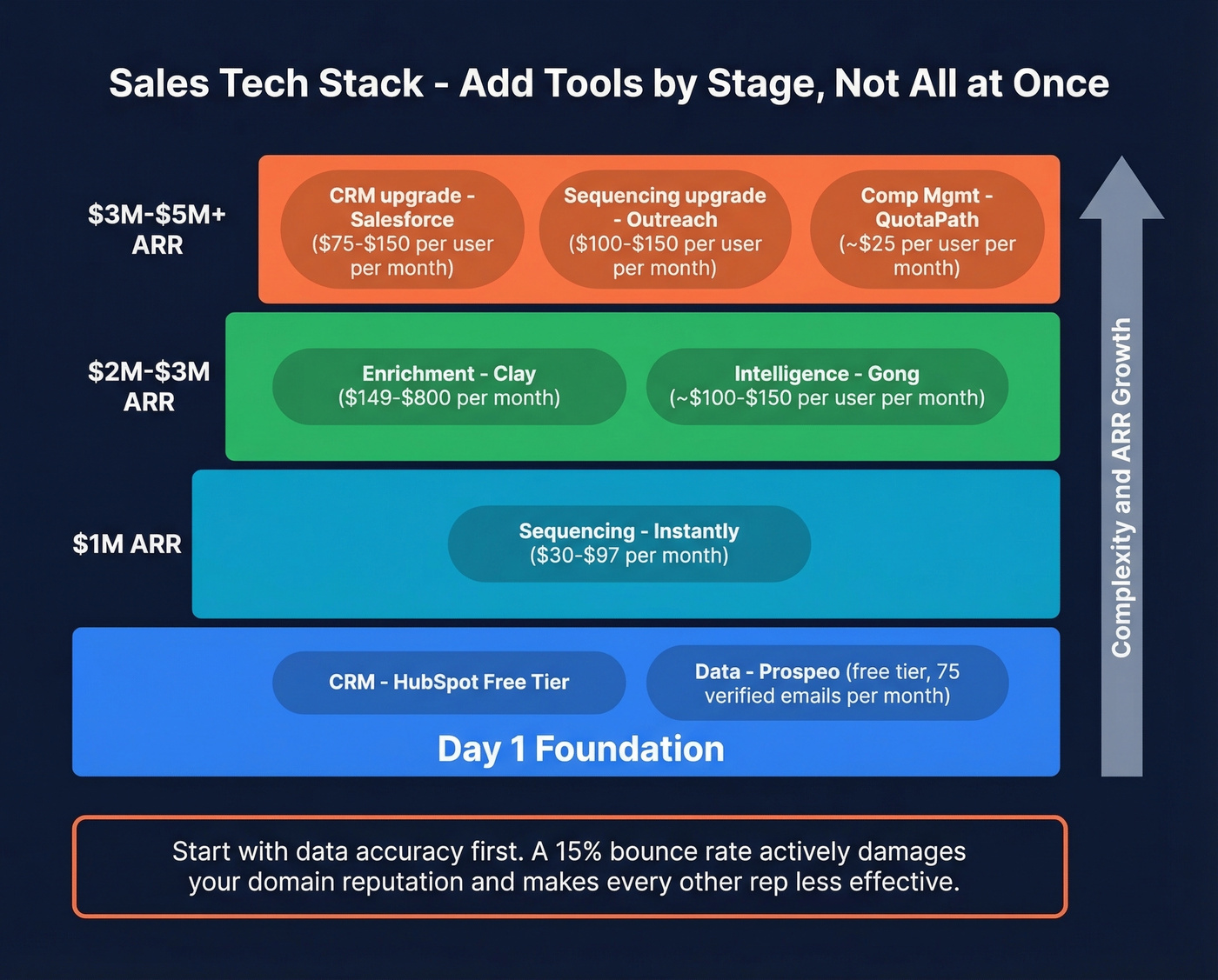
When you go from 3 reps to 15, every tool decision compounds. Add tools by stage, not all at once:
| Category | Tool | When to Add | Approx. Cost |
|---|---|---|---|
| CRM | HubSpot -> Salesforce | Day 1 (free tier) -> $3M+ ARR | Free -> $75-$150/user/mo |
| Data | Prospeo | Day 1 | Free tier -> ~$0.01/email |
| Sequencing | Instantly -> Outreach | $1M ARR -> $5M+ ARR | $30-$97/mo -> $100-$150/user/mo |
| Intelligence | Gong | $3M+ ARR | ~$100-$150/user/mo |
| Enrichment | Clay | $2M+ ARR | $149-$800/mo |
| Comp Mgmt | QuotaPath | $3M+ ARR | ~$25/user/mo |
Data quality is the scaling constraint most teams underestimate. A rep sending 100 emails a day with a 15% bounce rate isn't just wasting time - they're actively damaging your domain reputation, which makes every other rep's emails less likely to land. If you're seeing bounces climb, start with email bounce rate benchmarks and fixes.

We've watched teams spend $40K on a legacy data platform and still have reps manually verifying emails in a spreadsheet. Start with data accuracy, then layer on workflow tools as complexity demands it. Prospeo's free tier gives you 75 verified emails per month plus 100 Chrome extension credits to test data quality before committing budget - and it plugs directly into HubSpot, Salesforce, Instantly, and Clay.
If you're building outbound at the same time, pick a few sales prospecting techniques that your team can repeat.
GreyScout doubled their sales team from 2 to 5 reps and cut ramp time from 8-10 weeks to 4 - because reps spent time selling, not cleaning lists. With 300M+ profiles, 30+ filters, and emails at $0.01 each, Prospeo gives scaling teams enterprise-grade data without enterprise pricing.
Scale headcount without scaling your data budget.
Unit Economics of Scaling
If your unit economics don't support the headcount plan, you're scaling into a wall.
The median CAC ratio is $2.00 in S&M spend to acquire $1.00 of new ARR - up 12.5% since 2022. If you're above $2.82 (fourth quartile), you're burning cash faster than you're building value. Net revenue retention sits at 101% median, meaning expansion is barely covering churn for most companies.
Productivity benchmarks: ARR per FTE runs $200K in the $50M-$100M segment and $300K above $100M. If your team is well below those numbers, adding headcount won't fix the problem - it'll amplify it. Sales and marketing as a percentage of revenue runs 47% for VC-backed companies versus 33% for PE-backed. Know which model you're operating under, because it determines how much runway you have before efficiency pressure hits.
One bright spot: expansion ARR now represents a median 40% of total new ARR, up 5 points year-over-year. The best scaling teams aren't just acquiring - they're expanding existing accounts. Build that into your comp plans and team structure from the start.
If you want a cleaner way to monitor this, set up pipeline health metrics before you add more seats.
Seven Mistakes That Kill Scalability
Hiring before product-market fit. If founders can't close consistently, reps won't either.
Scaling headcount without scaling process. More reps on a broken process just means more chaos. We've seen teams burn $180K on six SDRs who generated $40K in pipeline - the SDRs weren't the problem.
Ignoring data quality. Bad contacts tank deliverability, kill rep confidence, and inflate CAC. Skip this if you want to learn the hard way.
Neglecting manager development. Only 32% of orgs train their managers. Your managers are the multiplier - not your reps.
Wrong comp structure. Capped commissions, no ramp quota, misaligned variable triggers - any of these will drive your best reps out the door.
No onboarding system. "Shadow a senior rep for two weeks" isn't onboarding. Build a structured ramp with clear milestones and weekly checkpoints.
Chasing ACV over LTV. A smaller deal that renews and expands is worth more than a big logo that churns in 6 months. In our experience, teams that optimize for net revenue retention outgrow teams that optimize for new logos every single time.
FAQ
How long does it take to scale a sales team?
Most companies spend 6-12 months proving repeatability before adding headcount. From first hire to a team of 10, expect 12-18 months if you're disciplined. Rushing this timeline is the most common and most expensive mistake - especially when investor pressure pushes founders to hire ahead of process.
What's the first sales hire after the founder?
Two SDRs or two full-cycle AEs - never one. You need a pair for comparative data and peer learning. Add a sales manager before you add a fifth rep.
When should you hire a VP of Sales?
After the sales motion works with 3-5 reps and you have $3M-$5M ARR. Start with a Sales Director who builds playbooks. The VP scales what already works - hiring one before $3M ARR usually means outsourcing strategy to someone without enough data to build it.
How do you prevent bad data from stalling growth?
Use verified contact data to keep bounce rates under 5%, warm up sending domains separately, and cap volume at 30-50 emails per domain per day. A 7-day data refresh cycle keeps contacts current - critical when you're onboarding new reps who need to trust their lists from day one.
What's a good pipeline coverage ratio?
Target 3x quota coverage for short-cycle deals under 30 days, 4-5x for mid-market at 60-90 days, and 5-6x for enterprise at 90+ days. New reps during ramp need higher coverage because their conversion rates are still developing. Let's be honest - most teams don't measure this until they're already behind on the quarter.