

The SDR and AE Relationship Playbook (With Actual Numbers)
Your SDR books a meeting with a VP of Operations. She spent three weeks warming the prospect, surfaced the pain point, confirmed budget authority, and locked a 30-minute slot. The AE shows up and opens with "So, what do you guys do?"
The prospect checks out. The SDR did the work. The handoff killed it.
That's not an isolated story. Across the sales-marketing boundary, 53% of companies have a broken handoff - sales follows up with fewer than 35% of engaged prospects. If orgs can't even hand off marketing-engaged leads to sales, imagine what's happening between SDRs and AEs. Most guides on the SDR and AE relationship give you platitudes. "Communicate better." That's a poster in the break room, not a playbook. Here are the actual numbers and the operational fixes behind them.
The Short Version
Three things matter most, in order:
- Implement a shared qualification framework - MEDDICC or SPICED - with mandatory CRM fields. If your SDRs and AEs can't agree on what "qualified" means, nothing else matters.
- Set explicit handoff SLAs: 15-minute MQL-to-SDR touch, 24-hour SDR-to-AE loop-in, 48-hour AE-to-CS kickoff.
- Create an "SDR Owner" property in your CRM for clean attribution.
What the 2026 Data Says
We pulled benchmarks from multiple independent datasets. The 2025 Sales Development Report covering 351 B2B companies (83% SaaS, $47M median revenue) gives us the clearest picture of what "normal" looks like, and the 6sense BDR benchmark with 262 responses fills in activity-level detail.
| Metric | Number | Source |
|---|---|---|
| SDR:AE ratio | 1:2.4 avg | Sales Dev Report |
| Median OTE | $80K | Sales Dev Report |
| Avg ramp time | 3.0 months | Sales Dev Report |
| Avg tenure | 1.9 years | Sales Dev Report |
| Attempts per contact | ~21 | 6sense BDR Benchmark |
| Cadence length | 53 days | 6sense BDR Benchmark |
| Quota attainment | ~88% | 6sense BDR Benchmark |
| AI tool adoption | 60% | 6sense BDR Benchmark |
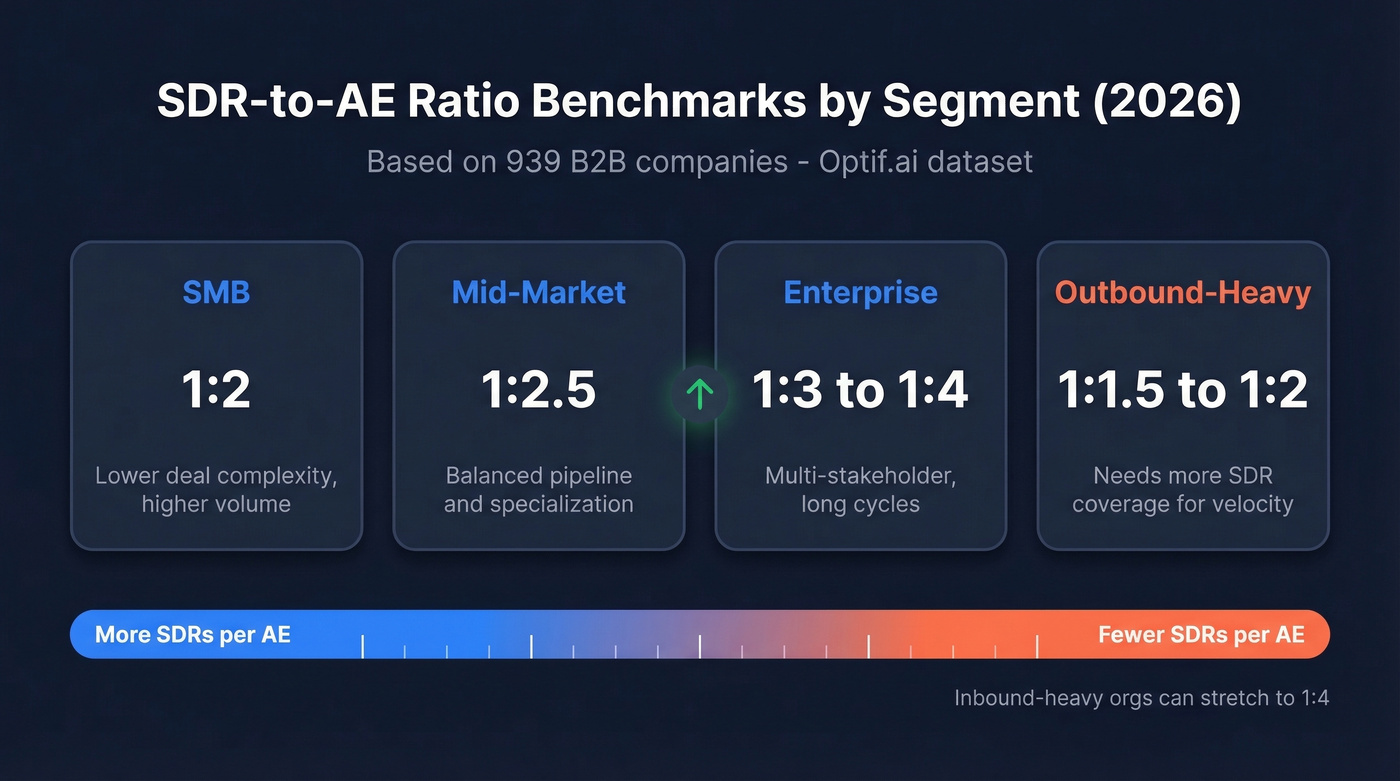
The ratio varies by segment. Optif.ai's dataset of 939 companies breaks it down: SMB teams run 1:2, mid-market 1:2.5, and enterprise 1:3 to 1:4. Inbound-heavy orgs can stretch to 1:4. Outbound-heavy teams need 1:1.5 to 1:2 to keep pipeline velocity up.
If your SDRs are giving up after a handful of touches, they're leaving pipeline on the table. Twenty-one attempts over 53 days is the benchmark. That's a lot more persistence than most teams enforce.
Why the Handoff Breaks
Three failure modes show up repeatedly, and the 6sense data puts a number on the stakes: BDRs who feel supported by their counterparts hit 95% of quota versus 80% for those who don't. That 15-point gap is the difference between a team that hits plan and one that doesn't.
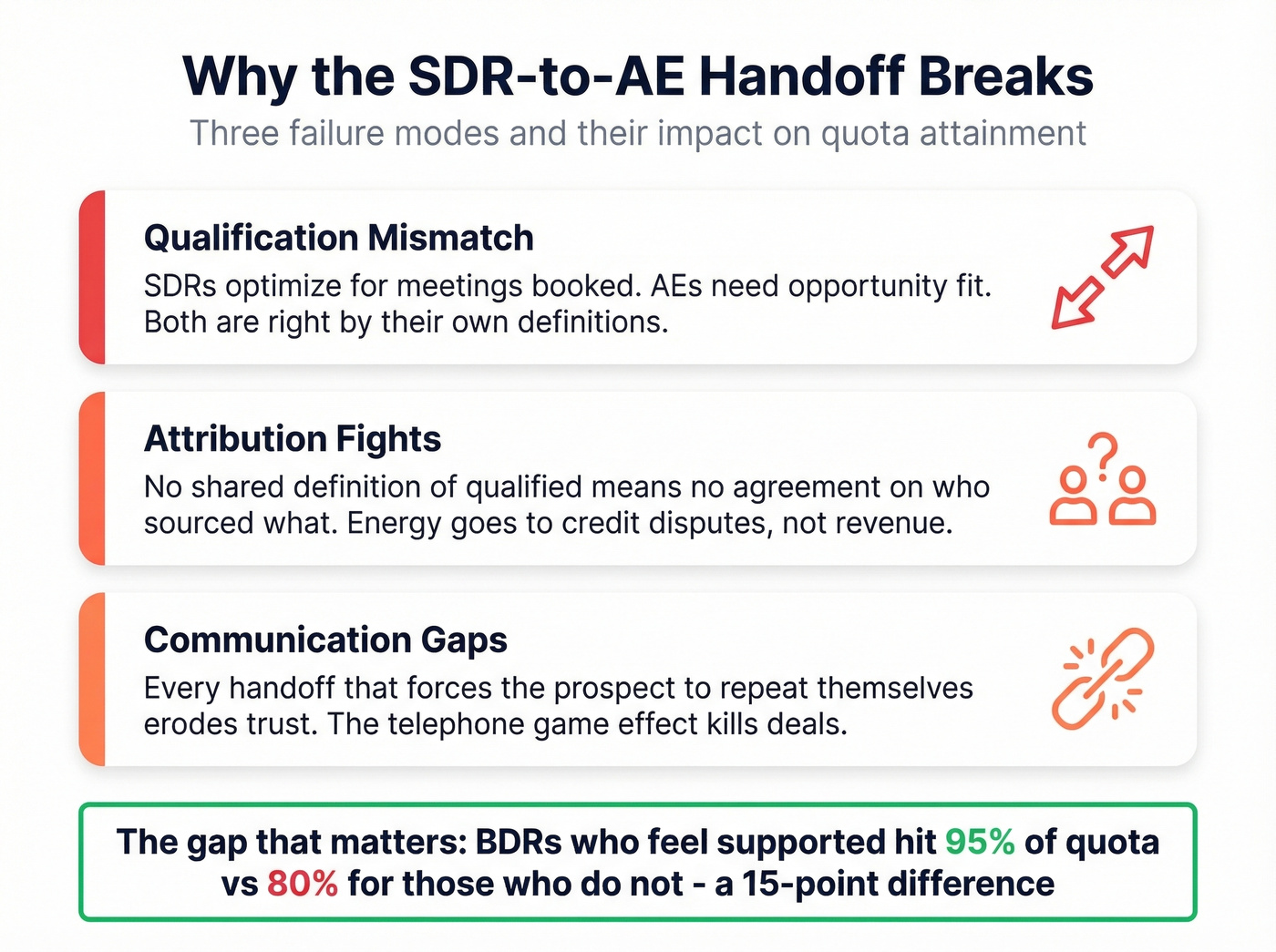
Qualification mismatch. SDRs optimize for meetings booked. AEs need opportunity-fit. Without a shared framework, these incentives pull in opposite directions. The SDR books a meeting that technically qualifies. The AE rejects it. Both are right by their own definitions, and both walk away frustrated. 82% of orgs align SDRs to AE territories, yet attribution fights persist because territorial alignment doesn't equal agreement on what counts as a qualified opportunity.
Attribution fights. No shared definition of "qualified" means no agreement on who sourced what. The HubSpot community is full of threads about teams arguing over deal ownership instead of closing deals. We've watched this play out at multiple companies - the energy spent on credit disputes is energy not spent on revenue.
Communication gaps. Gong calls this the "telephone game" effect - every handoff that forces the prospect to repeat themselves erodes trust. Bad handoffs don't just lose meetings. They lose customers. Bain's data shows a 5% retention improvement lifts profits 25-95%.
The Handoff SLA Your Team Needs
You've got SLAs for your support tickets but not for your pipeline? Fix that today.
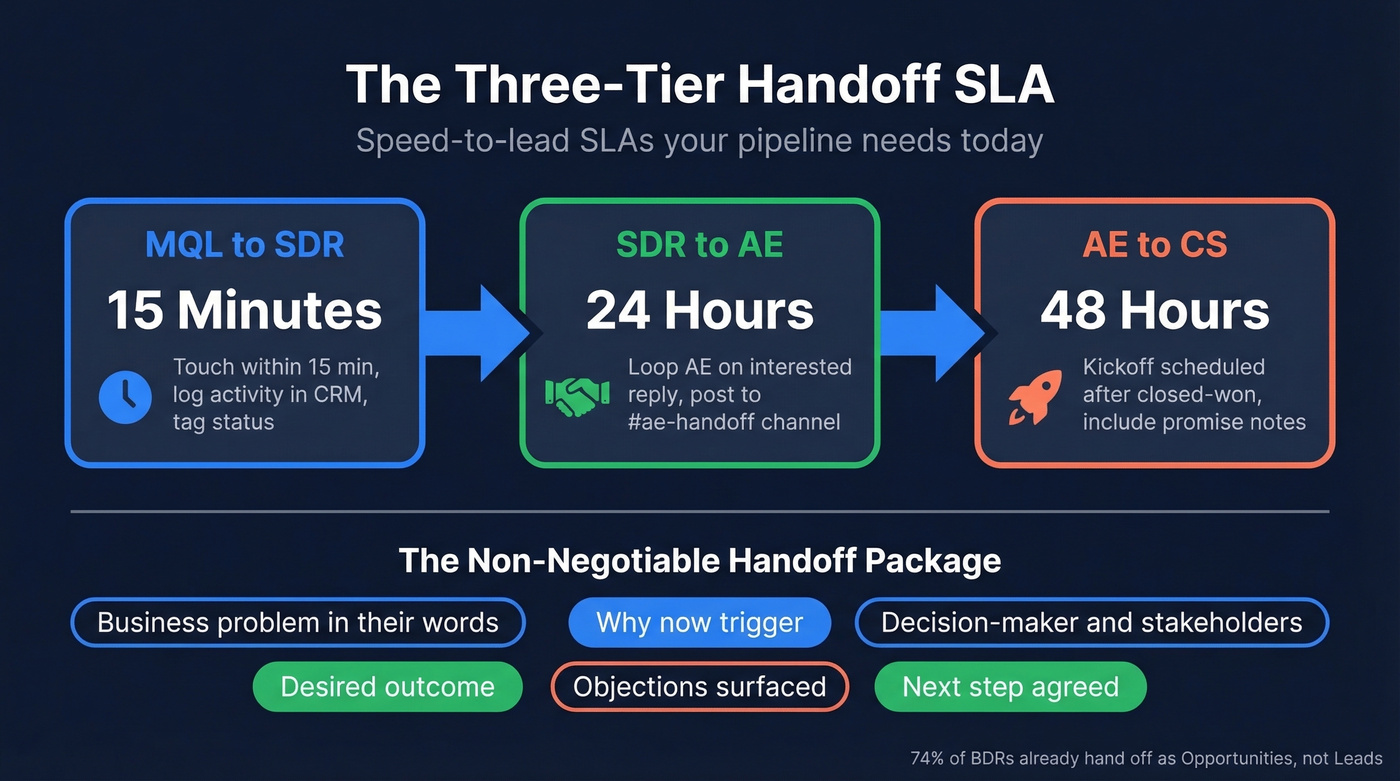
The three-tier SLA, adapted from Heyreach's framework:
- MQL to SDR: Touch within 15 minutes. Log activity in CRM. Tag status.
- SDR to AE: Loop AE within 24 hours of an interested reply. Post to a dedicated
#ae-handoffchannel. - AE to CS: Kickoff scheduled within 48 hours of closed-won. Include promise notes.
Speed-to-lead is one of the biggest controllable variables in conversion. But timing alone isn't enough. Here's the non-negotiable handoff package every SDR should deliver:
- Business problem in the prospect's own words
- "Why now" trigger - what changed
- Decision-maker + stakeholders - who's in the room
- Desired outcome - what success looks like from their side
- Objections surfaced - what they pushed back on
- Next step agreed - an actual committed action, not "follow up"
Here's a stat most teams miss: 74% of BDRs already hand off prospects as Opportunities rather than Leads. If your team is still passing Leads, you're creating extra steps that slow everything down and introduce confusion about ownership.

Your SDRs average 21 touches per prospect. Every bounce is a wasted touch - and a handoff that never happens. Prospeo's 98% email accuracy and 30% mobile pickup rate mean your SDRs hand off real conversations, not dead leads. At $0.01/email, bad data is no longer an excuse for broken handoffs.
Stop losing deals at the handoff because the contact data was wrong.
Comp and Attribution That Work
Do this: Store SDR attribution in a separate "SDR Owner" property on the Deal. Round-robin at the meeting level, not the deal level. Create Deals only after qualification to avoid bloating your pipeline with junk.
If you need a clean way to operationalize this, start with your CRM object model and required fields.
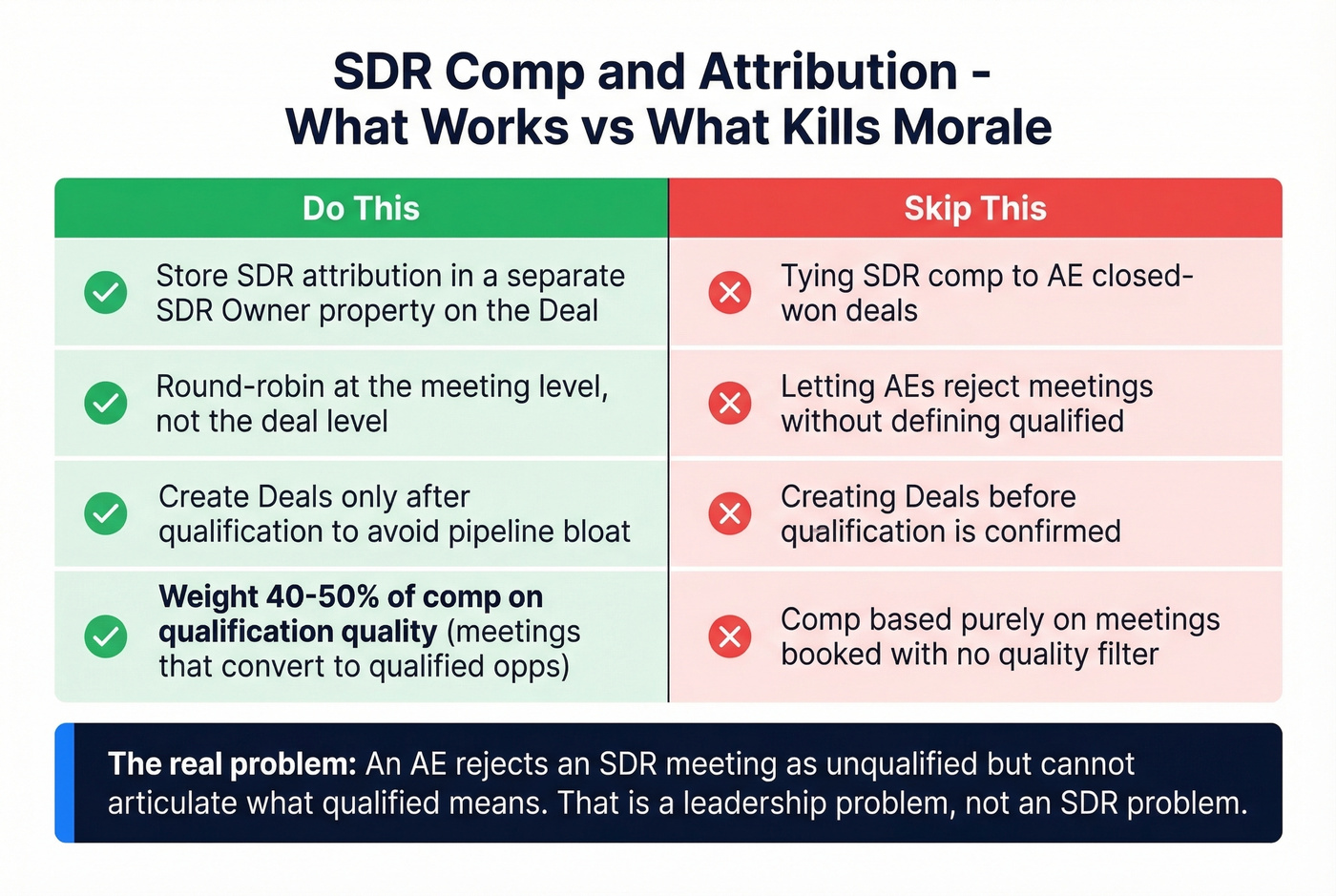
Skip this if you want to keep your SDRs: tying SDR comp to AE closed-won deals. It's a morale killer. The SDR can't control whether the AE runs a good demo, whether procurement stalls, or whether the champion leaves mid-cycle. Weight 40-50% of SDR comp on qualification quality - meetings that convert to qualified opportunities - and the rest on activity and pipeline generation.
Let's be honest: we've seen this play out dozens of times. An AE rejects an SDR-sourced meeting as "unqualified" but can't articulate what "qualified" means. That's not an SDR problem. That's a leadership problem, and no comp model fixes it.
Building a Workflow That Scales
Pool your SDRs. The 1:1 SDR-to-AE pairing model creates single points of failure. When one person is out sick or underperforming, the AE's pipeline dries up overnight. Outreach recommends pooling SDRs across AE pods to smooth performance variability. It's a contrarian move, but it works - and it removes the toxic dynamic where an AE blames "their" SDR for a bad quarter instead of looking at the system.
Run a 20-minute weekly sync. Five minutes on pipeline review, ten on deal strategy for the top three accounts, five on feedback. This replaces the ad-hoc Slack messages that get lost and the "quick question" interruptions that derail deep work. Structure beats good intentions every time. In our experience, this single ritual does more for alignment than any shared dashboard or Slack channel. (If you want to formalize the meeting, use a QBR questions structure and trim it down.)
Have the SDR draft the intro message. When an SDR asks an AE for a referral introduction, the AE's mental cost is "write a thoughtful email." That never happens. The SDR drafts the message, the AE hits send. A 20-minute task becomes a 2-minute one. If you need a starting point, borrow a handoff email template.
The Career Progression Truth
The tone on r/sales and r/techsales is blunt: SDR purgatory is real. Average tenure is 1.9 years. A top-performing SDR asks about an AE promotion, hears "no open seats," and she's updating her profile that night.
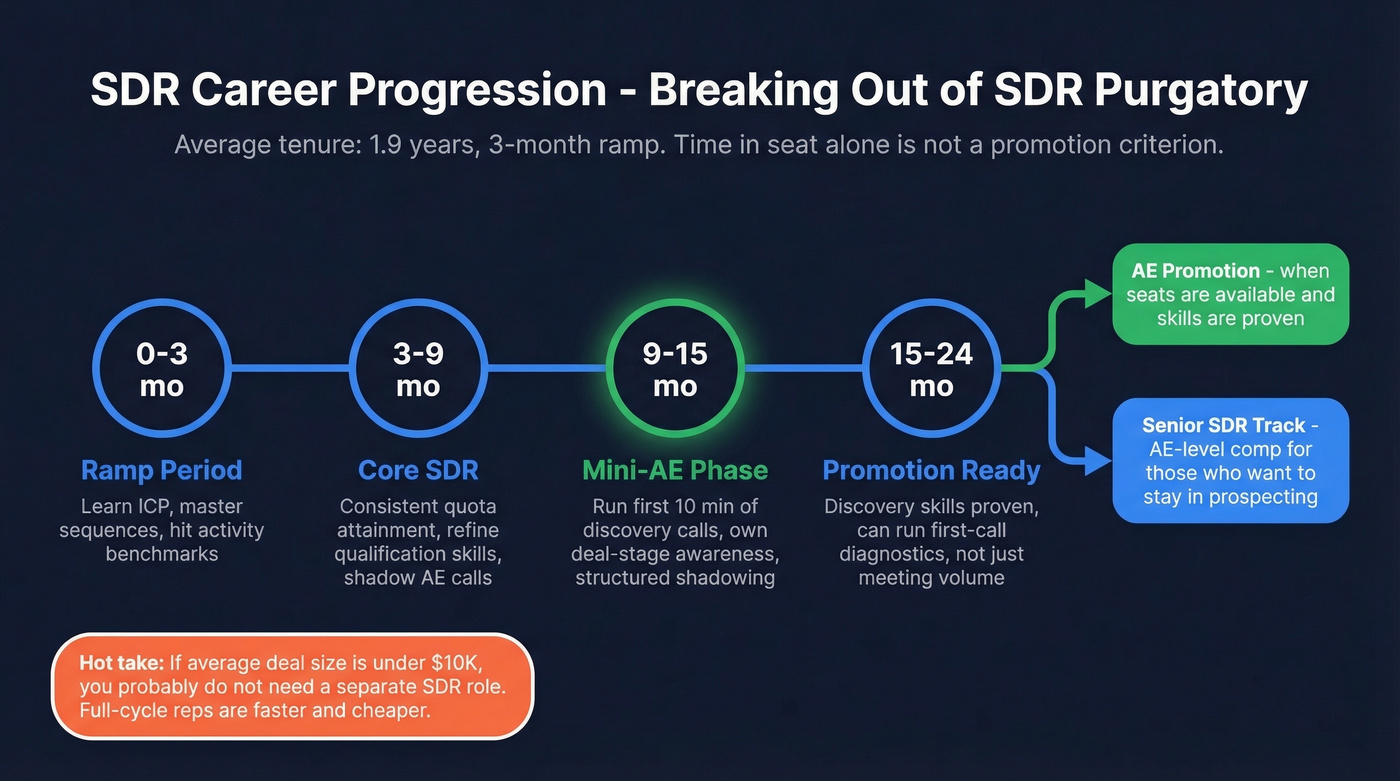
Hot take: if your average deal size is under $10K, you probably don't need a separate SDR role at all. Full-cycle reps are faster and cheaper at that price point. The SDR-AE split only pays off when deal complexity justifies the specialization - think multi-stakeholder buying committees, long evaluation cycles, and six-figure contracts. (This is where enterprise B2B sales mechanics start to matter.)
The deeper issue is a skills mismatch. Prospecting and running a complex sales cycle have almost zero overlap. The fix isn't more time in the seat. It's structured shadowing, "mini-AE" responsibilities like running the first 10 minutes of discovery, and a Senior SDR track with AE-level comp for those who want to stay in prospecting. A practical way to systematize the ramp is a 30-60-90 day plan.
The Data Problem Nobody Mentions
You can build the perfect SLA, nail your qualification framework, and design a flawless comp model. None of it matters if your SDRs are sequencing unverified emails that bounce and handing off phone numbers that ring dead lines.
This is where data quality quietly determines whether your handoff process actually works. Prospeo's 143M+ verified emails at 98% accuracy, 7-day data refresh cycle, and 125M+ verified mobile numbers with a 30% pickup rate mean SDRs hand off contacts that AEs can actually reach. That one change fixes half the "handoff quality" complaints that surface in pipeline reviews - because the problem was never the handoff process. It was the data going into it. If you're auditing this, start with your email bounce rate and then evaluate data enrichment services.
Attribution fights disappear when SDRs book meetings with verified decision-makers. Prospeo's 300M+ profiles with 30+ filters - including job title, seniority, and department headcount - let SDRs target the exact buyers AEs want to talk to. No more 'So, what do you guys do?' moments.
Arm your SDRs with the contacts your AEs actually want to close.
What's the ideal SDR-to-AE ratio?
The average across 351 B2B companies is 1:2.4. SMB teams run 1:2, mid-market 1:2.5, and enterprise 1:3 to 1:4. Outbound-heavy teams need 1:1.5 to 1:2 to maintain pipeline velocity - anything wider starves AEs of meetings.
Should SDR comp be tied to AE closed-won deals?
No. Weight 40-50% on qualification quality (meetings converting to qualified opportunities) and the rest on activity metrics. Tying SDR pay to close rates creates resentment because SDRs can't control demo execution, procurement delays, or champion turnover.
How long should an SDR stay before promoting to AE?
Average tenure is 1.9 years with a 3-month ramp, but time-in-seat alone isn't a promotion criterion. Look for discovery skills, deal-stage awareness, and the ability to run first-call diagnostics - not just meeting volume.
What breaks the SDR and AE relationship most often?
Qualification mismatch. When SDRs optimize for meetings booked and AEs optimize for opportunity-fit without a shared framework like MEDDICC, both sides end up frustrated. Structured handoff SLAs and a shared definition of "qualified" resolve this fastest.
How does bad contact data hurt the handoff?
Bounced emails and dead phone numbers account for a huge share of "low-quality meeting" complaints. When AEs can't reach the prospect the SDR booked, they blame the SDR - even though the real problem was the data. Verified contact data at 98% accuracy eliminates this variable entirely, so AEs judge handoff quality on fit, not reachability.