

The SDR Coaching Playbook: How to Coach SDRs Who Actually Hit Quota
It's Tuesday morning. You've got 47 unreviewed call recordings from last week, three reps who missed activity targets, and a 1:1 in 20 minutes you haven't prepped for. You open the first recording, skip ahead 90 seconds, realize you need context, rewind - and now you're late.
[75% of sales reps](https://www.salesforce.com/sales/state-of-sales/sales-statistics/) say they're more likely to hit targets with a coach or mentor. The problem isn't that SDR coaching doesn't work. It's that most managers don't have a system for doing it well. We've watched managers spend more time reviewing calls than actually changing behavior - and that's the gap this playbook closes.
What You Need Before Monday
Build these three things:
- A 30-minute 1:1 template that isn't a pipeline interrogation
- A tagged call library with at least 10 categorized examples
- Verified prospect data so coached skills land on real humans, not disconnected numbers
The 10/10/10 Session Template
Most 1:1s are pipeline interrogations wearing a coaching costume. The manager spends 30 minutes asking "what's closing this month?" and the rep spends 30 minutes defending their forecast. Nobody improves.
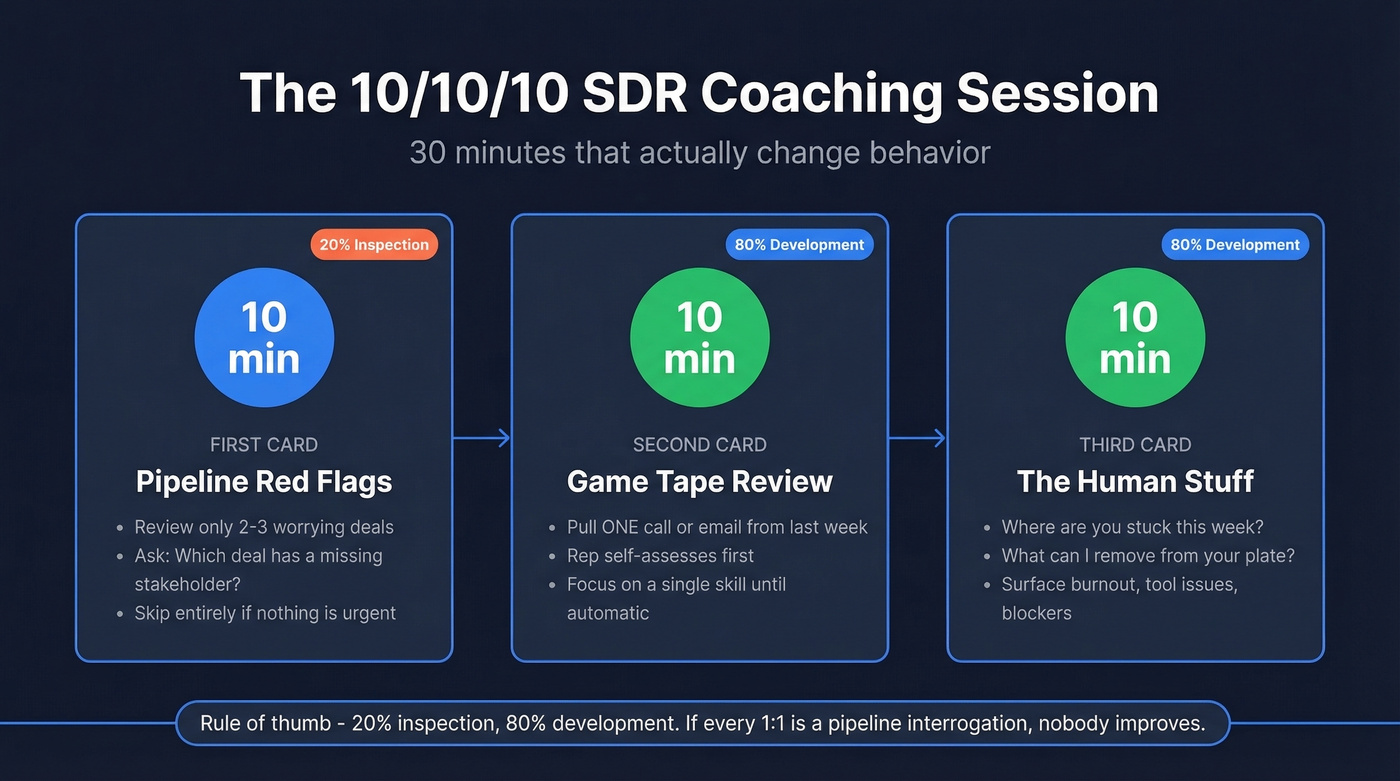
The rule of thumb: 20% inspection, 80% development.
First 10 minutes - Pipeline red flags only. Don't review every deal. Ask about the two or three that worry you. "Which deal has a missing stakeholder?" and "What's the next step on the Acme deal, and when is it?" are enough. If nothing's urgent, skip this block entirely and give the time back to skill work.
Middle 10 minutes - Game tape. Pull one call or email from the past week. One. Not five. Ask the rep to self-assess first: "What would you do differently on that call?" Then focus on a single skill - objection handling, discovery depth, whatever the rep is working on that week. Discovery matters more than ever when buying groups include 5-11 stakeholders, and one skill practiced until it's automatic beats a 45-minute feedback dump every time. (If you need a tighter structure, borrow a few discovery questions that map to your ICP.)
Last 10 minutes - The human stuff. "Where are you stuck this week?" and "What's one thing I can remove from your plate?" These questions surface roadblocks that pipeline reviews never catch - a broken integration, a territory overlap, burnout from 200 daily dials with no connects.
Five Mistakes That Kill Performance
1. Telling instead of asking. When you say "you should've asked about budget earlier," the rep nods and forgets. When you ask "at what point did you feel the conversation shift?" they diagnose the problem themselves. Self-discovered insights stick. This is one of the most overlooked principles in developing reps - questions build critical thinking faster than directives ever will.
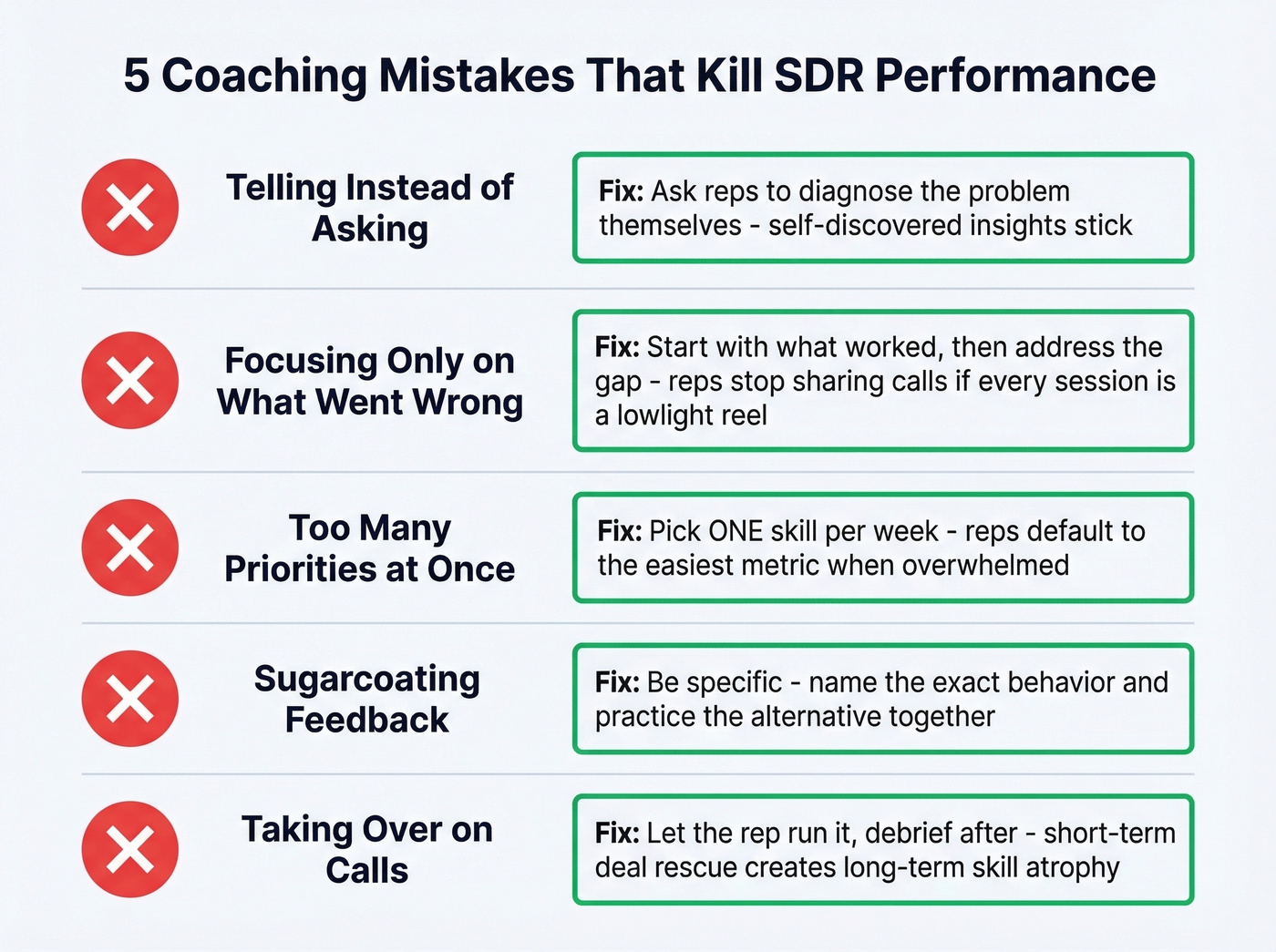
2. Focusing only on what went wrong. If every 1:1 is a lowlight reel, reps stop sharing calls. Start with what worked: "That transition from small talk to discovery was clean - let's talk about why." Then address the gap.
3. Too many priorities at once. A manager on r/sales described instructing repeated same-day calls after a deal was lost - the prospect felt chased. When you pile on activity targets, tone feedback, and objection handling simultaneously, reps default to the easiest metric: more dials. That's how persistence becomes aggression. Pick one skill per week.
4. Sugarcoating feedback. "That was pretty good, maybe just tweak the close a little" tells the rep nothing. Be specific: "You asked three discovery questions, but none uncovered the business pain. Let's practice that."
5. Taking over on calls. You jump in, save the deal, and feel great. The rep learns nothing except that you'll bail them out. Let the rep run it. Debrief after. Short-term deal rescue creates long-term skill atrophy.

You just built a 10/10/10 coaching framework. Now make sure your reps aren't wasting those sharpened skills on disconnected numbers and bounced emails. Prospeo delivers 98% email accuracy and 125M+ verified mobiles - refreshed every 7 days - so coached behaviors convert into actual conversations.
Coaching fixes technique. Prospeo fixes the data underneath it.
Build a System That Scales
The #1 complaint on r/salesdevelopment about coaching? It doesn't scale. Listening to recordings takes forever, and by the time you give feedback, the rep has already made 20 more dials.
Start with a call library. Categorize recordings by scenario - cold outreach, follow-ups, high-intent inbound, gatekeeper navigation - and tag key moments like strong openers, clean objection handles, and effective CTAs. New reps study the library before they ever pick up the phone. This is the "coil the spring" approach: build lists, group personas, and anticipate objections before a single dial goes out, so reps aren't learning on live prospects. (If your team needs a baseline, align on sales prospecting techniques before you start tagging calls.)
Use AI as a filter, not a replacement. Conversation intelligence tools like Gong review every call so you only review the ones that matter. They flag talk-to-listen ratio problems, missed discovery questions, and monologue patterns. But AI can't read a rep's energy on a bad day or ask the right follow-up question in a 1:1. Use it to surface the 5 calls worth your time out of 50. If you're standardizing the stack, start with a shortlist of SDR tools.
Here's the thing: most SDR teams don't have a coaching problem - they have a prioritization problem. A manager who reviews 5 calls deeply will develop reps faster than one who skims 50. AI helps you pick the right 5.
Roleplays are "super effective" - every practitioner agrees on that - but they're hard to run consistently. AI simulation tools are filling this gap, letting reps practice objection handling and discovery at scale without needing a manager or peer available.
Don't skip the data quality prerequisite. Reps spend 60% of their time on non-selling tasks, and a chunk of that is chasing bad numbers and bounced emails. Meanwhile, 73% of B2B buyers actively avoid sellers who send irrelevant outreach - bad data guarantees you're one of them. If you're cleaning lists, start with data enrichment services and a deliverability plan like this email deliverability guide.
Let's be honest: your top SDR told you half her numbers are disconnected. She's not underperforming - she's under-equipped. One team we've worked with, GreyScout, cut rep ramp time from 8-10 weeks to 4 weeks after improving data quality and deliverability with Prospeo. Coaching fixes technique. Bad data wastes it.
GreyScout cut SDR ramp time from 8-10 weeks to 4 by pairing coaching with clean data from Prospeo. When reps stop chasing bad numbers, they practice real selling - not voicemail recovery. At ~$0.01/email with no contracts, the ROI math writes itself.
Stop letting bad data erase your coaching investment.
How to Measure Coaching ROI
Don't judge by one week. The measurement chain runs: coaching intervention, then behavior change, then pipeline impact, then revenue outcome. Each link takes time, and 3-6 weeks is the minimum window to detect a reliable signal. To keep leadership aligned, tie this to pipeline health metrics you already report.
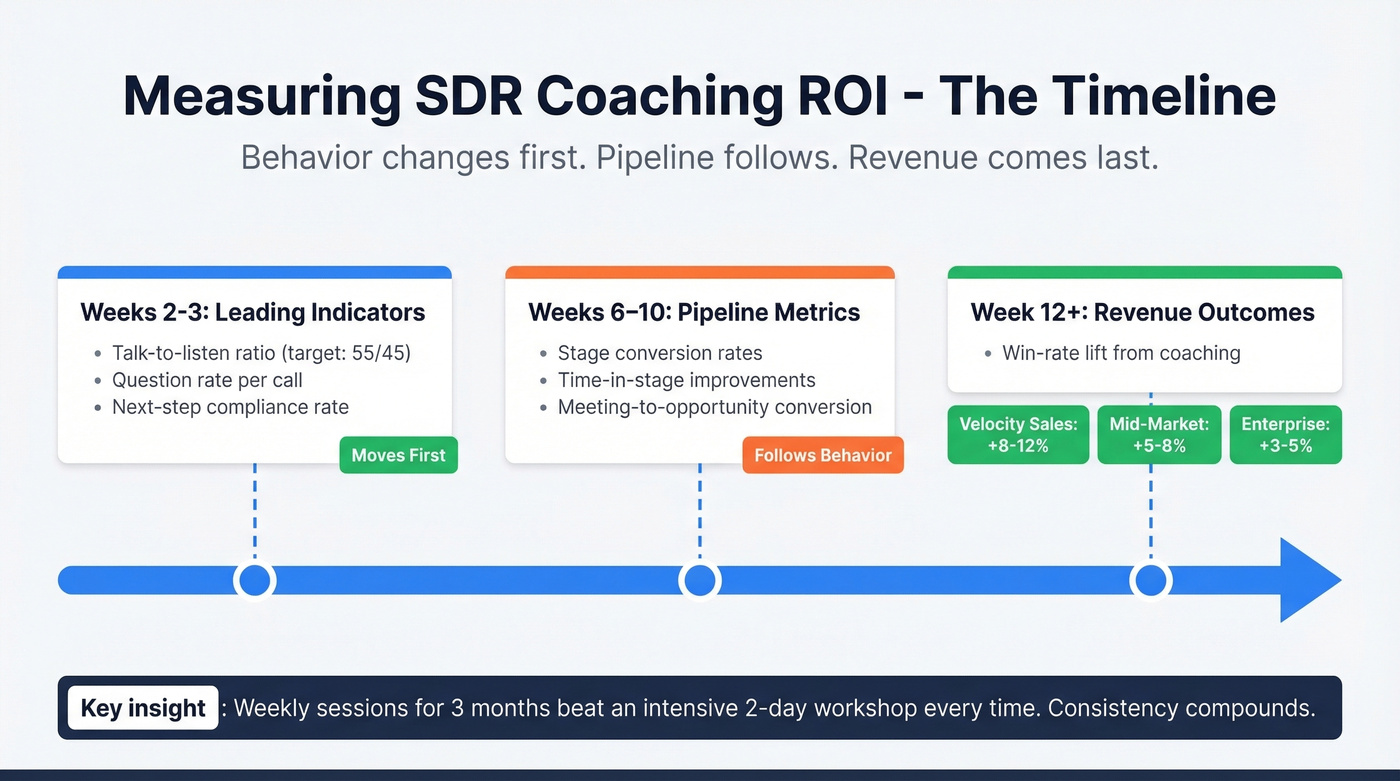
Start with leading indicators. Track talk-to-listen ratio, question rate per call, and next-step compliance - the percentage of opportunities with a defined next step and due date. These move first. If your rep's talk-to-listen ratio shifts from 70/30 to 55/45 within two weeks of working on discovery, the behavior is changing. We've seen this pattern repeatedly: leading indicators move in weeks, pipeline follows in months.
Then watch the pipeline. Stage conversion rates, time-in-stage, and meeting-to-opportunity conversion are your mid-funnel signals. Typical win-rate lifts from consistent SDR coaching run 8-12% in velocity sales, 5-8% in mid-market, and 3-5% in enterprise. The key is consistency - weekly sessions for three months beat an intensive two-day workshop every time. If you need benchmarks to sanity-check your numbers, use sales pipeline benchmarks.
Best Practices for Managers
For teams that want a condensed checklist, here's what separates the best from the rest:
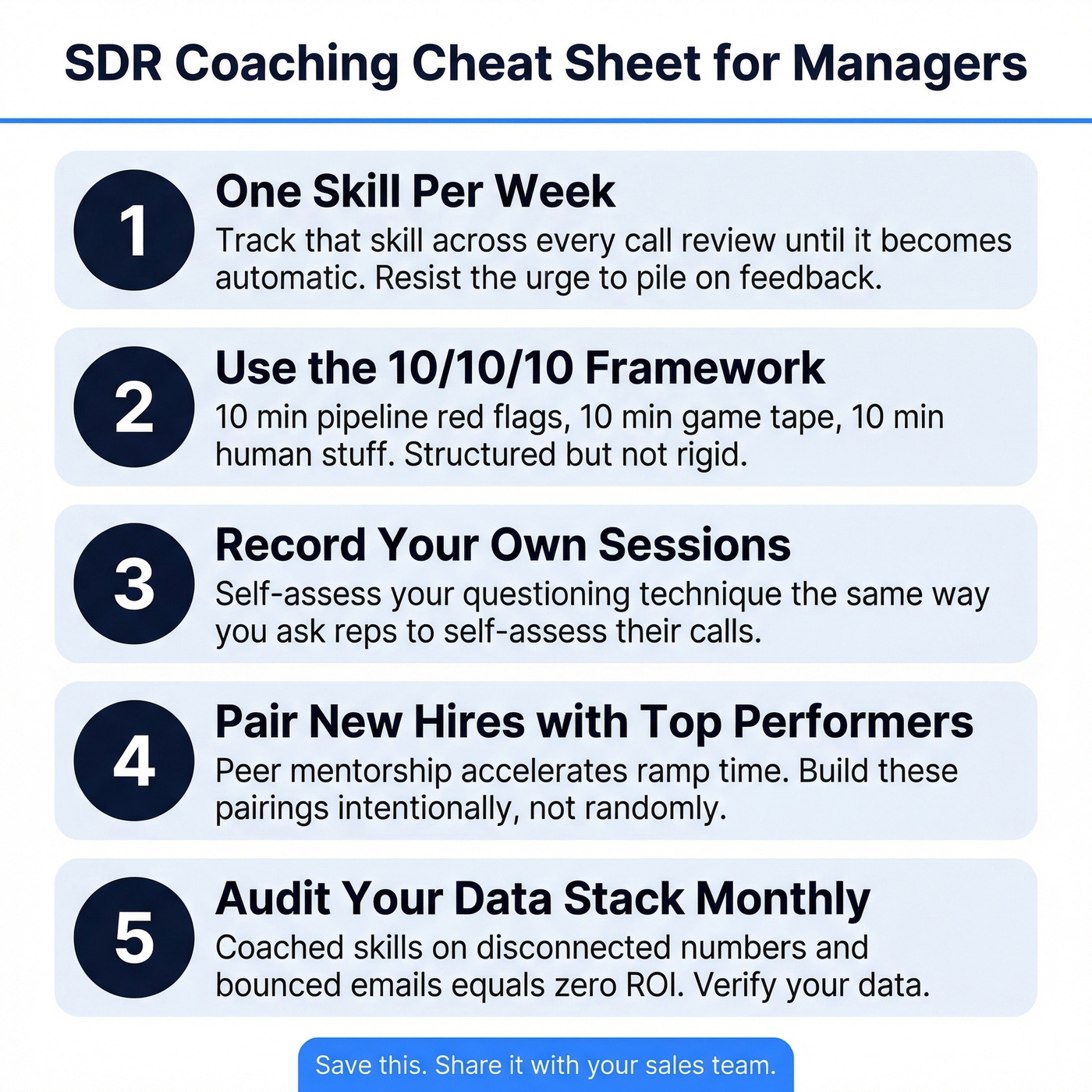
- Focus on one skill per week and track that skill across every call review until it's automatic.
- Use the 10/10/10 framework to keep sessions structured without making them rigid.
- Record your own sessions periodically so you can self-assess your questioning technique - the same way you ask reps to self-assess their calls.
- Pair new hires with top performers for peer mentorship. Managers who build these pairings see faster ramp times across the board. (For onboarding structure, adapt a 30-60-90 day plan for sales reps.)
- Audit your data stack monthly. Skip this if you enjoy watching reps burn through coached skills on disconnected numbers and bounced emails.
FAQ
How often should you coach SDRs?
Weekly 30-minute 1:1s plus one group roleplay session per week is the minimum effective cadence. Each 1:1 should focus on a single skill. A reliable weekly rhythm outperforms sporadic hour-long sessions - consistency compounds.
What's the biggest coaching mistake managers make?
Turning 1:1s into pipeline interrogations instead of skill-building sessions. Use the 10/10/10 format: 10 minutes on red-flag deals, 10 on game tape, 10 on the human stuff. Reps improve when they practice, not when they defend forecasts.
Can AI replace a sales coach?
No. AI conversation intelligence tools scale call review, but they can't ask the right follow-up question or read a rep's energy. Use AI to surface the 5 calls worth your time out of 50, then coach those deeply.
How do you develop reps who already hit quota?
Shift from foundational skills to advanced techniques: multi-threading into accounts, running discovery with senior buyers, or mentoring newer reps. Pair this with better data - verified mobiles with a 30% pickup rate give top performers direct access to decision-makers, not gatekeepers.
How long before coaching shows pipeline results?
Expect leading indicators like talk-to-listen ratio and question depth to shift within 2-3 weeks. Pipeline metrics like stage conversion and meeting quality typically follow in 6-10 weeks. Track both to prove ROI to leadership.