

SDR Marketing Alignment: The 2026 Playbook
Marketing sends 200 MQLs. SDRs convert six to meetings. Marketing says the leads were qualified. Sales says they were junk. Both dashboards prove each team is right, and the pipeline still isn't growing.
This is the SDR marketing problem, and it's bleeding pipeline every single week at companies of every size, in every industry, with every CRM you can name.
65% of sales and marketing professionals report a lack of alignment between their teams. That's not a communication problem. It's structural. Forrester's data makes the stakes plain: firms with strong cross-functional alignment see 2.4x higher revenue growth than those without it.
The Short Version
Aligning sales development with marketing comes down to three things: shared definitions (what counts as an MQL vs. SQL vs. SQL), a 15-minute response SLA, and monthly reject-code reviews. Everything else is optimization. If your data is stale, none of it works - start with verified contact data and build from there.
What SDR Marketing Actually Means
The term gets misused constantly. People hear "SDR marketing" and think it means SDRs doing marketing tasks. It doesn't.
It's the operational system connecting marketing demand gen to SDR pipeline creation - the handoff mechanics, the shared definitions, the SLAs, the scoring models, and the feedback loops that determine whether marketing spend actually turns into qualified meetings. When this system works, marketing generates demand that SDRs can convert. When it doesn't, you get the 200-MQLs-to-6-meetings problem and a lot of finger-pointing in the Monday standup.
Aligning marketing with SDRs isn't a one-time project. It's an ongoing operating rhythm that requires constant tuning.
Why Alignment Breaks
The core issue is incentive misalignment. Marketing gets measured on MQL volume and cost per lead. Sales gets measured on pipeline and revenue. These metrics can move in opposite directions, and they frequently do.
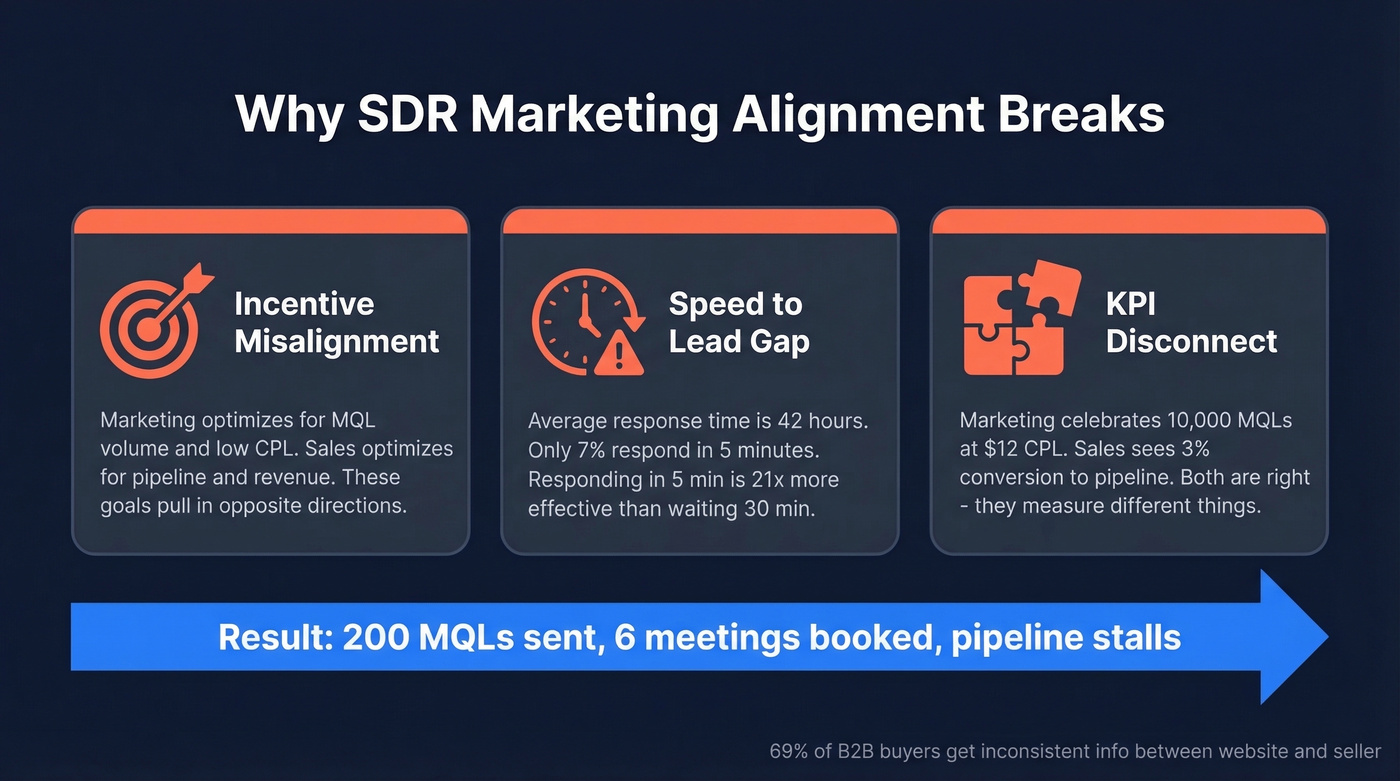
Here's the thing: when marketing is incentivized on lead volume and low CPL, the rational move is to buy cheap traffic. The consensus on r/sales is blunt - "MQLs are garbage" when marketing optimizes for quantity. One practitioner broke down click-fraud minimums on audience networks like Meta Audience Network (67%), TikTok Audience Network (79%), and Google Display (27%), with other networks called out in the same breakdown. Cheap traffic sources generate leads that look real in the CRM but never pick up the phone.
The buyer side is just as broken. 69% of B2B buyers report inconsistent information between a vendor's website and what the seller actually tells them. That's what happens when marketing and sales aren't aligned on messaging - the prospect gets two different stories and trusts neither.
Then there's the speed-to-lead problem. The average response time to an inbound lead is 42 hours. Only 7% of companies respond within five minutes. Responding within five minutes makes conversion 21x more likely compared to waiting 30 minutes. So marketing spends $50K on a campaign, generates 300 leads, and SDRs don't touch them for two days. By then, the prospect has already talked to a competitor or forgotten they filled out the form.
The third failure mode is the KPI disconnect. Marketing celebrates 10,000 MQLs at a $12 CPL. Sales sees a 3% conversion rate to qualified pipeline and wonders why they're wasting time on leads that don't convert. Neither team is wrong - they're just measuring different things.
The Alignment Playbook
Shared Definitions: MQL, SQL, and Opportunity
The single highest-leverage fix is agreeing on what the words mean. Most teams use MQL and SQL without ever defining them precisely, which means marketing and sales are literally speaking different languages.
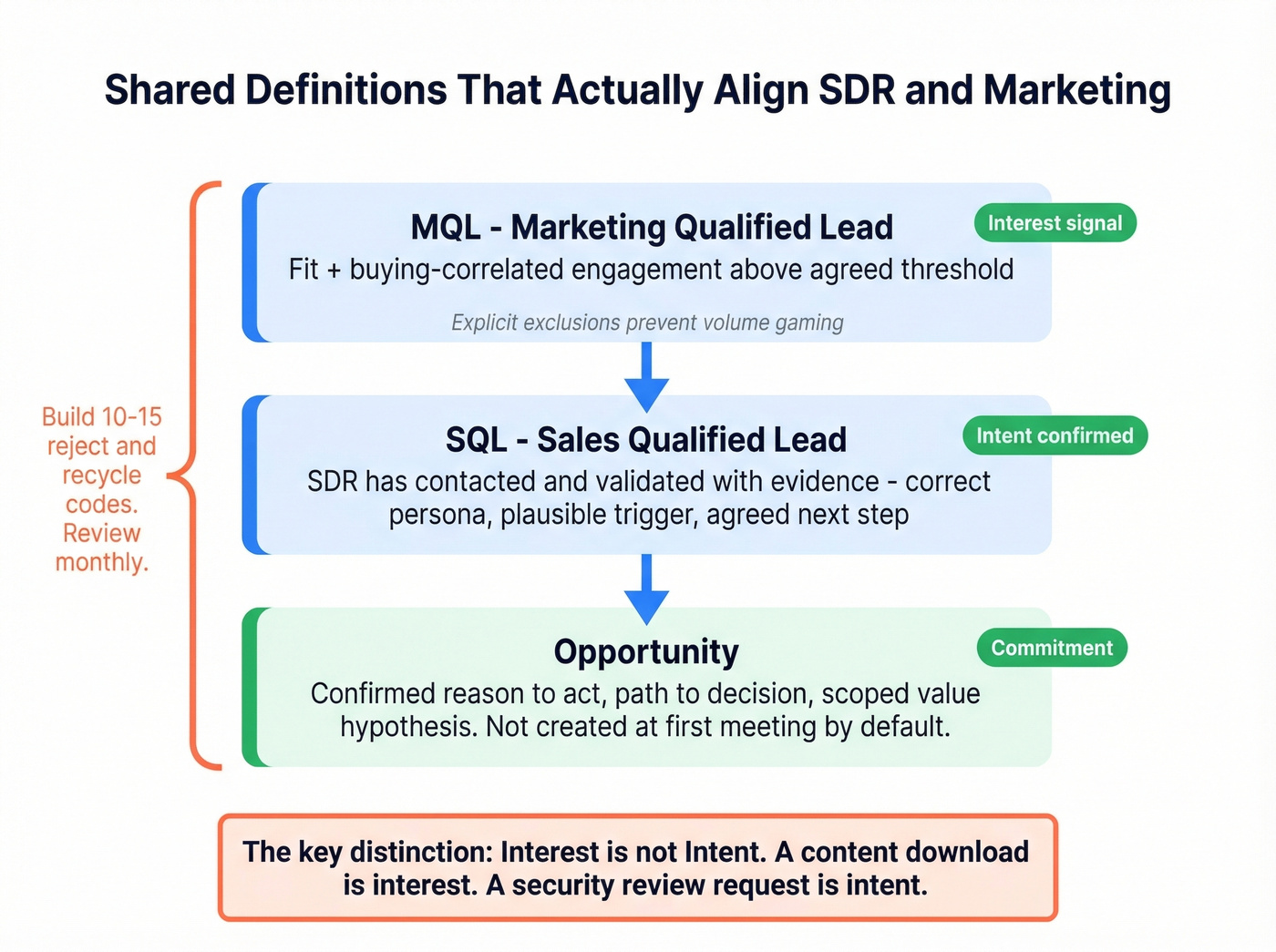
The distinction that matters is interest vs. intent. A content download is interest. A security review request is intent. An email sent is activity. A scheduled meeting with an agenda is commitment. These aren't the same thing, and your funnel stages should reflect that.
A framework that works:
- MQL - An agreed threshold of fit plus buying-correlated engagement, with explicit exclusions to prevent volume gaming.
- SQL - The SDR has contacted and validated the lead with evidence: correct persona, plausible trigger, and an agreed next step.
- Opportunity - Don't create at first meeting by default. Require a confirmed reason to act, a path to decision, and a scoped value hypothesis.
Build 10-15 reject and recycle reason codes. Review them monthly. This is where the real alignment happens - when marketing sees that 40% of rejects are "wrong persona" or "no budget authority," they can fix targeting upstream instead of arguing about lead quality in Slack.
Shared KPIs That Force Quality
Replace MQL volume as marketing's north star. The metrics that actually force alignment are qualified pipeline generated, pipeline velocity, and win rate on marketing-sourced leads. When marketing is accountable for pipeline - not just leads - the incentive to buy cheap traffic disappears overnight.
We've seen teams transform their conversion rates within a quarter just by changing what marketing gets bonused on. It's not complicated. It's just uncomfortable for the marketing team that's been hitting their MQL target every month.
SLAs That Close the Gap
Speed kills deals when it's absent.
| Lead Type | Response Target | Owner |
|---|---|---|
| New MQL | 15 minutes | SDR |
| Paid search lead | < 5 minutes | SDR |
| Paid social lead | < 1 hour | SDR |
| Interested reply | 24 hours to AE | SDR → AE |
60-70% of paid leads never make it to a discovery call. That's not a lead quality problem - it's a handoff problem. Every handoff needs required context fields, and here's the minimum checklist every lead should carry when it hits the SDR's queue:
- Campaign source and engagement history
- Company name, size, and industry
- Contact role and seniority
- Pain point or trigger signal (if captured)
- Urgency indicator like a pricing page visit or demo request
- Defined next step
Without this context, the SDR is cold-calling a warm lead. That defeats the entire purpose.

Every SLA you set is worthless if your SDRs are dialing wrong numbers and bouncing emails. Prospeo delivers 98% verified emails and 125M+ direct dials - refreshed every 7 days, not 6 weeks. When marketing hands off an MQL, your reps connect on the first attempt.
Stop wasting marketing spend on leads your SDRs can't reach.
Lead Scoring That Works
Most lead scoring models are either too simple - downloaded a whitepaper equals MQL - or too complex, with a 47-variable model nobody maintains. The sweet spot is a three-layer approach.
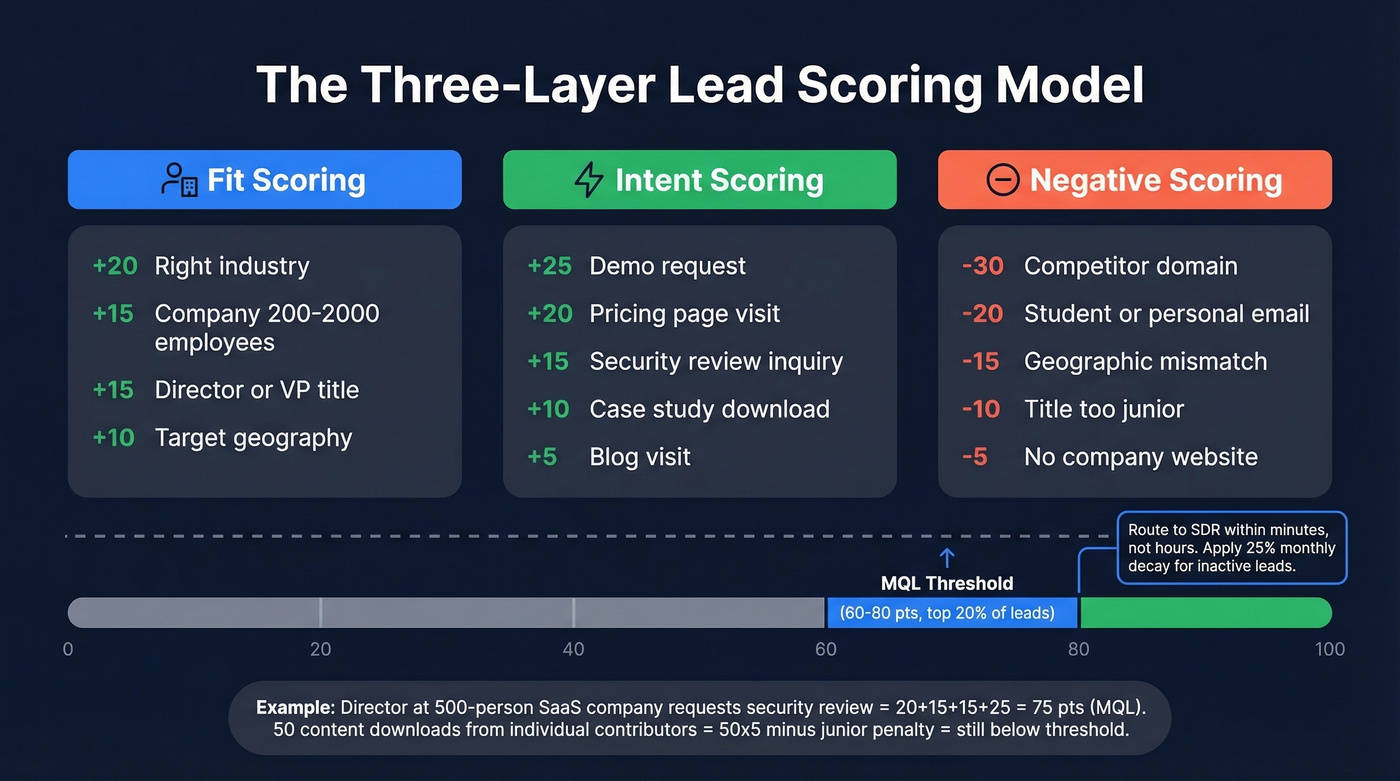
Fit scoring covers firmographics: right industry, right company size, right title. Intent scoring captures behavioral signals like pricing page visits, demo requests, and security review inquiries. Negative scoring subtracts points for disqualifying signals - competitor domains, student emails, geographic mismatches.
Set your MQL threshold at 60-80 points, targeting the top 20% of leads by score. Route leads crossing the threshold to SDRs within minutes, not hours. Apply a 25% monthly score decay for leads without new activity. A whitepaper download from four months ago isn't a buying signal anymore.
A security review request from a director at a 500-person SaaS company is worth more than 50 content downloads from individual contributors. Your scoring model should reflect that gap, not treat all engagement equally. (If you need a deeper framework, use a dedicated lead scoring model.)
SDR Benchmarks for 2026
Numbers ground the conversation. Here's what current benchmarks look like:
| KPI | Inbound SDR | Outbound SDR | Top Performer |
|---|---|---|---|
| Meetings/month | 20-25 | 12-15 | 18-20 |
| Show rate | 80-85% | 75-80% | 85%+ |
| Held meetings/mo | 16-21 | 9-12 | 15-17 |
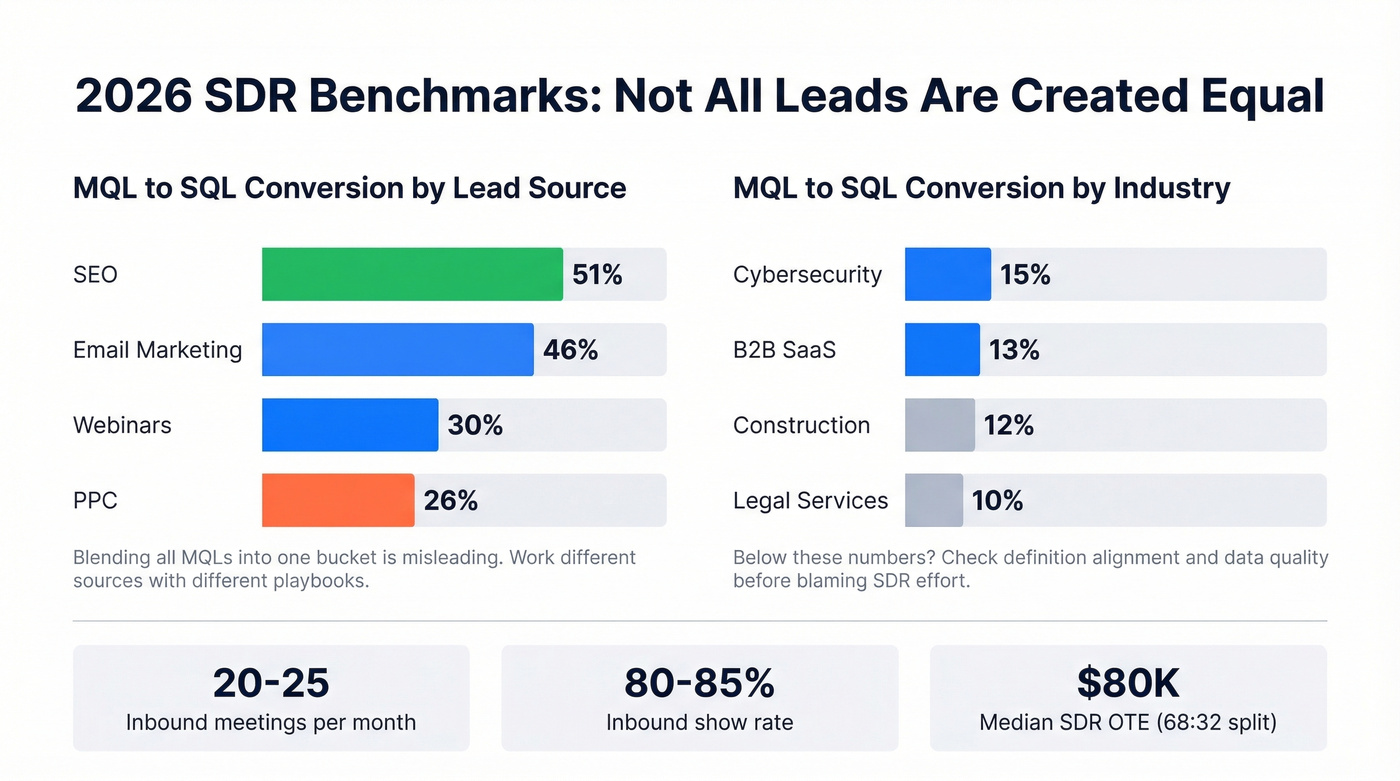
MQL-to-SQL conversion varies significantly by industry. B2B SaaS runs about 13%, cybersecurity around 15%, construction 12%, legal services 10%. If you're below these numbers, the problem is usually definition misalignment or data quality - not SDR effort. (Compare against the broader average B2B lead conversion rate benchmarks.)
Lead source matters enormously for conversion. SEO-sourced leads convert at roughly 51%, email marketing at 46%, webinars at 30%, and PPC at 26%. Blending all MQLs into one bucket is misleading - a PPC lead and an organic demo request are fundamentally different prospects with different conversion expectations. Working them with the same playbook is a recipe for wasted effort.
On compensation, the median SDR OTE sits around $80K with a 68:32 base-to-variable split. That's relevant because comp tied to meeting volume rather than qualified pipeline creates the same perverse incentive that plagues marketing: quantity over quality. (If you want to sanity-check comp design, start with OTE in Sales.)
The SDR Tech Stack
The right tools don't fix broken alignment, but the wrong tools make it impossible.
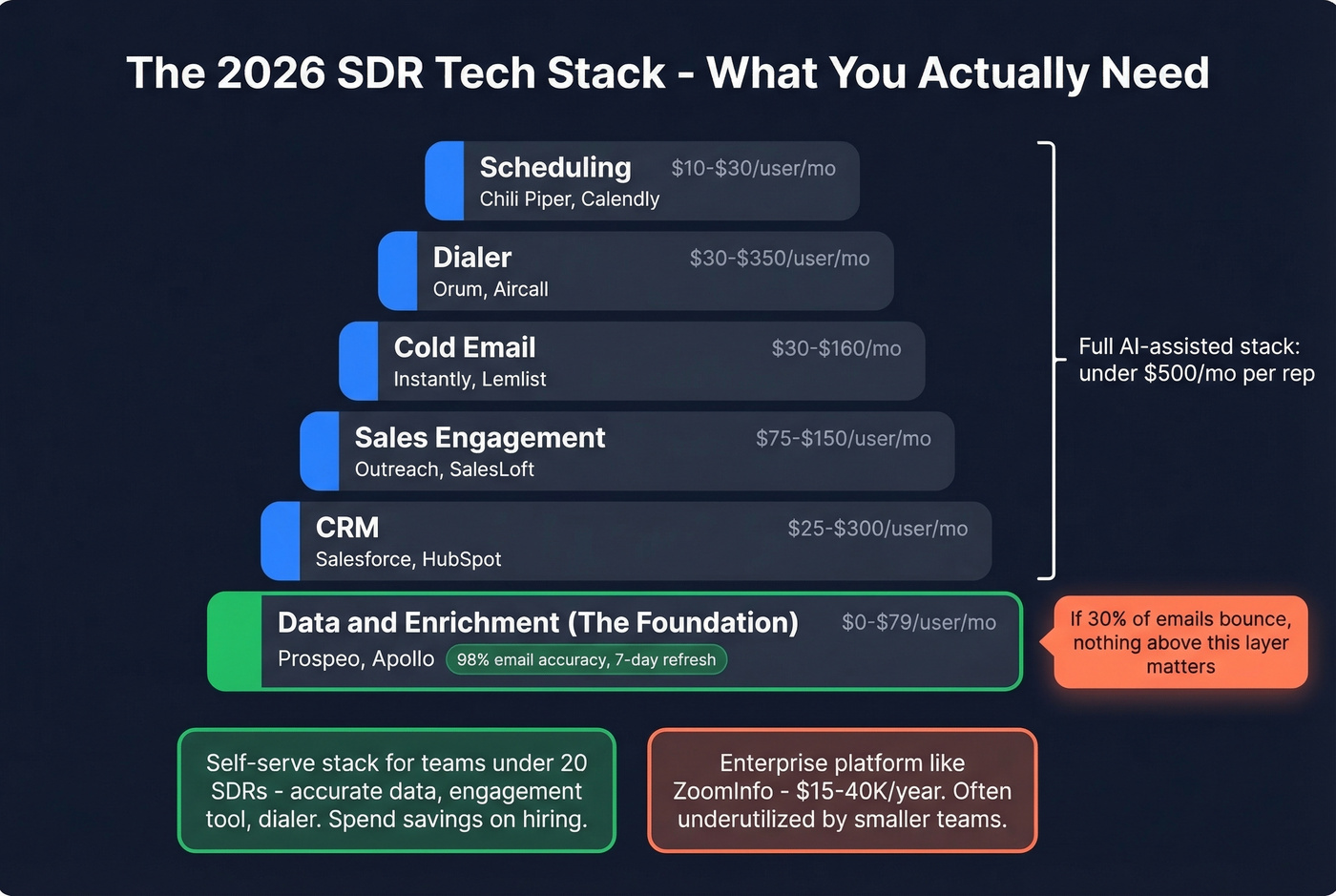
| Category | Tools | Typical Cost |
|---|---|---|
| CRM | Salesforce, HubSpot | $25-$300/user/mo |
| Sales Engagement | Outreach, SalesLoft | $75-$150/user/mo |
| Cold Email | Instantly, Lemlist | $30-$160/mo |
| Data / Enrichment | Prospeo, Apollo | Free-$79/user/mo |
| Dialer | Orum, Aircall | $30-$350/user/mo |
| Scheduling | Chili Piper, Calendly | $10-$30/user/mo |
The data layer is where most stacks quietly fail. If 30% of your emails bounce, no SLA or scoring model saves you. Prospeo runs 98% email accuracy across 300M+ professional profiles with a 7-day refresh cycle, compared to the industry average of six weeks. That freshness gap matters because people change jobs constantly, and stale data means your SDRs are emailing inboxes that no longer exist. When Snyk rolled out Prospeo to 50 AEs, bounce rates dropped from 35-40% to under 5%, and AE-sourced pipeline grew 180%. (If bounces are a recurring issue, start with email bounce rate fundamentals.)

One Reddit thread on r/sales broke down the cost of a full AI-assisted outbound stack at under $500/month per rep using self-serve tools. That math checks out. For context, ZoomInfo typically runs $15-40K/year depending on seats and modules - a meaningful budget line for any team under 50 reps.
Let's be honest: most teams with fewer than 20 SDRs don't need an enterprise data platform. A self-serve stack with accurate data, a solid engagement tool, and a dialer will outperform a $40K/year ZoomInfo contract that nobody fully utilizes. Spend the savings on hiring another rep. (If you're rebuilding your stack, use a ranked list of SDR tools to avoid overlap.)
You just built reject codes, SLAs, and shared KPIs. Now make sure 'bad data' isn't your top reject reason. Prospeo's 5-step verification and 7-day refresh cycle mean SDRs spend time selling - not chasing bounced emails and disconnected numbers.
Eliminate 'wrong contact info' from your reject codes permanently.
AI SDRs: Hype vs. Reality
The AI SDR market is projected to hit $5.2 billion in 2026, and every vendor promises to replace your SDR team. The reality is more interesting than the pitch.
SaaStr's internal data from running multiple AI SDR agents shows genuinely impressive numbers: AI answers technical questions immediately 87% of the time versus 15% for humans, buyer satisfaction scores hit 8.4/10 for AI versus 6.2/10 for humans, and time to technical qualification drops from 8.3 days to 2.1 days.
But in head-to-head experiments, human SDRs still generate higher show rates - 71% versus 52% for AI. The cost per qualified lead favors AI dramatically ($39 vs. $262), but revenue per lead favors humans. The hybrid model, where AI handles inbound qualification and initial response while humans run complex outbound and relationship-building, is where the economics actually work. (If you're testing automation, map it to generative AI lead generation workflows, not just tools.)
With buying committees now averaging 10-11 stakeholders, multi-threaded outreach makes the sales development-marketing handoff even more critical. AI can handle initial qualification and routing at scale, but navigating a complex buying committee still requires human judgment.
If you're considering AI SDRs, skip outbound for now. Pilot them on inbound qualification first. That's where the speed advantage - sub-minute response vs. 42-hour average - creates the most value. The personalization and objection handling for high-value outbound prospects still need a human.
The Reporting Line Debate
68% of SDR teams report to the head of sales. Inbound-focused SDR teams are 2.1x more likely to sit under marketing. There's a cottage industry of hot takes about which structure is "right."
Our take: the reporting line matters far less than shared KPIs and shared definitions. We've seen SDR teams thrive under marketing leadership and fail under sales leadership - and vice versa. The variable isn't the org chart. It's whether both teams are accountable for the same pipeline number and whether they review reject codes together every month. (This is also where a strong RevOps Manager function pays for itself.)
The contrarian view - that the SDR marketing model is structurally flawed because it prevents reps from actually selling - has some merit for teams where SDRs are so process-bound they can't exercise judgment. But the fix isn't eliminating the connection between sales development and demand gen. It's giving SDRs enough autonomy to qualify intelligently while maintaining the feedback loop that makes marketing spend more effective.
FAQ
What's the difference between an SDR and a BDR?
SDRs typically handle inbound leads, qualifying marketing-generated MQLs and booking meetings for AEs. BDRs focus on outbound prospecting, sourcing their own leads through cold outreach. Many companies use the titles interchangeably; the distinction matters less than whether the role is inbound-focused or outbound-focused.
Should SDRs report to marketing or sales?
Most SDR teams (68%) report to sales leadership, while inbound-focused teams are 2.1x more likely to sit under marketing. The reporting line matters less than shared KPIs - if both teams are accountable for qualified pipeline and review reject codes monthly, either structure works.
What's a good MQL-to-SQL conversion rate?
The B2B median runs 13-15%. B2B SaaS averages about 13%, cybersecurity around 15%, and legal services roughly 10%. If you're significantly below these benchmarks, investigate your MQL definition and data quality before blaming SDR performance.
How fast should SDRs respond to inbound leads?
Within 15 minutes for standard MQLs, under 5 minutes for paid search leads. Responding within 5 minutes makes conversion 21x more likely than waiting 30 minutes. The average company takes 42 hours - which is why speed-to-lead is the easiest alignment win.
What tools fix bad data in the SDR workflow?
Prospeo delivers 98% email accuracy with a 7-day refresh cycle and 125M+ verified mobile numbers, which is critical for ensuring SDRs can actually reach the contacts marketing generates. Apollo and ZoomInfo are alternatives, though ZoomInfo's $15-40K/year price tag is steep for smaller teams. Start with a free tier to test accuracy before committing budget.