

The Complete SDR Outbound Playbook for 2026
Forty-seven dials. Three pickups. One "send me an email" that goes nowhere. That's a Tuesday for most SDR outbound teams - and it doesn't have to be. The gap between average and top-performing reps isn't effort or talent. It's system: the data feeding your dials, the cadence structuring your touches, and the benchmarks telling you where your funnel leaks.
This is the playbook we wish someone had handed us on day one.
What Is an Outbound SDR?
An outbound SDR (Sales Development Representative) creates pipeline from scratch. No inbound leads, no warm handoffs - just a list, a phone, and an email tool. The job is to identify prospects who fit your ICP, reach them through cold outreach, and book qualified meetings for account executives.
It's the hardest seat in sales. Over 40% of reps say prospecting is the most challenging part of the entire sales process. And yet SDRs produce 30-45% of B2B SaaS pipeline, with the median rep generating $3M in pipeline per year. The typical SDR-to-AE ratio sits at 1:2.4, average ramp time is 3 months, and median tenure is just 1.9 years - so every week of productive selling time matters.
One SDR on r/sales shared their team's quota: 80 dials/day and 20 accepted opportunities/month, with only 1-2 of roughly 20 reps actually hitting it. That ratio tells you everything about how broken most outbound systems are.
What You Need (Quick Version)
Before getting into scripts and cadences, here's the 80/20:
- Fix your data first. 98%+ email accuracy and verified mobile numbers are the highest-ROI lever you can pull. Everything downstream - reply rates, meetings, pipeline - improves when your data is clean. (If you’re diagnosing bounces, start with bounce rate benchmarks.)
- Run a multichannel cadence. Email, phone, and social touches combined produce 287% better results than single-channel outreach. Single-channel is dead.
- Measure meetings per 100 dials, not dials per day. A rep making 35 targeted calls with verified numbers will outbook someone hammering 80 dials into bad data every time.
Outbound SDR Benchmarks for 2026
You can't fix what you don't measure. Here's what "good" looks like across the full funnel, compiled from 16.5M cold emails and 204K+ cold calls:
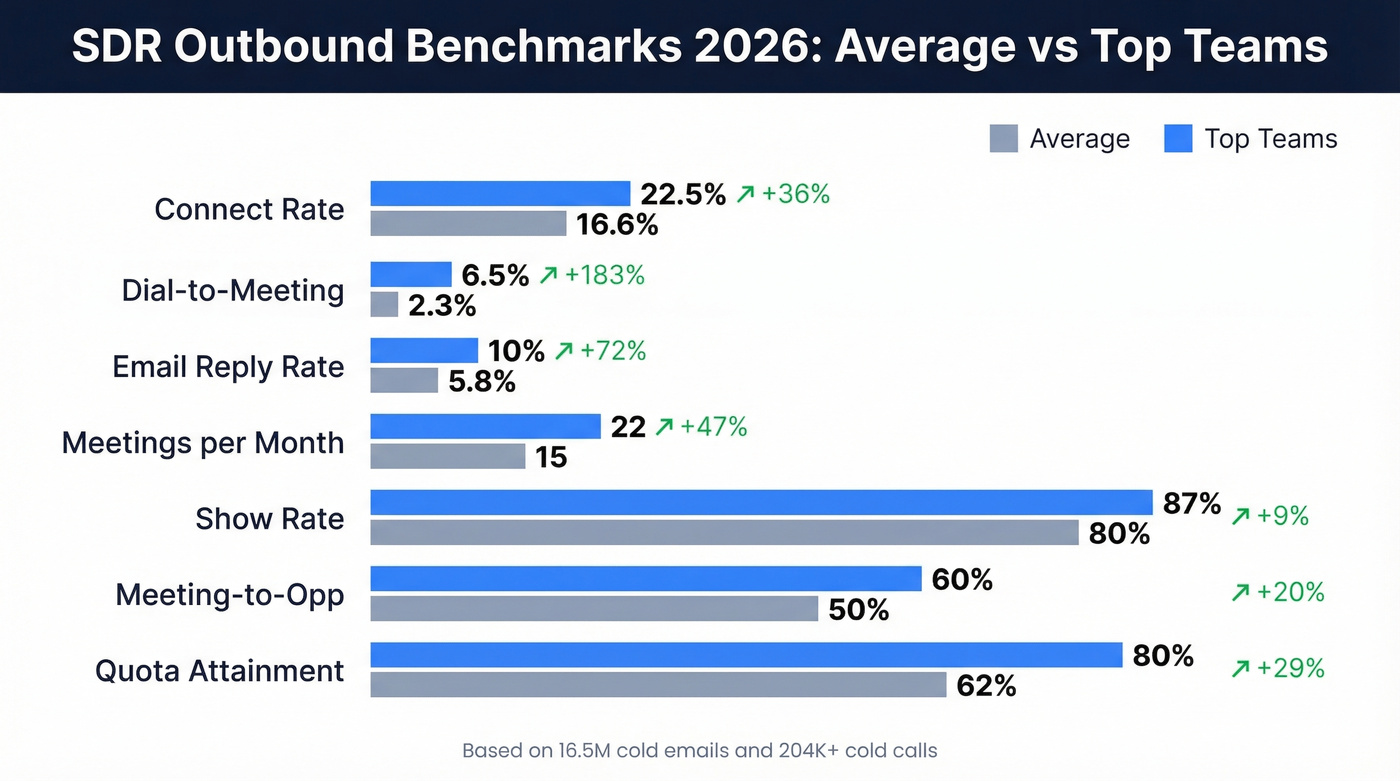
| Metric | Average | Top Teams |
|---|---|---|
| Connect rate | 16.6% | 20-25% |
| Dial-to-meeting | 2.3% | 5-8% |
| Email reply rate | 5.8% | 8-12% |
| Meetings/month | 15 | 20-25 |
| Show rate | ~80% | 85-90% |
| Meeting-to-opp | ~50% | 60%+ |
| Quota attainment | 56-68% | 80%+ |
A few things jump out. The average dial-to-meeting rate is 2.3% - roughly 43 dials to book one meeting. Top teams cut that nearly in half. Reply rates have declined from 6.8% in 2023 to 5.8% today, which makes data quality and personalization more important than ever.
And here's a counterintuitive one: single-email sequences actually produce the highest reply rate at 8.4%. More touches aren't always better. Sometimes one sharp, well-timed message outperforms a seven-step drip.
The biggest gap is quota attainment. Only 56-68% of SDRs hit their number across 351 B2B companies studied. Most of that gap is systemic - bad data, poor cadence design, no call blocks during peak windows - not individual performance.
The Daily Schedule That Works
The average outbound rep logs 94.4 activities per day: 35.9 calls, 32.6 emails, 15.3 voicemails, and 7 social touches. But when you do those activities matters as much as how many you do. (If you want a tighter definition of what counts, see these sales activities.)
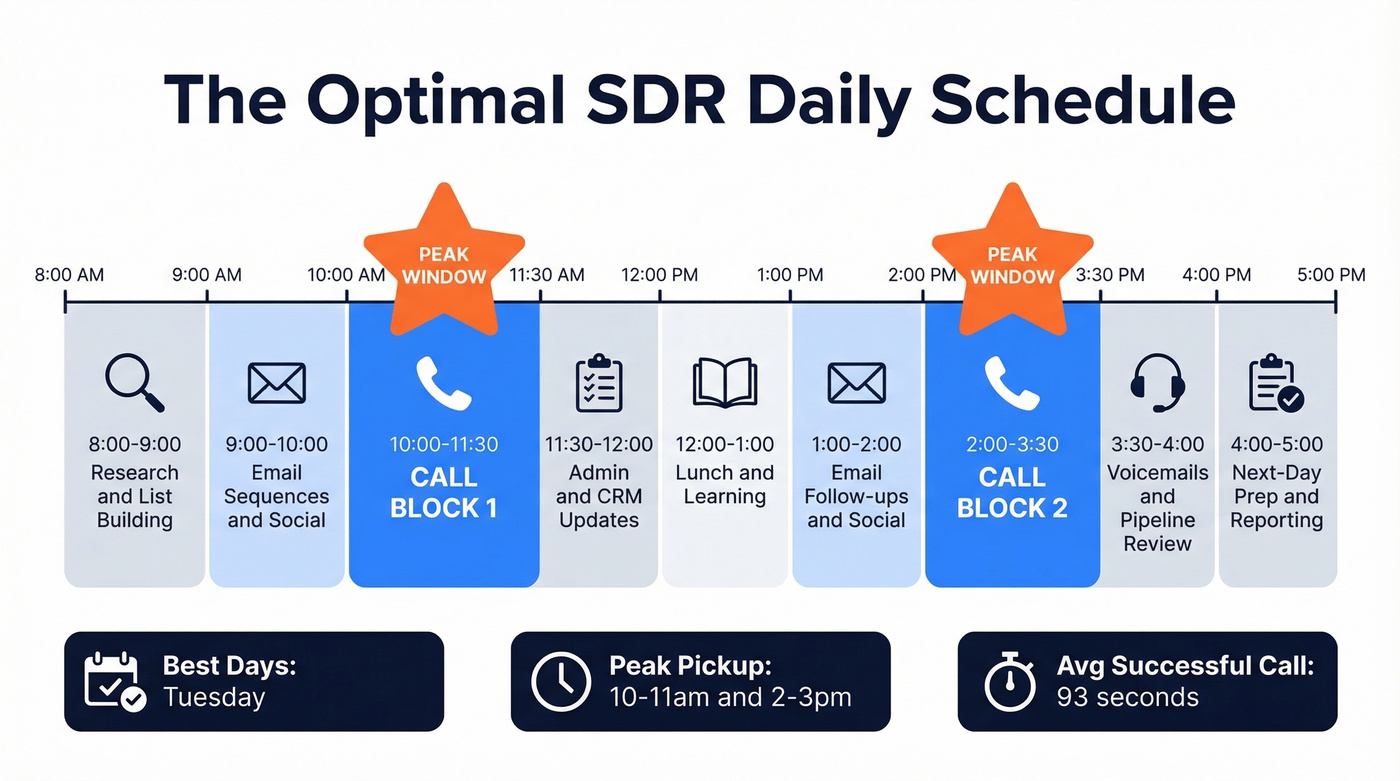
An analysis of 962,074 calls found afternoon pickup rates hit 3.8% versus 3.5% in the morning, with Tuesdays performing best overall. Peak windows: 10-11am and 2-3pm in your prospect's timezone. The average successful cold call lasts just 93 seconds - you're not looking for long conversations, you're looking for sharp ones.
| Time | Activity |
|---|---|
| 8:00-9:00 | Research, list building, prep |
| 9:00-10:00 | Email sequences + social |
| 10:00-11:30 | Call block #1 (peak) |
| 11:30-12:00 | Admin, CRM updates |
| 12:00-1:00 | Lunch + learning |
| 1:00-2:00 | Email follow-ups + social |
| 2:00-3:30 | Call block #2 (peak) |
| 3:30-4:00 | Voicemails + pipeline review |
| 4:00-5:00 | Next-day prep + reporting |
The two call blocks are non-negotiable. Protect them. Every meeting, every Slack thread, every "quick sync" that eats into those windows costs you pipeline.
Cold Call Scripts That Book Meetings
Permission-Based Opener
This is the workhorse. It respects the prospect's time and earns you 30 seconds to pitch:
"Hey [Name], this is [Your Name] from [Company]. I know I'm calling out of the blue - do you have 30 seconds so I can tell you why, and you can decide if it's worth continuing?"
Simple, honest, and it works. Build on this with a "choose your own adventure" follow-up - offer two pain points and let the prospect pick which one to discuss. That small choice creates buy-in.
Personalized Opener
When you've done your homework, lead with it:
"Hey [Name], saw [Company] just [specific trigger - opened a new office, posted 3 SDR roles, switched to Salesforce]. That usually means [related challenge]. Quick question - is that something your team is dealing with right now?"
This converts at a higher rate because it proves you're not reading from a sheet. The 6.6x success rate boost from pattern-interrupt openers like "How have you been?" works on the same principle - breaking the "sales call" script the prospect expects.
Gatekeeper Script
"Hi, I'm hoping you can help me. I'm trying to reach [Prospect Name] about [specific topic]. What's the best way to make that happen?"
Asking for help instead of demanding a transfer changes the dynamic entirely.
Voicemail Template
Keep it under 20 seconds:
"Hey [Name], [Your Name] from [Company]. I'm calling because [one-sentence reason tied to their role]. I'll shoot you an email with more context - my number is [number], that's [repeat number]. Talk soon."
Two more data points worth internalizing: name-dropping a familiar client boosts conversion by 73%, and showing your name on caller ID spikes conversion 54%. Both are free to implement. And 93% of conversations happen by the third call - if you're giving up after one attempt, you're leaving meetings on the table. (For more on handling “no” without spiraling, use these cold call rejection fixes.)

The benchmarks above prove it: top SDR teams hit 20-25% connect rates while average teams sit at 16.6%. The difference is data. Prospeo delivers 98% email accuracy, 125M+ verified mobile numbers with a 30% pickup rate, and refreshes every record every 7 days - not 6 weeks like the tools you're probably using now.
Stop burning call blocks into disconnected numbers and bounced emails.
Email Strategy That Converts
Lead Gen Sequence (3-Touch)
Email 1 - The Hook (Day 1)
Subject: [Company] + [their pain point]
Hi [Name], noticed [Company] is [specific trigger]. Most [role] teams at that stage run into [specific problem]. We helped [similar company] solve that by [one-line outcome]. Worth a 15-min call this week?
Email 2 - The Value Add (Day 3)
Quick follow-up. [One relevant stat or case study result]. Happy to walk through how this applies to [Company] - here's my calendar: [link].
Email 3 - The Direct Ask (Day 7)
[Name], is [pain point] something your team is actively working on? If so, I'd love 15 minutes. If not, no worries - just let me know and I'll close the file.
The sweet spot is 6-8 sentences per email, which produces a 6.9% reply rate. Thursday is the best send day at 6.87% versus Monday's 5.29%. And here's a counterintuitive finding: contacting 1-2 people per company yields a 7.8% reply rate, while spraying 10+ contacts drops you to 3.8%. Precision wins again. (If you need options beyond “Worth a 15-min call?”, steal these sales follow-up templates.)
Breakup Email
Subject: Should I close the file?
[Name], I've reached out a few times and haven't heard back - totally fine. I'll assume the timing isn't right. If [pain point] becomes a priority, reply to this thread. Cheers, [Your Name]
Space your touches 2-4 business days apart. Tighter feels aggressive; wider loses momentum.
The 30-Day Multichannel Cadence
The 30 Minutes to President's Club framework nails this: 10-14 touches over 30 days across email, phone, and social.
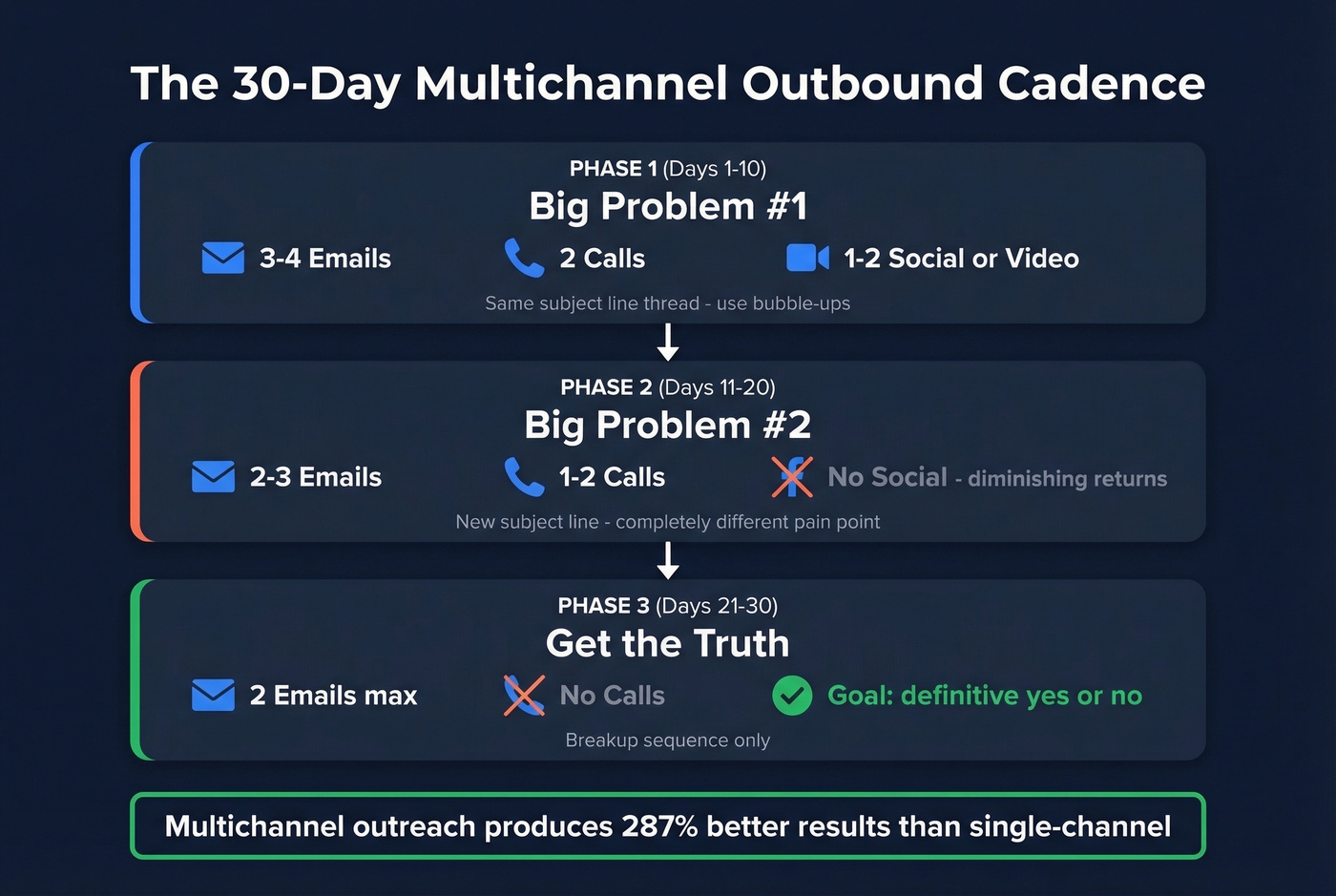
Phase 1: Big Problem #1 (Days 1-10) 3-4 emails focused on one specific pain point. Add 2 call attempts during peak windows and 1-2 social touches, including a short Loom or Vidyard video if your deal size justifies the effort. Every email shares the same subject line thread. Use "bubble-ups" - replies to your own thread with a new angle - to stay in the same conversation.
Phase 2: Big Problem #2 (Days 11-20) Switch to a completely different pain point. New subject line. Drop social touches because returns diminish fast. Keep 2-3 emails and 1-2 calls.
Phase 3: Get the Truth (Days 21-30) Breakup sequence. 2 emails max. No calls. The goal is a definitive yes or no.
The key principle: sell one problem at a time. When you switch themes, you get a fresh chance to resonate. Multichannel execution can double email reply rate because the prospect sees your name across channels before they ever open your message. (If you want more structure, build this into a repeatable cold calling system.)
Why Bad Data Kills Your Outbound
Here's the thing: none of the scripts, cadences, or time blocks above matter if you're dialing wrong numbers and emailing dead addresses. SDRs waste 25%+ of their time on inaccurate data - researching contacts that don't exist, leaving voicemails at wrong extensions, watching emails bounce.
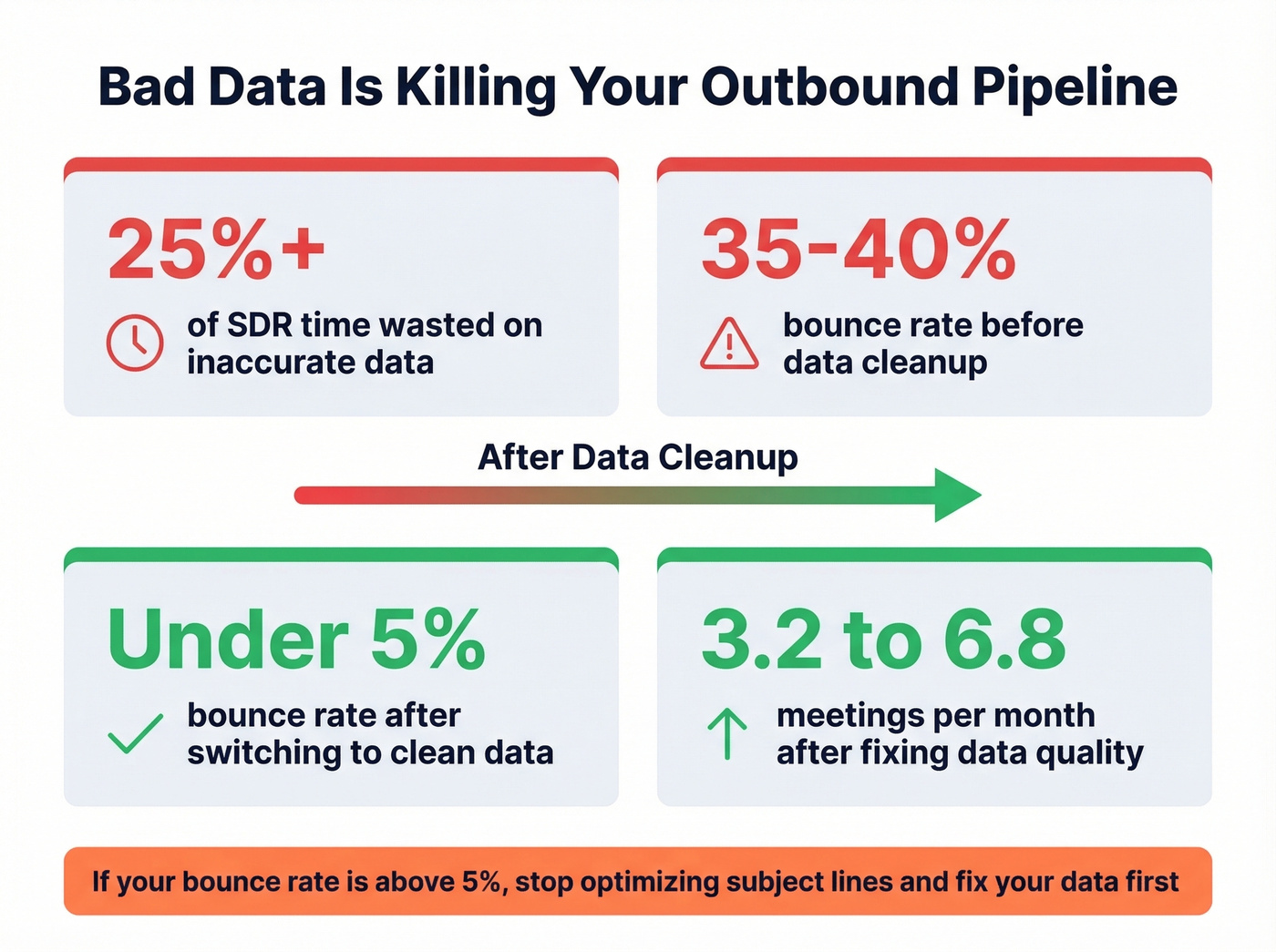
Snyk saw similar results: 50 AEs prospecting 4-6 hours per week cut bounce rates from 35-40% to under 5%, and AE-sourced pipeline jumped 180%, creating 200+ new opportunities per month.

Outreach's data shows teams that clean their data regularly see bounce rates drop from 4.8% to 1.2%, and the average rep improves from 3.2 to 6.8 meetings per month.
If your bounce rate is above 5%, stop optimizing your subject lines and fix your data. It's the single highest-ROI move you can make. (If you’re evaluating vendors, start with these data enrichment services.)
The Outbound Tech Stack
The average SDR team uses 12-15 tools at $2,000-$5,000 per SDR per month. That's insane. We've seen teams consolidate from 12 tools down to 3-4 that actually move the needle, and their results didn't suffer - they improved because reps spent less time toggling between tabs and more time selling. (Here’s a broader shortlist of SDR tools if you’re rebuilding your stack.)
| Category | Best Pick | Runner-Up | Price Range |
|---|---|---|---|
| CRM | HubSpot (free start) | Salesforce (enterprise) | $0-$300/user/mo |
| Prospecting & Data | Prospeo (accuracy) | Apollo (volume) | $50-$500/user/mo |
| Sales Engagement | Outreach (enterprise) | Instantly (SMB) | $25-$150/user/mo |
| Dialer | Orum (parallel) | Aircall | $30-$350/user/mo |
| Enrichment | Clay (workflows) | Clearbit | $30-$200/user/mo |
| Scheduling | Chili Piper (routing) | Calendly | $10-$30/user/mo |
| Intent Data | Bombora | 6sense | $500-$5,000/mo |
| Conversation Intel | Gong | Chorus | $100-$200/user/mo |
77% of outbound teams use a sales engagement platform, 74% use contact data tools, and 66% use conversation analytics. Those are your three must-haves beyond CRM.
Skip intent data if your average deal size is under $25K - the cost won't justify itself. And if your team is under 5 reps, you don't need Gong yet. Record calls in your dialer and review them manually.
AI SDRs: What They Can't Replace
75% of companies plan to invest in AI-powered sales tools in the next two years, and roughly 30% of outbound messages are already AI-generated. The Bridge Group's 2025 report is the first to track AI SDRs in their ratio data.
AI excels at research, account mapping, and first-draft personalization - the repetitive work that eats 2+ hours of a rep's day. A human SDR costs $150K-$250K per year fully loaded, and AI tools deliver roughly 30% productivity gains. But AI still can't handle complex qualification conversations, creative objection handling, or reading tone on a live call. (For more on what to automate vs keep human, see generative AI sales tools.)
The winning model in 2026 is AI-assisted humans, not AI-replaced humans. Let's be honest - if your AI SDR could actually close, every company would have fired their sales team by now. Use AI to accelerate research so reps spend more time on the calls, emails, and social touches that build real relationships.
7 Mistakes That Kill Your Pipeline
- Blasting 200+ emails a day. Chili Piper's SDR leadership team documented this anti-pattern: reps sending 200+ emails and working 600-700 accounts monthly without hitting quota. Volume without precision is just noise.
- Single-channel outreach. Email-only or call-only approaches leave 287% of potential results on the table.
- No call blocks during peak windows. If you're not protecting 10-11am and 2-3pm for dials, you're calling when nobody picks up.
- Too many accounts. Working 600 accounts means you can't personalize anything. Tighter lists, better data, fewer accounts, more meetings.
- No theme switching. Hammering the same pain point for 14 days straight guarantees fatigue. Switch problems every 7-10 days.
- Ignoring benchmarks. If your connect rate is 8% and the benchmark is 16.6%, the problem isn't your script - it's your data or your timing.
- Skipping voicemail. SDRs average 15.3 voicemails per day for a reason. A good voicemail primes the prospect to open your email.
Only 56-68% of SDRs hit quota. Most of that gap comes from these systemic mistakes, not from lack of hustle.
Every script in this playbook is worthless if your list is wrong. At $0.01 per email and 10 credits per verified mobile, Prospeo gives your SDRs the clean data that turns 43-dial meetings into 20-dial meetings. One team tripled pipeline from $100K to $300K/week and cut bounce rates from 35% to under 4%.
Book 26% more meetings than ZoomInfo-powered teams - with data you can trust.
FAQ
How many calls should an outbound SDR make per day?
The average is 35.9 calls per day, but what matters is calls during peak windows. Two focused 90-minute blocks during 10-11am and 2-3pm will outperform 80 scattered dials. Aim for 35-50 targeted calls with verified numbers rather than maximizing raw dial count.
What's a good cold email reply rate in 2026?
The current benchmark is 5.8%, down from 6.8% in 2023. Top teams hit 8-12% by combining tight ICP targeting, 6-8 sentence emails, and verified contact data. Below 4% usually signals a list quality problem.
Is outbound dead?
No - sloppy outbound is dead. SDRs still produce 30-45% of B2B SaaS pipeline. What's changed is that multichannel, data-driven prospecting has replaced spray-and-pray email blasting. Teams adapting to this model are booking more meetings than ever.
What does an outbound SDR earn?
The national average base salary is around $64,000, with variable comp adding 50-150% on top. Total comp for a strong performer typically lands in the $70-90K range, with top earners in high-cost markets clearing six figures.
What's the fastest way to improve outbound results?
Fix your data. Switching to a provider with 98% email accuracy and verified mobiles cuts bounce rates below 4% and lifts connect rates immediately. After that, implement time-blocked call schedules during peak windows and run a multichannel cadence across email, phone, and social.