SDR Pitch Framework + Scripts That Book Meetings (2026)
Most SDR pitches don't fail because reps "can't talk." They fail because the first 12 seconds are vague, the ask is clumsy, and the list is trash.
Fix those three things and cold calling starts converting.
And yes, your SDR pitch matters. It's just rarely the only thing that matters.
What you need (quick version)
- Know your baseline math: connect rate 3-10%; average call-to-meeting ~2.3%; top SDRs 10-15%
- Run a simple call funnel: Connect -> Conversation (30-90 sec) -> Meeting set
- Memorize one flow: Opener -> Value Hook -> Permission -> Discovery -> Next Step
- Test 2 openers only: run volume, keep the winner
- Keep discovery tight: 2-3 questions, then ask for a 15-30 minute follow-up
- Coach the controllables: talk time, question quality, next-step clarity, objections
- Hot take: if your connect rate's under 2%, stop rewriting your script and fix your data for a week, then come back to the words.
Why your pitch isn't working (and what "good" looks like)
The most common failure mode is a "nice" pitch that never lands a reason to care. It sounds like: "Hi, I'm with X, we help companies streamline Y, do you have time next week?" That's feature fog plus a premature meeting ask.
People hang up because you didn't earn the next 30 seconds.
"Good" is measurable. A common target in SDR training is 8-15 meetings/week per rep when list, offer, and activity line up.
Here's the dial math you can plan around: ~50-100 dials per meeting depending on list quality and how tight your ICP is. One rep's self-tracked month (posted on Reddit) logged 820 dials -> 12 meetings (about 72 calls per meeting) which is a useful gut-check, not a universal law.
If you're doing 100 dials/day and booking zero meetings for weeks, it's almost never "you're bad at talking." It's one of these:
- You're calling the wrong people (ICP mismatch).
- You're calling the right people with no trigger (no reason now).
- You're calling the right people with bad data (no connects).
- You're monologuing (no permission, no discovery, no control).
Here's the thing: new SDRs get buried under contradictory advice - "be casual," "be direct," "pattern interrupt," "never pattern interrupt." Pick one lane for two weeks.
In our experience coaching teams, the cleanest lane is permission-based opener + problem proposition + 3-question discovery. Don't mix frameworks mid-test.
What SDRs complain about (and what to do instead)
- "I freeze because I'm trying to remember the perfect line." -> Memorize a flow, not a paragraph.
- "I get hung up on before I can explain." -> Stop explaining. Earn permission, then deliver a 12-second micro-pitch.
- "Every manager wants a different script." -> Use a scorecard and let numbers decide.
SDR pitch framework: one page you can memorize
This framework scales because it's flexible. It's not "say these 47 words." It's a repeatable path you can run under pressure, and it's the backbone behind most cold call scripting best practices.
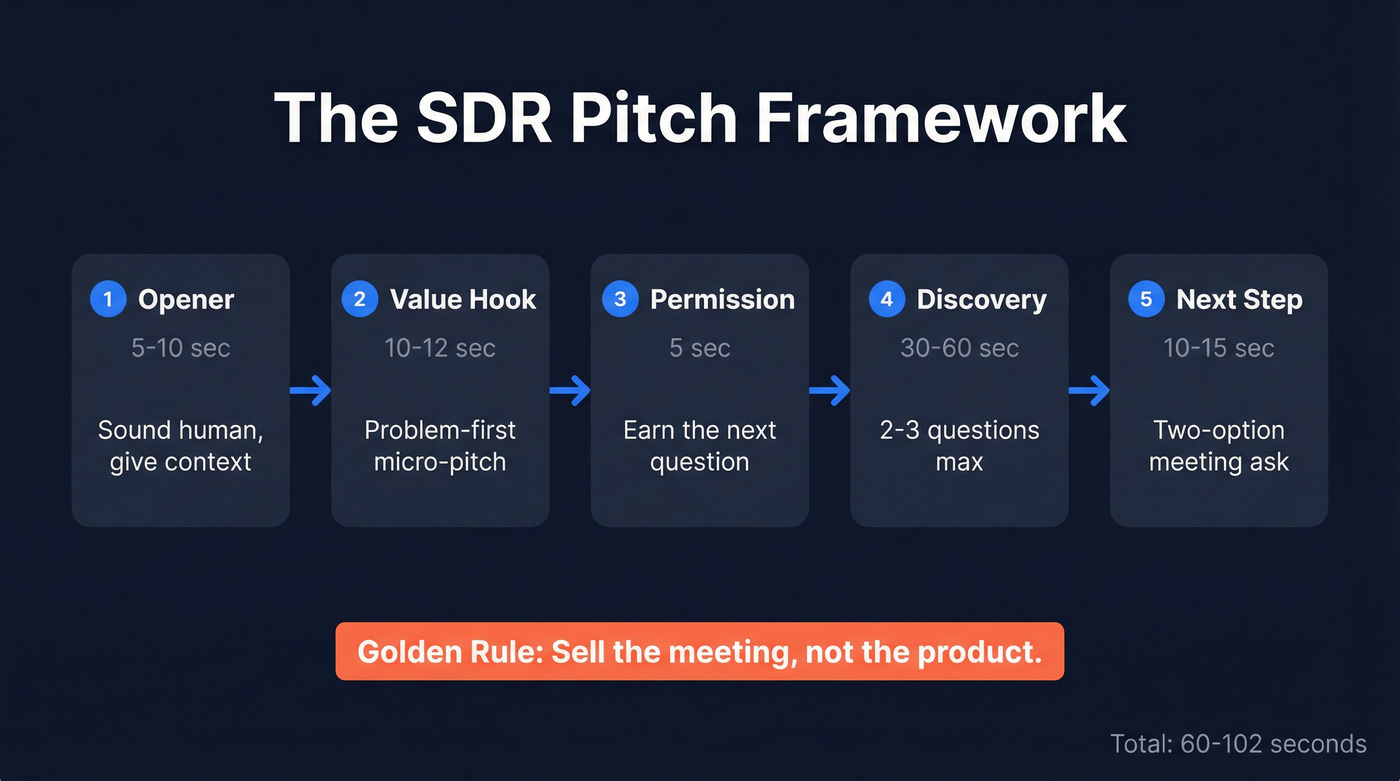
Opener -> Value Hook -> Permission -> Discovery -> Next Step
The rule that keeps you honest: sell the meeting, not the product.
The flow (mini version)
- Opener (5-10 sec): human + context
- Value hook (10-12 sec): problem-first micro-pitch
- Permission (5 sec): earn the next question
- Discovery (30-60 sec): 2-3 questions max
- Next step (10-15 sec): two-option meeting ask + calendar lock
"What good sounds like" (one line per step)
- Opener: "Hey Sam, Jordan from Nova. I'll be brief."
- Value hook: "Calling because teams like yours lose deals when X happens."
- Permission: "Can I take 30 seconds for context, then you tell me if I'm off?"
- Discovery: "Are you seeing more of X or more of Y right now?"
- Next step: "Worth a 20-minute working session - Tuesday 10:30 or Wednesday 2:00?"
If they interrupt you (micro-branch you should memorize)
Prospects interrupt when you sound like you're winding up for a pitch. Don't fight it.
If they cut in with "What is this about?":
"Totally fair - one sentence: it's about [problem]. Can I take 20 seconds, then you can stop me?"
If they cut in with "Not interested" before you've said anything:
"Got it - before I go, is that because it's irrelevant, or you're already set on this?"
If they cut in with "Just email me":
"I will - quick question: is this more about X or Y so I don't send fluff?"
The checklist I want SDRs to internalize
- Opener: sounds like a normal person, not a voicemail transcription.
- Value hook: one problem, one outcome, one proof point (optional).
- Permission: a small ask that keeps control ("Worth 30 seconds?").
- Discovery: qualify urgency and fit, not a full demo.
- Next step: specific, short, and scheduled live.
If you want one behavior change that moves numbers fast: stop pitching before you've earned permission.
Permission isn't submissive. It's call control.
Openers that keep them on the line (ranked by data)
Gong analyzed 300M+ cold calls and published success rates by opener. Use this like a leaderboard: pick a top opener, run it clean, and stop freelancing.
Opener leaderboard (short labels for mobile)
| Opener (label) | Success rate | Use this if... | Skip this if... |
|---|---|---|---|
| Tailored permission (30 sec) | 11.18% | You can name a clear reason for calling | You ramble after permission |
| Light brand check | 11.24% | You have real awareness in the space | You're unknown and can't justify it |
| Human reset | 7.6% | You can pivot fast into a reason | You drift into small talk |
| "Bad time?" | 2.15% | Never | Always |

Yes, "Did I catch you at a bad time?" is the worst. It hands them an easy out and frames you as low-status.
The mini upfront contract (full script)
"Hey [Name], [You] from [Company]. I know you weren't expecting my call. I've got a quick reason I called that's relevant to [role/team]. Can I take 30 seconds, and you can tell me if I'm off base?"
What happens after the opener (3 rules)
- Permission -> micro-pitch -> first question. Don't insert a company history in the middle.
- Time-box everything. "30 seconds" and "one quick question" keeps you in control.
- Ask a question that forces a real answer. "Is that a priority?" gets you a shrug. "More X or more Y?" gets you signal.
Delivery rules (tone > words)
- Slow down 10-15%. Fast reads as nervous and salesy.
- Use downward inflection on statements ("I'll be brief.") so you sound certain.
- Smile on the voice for the opener only, then get crisp.
- Pause after the permission ask. Silence is what makes it a real question.
How to A/B test openers without wasting a month
Pick two openers max and run them like a grown-up experiment: one opener per day (so list quality and time-of-day don't muddy results), log outcomes as hang up <10 sec / conversation >30 sec / meeting set, and don't switch until you've run at least 100 calls per opener. Anything less is noise.
If you want the original breakdown, Gong's analysis is here: https://www.gong.io/blog/the-best-and-worst-cold-call-openers-backed-by-data-from-300m-calls

You just read that 50-100 dials per meeting is normal - but that math assumes you're actually connecting. Bad data kills connect rates before your opener even gets a chance. Prospeo's 7-day refresh cycle and 98% email accuracy mean your SDRs spend time pitching, not chasing dead numbers.
Stop rewriting scripts. Start fixing your list.
Your 12-second micro-pitch (Problem Proposition template)
Feature dumps kill cold calls because they force the prospect to translate: "So what?" You don't have time for that.

Problem language wins. Gong data shared by 30MPC shows problem language performs ~16% versus buzzwords ~5.5%.
Your micro-pitch should be 12 seconds. If it's longer, you're explaining. If you're explaining, you're losing.
The fill-in-the-blank template
- Triggering problem (specific + vivid)
"Teams like yours run into [pain] when [context]."
- One-sentence solution (what you do + differentiator)
"We help [ICP] [remove pain] by [how you do it differently]."
- Interest check (not a meeting ask yet)
"Is that showing up for you this quarter?"
Put it together:
"Teams like yours run into [pain] when [context]. We help [ICP] fix that by [differentiator]. Is that showing up for you this quarter?"
Three example micro-pitches (SaaS, services, recruiting/HR tech)
SaaS (RevOps / pipeline)
"RevOps teams hit a wall where outbound volume goes up, but reply rates drop because targeting's too broad. We help teams tighten ICP and route the right accounts to the right plays using intent plus firmographic signals. Is outbound conversion a focus for you this quarter?"
Services (agency / consulting)
"Teams feel it when they spend on ads or outbound but can't tie it cleanly to pipeline and revenue. We help service firms build simple attribution and follow-up so leads don't leak. Are you happy with lead-to-meeting conversion right now?"
Recruiting / HR tech
"When hiring ramps up, TA teams get buried in scheduling and candidate drop-off, and time-to-fill creeps up. We help reduce drop-off by automating high-friction steps and improving candidate engagement. Is time-to-fill a priority this quarter?"
You don't need "AI-powered." You need one problem they recognize instantly.
Discovery that earns the meeting (the "two-path" script)
Cold-call discovery is a quick sort: "Is there enough pain and fit to justify 15-30 minutes?"

Keep it to 2-3 impactful questions. Anything more feels like an interrogation.
My favorite structure is the two-path framing: give them two common problems and ask which is closer. It's easy to answer and it keeps you out of yes/no traps.
The 3 questions (and why they're in this order)
Q1 (two-path):
"Teams I talk to struggle more with X or Y - which is closer for you?"
Q2 (current state):
"How are you handling that today?"
Q3 (impact/priority):
"What happens if that doesn't change in the next 60-90 days?"
Mini decision tree (keep it simple)
If they pick X (pain is real):
- "Got it - what have you tried so far?"
- "If I could show you how teams reduce [pain] by [outcome], is a 20-minute working session worth it?"
If they pick Y (different pain):
- "When does that spike - quarter-end, hiring, new territories?"
- "Let's pencil 15 minutes so you have options before it hits."
If they pick neither:
- "Fair, I'm off. What's the top priority for your team right now?" If it's adjacent, pivot. If it's not, exit clean and ask who owns the adjacent area.
Objection handling talk tracks (the 8 you'll hear every day)
You don't "overcome" objections. You navigate them.

Use this 3-step framework: Listen -> Clarify -> Respond.
Also, "Not interested" is a reflex. A common stat in SDR training puts it around 60% of cold calls. Treat it like a speed bump, not a verdict.
"Send me an email"
If they're brushing you off but not angry, earn a topic so your email isn't ignored.
"Happy to. So I don't send something generic - should I frame it around [X pain] or [Y pain]? I'll send three bullets. If it's irrelevant, ignore it."
If they answer, you've got a thread. If they don't, send the email and move on.
"Not interested"
This is usually automatic. Your job's to get the real reason in one question.
"Totally fair. When people say 'not interested,' it's usually timing or relevance. Which is it?"
Then shut up. If it's timing, ask when it becomes relevant. If it's relevance, ask what they're focused on instead.
"Already have a vendor"
Don't pick a fight with the incumbent. Position as a comparison.
"Makes sense - most teams do. Quick question: are you happy with them on [measurable outcome], or is there something you wish was better?"
If they're happy, exit. If they're not, you've earned discovery.
"No budget" / "Not a priority"
Budget's a priority conversation. Go straight to what they're measured on.
"Got it. What's the top initiative your team is measured on this quarter?"
If your problem maps to that initiative, continue. If it doesn't, stop pushing. Book a later touch or ask for the right owner.
"I'm in a meeting" / "No time"
Respect the interruption and ask for a clean callback window.
"No worries - should I call back later today or tomorrow morning?"
If they give you a time, lock it. If they won't, ask permission to send a three-bullet email.
"Who are you?" / "What is this about?"
Re-anchor in the problem and give an exit option.
"Fair question. I'm calling because teams like yours run into [problem] when [context]. If it's not relevant, I'll get out of your hair."
Short wins. Explanations lose.
"We don't take cold calls"
If it's a hard boundary, stop. If it's pushback, ask for 10 seconds.
"I hear you. I'll keep it to 10 seconds - if it's irrelevant, I'll hang up. Sound fair?"
If they say yes, deliver the 12-second micro-pitch and ask one discovery question. If they say no, you're done.
"Just talk to procurement / my team"
Keep the buyer involved long enough to qualify.
"Happy to loop them in. Before I do - what outcome would make this worth evaluating for you?"
If they can't answer, you targeted the wrong person. Ask who owns it and move on.
Close cleanly: the meeting ask + calendar lock
If you've earned it (they acknowledged pain, answered questions, or showed curiosity), don't get cute. Ask.
A cold call sells a 15-30 minute follow-up. That's it.
Script (copy/paste)
"This sounds worth a quick follow-up. Are you open to a 15-30 minute working session to see if there's a fit?"
If yes:
"Great - what's better, Tuesday at 10:30 or Wednesday at 2:00?"
When they pick:
"Perfect. Hold the line while I send the invite - what's the best email to put it on?"
Checklist so it doesn't fall apart
- Give two time options (don't ask "when works?")
- Confirm timezone
- Confirm email live
- Add a one-line agenda ("Review current process + see if we can improve X")
- If it's an AE handoff, say it: "You'll meet [Name], they run these sessions."
Scorecard + testing plan (so you stop guessing)
Most SDR teams "iterate" by changing everything at once. That's not iteration. That's panic.
Run a simple plan: one opener, one micro-pitch, one discovery path. Then measure.
Gong's talk/listen benchmarks come from sales calls 10+ minutes, but the principle still applies: don't monologue. Their baseline is 60% talk / 40% listen, and >65% talk correlates with worse outcomes; on cold calls you won't hit those exact ratios, but you can still coach the behavior with crisp statements, real pauses, and questions that earn signal.
The 2-week test I'd run with any SDR team
- Week 1: Opener A + one micro-pitch + 3-question discovery
- Week 2: Opener B + same micro-pitch + same discovery
- Review 5 calls per rep per week with the scorecard below
- Promote the winner, then test the micro-pitch next (not at the same time)
After the call: the 5-minute follow-up that turns connects into meetings
If you get a "send info" brush-off or a short conversation that doesn't book, don't leave it to chance.
A real scenario we've seen: an SDR gets "send me something" from a VP, sends a five-paragraph email, waits three days, then calls again with no reference and gets routed to voicemail. That's not bad luck. That's sloppy follow-up.
Run a tight multi-channel sequence:
- Within 5 minutes: send a short social touch (name the problem + one line of proof)
- Same day: send a 3-bullet email recap ("You said X; here's Y; question: Z")
- Next day: call again referencing the message ("Wanted to make it easy to say yes or no.")
A rep's self-report on Reddit tracked higher response when the social touch went out within minutes versus leaving only a voicemail. Speed beats perfection.
Coaching scorecard (use this every week)
| Category | What "good" sounds like | Score (1-5) |
|---|---|---|
| Opener | calm, direct, time-boxed | |
| Micro-pitch | problem-first, ~12 sec | |
| Permission | earns the next question | |
| Discovery | 2-3 strong questions | |
| Talk balance | no monologues | |
| Objections | listen -> clarify -> respond | |
| Close | 2 options + calendar lock |
Wrap-up: the system I'd bet on
If you're overwhelmed, simplify.
Pick one permission-based opener, one 12-second problem proposition, three discovery questions, and a two-option close. Run it for 100 calls before you change anything.
Then coach with a scorecard, not vibes: opener clarity, permission, question quality, and next-step specificity. Do that for two weeks and you'll know exactly what's broken - your list, your trigger, your delivery, or your ask.
That's when outbound stops feeling random and starts feeling like a machine you can tune.
If your connect rate's low, it's not your pitch (it's your data)
A brutal truth: you can have the best SDR pitch on earth and still lose if you can't reach anyone.
Phone data quality varies wildly. One controlled benchmark test of 9 providers against 307 verified contacts found accuracy ranging 63-91% and coverage ranging 26-92%. Those two numbers matter because your real output is:
effective reach = accuracy x coverage
Example:
- Provider A: 90% accurate but 30% coverage -> 27% effective reach
- Provider B: 75% accurate and 80% coverage -> 60% effective reach
That gap shows up as "my connect rate sucks" and SDRs blame themselves. I've watched good reps get managed out over this, and it still annoys me.
The operational fix (so the pitch gets a fair shot)
Prospeo, "The B2B data platform built for accuracy," is the fastest lever we've used to clean a list because it's built for accuracy and freshness, not feature bloat. It has 300M+ professional profiles, 143M+ verified emails, 125M+ verified mobile numbers, and 98% email accuracy, with a 7-day refresh cycle (industry average: 6 weeks). For enrichment workflows, 83% of leads come back with contact data.
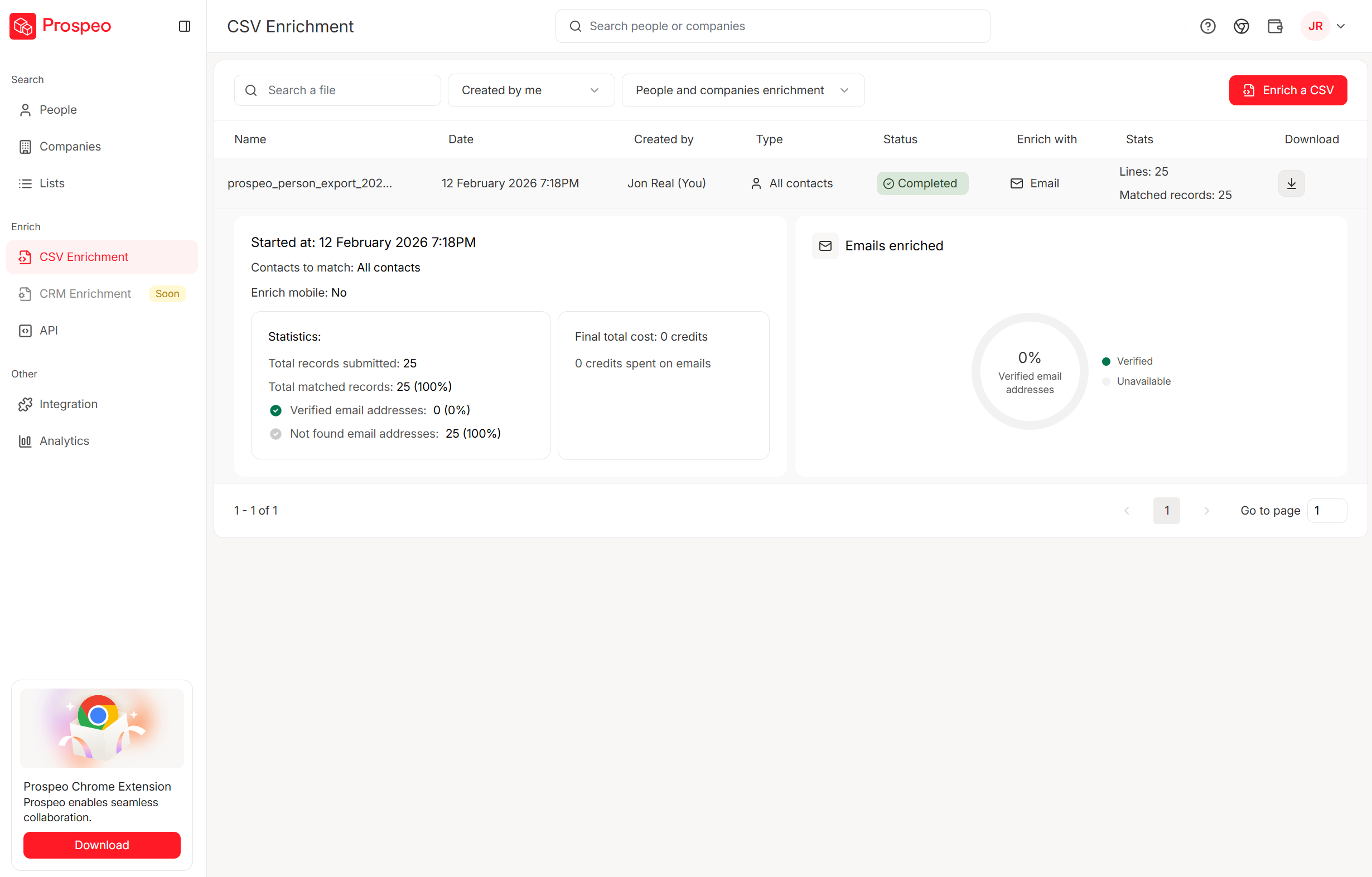
Practically, the workflow's simple: verify and enrich before you dial. Use real-time verification on the Email Finder (https://prospeo.io/email-finder) and enrichment (https://prospeo.io/b2b-data-enrichment) to turn a messy export into a dial-ready list, then only call records that come back Verified.
One team using Prospeo cut their bounce rate from 35% to under 4% and tripled pipeline. When your SDRs have verified direct dials with a 30% pickup rate, every opener in this framework actually reaches a human.
Give your reps real phone numbers and watch connect rates climb.
FAQ
How long should an SDR pitch be on a cold call?
An SDR pitch should be 60-90 seconds total, with a 12-second micro-pitch inside it, because the goal's to earn a follow-up, not deliver a demo. Aim for 5-10 seconds to open, 10-12 seconds for the problem proposition, then 30-60 seconds of discovery and a clean meeting ask.
What's a good SDR cold call connect rate and meeting rate?
A good cold call connect rate is 3-10%, and average call-to-meeting conversion is around 2.3%, while top SDRs can hit 10-15%. If you're consistently below 3% connect, fix list quality and direct dials before you rewrite your script.
Should I use a permission-based opener or a pattern interrupt?
Use a permission-based opener when you can give a clear reason for calling and time-box it to 30 seconds, because it keeps control without sounding gimmicky. Use a pattern interrupt only if you can pivot immediately into a problem-first micro-pitch and ask a real discovery question within 15 seconds.
What tool helps verify emails and mobile numbers before outreach (so my pitch gets a fair shot)?
Prospeo verifies emails in real time at 98% accuracy, includes 125M+ verified mobile numbers, and refreshes records every 7 days, which directly improves reach and makes results easier to diagnose. Start by enriching a CSV (83% match rate) and only dialing contacts that return Verified status.