

The Best SDR Tools in 2026 (by Category, With Real Pricing)
Most guides to SDR tools recommend 12-15 options. That's the problem, not the solution. The average SDR already juggles 10-15 tools daily, spends 10% of their day switching between them, and 83.4% of SDRs fail to consistently hit quota. Adding more software doesn't fix a broken stack - picking the right 3-5 tools does.
The SDR Productivity Problem
The average SDR logs 94.4 activities per day and books roughly 15 meetings a month. Sounds productive until you realize reps spend only 28-39% of their time on revenue-generating work. Admin, CRM hygiene, and tool-switching eat the rest. The typical rep manages just 3.6-4.4 quality conversations per day.
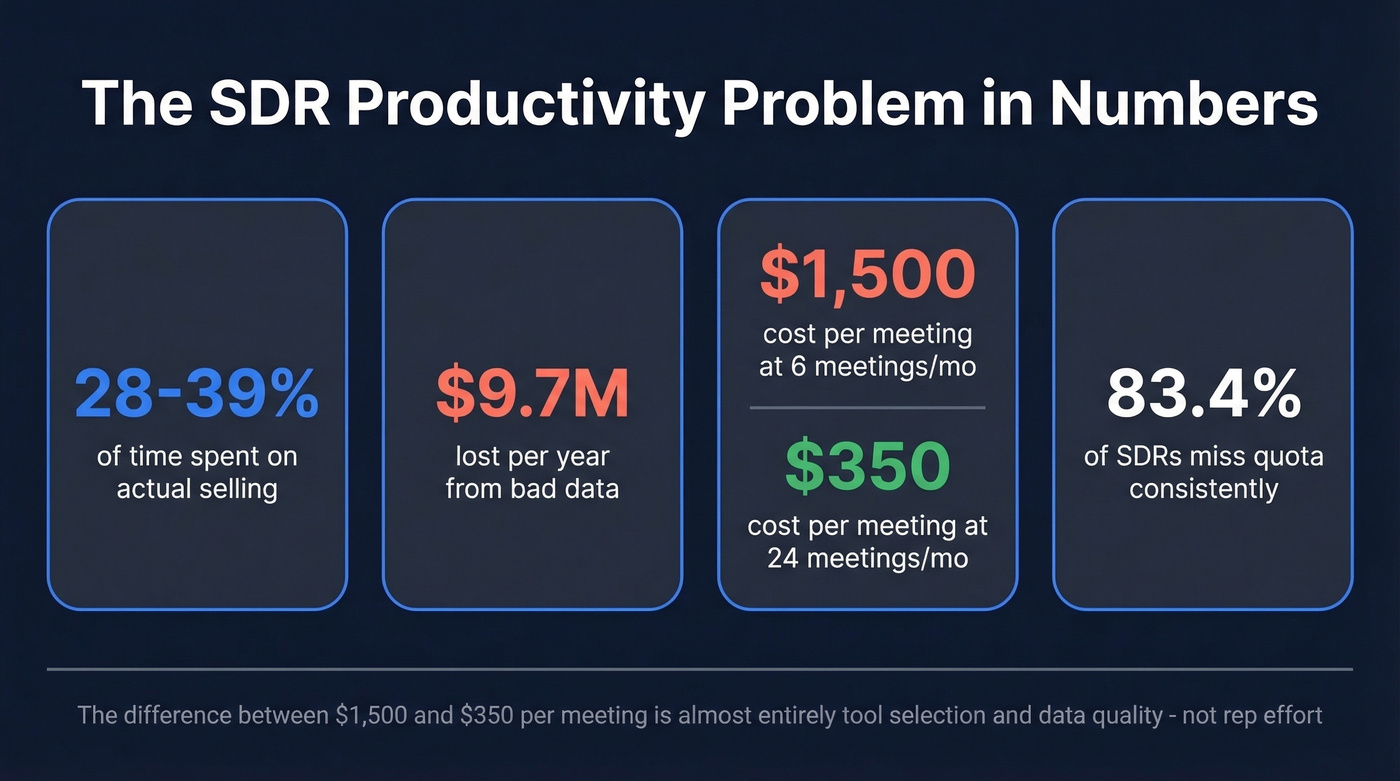
The stack itself costs $2,000-$5,000 per SDR per month when you add up CRM seats, data subscriptions, engagement platforms, dialers, and the random point solutions someone bought last quarter. Bad data alone costs organizations $9.7M per year in wasted effort - sellers waste 27% of their time dealing with inaccurate CRM info, calling wrong numbers, emailing dead addresses, researching contacts who left six months ago.
Here's the number that should drive every stack decision: at 6 meetings per month, your cost per meeting runs $1,500-$1,800. Scale to 24 meetings and it drops to $350-$450. The difference between those two numbers is almost entirely tool selection and data quality - not rep effort.
Our Picks (TL;DR)
| Category | Top Pick | Starting Price |
|---|---|---|
| B2B Data | Prospeo | Free / ~$0.01/email |
| Cold Email | Instantly | $30/mo (annual) |
| Engagement | Outreach | ~$100-$150/user/mo |
| Enrichment | Clay | $149/mo |
| Dialer | Orum | $250-$350/user/mo |
| CRM | HubSpot | Free |
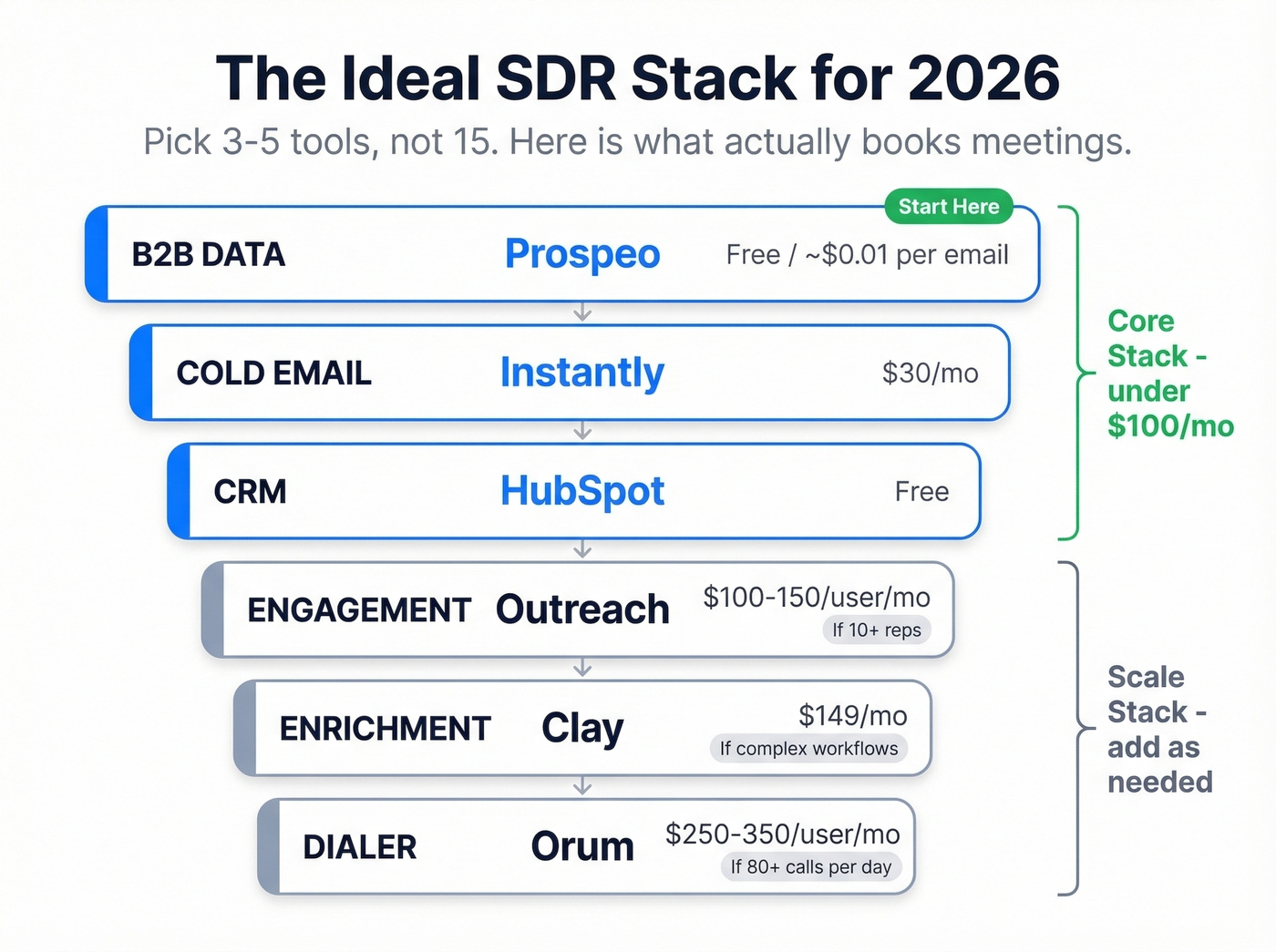
If you only trial three tools: Prospeo for data, Instantly for cold email, and whatever CRM you already have. That stack books meetings on day one.
B2B Data & Prospecting
Data is the foundation of everything an SDR does. Bad data means bounced emails, wrong numbers, wasted sequences, and a domain reputation that takes months to rebuild. If you're building a repeatable outbound motion, start with proven sales prospecting techniques before you add more tools.
Prospeo
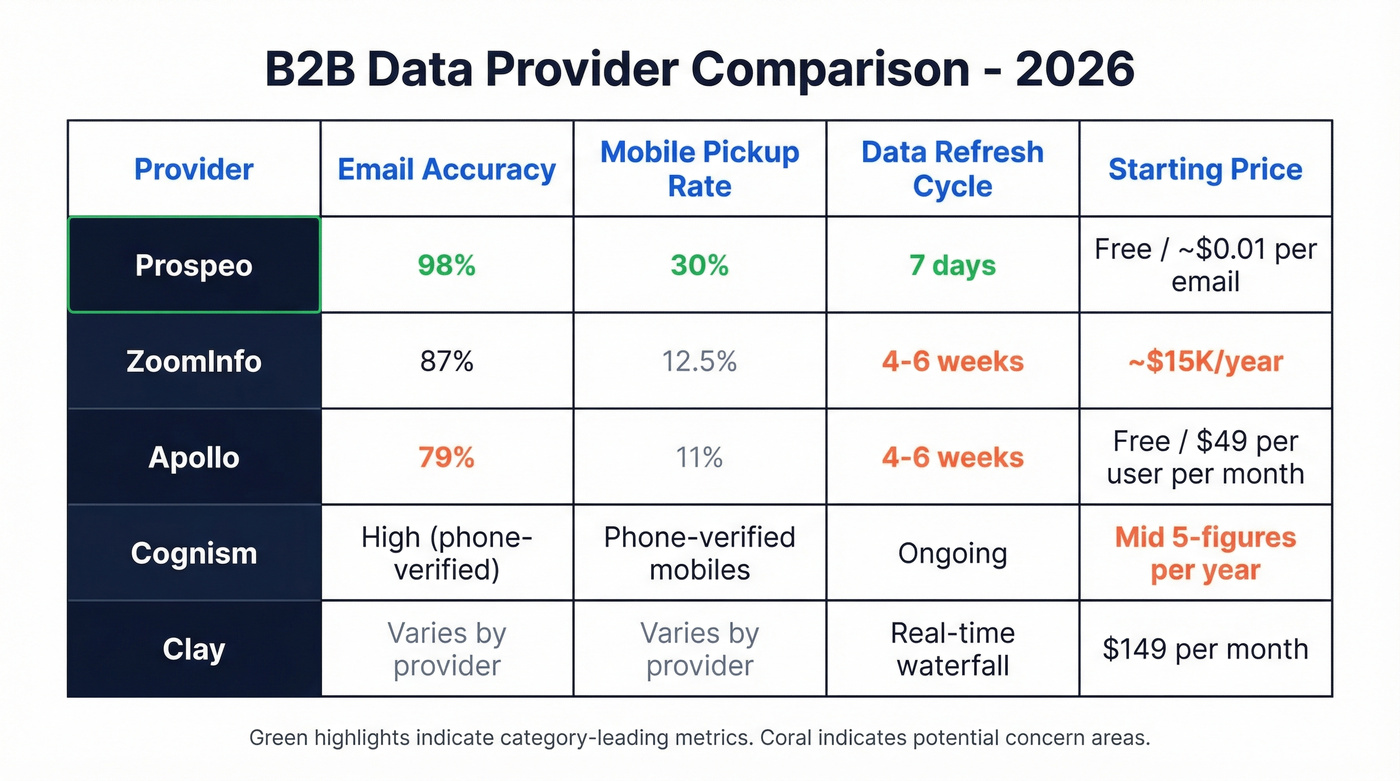
Prospeo covers 300M+ professional profiles, 143M+ verified emails, and 125M+ verified mobile numbers - all refreshed on a 7-day cycle. The industry average is 6 weeks, which means most providers are feeding you contacts who've already changed jobs.

We've tested this extensively: 98% email accuracy through a proprietary 5-step verification process that handles catch-all domains, removes spam traps, and filters honeypots. Mobile numbers hit a 30% pickup rate across all regions. Teams routinely go from 35-40% bounce rates to under 4% after switching - that's the difference between a healthy domain and one that lands in spam. (If you're troubleshooting bounces, see our email bounce rate benchmarks and fixes.)
Search filters go 30+ deep: buyer intent powered by Bombora across 15,000 topics, technographics, job changes, headcount growth, funding signals, and department-level headcount. GDPR compliant with DPAs available. Pricing runs ~$0.01 per email with a free tier of 75 emails and 100 Chrome extension credits monthly. No contracts, no sales calls, self-serve from minute one.
Apollo
Apollo is the default starting point for budget-conscious teams. The free tier gets you 50 credits and basic contact access. Paid plans run $49/user/mo (Basic) to $119/user/mo (Organization, minimum 3 seats), with a 275M+ contact database and a G2 rating of 4.7/5 across 9,250 reviews.
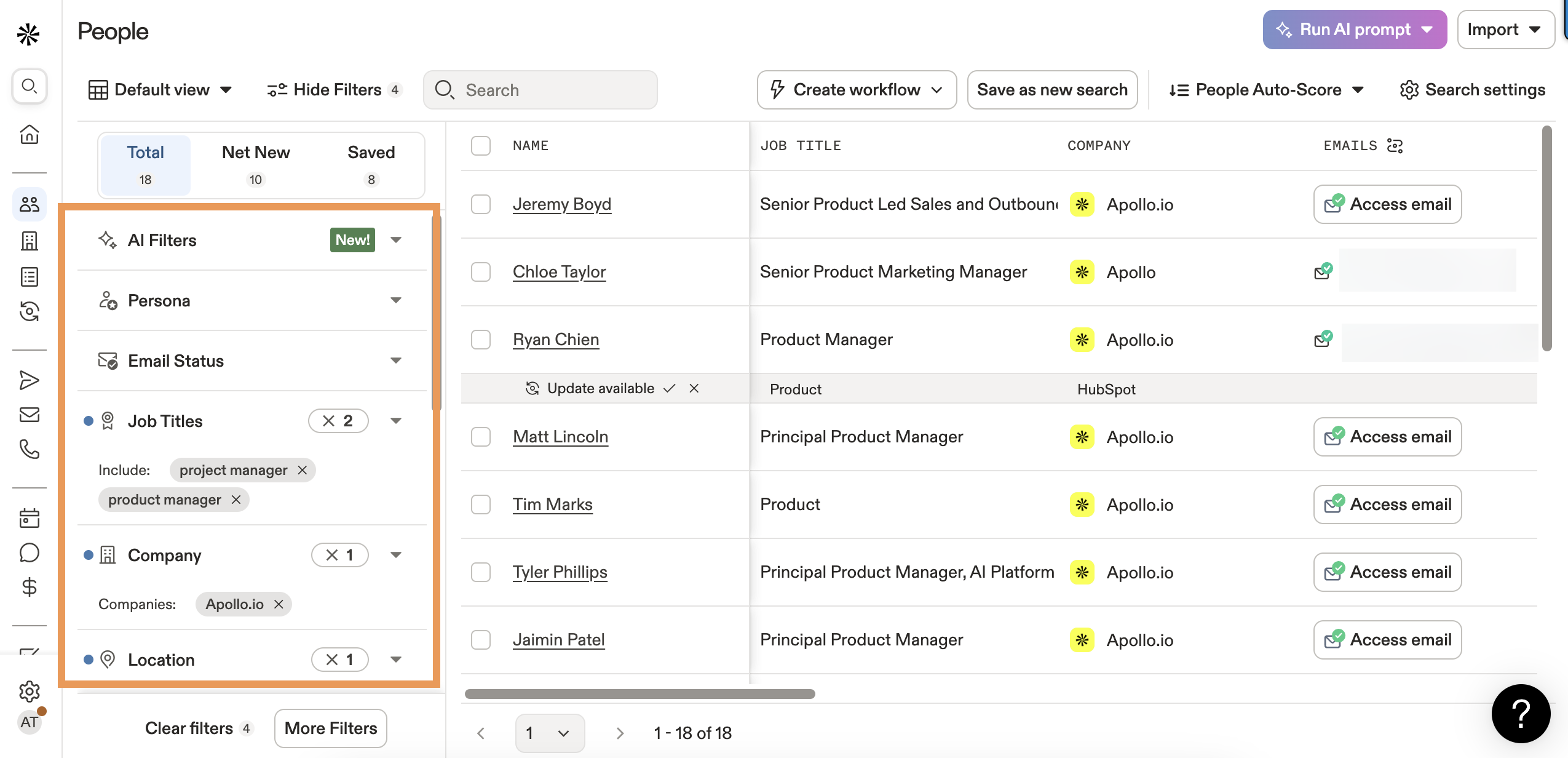
The catch is accuracy at scale. Apollo's email accuracy runs around 79% - workable for small campaigns, but at volume that means one in five emails is wrong. Credits don't roll over between billing cycles, which creates a "use it or lose it" dynamic that pushes reps to export contacts they don't need. Apollo wins over ZoomInfo on self-serve pricing and a genuinely useful free tier. It falls short on data quality, especially for mobile numbers and EMEA contacts.
ZoomInfo
ZoomInfo's database covers 260M+ profiles with a G2 rating of 4.5/5 across 8,875 reviews. Email accuracy sits around 87%. The real issue is cost - a typical team contract runs $20K-$50K/year, with entry packages starting at ~$15K/year. Annual contracts are mandatory, and pricing isn't public.
The consensus on Reddit is blunt: "crazy expensive." ZoomInfo is worth it if you're running 50+ reps and will actually use the intent modules, chat features, and workflow tools bundled in. For teams under 50 reps, you're paying for capabilities that sit idle.
Let's be honest: ZoomInfo is still the most complete all-in-one GTM platform. But most teams don't need all-in-one - they need accurate data and a sequencer that works. If your average deal size is under $15K, you almost certainly don't need ZoomInfo-level spend.
Clay
Clay isn't a database - it's an orchestration layer that runs waterfall enrichment across dozens of data providers. G2 rating: 4.8/5 with 174 reviews. Pricing starts at $149/mo (Starter) and scales to ~$800/mo (Pro) on a workspace-plus-credits model. If you're comparing vendors, our breakdown of data enrichment services can help.
Clay is the Reddit darling for lead gen workflows, and the enthusiasm is earned. If you want to build "if this, then enrich with that" logic across multiple providers, nothing else comes close. The tradeoff: it requires setup time and a real learning curve. Not a tool you hand to a new SDR on day one.
Cognism
Cognism focuses on GDPR/CCPA compliance with phone-verified mobiles and DNC list cleaning across multiple countries. Annual contracts land in the mid-five-figure range. G2: 4.5/5 with 1,200 reviews. If your team sells heavily into EMEA and compliance is non-negotiable, Cognism is the safest bet.
Data Accuracy Comparison
| Provider | Email Accuracy | Mobile Pickup | Data Refresh | Starting Price |
|---|---|---|---|---|
| ZoomInfo | 87% | 12.5% | 4-6 weeks | ~$15K/year |
| Apollo | 79% | 11% | 4-6 weeks | Free / $49/user/mo |
Sales Engagement Platforms
Outreach
Outreach is the engagement platform most experienced SDR teams land on. Pricing starts around $100/user/mo and often lands ~$100-$150/user/mo on annual contracts. The product earns its reputation: multichannel sequence building across email, phone, and social with branching logic based on prospect behavior. If you're standardizing your process, a solid sequence management system matters more than adding channels.
Reddit practitioners consistently call Outreach's customizability a "clear advantage" over alternatives. Where ZoomInfo tries to be the whole GTM platform, Outreach focuses on being the best sequencing engine. It also works equally well for SDR and AE workflows - reps can hand off sequences to closers without switching systems.
SalesLoft
Use this if you want Outreach-level engagement with a simpler UI and a slightly lower price point at ~$75-$125/user/mo. Good for smaller teams that don't need Outreach's full customization depth. Skip this if you're running complex branching sequences or need deep reporting - Outreach still wins there.

Bad data costs SDR teams $9.7M/year. Prospeo's 7-day refresh cycle and 98% email accuracy cut bounce rates from 35% to under 4% - so your reps spend time selling, not cleaning lists.
Stop paying $1,500 per meeting when better data fixes the math.
Cold Email & Deliverability
Instantly
Instantly dominates cold email for one reason: unlimited email accounts and built-in warmup on every plan. Pricing is transparent - Outreach Growth runs $30/mo annually or $37/mo monthly, Hypergrowth at $77.60/mo annually or $97/mo monthly. To improve reply rates, pair your tooling with proven cold email subject line examples.
Smartlead
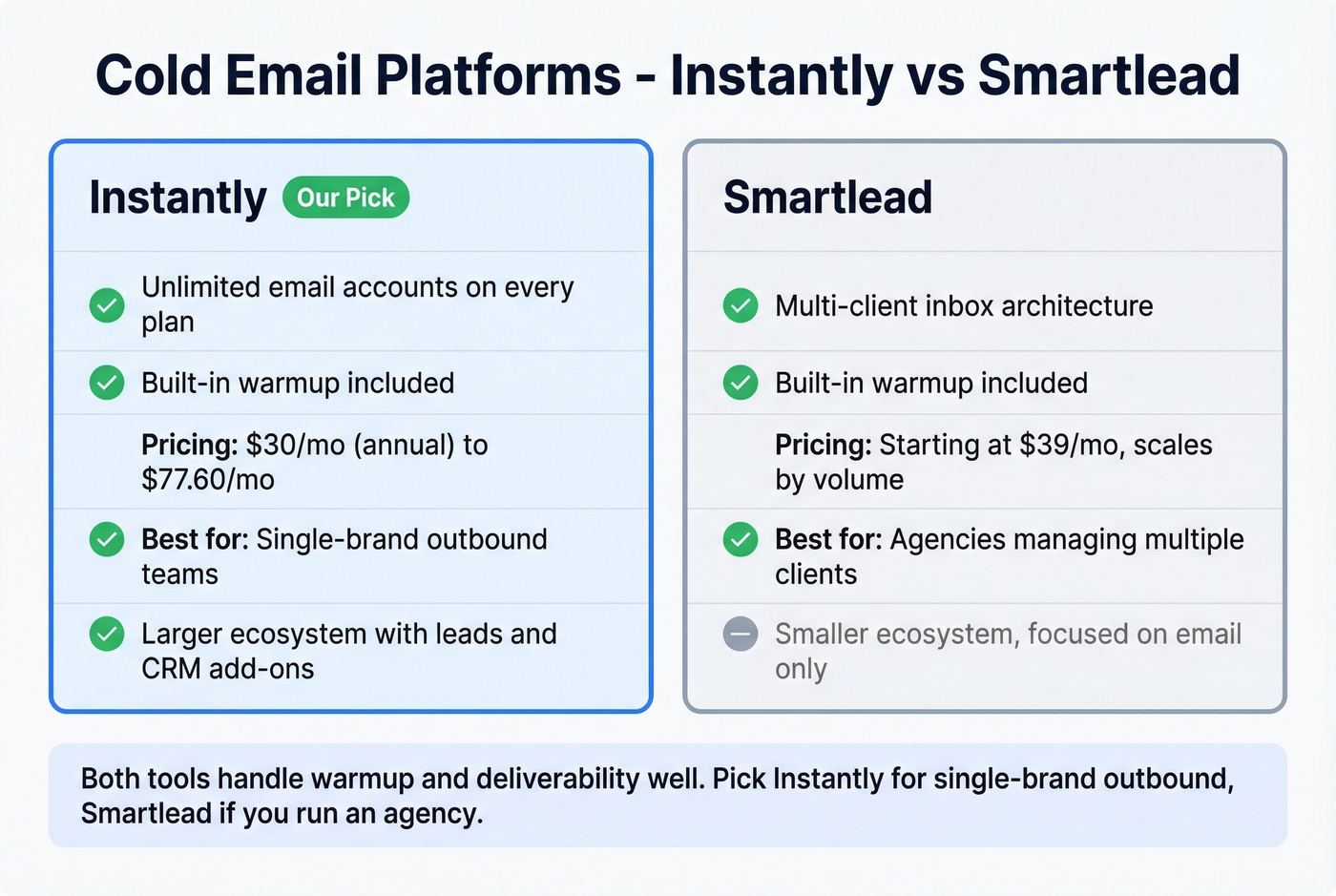
Smartlead starts around $39/mo and scales by volume. It's the go-to for agencies managing multiple client inboxes - the multi-client architecture is cleaner than Instantly's for that use case. For single-brand outbound teams, Instantly's ecosystem is more complete. If you're building a system end-to-end, use an AI cold email outreach playbook to avoid random experimentation.
CRM, Dialers & Scheduling
CRM: HubSpot & Salesforce
HubSpot's free CRM is the default starter - and it's good enough for teams under 20 reps. Paid tiers run $20/user/mo (Starter) to $100/user/mo (Professional). Salesforce starts at $25/user/mo and scales to $165/user/mo for Enterprise. If you're evaluating options, see more examples of a CRM with real pricing.
Don't switch CRMs for SDR tooling. If your team already uses Salesforce, stay on Salesforce. The migration cost and ramp time aren't worth it.
Dialers: Orum & Budget Options
Orum at $250-$350/user/mo and Nooks at $200+/user/mo are the parallel dialing leaders - calling 5-10 numbers simultaneously so reps only connect with live answers. The ROI math works if your team makes 80+ calls daily. For teams doing 20-30 calls, Aircall at $30-$50/user/mo or Dialpad at $15-$25/user/mo get the job done without the premium. If you're considering switching, compare Dialpad alternatives.
One Reddit practitioner's take stuck with us: they ripped out their AI dialer and were happier for it. Parallel dialing is proven; AI-powered call routing is still finding its footing.
Scheduling & Browser Extensions
Calendly handles basic meeting scheduling from free to $10/user/mo. Chili Piper starting at $30/user/mo adds inbound lead routing - if you're getting demo requests from your website, Chili Piper's instant routing to the right rep is worth the premium. Browser-based extensions like Prospeo's Chrome extension (40K+ users) also live in this category, letting reps find verified emails and phones without leaving their workflow. If you're on a budget, start with free lead generation tools before you add paid point solutions.
Conversation Intelligence: Gong
Gong typically runs $100-$200/user/mo and records and analyzes sales calls, surfacing coaching insights and deal risk signals. Essential for teams with 10+ reps where manager-to-rep ratios make live coaching impossible.
SDR Automation - Replace or Augment?
The AI SDR market is projected to grow from $4.27B to $18.19B by 2032 at a 23% CAGR. But here's what the headlines don't tell you: 50-70% of companies churn off AI SDR tools within a year.
A UserGems survey of 100+ revenue leaders found that 97% plan to increase AI spend - but only 7% report measurable ROI. The top barrier? 62% cite data accuracy as their biggest challenge. Autonomous sales agents are only as good as the data feeding them.
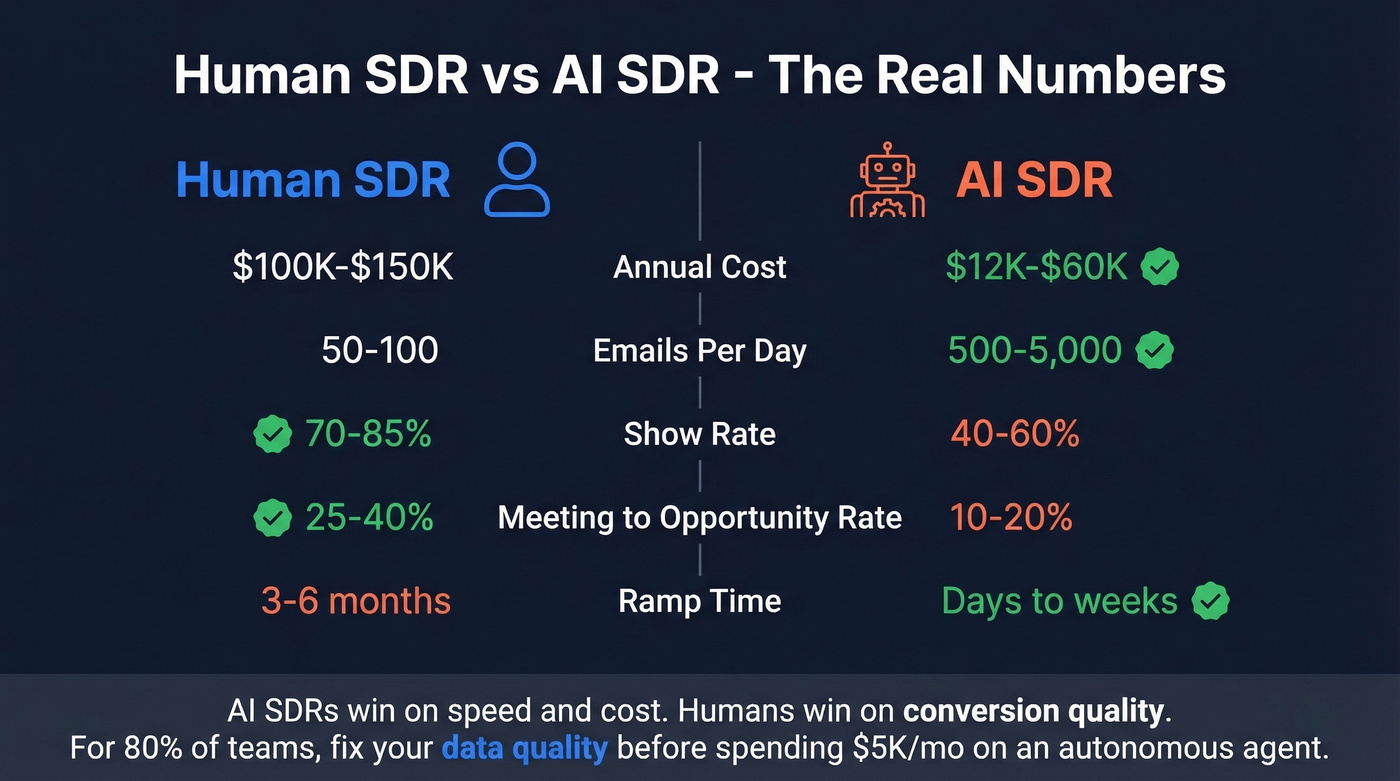
| Metric | Human SDR | AI SDR |
|---|---|---|
| Annual cost | $100K-$150K | $12K-$60K |
| Emails/day | 50-100 | 500-5,000 |
| Show rate | 70-85% | 40-60% |
| Meeting-to-opp rate | 25-40% | 10-20% |
| Ramp time | 3-6 months | Days to weeks |
AI SDRs are cheaper and faster at volume. Human-booked meetings convert at nearly double the rate. For 80% of teams, the right move is fixing data quality before spending $5K/month on an autonomous agent.

I watched a team deploy 11x at $5,000-$10,000/mo, get excited about the email volume, then churn after seven months because meeting quality was terrible. That pattern repeats across the category. AiSDR starts at $900/mo or $2,500/mo for Grow, billed quarterly. Artisan's Ava runs ~$2,400/mo on annual contracts. Reply.io's Jason AI starts at $500/mo. Salesforge's Agent Frank comes in at $499/mo plus an optional $200/mo email infrastructure add-on.
Most of these will churn you within a year. Fix your data accuracy first - AI amplifies whatever you feed it, good or bad.
What Does SDR Software Cost?
| Category | Monthly Range (per user) |
|---|---|
| CRM | $0-$165 |
| B2B Data | $0-$500+ |
| Engagement | $25-$150 |
| Cold Email | $30-$100 |
| Dialer | $15-$350 |
| Scheduling | $0-$30 |
| Conversation Intel | $100-$200 |
Three sample stacks to anchor your budgeting:
Bootstrap (~$77/mo): Prospeo free tier + Instantly Growth at $30/mo + HubSpot free + Calendly free. This stack books meetings from day one for under $100/month. Perfect for founders and solo SDRs who need to prove outbound works before investing further.
Growth ($500-$800/user/mo): Paid data provider + Instantly Hypergrowth + Outreach + Aircall. Verified data, high-volume sending with warmup, multichannel sequences, and a phone system. The sweet spot for Series A/B teams scaling from 3 to 15 reps.
Enterprise ($2,000-$3,000+/user/mo): Full data platform + Outreach + Orum + Gong + Salesforce Enterprise. Parallel dialing, conversation intelligence, and enterprise CRM. The winning move at this tier isn't adding tools - it's consolidating to 3-5 that actually integrate and feed each other clean data.
Mistakes That Kill SDR Productivity
Sending from unverified lists. Your SDR sends 500 emails and 180 bounce. That's a 36% bounce rate. Your domain reputation tanks, and now even the good emails land in spam. Verify before you send - always. (If you need the full system, follow an email deliverability guide.)
Overpaying for stale data. Finance just asked why you're paying $40K/year for ZoomInfo when only 4 people use it. If your data refreshes every 6 weeks, you're emailing ghosts by week three.
Tool sprawl without integration. Ten tools that don't talk to each other means 10% of every SDR's day lost to context-switching. If your enrichment tool doesn't push to your sequencer, you've built a manual workflow with expensive software.
Buying AI agents before fixing data quality. 62% of revenue leaders cite data accuracy as their top AI implementation barrier. An autonomous agent sending 5,000 emails a day from a 79%-accurate database will destroy your domain faster than a human ever could.
Ignoring credit burn. Apollo and ZoomInfo credits expire monthly. If your team exports contacts they don't need just to avoid waste, you're polluting your CRM with unqualified records. Credits that expire create perverse incentives.
The article says pick 3-5 tools, not 15. Start with data that actually works: 300M+ profiles, 125M+ verified mobiles with 30% pickup rates, and 30+ filters including buyer intent - all at ~$0.01/email.
Replace your most expensive SDR tool with your most accurate one.
FAQ
What SDR tools does a rep actually need?
At minimum, a CRM, a B2B data provider, and a cold email or engagement platform - three tools, not fifteen. Most productive teams use 3-5 tightly integrated tools. Start with data quality and build outward from there.
How much does an SDR tech stack cost?
A complete stack runs $200-$3,000+ per user per month depending on tool choices. A bootstrap setup using free tiers for data and CRM plus Instantly at $30/mo costs under $100/month and covers prospecting, sending, and pipeline management.
Are AI SDR tools worth it in 2026?
For most teams, not yet - 50-70% of companies churn off AI SDR tools within a year, and only 7% report measurable ROI. Fix your data quality and outbound fundamentals first. AI amplifies whatever you feed it, so bad data at 5,000 emails/day destroys domains fast.
What's the best free tool for SDRs?
HubSpot CRM for pipeline management (completely free), Apollo's free tier with 50 credits for basic prospecting, and Prospeo with 75 free verified emails per month for accurate contact data. That combination covers the essentials at zero cost and can book meetings from day one.
How do I reduce my email bounce rate?
Use a data provider with built-in verification that catches invalid addresses, spam traps, and catch-all domains before you send. Teams consistently drop from 35-40% bounce rates to under 4% after switching to verified data. Target under 4% as your benchmark.