

Best Search Intelligence Tools in 2026 (With Pricing)
"Search intelligence" returns a wall of OSINT and cybersecurity results. That's not what we're covering here. If you need threat intelligence frameworks, different article entirely.
For marketing and sales teams, search intelligence tools do something else: they track SEO visibility, monitor competitors, show how AI search is reshaping your traffic, and help you figure out who to contact once you've spotted an opportunity. The competitive intelligence market is projected to hit $1.46B by 2030, and the tooling has fragmented fast. We've spent the last few months testing and comparing what's out there, and here's what's actually worth your budget.
Top Picks at a Glance
Nine tools across four categories. Quick version:
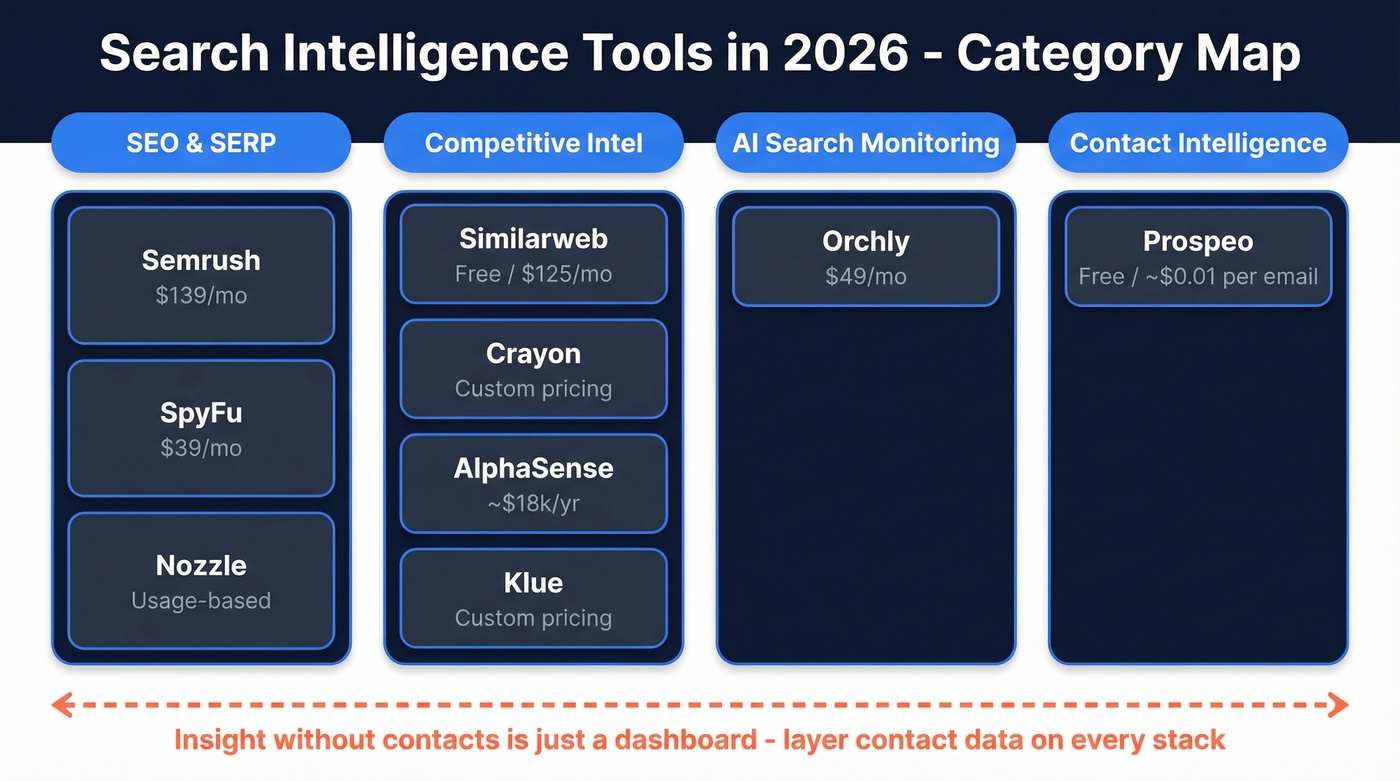
| Tool | Category | Starting Price | Best For |
|---|---|---|---|
| Semrush | SEO & SERP | $139/mo | Overall SEO intelligence |
| SpyFu | SEO & SERP | $39/mo | Competitor keywords on a budget |
| Prospeo | Contact Intel | Free / ~$0.01/email | Verified emails & direct dials |
| Nozzle | SEO & SERP | Usage-based | Deep SERP monitoring |
| Similarweb | Competitive Intel | Free / $125/mo | Traffic + AI traffic tracking |
| Crayon | Competitive Intel | Custom | Enterprise battlecards |
| AlphaSense | Market Intel | ~$18k/yr | Financial & market research |
| Klue | Competitive Intel | Custom | Battlecard-focused CI |
| Orchly | AI Search Monitoring | $49/mo | AI Overviews tracking |
SEO & SERP Intelligence
Semrush
Use this if you need one platform to cover keyword tracking, competitive gap analysis, backlink audits, and content optimization. Semrush scores 8.6/10 across 772 reviews on TrustRadius - the kind of volume that makes the rating meaningful. The newer AI brand visibility features track share of voice in AI conversations and competitive benchmarking across LLMs, which matters as generative search eats into organic traffic.
Skip this if you only need competitor keyword spying. Semrush starts at $139/mo, and plans commonly run $199/mo+ once you need more advanced features. You're paying for content marketing, social, and PPC modules even if you only care about organic search visibility.
If you're building a broader competitive program (not just SEO), pair this with a lightweight competitive intelligence strategy so the insights actually get used.
SpyFu
At $39/mo, SpyFu is the best budget play for competitive keyword intelligence. You get full competitor keyword and PPC history - which keywords they bid on, what ad copy they've tested, how their organic rankings shifted over time. TrustRadius gives it a 7/10 across 131 reviews.
It does one thing well: competitive analysis on keywords. No content tools, no technical SEO audits, no AI visibility tracking. SpyFu also supports basic competitor page view estimation, giving you a rough sense of which pages drive the most visits. If that's all you need, save the $100/mo over Semrush.
Once you’ve found the right accounts, you’ll still need repeatable outreach - keep a set of sales follow-up templates ready so the intel turns into replies.
Nozzle
SERP monitoring specialist with a perfect 10/10 on TrustRadius - though that's across just 17 reviews, so take it with a grain of salt. Pricing is usage-based, making it a fit when you need granular SERP feature tracking at scale without paying for modules you won't touch.
Competitive Intelligence Platforms
Similarweb
The standout feature here is AI Traffic tracking. Similarweb shows visits from ChatGPT, Perplexity, and Gemini, identifying which landing pages receive AI referrals and which prompts generate them. Free tier available; paid plans start at $125/mo.
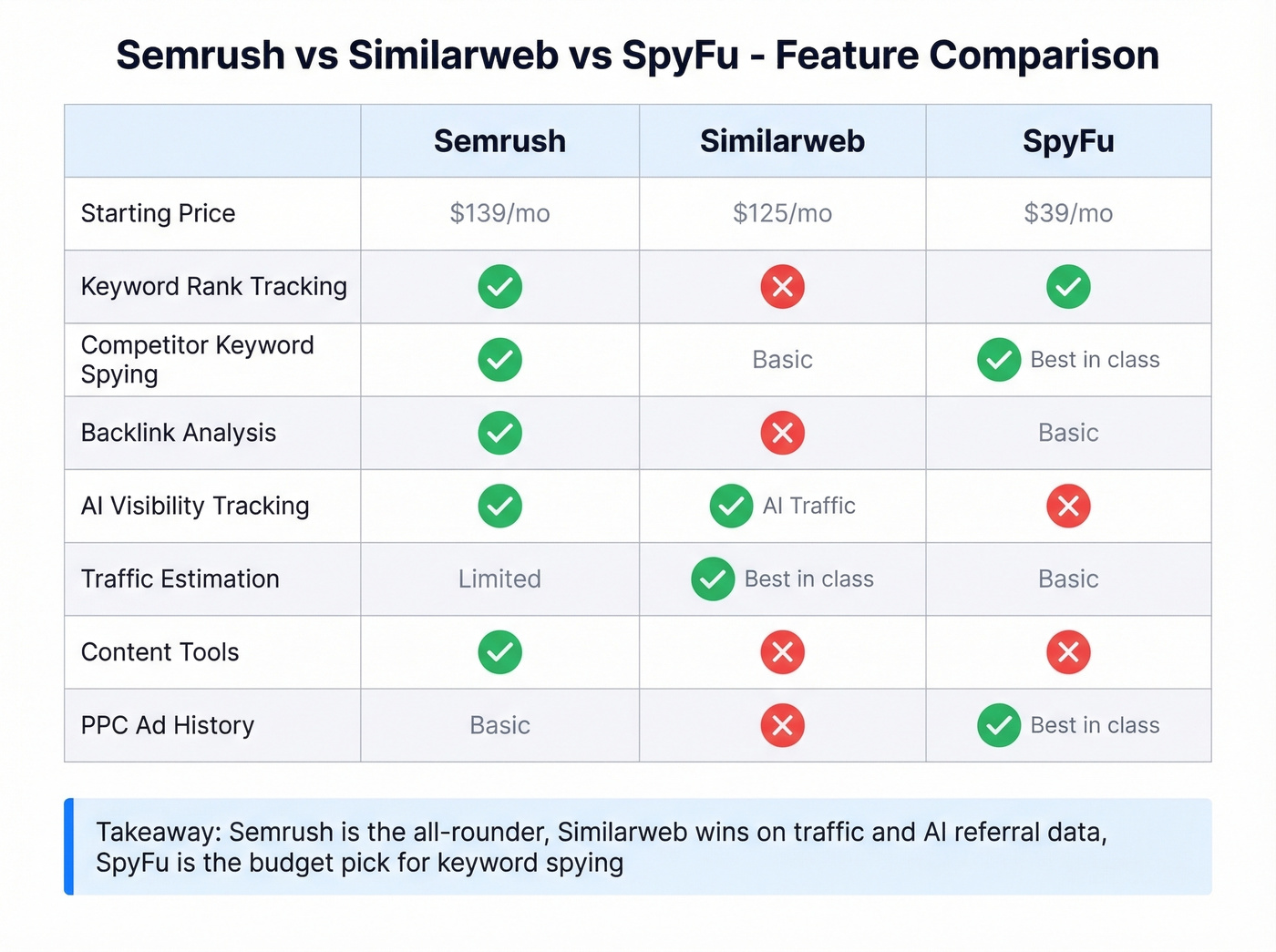
Where it falls short: deep keyword-level SEO analysis. Similarweb excels at traffic estimation and competitive benchmarking, not granular rank tracking. Among the platforms listed here, Semrush is the closest alternative on AI visibility, though Similarweb's traffic-level view gives you a different angle - how much actual traffic AI search sends, not just whether you rank.
Crayon
Enterprise CI platform focused on automated competitor monitoring - website changes, pricing shifts, messaging updates. 68% of sales opportunities are competitive, and 71% of battlecard users report improved win rates. Crayon is built for product marketing orgs that live in battlecards and need a competitive intelligence Slack integration pushing real-time alerts where reps already work. Custom pricing. Overkill for small teams.
If you’re operationalizing this for sales, build a simple process around sales battle cards so reps can actually use the updates.
AlphaSense
Powerful market intelligence for financial research and competitive analysis. Pricing spans from a median ~$18k/year up to six figures for enterprise deployments. Priced for hedge funds and corporate strategy teams, not marketing departments.
Klue
Battlecard-focused CI platform competing directly with Crayon. Custom pricing. If your product marketing team lives in battlecards, evaluate Klue alongside Crayon - the feature sets overlap significantly, and the right choice usually comes down to which UI your team prefers and which integrations match your stack.
If you’re tying CI to pipeline, it helps to align on lead generation metrics so you can prove impact.

Search intelligence shows you where the opportunities are. Prospeo shows you who to contact. Layer 15,000 buyer intent topics with technographics and job change signals to reach decision-makers at companies already in-market - with 98% email accuracy and a 7-day data refresh.
Turn every competitive signal into a conversation that books a meeting.
AI Search Monitoring
Orchly
This is the category most teams are ignoring, and it's a mistake. 55% of Google searches now show AI Overviews - nearly double from last year. If you aren't tracking whether your brand appears in those AI-generated answers, you've got a blind spot that's growing fast.
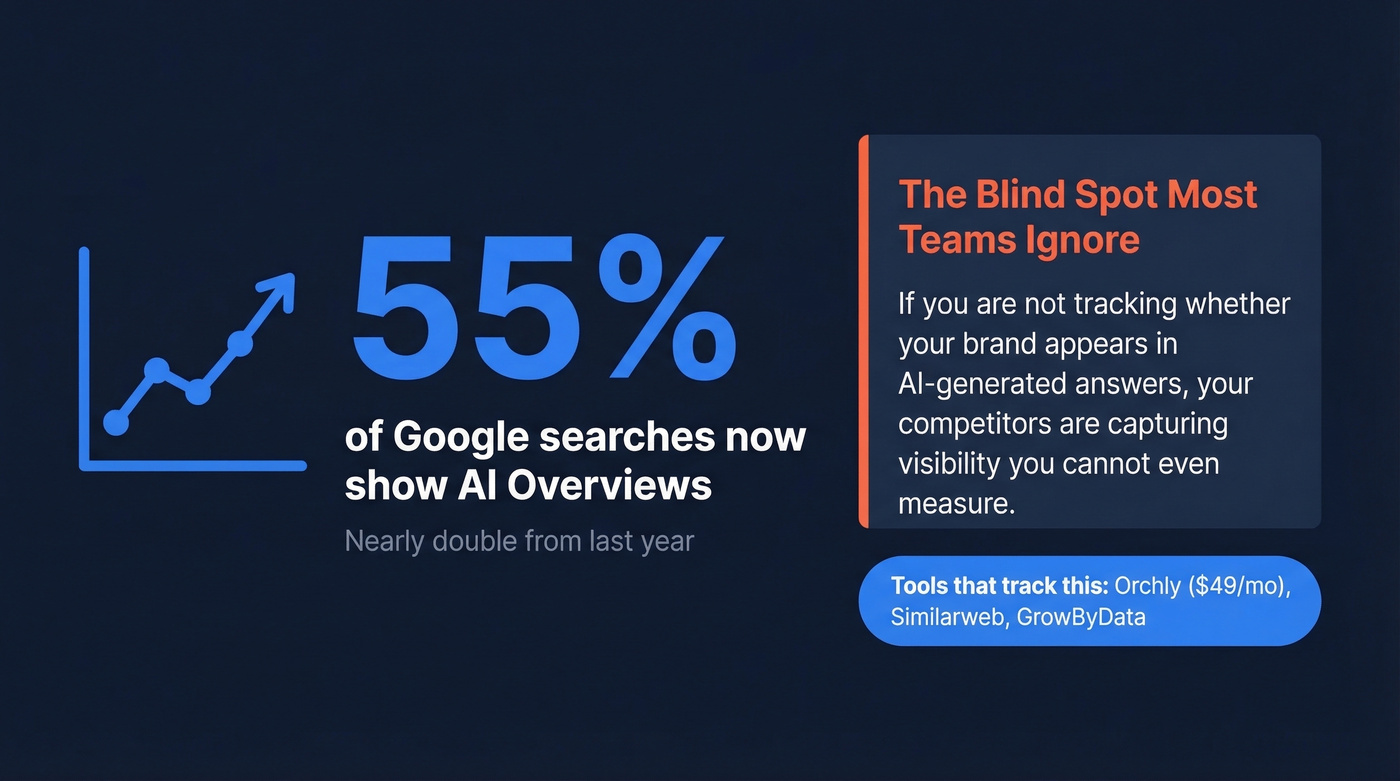
Orchly uses headless browser scraping of real AI Overviews, with historical tracking and an action center for prioritizing responses. $49/mo.
A few other tools worth knowing: GrowByData ($55k-$150k+/year) for enterprise-grade search marketing intelligence with AI Overviews tracking, Otterly for lightweight AI search monitoring, and SE Ranking ($65/mo) for broader SEO with AI features.
B2B Data & Contact Intelligence
Here's the thing most teams miss: every competitive insight, every keyword gap, every AI visibility report is useless until you can reach the decision-maker. We've seen teams build gorgeous dashboards full of competitive signals and then... email a generic info@ address. Don't be that team.
If you’re building a repeatable outbound motion, borrow a few proven sales prospecting techniques so your targeting and messaging stay consistent.
Prospeo
Prospeo covers 300M+ professional profiles with 143M+ verified emails and 125M+ verified mobile numbers. The accuracy numbers set it apart: 98% email accuracy on a 7-day data refresh cycle versus the 6-week industry average. Teams using Prospeo book 26% more meetings than ZoomInfo users and 35% more than Apollo users.

The search filters go deep - buyer intent powered by 15,000 Bombora topics, technographics, job changes, headcount growth, funding signals, and department-level headcount. You're finding contacts at companies showing buying signals you spotted through your SEO and competitive monitoring.
Pricing is self-serve and transparent. Free tier gives you 75 emails/month plus 100 Chrome extension credits/month. Paid plans run roughly $0.01 per email with no contracts. For context, ZoomInfo runs $15k-$40k+/year and Apollo starts at ~$49/mo per user.
If you’re comparing providers, start with a shortlist of data enrichment services to see what “good” looks like across accuracy and refresh.
How to Build Your Stack
Let's be honest: most teams don't need ten tools. They need three. The biggest mistake we see is paying for overlapping platforms that generate reports nobody reads.
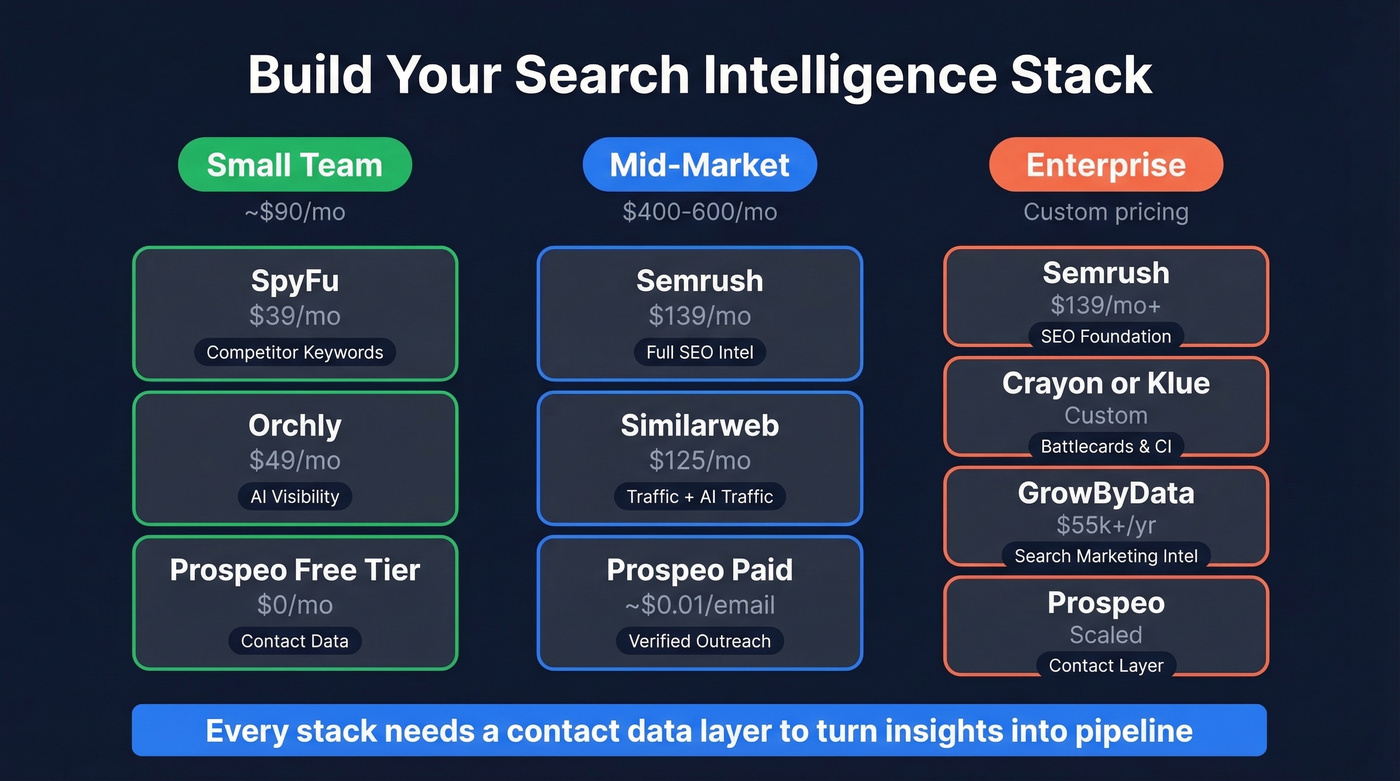
Small team (~$90/mo): SpyFu for competitive keywords, Orchly for AI visibility, and a free contact data tier. That covers the fundamentals without enterprise overhead.
Mid-market ($400-$600/mo): Semrush for full SEO intelligence, Similarweb for traffic and AI traffic analysis, and a paid contact data provider for verified outreach.
Enterprise: Semrush layered with Crayon for competitive battlecards and GrowByData for search marketing intelligence, plus a contact data platform for the outreach layer. Teams with OSINT-style competitive monitoring needs - tracking public web changes, social signals, and market shifts - sometimes add Klue or AlphaSense on top.
The common thread across every stack: insights without a contact data layer are just dashboards. The best search intelligence tools surface opportunities. You still need verified emails and direct dials to act on them.
To keep the stack from turning into shelfware, define a simple lead generation workflow that routes signals to outreach.
Every keyword gap and AI visibility insight dies at a generic info@ address. Prospeo gives you 300M+ profiles, 125M+ verified mobiles, and 30+ search filters so the intel from your SEO stack actually converts into pipeline. Teams book 35% more meetings than Apollo users.
Stop monitoring competitors. Start reaching their customers first.
FAQ
What's the difference between search intelligence and OSINT?
Search intelligence tracks SEO rankings, competitor strategies, AI visibility, and buyer signals for marketing and sales teams. OSINT is a cybersecurity discipline focused on publicly available data for threat analysis. Different audiences, different tools, almost zero overlap.
How much do these tools typically cost?
Budget options start at $39-$49/mo (SpyFu, Orchly). Mid-range platforms run $125-$199/mo (Semrush, Similarweb). Enterprise CI platforms range from ~$18k to $150k+/year (AlphaSense, GrowByData). Contact intelligence starts free with Prospeo's 75 emails/month tier, scaling to roughly $0.01 per verified email on paid plans.
Do I need a separate tool for contact data?
Yes. SEO and CI platforms tell you what competitors are doing, not who to reach. You need verified emails and direct dials for the decision-makers at companies your competitive monitoring identified. A free tier covers light outreach; teams running real campaigns typically pair a contact data provider with their SERP and CI tools for a complete workflow.