

How to Write a Second Follow Up Email That Actually Gets a Reply
It's Tuesday afternoon. You're staring at a blank compose window, cursor blinking, wondering if sending another email makes you persistent or pathetic. Three tabs over, a job candidate is searching "how do I write a second follow up email after an interview" for the fourth time this week. Both of you are overthinking the same problem.
Here's the reality: 42% of replies come from follow-ups, and 48% of reps never even send a second message. Meanwhile, 80% of non-routine sales happen only after at least five follow-ups. The gap between those numbers is where deals die and job offers go to the candidate who actually followed up.
The problem usually isn't your follow-up. It's your first email - or worse, you're following up on an address that doesn't even work.
What You Need (Quick Version)
Send the second follow up email. Wait 3-7 days depending on context. Add something new - never just "bump." Keep it 40-60 words for cold outreach, under six sentences for everything else. For cold outreach, refresh the subject line on follow-ups to earn attention again. And if you're doing cold outreach at scale, verify the email address before you follow up; 17% of cold emails never reach the inbox due to bounces and spam filtering. Templates for every scenario below.
When to Send Your Second Follow-Up
A missed meeting needs a next-day nudge. A job interview needs a week of patience. A cold prospect needs enough space to forget they ignored you.
| Scenario | Wait Time | Max Follow-Ups | Notes |
|---|---|---|---|
| Cold outbound | 5-7 days | 5-8 total | New value each time |
| Warm inbound | 3-5 days | 3-5 total | Don't let interest cool |
| Job interview | 5-7 biz days | 2 total | After 2, stop |
| Networking event | 3-5 days | 2-3 total | First touch within 24 hrs |
| Post-proposal | 4-6 days | 3-4 total | Add a new angle each time |
| Missed meeting | 1-2 days | 2 total | Assume scheduling, not rejection |
Cold outbound gets the widest window because you're building familiarity from zero - each touch needs to earn attention independently. Job interviews get the tightest cap because a third follow-up in a hiring context crosses from interested to desperate. Post-proposal follow-ups demand the most creativity: they're evaluating you against other vendors, so every touch needs a fresh reason to revisit your pitch.
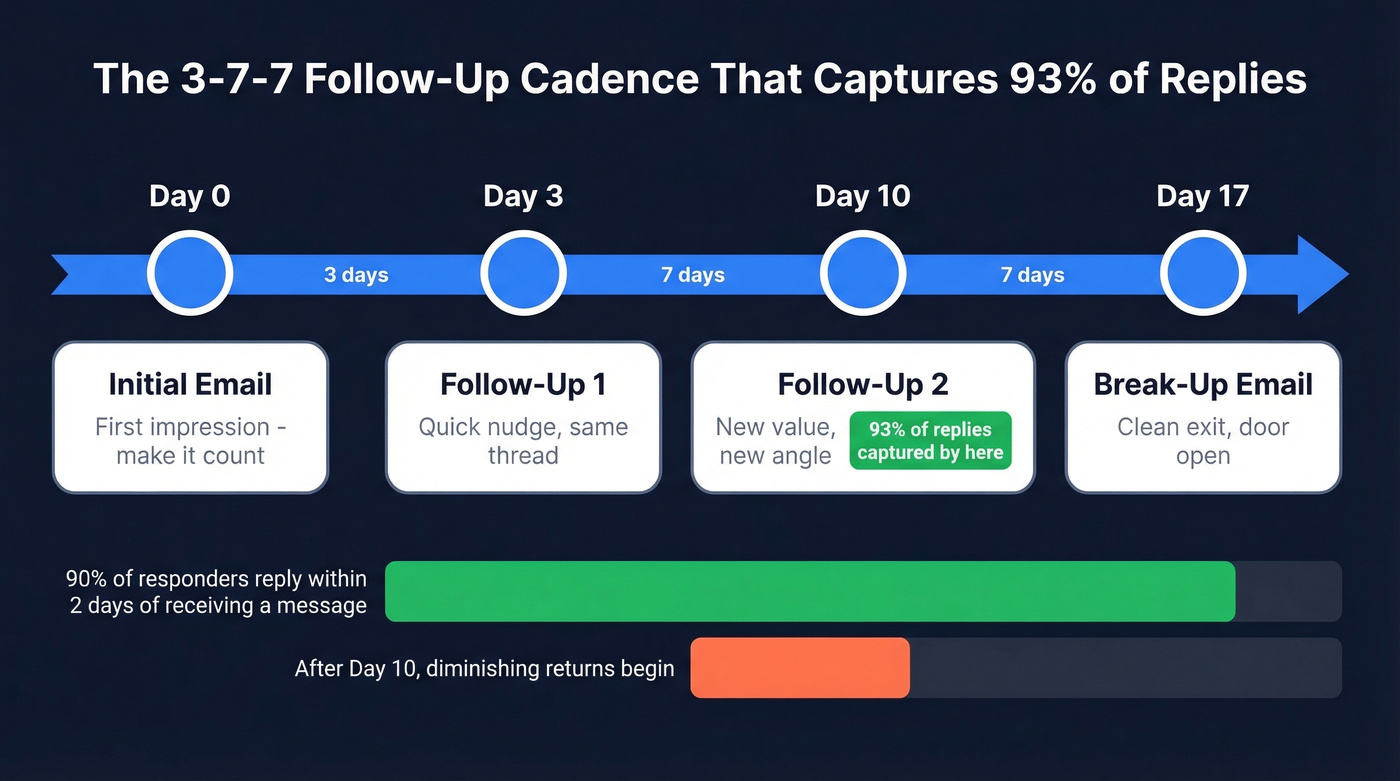
The cadence that ties it all together: the 3-7-7 framework. Send your initial email on Day 0, first follow-up on Day 3, second follow-up on Day 10, and a break-up on Day 17. This captures 93% of replies by Day 10. After that, you're chasing diminishing returns.
One stat worth internalizing: 90% of buyers who respond do so within two days of their most recent message. If five days pass with no reply, they didn't miss your email - they deprioritized it. Your second attempt needs to change the equation, not repeat it.
For warm conversations where someone's already engaged, compress the timeline. For enterprise prospects, stretch it - Belkins' 16.5M-email study found enterprises are allergic to persistence.
Templates That Get Replies
Every guide tells you to "add value" in your follow-up. None of them tell you what that actually means. Here are copy-paste templates for every scenario, with the reasoning baked in.
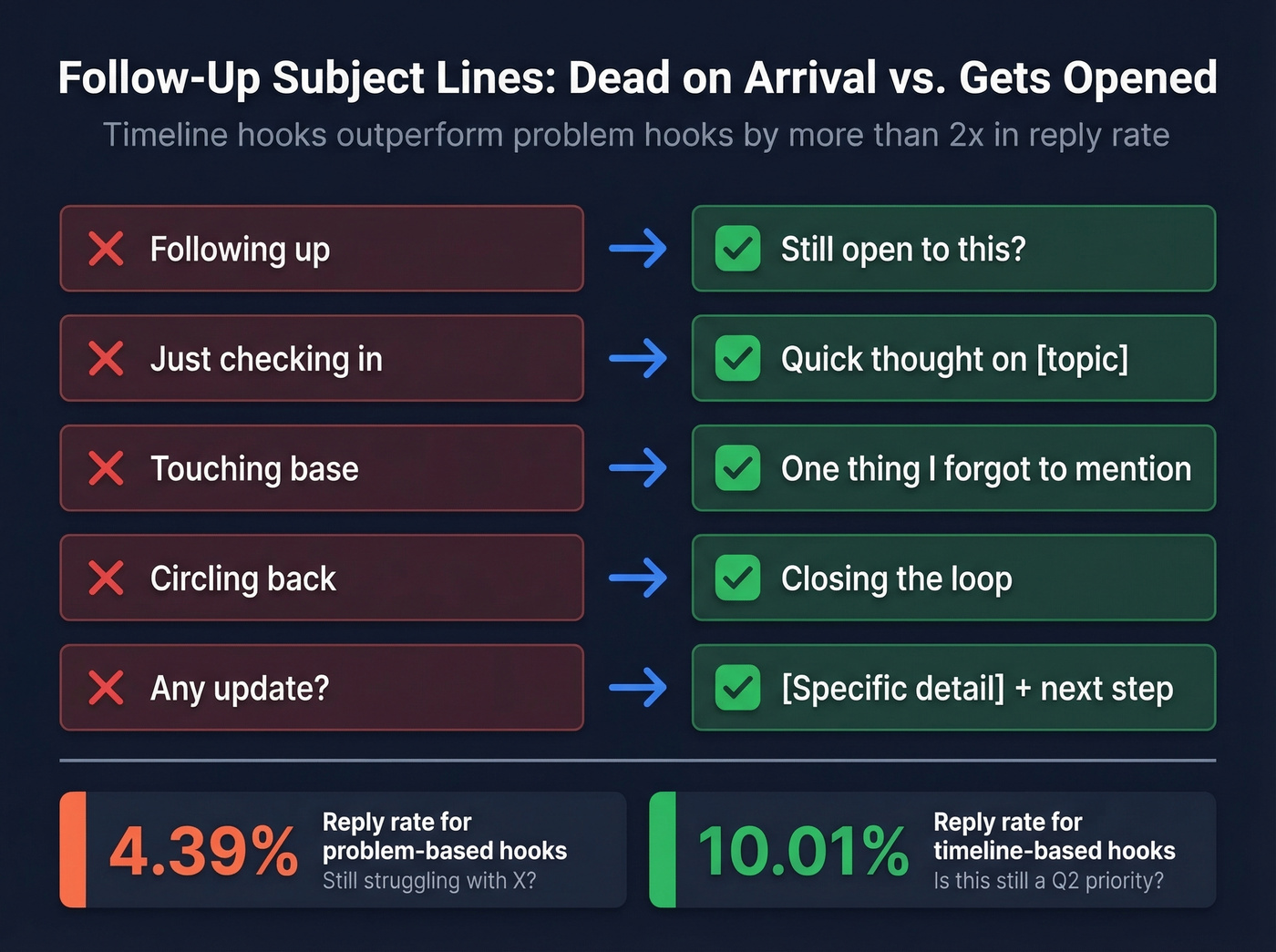
One principle applies to all of them: use timeline-based hooks over problem-based hooks. DigitalBloom's data shows timeline hooks ("Is this still a priority for Q2?") pull a 10.01% reply rate versus 4.39% for problem hooks ("Still struggling with X?"). People respond to urgency and relevance, not to being reminded of their pain.
After a Job Interview
This is the scenario people agonize over most. If you're wondering how to write a second follow up email after an interview, the key is adding value rather than just asking for a status update.
Subject: Quick thought on [specific topic from interview]
Hi [Name],
I've been thinking about the [specific challenge they mentioned] since our conversation. I came across [article/case study/project] that's directly relevant - thought it might be useful regardless of the hiring timeline.
Happy to share more context if helpful. Any update on next steps?
Best, [Your name]
Reference something specific from the conversation, then add a piece of value they didn't ask for. Two follow-ups is the ceiling for interviews. If you haven't heard back after two, stop and move on.
Cold Sales Outreach
Most reps get this wrong by writing too much. The consensus on r/copywriting is clear: 40-60 words max, a specific offer, and a soft CTA. Short wins.
If you want more options, start with these sales follow-up templates and adapt them to your offer.
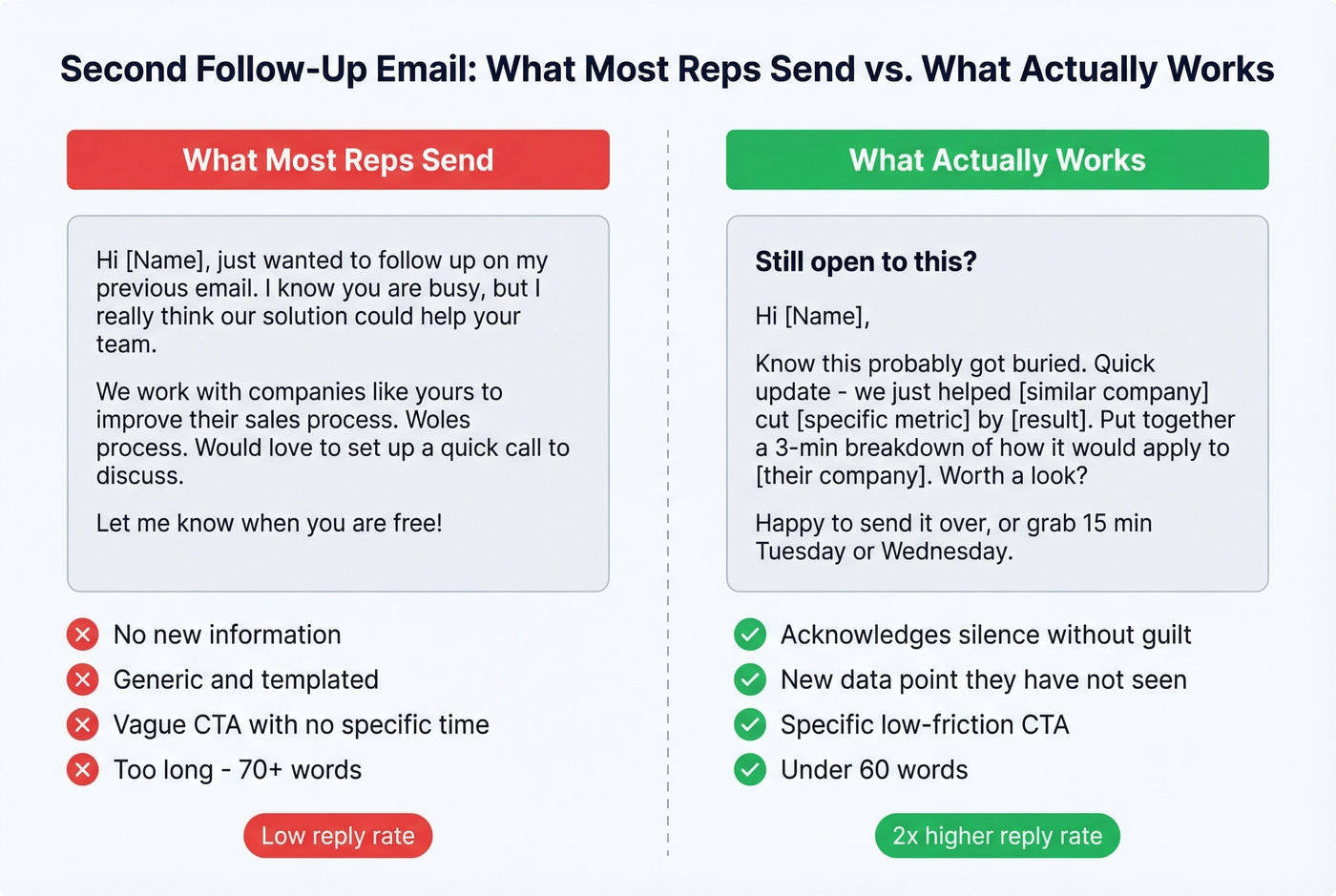
What most reps send:
Hi [Name], just wanted to follow up on my previous email. I know you're busy, but I really think our solution could help your team. We work with companies like yours to improve their sales process. Would love to set up a quick call to discuss. Let me know when you're free!
What actually works:
Subject: Still open to this?
Hi [Name],
Know this probably got buried. Quick update - we just helped [similar company] cut [specific metric] by [result]. Put together a 3-min breakdown of how it'd apply to [their company].
Worth a look? Happy to send it over, or grab 15 min Tuesday or Wednesday.
The second version works because it acknowledges the silence without guilt-tripping, introduces a new data point they haven't seen, and offers a low-friction next step. "Tuesday or Wednesday?" beats "Let me know when you're free" every time - we've seen this play out across hundreds of campaigns our team has reviewed. Customize the metric to match your prospect's industry.
After a Networking Event
Here's something most people miss: recruiting and business development teams move fast. One recruiting insider on Reddit shared that an event ended at 8PM, and by 10:30AM the next morning, the team had already emailed attorneys asking who stood out. If you wait three days, you're already forgotten.
The first follow-up should go out within 24 hours. The second attempt, if needed, comes 3-5 days later:
Subject: Great meeting you at [event] - [specific topic]
Hi [Name],
Really enjoyed our conversation about [specific detail]. I mentioned [resource/intro/idea] - here's the link: [URL]. Thought it might be useful for what you're working on with [their project].
Would love to continue the conversation over coffee or a quick call next week. What works?
After Sending a Proposal
They're evaluating. They're comparing you to other vendors. Your second follow up email needs to give them a reason to come back to your proposal specifically.
Subject: One thing I forgot to include
Hi [Name],
While you're evaluating, wanted to share a quick ROI comparison we ran for [similar company in their industry]. They saw [specific result] within [timeframe] - the math is on page 2 of the attached.
Happy to walk through the numbers if it'd help your decision by [their stated timeline].
Adding a new angle - an ROI calculator, a competitor comparison, a customer reference - gives them a reason to re-engage without feeling pressured. Notice the timeline hook in the last line: anchoring to their deadline creates urgency without you having to manufacture it.
The Break-Up Email
Break-up emails work because they remove pressure. When someone knows this is the last email, the psychological barrier to responding drops.
Subject: Closing the loop
Hi [Name],
I've reached out a few times and haven't heard back - totally understand if the timing isn't right. I'll close this out on my end.
If things change down the road, I'm easy to find. Wishing you and the team a strong [quarter/year].
No guilt trip. No passive aggression. Just a clean exit that leaves the door open.

Your second follow-up email is useless if it bounces. 17% of cold emails never reach the inbox - and every bounce damages your domain reputation. Prospeo's 5-step verification delivers 98% email accuracy, so every follow-up lands where it should.
Stop following up on dead addresses. Verify before you send.
Subject Lines That Work
The words "follow-up," "touching base," and "just checking in" are dead on arrival. They signal exactly what the recipient expects - another generic nudge - and get ignored or filtered.
If you need more inspiration, pull from these email subject line examples and tailor them to your context.
| Don't Use | Use Instead |
|---|---|
| "Following up" | "Still open to this?" |
| "Just checking in" | "Quick thought on [topic]" |
| "Touching base" | "One thing I forgot to mention" |
| "Circling back" | "Closing the loop" |
| "Any update?" | "[Specific detail] + next step" |
Timeline-based hooks outperform problem-based hooks by more than 2x in reply rate. "Is [project] still a Q2 priority?" will always beat "Still dealing with [pain point]?" because the first one signals relevance without making them feel called out.
Same thread or new subject line? Use the same thread for warm conversations where they've already replied - it preserves context and makes it easy to scroll back. Start a new subject line for cold outreach when you didn't get an open or reply. One nuance worth knowing: reply to the original message rather than your most recent follow-up. This puts the full conversation context in front of them without making them scroll through a stack of your unanswered emails.
Mistakes That Kill Reply Rates
Bumping without new information. "Just making sure you saw this" tells the recipient you have nothing new to say. Every follow-up needs a fresh angle - a case study, a data point, a relevant article, a new question. If you can't think of something new, you're not ready to send.
If you keep defaulting to “checking in,” use these alternatives for how to say just checking in professionally.
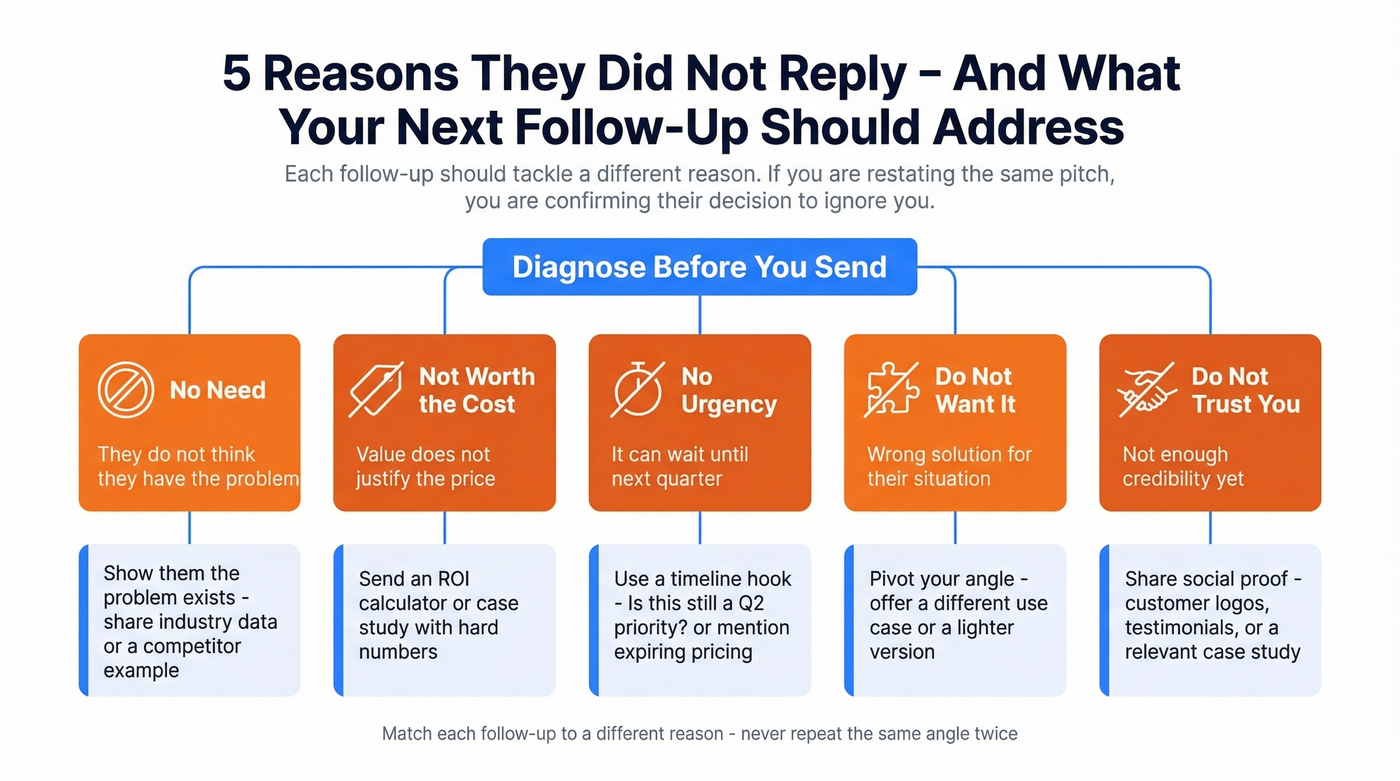
A useful framework: the five reasons people don't respond are no need, value not worth cost, no urgency, don't want it, or don't trust you. Each follow-up should address a different one. Your second touch might tackle urgency ("this pricing expires Friday"). Your third might build trust ("here's a case study from your industry"). If you're just restating the same pitch, you're confirming their decision to ignore you.
Wrong timing. Too soon feels desperate. Too late feels forgotten. Stick to the timing table above. Early touches should be 3-5 days apart; later touches stretch to 5-7 days. Remember: 90% of people who will reply do so within two days. If a week passes, you need a new angle, not just a reminder. If you want a deeper timing breakdown, see when should you follow up on an email.
Sounding like a template. "I hope this email finds you well" is the fastest way to signal that you copy-pasted this from a HubSpot guide. Drop the filler. Reference something specific to them - their company, their role, something from a previous conversation. In our experience reviewing outbound campaigns, the emails that get replies almost always include at least one detail that proves the sender actually looked at the prospect's business. If you want to tighten your writing, start with email copywriting.
Following up on a dead email address. This is the silent killer. 17% of cold emails never reach the inbox. Gmail's spam complaint threshold sits at 0.1% - exceed that and your entire domain starts getting filtered. If you're sending follow-ups to unverified addresses, you're wasting your best copy on a void. Prospeo catches bounces, spam traps, and catch-all domains before you hit send with 98% accuracy, and the free tier handles 75 verifications a month - enough to gut-check any small campaign. If you’re troubleshooting deliverability, start with email bounce rate and then work through an email deliverability guide.
Not knowing when to stop. Sending 4+ emails in a sequence triples your unsubscribe rate and more than triples spam complaints. There's a line between persistent and annoying, and most reps cross it without realizing. Let's be honest - if someone hasn't replied after four well-crafted emails, a fifth one isn't going to change their mind. It's going to change their opinion of you.
The best follow-up template won't save you if you're emailing the wrong person. Prospeo gives you 300M+ verified contacts with 30+ filters - buyer intent, job changes, technographics - so your second touch reaches a real decision-maker, not a dead inbox.
Find the right contact at $0.01 per email. No contracts.
When to Stop Following Up
More follow-ups don't always mean more replies. Belkins' data on founder-targeted sequences tells the story: reply rates go 6.64% to 6.66% to 6.94% to 5.75% to 3.01%. The second follow-up is the peak. After that, you're in decline.
For sales outreach, the benchmark is 5-8 total emails in a sequence, but front-load your best material:
- Day 1 - Initial email
- Day 3 - Follow-up with new insight
- Day 6 - Follow-up with case study or result
- Day 12 - Follow-up addressing likely objection
- Day 24 - Break-up email
For interviews, two follow-ups max, then move on. For networking, 2-3 touches total.
Look - if you consistently need five or more touches to get replies, the problem isn't your follow-up cadence. It's your targeting or your first email. Sharp targeting, a relevant offer, and a verified address will get you a reply in two or three touches. We've watched teams cut their sequence length in half and see reply rates go up because they spent more time on the first email and less time writing follow-up number seven. If you want to improve the top of the funnel, use these sales prospecting techniques to tighten targeting.
FAQ
How long should a second follow-up email be?
For cold outreach, 40-60 words - shorter emails consistently outperform longer ones. For interview or networking follow-ups, 3-5 sentences is the sweet spot. Add one new piece of value and make it easy to respond; don't restate your entire pitch.
Should I reply in the same thread or start a new one?
Same thread for warm conversations where they've already replied - it preserves context. New subject line for cold outreach when you didn't get an open or reply. If the original subject line didn't earn attention, sending it again won't help.
How do I know my follow-up actually arrived?
You don't - unless you verify the address first. With 17% of cold emails bouncing or hitting spam, tools like Prospeo confirm deliverability before you send so you're not following up into a void. The free tier covers 75 verifications a month.
What should I say in a second follow-up email?
Never repeat your first message. Add a relevant case study, a data point, a customer reference, or a timeline-based hook like "Is [project] still a priority this quarter?" Each follow-up should address a different reason they haven't replied - no need, no urgency, unclear value, lack of trust, or disinterest.
Can I send a second follow up email after an interview without seeming desperate?
Two follow-ups is standard and expected. Reference a specific topic from the interview, attach a relevant resource they didn't ask for, and close with a soft ask for a timeline update. After two messages with no response, stop. Persistence beyond that signals desperation, not enthusiasm.