

How to Write a Self Introduction Letter to Clients (With 7 Templates)
50.9% of recipients never engage with cold outreach. Another 13.7% delete it without reading a word. That means your self introduction letter to clients has a tiny window to prove it's worth someone's time - and most people blow it with a three-paragraph autobiography nobody asked for.
The word is "letter," but you're almost certainly sending an email. Either way, the templates below work for both formats. Every one is under 80 words and built around one framework: BLUF framework).
Letter vs. Email - Pick Your Channel
Letters carry weight in formal industries. Emails are faster, trackable, and how the vast majority of introductions actually happen. With 46% of emails opened on mobile, formatting matters more than ever - a beautifully typeset PDF attachment that nobody downloads on their phone is a waste of everyone's time.
| Channel | Best For | Watch Out |
|---|---|---|
| Printed letter | Wealth management, law, luxury | Slow, no tracking |
| Most B2B intros, SaaS, consulting | Crowded inboxes | |
| Text/voice note | Warm intros only | Feels invasive cold |
Every template below works as an email or a printed letter - just adjust the format.
What Every Introduction Letter Needs
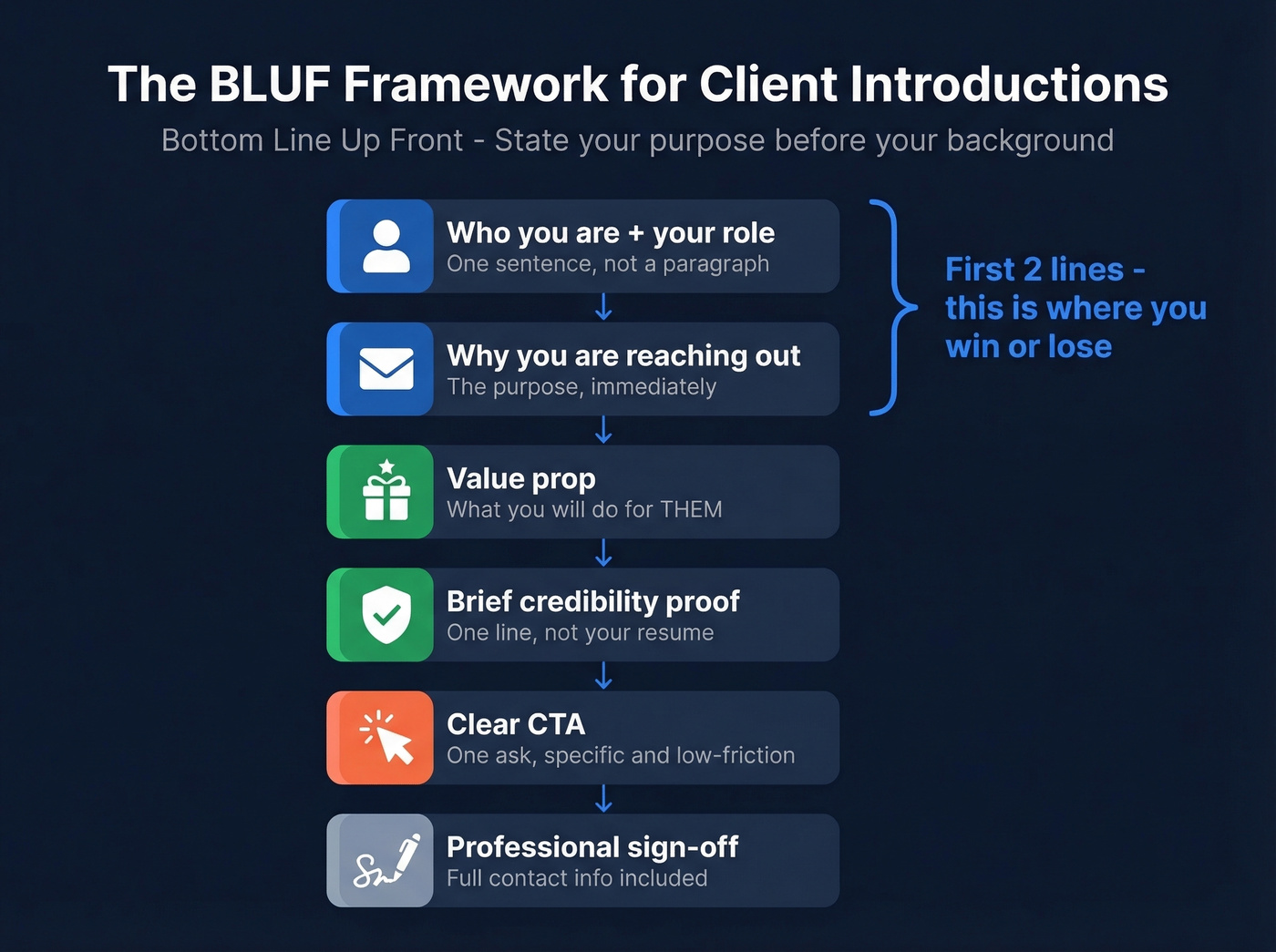
Use the BLUF framework - Bottom Line Up Front. State who you are and what you want in the first two lines. Background comes second. Most people won't make it deep into a long letter from someone they don't know yet.
Your checklist:
- Personalized greeting - use their name, never "Dear Sir/Madam"
- Who you are + your role - one sentence
- Why you're reaching out - the purpose, immediately
- Value prop - what you'll do for them
- Brief credibility proof - one line, not your resume
- Clear CTA - one ask, specific and low-friction
- Professional sign-off - with full contact info

A perfect self introduction letter means nothing if it lands in the wrong inbox - or bounces entirely. Prospeo gives you 98% verified email addresses so your intro actually reaches the decision-maker, not a dead mailbox.
Stop crafting great intros for bad email addresses.
7 Industry-Specific Templates
1. Account Handoff (New Rep or CSM)
Use when: You're taking over an existing client relationship.
Subject: Your new point of contact at [Company]
Hi [Name],
I'm [Your Name], your new [role] at [Company]. I'll be your primary contact for [scope - renewals, support, strategy].
I'd love a quick 15-minute call to learn what's working, what's not, and your priorities for [quarter/year]. Here's my calendar: [link]
PS - Congrats on [something specific from their site or news]. Would love to hear more about it.
Tone tip: For a more casual version, swap "I'd love a quick 15-minute call" with "Got 15 minutes this week?" and drop the formal sign-off.
2. Consultant or Freelancer to a Prospect
Use when: You're pitching services to someone who doesn't know you. Think of this as an interest email - your goal is to spark curiosity, not close a deal.
Subject: [Specific result] for [their company type]
Hi [Name],
I'm [Your Name], a [specialty] consultant who works with [their industry] companies on [specific outcome]. I recently helped [similar client] achieve [result with number].
Would it be worth a quick call to see if there's a fit? Happy to share the approach - no strings.
Best, [Your Name]
3. Agency Welcoming a New Client
Use when: Contract is signed, you're the day-to-day contact. This is the one template where a short bulleted list actually helps, because the client genuinely wants to know what happens next and in what order.
Subject: Welcome aboard - here's what happens next
Hi [Name],
I'm [Your Name], your [role] at [Agency]. I'll be your main point of contact throughout our engagement.
Here's what the first two weeks look like:
- Kickoff call [date] to align on goals
- Access to our shared workspace by [date]
- First deliverable review by [date]
Questions before we start? Just reply here.
Tone tip: If your agency culture is more relaxed, open with "Hey [Name]" and close with "Talk soon." Match the energy of your sales conversations.
4. Financial Advisor or Accountant
Use when: Welcoming a new client to your practice.
Dear [Name],
I'm [Your Name], and I'll be managing your [financial planning / tax compliance] needs at [Firm]. Our next step is a [30-minute onboarding call / document collection] - I'll send a calendar invite shortly.
Warm regards, [Your Name], [Credentials]
Short and direct. Financial clients don't need a personality showcase - they need to know you're organized and responsive.
5. SaaS Company Onboarding a Customer
Use when: Post-sale, introducing the customer success contact.
Subject: Your success team at [Product]
Hi [Name],
I'm [Your Name], your Customer Success Manager at [Product]. My job is to make sure you get real value from [Product] - not just a login.
To get started: [link to onboarding guide]. I've also booked us a 20-minute setup call on [date] to walk through your goals.
Looking forward to working together.
6. Creative Services (Photographer, Designer)
Use when: Introducing yourself to potential clients like real estate agents or event planners.
Subject: [Service] for [their business type] in [area]
Hi [Name],
I'm [Your Name], a [photographer/designer] specializing in [niche] in [area]. My clients typically see [specific result - faster sales, higher engagement].
I'd love to show you a few recent projects. Here's my portfolio: [link]. Worth a quick call?
[Your Name]
Why this works: It leads with a result, not a biography. The portfolio link gives them an easy next step that doesn't require a commitment. We've seen intro emails that open with "here's the result I help clients get" consistently outperform intros that open with a long personal history.
7. Legal Professional to a New Client
Use when: Engagement letter or initial introduction after retainer. This one works best as a printed letter or PDF on firm letterhead.
[Date] [Client Name and Address]
Re: [Case/Matter Reference]
Dear [Name],
Thank you for choosing [Firm Name] to represent you in [matter description]. I'm [Your Name], and I'll be your primary attorney on this matter.
Enclosed you'll find our engagement agreement outlining scope, fees, and next steps. Please review, sign, and return by [date].
I'm available at [phone] or [email] for any questions.
Sincerely, [Your Name], [Bar Number/Credentials]
Check your local bar's advertising and communication rules before sending client-facing letters.
Five Mistakes That Kill Client Introductions
Too long. Emails under 80 words get the highest reply rates. For printed letters, one page maximum - and don't cheat by shrinking the font.
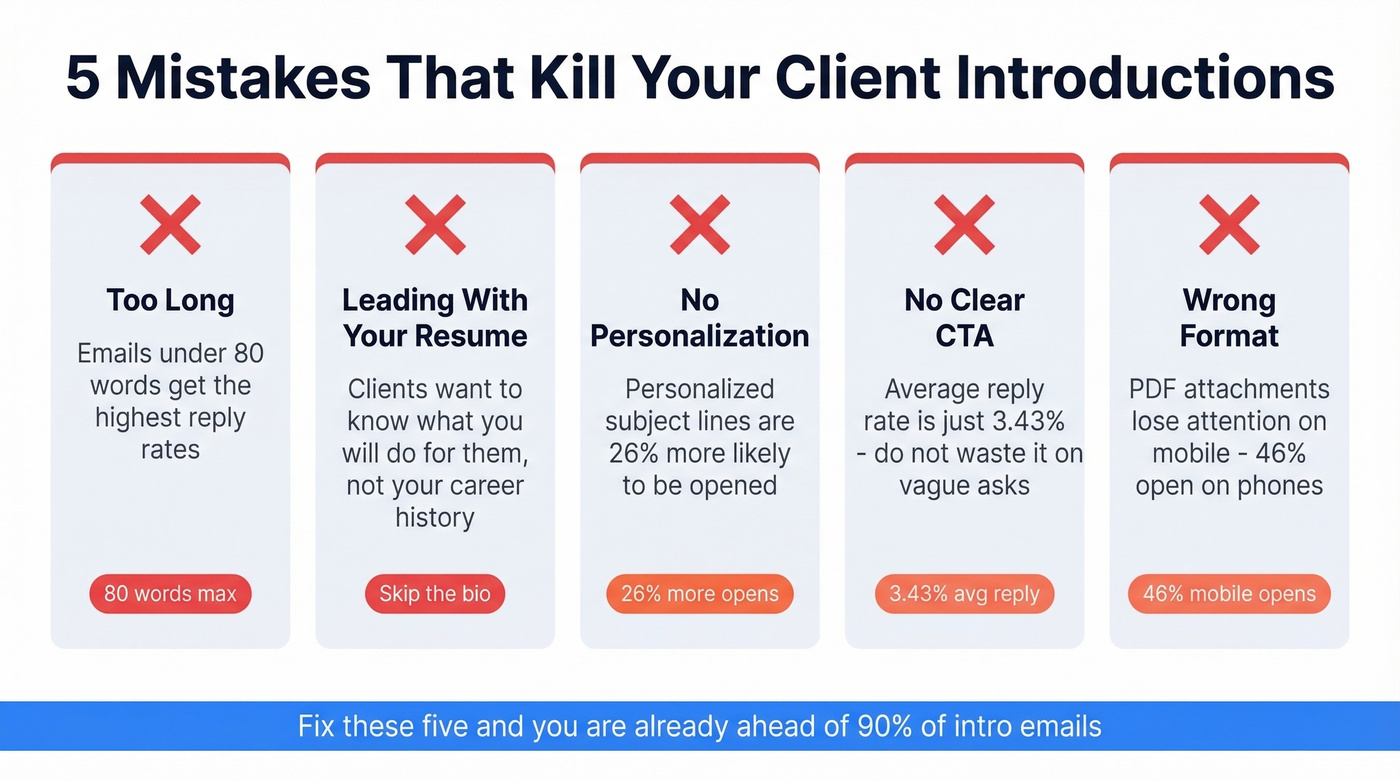
Leading with your resume. As one customer success manager put it on r/CustomerSuccess, including your tenure and awards in an intro email is "tacky peacocking." I've seen this kill more intro emails than any other single mistake. Clients want to know what you'll do for them, not where you went to school.
No personalization. Personalized subject lines are 26% more likely to be opened. Using their name and referencing something specific about their business is the bare minimum. (If you need ideas, borrow from these email subject lines.)
No clear CTA. The average reply rate sits at 3.43%. Don't waste your shot on "let me know if you'd like to chat sometime." Give them a specific next step - a calendar link, a date, a question to answer. If you want more options, use these sales follow-up templates and keep the ask consistent.
Wrong format for the channel. If you're emailing a PDF letter as an attachment, you'll lose attention on mobile. Your intro needs to render in the email body, not behind a download button.
What to Do After You Hit Send
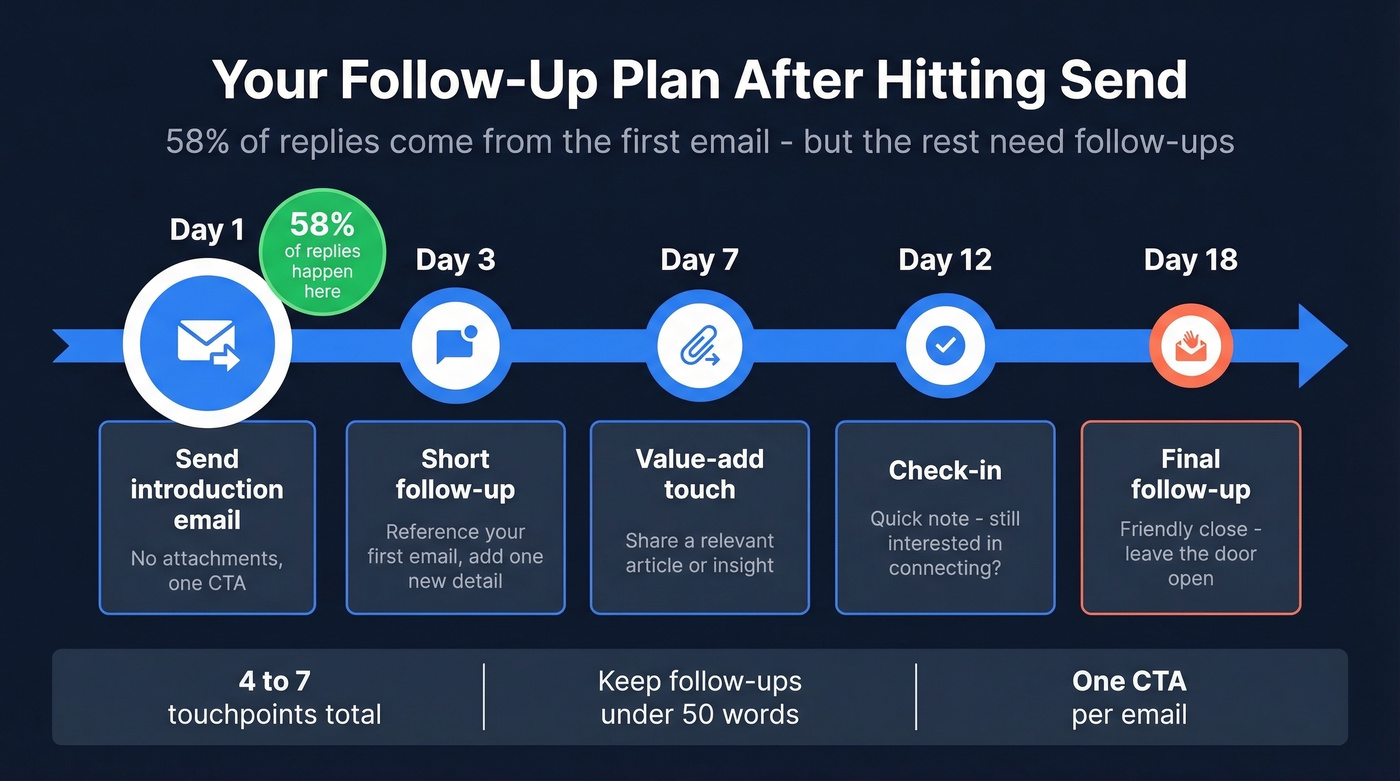
58% of replies come from the first email. That's encouraging - but most of the remaining 42% land after the second or third follow-up. Plan 4-7 touchpoints over two to three weeks. Keep follow-ups short, avoid attachments in the first message, and stick to one CTA per email. For timing, see when you should follow up on an email.
Here's the thing most people miss: the best introduction letter fails if it lands in a generic info@ inbox. A mediocre email to the right person outperforms a perfect email to info@company.com every single time. If you don't have your client's direct email, use Prospeo's email finder to get a verified address - paste a company URL or name and you'll have it in seconds. (Or go deeper with how to find a direct email address and name to email.)
Nail the targeting first. Then polish the copy. If you're building a repeatable outbound motion, use proven sales prospecting techniques and tighten your email copywriting.
You just picked your template. Now you need the right recipient. Prospeo's 300M+ database with 30+ filters lets you find the exact client contacts worth introducing yourself to - by industry, role, company size, even buyer intent.
Send your introduction to someone who's already looking for what you offer.
FAQ
How long should a client introduction letter be?
Under 80 words for email, one page max for printed letters. Emails under 80 words earn the highest reply rates according to 2026 benchmark data. Edit ruthlessly - every sentence should earn its place.
Should I include personal background?
One sentence maximum. Lead with purpose and value, not biography. Clients care about what you'll do for them, not your career history. Save the credentials for your email signature.
Can I use a sample template as-is?
Start with any template above, but always customize the details - your name, role, a specific result, and something personal about the recipient. A template gets you 80% there; personalization closes the gap.
How do I find the right email address for a client?
Use a B2B contact tool to look up verified emails by company name or URL. A direct address is the difference between getting read and getting deleted - we've found that bounce rates drop dramatically when you skip the guesswork and verify before sending.