

Selling Business to Business: Benchmarks, Frameworks & Templates
You send 500 cold emails. Three people reply - two to unsubscribe. Your domain takes a hit, sequences stall, and your manager asks why pipeline is flat. If you're selling business to business, that's the default outcome when outreach runs on bad data and generic messaging.
73% of B2B buyers actively avoid suppliers who send irrelevant outreach. That stat should reshape how you approach every deal. The game isn't volume - it's precision. And precision starts well before you write a single email.
The Playbook in Three Moves
- Fix targeting and data quality first. Bad data kills deliverability before your copy gets a chance. Verify every email before it hits a sequence.
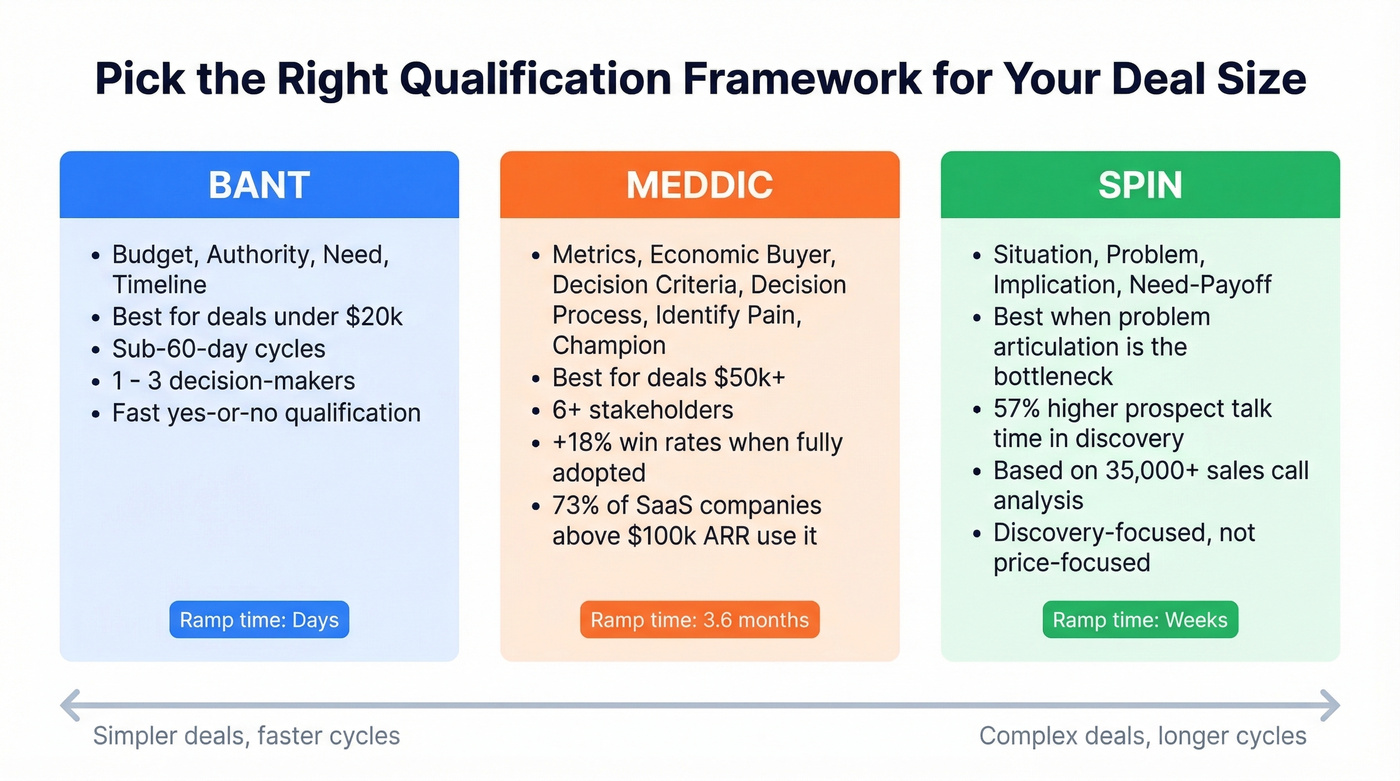
- Match your qualification framework to deal size. BANT for deals under $20k. MEDDIC for $50k+ enterprise cycles.
What Is B2B Selling?
When you sell business to business, your buyer is a company, not an individual consumer. You're navigating a buying committee of 6-10 stakeholders - and in enterprise deals, that number pushes past 15.
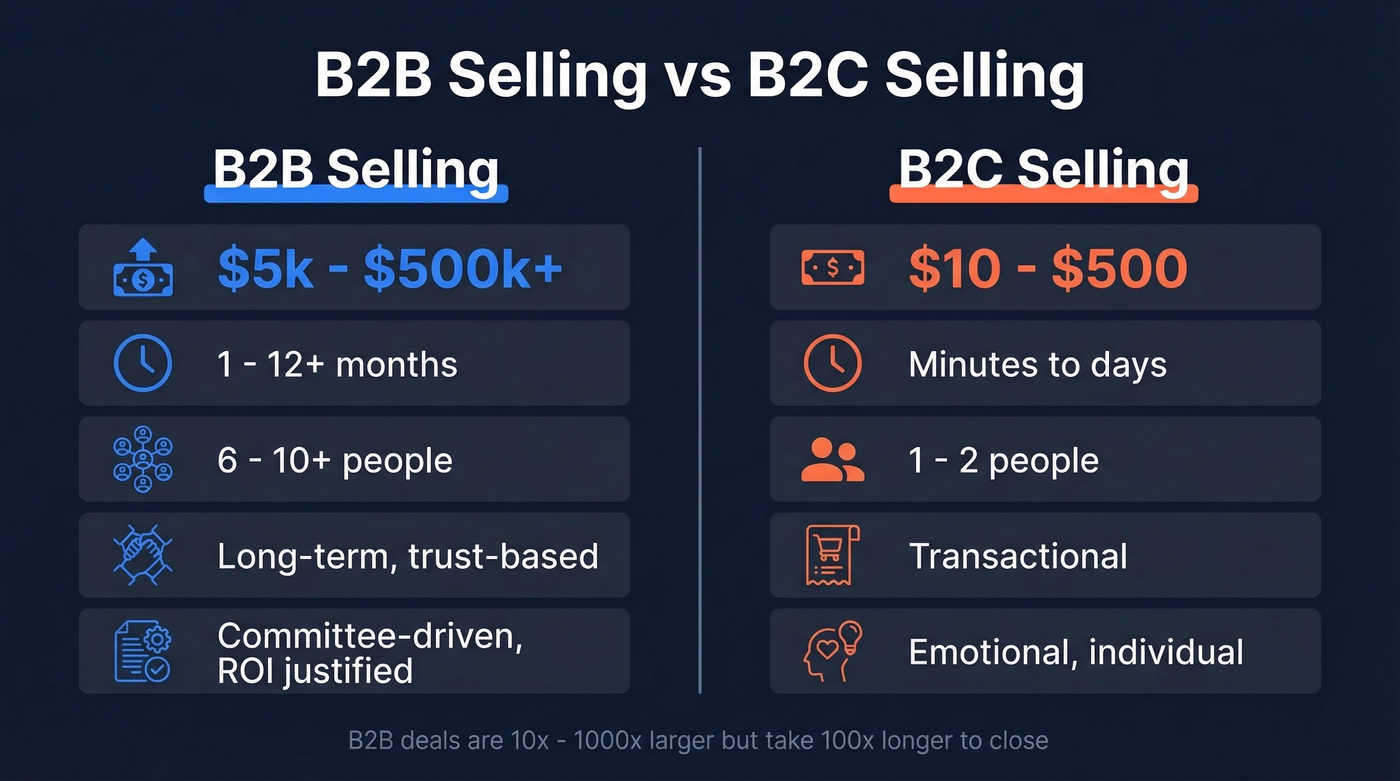
The global B2B e-commerce market sits at roughly $18.7 trillion and is projected to grow at around 18% annually. B2B isn't monolithic, either. It includes B2B2C (selling through businesses to reach consumers), B2B2B (selling through channel partners), and B2G (selling to government agencies). Each model has distinct sales motions, but the fundamentals below apply across all of them.
| B2B | B2C | |
|---|---|---|
| Deal size | $5k-$500k+ | $10-$500 |
| Cycle length | 1-12+ months | Minutes to days |
| Stakeholders | 6-10+ | 1-2 |
| Relationship | Long-term, trust-based | Transactional |
| Decision process | Committee, ROI-driven | Emotional, individual |
Longer cycles mean more touchpoints. More stakeholders mean more objections. Higher deal values mean the cost of a broken process is enormous. Think about a SaaS company selling project management software to a 500-person engineering team, a logistics firm contracting fleet management to an enterprise shipper, or a cybersecurity vendor replacing a legacy firewall across 40 offices. Each deal looks different, but the underlying dynamics - committee alignment, ROI justification, multi-month timelines - stay the same.
The Modern B2B Buyer
The buyer you're selling to in 2026 doesn't behave like the buyer from three years ago. 61% of B2B buyers prefer a completely rep-free buying experience. They've done nearly 80% of their research before they talk to your sales team, and they spend only 17% of their buying time meeting with potential suppliers.
Buyers now use roughly 10 interaction channels on average, up from 5 in 2016. They're reading your website, checking G2 reviews, asking peers on Slack communities, watching product demos on YouTube, and comparing you against three competitors - all before your SDR gets a reply. McKinsey's "rule of thirds" holds: at any stage, roughly a third of buyers prefer in-person interaction, a third remote, and a third digital self-serve.
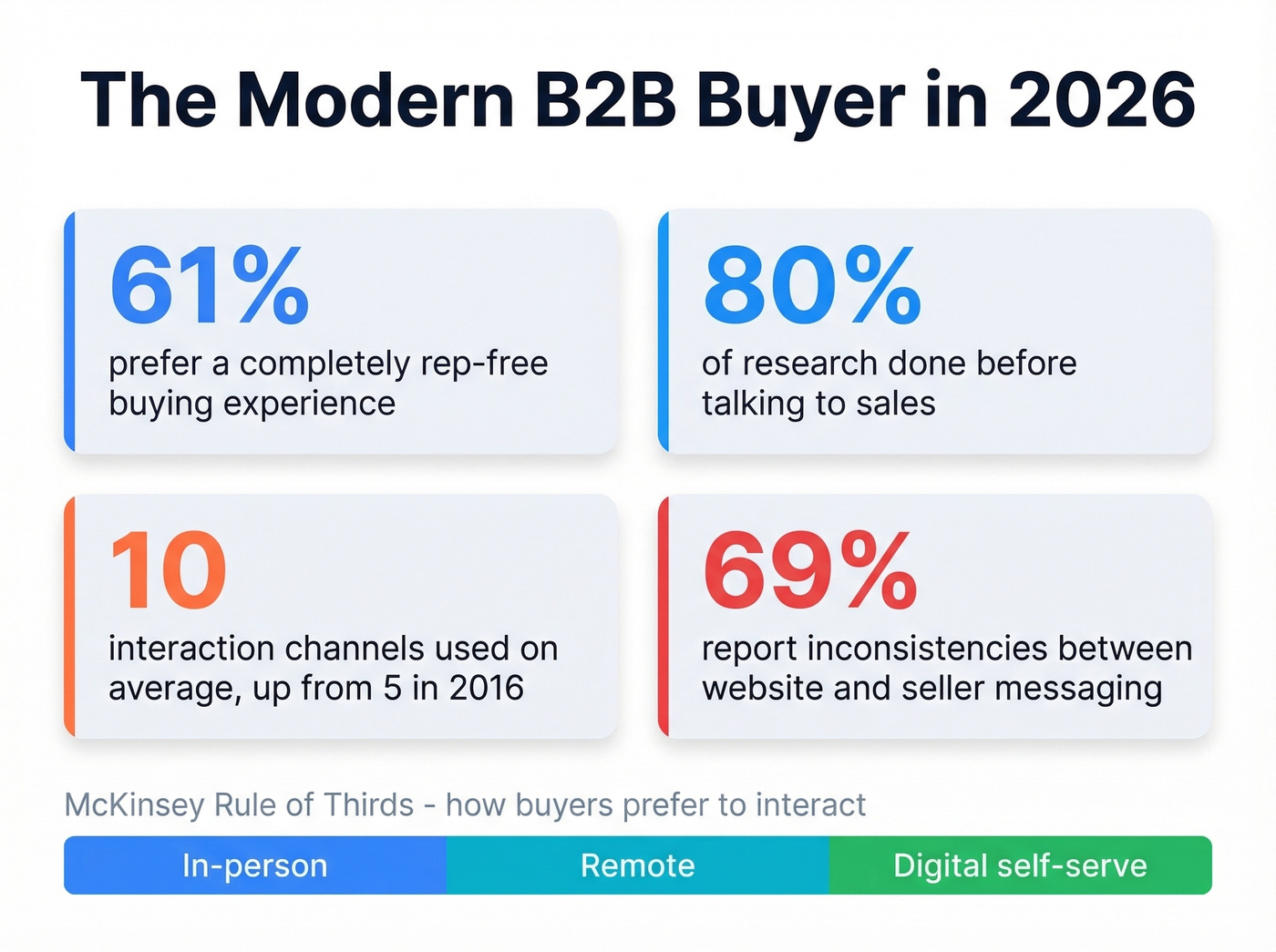
Here's what makes this brutal: 69% of buyers report inconsistencies between what a company's website says and what the seller tells them. That gap destroys trust instantly. When you do get a buyer's attention, you'd better be relevant, consistent, and adding value they can't get from a search engine.
The 7-Step B2B Sales Process
Every B2B sale follows roughly the same arc, whether you're closing $8k software or $500k consulting engagements. The goal is to strip away complexity at each stage so reps focus on the actions that actually move deals forward.
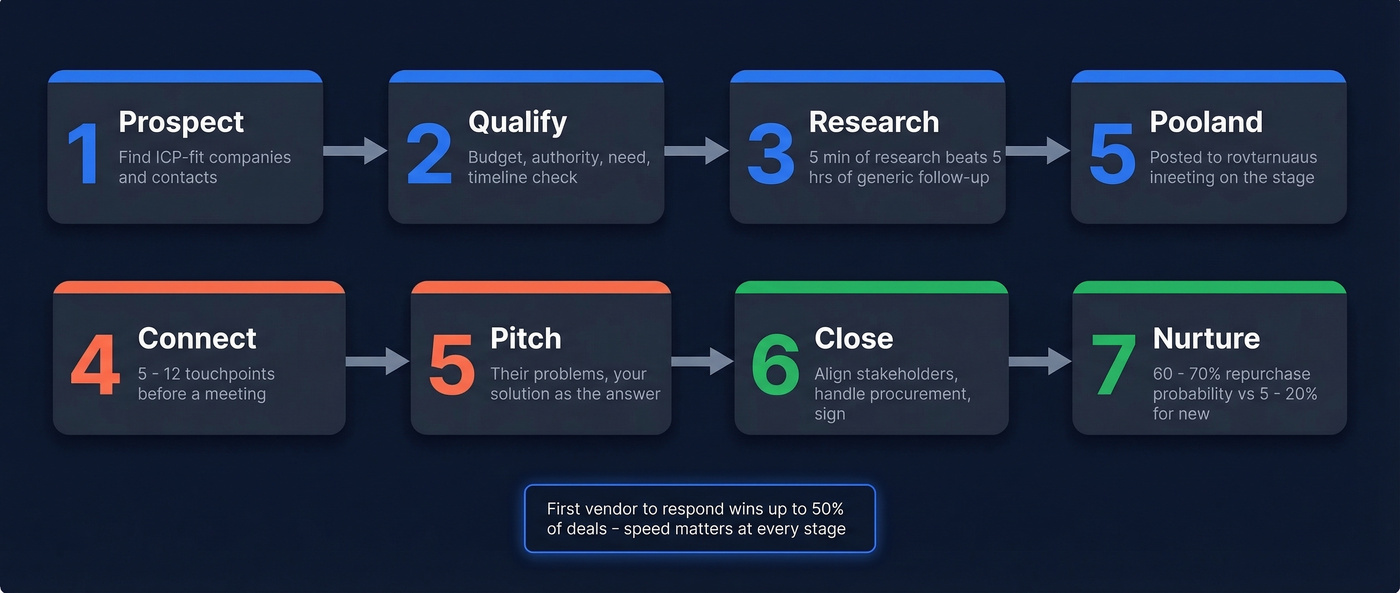
Prospecting. Identify companies and contacts that match your ideal customer profile. Data quality matters most here - garbage in, garbage out. Up to 50% of sales go to the first vendor to respond, so speed matters.
Qualifying. Determine whether this prospect has the budget, authority, need, and timeline to buy. Most reps skip this or do it poorly.
Research. Understand the prospect's business, recent news, tech stack, and likely pain points before you reach out. Five minutes of research beats five hours of generic follow-ups.
Connecting. Make first contact - cold email, warm intro, social touch, or phone call. Most deals require 5-12 touchpoints before a meeting. One underrated tactic: partner with non-competing vendors who sell to the same buyer and trade warm introductions. A referral from a trusted vendor cuts through noise faster than any cold sequence.
Pitching. Present your solution in terms of the buyer's specific problems and outcomes. This isn't a feature demo - it's a conversation about their business with your product as the answer.
Closing. Navigate objections, align stakeholders, handle procurement, get the signature. (If you need a tighter close motion, use this steps to close a sale breakdown.)
Nurturing. Existing customers have a 60-70% purchase probability versus 5-20% for new prospects. Expansion revenue is the highest-leverage motion in B2B.
B2B Sales Benchmarks for 2026
Let's ground this in numbers. Knowing what "normal" looks like prevents you from panicking when a quarter feels slow - and helps you spot real problems early.
| Metric | Benchmark |
|---|---|
| Win rate | 20-21% |
| Quota attainment | ~43% (up to 70% miss) |
| Sales cycle (mid-market) | 1-3 months |
| Sales cycle ($100k+ deals) | 6-12+ months |
| Visitor to Lead | 0.8-2.5% |
| Lead to MQL | 20-40% |
| MQL to SQL | 20-35% |
| SQL to Opportunity | 30-50% |
| Opportunity to Won | 20-35% |
Win rates are low. If you're closing one in five qualified opportunities, you're at benchmark. Sales cycles have stretched roughly 38% since 2021 as buying committees expand and budgets tighten.
The multi-threading data is the most actionable insight here. An analysis of 1.8 million opportunities found that closed-won deals have roughly 2x as many buyer contacts as lost deals. For deals over $50k, multi-threading boosts win rates by 130%. If you're only talking to one person in the account, you're leaving money on the table - and the consensus on r/sales backs this up. Thread after thread repeats the same lesson: single-threaded deals die in committee.

Multi-threading wins B2B deals - but only if you can reach every stakeholder. Prospeo gives you verified emails and direct dials for entire buying committees, with 98% email accuracy and 125M+ verified mobiles. At $0.01 per email, you cover all 6-10 decision-makers for less than a dollar.
Stop single-threading deals because you can't find the rest of the committee.
Qualification Frameworks
Not every deal deserves the same qualification rigor. Here's how to match framework to deal size.
BANT
Budget, Authority, Need, Timeline. Fast, simple, effective for transactional sales with sub-60-day cycles and 1-3 decision-makers. For deals under $20k, BANT gets you to a yes-or-no quickly. Modern variants like ANUM and FAINT update the order but keep the same logic. Use it as a mental checklist, not a script - buyers who've already done their research don't want an interrogation.
MEDDIC for Enterprise
The results tell the story before the acronym does: teams that fully adopt MEDDIC report +18% win rates and +24% larger deal sizes. 73% of SaaS companies selling above $100k ARR use some version of it. Metrics, Economic Buyer, Decision Criteria, Decision Process, Identify Pain, Champion - each element maps to a specific deal risk. The tradeoff is ramp time, roughly 3.6 months to proficiency, but for $50k+ deals with 6+ stakeholders, it's worth every hour of training.
SPIN Selling
Where BANT qualifies, SPIN discovers. Based on analysis of 35,000+ sales calls, SPIN practitioners see 57% higher prospect talk time in discovery. Situation, Problem, Implication, Need-Payoff. Best when the bottleneck is problem articulation, not price negotiation.
Skip Challenger and NEAT Unless...
Challenger Sale works in commoditized markets where every vendor sounds identical - it forces you to lead with insight rather than features. NEAT (Need, Economic Impact, Access to Authority, Timeline) is BANT's modern cousin for sophisticated buyers who already know their budget. Both are niche. If you're reading this article, start with BANT or MEDDIC.
Outreach That Gets Responses
Data Quality Is Your Ceiling
We've seen teams spend weeks perfecting email copy, A/B testing subject lines, and optimizing send times - then blast sequences to a list with a 25% bounce rate. The copy never mattered because the emails never arrived.
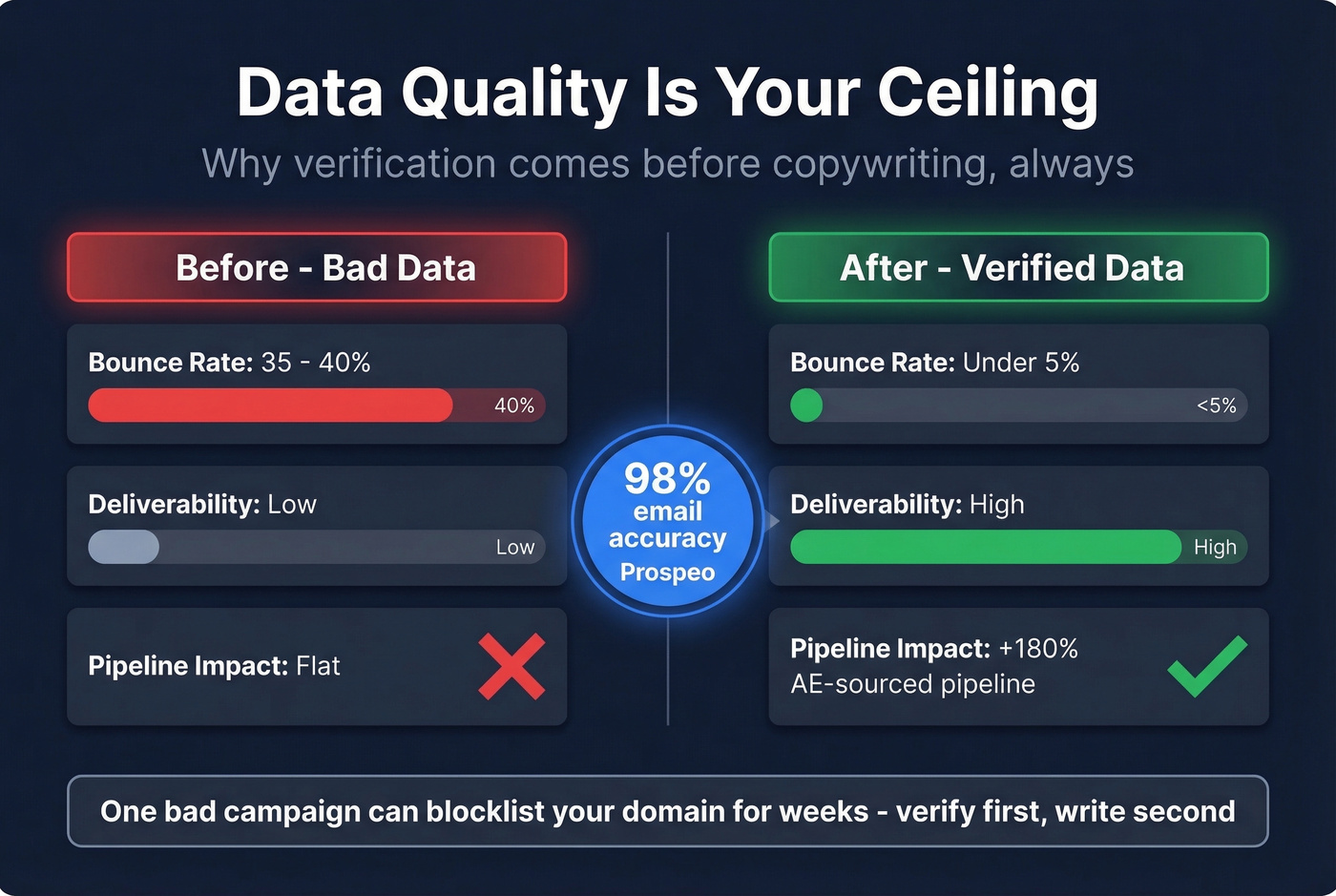
Bounces kill your domain reputation before subject lines get a chance. One bad campaign can land your domain on a blocklist that takes weeks to recover from. Verification comes before copywriting, always. (If you're troubleshooting bounces, start with email bounce rate benchmarks and fixes.)
Prospeo runs every email through a 5-step verification process - catch-all handling, spam-trap removal, honeypot filtering - and delivers 98% email accuracy. Snyk's 50-person AE team cut their bounce rate from 35-40% to under 5% after switching, and AE-sourced pipeline jumped 180%.
Cold Email Rules
Keep emails under 100 words. Subject lines under 6 words. One value proposition. One call to action. Tuesday through Thursday mornings. (For more angles, see these cold email follow-up templates.)
The CTA matters more than most people think. Don't ask for a 30-minute meeting in the first email - ask for a "small yes." Something like "Want me to send a short breakdown?" or "Worth a 5-minute look?" Lower the commitment and you'll get more replies. And don't skip compliance: CAN-SPAM, GDPR, and CASL all require opt-out mechanisms and sender identification.
Template: Value-First
Subject: Quick win for {{company}}
Hi {{first_name}},
{{Company}} is scaling {{specific motion}} - which usually means {{pain point}}.
We helped {{similar company}} cut {{metric}} by {{result}} in {{timeframe}}.
Want me to send a 2-minute breakdown of how?
Template: Pain-Point
Subject: {{Pain point}} fix
Hi {{first_name}},
Most {{role}} teams at {{company size}} companies tell us {{specific frustration}}.
We built {{product}} specifically for that - {{one-sentence outcome}}.
Worth a quick look?
Both under 100 words. Both ask for a small yes. Personalize the pain point and proof point, and you'll outperform 90% of cold outreach.
7 Mistakes That Kill B2B Deals
Leading with price instead of value. If you're opening with "we're cheaper," you've already lost the framing battle. Buyers care about ROI, not line items.
Talking too much on discovery calls. The best calls have the prospect talking more than the rep. Monologuing through a demo means you're not learning what matters. (Use a tighter set of discovery questions to keep it buyer-led.)
Failing to qualify early. Three months on a deal that was never going to close is the most expensive mistake in B2B. Walk away faster.
Single-threading. Your champion loves you but can't sign the contract. Find the economic buyer early. (This MEDDPICC economic buyer guide helps.)
Ignoring existing customers. Your best pipeline is already in your CRM. Existing customers buy at 60-70% probability.
Using jargon buyers don't understand. Technical accuracy doesn't matter if the CFO can't follow your pitch.
Skipping objection prep. Every deal has 3-5 predictable objections. Rehearse them or lose to them.
AI in B2B Sales
Look, most teams buy AI tools before they've fixed their process and data foundations. AI amplifies whatever you feed it. Feed it bad data and a broken process, and you get bad outreach faster.
That said, the adoption curve is real. Juniper Research projects automated B2B interactions will jump from 3.3 billion in 2025 to 34 billion+ by 2027. Teams using AI report 83% revenue growth versus 66% without it. But Gartner predicts 40%+ of agentic AI projects will be abandoned by 2027 - the gap between "using AI" and "using AI well" is massive.
AI SDRs can process 1,000+ contacts per day versus 50-80 for humans, but their meeting-to-opportunity conversion runs about 15% compared to 25% for human reps. In our experience, the best approach is to use AI for the grunt work - research, first drafts, data enrichment, scheduling - and keep humans on discovery calls, negotiation, and relationship building. That's where deals are won. (If you're building the stack, start with these SDR tools.)
Essential Tools for B2B Sales
You don't need 15 tools. You need the right three or four, connected properly.
| Category | Tool | Starting Price |
|---|---|---|
| Prospecting & Data | Prospeo | Free (75 emails/mo) |
| Prospecting & Data | Apollo | Free; paid from ~$49/user/mo |
| CRM | HubSpot CRM | Free; Sales Hub from ~$15/user/mo |
| CRM | Salesforce | From ~$25/user/mo |
| CRM | Pipedrive | From ~$14/user/mo |
| Engagement | Outreach / Salesloft | ~$100-150/user/mo |
| Multichannel | Reply.io | From $99/mo |
| Scheduling | Calendly | Free; ~$10/user/mo |
| Data Intelligence | ZoomInfo | ~$15-40k/year |
For teams that need accuracy without enterprise pricing, Prospeo offers 300M+ professional profiles, 98% email accuracy, 125M+ verified mobile numbers, and a 7-day data refresh cycle - all at roughly $0.01 per email. Pair it with HubSpot's free CRM and Calendly's free plan for a fully functional outbound setup at $0/month to start, scaling to under $100/month as you grow. You don't need a $40k ZoomInfo contract to build pipeline. (If you're comparing providers, start with data enrichment services.)
Skip ZoomInfo entirely if your team is under 10 reps. The ROI math doesn't work at that scale, and the annual contract locks you in whether the data performs or not.
The article says it clearly: garbage data in, garbage pipeline out. Prospeo refreshes 300M+ profiles every 7 days - not the 6-week industry average - so your sequences hit real inboxes. Teams using Prospeo book 26% more meetings than ZoomInfo users and keep bounce rates under 4%.
Your B2B sales process is only as good as the data feeding it.
FAQ
How long does a typical B2B sales cycle take?
Mid-market deals close in 1-3 months. Enterprise deals over $100k stretch to 6-12+ months. Cycles have lengthened roughly 38% since 2021 as buying committees expand. Plan pipeline coverage accordingly - a 6-month cycle needs 6 months of pipeline ahead at all times.
Is cold email still effective in 2026?
Yes, when it's targeted and personalized. Generic blasts fail because 73% of buyers avoid irrelevant outreach. Verify your list, keep emails under 100 words, and ask for a small yes instead of a 30-minute meeting.
What's the best free tool for B2B prospecting?
Prospeo's free tier gives you 75 verified emails per month with 98% accuracy - enough to test outreach without risking your domain. Pair it with HubSpot's free CRM and Calendly for a complete outbound workflow at zero cost.
What are common B2B sales examples?
A cloud infrastructure provider selling compute capacity to a fintech startup, a staffing agency placing contract engineers at a manufacturing firm, and a marketing platform licensing analytics dashboards to a retail chain. In each case the buyer is an organization solving a business problem, not an individual making a personal purchase.
How does selling B2B differ from B2C?
B2B involves longer cycles (months vs. minutes), larger deal sizes ($5k-$500k+ vs. under $500), and 6-10 stakeholders who each evaluate the purchase differently - finance cares about ROI, IT about integration, end users about usability. Consumer sales are faster, lower-value, and driven by individual emotion rather than committee consensus.