

How to Shorten Your Sales Cycle: A Diagnostic Playbook for 2026
Your forecast just slipped again. The deal that was "closing this quarter" now needs legal review, a second champion, and one more meeting with procurement. 58% of B2B professionals say their sales cycles got longer over the past year, and the math is unforgiving: opportunities closed within 50 days carry a 47% win rate, while deals that drag past that threshold drop to 20% or lower. Time kills all deals - so if you want to shorten your sales cycle, start by understanding exactly why it's long.
Benchmark Your Cycle With B2B Sales Data
A 90-day cycle is fast for manufacturing and painfully slow for retail. Before you fix anything, figure out whether your cycle is actually long or just feels long.
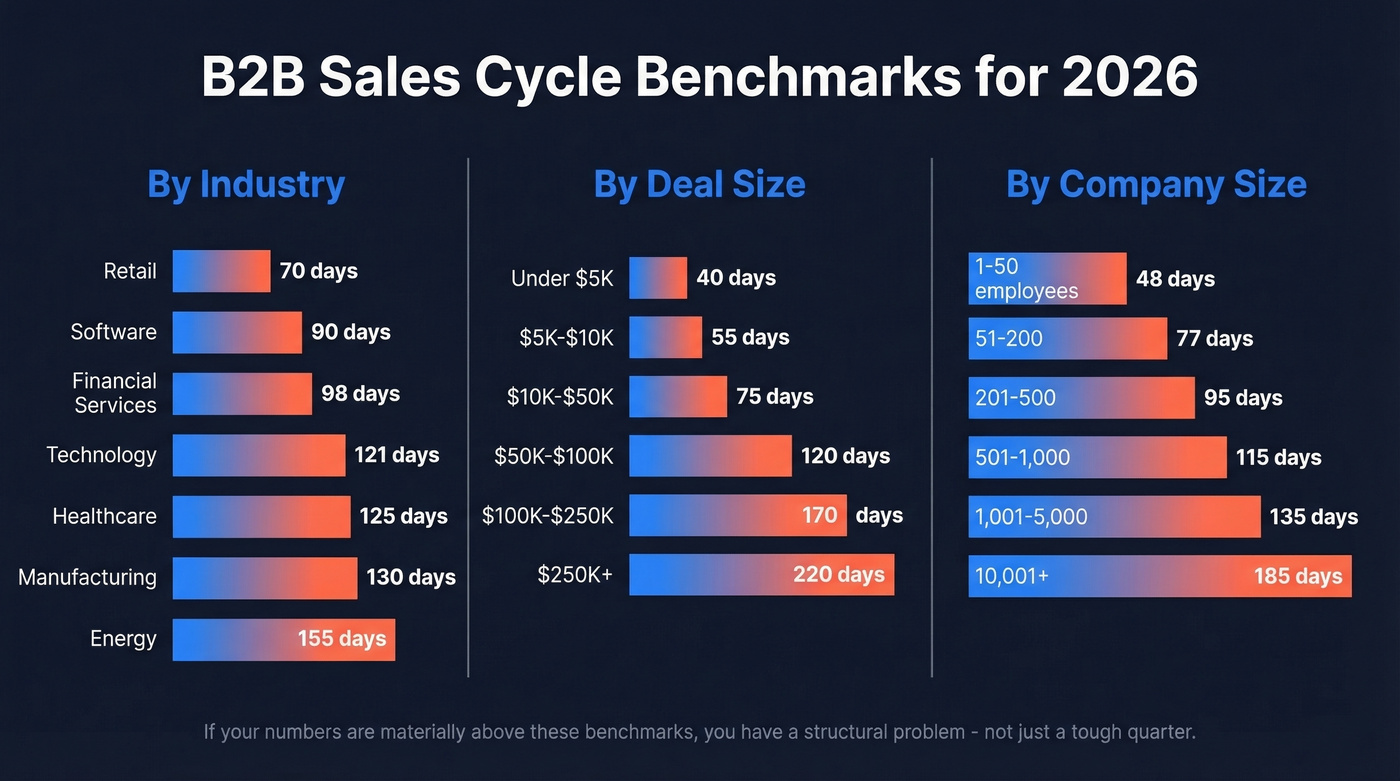
Average sales cycle by industry (days):
| Industry | Avg. Days |
|---|---|
| Retail | 70 |
| Software | 90 |
| Financial Services | 98 |
| Technology | 121 |
| Healthcare | 125 |
| Manufacturing | 130 |
| Energy | 155 |
Average sales cycle by deal size:
| Deal Size | Avg. Days |
|---|---|
| Under $5K | 40 |
| $5K-$10K | 55 |
| $10K-$50K | 75 |
| $50K-$100K | 120 |
| $100K-$250K | 170 |
| $250K+ | 220 |
Deals also slow down at predictable stages. Software deals spend the most time in proposal (30 days) and negotiation (25 days). Manufacturing's bottleneck is proposal at 45 days. Knowing which stage is your drag - whether it's technical discussions or list price negotiations - tells you where to intervene.
Average sales cycle by company size:
| Employees | Avg. Days |
|---|---|
| 1-50 | 48 |
| 51-200 | 77 |
| 201-500 | 95 |
| 501-1,000 | 115 |
| 1,001-5,000 | 135 |
| 10,001+ | 185 |
The cycle for SMEs under 200 employees typically runs 48-77 days, while enterprise deals routinely stretch past 135. If your numbers are materially above these benchmarks, you've got a structural problem - not just a tough quarter.
Diagnose Before You Optimize
Don't guess which lever to pull. Calculate it.
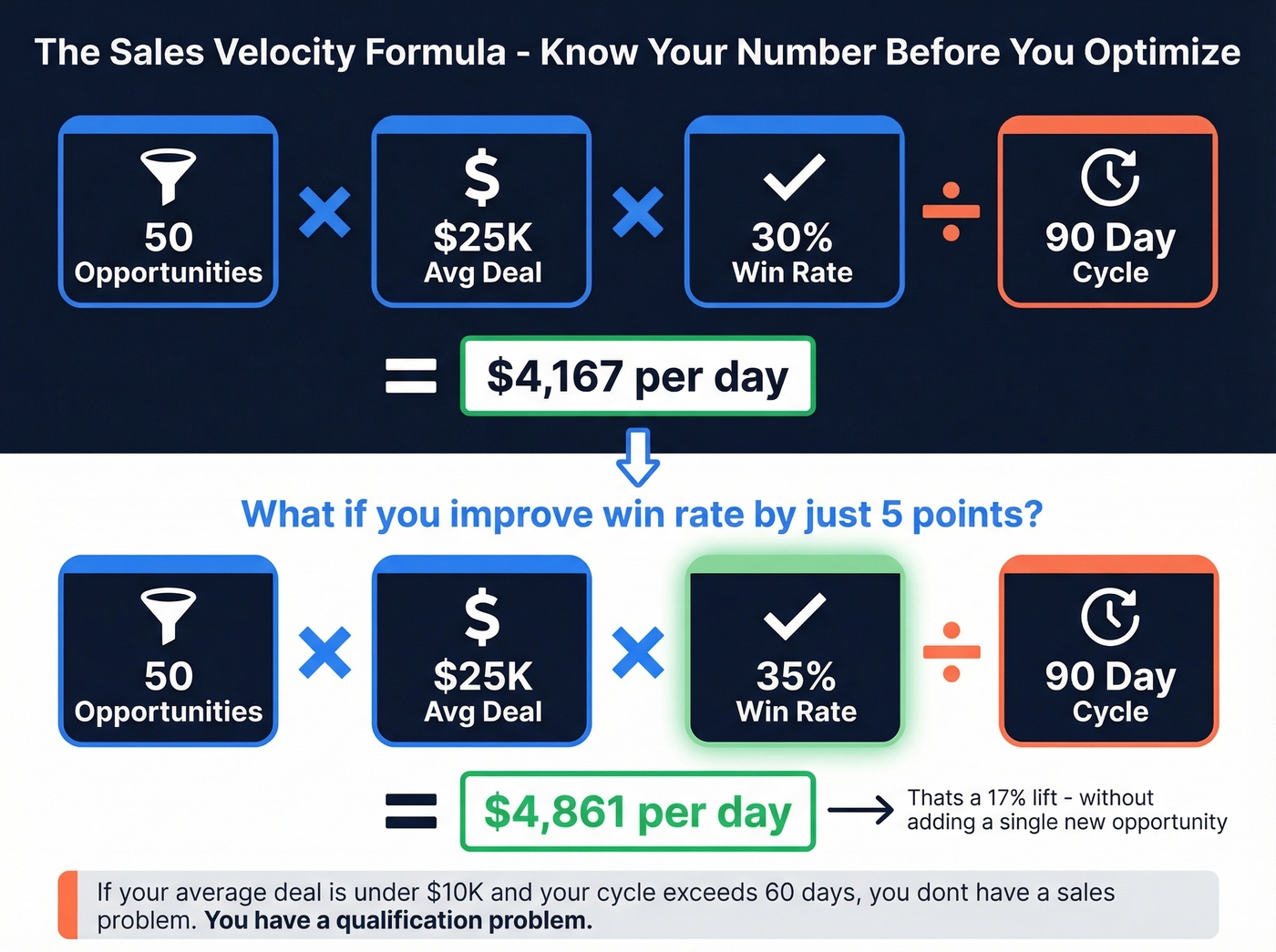
Sales Velocity = (Opportunities x Avg. Deal Value x Win Rate) / Sales Cycle Length
Say your team has 50 qualified opportunities, a $25K average deal, a 30% win rate, and a 90-day cycle. That's (50 x $25,000 x 0.30) / 90 = $4,167/day in pipeline velocity. Improve win rate from 30% to 35% and velocity jumps to $4,861/day - a 17% lift. A 5-point win-rate improvement often outperforms adding 20% more pipeline because win rate compounds across every deal.
Most teams reflexively chase more pipeline when the real bottleneck is conversion or cycle length. Shorter cycles also make your forecast more reliable - fewer open days means fewer chances for deals to slip or die. Run the formula before you prescribe.
If your average deal is under $10K and your cycle exceeds 60 days, you don't have a sales problem. You have a qualification problem. No amount of process will fix selling to the wrong accounts.

You can't shorten your sales cycle if reps waste weeks chasing bad emails. Prospeo gives you 98% verified emails and 125M+ direct dials - refreshed every 7 days - so your team reaches decision-makers on the first attempt, not the fifth.
Stop losing weeks to bounced emails. Start closing faster.
Eight Strategies That Compress Deal Timelines
1. Qualify With Intent Data, Not Gut Feel
Use this when: outbound reply rates are below 3% and reps burn time on accounts that aren't in-market.
Skip this if your inbound pipeline already converts at 25%+ and the problem is cycle length, not volume.
Buyers define their requirements before talking to sales 83% of the time . If you're reaching out cold to accounts that haven't started researching, you're inserting yourself into a cycle that doesn't exist yet. It takes an average of 62 touches across 3+ channels to close a deal - intent data lets you start those touches when they actually matter instead of sending cold emails to accounts that won't respond for six months.
Here's the counter-narrative worth noting: 49% of buyers say economic pressures actually shortened their buying cycles, and first contact has moved from 69% to 61% of the buyer's journey. Sellers are getting in earlier. Intent data is how you find those windows, compressing months of nurturing into weeks by timing outreach to real buying signals.
2. Multithread From Meeting One
The average B2B buying committee has ballooned - 5.4 stakeholders in 2015, 6.8 by 2017, and 8-13 today. Every stakeholder you don't engage early is a stakeholder who can stall you later.
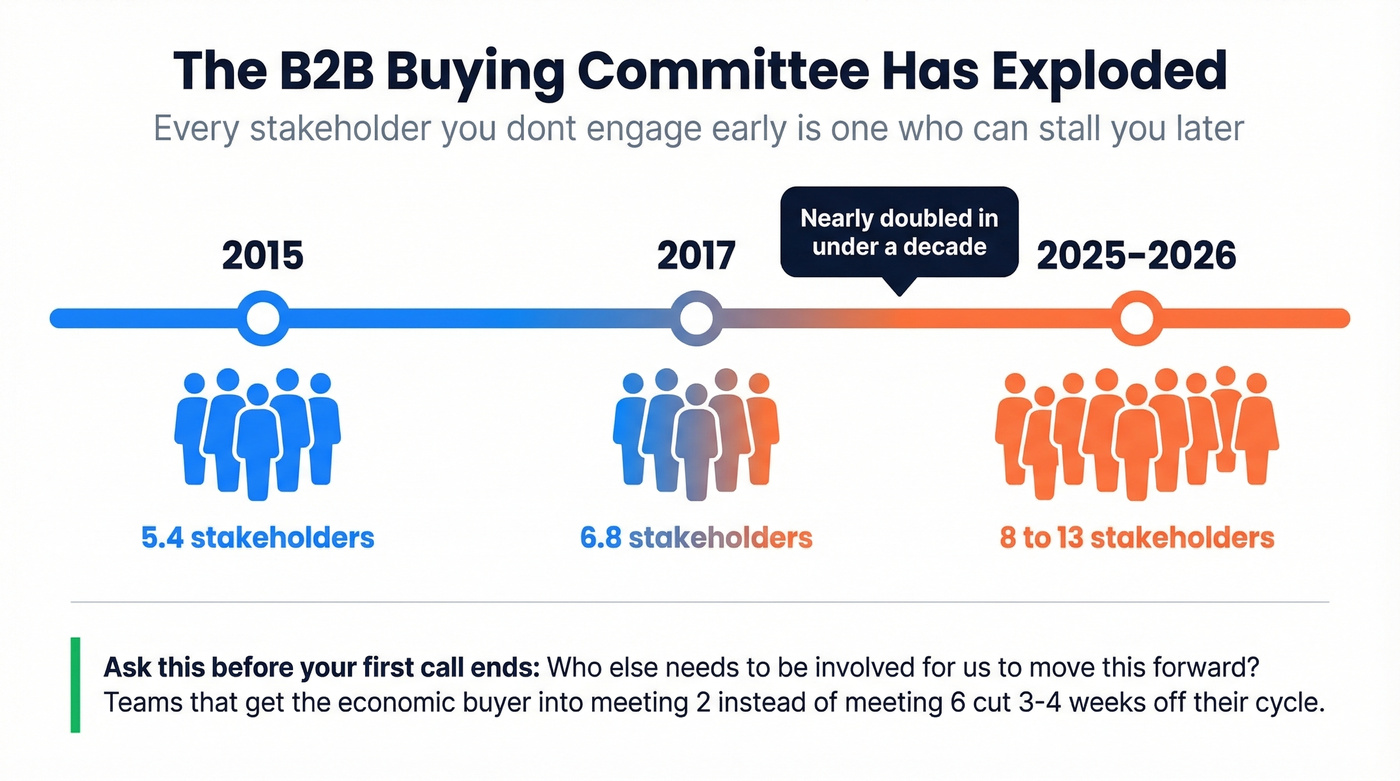
The simplest multithreading question, and one we've seen echoed across r/SaaSMarketing: "Who else needs to be involved for us to move this forward?" Ask it before the first call ends. We've seen teams cut 3-4 weeks off their cycle just by getting the economic buyer into meeting two instead of meeting six. Don't wait for the champion to "loop in" their CFO in month three.
3. Fix Your Discovery Calls
Here's the thing: most reps talk too much. Gong's data shows top-closing B2B reps speak 43% of the time versus 65% for average performers. If your discovery calls run 30 minutes and the rep talks for 20, you're not discovering anything - you're presenting. And presenting without context adds cycles, often weeks of back-and-forth that better listening would have prevented.
4. Use Mutual Action Plans
The "let me check with my team" black hole kills more deals than bad pricing. A Mutual Action Plan - a shared doc aligning both sides on who does what, by when - is the best antidote.
Per Highspot's framework, introduce it right after confirming shared objectives. Every MAP should include success criteria both sides agree on, named owners for each action item, approval checkpoints, and legal review timing. Treat it as a living document and update it after every call. The MAP doesn't just accelerate your deal - it makes stalls visible before they become fatal, creating shared accountability that keeps both sides honest about timelines.
5. Surface Objections in the First Call
Most reps avoid objections early because they're afraid of killing the deal. That instinct adds weeks. 86% of B2B purchases stall during the buying process, and 81% of buyers end up dissatisfied with their final choice - often because real concerns went unaddressed until it was too late.
Budget concerns, competing priorities, internal politics: ask about them in call one. Objections aren't the disease. They're the diagnosis. (If this is a recurring issue, tighten your objection handling system.)
6. Fix Your Contact Data
Bad data is the silent cycle killer. Before your reps can multithread, run discovery, or build a MAP, they need to reach the right person - and if 30-40% of their emails bounce, they're burning 2-4 weeks just trying to start a conversation.
This isn't hypothetical. Snyk's 50-person AE team was running bounce rates of 35-40% before switching to Prospeo. After cleaning up their stack, bounces dropped under 5%, AE-sourced pipeline jumped 180%, and they generated 200+ new opportunities per month. With 98% email accuracy and a 7-day refresh cycle - compared to the 6-week industry average - reps start selling on day one instead of chasing dead addresses for a month.
Your channel mix matters too: referral-sourced deals close in about 20 days, SEO-sourced leads in 28, and cold calling averages 60. If your data quality is forcing everything into the cold-calling bucket, you're adding weeks before a rep even opens their mouth.
7. Automate the Admin
Reps spend too much time on research, logging, and follow-up scheduling. Outreach's data shows deals supported by AI coaching close 11 days faster on average, and sales automation tools can reduce cycle time by roughly 15%. That's not a silver bullet on its own, but stacked with better qualification and multithreading, it compounds fast.
If you're rebuilding your stack, start with sales engagement platform basics and a clean sales process optimization workflow.
8. Start Small to Close Fast
Here's a tactic the enterprise playbooks rarely mention: offer a pilot. Six-figure deals often take 3-6 months to close, so a smaller, focused engagement can move in weeks and earn the right to expand. This isn't discounting - it's reducing buyer risk, which is the real reason enterprise cycles drag. Early customer references from pilot wins also give your next prospects the social proof they need to move quickly, creating a flywheel where each closed deal shortens the next one.
If you're selling upmarket, align this with your enterprise B2B sales motion.
Make Delay Visible to the Buyer
Stop letting "we'll circle back next week" slide. Quantify what each week of delay costs the buyer - in lost revenue, continued inefficiency, or competitive risk.
Look, buyers don't feel urgency about your timeline. They feel urgency about their own pain. Frame delay in their terms, not yours. When both sides capture value sooner, the deal accelerates naturally - make sure the buyer sees that math.
Case Study: 70 Days to 10
A financial planning firm was running a 70-day sales cycle with 10 in-person meetings per prospect, heavy travel, and long proposal reviews. After a 12-week overhaul, they compressed to 10 days - with some deals closing in 10 hours.
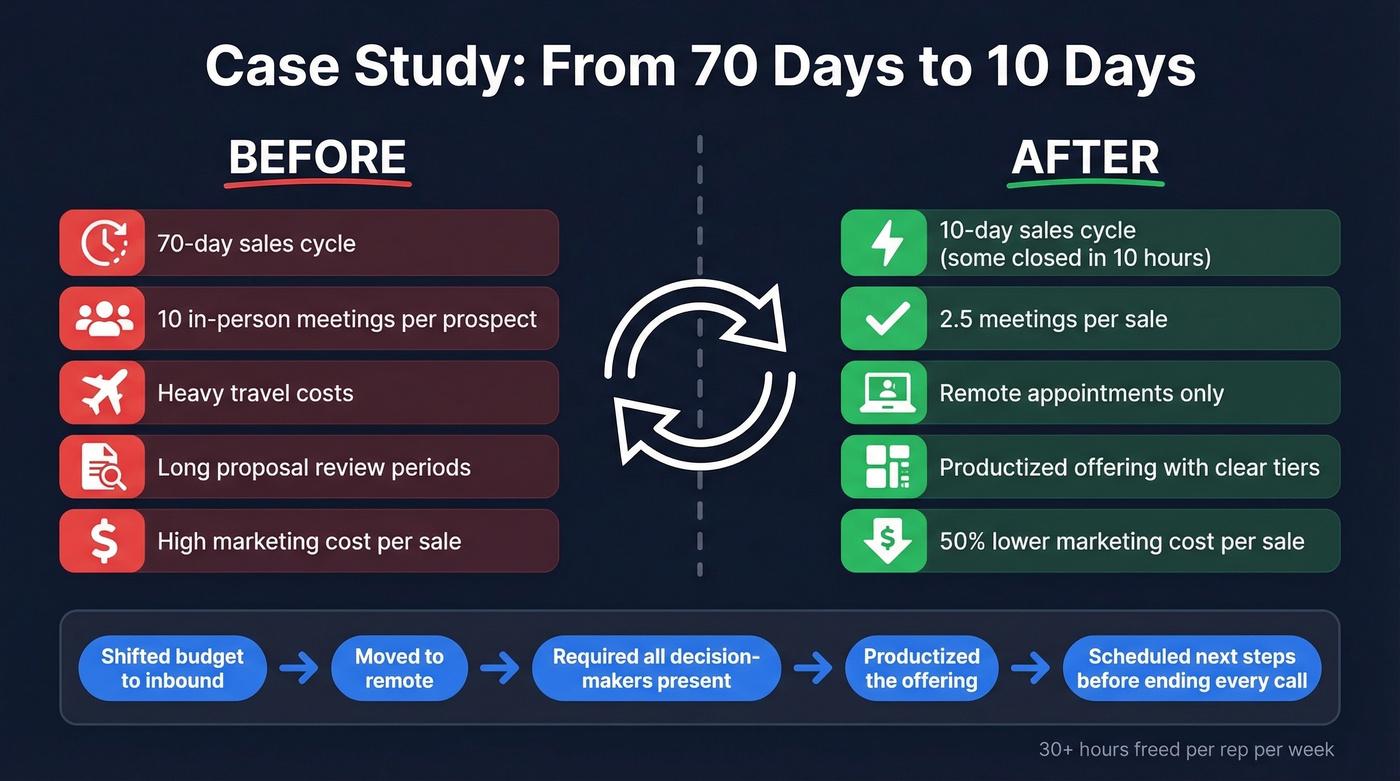
The interventions: they shifted marketing budget to inbound, moved to remote appointments, required all decision-makers present at meetings, productized their offering into clear tiers, and scheduled next steps before ending every call. Meetings per sale dropped from 10 to 2.5. Marketing cost per sale fell 50%. Each salesperson freed up 30+ hours per week.
The lesson isn't "copy this playbook." It's that cycle compression comes from structural changes to how you sell, not from one magic tactic. If your deals take too long, audit the entire journey - not just one stage. Use funnel metrics to pinpoint where time is actually leaking.
Multithreading only works when you can actually reach the buying committee. Prospeo's 300M+ profile database with intent data across 15,000 topics lets you identify in-market accounts and find every stakeholder's verified contact - for about $0.01 per email.
Reach the full buying committee before your competitor does.
FAQ
What's a good sales cycle length?
Software averages 90 days, manufacturing 130, and deals under $5K should close in about 40 days. Deals in the $100K-$250K range average around 170 days. Benchmark against your segment and deal size - not a universal number.
What's the fastest way to shorten a B2B sales cycle?
Diagnose first using the sales velocity formula, then fix the weakest lever. For most teams, multithreading deals and implementing Mutual Action Plans deliver the fastest results - often shaving 2-4 weeks within a single quarter.
How does bad contact data make cycles longer?
Bounced emails and wrong numbers delay first meaningful contact by 2-4 weeks. Verified data with a short refresh cycle means reps start real conversations immediately instead of chasing dead leads.
How do you shorten the sales cycle without discounting?
Focus on reducing buyer risk rather than cutting price. Offer pilots, provide early customer references, use Mutual Action Plans to maintain momentum, and surface objections in the first call. Compression is about removing friction - not margin.