

Should You Leave Voicemails When Cold Calling? Here's What the Data Says
52% of cold calls land in voicemail. That's from a CallHippo study of 72,000 call attempts over 90 weeks across 3,000+ businesses in 20+ countries. Layer on the finding that 80% of sales calls go to voicemail - and most of your dialing time produces a beep, not a conversation.
The question isn't whether you'll hit voicemail. It's whether you should bother saying anything when you do.
Leave a Voicemail - But Only Twice
An analysis of 300M+ cold calls found a paradox: voicemails reduce your future connect rate by 28% (from 7.18% down to 5.17%), but they more than double email reply rates - from 2.73% to 5.87%. The catch? Leave three or more voicemails and email replies crater to 2.2%, worse than leaving none at all.
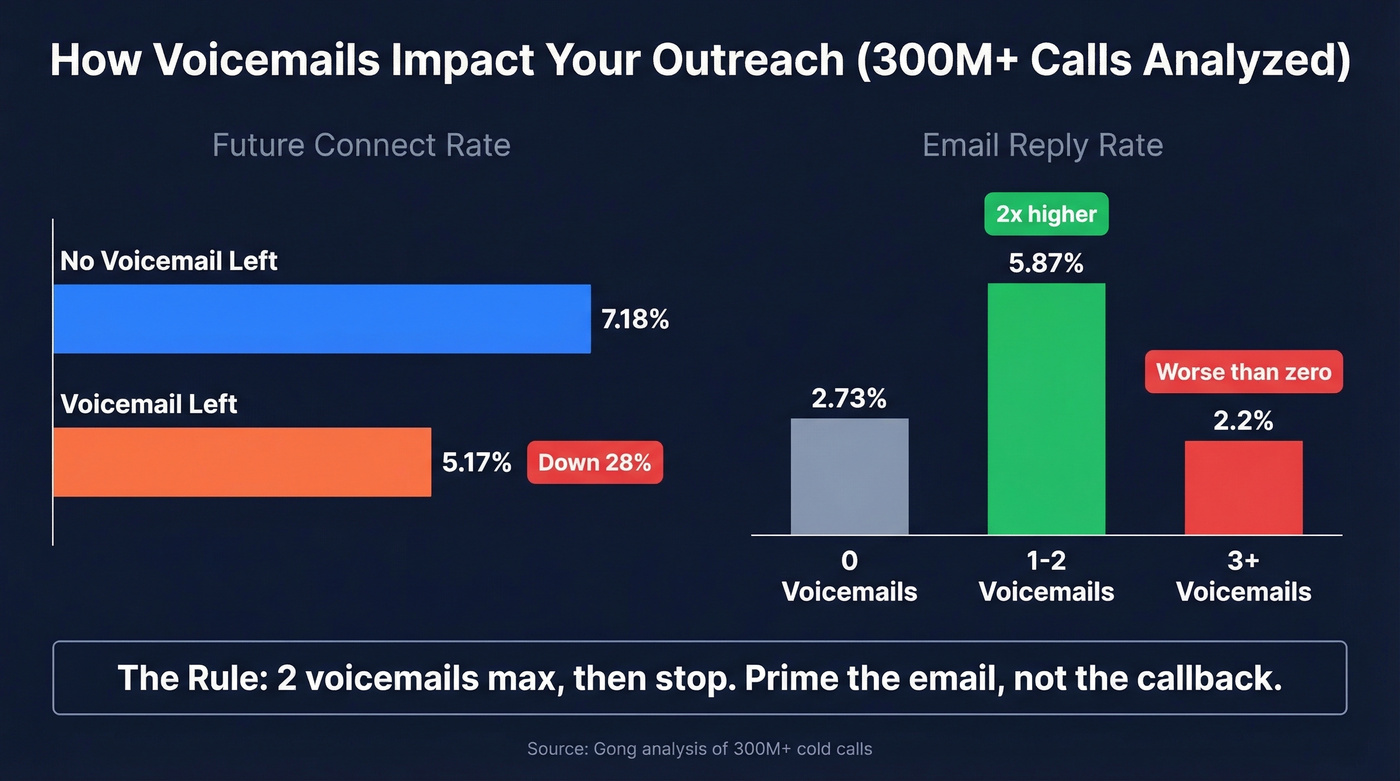
The rule: two voicemails max, then stop. Your voicemail isn't meant to generate a callback. It's meant to prime the email that follows.
If you need help building the follow-up, use these sales follow-up templates to keep the sequence tight.
What 300M+ Calls Actually Show
CallHippo's dataset gives us a clean split: 31% connect to a live person, 52% go to voicemail, and 17% hit disconnected or incorrect numbers. That last number matters more than most reps realize - we'll come back to it.
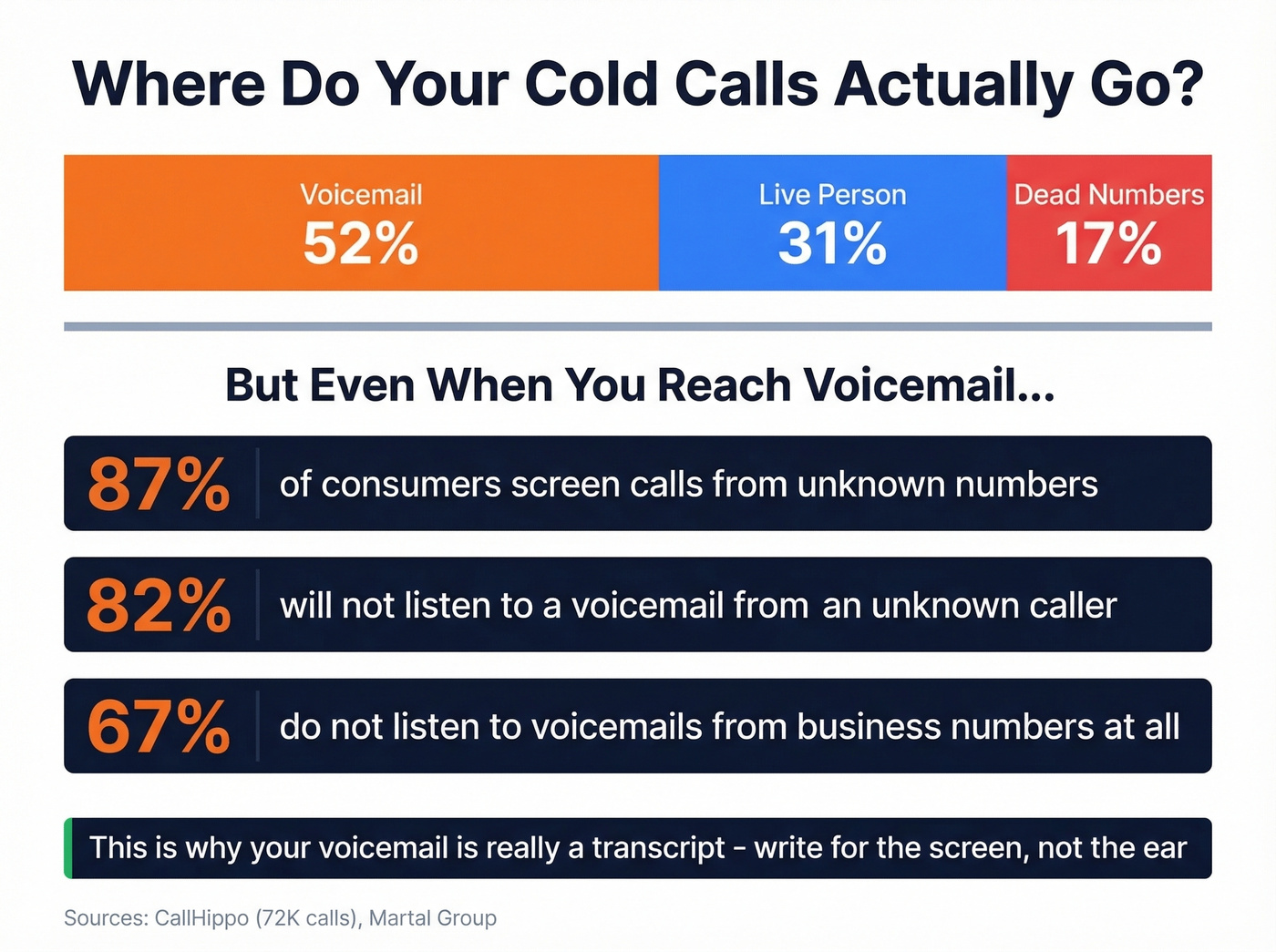
The behavioral data is brutal. 87% of consumers screen calls from unknown numbers. 82% won't listen to a voicemail from an unknown caller. And 67% don't listen to voicemails from business numbers at all. Reps already spend 15% of their day leaving voicemails, so the two-voicemail cap isn't just about reply rates - it's about reclaiming hours you're currently burning.
But the 300M-call dataset tells us the fight is worth it within limits. One or two voicemails paired with email follow-up create a multi-touch effect that nearly doubles reply rates. The voicemail makes your name familiar enough that the email doesn't feel cold anymore. Three voicemails, though, and you've crossed from persistent to annoying - email reply rates drop to 2.2%, a penalty worse than silence.
The Double Tap Framework
This is the framework the data supports, and it's the one we've seen work best across dozens of outbound teams we've talked to.
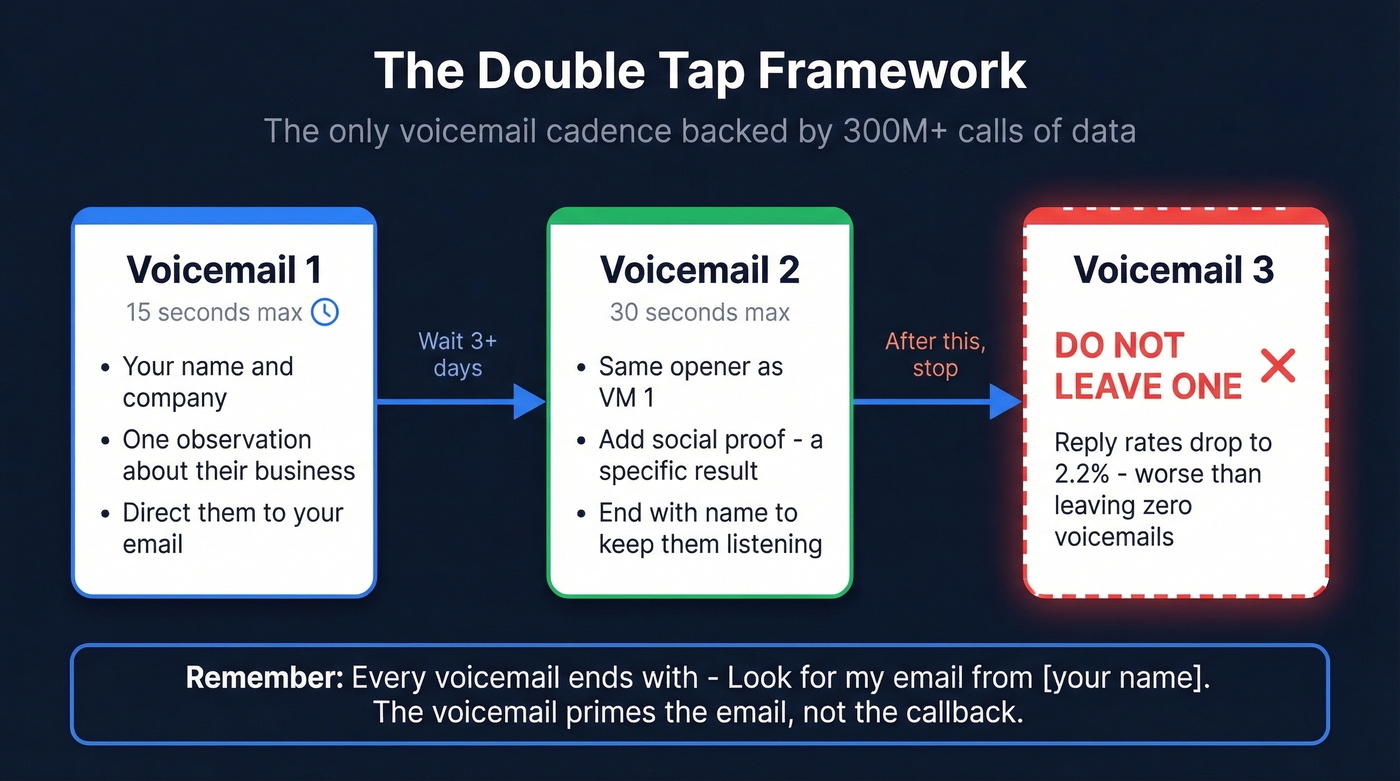
Voicemail #1: Context only (15 seconds). State your name, company, and one sentence about why you're calling - tied to their world, not yours. No pitch. No feature dump. End with: "I'm going to send you a quick email - look for it from [your name]." You're not asking for a callback. You're priming them to open an email.
Here's a template you can steal:
"Hey [name], this is [your name] from [company]. I noticed [observation about their business]. I'm sending you a quick email - look for it from [your name]."
Voicemail #2: Context + social proof (30 seconds). Same opener, but add a proof point: "We helped [similar company] do [specific result]." Still no pitch. Still directing to email. The name-at-end tactic from UserGems works well here - close with "oh, by the way, this is [first name] from [company]" to encourage listening through the whole message.
"Hey [name], [your name] from [company] again. Wanted to mention we helped [similar company] cut [metric] by [result]. I'm sending over one more detail by email - look for it from [your name]. Oh, and this is [first name] from [company]."
Voicemail #3: Don't leave one. Hard stop. The data is unambiguous.
The sweet spot for length is 18-30 seconds, though some practitioners push for an aggressive 8-13 seconds. We've tested both - the right length depends on your ICP's seniority. C-suite prospects tolerate shorter messages; directors and managers will listen to 25-30 seconds if the content is relevant. Either way, shorter beats longer every time.
Pro tip: leave yourself a voicemail first and listen back. If you can't catch your own name and company from the transcript, neither will your prospect.
If you're building a repeatable outbound motion, a documented cold calling system helps keep messaging and timing consistent.

Your voicemail says "check your email" - but 17% of your contact data is already dead. Prospeo's 143M+ verified emails at 98% accuracy ensure the follow-up actually lands. Data refreshed every 7 days, not 6 weeks.
Stop leaving voicemails for emails that bounce.
Write for the Transcript, Not the Ear
Here's the thing most cold call voicemail tips miss entirely: your prospect probably won't listen to your message. They'll read it.
With iOS Live Voicemail and Android's transcription features, many prospects skim the text preview rather than playing the audio. This changes everything about your script. Put your name, company, and value statement in the first five seconds so it shows up in the transcript preview. Speak clearly and at a measured pace - mumbling doesn't just sound bad, it garbles the transcription into nonsense. Adopt a casual, conversational tone rather than a hyped-up sales voice. One Reddit thread captured this perfectly: a prospect loved a voicemail's content but couldn't catch the website name from the audio, forcing them to Google it. If the transcription can't parse your words, your message is dead on arrival.
And since your voicemail says "check your email," that email needs to actually arrive. Prospeo's 98% email accuracy across 143M+ verified addresses helps ensure the follow-up lands in the inbox, not a bounce folder. If deliverability is a recurring issue, start with an email deliverability guide and track your email bounce rate.
A Voicemail Script That Actually Worked
A prospect on r/sales described the "perfect" cold call voicemail they'd received:
"Hey [name], this is [rep name] with [company]. We're a [what they do] - because we're the manufacturer, we can offer [clear differentiator]. Check us out at [website]. My number is [phone number]."
What made it work: brevity, directness, and a conversational tone. The prospect visited the website, checked pricing, and saved the link. That's a voicemail doing its job.
An InsideSales study found well-crafted scripts can lift callback rates by up to 22%. But callbacks aren't the real goal - email replies are. This is one of the most overlooked things about cold calling voicemail strategy: measure success by email engagement, not returned calls. If your email reply rate goes up after your first voicemail, the voicemail worked. Period.
To improve the email side of the double tap, borrow proven cold email subject line examples and tighten your email copywriting.
Five Mistakes That Kill Replies
Skip the voicemail optimization if you're making any of these:
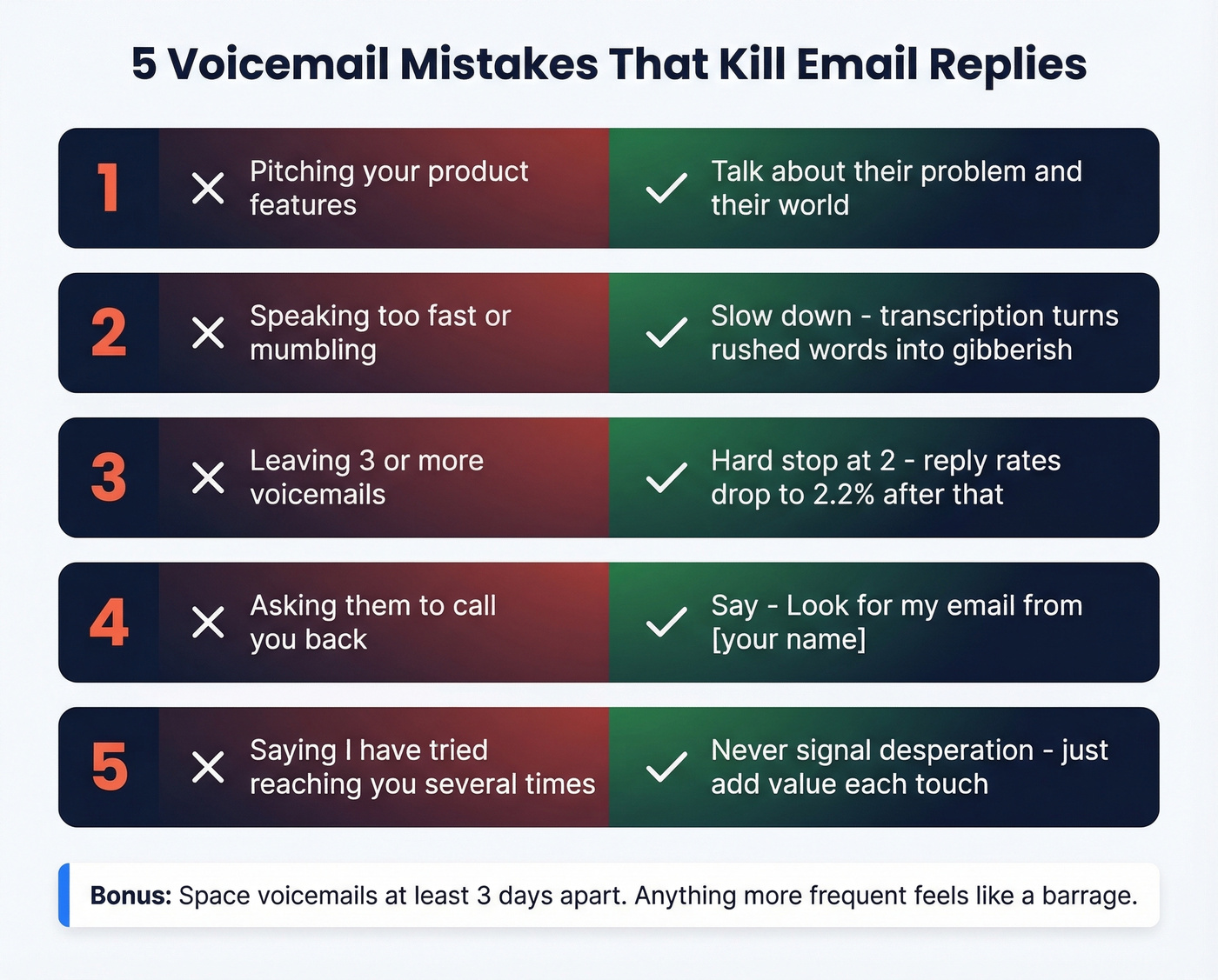
- Pitching your product instead of their problem. The voicemail isn't a demo. It's a door knock. Talk about their world, not your features.
- Speaking too fast or mumbling. Transcription turns your rushed delivery into gibberish. Slow down.
- Leaving three or more voicemails. Reply rates drop to 2.2% - worse than leaving zero messages.
- Asking them to call you back. Direct to email instead. "Look for my email" converts; "give me a call" doesn't.
- Saying "I've tried reaching you several times." This signals desperation, not persistence. It makes the prospect feel hunted rather than helped.
Space your voicemails at least three days apart. Anything more frequent feels like a barrage.
If your team is still ramping, this cold calling for beginners guide can help standardize the basics.
The Real Bottleneck: Bad Data
Remember that 17% of calls hitting disconnected or incorrect numbers? That's not a voicemail problem - it's a data problem. B2B contact data decays at roughly 2.1% per month, meaning 22.5% of your list goes stale every year. The consensus on r/sales is that ~5% connect rates are realistic with clean data and a good dialer - but that number craters when a sixth of your list is disconnected.
Let's be honest: most reps agonize over the perfect voicemail script when the real issue is they're dialing numbers that haven't been valid in six months. A perfect 15-second voicemail left on a disconnected line is still zero pipeline.
Fix your data first, then worry about your delivery. A database like Prospeo's - 125M+ verified mobiles refreshed every 7 days - cuts the dead-number problem at the source. And since the whole voicemail strategy hinges on "check your email," you need that email to actually land.
If you're evaluating providers, start with data enrichment services and compare options in a sales prospecting database.
Bad phone numbers waste 17% of your dials before you even get to voicemail. Prospeo gives you 125M+ verified mobile numbers with a 30% pickup rate - so more calls reach a real person, not a disconnected line.
Dial direct numbers that actually ring.
FAQ
How many voicemails should you leave a prospect?
Two maximum. The 300M-call dataset shows three or more voicemails drop email reply rates to 2.2% - worse than leaving none. Space your two messages at least three days apart, and direct the prospect to your follow-up email rather than asking for a callback.
How long should a cold call voicemail be?
Between 18 and 30 seconds. Some practitioners recommend an even tighter 8-13 second window. Since most prospects read the transcript rather than listening, brevity equals clarity. Front-load your name, company, and value in the first five seconds so the transcript preview captures what matters.
Do cold call voicemails increase callback rates?
Rarely - and callbacks shouldn't be the goal. Voicemails increase email reply rates by more than 2x (2.73% to 5.87%). The real play is using voicemails to prime your email outreach. Direct prospects to "look for my email" and make sure that email actually arrives using verified contact data.