

The One-Page Go-to-Market Strategy That Actually Works
You've bookmarked three GTM guides this week and you still don't have a single paying customer. Here's the thing: a simple go-to-market strategy fits on one page, and you can fill it out this afternoon.
The Canvas (Quick Version)
Answer five questions. Who's your ICP? PLG or sales-led? Which one or two channels? What's the activation moment? What are your 30/60/90-day KPIs?
The rest of this article gives you the canvas, the benchmarks, and the mistakes that kill early-stage launches before they ever get traction.
What a GTM Strategy Is (and Isn't)
A go-to-market strategy is a launch-specific plan for bringing a product to a defined market. It's not your brand playbook or your annual demand gen plan. You need one when launching a new product, entering a new market, or repositioning for a new segment. Asana's GTM guide walks through a 9-step version, but most teams don't need all nine on day one.
Your One-Page GTM Canvas
Every overcomplicated GTM plan started as a simple document nobody had the discipline to keep simple. The canvas below borrows from Anthony Murphy's Product GTM Canvas and the viamrkting one-page template.
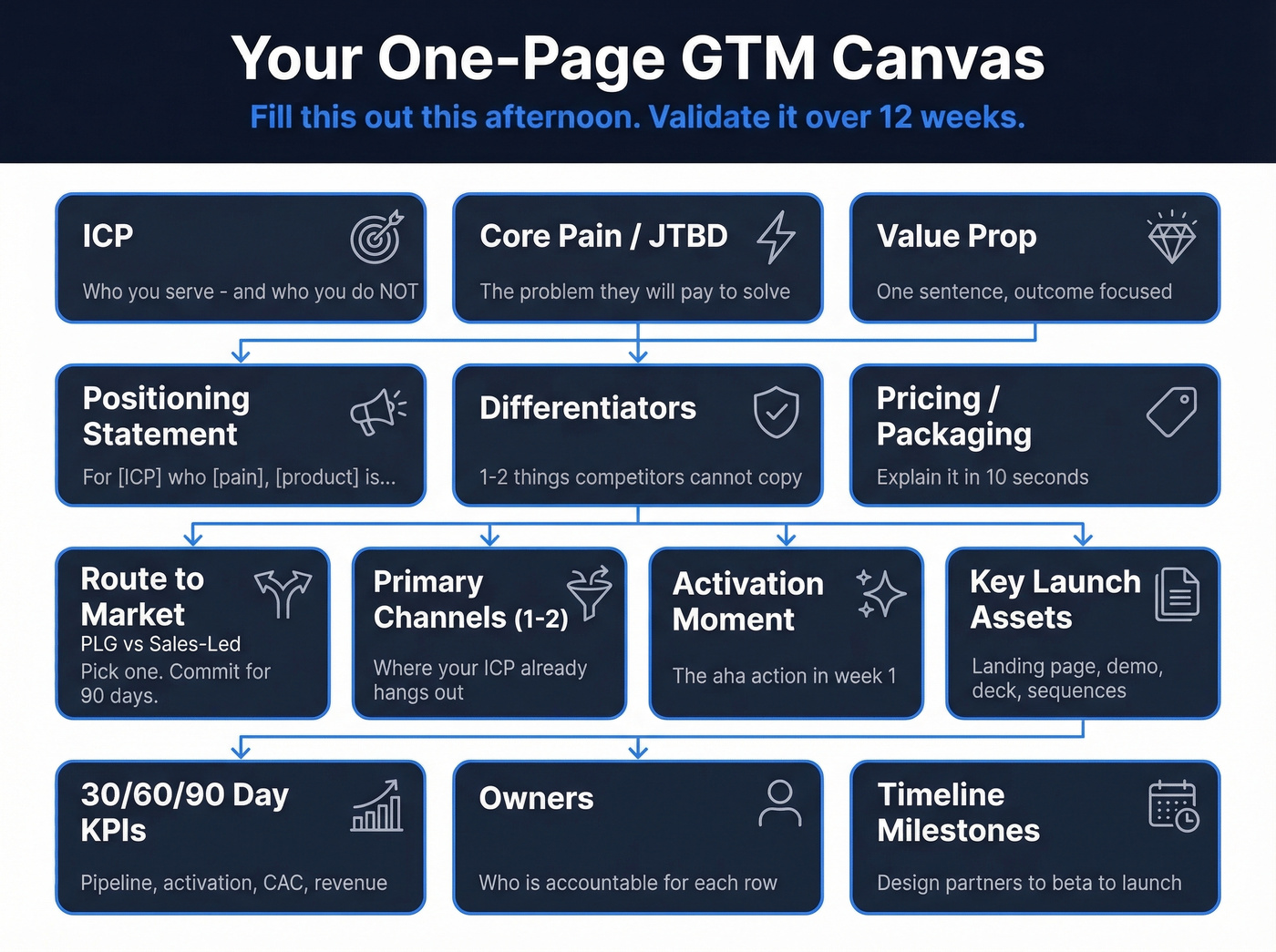
| Field | Your Answer |
|---|---|
| ICP | Who - and who you're NOT targeting |
| Core Pain / JTBD | The problem they'll pay to solve |
| Value Prop | One sentence, outcome-focused |
| Positioning Statement | For [ICP] who [pain], [product] is [category] that [key benefit] |
| Differentiators | 1-2 things competitors can't easily copy |
| Pricing / Packaging | Simple enough to explain in 10 seconds |
| Route to Market | PLG, sales-led, partner-led, or hybrid |
| Primary Channels (1-2) | Where your ICP already spends time |
| Activation Moment | The "aha" action in week 1 |
| Key Launch Assets | Landing page, demo, sales deck, sequences |
| 30/60/90-Day KPIs | Pipeline, activation, CAC, revenue, retention |
| Owners | Who's accountable for each row |
| Timeline Milestones | Design partners -> beta -> launch -> scale |
Here's a filled-out version for a hypothetical B2B SaaS tool called "DataSync":
| Field | Example: "DataSync" |
|---|---|
| ICP | RevOps managers at 50-200 person SaaS companies |
| Core Pain | CRM data decays 30%/quarter; reps waste hours on bad records |
| Value Prop | Automated CRM hygiene that keeps contact data fresh weekly |
| Positioning | For RevOps teams tired of manual data cleanup, DataSync is an enrichment layer that cuts stale records by 80% |
| Differentiators | Real-time sync (not batch), native HubSpot integration |
| Pricing | $99/mo per 10K records, free tier for 1K |
| Route to Market | PLG with sales-assist for 50K+ records |
| Channels | Content SEO + founder-led outbound |
| Activation | First CRM sync completed |
| Launch Assets | Landing page, 3-min demo video, 5-email sequence |
| 30/60/90 KPIs | 100 signups / 25% activation / 10 paid conversions |
| Owners | Founder (sales), co-founder (product + content) |
| Timeline | Design partners (wk 1-8) -> beta (wk 9-20) -> launch (mo 6) |
If you haven't nailed your broader business strategy yet, Wes Bush's One-Page Endgame framework is a solid upstream exercise before you touch the GTM canvas.

Your GTM canvas has a "Channels" row and a "30/60/90 KPIs" row. Outbound only works when your data connects you to real buyers. Prospeo gives you 300M+ profiles with 98% email accuracy, 125M+ verified mobiles, and 30+ filters to nail your ICP - so your simple GTM plan stays simple.
Fill your GTM canvas with data that actually converts.
Five Decisions That Fill the Canvas
Who's Your ICP?
Narrow beats broad at launch. Don't target "marketing leaders at mid-market companies" - target "demand gen managers at Series B SaaS companies with 3-5 person teams frustrated with their current data provider." Write down who's NOT targeting too. That constraint prevents the "let's also try enterprise" drift that kills focus in month two.
And don't confuse product research with buyer research. Knowing someone would use your feature isn't the same as knowing they'd pay for it.
If you need a fast starting point, use an ICP scoring rubric before you write a single outbound message.
PLG or Sales-Led?
This is a math problem, not a philosophy debate.
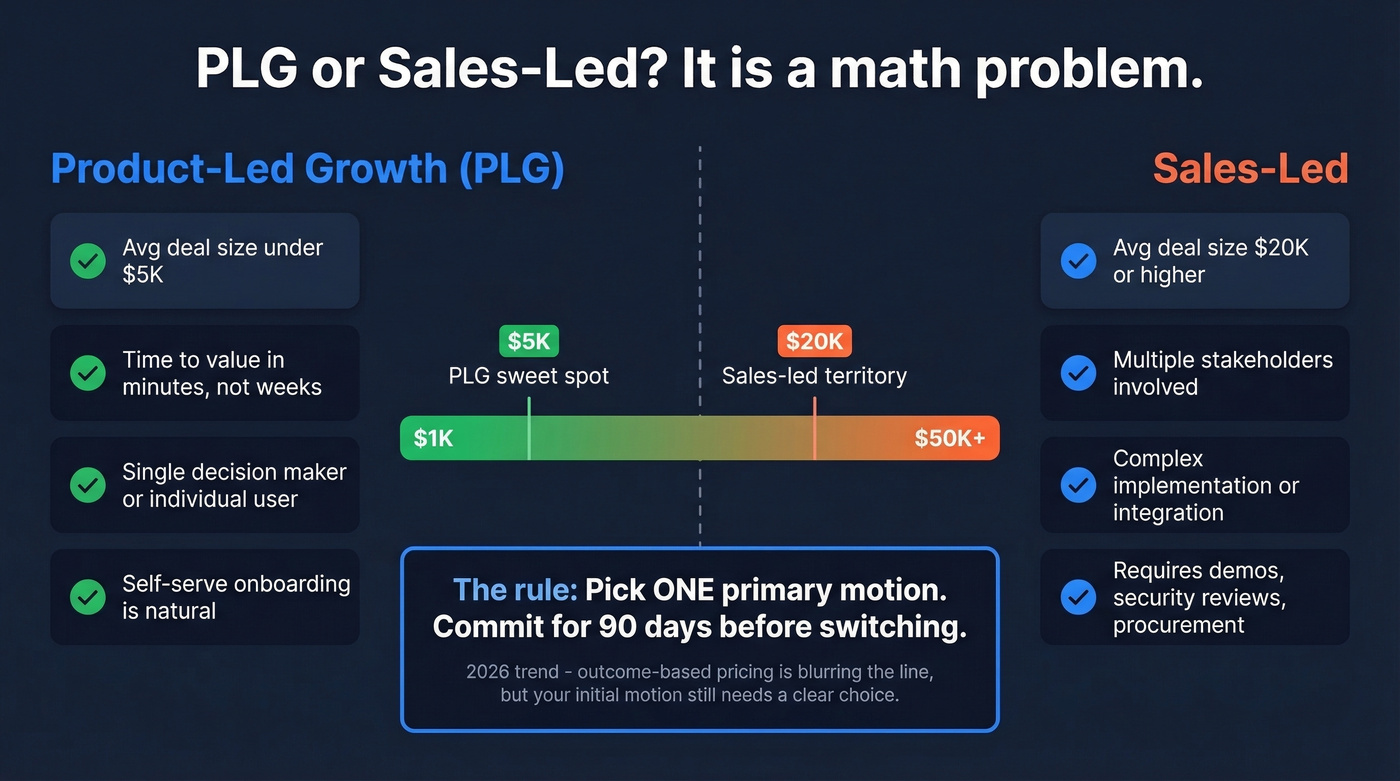
If your average deal is under $5K, you probably don't need a sales team yet. PLG works when time-to-value is measured in minutes. Sales-led makes sense at $20K+ with multiple stakeholders. Pick one primary motion and commit for 90 days before switching. A growing 2026 trend worth watching: pricing tied to measurable outcomes rather than seats or usage.
Which 1-2 Channels?
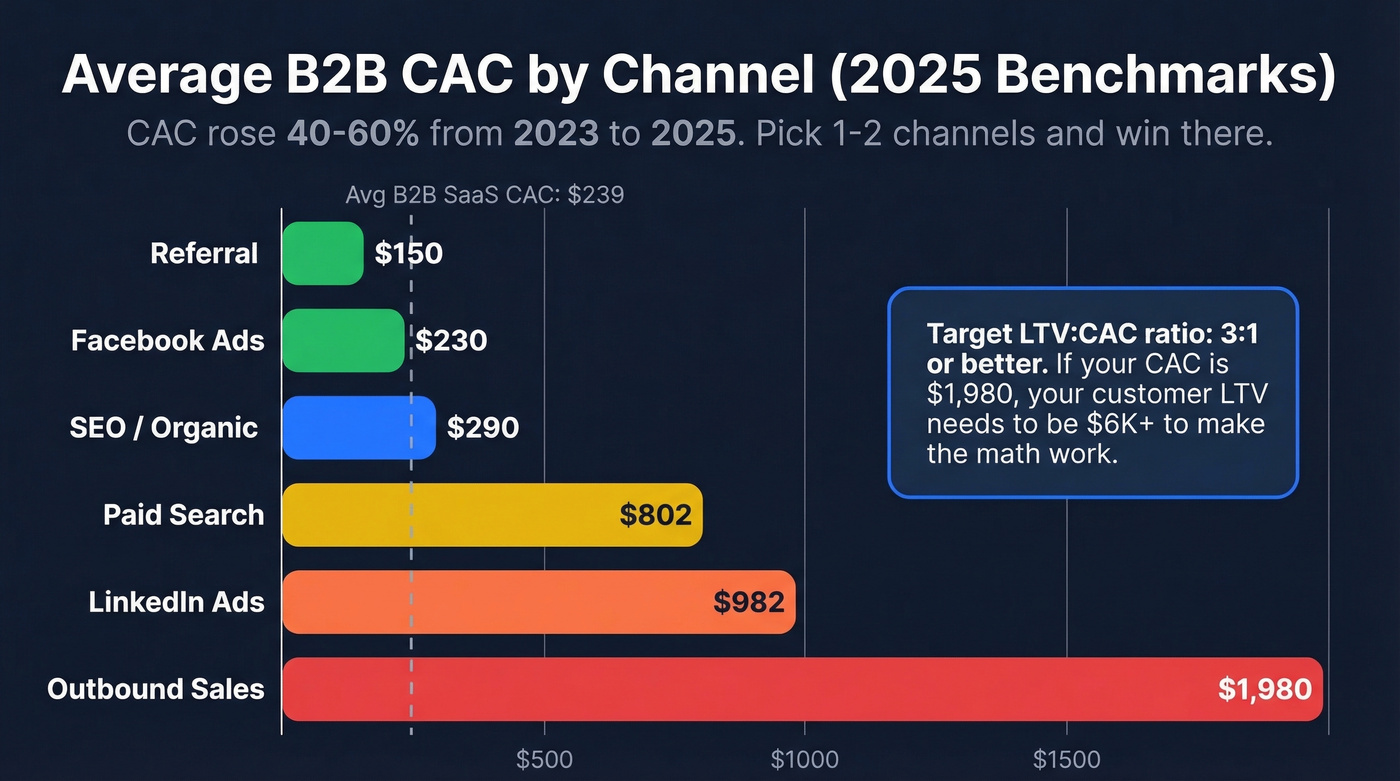
Startups that spread across five channels at once rarely win in any of them. CAC increased 40-60% from 2023 to 2025, and these numbers aren't getting friendlier:
| Channel | Avg B2B CAC |
|---|---|
| Referral | $150 |
| Facebook Ads | $230 |
| SEO / Organic | $290 |
| Paid Search | $802 |
| LinkedIn Ads | $982 |
| Outbound Sales | $1,980 |
Average B2B SaaS CAC sits at $239. Your LTV:CAC ratio should be 3:1 or better. If you're spending $1,980 per outbound-acquired customer, that customer better be worth $6K+ over their lifetime.
If you want to go deeper on the math, start with a clean definition of CAC before you compare channels.
What's working in 2026 for capital-constrained teams: small in-person events, founder brand paired with warm outbound, and ecosystem partnerships. We've seen early-stage teams get more traction from 20-person dinners than from $10K ad campaigns.
What's Your Activation Moment?
The single action that predicts whether a new user becomes a paying customer. Slack's was the first team message. Dropbox's was the first file sync.
Yours needs to be specific, measurable, and achievable in the first week. If you can't name it, you don't understand your product's value well enough yet. Design your entire onboarding around this single action - everything else is a distraction until that moment clicks for the user.
Your 30/60/90-Day KPIs
30 days: Pipeline or signups, activation rate. Are people showing up and doing the thing?
60 days: Conversion rate (free to paid or lead to closed), CAC by channel. Now you're measuring the economics.
90 days: Revenue run rate, retention/churn, LTV:CAC. This is where you decide what to double down on and what to kill.
If you’re building a sales motion, a 30/60/90-day plan helps you keep the KPIs realistic.
For early-stage outbound B2B, expect 2-6 months to meaningful revenue. SEO takes 3-9 months. Set expectations accordingly and don't panic-pivot at week three.
Mistakes That Kill Simple GTM Plans
Scaling assumptions instead of truths. Hiring reps and formalizing funnels before validating that customers will pay is the classic early-stage trap. Your first GTM motion should optimize for learning, not efficiency.
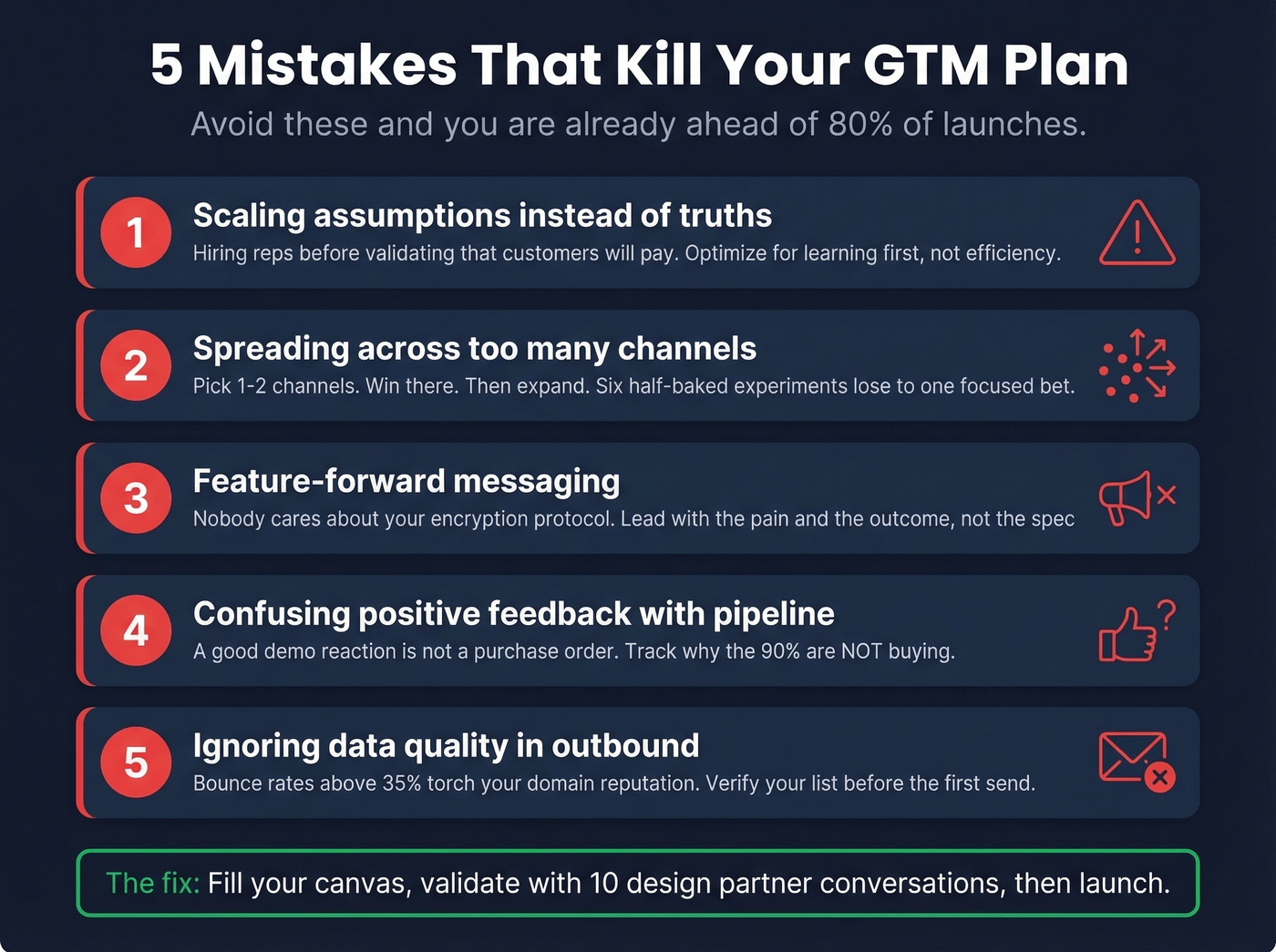
Spreading across too many channels. Pick one or two. Win there. Then expand. We can't stress this enough - in our experience, the teams that resist the urge to be everywhere outperform the ones running six half-baked experiments.
Feature-forward messaging. Cybersecurity buyers don't care about your encryption protocol. They care about not getting breached. Lead with the pain and the outcome, not the spec sheet.
If you’re struggling to land the message, steal a few sample elevator pitches and rewrite them in your buyer’s language.
Confusing "prospect likes it" with "prospect will buy it." Positive demo feedback isn't pipeline. As one multi-startup sales leader put it on Reddit: "Track why the 90% aren't buying - not just the 10% who do."
Ignoring data quality in outbound. Bounce rates above 35% don't just waste sends - they torch your domain reputation. If you're running outbound as a primary channel, verifying your list before the first send isn't optional. Prospeo's free tier gives you 75 verified emails per month at 98% accuracy, which is enough to validate your first outbound motion without spending a dollar.
If you’re seeing deliverability issues, start by tracking your email bounce rate and fixing the root cause before scaling volume.
Let's be honest: not every shortcut is a mistake. Skipping a full enablement program to launch faster is an acceptable tradeoff when your team is small enough to iterate in real time. A good GTM plan has the canvas filled. A great one has been validated with 10 design partner conversations.

You just saw that outbound CAC averages $1,980. Bad data makes it worse - bounced emails burn your domain and waste every dollar. Prospeo's 7-day data refresh and 5-step verification keep bounce rates under 4%, so your outbound channel hits the 3:1 LTV:CAC ratio you need.
Cut your outbound CAC by starting with data that doesn't bounce.
Your Launch Timeline
Not every launch needs the full playbook. Use the P0/P1/P2 tiering from Intercom's framework to right-size the work: P0 gets the complete GTM plan, P1 gets a lighter version, P2 gets a landing page and an email. Skip the P0 treatment for minor feature updates - you'll burn out your team and your audience.
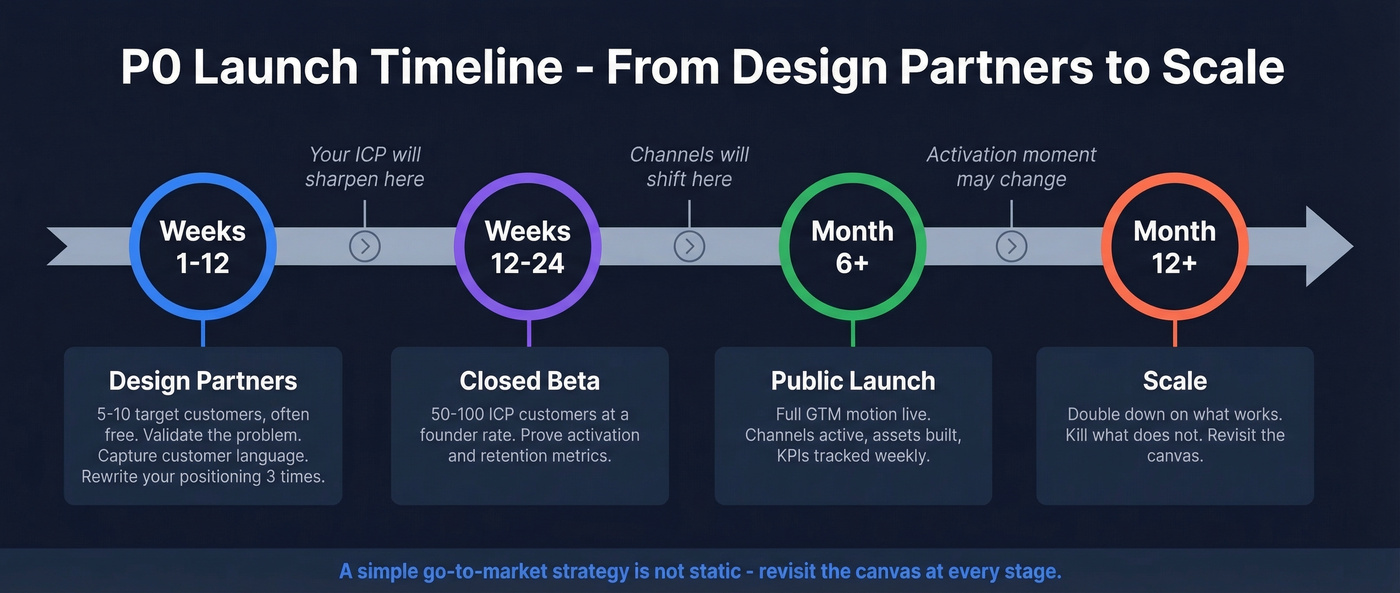
For a P0 launch:
- Weeks 1-12 (Design Partners): 5-10 target customers, often free. Validate the problem, capture customer language. This is where your positioning statement gets rewritten three times, and that's a good thing.
- Weeks 12-24 (Closed Beta): 50-100 ICP customers at a discounted "founder rate." Prove activation and retention.
- Month 6+ (Public Launch): Full GTM motion - channels live, assets built, KPIs tracked.
- Month 12+ (Scale): Double down on what's working. Kill what isn't.
Revisit the canvas at each stage. Your ICP will sharpen, your channels will shift, and your activation moment will change. That's the point - a simple go-to-market strategy isn't static, it's a living document that evolves with every customer conversation.
If your launch includes outbound, build a repeatable B2B cold email sequence before you scale list size.
FAQ
How long does a one-page GTM plan take to build?
The canvas itself takes an afternoon. Validating it with real customers takes 4-12 weeks of design partner conversations. Don't confuse planning with execution - the plan is fast, the learning isn't.
What makes a go-to-market strategy effective?
A strong GTM strategy clearly defines one ICP, one primary motion, and one or two channels - then validates all three with real buyer conversations before scaling spend. If you can't explain it in under a minute, it's too complicated for launch stage.
GTM strategy vs marketing strategy?
A GTM strategy is a launch-specific sprint with a defined end date. A marketing strategy is the long game - brand, demand gen, retention over time. You need both, but the GTM plan comes first.
What's a good CAC for a startup?
B2B SaaS average CAC is $239, but the number that matters is your LTV:CAC ratio - aim for 3:1 or better. If you're spending $500 to acquire a customer worth $400, your GTM motion is broken regardless of channel.
How do I validate outbound without burning my domain?
Start with a small, verified list - 75-150 contacts - and send personalized sequences from a warmed domain. Keep bounce rates under 4% by verifying every address before you send, and don't scale volume until your reply rates prove the messaging works.