


What Independent Tests Actually Show
Skrapp holds a 4.5/5 on G2 across 324 reviews and a 4.5 on Capterra across 57 reviews. It also claims a 92% email search success rate. Those numbers don't tell the same story. Three independent benchmarks - covering 2,500 to 100,000+ contacts - consistently land Skrapp's valid email rate between 43% and 48%. If you're reading Skrapp reviews to figure out whether it's worth the money, that gap between marketing and reality is the only thing that matters.
Skrapp works for casual prospecting on a tight budget. It's not reliable enough for teams where deliverability is non-negotiable.
What Skrapp Does
Skrapp is a credit-based email finder and verifier with a Chrome extension. You can find emails via its lead/company search, enrich lists in bulk via CSV upload, then verify results one at a time or in batches. Coverage includes 20M+ companies and 150M+ leads, and there's API access for programmatic workflows. Setup takes minutes and the interface is genuinely simple - we'll give it that.
Accuracy: Claims vs. Reality
Skrapp's pricing page advertises a 92% email search success rate and 97%+ verification accuracy. We compared three independent benchmarks to see what actually holds up.
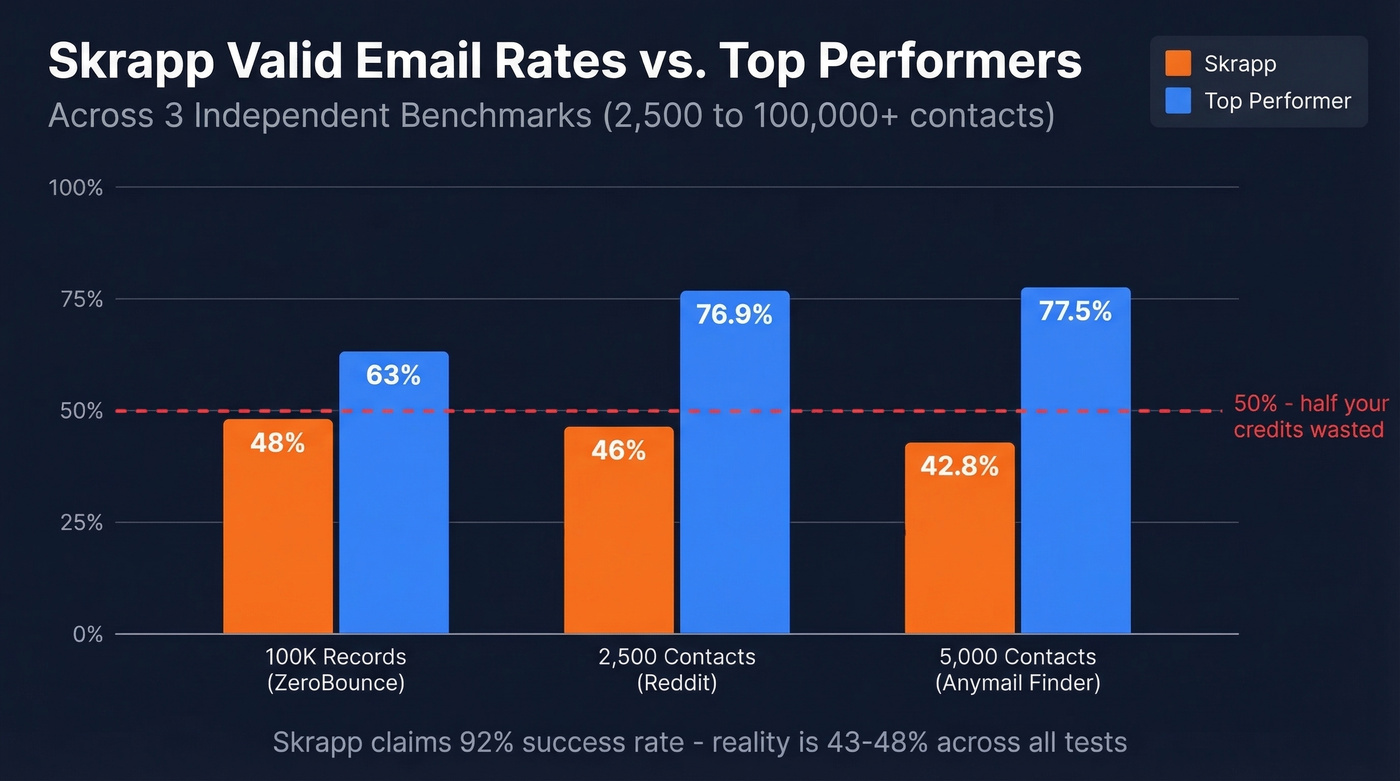
| Test | Sample Size | Skrapp Valid Rate | Top Performer |
|---|---|---|---|
| ZeroBounce-validated | 100,000 records | 48% | Apollo: 63% |
| Same-file comparison | 2,500 contacts | 46% | Tomba: 76.9% |
| Anymail Finder benchmark | 5,000 contacts | 42.8% | Anymail Finder: 77.5% |
The pattern holds across different sample sizes, testers, and validation methods. Skrapp lands in the mid-40s every time. The 100K-record test - the largest and most rigorous - also flagged that Skrapp gave "very poor results" for non-technical verticals like healthcare and finance.
Top performers in these benchmarks hit 75-77% valid rates, and the best verification stacks reach 98% accuracy. A 45% valid rate means more than half your credits produce unusable contacts. In our experience, anything below ~60% creates more deliverability problems than it solves.
Here's the thing: Skrapp's accuracy is fine if you're a solo founder sending 50 cold emails a week. The moment you scale past that - or care about domain reputation - you've outgrown it.

At 45% valid rates, more than half your Skrapp credits produce unusable contacts. Prospeo's 5-step verification - with catch-all handling, spam-trap removal, and honeypot filtering - delivers 98% email accuracy at ~$0.01/email. Snyk's 50 AEs dropped bounce rates from 35-40% to under 5% after switching.
Stop paying for emails that bounce - get 98% accuracy from day one.
Pricing Breakdown
| Plan | Monthly (Billed Annually) | Credits/Mo | Users |
|---|---|---|---|
| Free | $0 | 100 | 1 |
| Professional | $30/mo | 1,000 | 2 |
| Enterprise | $262/mo | 50,000 | 15 |
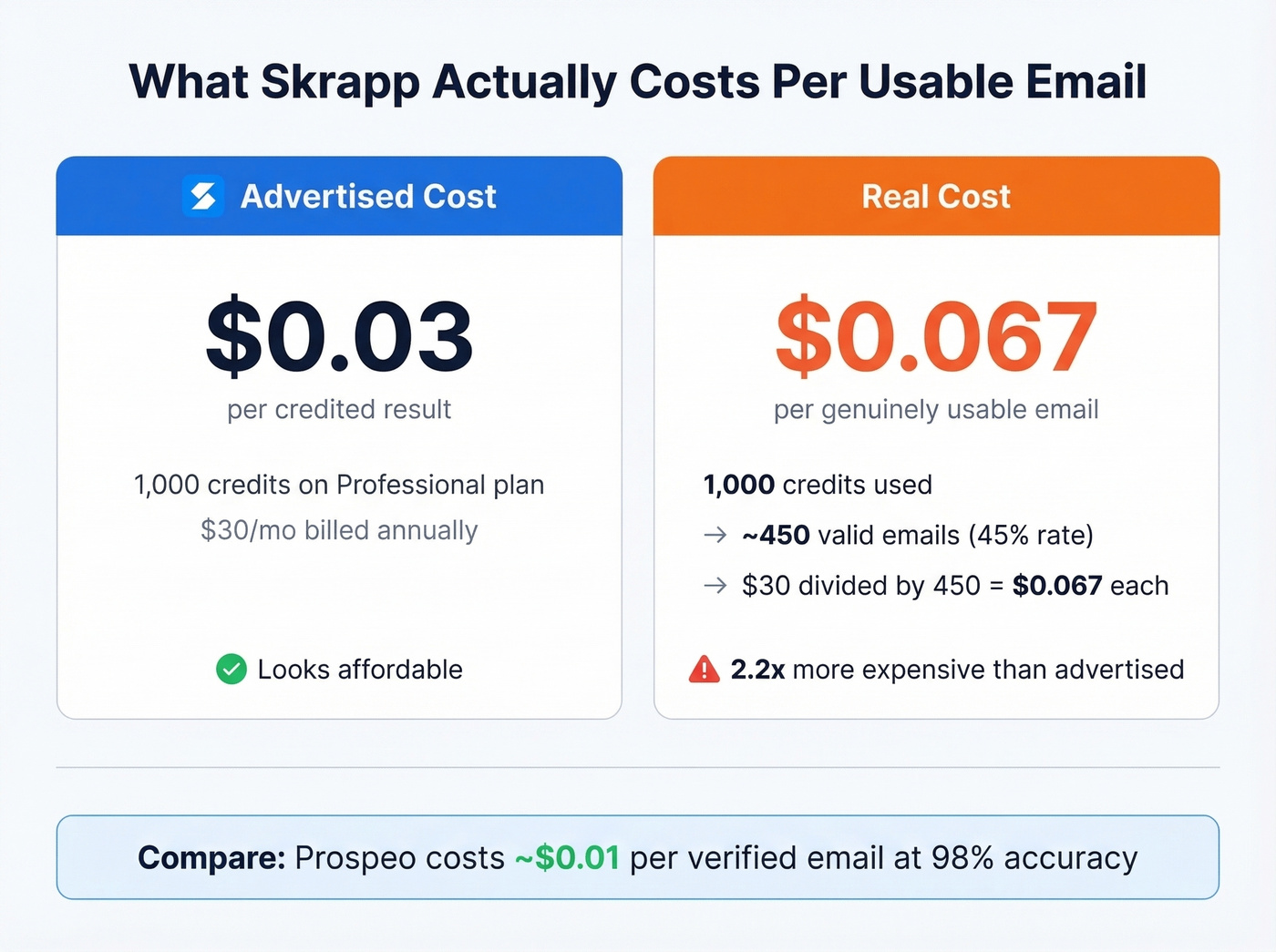
Credits roll over, and you keep unused credits if you cancel. Skrapp charges one credit per email returned as "Valid" or "Catch-all" - you aren't charged for Invalid or Unknown results.
That catch-all detail matters more than it looks. Catch-all emails accept any address at the domain, so they often bounce in practice. At a 45% valid rate on the Professional plan, your effective cost per genuinely usable email is roughly $0.067 - not $0.03 per credited result. For teams running volume, that math gets ugly fast.
Pros and Cons From Real Users
What users genuinely like: Ease of use dominates the positive feedback - 92 mentions on G2 alone. Setup is fast, the Chrome extension integrates cleanly into prospecting workflows, and the interface requires zero training. If you just need something simple that works out of the box, Skrapp delivers on that front.
If you're building a broader outbound stack, it helps to compare tools in the wider category of SDR tools and sales prospecting techniques before you commit.
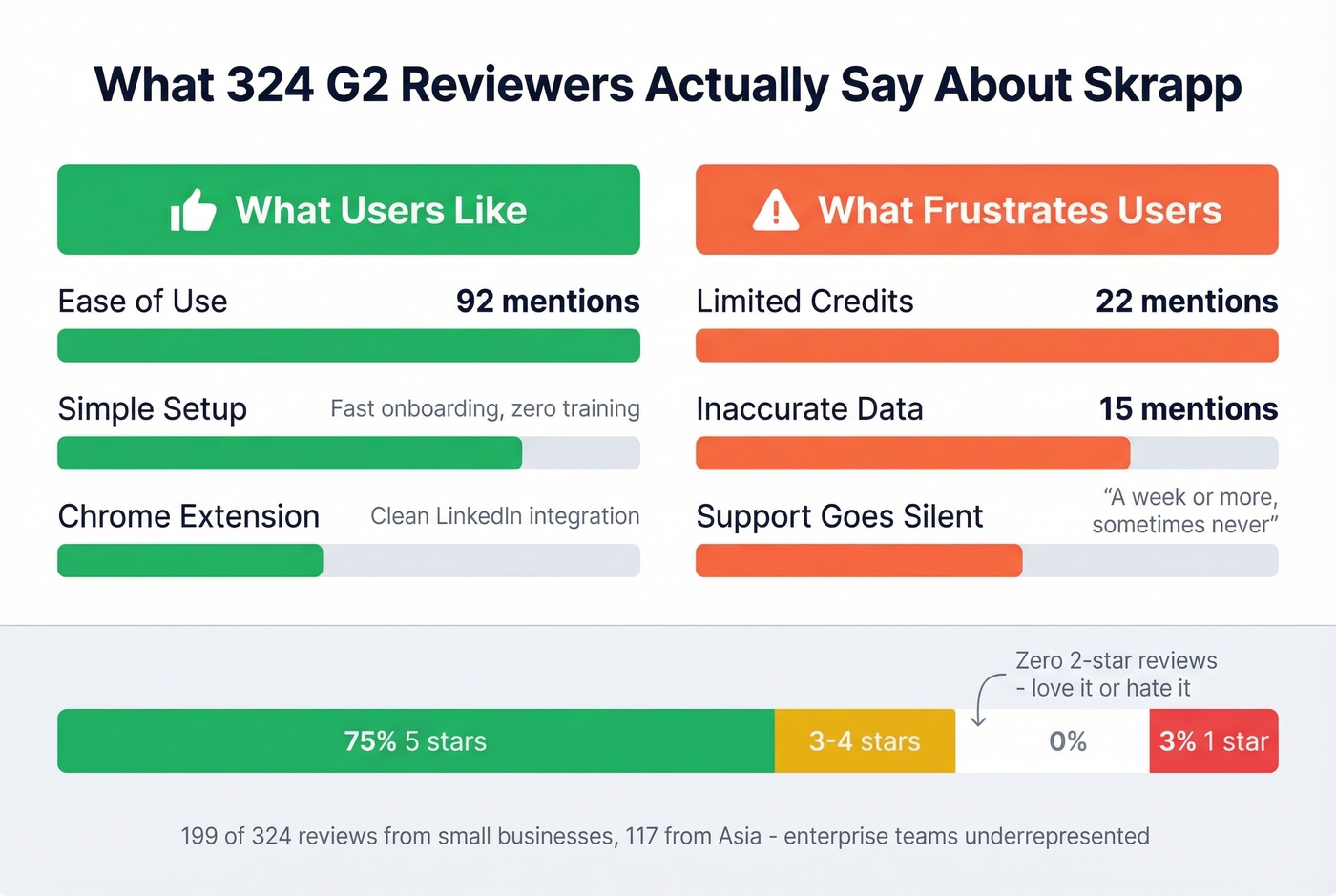
What keeps coming up as problems: Limited credits (22 G2 mentions) and inaccurate data (15 mentions) are the top complaints. On Capterra, one CEO wrote that support "go silent for a week or more... sometimes never reply." Multiple reviewers report entire batches where "not single email is not correct in entire data." The extension also feels dated, and users report compatibility issues with evolving web interfaces.
The rating distribution tells its own story. 75% five-star but 3% one-star with zero two-star reviews, suggesting users either love the simplicity or hit serious accuracy walls with nothing in between. It's also worth flagging that 199 of 324 G2 reviews come from small businesses, with 117 from Asia - enterprise and mid-market teams running high-volume outbound are underrepresented in the review base.
If you're seeing bounces, start with the basics: email bounce rate and a proper email deliverability guide.
Better Alternatives
Prospeo - Best for Accuracy
If bounce rates are the reason you're comparing email finders, this is the direct fix. Prospeo runs a 5-step verification process with catch-all handling, spam-trap removal, and honeypot filtering - delivering 98% email accuracy across 143M+ verified emails. Its proprietary email-finding infrastructure doesn't rely on third-party providers, and data refreshes every 7 days instead of the 6-week industry average.
If you want a broader shortlist first, compare options across the best email search tools and data enrichment services.
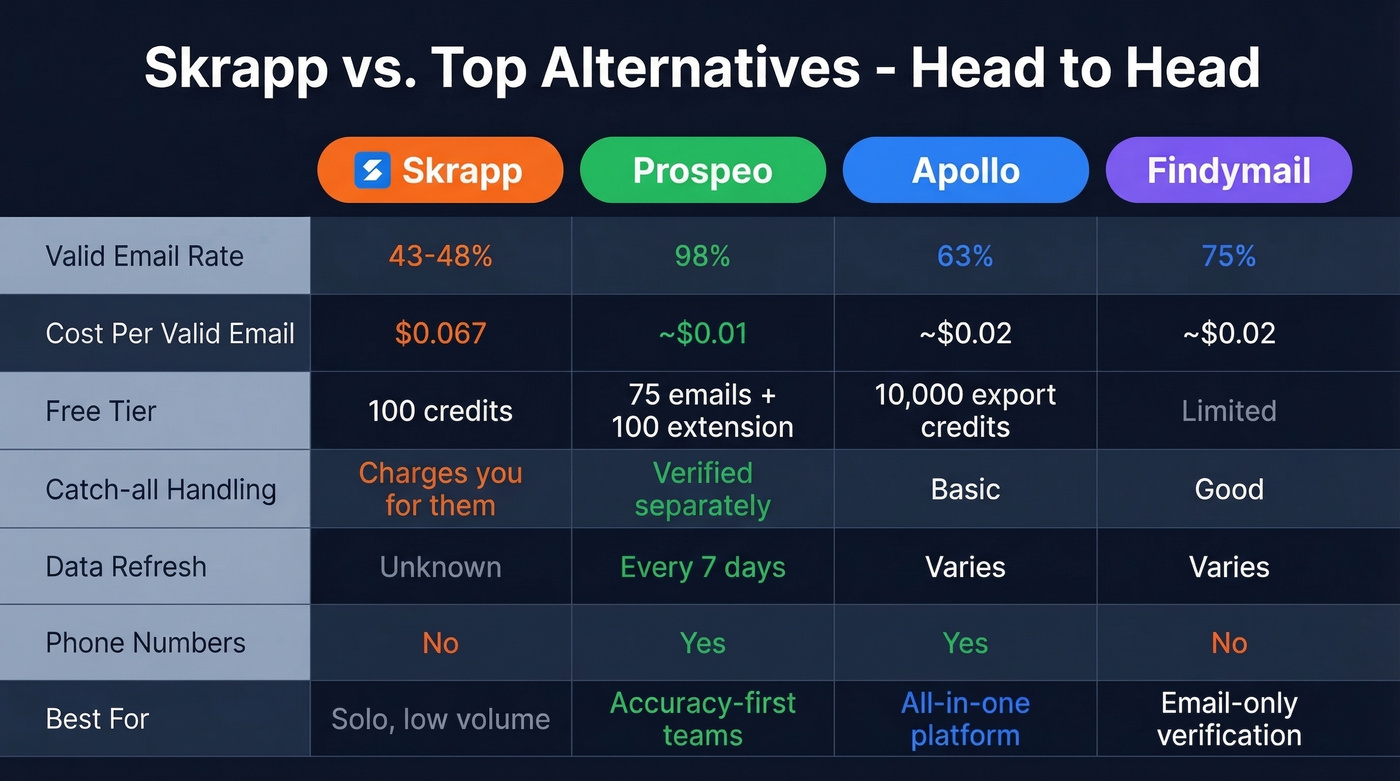
At roughly $0.01 per email with a free tier of 75 emails/month, the effective cost per valid contact is a fraction of what you'd pay with Skrapp. No contracts, self-serve signup, and native integrations with Salesforce, HubSpot, Instantly, and Lemlist. Real-world results back this up: Snyk cut bounce rates from 35-40% to under 5% after switching, and Stack Optimize maintains 94%+ deliverability across all client campaigns.

Apollo - Best All-in-One Platform
Apollo hit 63% valid in the same ZeroBounce test where Skrapp scored 48%. Its 275M+ contact database and built-in sequencer make it the better bet if you want prospecting and outreach in one platform. Plans start around $59/mo per user.
If you're scaling outbound, it’s also worth tightening your email velocity to protect deliverability.
Findymail - Strong Verified Rates
Findymail scored 75.1% in the 5,000-contact benchmark and 75.2% in the Reddit same-file test. If verified rates are your primary metric, it's a solid pick. The consensus on r/coldemail is that RocketReach is also worth testing if you've been burning through bounces with other tools.
Skip Findymail if you need phone numbers or a full leads database - it's email-only.
Skrapp charges you for catch-all emails that frequently bounce, inflating your real cost to $0.067 per usable contact. Prospeo's proprietary infrastructure verifies catch-all domains separately, refreshes data every 7 days, and costs roughly $0.01 per verified email. No contracts, no surprises.
Pay for emails that actually land - 75 free credits, zero commitment.
FAQ
Is Skrapp accurate?
Independent tests show 43-48% valid email rates across samples of 2,500 to 100,000 contacts, well below the claimed 92%. Roughly half your results will be unusable for outbound campaigns. Tools like Prospeo (98%) and Findymail (75%) consistently outperform in the same benchmarks.
Does Skrapp charge for catch-all emails?
Yes. Skrapp deducts one credit for any result returned as "Valid" or "Catch-all." Since catch-all domains accept all addresses regardless of whether a mailbox exists, these frequently bounce. Your effective cost per usable contact jumps from $0.03 to roughly $0.067.
Is Skrapp worth it for outbound teams?
For solo prospectors sending under 50 emails per week, the free or $30/mo plan can work. For teams running outbound at scale, the 43-48% valid rate makes per-contact economics hard to justify - alternatives deliver 75-98% accuracy at comparable or lower prices.
What's the best free alternative to Skrapp?
Prospeo offers 75 free emails per month plus 100 Chrome extension credits with full 5-step verification at 98% accuracy. That's more usable contacts from fewer credits than Skrapp's 100-credit free tier at 45% valid rates. Apollo also has a free plan with 10,000 export credits monthly, though its accuracy sits lower at 63%.