

What Every Major Definition Actually Says
Ask ten sales leaders to define SMB employee size and you'll get twelve answers. One r/sales thread captures this perfectly - a poster's previous company called SMB anything under 10 employees, while their current employer uses the label for companies under 1,000. That's not a rounding error. It's a completely different market.
The Quick Answer
For most B2B sales and marketing teams: small business = 1-99 employees, midsize = 100-999, enterprise = 1,000+. No universal standard exists, but this is the segmentation most SaaS companies default to when defining SMB company size.

You just defined your SMB headcount bands. Now build lists that match them. Prospeo's B2B database lets you filter 300M+ profiles by exact employee range, headcount growth, and department size - so your segmentation model becomes a targetable pipeline, not a slide in a strategy deck.
Turn your headcount bands into verified prospect lists in minutes.
Definitions by Source
Different institutions define "small" and "medium" for completely different purposes. The SBA cares about contracting eligibility. The EU cares about regulatory compliance and program access. Gartner-style bands get used for market sizing and GTM segmentation. And your VP of Sales? They care about quota assignment.
If you're building a repeatable segmentation model, it helps to treat headcount as one of your core firmographic filters and document it inside your ideal customer profile.
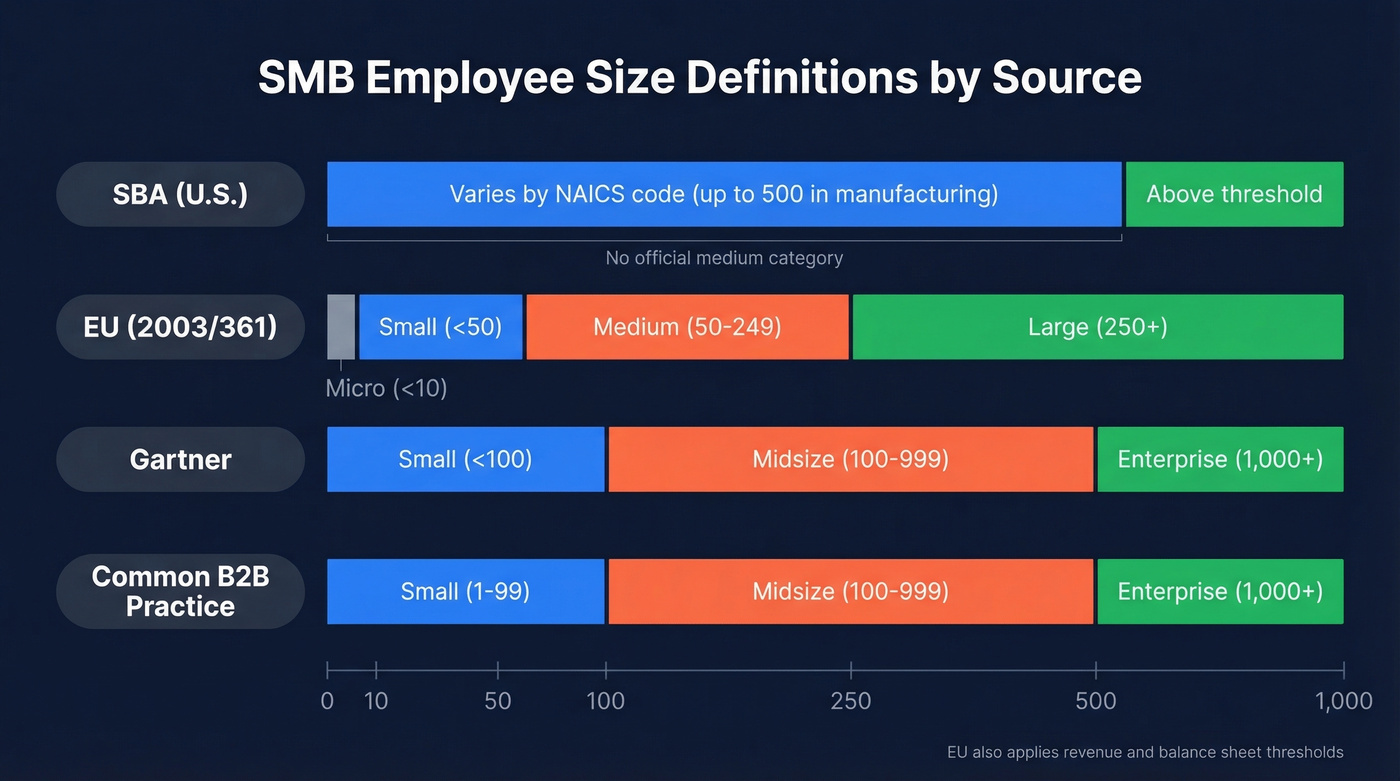
| Source | Small Business | Medium Business | Large/Enterprise |
|---|---|---|---|
| SBA (U.S.) | Varies by NAICS code | N/A (no "medium" category) | Above SBA threshold |
| EU (2003/361) | <50 employees (+ financial thresholds) | 50-249 employees (+ financial thresholds) | 250+ employees |
| Gartner (common cite) | <100 employees | 100-999 employees | 1,000+ employees |
| Common B2B practice | 1-99 employees | 100-999 employees | 1,000+ employees |
The EU also defines micro-enterprise as <10 employees. Its SME definition uses staff headcount plus turnover or balance sheet thresholds, and companies in a group may need to include group-level headcount and financials.
The SBA doesn't use a single employee number - it sets size standards industry by industry via NAICS codes. Manufacturing businesses can qualify as "small" with up to 500 employees, which is wild when you think about it. For B2B sales teams, the SBA definition is mostly irrelevant. It was built for procurement policy, not pipeline segmentation.
The EU layers financial criteria on top of headcount, and the Commission is introducing a "small mid-cap (SMC)" category to address the cliff-edge problem when firms outgrow SME status. That's a practical acknowledgment that the jump from 249 to 250 employees shouldn't change everything overnight.
Here's the thing: if your average contract value is under $15k, you probably don't need to agonize over whether "midsize" starts at 100 or 200 employees. Pick a number, document it, and move on. Consistency matters more than precision.
U.S. Business Size Distribution
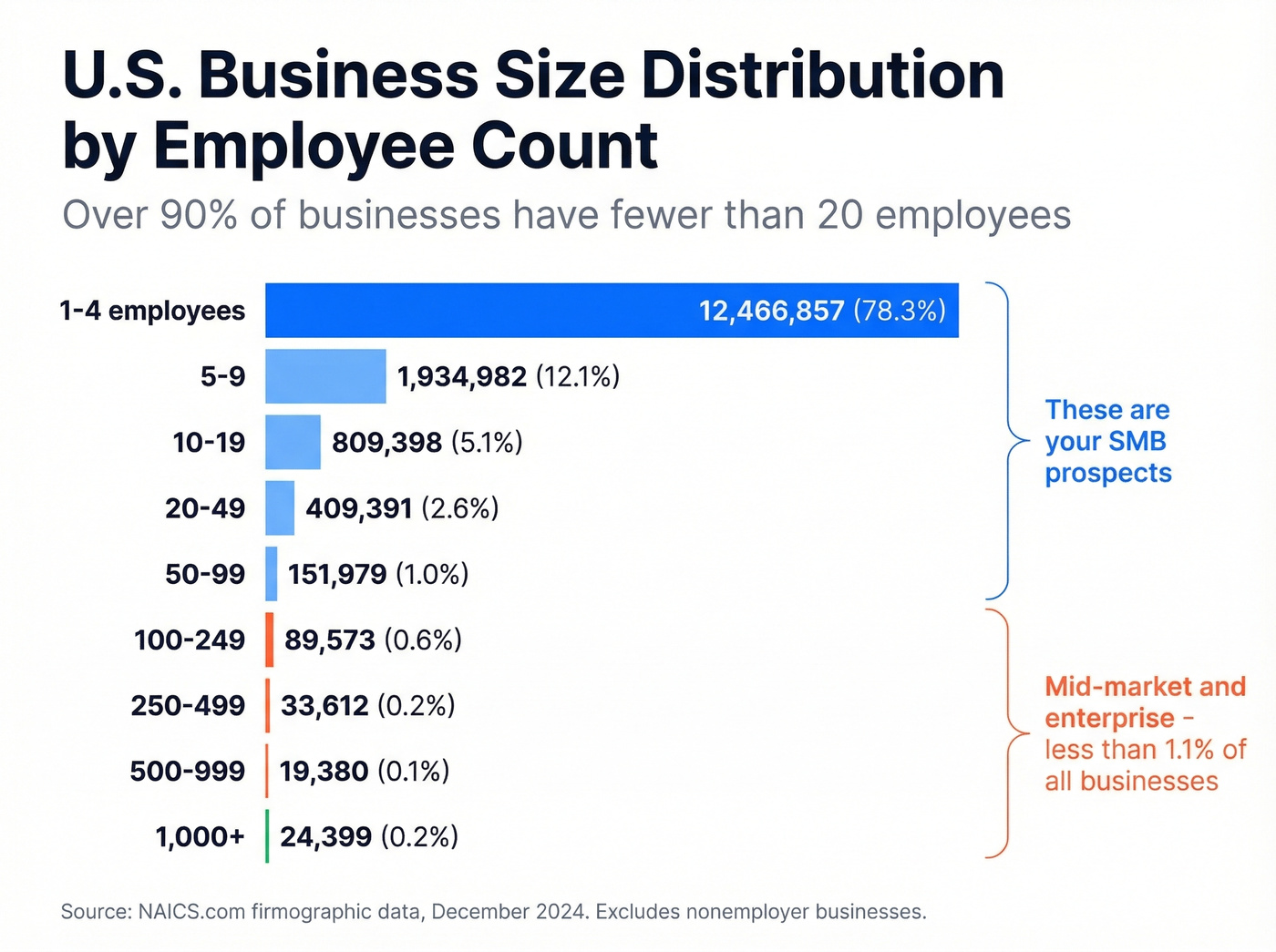
The vast majority of U.S. businesses are tiny. This table makes the skew obvious.
| Employee Band | Count | % of Total |
|---|---|---|
| 1-4 | 12,466,857 | 78.3% |
| 5-9 | 1,934,982 | 12.1% |
| 10-19 | 809,398 | 5.1% |
| 20-49 | 409,391 | 2.6% |
| 50-99 | 151,979 | 1.0% |
| 100-249 | 89,573 | 0.6% |
| 250-499 | 33,612 | 0.2% |
| 500-999 | 19,380 | 0.1% |
| 1,000+ | 24,399 | 0.2% |
Computed from NAICS.com firmographic data (updated December 2024). Excludes 1,830,128 uncoded records.
Over 90% of businesses in that dataset have fewer than 20 employees. And that's before counting the 29,811,495 nonemployer businesses - sole proprietors, freelancers, and single-member LLCs with no paid employees - tracked by the Census Bureau in 2022. When someone says "99.9% of U.S. businesses are small," they're technically right but practically misleading, because most of those businesses aren't buying your software.
If you're using this distribution to estimate market size, map it into your addressable market model so your TAM/SAM/SOM math stays consistent.
Why Headcount Bands Matter for Sales
Getting your size bands right directly shapes how you sell and who you hire.
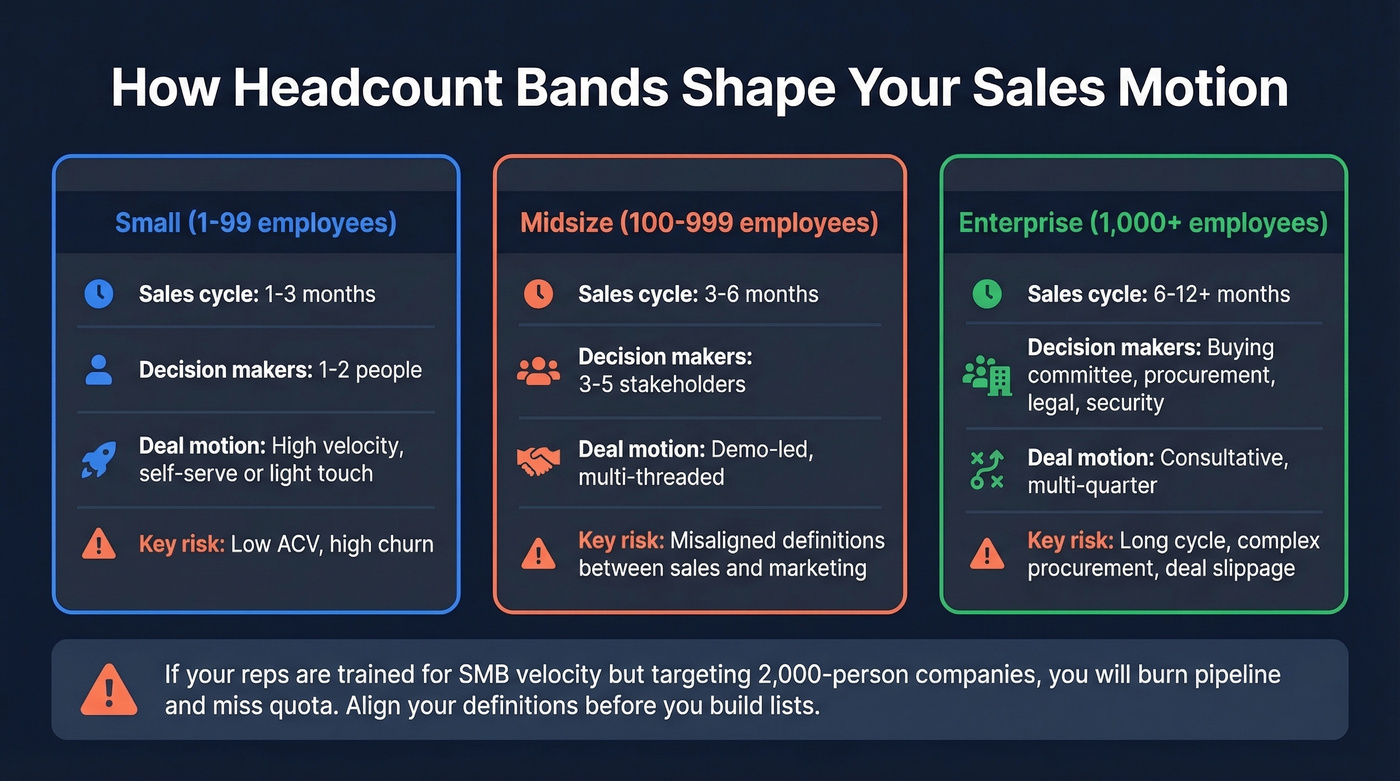
SMB deals typically close in 1-3 months with one or two decision-makers. Enterprise deals run 6-12 months with procurement teams, security reviews, and legal redlines. If your reps are trained for SMB velocity and you're accidentally targeting 2,000-person companies, you'll burn pipeline and miss quota.
We've seen teams waste months because sales and marketing were using different definitions of "mid-market." One team meant 50-200 employees, the other meant 200-2,000. That misalignment showed up everywhere - in ad targeting, lead scoring, territory assignments, and eventually in a very uncomfortable QBR. Let's be honest: most segmentation problems aren't strategic failures. They're alignment failures. Once you've agreed on bands internally, the next step is building lists that actually match them. Prospeo's B2B database lets you filter by exact headcount range and headcount growth across 300M+ profiles, so your segmentation translates into targetable prospects instead of sitting in a strategy deck.
To operationalize the handoff, build a simple lead generation workflow and track pipeline health by segment so you can see where each band breaks.
FAQ
What is an SMB company?
An SMB is a small or medium-sized business, typically defined by headcount, revenue, or both. In most B2B contexts, an SMB has fewer than 1,000 employees. The EU caps the definition at 250, while Gartner and most SaaS vendors use 999 as the upper bound.
Is 500 employees SMB or enterprise?
Under SBA rules, 500 employees still qualifies as "small" for many manufacturing NAICS codes. Gartner-style segmentation calls it midsize. Most B2B sales teams label it mid-market. Use whichever definition your organization has documented and agreed on - skip this debate entirely if you haven't aligned sales and marketing on the same number first.
What's the difference between SMB and SME?
Same concept, different geography. SMB is the North American term; SME is the European equivalent. The EU caps SME at 249 employees with financial thresholds, while most U.S. B2B teams use 999 as the midsize upper bound.
How do I build prospect lists by company size?
Pick a framework - Gartner-style bands work for most B2B teams. Document it so sales and marketing align. Then use a database with headcount filters to build lists that match your specific bands. Prospeo offers 30+ filters including headcount range, headcount growth, and department size, which makes it straightforward to turn your segmentation model into actual outreach lists.
Misaligned size definitions kill pipeline. Bad contact data kills deals. Once your team agrees on SMB vs. mid-market vs. enterprise, you need emails that actually land. Prospeo delivers 98% email accuracy at ~$0.01/email with a 7-day data refresh - so your segmented lists don't rot before reps touch them.
Segment by headcount, reach verified contacts - start free with 75 emails.