

How to Build a Software Development Sales Pitch That Actually Closes Deals
Your last proposal took 12 hours to write. The prospect ghosted. You followed up twice, got a polite "we went another direction," and never learned what went wrong.
Here's the uncomfortable truth: 96% of B2B buyers have already researched you before you get the meeting, and 59% feel reps don't bother learning their specific challenges. Your software development sales pitch structure is probably fine. Your targeting and discovery are the problem.
What Buyers Actually Evaluate
Forget what you think buyers care about. They're not scoring your tech stack or your team's GitHub profiles. The criteria that actually drive vendor selection: time-to-value (can you show a working prototype in weeks, not months?), onboarding speed, documentation quality, and reference checks with past clients who'll answer honestly.
The red flags that kill deals before you know you've lost them? Agencies that can't articulate their delivery process. Teams that overpromise timelines without asking hard questions about scope. Vendors who push solutions before understanding context. If a buyer senses you're an interchangeable task-taker rather than a strategic partner, you've already lost - and you probably won't get feedback explaining why.
The recurring theme in dev-agency threads on Reddit is that generic positioning makes you blend in, and cold outreach falls apart when you aim at irrelevant or low-budget leads. Smart agencies preempt these objections directly in the pitch - show your process, name your delivery methodology, and offer references unprompted.
Pitch Structure That Converts
The structure that consistently converts follows a specific arc: problem, story, outcomes, proof, pricing, CTA. Not features. Not your founding story. Not a slide about your tech stack.
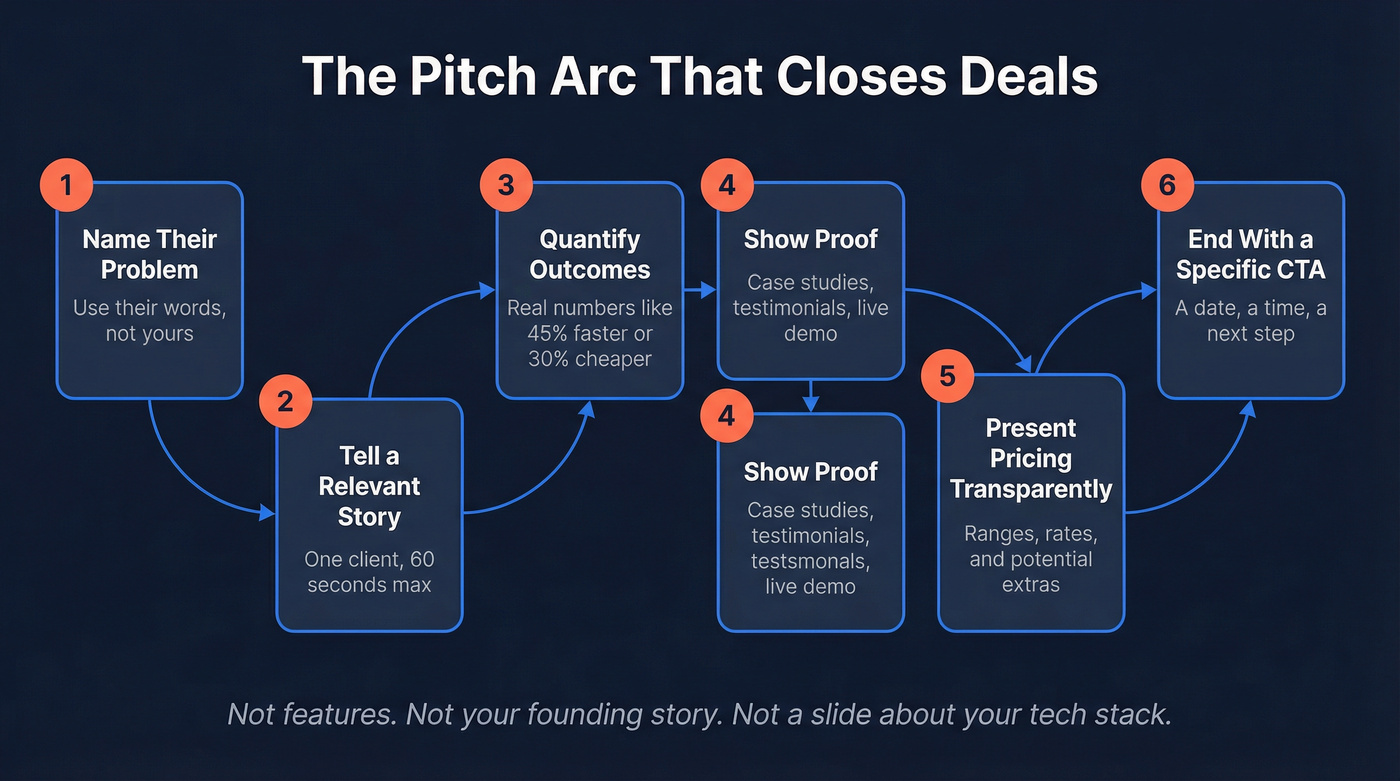
- Name the prospect's problem in their language. "Your ops team is managing inventory in spreadsheets and losing $X per quarter to manual errors" beats "we build custom software solutions."
- Tell a relevant story. One client. Similar problem. What you built. Under 60 seconds.
- Quantify outcomes. Not "improved efficiency" - actual numbers. "Cut order fulfillment time by 45%." "Reduced operational costs 30%." If you need benchmarks, ERP implementations average 200%+ ROI with a 16-month payback, and cloud ERP deployments deliver 4.01x the ROI of on-premises. Use numbers like these to frame your own case studies.
- Show proof. Case studies, testimonials, a live demo of similar work.
- Present pricing transparently. Approximate range, hourly rates by role, potential extras.
- End with a specific CTA. Not "let us know if you're interested." A date, a time, a next step.
One positioning angle that keeps surfacing on r/webdev and r/SaaS: "spreadsheet replacement." An agency owner described how most of their revenue came from helping companies stop managing sales, inventory, and operations in Excel. That's a niche. It's repeatable. And it immediately communicates value without jargon.
Run Discovery That Writes Your Pitch
The best pitch isn't written at your desk. It's assembled from what the prospect tells you on the discovery call. Here's a 30-minute structure we've refined over dozens of engagements:
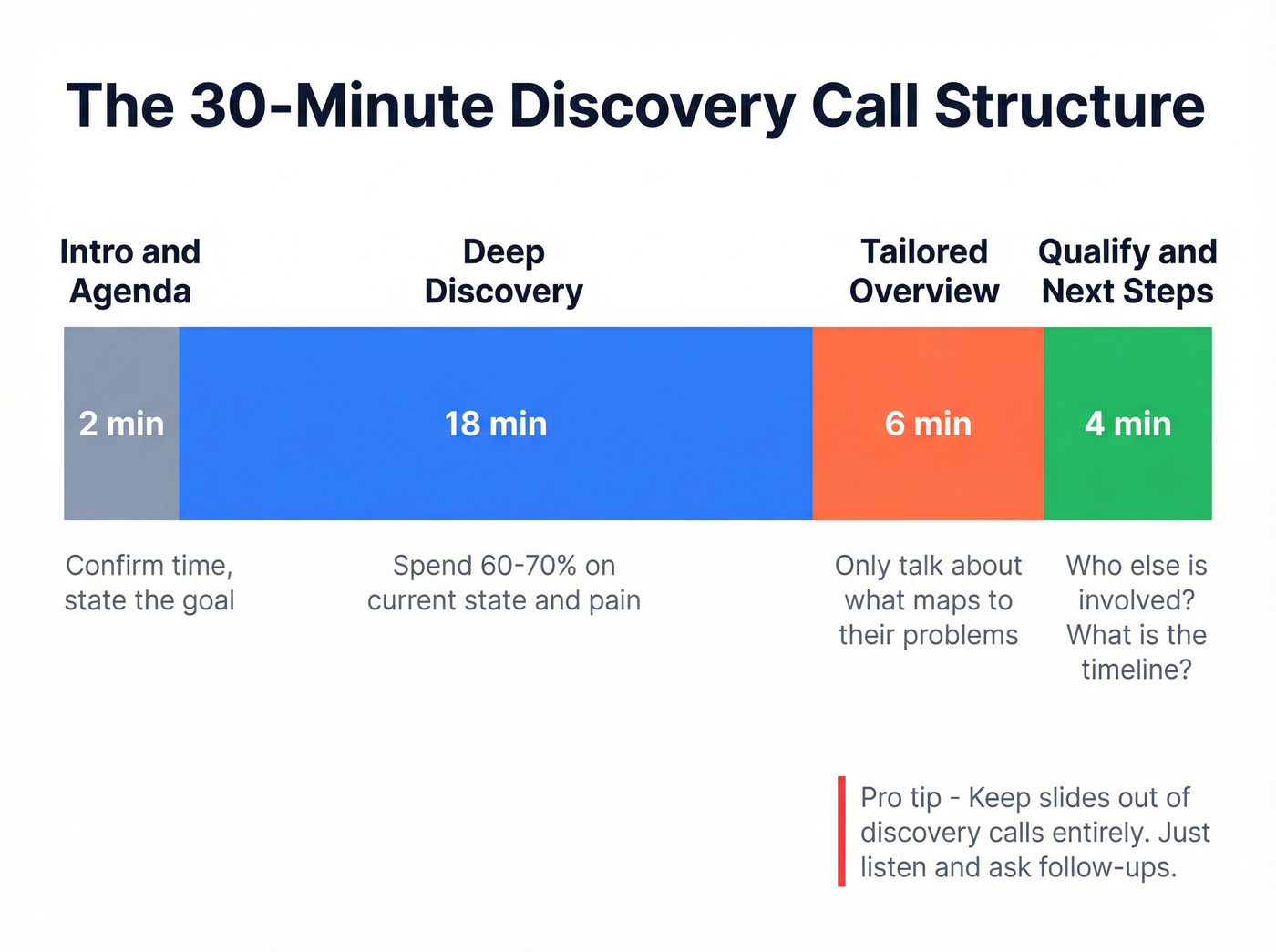
- 2 min: Intro and agenda-setting. Confirm time, state the goal.
- 18 min: Deep discovery. Spend 60-70% on current state and negative consequences. What's broken? What does it cost them? Who feels the pain most acutely, and how far up the org chart does that frustration travel? (If you want a tighter question bank, use a discovery call structure.)
- 6 min: Tailored overview. Only now do you talk about your approach - and only the parts that map to what they just told you.
- 4 min: Qualification and next steps. Who else needs to be involved? What's the timeline?
The second you share your screen, everyone's brain shuts off. Keep slides out of discovery calls entirely. Just listen, take notes, and ask follow-up questions.
For enterprise deals, add MEDDPICC's Paper Process questions early - legal review timelines, infosec requirements, procurement cycles. A deal that needs SOC 2 compliance review and a 6-week legal process isn't closing this quarter, and you need to know that before you invest 40 hours in a custom proposal.
Present Pricing Without Losing the Deal
Pricing is where most dev agency pitches fall apart. You either lowball and regret it, or present a number with zero context and watch the prospect's eyes glaze over.
| Model | Best For | Client Risk | Flexibility | Premium |
|---|---|---|---|---|
| Fixed Price | Small, scoped projects | Low cost, high scope | Low | 15-30% over T&M |
| Time & Materials | Complex/evolving work | Budget uncertainty | High | Baseline |
| Dedicated Team | Long-term products | Predictable monthly | High | Varies |
Fixed-price contracts carry a 15-30% risk premium over T&M quotes, and research from Jørgensen et al. found they double the risk of project failure after adjusting for project differences. Reserve fixed-price for small, well-defined engagements. For everything else, T&M with clear milestones gives both sides more room to build the right thing.
In our experience, pairing T&M with a lightweight SOW - scope summary, acceptance criteria, and a clear change-order process - prevents the budget disputes that kill client relationships.
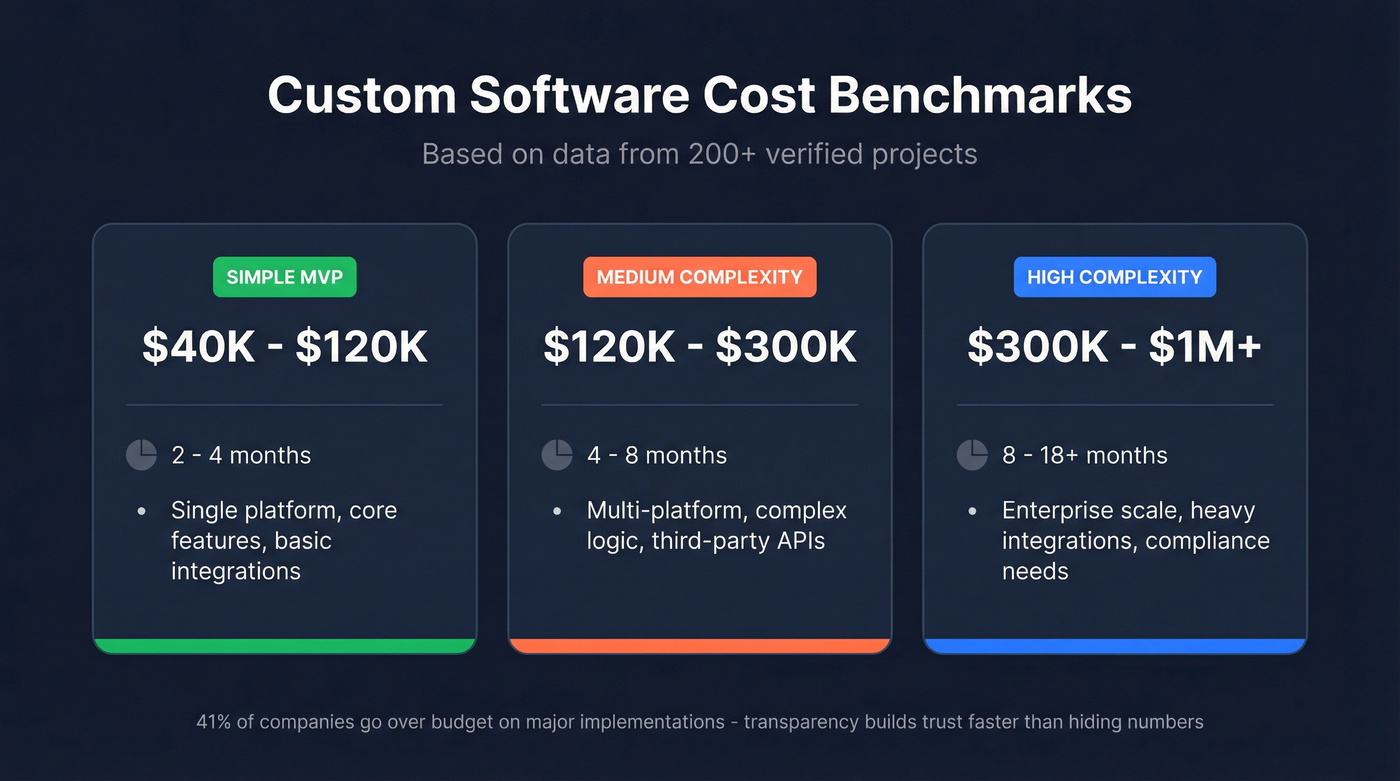
Give prospects concrete benchmarks so your number doesn't exist in a vacuum. Based on data from 200+ verified projects:
- Simple MVP: $40K-$120K (2-4 months)
- Medium complexity: $120K-$300K (4-8 months)
- High complexity: $300K-$1M+ (8-18+ months)
Be transparent about your rate card. 41% of companies go over budget on major ERP implementations, and buyers know overruns happen. Showing them you've thought about cost control builds trust faster than hiding the numbers.
Let's be honest: if your average contract value is under $50K, you don't need a 12-slide deck and a three-call sales process. Send a Loom walkthrough of a similar project, attach a one-page SOW with a price range, and ask for a 20-minute call. Overengineering the sales process for small deals is how agencies burn months chasing $30K projects.

Your software development sales pitch dies the moment it lands in the wrong inbox. Prospeo gives you 98% accurate emails and 30+ filters - target CTOs, VPs of Engineering, and technical buyers at companies actively hiring developers or growing headcount. Stop pitching spreadsheet-stage companies that can't afford you.
Find the right buyers before you write the pitch. Start free.
Common Pitch Mistakes
The worst opener in dev services sales? Listing your tech stack. "We do application development, blockchain, AI, cybersecurity..." - this triggers guardedness immediately because it's entirely about you. Replace the product dump with a value proposition and pain questions.
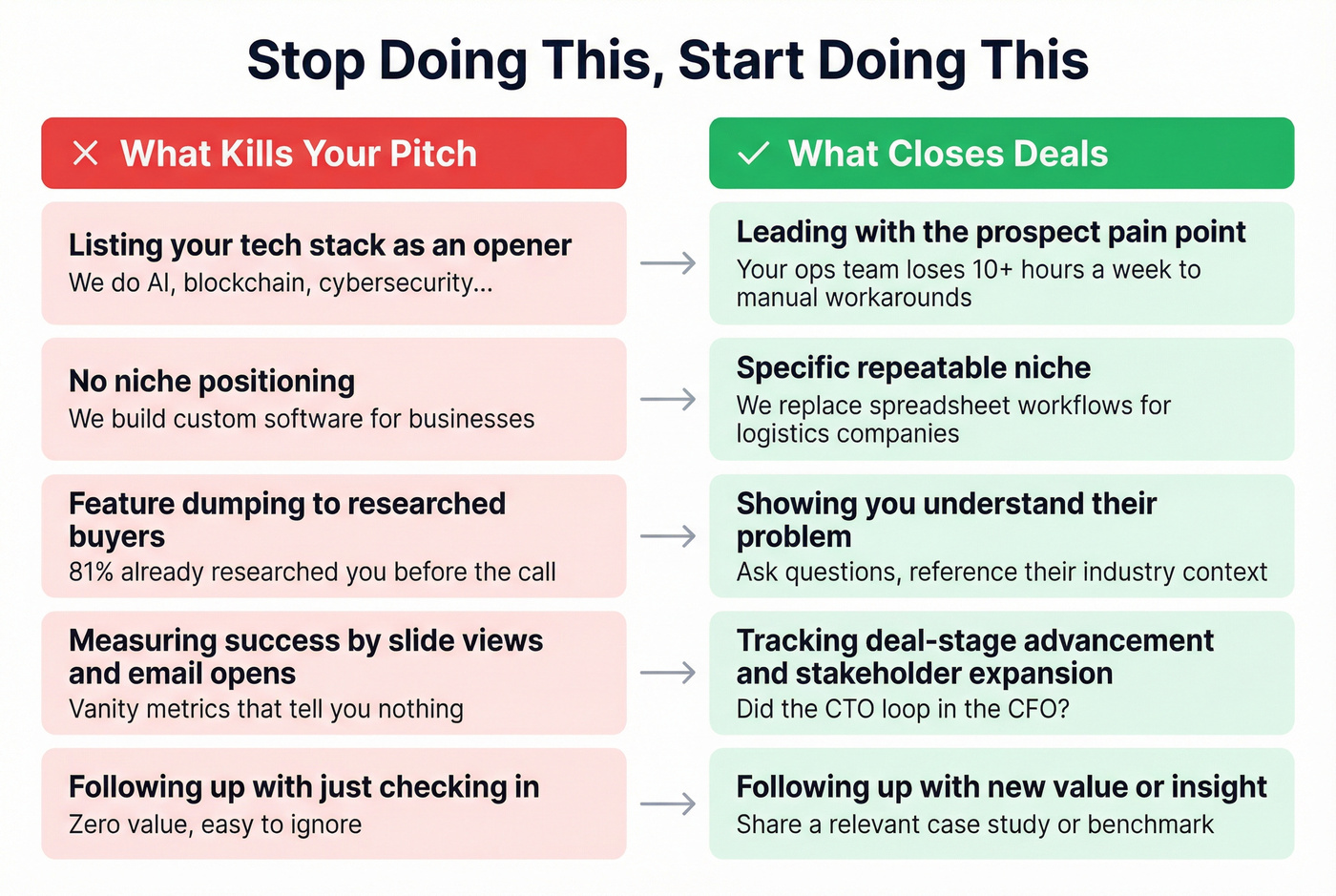
Other mistakes we see constantly: no niche positioning (you build "custom software" for "businesses" - so does everyone else), no quantified proof points, and feature-dumping to buyers who've already done their research. 81% of reps acknowledge that buyers research before engaging. They don't need your feature list. They need to know you understand their problem.
Here's the thing nobody tracks: pitch effectiveness signals. Stop measuring success by slide views or email opens. The real indicators are deal-stage advancement after the pitch, repeat stakeholder interest (did the CTO loop in the CFO?), and whether the prospect starts asking deeper evaluation questions. If none of those happen within a week of your pitch, the deal is stalling - follow up with new value, not another "just checking in." (If you need options, keep a few sales follow-up templates ready.)
Find the Right Person Before You Pitch
The best software development sales pitch in the world is worthless if it lands in a generic info@ inbox or reaches someone who can't approve the budget. In custom software deals, the buyer is usually the CTO, VP of Engineering, or Head of Product - and for internal workflow tools, it's often an operations leader who owns the pain and the budget.
This is where most dev agencies waste time: manually hunting for contact info, guessing email formats, or paying for databases full of stale data. We've tested this workflow with Prospeo, and it cuts the prospecting step to minutes. With 98% email accuracy and 125M+ verified mobile numbers, you're reaching the actual decision-maker instead of bouncing off dead addresses. The 30+ search filters - including technographics and buyer intent powered by Bombora - let you target companies already evaluating custom development solutions, so your pitch arrives when the problem is top of mind. (If you're rebuilding your outbound motion, start with these sales prospecting techniques.)
Skip this step if you're only working inbound referrals. But if you're doing any outbound at all, bad contact data is the silent killer of otherwise strong pitches. (Also: track your email bounce rate so you catch list decay early.)
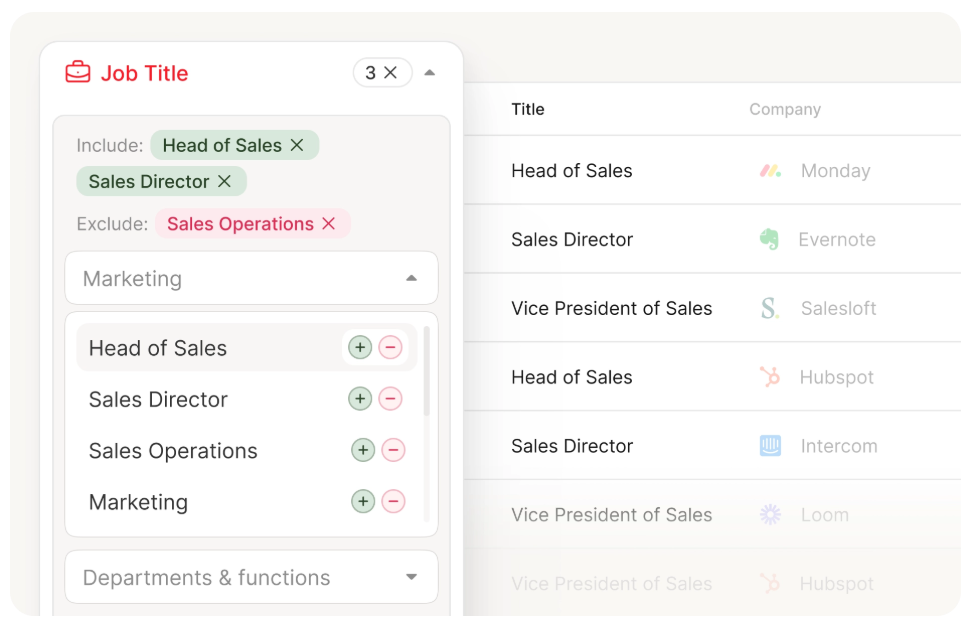
Discovery calls don't happen if your outreach bounces. Dev agencies using Prospeo cut bounce rates below 4% and reach real decision-makers with verified direct dials. At $0.01 per email, a single closed deal pays for years of prospecting data.
Stop ghosting yourself with bad contact data.
Copy-Paste Pitch Scripts
Elevator pitch (30 seconds):
"We build custom software that replaces the spreadsheets and manual workflows costing your ops team 10+ hours a week. For [industry] companies like [reference client], we've cut operational costs by 30% and delivered a working MVP in under 12 weeks. Can I show you what that'd look like for [your company]?"
Cold email template:
Subject: [Company]'s [specific process] - still in spreadsheets?
Hi [First Name],
Most [industry] companies we talk to are still managing [process] in Excel or a tool they've outgrown. It works until it doesn't - missed orders, manual errors, ops team buried in workarounds.
We built [reference client] a custom [solution type] that cut their [metric] by [X%] in [timeframe]. Worth a 20-minute call to see if something similar makes sense for [Company]?
The "spreadsheet replacement" angle works because it's specific, relatable, and immediately communicates the before/after. Swap the bracketed sections for your niche and send it to the decision-maker's verified email - not the company's contact form. (If you want more options, pull from these sample elevator pitches and tighten your email subject lines.)
Tying It Together
The arc is simple: find the right person, run a discovery call that surfaces real pain, build your software development sales pitch around what they told you, and present pricing with enough context that the number doesn't scare them. Most dev agencies fail at step one. Fix your targeting, and the rest of the pitch gets dramatically easier. (If you need a full framework, map it to the steps to close a sale.)
FAQ
How long is the typical sales cycle for custom software?
Most custom dev deals close in 4-12 weeks for mid-market engagements. Enterprise deals with procurement, legal review, and infosec audits can stretch to 6 months. Build that timeline into your pipeline forecasting - a deal that needs SOC 2 review isn't closing next month regardless of pitch quality.
Should I use fixed-price or T&M pricing?
T&M is the safer default for most projects. Fixed-price contracts carry a 15-30% risk premium and double the failure risk according to published research. Reserve fixed-price for small, well-scoped engagements under $50K where requirements won't shift.
How do I find decision-makers at target companies?
Use a B2B data platform with verified emails and direct dials to reach CTOs and VPs of Engineering. Prospeo's free tier gives you 75 emails per month at 98% accuracy - enough to start testing your pitch on real prospects without any commitment.
What's the biggest mistake in a software sales pitch?
Leading with your tech stack instead of the prospect's problem. 81% of buyers research vendors before engaging - they already know what you build. Open with a specific pain point and quantified outcomes from a similar client instead.