

The Best Software for Sales Reps in 2026
Sales reps spend 60% of their time on non-selling tasks](https://www.salesforce.com/sales/state-of-sales/sales-statistics/). CRM updates, note-taking, list building, scheduling, chasing down contact info that bounces anyway. The right software exists to protect the other 40% - where revenue actually happens - and claw back some of the rest.
This isn't a list of 33 tools. It's the 12 that matter, with real pricing on every single one.
Our Picks
| Best For | Tool | Starting Price |
|---|---|---|
| Email & mobile accuracy | Prospeo | Free (75 emails/mo) |
| All-in-one prospecting | Apollo.io | Free / $49/user/mo |
| Call coaching & deals | Gong | ~$250/user/mo + fee |
| Enterprise CRM | Salesforce | $25/user/mo |
| Visual pipeline (SMB) | Pipedrive | $14/user/mo |
What a Sales Stack Actually Looks Like
There are over 8,000 sales tools on the market. You need four or five. Every functional stack has five layers:
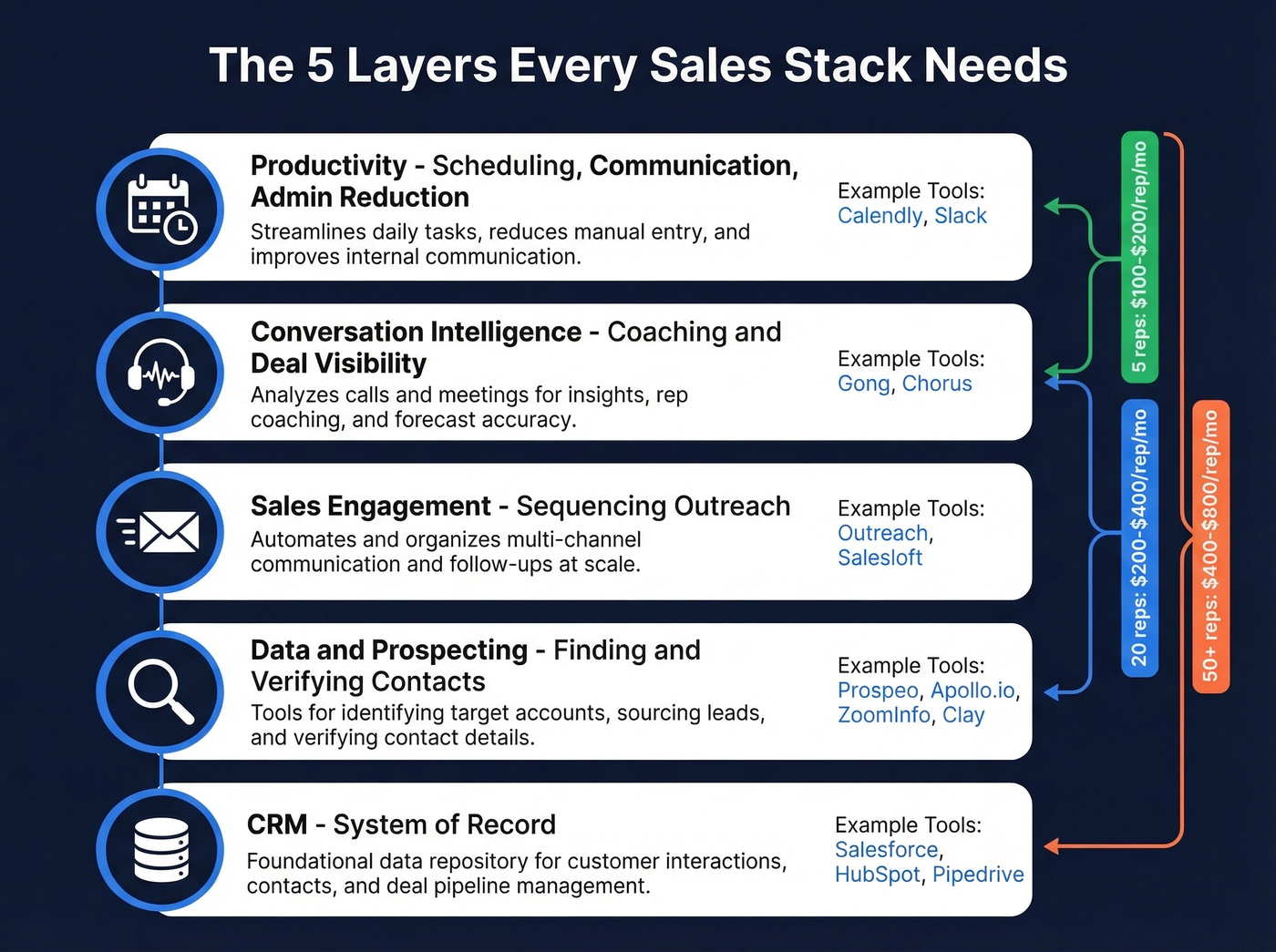
- CRM - your system of record (Salesforce, HubSpot, Pipedrive)
- Data & prospecting - finding and verifying contacts
- Sales engagement - sequencing outreach (Outreach, Salesloft)
- Conversation intelligence - coaching and deal visibility (Gong)
- Productivity - scheduling, communication, admin reduction
CRMs alone boost rep productivity by 20-30%, and 96% of prospects do their own research before engaging with a rep](https://blog.hubspot.com/sales/sales-statistics). That means the data layer feeding your outreach matters more than ever - stale contacts and bad emails don't just waste time, they torch your domain reputation.
For a 5-rep team, you can cover all five layers for $100-$200/rep/month. A 20-rep team typically runs $200-$400/rep/month. At 50+ reps, expect $400-$800/rep/month once enterprise CRM tiers and platform fees stack up.
If your reps are in the field, you'll want mobile-first CRM access and possibly route-planning tools like SPOTIO or RepMove. The core stack layers stay the same - the delivery format just shifts to mobile.

Your data layer is the foundation of your entire sales stack. Prospeo delivers 300M+ profiles with 98% email accuracy and a 7-day refresh cycle - 6x faster than the industry average. Snyk's 50 AEs dropped bounce rates from 35-40% to under 5% and grew AE-sourced pipeline 180%.
Stop feeding your reps stale data. Start at $0.01/email, no contracts.
The 12 Best Sales Rep Tools
CRM Software
Salesforce Sales Cloud
Salesforce is the default CRM. That doesn't make it the right choice for every team. It's G2's #1 Best Sales Software Product for 2026, with six pricing tiers: Free Suite ($0, max 2 users), Starter Suite ($25/user/mo), Pro Suite ($100/user/mo), Enterprise ($175/user/mo), Unlimited ($350/user/mo), and Agentforce 1 Sales ($550/user/mo) - the newest tier bundling AI agents into the Sales Cloud package.
Here's the thing nobody mentions on the pricing page: you'll also need a dedicated admin or RevOps hire. That's a hidden $60K-$120K/year cost that turns a "$175/user/mo" CRM into something much heavier. Enterprise and Unlimited tiers saw a ~6% price increase on Aug 1, 2025, so factor that into renewal planning.
Skip this if you're a 5-rep startup. Paying $175/user/mo for Enterprise when you need a pipeline tracker is overspending.

HubSpot Sales Hub
HubSpot works best for inbound-heavy teams of 10-50 reps already in the ecosystem. Starter runs about $20/seat/mo, Professional about $500/mo for 5 seats, and Enterprise about $1,200/mo for 10 seats - plus onboarding fees. G2's #2 Best Sales Software Product for 2026.
Skip this if your motion is primarily outbound. Reps on r/sales consistently prefer dedicated engagement platforms like Outreach or Salesloft for multi-touch outbound sequences over HubSpot's built-in tools.
Pipedrive
The cleanest visual pipeline for teams under 10 reps. Four tiers at $14 / $29 / $49 / $99 per user/mo (annual billing), with a 14-day free trial. It does one thing - pipeline management - and does it well.
You'll outgrow it past 20 reps, but until then, nothing beats the simplicity. We've seen small teams try Salesforce first, burn three months on configuration, then switch to Pipedrive and actually start selling. For teams on a tight budget, it consistently delivers the best value per dollar.
B2B Data & Prospecting
Prospeo
Prospeo covers 300M+ professional profiles with 143M+ verified emails, 98% email accuracy, and 125M+ verified mobile numbers delivering a 30% pickup rate - most competitors sit around 11-12.5% on their phone data. The Chrome extension (40,000+ users) lets reps pull verified contacts from any website or CRM in one click.
The 7-day data refresh cycle is the real differentiator. The industry average is six weeks, which means most databases serve stale contacts by the time your sequence hits. The platform includes 30+ search filters - buyer intent powered by 15,000 Bombora topics, technographics, job changes, funding signals, and headcount growth. It integrates natively with Salesforce, HubSpot, Smartlead, Instantly, Lemlist, Salesloft, Outreach, Clay, Zapier, n8n, Make, and more.
Real-world proof: Snyk's 50 AEs cut bounce rates from 35-40% to under 5% after switching, and AE-sourced pipeline jumped 180%. Pricing starts free (75 emails/mo), scales at roughly $0.01/email, no contracts.

Apollo.io
Apollo is the obvious starting point for bootstrapped teams that want prospecting, enrichment, and basic engagement in one platform. G2 rating of 4.7/5 across 9,235 reviews - one of the highest review counts among sales prospecting platforms. Free tier is genuinely usable, Basic runs $49/user/mo, Professional $79/user/mo (annual billing).
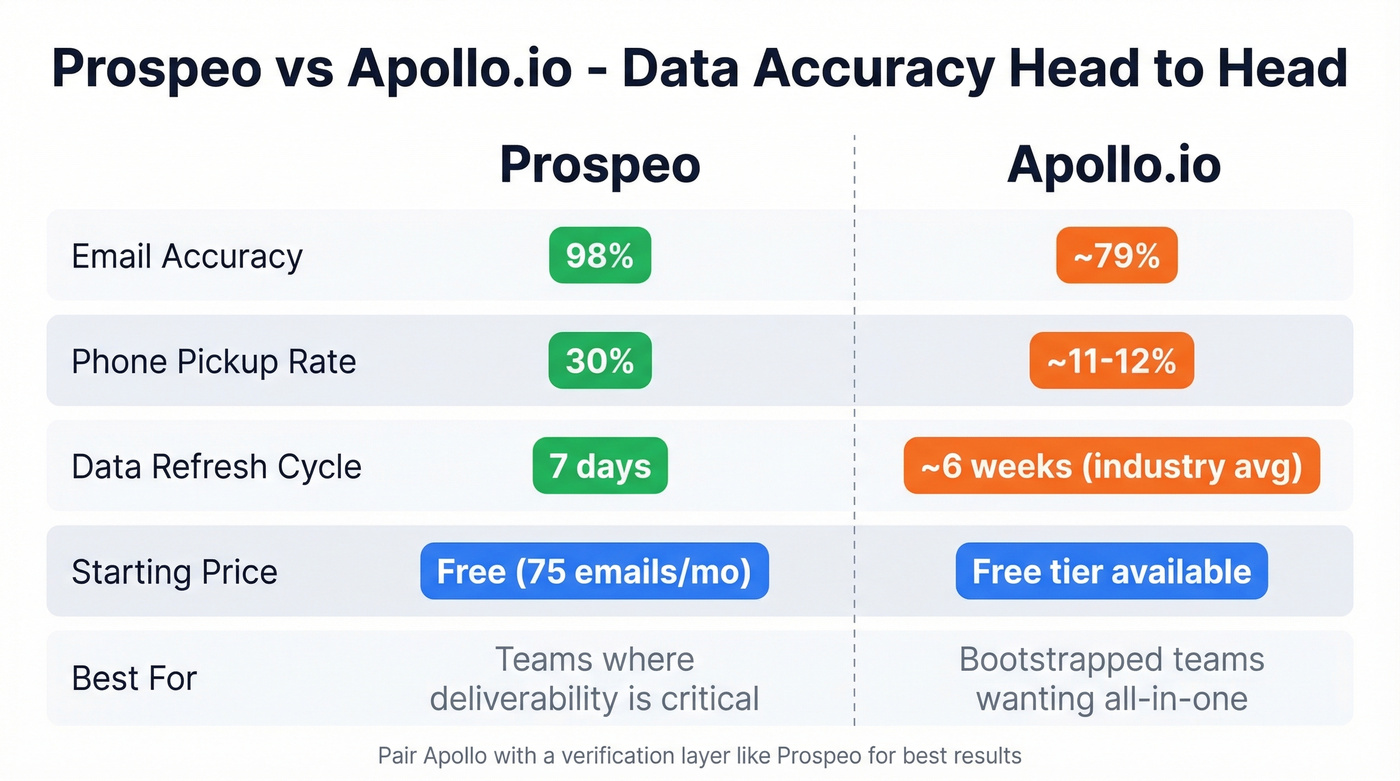
The all-in-one approach is Apollo's strength and its limitation. You get a database, email sequences, a dialer, and basic analytics without buying four separate tools. But email accuracy runs around 79%, which means roughly one in five emails won't land. For 3-5 reps moving fast on a tight budget, Apollo is hard to beat. For teams where deliverability is make-or-break, pair it with a dedicated verification layer like an email deliverability tool.
ZoomInfo
ZoomInfo is built for 50+ rep orgs with budget for a $15K-$40K/year contract, plus intent, chat, and workflow modules under one roof.
Skip this if you're under 30 reps. The most common complaint on r/sales is price - and paying for modules you don't use. The usual take: it's crazy expensive, but worth it if the data is 10-20% better than what you had. Annual contracts are standard, pricing is quote-based, and renewals are rarely fun.
Clay
Clay is the most-discussed lead gen tool in sales communities heading into 2026. It's an enrichment orchestration layer - you build "waterfall" workflows that pull data from dozens of providers, clean it, and push it to your CRM or sequencer. Free tier available, with paid plans commonly landing around $149-$800/month.
Think of Clay as middleware between your data sources and your engagement platform, not a replacement for either. If you're the kind of rep who gets excited about automating data workflows, you'll love it. If you just want a list of verified emails, it's overkill.
If you want the step-by-step workflow, see waterfall enrichment list building.
Sales Engagement Platforms
Outreach
Outreach has a clear customizability advantage over Salesloft - a common take on r/sales. Pricing is quote-based, so expect ~$100-$170/user/mo on annual contracts.
Skip this if you want transparent pricing. The fact that Outreach still won't publish pricing in 2026 tells you how they view buyers. Great product, enterprise sales process - even for 10-person teams.
SalesLoft
Salesloft runs ~$80-$125/user/mo (quote-based, annual) with a G2 rating of 4.5/5 across 4,237 reviews. It's the slightly simpler, slightly cheaper alternative to Outreach - best for teams that want solid multi-channel sequencing without the configuration overhead. In our experience, reps ramp faster on Salesloft, which matters when you're hiring.
If you're building sequences from scratch, keep a set of sales follow-up templates handy.
Conversation Intelligence
Gong
Gong earns its G2 rating of 4.8/5 (6,407 reviews). It records calls, surfaces deal risks, coaches reps on talk patterns, and gives managers visibility they can't get any other way. One AE on Reddit described spending 30+ minutes after every call updating notes before adopting conversation intelligence.
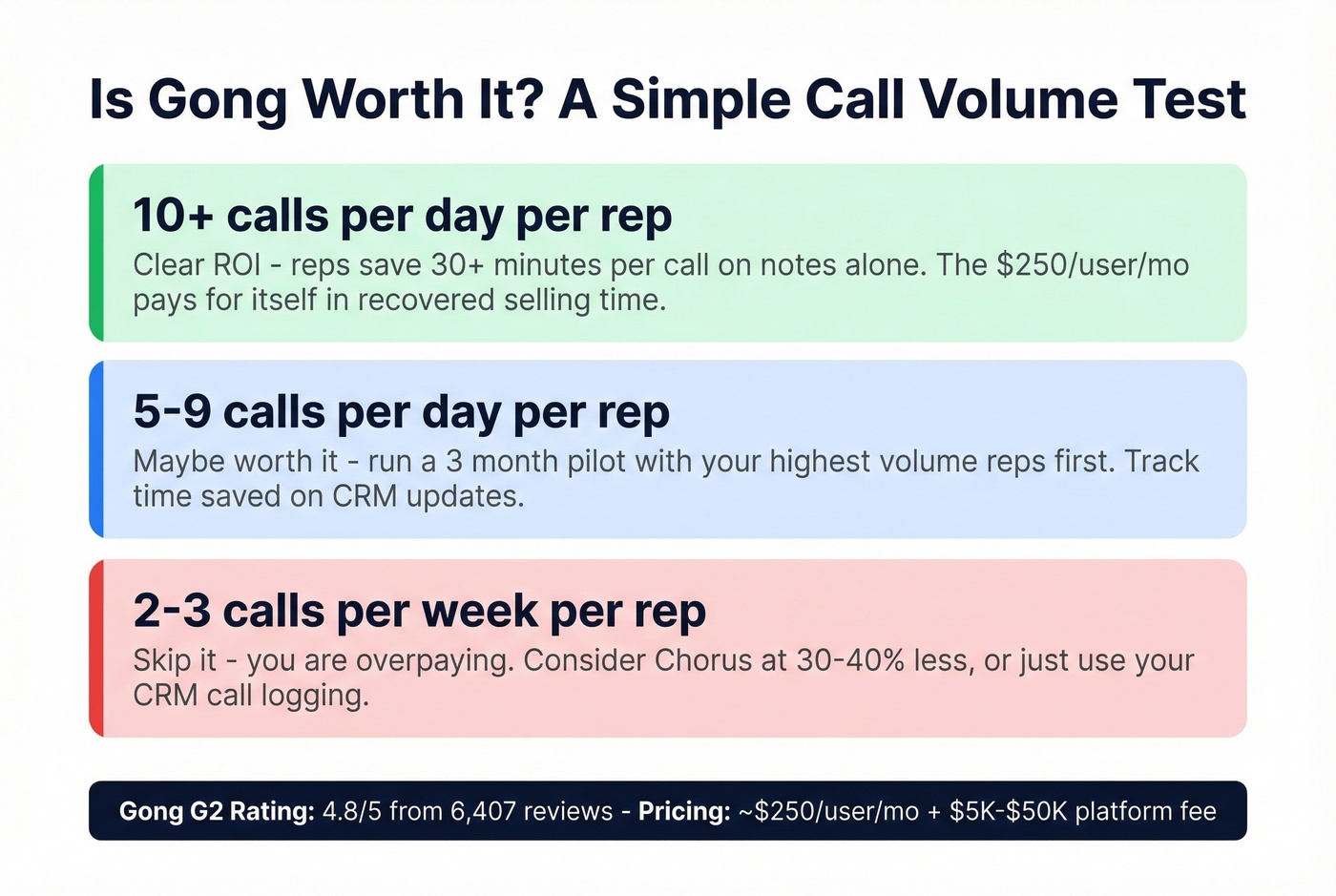
Pricing is the catch: ~$250/user/mo plus a platform fee from $5K-$50K depending on team size. If your team runs 10+ calls per day, the ROI math works. Two or three calls a week? You're overpaying. For budget-conscious teams, Chorus (now part of ZoomInfo) offers similar core functionality at roughly 30-40% less.

Orum
A parallel dialer for high-volume cold calling teams at ~$200-$300/user/mo (quote-based). It dials multiple numbers simultaneously and connects reps only when someone picks up. Dialer ROI is directly tied to phone number quality - garbage numbers in, wasted dials out.
If you're building a calling motion, a cold calling system matters as much as the dialer.
Productivity & Scheduling
Calendly
Free tier handles basic scheduling. Standard at $10/seat/mo and Teams at $16/seat/mo add routing, round-robin, and CRM integrations. Kills the 4-email scheduling back-and-forth. Not glamorous, but every rep needs it.
Slack
Free tier works for small teams. Pro at $8.75/user/mo and Business+ at $15/user/mo unlock deal-room channels, Salesforce integrations, and the async collaboration that makes team selling function.
Pricing Comparison
| Tool | Category | Starting Price | Mid-Market Cost | Contract |
|---|---|---|---|---|
| Prospeo | Data | Free | ~$0.01/email | None |
| Apollo.io | Data + Engage | Free | $49-$79/user/mo | Annual |
| ZoomInfo | Data | ~$15K/yr | $25-$40K/yr | Annual |
| Clay | Enrichment | Free | ~$149-$800/mo | Monthly |
| Salesforce | CRM | $25/user/mo | $100-$175/user/mo | Annual |
| HubSpot | CRM | ~$20/seat/mo | ~$500/mo (5 seats) | Annual |
| Pipedrive | CRM | $14/user/mo | $29-$49/user/mo | Annual |
| Outreach | Engagement | ~$100/user/mo | ~$130-$170/user/mo | Annual |
| Salesloft | Engagement | ~$80/user/mo | ~$100-$125/user/mo | Annual |
| Gong | Intelligence | ~$250/user/mo | +$5K-$50K platform | Annual |
| Orum | Dialer | ~$200/user/mo | ~$250-$300/user/mo | Annual |
| Calendly | Scheduling | Free | $10-$16/seat/mo | Monthly |
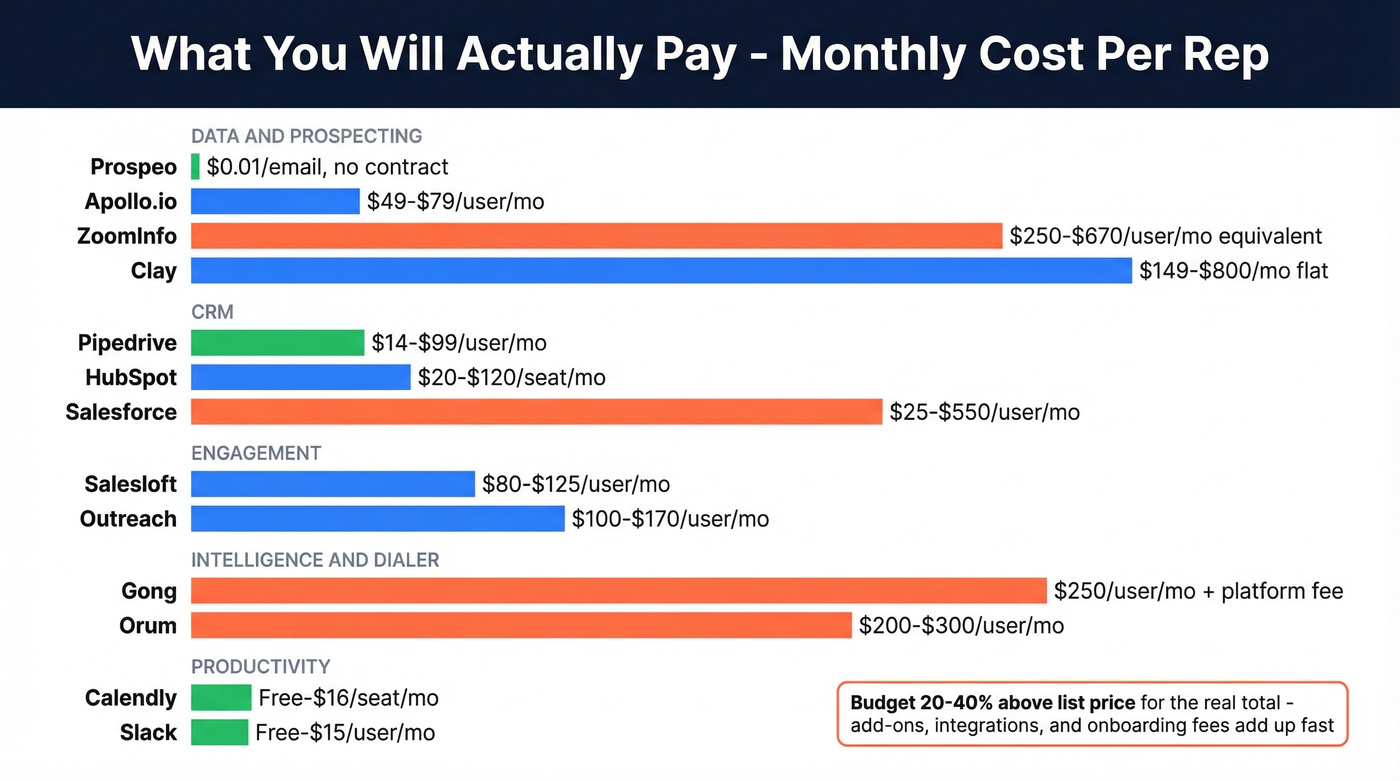
CRM costs by team size break down roughly to $10-$30/user/mo for small teams, $40-$100 for mid-market, and $150-$650 for enterprise. Budget 20-40% above list price for the real total - add-ons, integrations, onboarding fees, and scaling costs add up fast. A "$100/user/mo" CRM becomes $130 once you add the features you actually need.
Build Your Stack Without Overspending
Let's be honest: most sales teams are over-tooled and under-integrated. If your average deal size is under five figures, you probably don't need ZoomInfo-level data or Gong-level call intelligence. A tight three-tool stack will outperform a bloated seven-tool mess every time.
For a 5-rep team, target $100-$200/rep/month total - a CRM like Pipedrive or HubSpot Starter, a data platform with verified contacts, and a sequencer like Apollo's built-in or HubSpot sequences. When you hit 20 reps, budget $200-$400/rep/month and add a dedicated engagement platform plus conversation intelligence for your top performers. At 50+ reps, you're in the $400-$800 range with enterprise CRM, full Outreach/Salesloft deployment, and Gong across the org.
The non-negotiable requirement: your CRM, engagement platform, and data tool must sync natively. Manual CSV imports between tools is how data rots and pipelines stall. The best software for sales reps isn't the most expensive - it's the stack where every tool talks to every other tool without someone manually exporting a spreadsheet at 6 PM on a Friday.
If you're tightening outbound, revisit your sales prospecting techniques and your lead generation workflow before buying more tools.
A $100-$200/rep/month stack falls apart when bad contact data torches your domain reputation. Prospeo's 125M+ verified mobiles hit a 30% pickup rate - nearly 3x ZoomInfo's - and the Chrome extension lets reps pull verified contacts from any site in one click.
Replace the weakest layer in your sales stack. 75 free emails to prove it.
FAQ
What software do most sales reps use?
Most reps rely on a CRM (Salesforce or HubSpot), a B2B data provider (Apollo, or ZoomInfo), and a sales engagement platform (Outreach or Salesloft). Scheduling tools like Calendly and conversation intelligence like Gong round out the typical stack.
How much does sales software cost per rep?
Small teams spend $100-$200/rep/month across their full stack. Mid-market runs $200-$400. Enterprise orgs with Salesforce, Gong, and Outreach hit $400-$800. Budget 20-40% above list prices for add-ons and onboarding fees.
What's the best free sales tool?
Apollo.io offers the strongest free all-in-one tier with prospecting, email sequences, and a basic dialer. Prospeo's free plan includes 75 verified emails plus 100 Chrome extension credits - better email accuracy (98% vs 79%) for teams where deliverability matters. HubSpot CRM's free tier handles pipeline management for up to 5 users.
What's the best CRM for sales reps?
Salesforce for teams over 20 reps with dedicated admin resources. HubSpot for inbound-heavy teams already in that ecosystem. Pipedrive for teams under 10 who want simplicity at $14/user/mo. Match the CRM to your team size and sales motion, not feature count.
How do I choose the right sales stack?
Start with your sales motion and team size, not feature lists. Outbound-heavy teams need strong data and multi-channel engagement tools, while inbound teams benefit more from CRM automation and lead scoring. Map your five stack layers, pick one tool per layer, and confirm they integrate natively before signing any annual contracts.