

Strategic Accounts: Scoring Models, Account Plans & the Playbook Your CRM Vendor Won't Ship
Strategic accounts don't get the tooling they deserve. SDRs get sequencers, dialers, intent platforms, and a dozen Chrome extensions. Account managers running $5M relationships? They get Excel, a stale CRM, and a quarterly business review template from 2019. 65% of account managers' time goes to non-revenue activities - and the tooling gap is a big reason why.
What Is Strategic Account Management?
Strategic account management (SAM) is a cross-functional operating model, not a sales tactic. It pulls sales, marketing, product, and customer success around a small set of accounts that drive disproportionate revenue. The 80/20 rule applies: 80% of sales come from 20% of clients in many organizations.
SAM is broader than key account management (KAM), which usually means assigning a dedicated AM to high-value customers. It's also different from ABM, which coordinates marketing and sales around a defined set of target accounts as a go-to-market motion. SAM is an organizational commitment - it changes how your company operates, not just how your reps sell.
Why They Drive Disproportionate Growth
RAIN Group's study of 472 sales leaders found that top performers are 3.1x more likely to grow revenue by 20%+ in existing accounts. A ZS Associates case study tracked an industrial services company that launched a SAM program around just 4 accounts representing ~15% of revenue. One year later, those accounts grew 26% YoY. Non-strategic accounts declined 5%.
Here's the insight most teams miss: in RAIN Group's data, "offerings" ranked 72nd out of 72 factors separating top performers from the rest. Product doesn't differentiate. Process discipline does.
How to Identify the Right Accounts
You don't need 50 strategic accounts. You need 5-10 you actually resource. Companies with structured selection processes achieve 68% higher win rates than those using ad-hoc approaches.
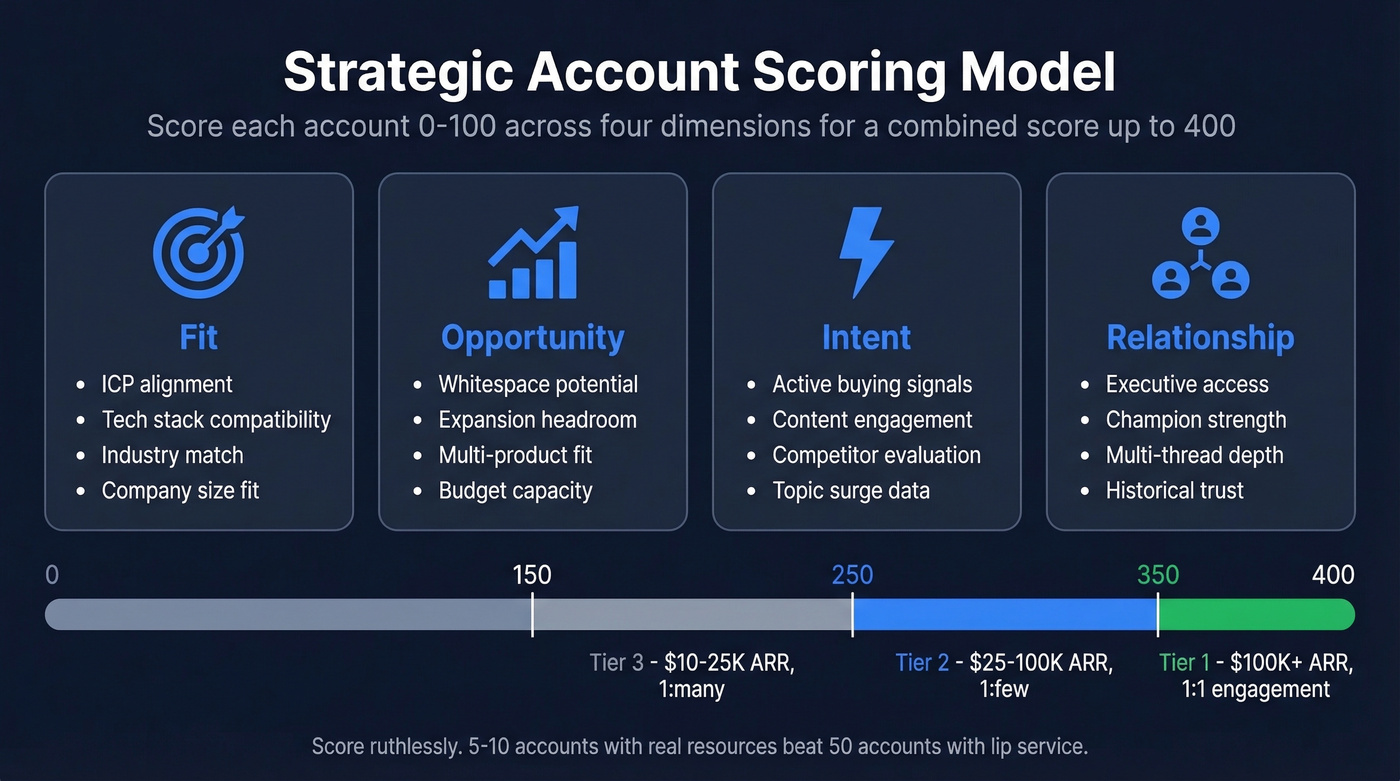
Score each account across four dimensions - Fit, Opportunity, Intent, and Relationship - on a 0-100 scale, for a combined score up to 400.
| Tier | Score | Account Potential | Engagement | Horizon |
|---|---|---|---|---|
| Tier 1 | 350-400 | $100K+ ARR | 1:1 | 12-18 mo |
| Tier 2 | 250-349 | $25-100K ARR | 1:few | 6-12 mo |
| Tier 3 | 150-249 | $10-25K ARR | 1:many | 3-6 mo |
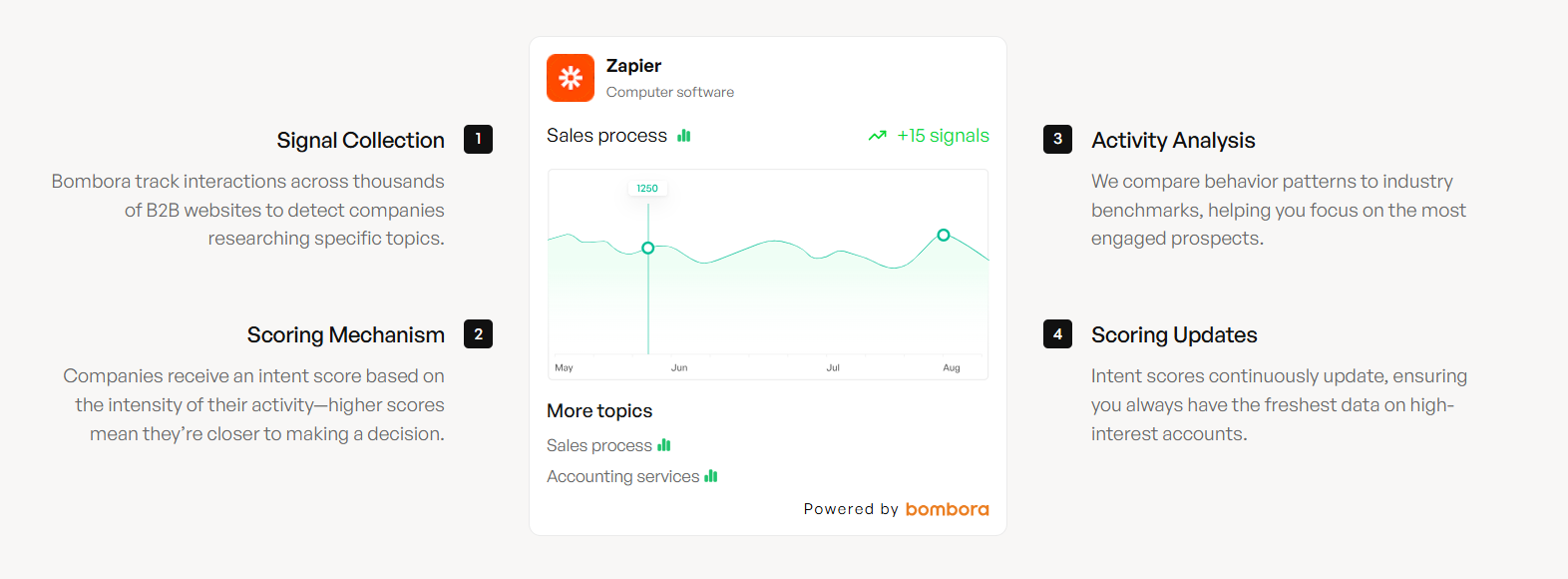
Fit captures ICP alignment and tech compatibility. Opportunity measures whitespace and expansion potential. Intent tracks active buying signals - tools like Prospeo surface intent data across 15,000 Bombora-powered topics, so you can layer in-market signals directly into your scoring model. Relationship scores executive access and champion strength.
Identifying strategic accounts means tiering ruthlessly, not labeling every big logo as strategic.
The 8-Section Account Plan
Every strategic account needs a living document - not a slide deck that collects dust after QBR season. 85% of B2B marketers say ABM delivers higher returns than any other marketing approach, and the account plan is what makes ABM operational.
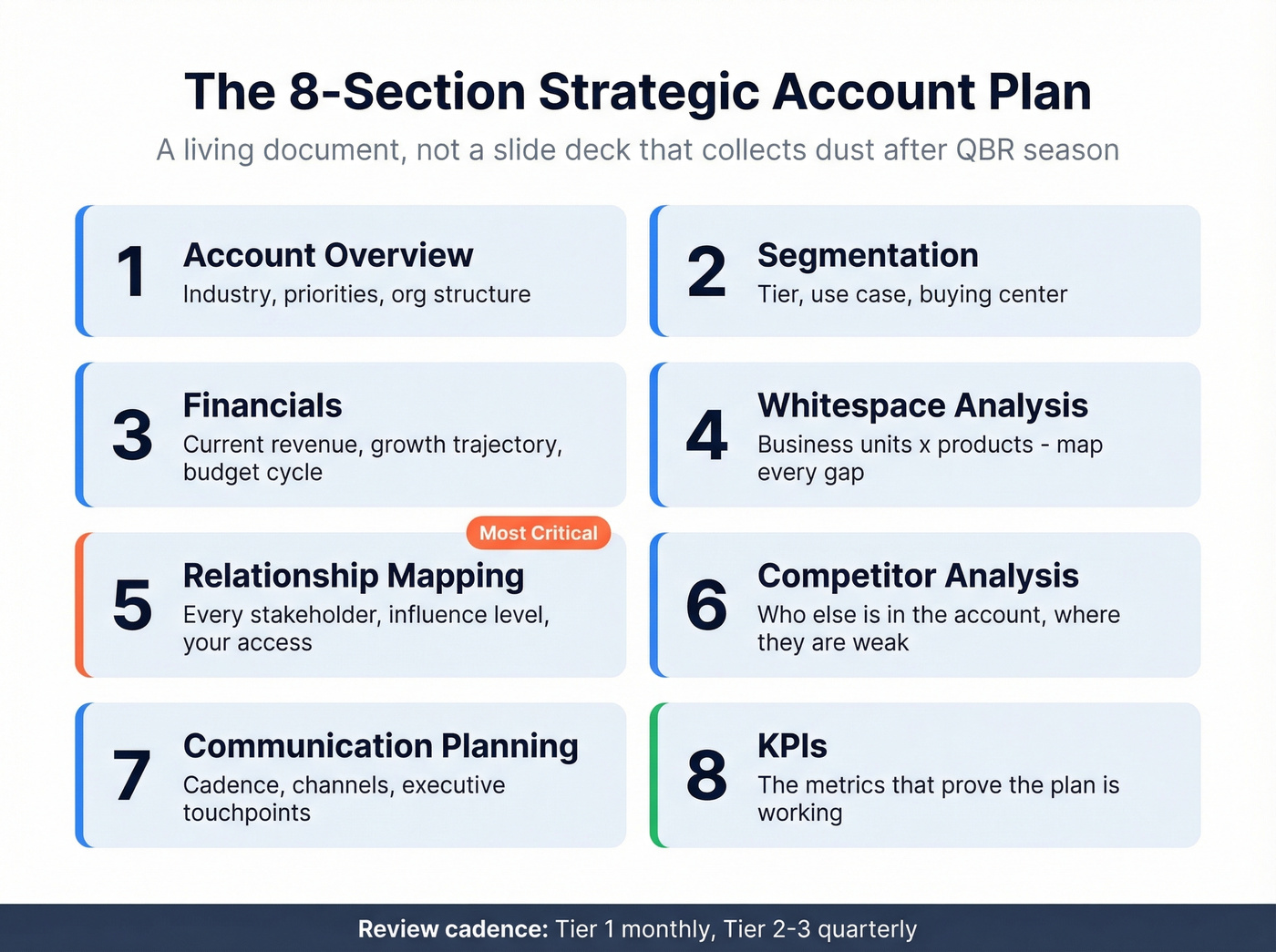
- Account overview - industry, strategic priorities, org structure
- Segmentation - tier, use case, buying center
- Financials - current revenue, growth trajectory, budget cycle
- Whitespace analysis - business units x your products (label each cell: saturated, underway, not a fit, or whitespace)
- Relationship mapping - every stakeholder, influence level, and your access; verify contact data for every person on the map with a tool that refreshes weekly
- Competitor analysis - who else is in the account, where they're vulnerable
- Communication planning - cadence, channels, executive touchpoints
- KPIs - the metrics that tell you if the plan is working
Voice of Customer data should feed directly into relationship mapping and whitespace analysis. It's the fastest way to spot expansion signals your CRM won't surface. Review Tier 1 plans monthly. Tier 2 and 3 can run quarterly.

Strategic accounts live or die on stakeholder mapping - and stakeholder maps live or die on data quality. Prospeo refreshes 300M+ profiles every 7 days, delivers 98% email accuracy, and surfaces intent data across 15,000 Bombora topics so you can score accounts on real buying signals, not gut feel.
Stop building account plans on stale CRM data.
First 90 Days of a SAM Program
Weeks 1-2: Dig into pipeline, renewals, install base, whitespace. Identify gaps in your CRM data. This is the unglamorous part, and it's the most important - we've seen teams skip it and spend months backfilling later.
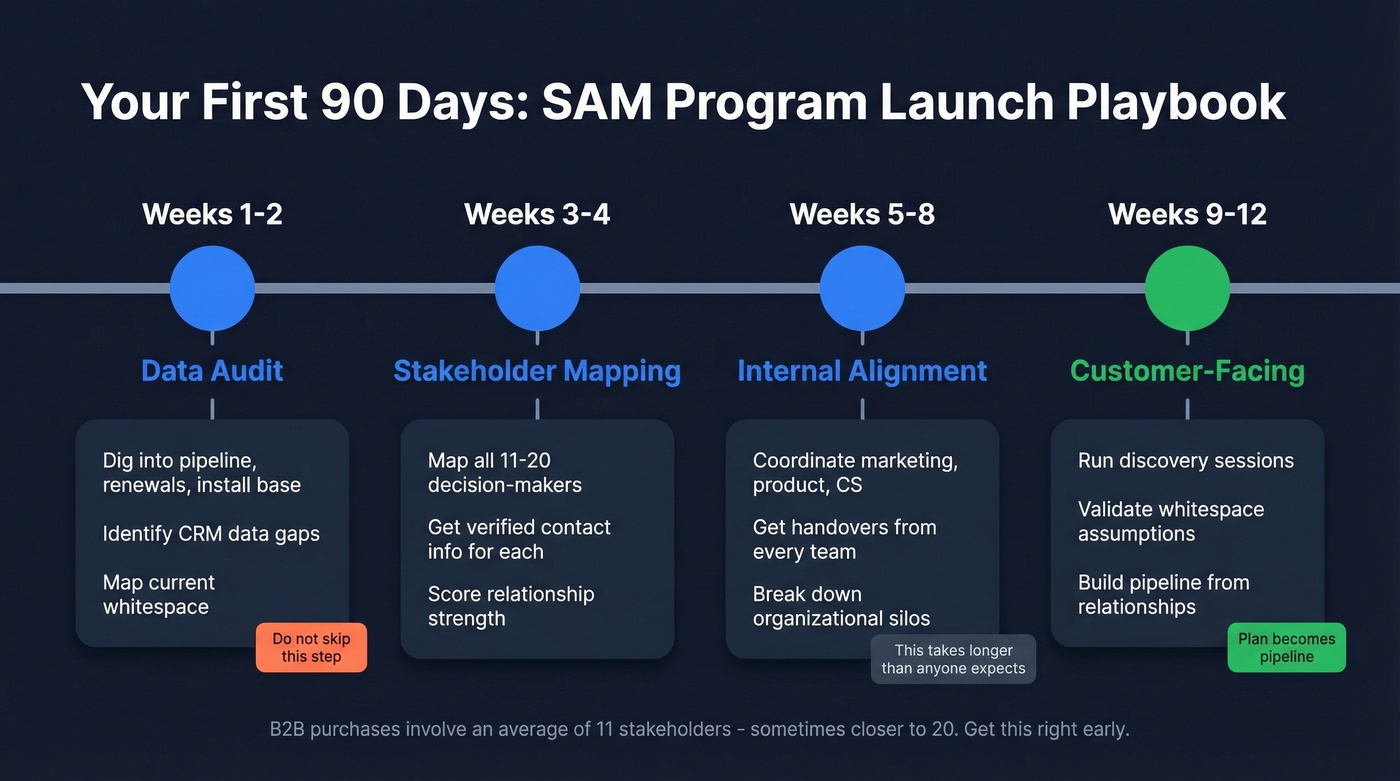
Weeks 3-4: Map stakeholders. B2B purchases involve an average of 11 stakeholders - sometimes closer to 20. Get verified contact info for each. Prospeo's 7-day refresh cycle keeps this map current as people change roles, delivering 98% email accuracy across 300M+ professional profiles.
Weeks 5-8: Align internally. Coordinate marketing, product, and CS around the account. Get handovers from every team that's touched the customer. This step takes longer than anyone expects because it requires breaking down silos that have existed since the company was founded, but without it your account plan is just a sales plan with extra steps.
Weeks 9-12: Get customer-facing. Run discovery, validate whitespace, and start building the relationships that turn a plan into pipeline. By this point you should be targeting key accounts with tailored messaging grounded in real stakeholder insights.
Mistakes That Kill SAM Programs
Only 28% of sales leaders believe their account management channels meet cross-sell and growth targets. In our experience, mistake #1 below is the most common - and the hardest to fix politically.
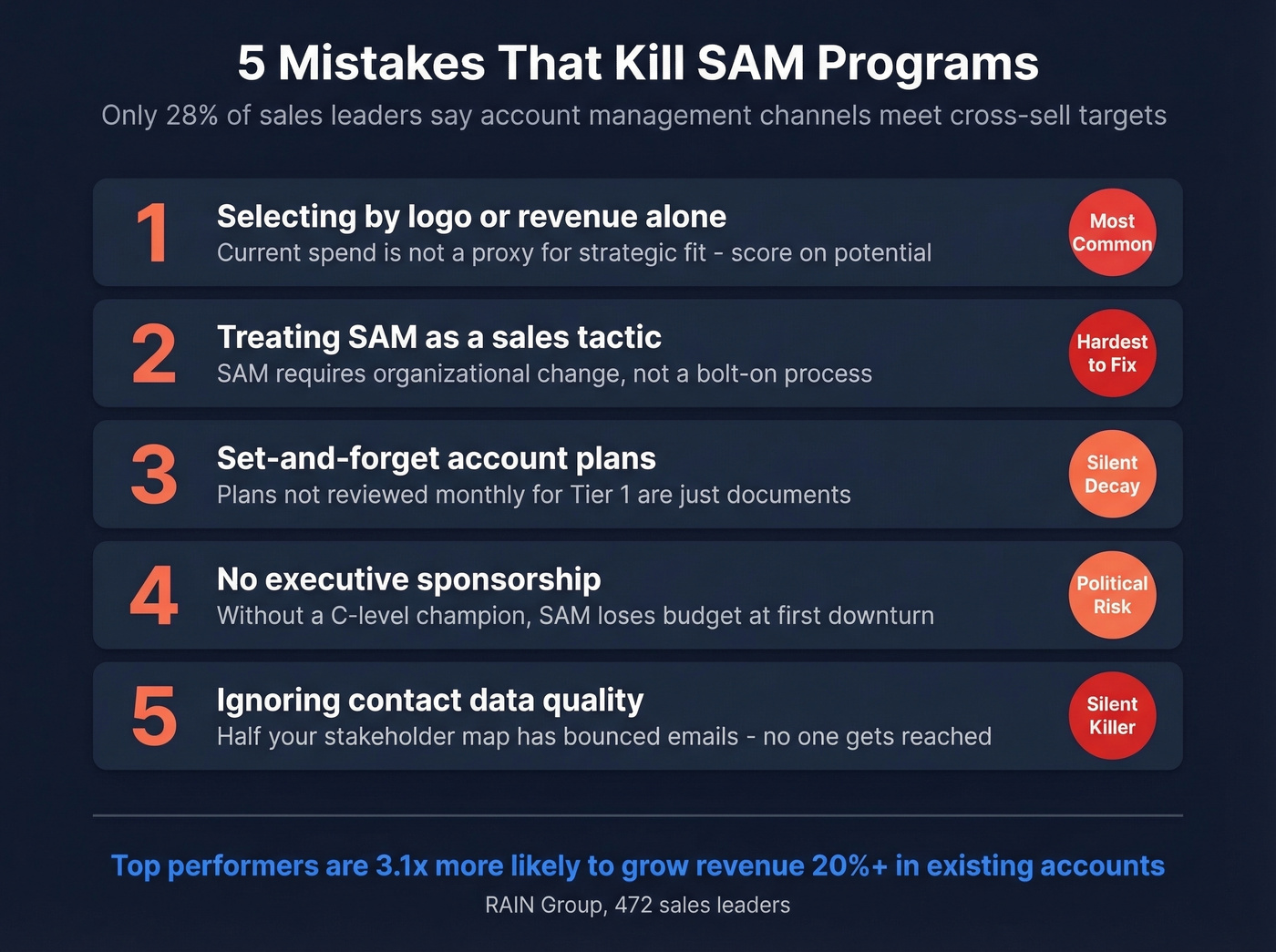
- Selecting accounts by logo or revenue alone. Current spend isn't a proxy for strategic fit. Score on potential, not history.
- Treating SAM as a sales tactic, not a business model. Cranfield's research is clear: SAM requires organizational change, not a bolt-on process.
- Set-and-forget plans. An account plan that isn't reviewed monthly for Tier 1 or quarterly for Tier 2-3 is just a document.
- No executive sponsorship. Without a C-level champion internally, SAM programs lose budget at the first downturn.
- Ignoring contact data quality. Look, when everyone on your target list gets VIP treatment but half the stakeholder map has bounced emails, no one actually gets reached. This is the silent killer.
KPIs Worth Tracking
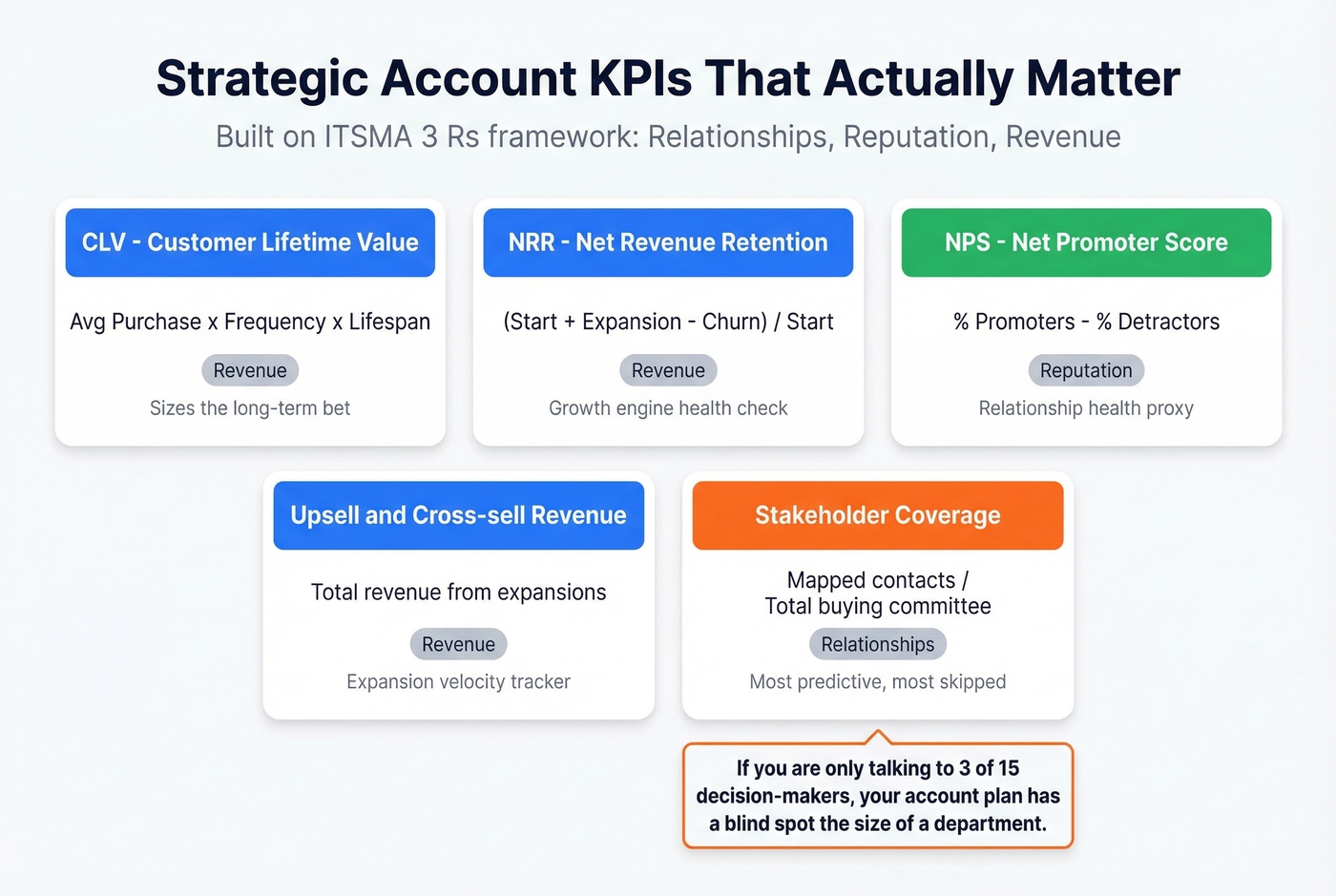
ITSMA's "3 Rs" framework - relationships, reputation, revenue - gives you the organizing principle.
| KPI | Formula | Why It Matters |
|---|---|---|
| CLV | Avg Purchase x Freq x Lifespan | Sizes the long-term bet |
| NRR | (Start + Expansion - Churn) / Start | Growth engine health |
| NPS | % Promoters - % Detractors | Relationship health proxy |
| Upsell/Cross-sell Rev | Total from expansions | Expansion velocity |
| Stakeholder Coverage | Mapped / Total buying committee | Relationship depth |
Stakeholder coverage is the one most teams skip - and it's the most predictive. If you're only talking to 3 of 15 decision-makers, your account plan has a blind spot the size of a department.
Tools That Fill the Gap
AMs on Reddit are blunt about this: they're managing multi-million-dollar accounts with static CRMs and slide decks while SDRs get every shiny tool on the market. The consensus on r/sales is that dedicated KAM platforms are worth it once you have 10+ strategic accounts, but data quality matters more than planning software at every stage.
| Category | Examples | Price Range |
|---|---|---|
| KAM Platforms | DemandFarm, Kapta, ARPEDIO | ~$1,000-$5,000+/mo |
| CRM | HubSpot, Salesforce | $15-$150+/user/mo |
| Contact Data | Prospeo | Free tier available; ~$0.01/email |
Dedicated KAM platforms add org charts, whitespace analytics, and account health scoring that CRMs don't natively provide. But the gap that kills most SAM programs is contact data. Strategic accounts require reaching 11-20 stakeholders, and if half your data bounces, your account plan is fiction.
Let's be honest: most teams overspend on planning software and underspend on data quality. A $2,000/month KAM platform is worthless if the stakeholder emails underneath it are six months stale. Fix the data layer first. Skip the fancy planning tool until your contact accuracy is above 95%.
If you're trying to improve contact accuracy, start with data enrichment and a process for how to check if an email will bounce.
Your article's stat says it: B2B purchases involve 11+ stakeholders. That's 11 people who need verified emails and direct dials in your account map. Prospeo gives you 98% accurate emails and 125M+ verified mobiles - refreshed weekly, not quarterly - so your Tier 1 plans actually connect you to decision-makers.
Map every stakeholder with contact data that doesn't bounce.
FAQ
How do strategic accounts differ from key accounts?
SAM is a cross-functional operating model spanning sales, marketing, product, and CS - it reshapes how the entire company engages with its most important customers. KAM typically means assigning a dedicated AM per high-value customer without requiring the same organizational commitment.
How many accounts should a company designate as strategic?
Five to fifteen with truly dedicated resources. The ZS case study showed 4 focused accounts drove 26% YoY growth while non-strategic accounts declined 5%. Spreading resources across 50+ accounts dilutes the model.
How do I keep stakeholder data current across large accounts?
Use a contact data platform with automated weekly refresh cycles so your stakeholder map reflects the current org chart, not last quarter's. A 7-day refresh cycle - compared to the 6-week industry average - makes a real difference when you're tracking 15+ stakeholders per account.
What's the fastest way to get executive sponsorship for a SAM program?
Tie the business case to NRR and expansion revenue. Show leadership that top-performing SAM programs grow existing accounts 20%+ annually and that a pilot with 4-5 Tier 1 accounts can prove ROI within two quarters. Numbers talk. Anecdotes don't.