

SugarCRM vs Zoho CRM: Honest Comparison (2026)
Most comparison articles still list SugarCRM at $49/month. That price doesn't exist anymore. We verified the numbers here against official pricing pages as of early 2026, so you're working with real figures - not recycled copy from three years ago.
30-Second Verdict
Pick Zoho CRM if you're an SMB under 20 users who wants a free tier, low per-seat costs, and a broad app ecosystem.
Pick SugarCRM if you're a larger, more complex team that needs on-prem deployment, deep workflow customization, or tight ERP integration.
Here's the thing: most teams agonizing over this decision would get more ROI from spending that evaluation time cleaning their contact data. Neither platform fixes bounced emails or disconnected phone numbers, and bad data will sabotage whichever CRM you pick.
Quick Feature Comparison
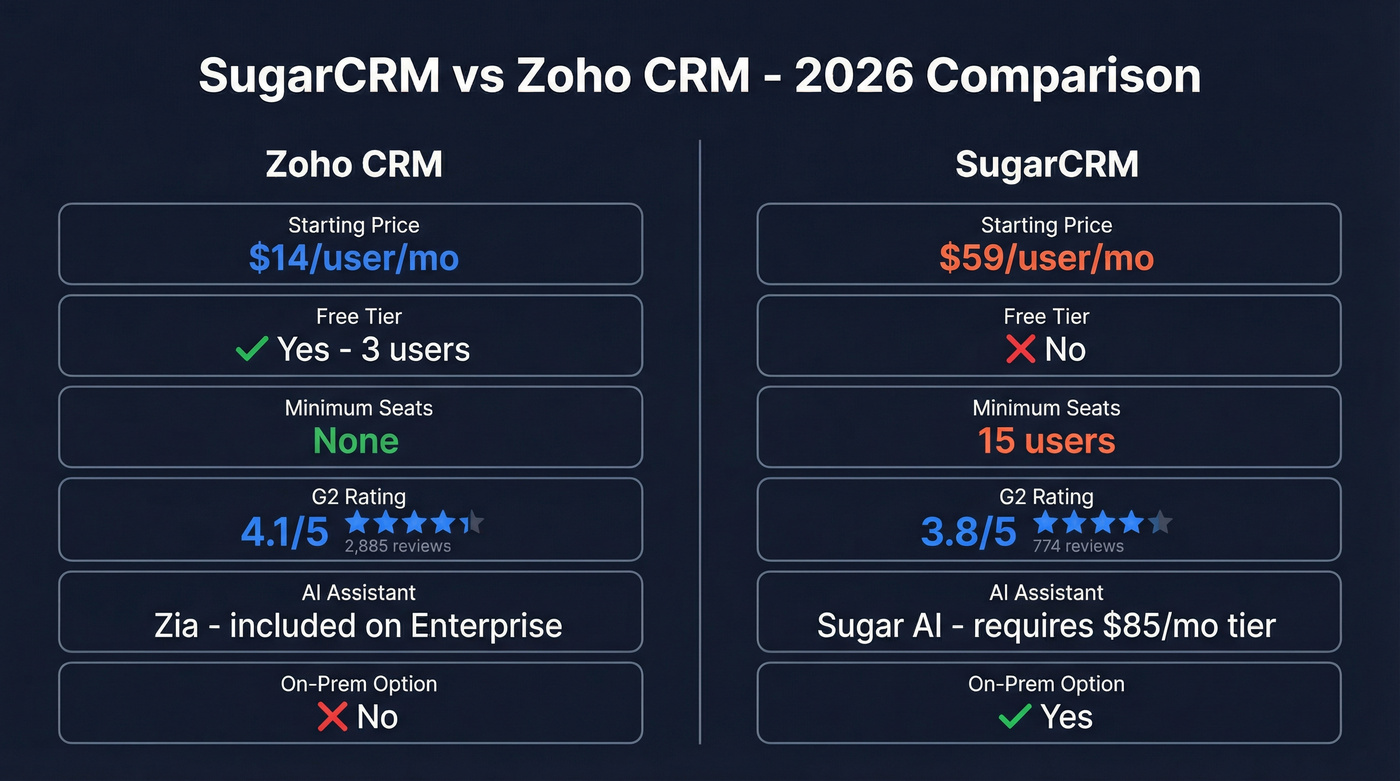
| Zoho CRM | SugarCRM | |
|---|---|---|
| Starting price | $14/user/mo (annual) | $59/user/mo (annual) |
| Free tier | Yes (3 users) | No |
| Minimum seats | None | 15 users |
| G2 rating | 4.1/5 (2,885 reviews) | 3.8/5 (774 reviews) |
| AI assistant | Zia | Sugar AI ($85/mo tier) |
| On-prem option | No | Yes |
Pricing - Do the Math
SugarCRM's entry point isn't just $59/user/month - it's $59/user/month with a 15-user minimum. That means your minimum annual commitment is $10,620, even if you only have 8 reps. The $85/mo tier that unlocks AI features pushes that floor to $15,300/year. Premier at $135/mo? $24,300/year minimum. Managed services add-ons run $375-$1,210/month on top of all that.
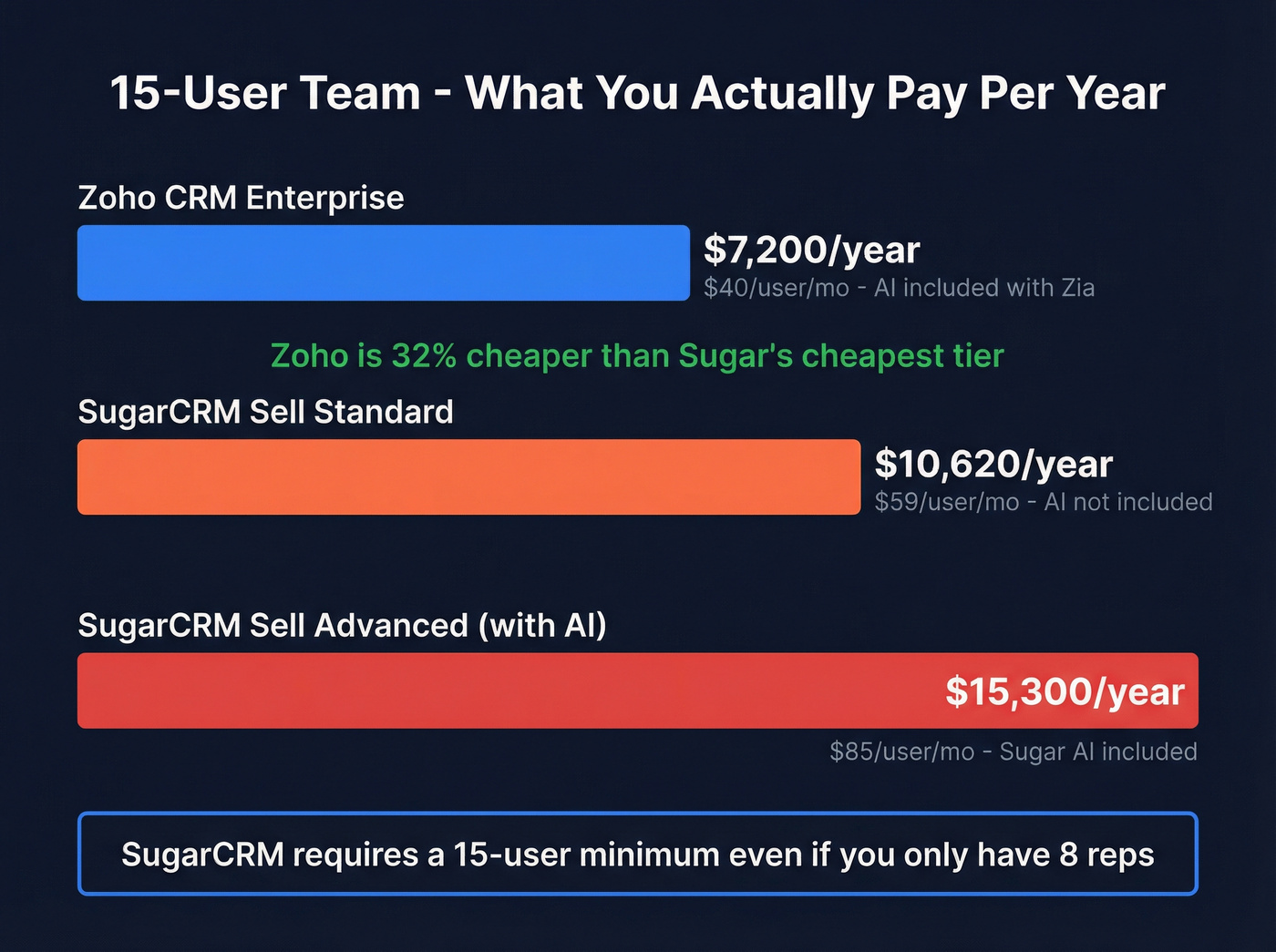
Zoho's math is friendlier. A 15-person team on Zoho Enterprise ($40/user/month annual) runs $7,200/year - roughly 32% less than Sugar's cheapest option. Three-person startup? Zoho's free tier costs nothing. Zoho also offers a 30-45 day refund window, which makes testing low-risk.
One gotcha most comparisons miss: Zoho's "Team User" licensing. Adding non-sales teammates as Team Users strips access to reports, dashboards, automation, Zia, and Google/Microsoft integrations. If you're planning to give marketing or finance limited CRM access, plan your seat mix carefully or you'll hit frustrating permission walls.
For a 15-person sales team, apples to apples:
| Zoho Enterprise | Sugar Sell Standard | |
|---|---|---|
| Annual cost | $7,200 | $10,620 |
| AI included | Yes (Zia) | No (requires $85 tier) |
| On-prem | No | Yes |

You're comparing $7,200/year vs $10,620/year on CRM costs - but neither platform fixes the stale contacts inside it. Prospeo's CSV enrichment returns 50+ data points per contact at 98% email accuracy, works with both Zoho and SugarCRM, and costs roughly $0.01 per verified email.
Stop paying for a CRM your reps don't trust because the data bounces.
AI and Automation
Zoho's Zia covers a lot: churn prediction, email sentiment, deal scoring, anomaly detection, and call transcription. The catch is that advanced Zia capabilities are gated behind Enterprise and Ultimate tiers.
If you're evaluating AI for outreach and follow-ups specifically, compare it against dedicated AI tools for automating sales follow-ups before you assume your CRM's assistant will carry the load.
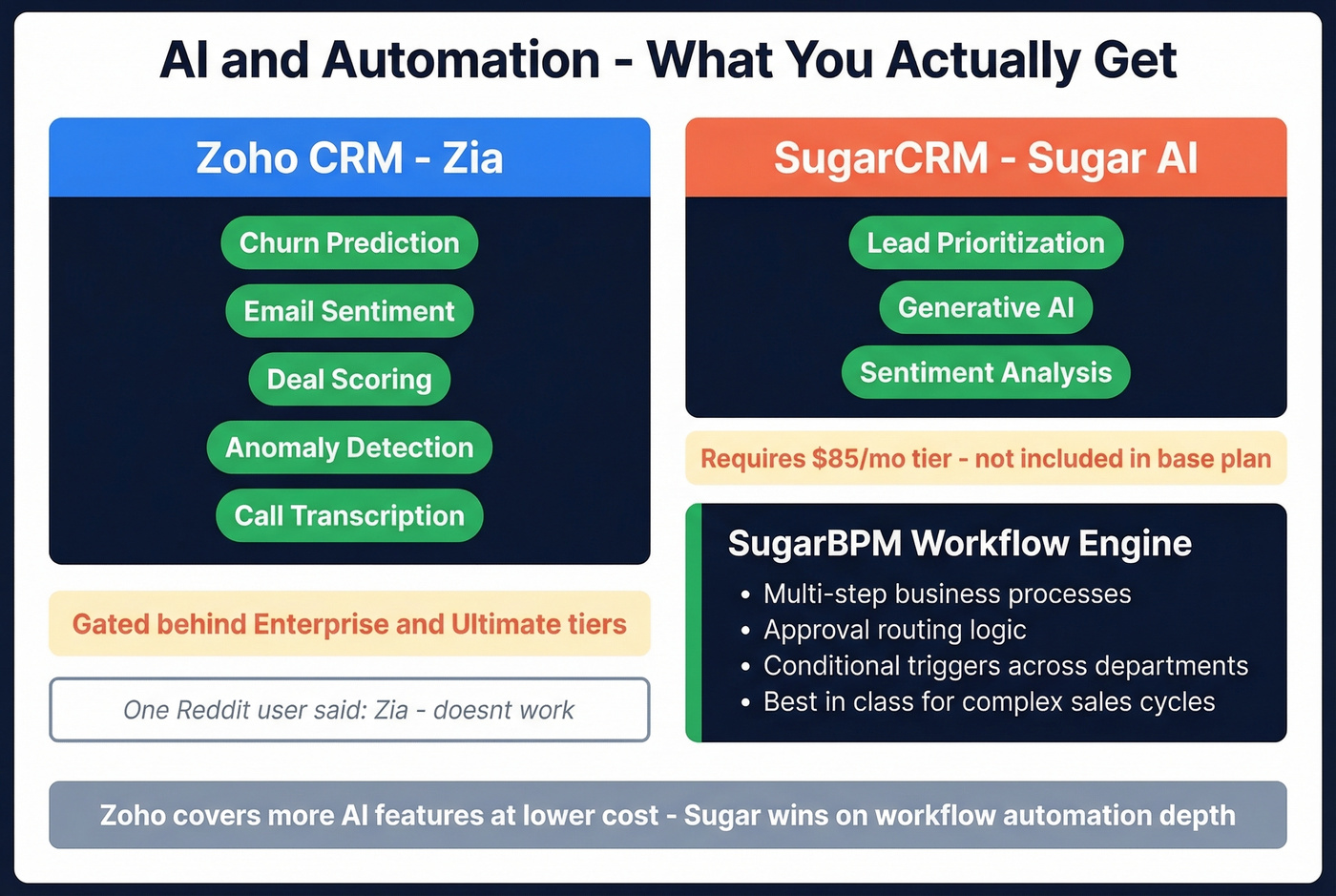
The community isn't always impressed. One user in r/Zoho put it bluntly: "Zia - doesn't work." That's one person's experience, but it matches a pattern we've seen with AI features that look great in a feature matrix and underdeliver in daily use.
Sugar's AI story is simpler but more focused. Lead prioritization, generative AI, and sentiment analysis all require the $85/month tier. Where SugarCRM genuinely shines is SugarBPM - its workflow automation engine handles complex, multi-step business processes better than most mid-market CRMs we've evaluated. If your sales cycle involves approvals, routing logic, and conditional triggers across departments, Sugar's workflow engine is legitimately strong. For teams with straightforward pipelines, though, you're paying for horsepower you won't use.
If you're trying to operationalize this kind of automation, it helps to map it to your sales process optimization work first.
Ease of Use and Support
Neither platform is known for a frictionless UX. Let's be honest about that.
SugarCRM's Trustpilot score is 1.5/5 across 146 reviews. Recurring themes: "buggy, complicated and far from user-intuitive," "appallingly slow at dealing with issues," and complaints about opaque pricing. Trustpilot skews negative by nature, but 1.5 is rough.
Zoho CRM fares better on G2 (4.1/5), but dig into the cons and you'll find familiar pain - complex setup, steep learning curve, poor customer support. On Reddit, one sysadmin called the backend "a nightmare of confusion" with "pretty useless" support. The G2 company-size breakdown tells you where each CRM actually lives: Zoho pulls 1,765 SMB reviews versus just 176 enterprise. It's an SMB tool that mid-market teams stretch into. SugarCRM's reviews skew toward mid-market and enterprise buyers who need the customization depth and can absorb the learning curve.
If your team lives on calls, also consider how your CRM will pair with your dialer/VoIP stack (see: connect outreach tool to CRM).
Who Should Pick Which
Zoho CRM is the right call for teams under 20 users who want a free tier to start, cloud-only deployment, ecosystem breadth (Zoho Books, Desk, Projects), and cost efficiency over deep customization. Zoho's native app ecosystem is broader than Sugar Exchange, and for most SMBs, that matters more than on-prem flexibility.
If you're still sanity-checking options, it can help to look at other examples of a CRM with real pricing and positioning.
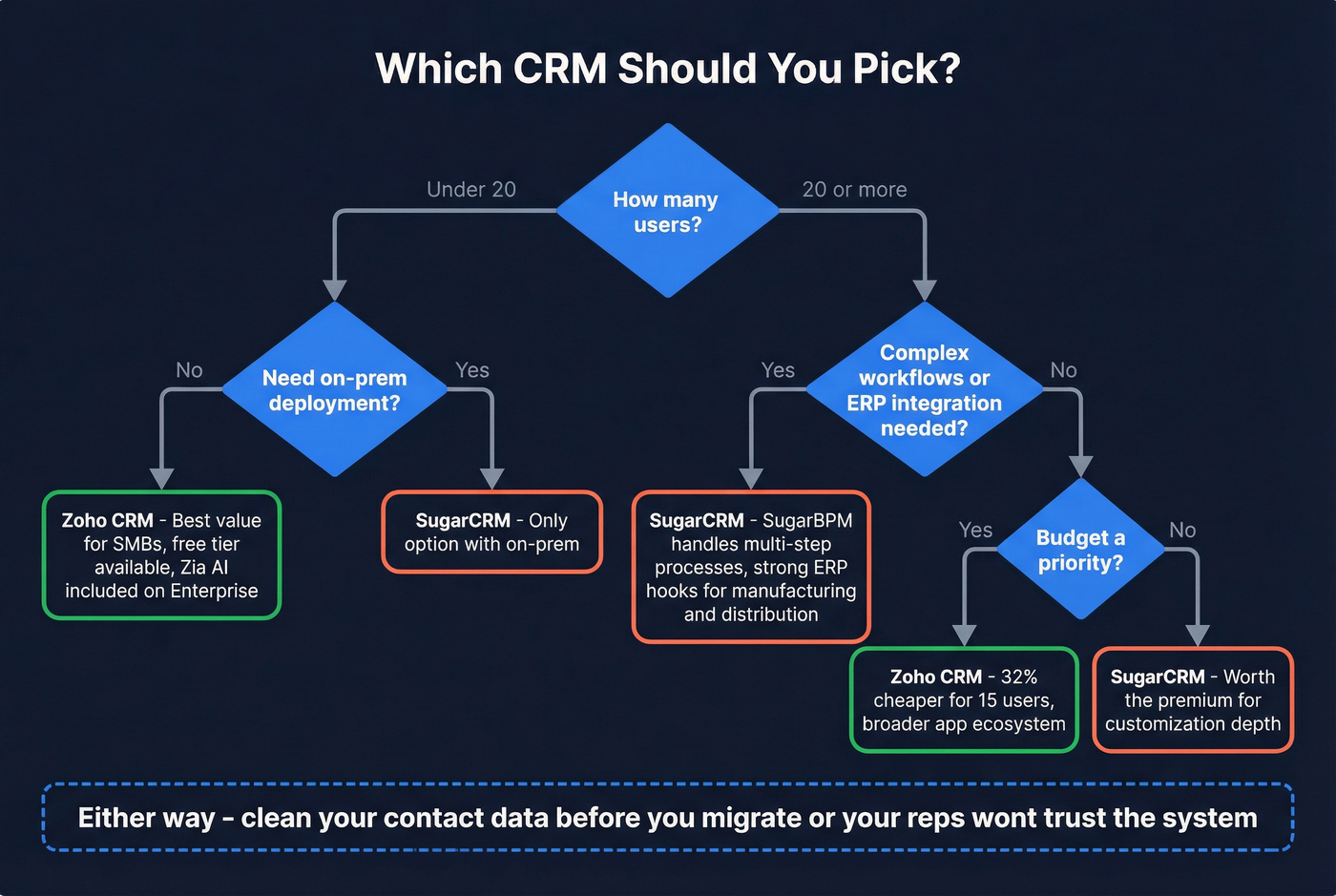
SugarCRM earns its premium for larger teams with complex sales processes, on-prem compliance requirements, ERP integration needs in manufacturing or distribution, and workflows that demand SugarBPM's multi-step automation engine.
Skip SugarCRM if you're a team of 10 who just needs pipeline tracking and email sequences - you'll be paying for infrastructure you don't need.
The 15-50 user range is where this decision actually gets hard. If cloud-only works and budget matters, Zoho wins on value. If on-prem is mandatory or you need deep ERP hooks, Sugar justifies the premium.
Fix Your Data Before You Migrate
Your CRM is a container - only as good as the contact data inside it. We've watched teams spend months evaluating SugarCRM vs Zoho CRM, migrate everything over, and immediately struggle with bounced emails and disconnected numbers. That's the part nobody talks about during the CRM selection process, and it's the part that actually determines whether reps trust the system or abandon it within a quarter.
If you're seeing bounces already, start with the basics: email bounce rate and email deliverability issues tend to compound fast after a migration.
Prospeo handles this with CSV enrichment that works with any CRM, returning 50+ data points per contact at a 98% email accuracy rate and an 83% enrichment match rate. The 7-day data refresh cycle means your records don't go stale the way they do with tools that update every six weeks. Clean data is what makes either platform perform.
If you're comparing vendors, see our roundup of data enrichment services.
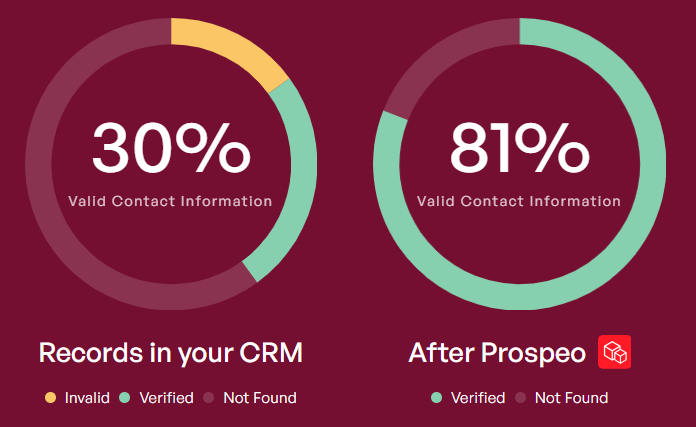
Before you migrate a single record into Zoho or SugarCRM, run it through Prospeo. Our 7-day data refresh cycle keeps contacts current - not 6 weeks stale like most providers. 83% of leads come back enriched with verified emails, direct dials, and firmographics.
Migrate clean data or waste your entire CRM investment. Your call.
FAQ
Is Zoho CRM really free?
Yes, for up to 3 users. The free tier covers basic contact management, lead tracking, and deal pipelines. Automation and advanced reporting start on paid plans, and Zia features are typically available on higher tiers like Enterprise and Ultimate.
Does SugarCRM still have a $49/month plan?
No. As of 2026, Sugar Sell starts at $59/user/month with a 15-user minimum ($10,620/year floor). The $49 figure still appears on third-party sites like Nutshell's comparison page, but it's outdated.
How do I keep CRM data accurate after migration?
Use a data enrichment tool to verify emails and phone numbers on an ongoing basis. Stale data degrades CRM performance regardless of platform - bounced emails hurt deliverability, and disconnected numbers waste rep time. A weekly refresh cycle and high match rates are what separate tools that actually solve this from ones that just claim to.