

The Summary Close: A Complete Framework for Sales Reps Who Want to Stop Losing Deals
You run a clean 45-minute demo. The prospect nods at the right moments, asks smart questions, and even says, "This could work for us." Then you send the recap and it's radio silence for two weeks.
That's not a product problem. It's a close problem. 35% of salespeople say closing is the hardest part of the sales process, and in our experience, the gap between "good call" and "signed deal" almost always comes down to how you wrap things up.
The summary close is the most reliable fix we've seen for "good call, no decision" deals. It turns scattered agreement into a decision-ready narrative - and it works whether you're on a live call or sending a follow-up email three days later.
The Quick Version
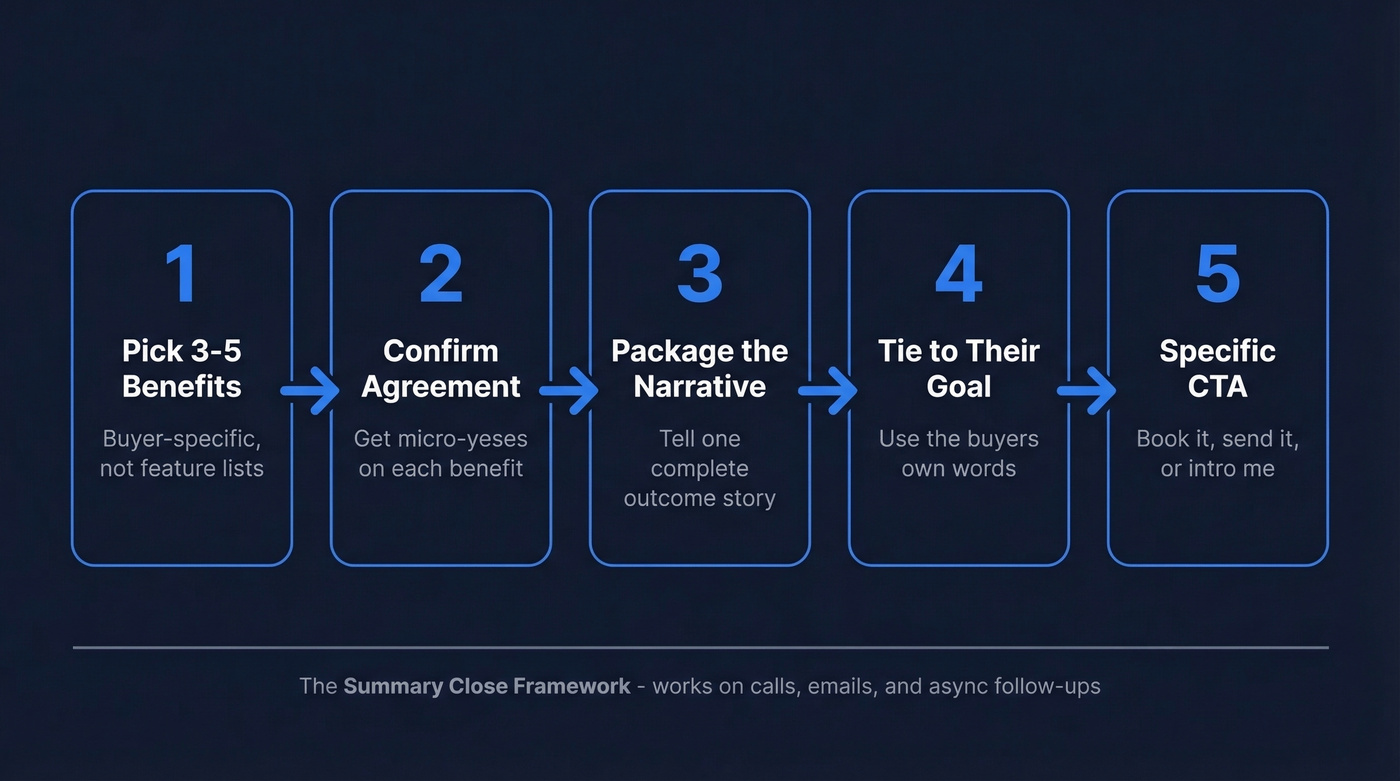
The 5-step framework:
- Pick 3-5 buyer-specific benefits - skip the feature parade
- Confirm each benefit was agreed during the conversation
- Package them into one tight narrative so the whole feels bigger
- Tie it to their stated outcome and the "why now"
- Ask a specific next step (calendar, paperwork, pilot, intro)
If you master one closing technique, make it this one.
What Is the Summary Close?
It's simple: you recap the benefits the buyer already agreed to, bundle them into a single "this is what you're getting" story, then ask for a commitment.
The psychology is why it works. When you restate agreed benefits together, the total offer feels bigger than the sum of its parts - it lands as one complete package, not a list of disconnected points. ChangingMinds calls this the "packaging effect." Two cognitive principles explain the rest. Recency bias means people overweight what they heard last, so ending with value instead of logistics matters. Commitment consistency means once someone agrees to benefits out loud, they're more likely to act in line with those agreements.
Why This Technique Works
Most B2B deals don't die because the buyer "didn't like it." They die because the buyer couldn't align internally, couldn't justify the spend, or couldn't remember what mattered by the time procurement got involved.
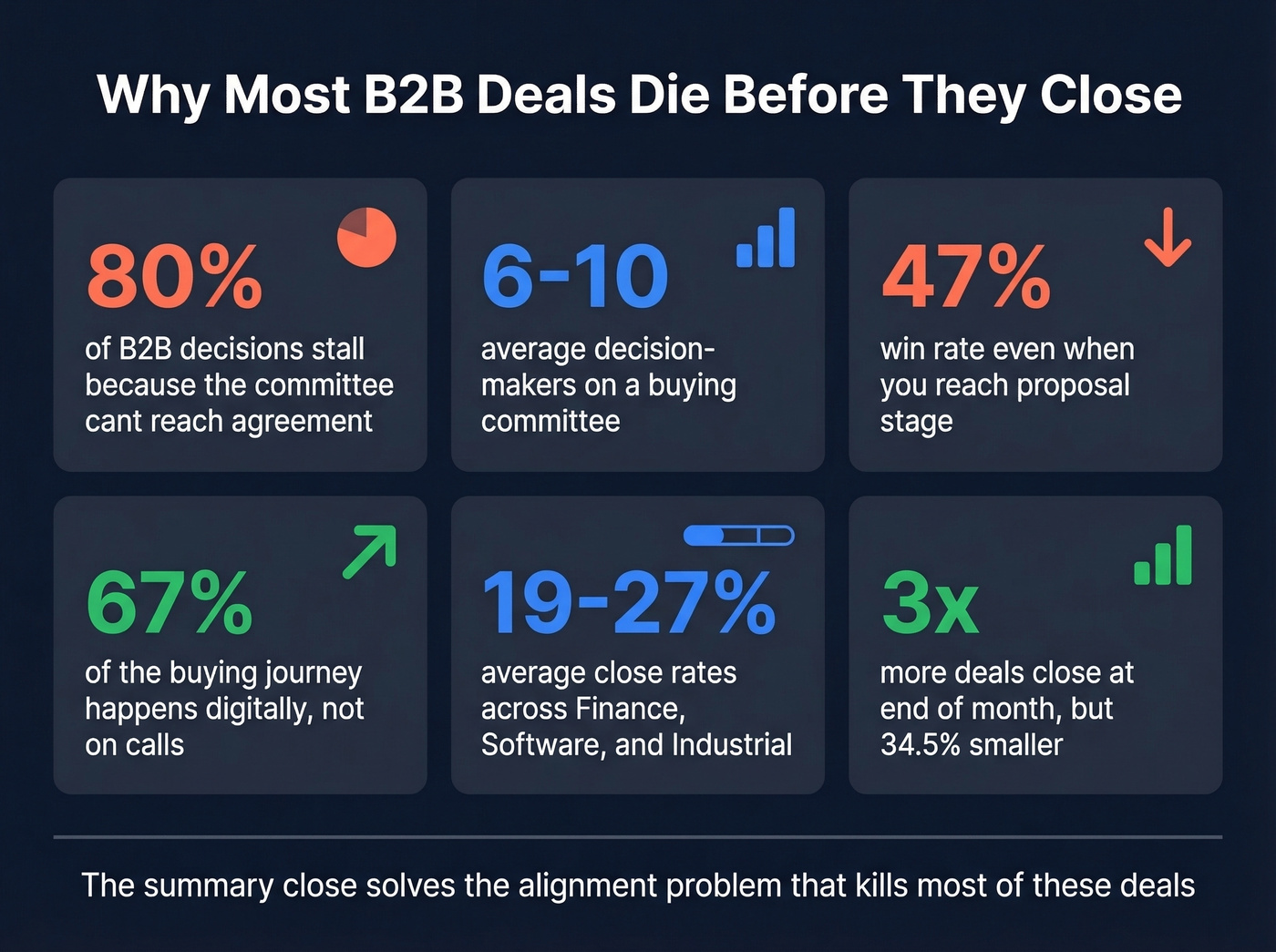
Close rates aren't great. Across industries, Finance averages 19%, Software 22%, and Business/Industrial 27%. Even when you reach proposal stage, the win rate is only 47%. Now layer in complexity: buying committees average 6-10 decision-makers, with some research putting the number as high as 11. Gartner's consensus problem is the real killer - roughly 80% of B2B decisions stall because the committee can't reach agreement.
And since 67% of the buying process is digital now, your "close" isn't just what you say on the call. It's what survives in writing, gets forwarded, and still makes sense three days later.
Here's a timing detail worth knowing: reps close three times as many deals at the end of the month, but those deals are 34.5% smaller. If you want full-value closes, run your recap mid-cycle when the buyer isn't being pressured by your quota breath.
The 5-Step Framework
Step 1: Pick 3-5 Buyer-Specific Benefits
Don't summarize the call. Summarize the decision.
Pick 3-5 benefits that map to what this buyer cares about: risk reduction, time-to-value, compliance, cost control, revenue lift, political safety. If you list 10 things, you're not "thorough" - you're unfocused. Features are what you showed. Benefits are what they get. There's a big difference, and buyers feel it immediately.
You can only pick the right benefits if you know who you're talking to. Tools like Prospeo that surface 50+ data points per contact help you summarize benefits that match the buyer's current context, not assumptions from a stale CRM record. (If you're evaluating vendors, start with this breakdown of data enrichment services.)
Step 2: Confirm Agreement
This isn't a monologue. It's a confirmation loop.
Before you package, get micro-yeses:
- "We're aligned that cutting manual reporting is a priority, right?"
- "And the compliance piece is non-negotiable for you?"
We've run enablement sessions where reps thought they had alignment, but they'd never actually asked for agreement. The close felt "pushy" because it was built on implied buy-in, not explicit buy-in. That single distinction - implied vs. explicit - is the difference between a deal that moves and one that stalls for three weeks while the buyer "thinks it over."
Step 3: Package the Narrative
Now you do the packaging effect on purpose.
You're not reading bullet points. You're telling a short story that sounds like a complete outcome: current pain, promised change, what enables it, what it means for them. Make it sound substantial enough to justify the spend, but tight enough that you don't bore them. That balance is the craft, and it gets easier with practice.
Step 4: Tie to Their Goal
This is where most reps get lazy. They recap benefits, then ask for the sale like it's a formality.
Connect the package to the buyer's own words instead: "You said the goal is to hit SOC2 by end of quarter without adding headcount..." or "You said the board wants forecast accuracy up before the next planning cycle..." If you're using MEDDICC or BANT, this is literally you reusing what you already qualified. Zig Ziglar built a career on structured closing techniques like the "Alternate of Choice" close. The summary close is the modern B2B version of that discipline - same structure, less cheese.
Step 5: Deliver a Specific CTA
A benefit recap without a next step is just a nice conversation.
The momentum-killer to avoid: "Would you like time to think about it?" That phrase almost always shuts the deal down. It gives them an easy off-ramp and trains you to accept vagueness. Use a concrete CTA instead:
- "Should we book a 30-minute implementation scoping call for Tuesday or Thursday?"
- "Do you want me to send the order form today, or do we need legal first?"
- "Let's run a 14-day pilot with these two teams - can you intro me to the ops lead?"
Look, the CTA doesn't need to be aggressive. It needs to be specific. (If you want more options, borrow from these sales follow-up templates.)

Step 1 says pick buyer-specific benefits - but you can't do that with a stale CRM record. Prospeo enriches every contact with 50+ data points at 92% match rate, so your summary close references what actually matters to this buyer, right now.
Stop guessing what matters. Close with data that's refreshed every 7 days.
Scripts and Examples by Scenario
SaaS / B2B Script
Use this after objections are handled and you've heard buying signals. Keep it to 3-5 benefits, not a feature parade.
"Based on what you shared, the big wins are: automated reporting that saves about 5 hours a week, priority support so your team isn't stuck waiting, and a dedicated account manager to keep rollout on track. If we deliver those outcomes, are you ready to get started and move this into procurement?"
Services / Consulting: A Dialogue Approach
Relationship-focused buyers want confidence and partnership more than "hard close" energy. Instead of a monologue, weave the recap into a conversation:
You: "So what I'm hearing is you want a partner who can take this off your plate and keep stakeholders aligned. Fair?"
Them: "That's exactly it."
You: "Then here's what we'll do: kickoff in week one, weekly checkpoints so you're never chasing status, and exec updates so leadership stays in the loop. If that's the partnership you're looking for, should we lock in the start date and I'll send the SOW?"
The dialogue format works because it keeps the buyer talking and confirming, which is the entire point.
Follow-Up Email Template (Async Close)
Since 67% of B2B buying happens digitally, the async version matters just as much as the spoken one.
Subject: Quick recap + next step (use these email subject line examples if you need ideas)
Hi {{Name}} - quick recap from today.
You said the priorities are:
- {{Benefit #1 tied to their pain}}
- {{Benefit #2 tied to their goal}}
- {{Benefit #3 tied to risk/effort}}
If we can deliver those outcomes in {{timeline}}, the next step is {{specific CTA}}. Does {{two time options}} work to confirm stakeholders + rollout plan?
Champion Enablement: Before and After
Your champion loved the pitch. But when they brought it to their VP, they couldn't articulate why. Here's what that sounds like - and the fix.
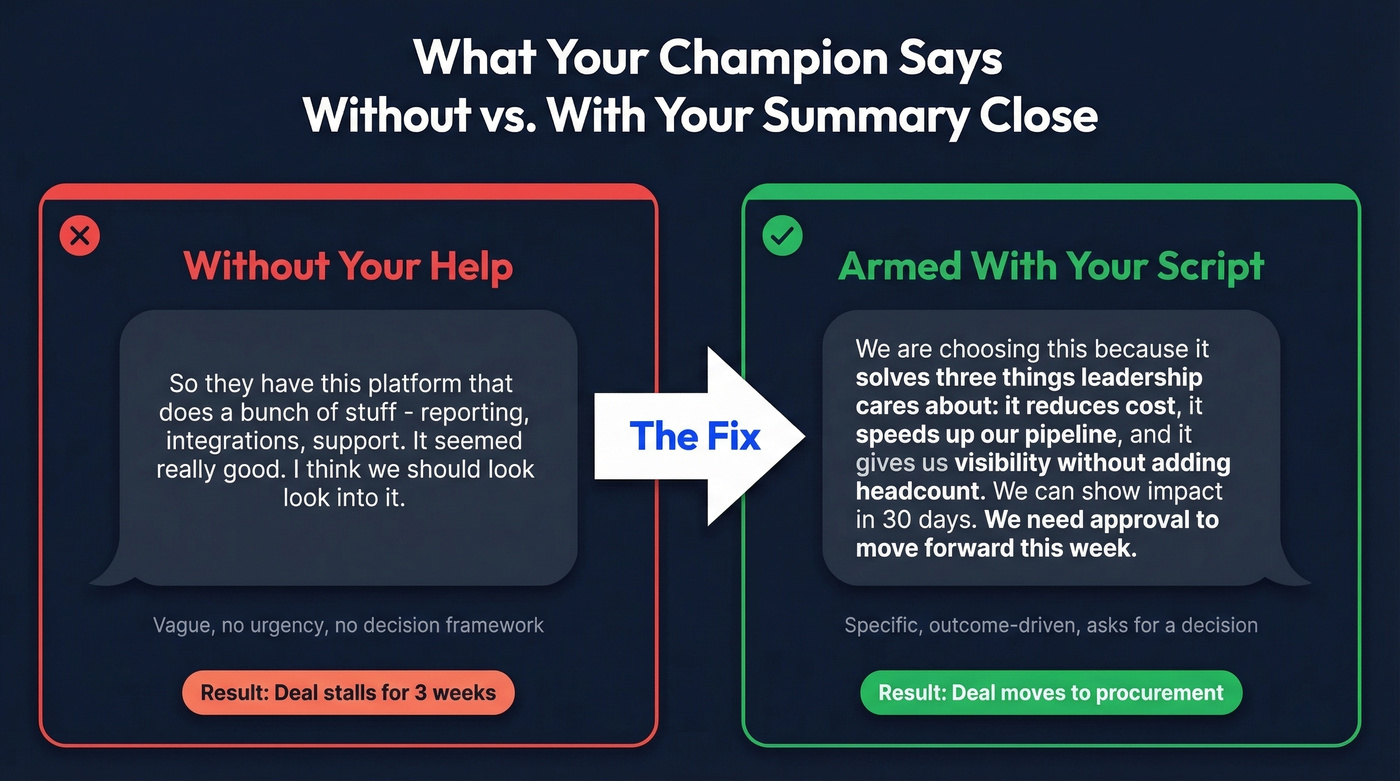
The fumbled version (what your champion says without help): "So they have this platform that does a bunch of stuff - reporting, integrations, support. It seemed really good. I think we should look into it."
The armed version (what they say with your script): "We're choosing this because it solves three things leadership cares about: it reduces {{cost/risk}}, it speeds up {{process/outcome}}, and it gives us {{control/visibility}} without adding headcount. Implementation is {{simple/low lift}} and we can show impact in {{time-to-value}}. The decision we need is approval to move forward with {{pilot/contract}} this week."
Night and day. Give your champion the armed version in writing right after the call ends. (This is also where sales deck storytelling pays off.)
Adapting to Buyer Types
Different buyers need different emphasis, but the five-step structure stays the same. Monday.com's buyer-type research breaks it down well:
| Buyer type | What to lead with | Approach | Best CTA |
|---|---|---|---|
| Analytical | ROI, metrics | Quantify 2-3 wins | "Approve a pilot?" |
| Relationship | Trust, fit | Softer partnership tone | "Lock in a start date?" |
| Exec / busy | Bottom line | 30-sec version | "Greenlight the deal?" |
| Committee | Alignment | Portable recap | "Intro me to stakeholders?" |
Buyer readiness signals to watch for:
- They ask about pricing or contract terms
- They bring up implementation timelines unprompted
- They ask who else on their team should be involved
When those signals show up, you've earned the right to close. (If you want a tighter rubric, see identifying buying signals.)
Summary Close vs. Other Techniques
Stop memorizing 12 techniques. Master one.
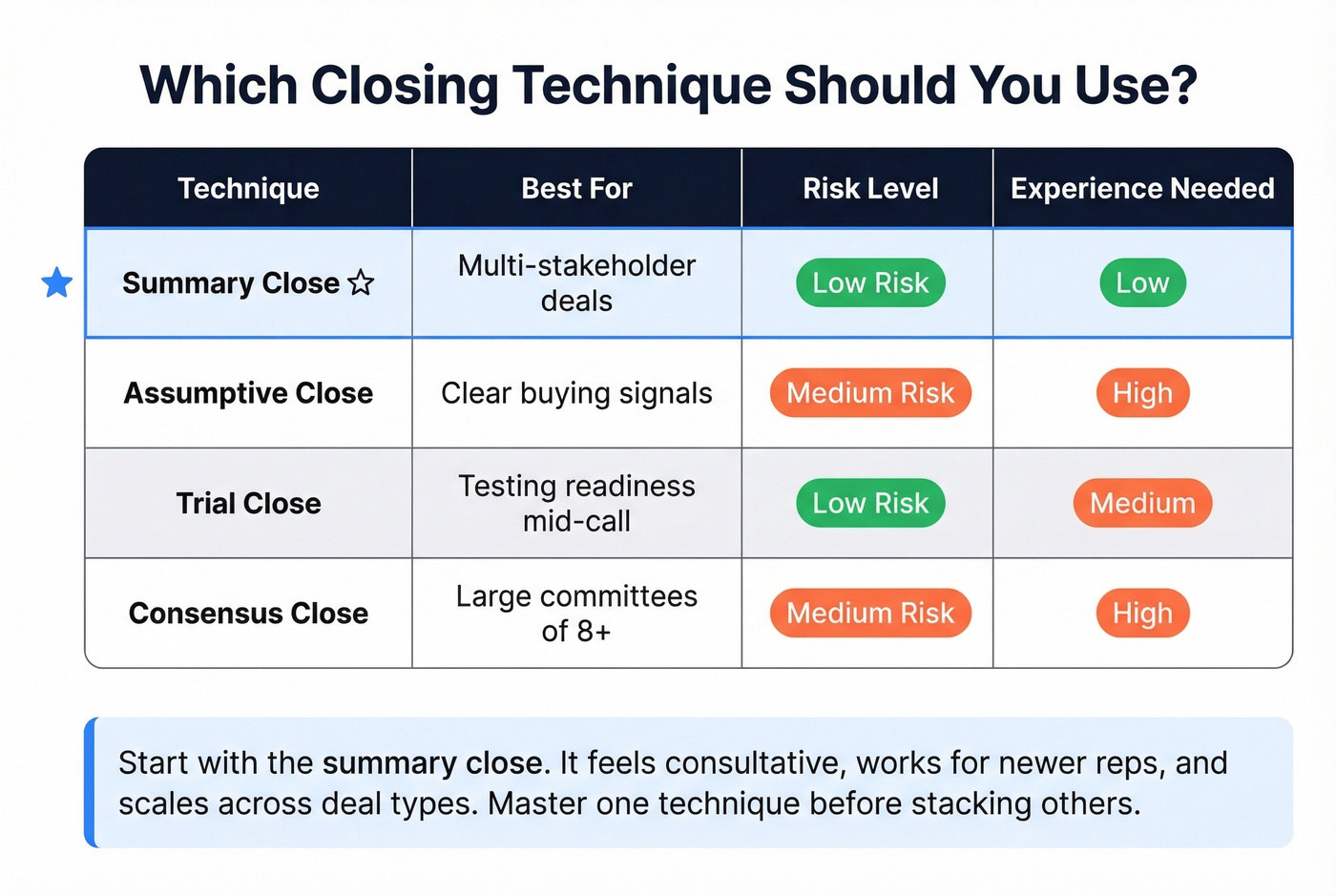
The assumptive close, trial close, and consensus-based close all work - but they're higher-variance. They depend on leverage, timing, and rep confidence. The summary close works for almost everyone because it's rooted in alignment, not pressure.
| Technique | Best for | Risk | Experience needed |
|---|---|---|---|
| Summary close | Multi-stakeholder deals | Low | Low |
| Assumptive | Clear buying signals | Medium | High |
| Trial close | Testing readiness mid-call | Low | Medium |
| Consensus-based | Large committees (8+) | Medium | High |
Assumptive closes backfire when you haven't earned the right to assume. Consensus-based closes require mapping every stakeholder's position, which is powerful but time-intensive. Recapping agreed benefits is the safest starting point for newer reps because it feels consultative even when you're asking for commitment.
Here's the thing: if your deal size is under $15k and your cycle is under 30 days, this is probably the only closing technique you need. Everything else is optimization on top of it. (For a broader view, compare with these steps to close a sale.)
Five Mistakes That Kill Your Close
1. Feature-dumping instead of benefit-summarizing. If it doesn't tie to their goal, it doesn't belong in the recap. Period.
2. No CTA after the summary. Newer reps trail off because asking feels uncomfortable. "Would you like time to think about it?" hands them an easy exit every time.
3. Summarizing to the wrong person. Multi-stakeholder deals punish lazy contact hygiene. Your CRM says they're the VP of Operations - but they left four months ago. Prospeo refreshes contact data every 7 days (the industry average is 6 weeks), so you're never closing a ghost. (This is exactly what good contact management software is supposed to prevent.)
4. Introducing new information during the close. The packaging effect only works with already-agreed items. New info triggers new objections and resets the decision.
5. Summarizing too early. This technique is for after objections are handled and value is clear. If pricing pushback is still live, you're closing on shaky ground. We've watched deals stall for a month because the rep "closed" before the buyer felt safe internally. Handle the risk first, then package the value.
Practice: Two Role-Play Scenarios
Scenario 1: Insurance (price reframing into benefit recap)
Prospect balks at annual premium. You reframe to monthly - "about $37/month" - then land the recap: "So for about $37 a month, you're getting broader coverage, faster claim support when something goes wrong, and peace of mind that you're not exposed on the big-ticket scenarios. If that's the protection you want, should we finalize the policy today?" (Adapted from Exec.com's roleplay structure)
Scenario 2: Enterprise SaaS (committee deal into written close)
Security likes you, finance is skeptical, ops wants low lift. You do the spoken recap, then immediately send a written version your champion can forward internally. That's how you survive committee buying - your words need to work when you're not in the room.
Practice the structure, not the exact words. Scripts are flexible frameworks, not teleprompter copy.
Deals stall when 6-10 stakeholders can't align. Prospeo gives you verified emails (98% accuracy) and direct dials (125M+ mobiles) for every decision-maker on the committee - so your summary close reaches the people who actually sign.
Reach every decision-maker on the buying committee for $0.01 per email.
FAQ
What's the difference between a summary close and an assumptive close?
A summary close recaps agreed-upon benefits and asks for explicit commitment. An assumptive close skips the recap and acts like the decision is already made. The summary approach is safer for newer reps and complex B2B deals because it builds alignment before the ask, reducing buyer resistance.
Can you use this technique in emails?
Yes - and the async version is essential when 67% of buying happens digitally. Recap the 3-5 agreed benefits, tie them to the buyer's stated goal, then include a concrete next step like two meeting times, a pilot start date, or a procurement handoff.
What's a good summary close example for SaaS?
"You're getting automated onboarding that cuts setup from 3 weeks to 4 days, a dedicated CSM so your team isn't filing tickets, and the compliance dashboard your legal team asked for. Ready to move forward this week?" Three benefits, all buyer-confirmed, with a specific ask - that's the formula.
How do you know which benefits to include?
Only include the 3-5 benefits the buyer explicitly agreed mattered during the conversation - never every feature you discussed. Enrichment tools that surface detailed data points per contact help you zero in on what matters before the call even starts, so your recap hits harder.