

SuperAGI Pros and Cons: What 441 Reviews Actually Reveal
You consolidated your entire GTM stack into one platform. Three months later, you're buying $49 credit packs every other week and your reps still can't reply to conversations inside the tool. That's the SuperAGI experience for a lot of teams - and it's the core tension in any honest look at this product.
30-Second Verdict
SuperAGI earns a 4.6/5 on G2 across 441 reviews . The UI is easy, support is responsive, and the all-in-one scope is ambitious. But credits burn fast, billing has hidden traps, and individual modules feel about 70% as polished as dedicated tools.
Best for teams that truly want one platform for everything. If you primarily need accurate contact data and outreach, you're overpaying for 25 apps you won't use.
What Is SuperAGI in 2026?
SuperAGI's roots trace back to its open-source agent framework era, which had around 6K GitHub stars in June 2023. The product today is very different. It's an AI-native CRM and all-in-one GTM platform bundling CRM, multi-channel sequences, a sales dialer, meetings (including an AI notetaker), customer support tooling, analytics, and an AI SDR under one roof.
The platform claims 450M+ agent-verified leads, though "agent-verified" comes with no published accuracy benchmarks - no email verification rate, no bounce-rate targets, nothing you can actually hold them to. Reddit threads asking for SuperAGI CRM feedback have gone largely unanswered, which tells you something about the community track record so far.

Where SuperAGI Shines
The praise on G2 clusters around consistent themes, and the volume of mentions gives them weight.
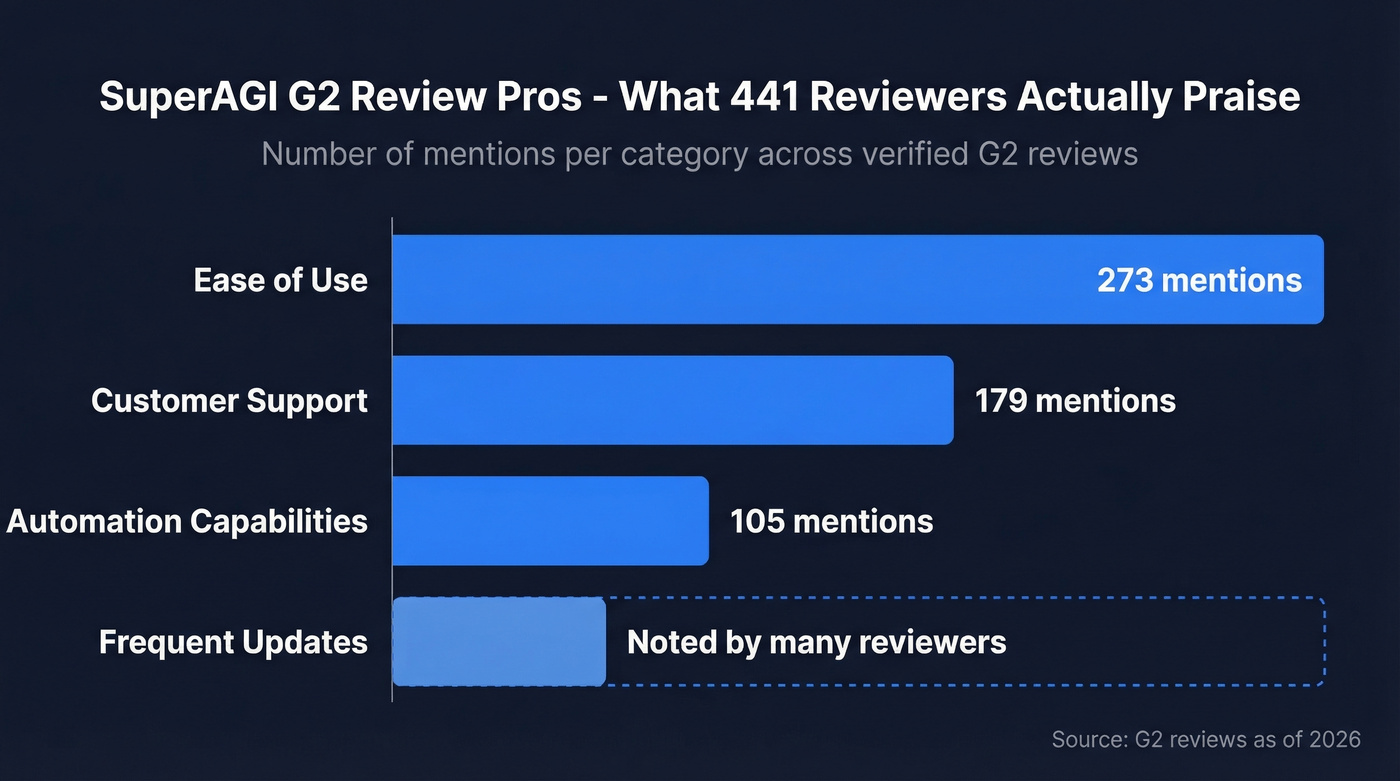
The UI actually works. Ease of use tops the review pro list with 273 mentions. For a platform replacing a dozen tools, the interface is surprisingly navigable. We've tested all-in-one platforms where onboarding takes weeks - SuperAGI isn't one of them.
Support is a real strength. 179 review mentions for customer support. One reviewer put it simply: "Customer Service is fantastic. Product is robust. Updates are frequent!" For a platform this young, responsive support matters more than it would for a mature tool.
Omnichannel automation scope. 105 mentions for automation capabilities across email, phone, web push, and SMS. If you hate stitching together Zapier workflows between five tools, the single-platform approach has appeal.
Frequent updates. The product ships fast. Features missing six months ago often show up. That's encouraging, but it means you're beta-testing features in production - and your team is the QA department.

SuperAGI bundles 25 tools but publishes zero accuracy benchmarks for its contact data. Prospeo's 5-step verification delivers 98% email accuracy and 30% mobile pickup rates - with published proof, not marketing claims. No credit complexity: you pay ~$0.01 per verified email.
Stop guessing about data quality. Get contacts that actually connect.
Where SuperAGI Falls Short
Here's where the review data gets interesting.
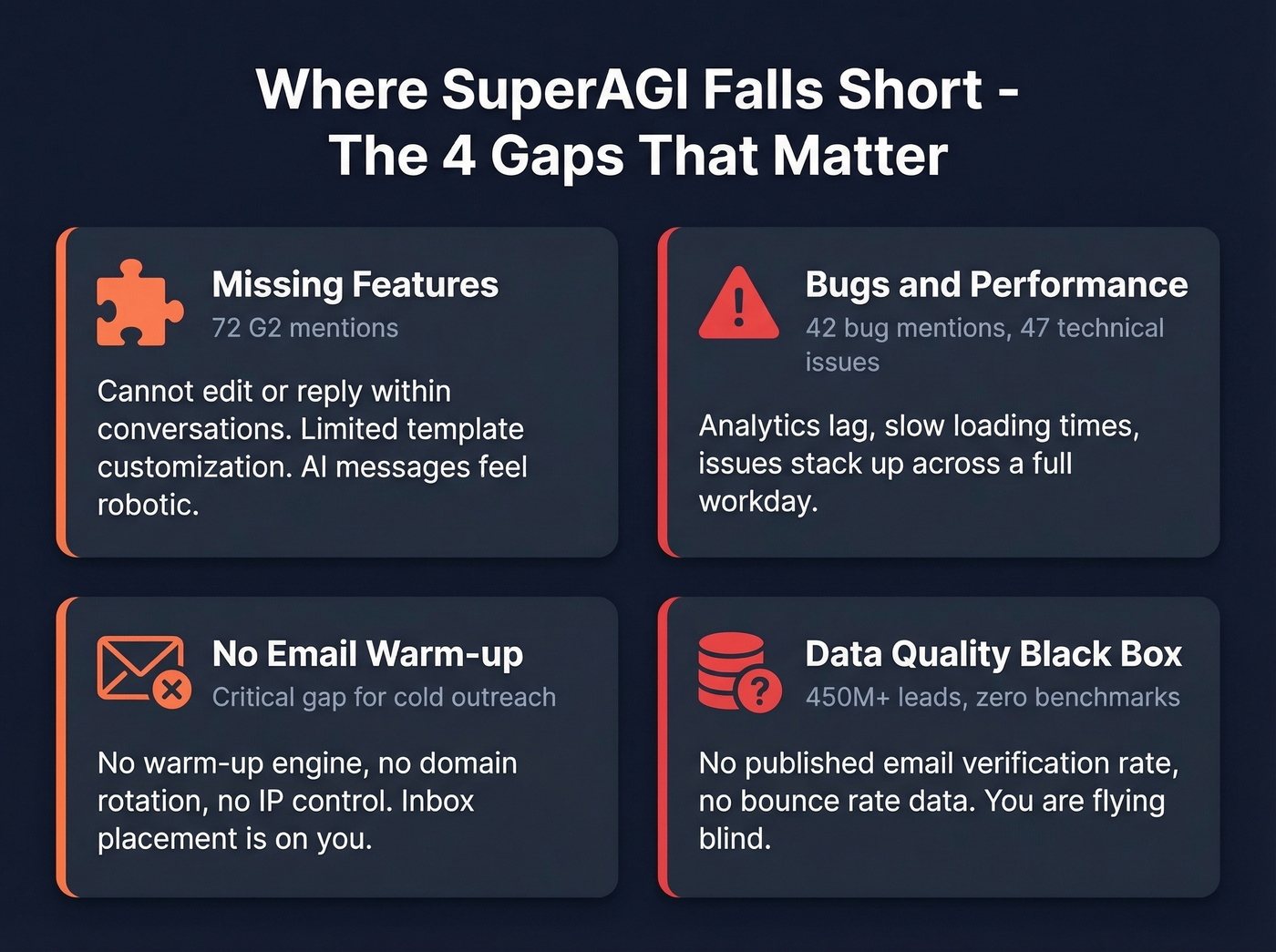
Missing features that should exist by now. 72 review mentions. You can't edit or reply within conversations. Template customization is limited. AI-generated messages can feel robotic, with limited personalization controls. For a platform selling consolidation, these gaps force workarounds that defeat the purpose of consolidating in the first place.
Bugs and performance issues. 42 mentions for bugs, 47 for technical issues. Even fans admit it: "At times, real-time analytics can lag slightly" (Vidit V., who still gave 5 stars). Loading times frustrate users. These aren't dealbreakers individually, but they stack up across a full workday.
No built-in email warm-up. If you're running cold outreach through SuperAGI's AI SDR, you're on your own for warming domains. No warm-up engine, no domain rotation, no IP control. For teams where inbox placement is everything, that's a serious gap. (If you’re evaluating warm-up options, see email warm-up.)
Data quality is a black box. 450M+ leads sounds impressive. But there are no published accuracy benchmarks - no email verification rate, no bounce rate data. We've seen teams switch off bundled databases after discovering 30%+ bounce rates the hard way. If you want a framework for evaluating vendors, start with data enrichment services and basic lead enrichment checks.
Pricing and Credit Burn Math
Let's be honest: the sticker price looks reasonable until you do the math.
| Plan | Monthly | Annual (per mo) | Credits |
|---|---|---|---|
| Free | $0 | $0 | 100/mo |
| Starter | $45/user | $30/user | 500/mo |
| Business | $150/user | $100/user | 2,500/mo |
| Enterprise | Custom | Custom | Custom |
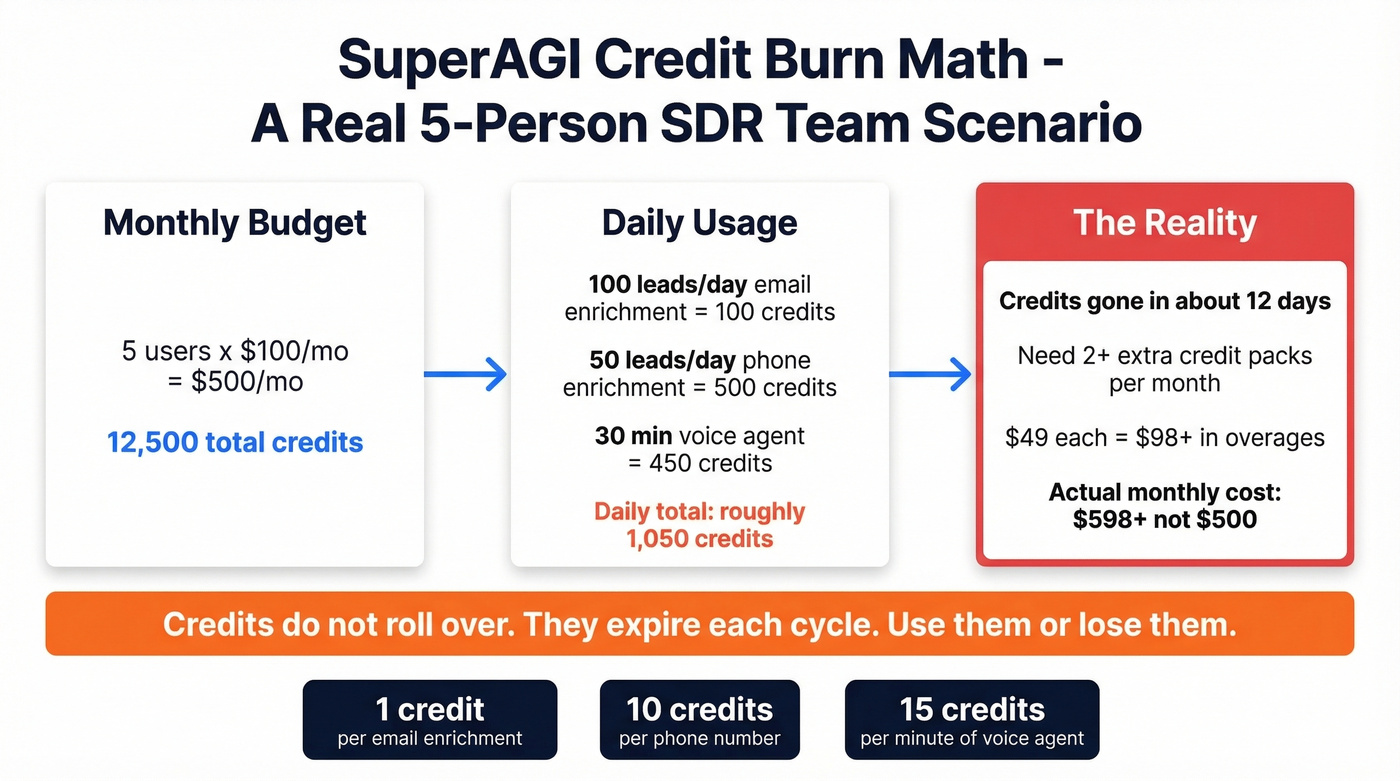
Email enrichment costs 1 credit. Phone enrichment costs 10. Voice agent burns 15 credits per minute. Anonymous visitor ID runs 10 credits per lead. Buying a mailbox costs 2,100 credits per year.
Here's a real scenario: a 5-person SDR team on Business annual ($100/user/mo) enriching 100 leads per day - a mix of email and phone - plus 30 minutes of voice agent daily burns through roughly 2,500 credits in about a week. Once you hit that ceiling, you're into overages via credit packs ($49/month for 2,500 additional credits), and it's easy to end up buying extra packs every billing cycle.
Credits don't roll over. They expire each cycle. Use them or lose them.
Watch the billing mechanics too: the pricing page shows tiered plans, but the billing FAQ describes seats at $49/month and notes that seats are charged immediately when added with no proration. If a domain auto-join or admin invite happens when no free seats remain, a new seat gets automatically purchased and billed on the spot.
If you want a deeper breakdown of how these models compare, it helps to benchmark against other sales prospecting databases and outbound lead generation tools.
Who Should (and Shouldn't) Use It
SuperAGI makes sense if you want to consolidate CRM, sequences, dialer, and support into one platform, have the budget for Business tier plus credit overages, and don't mind riding the product's development curve. The all-in-one bet pays off when your team values breadth over depth in any single module.
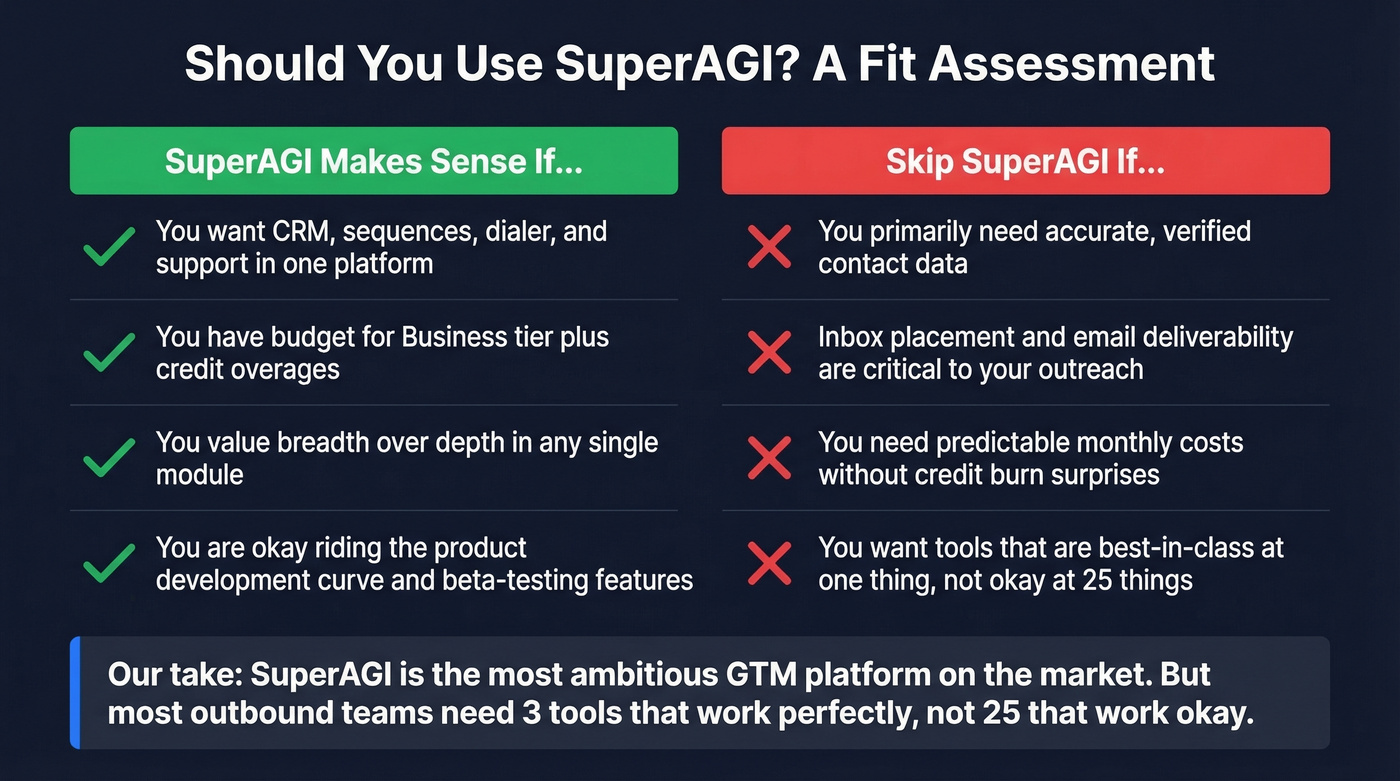
Our take: SuperAGI is the most ambitious GTM platform on the market right now. But ambition and execution are different things, and most outbound teams need three tools that work perfectly - not 25 that work okay. If you're building a modern outbound motion, compare it against dedicated SDR tools and tighten your process with proven sales prospecting techniques.
Alternatives Worth Considering
HubSpot makes sense if you want a mature, stable CRM without AI SDR experimentation. Free CRM tier available; Sales Hub starts around $20/user/mo. (If you’re still mapping what “CRM” can mean in practice, see examples of a CRM.)
Outreach or Salesloft are the picks for proven sequencing with deep deliverability infrastructure - the exact thing SuperAGI lacks. Expect ~$100-150/user/mo on annual contracts. For messaging that doesn’t sound robotic, keep a set of sales follow-up templates handy.
SuperAGI's credit system charges 10 credits per phone number and 15 per minute of voice agent - with no rollover. Prospeo gives you 125M+ verified mobiles, 143M+ verified emails, and 30+ search filters on transparent per-credit pricing. Free tier includes 75 emails/month. No contracts, no seat traps.
Replace credit burn math with a data platform that just works.
FAQ
Is SuperAGI's free plan worth trying?
Yes, but 100 credits/month covers roughly 100 email enrichments or 10 phone lookups. That's enough to test the UI, not enough to evaluate real workflows. You'll need Starter ($30/user/mo annual) minimum for a meaningful trial.