

How to Run a SWOT Analysis for Sales That Actually Changes How You Sell
You've been there. Staring at a blank 2x2 grid in a conference room, someone writes "strong team culture" under Strengths and "the economy" under Threats, and everyone nods like something useful just happened. It didn't.
46.5% of competitive intelligence professionals run SWOT analyses at least quarterly - but most produce generic outputs that never touch a sales number. The problem isn't the framework. It's that nobody adapts it for how sales teams actually operate. A SWOT analysis for sales needs pipeline data, territory math, and deal-specific intelligence - not vibes and sticky notes.
We're going to run SWOT at three levels: team-wide, territory, and deal. Every template below includes filled-in examples with real sales KPIs so you can adapt rather than start from scratch.
Three Levels, Three Questions
- Team-wide SWOT catches strategic gaps across win rates, pipeline health, outbound effectiveness, and competitive positioning.
- Territory SWOT fixes resource allocation by revealing which segments are over-invested, which are starving, and where reps waste time on low-fit accounts.
- Deal-level SWOT prevents lost revenue on active opportunities by surfacing stakeholder access, requirements fit, competitive threats, and "no decision" risk early enough to act.
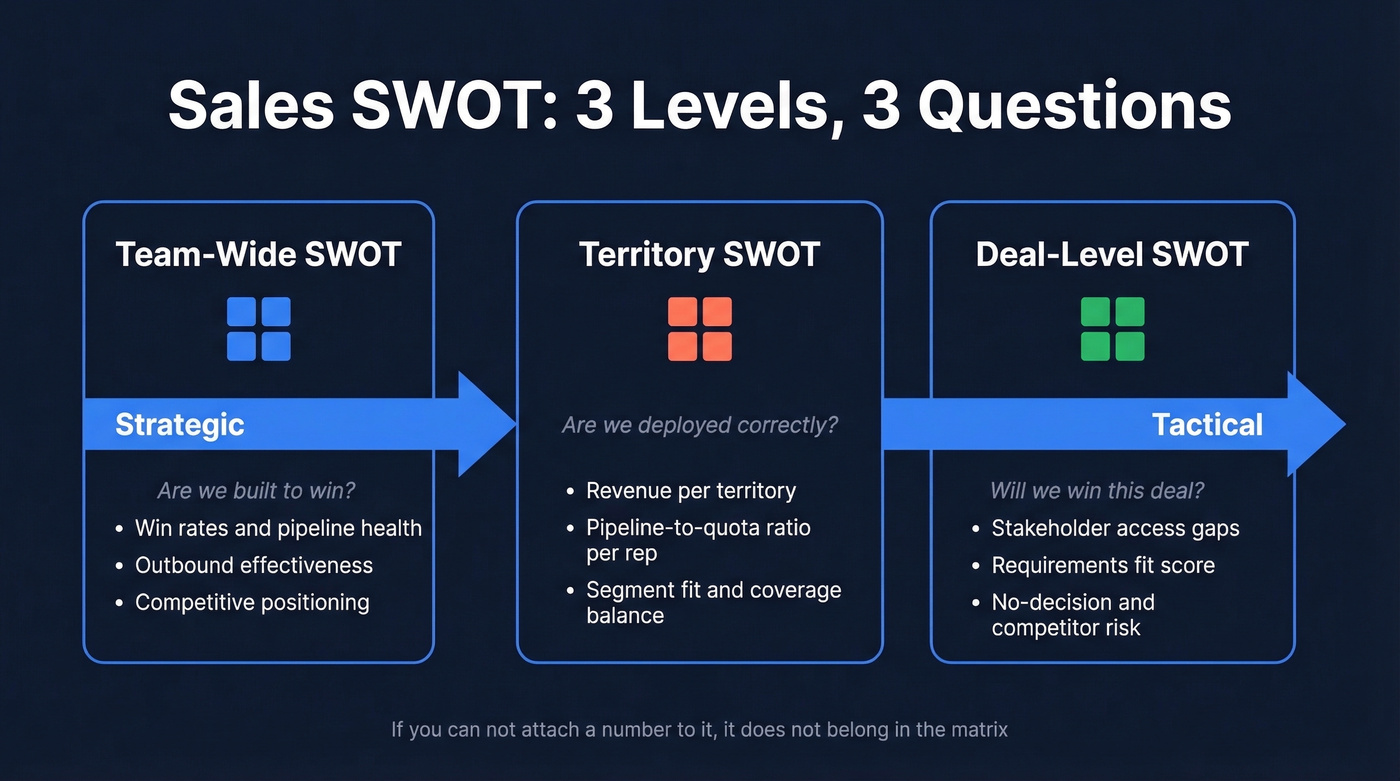
Here's the rule: if you can't attach a number to it, it doesn't belong in the matrix.
What Is a Sales SWOT Analysis?
SWOT stands for Strengths, Weaknesses, Opportunities, and Threats. The framework traces back to Albert Humphrey's work at the Stanford Research Institute in the 1960s, and over 70% of Fortune 500 companies use it in their planning cycles. The core distinction is simple:
| Helpful | Harmful | |
|---|---|---|
| Internal | Strengths | Weaknesses |
| External | Opportunities | Threats |
Strengths and Weaknesses are things you control - your team's skills, your tech stack, your process. Opportunities and Threats come from outside - market shifts, competitor moves, regulatory changes. Confusing the two is one of the most common SWOT mistakes, and it makes the entire exercise useless.
Why Sales Needs Its Own SWOT
A generic SWOT with "strong brand" and "competitive market" as entries is worthless for a sales leader trying to hit number next quarter. Those entries don't tell you what to change, who to coach, or where to invest pipeline resources.
The three-level framework answers different questions at each tier. Team-wide asks "are we built to win?" Territory asks "are we deployed correctly?" Deal-level asks "will we win this specific opportunity?"
Here's the thing: SWOT is a diagnostic tool, not a brainstorming exercise. Pull your CRM data before the meeting. If you walk in without stage conversion rates, win/loss data, and pipeline coverage numbers, you're going to get opinions instead of analysis.
Team-Wide Sales SWOT
This is the strategic view. You're evaluating the entire sales organization's position - capabilities, gaps, market dynamics, and competitive threats. Before you fill in a single quadrant, pull these CRM reports:
- Pipeline coverage ratio (3x is a common target; below 2x is a red flag)
- Stage-by-stage conversion rates to identify where deals die
- Quota attainment distribution across the team
- Average deal cycle length and whether it's trending longer
- Outbound sequence bounce rates and reply rates
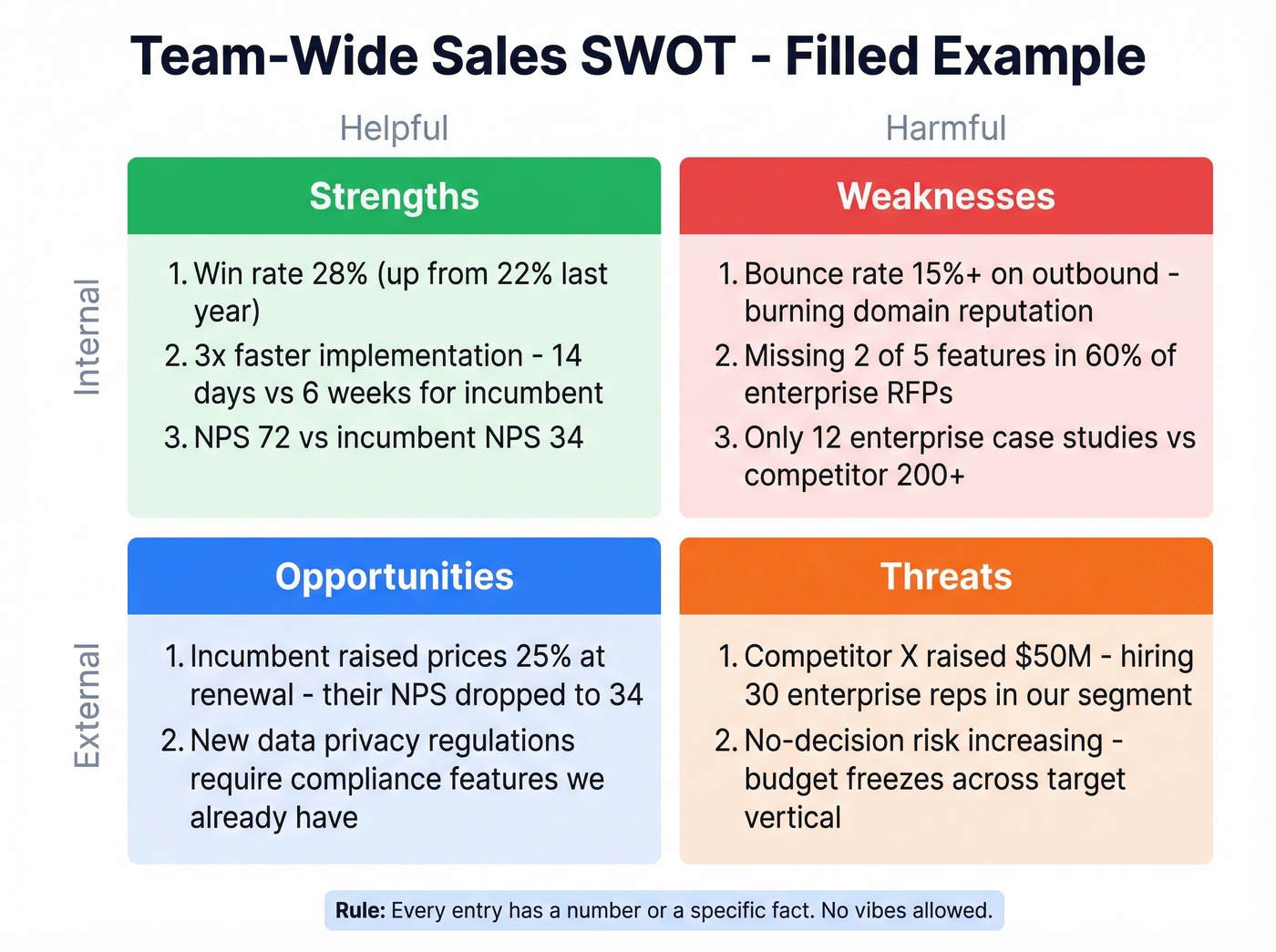
Here's a filled-in example for a mid-market SaaS team:
| Strengths | Weaknesses |
|---|---|
| Win rate 28% (up from 22% last year) | Bounce rate 15%+ on outbound sequences - burning domain reputation |
| 3x faster implementation: 14 days vs 6 weeks for incumbent | Missing 2 of 5 features in 60% of enterprise RFPs |
| NPS 72 vs incumbent's NPS 34 | Only 12 enterprise case studies vs competitor's 200+ |
| Opportunities | Threats |
|---|---|
| Incumbent raised prices 25% at renewal; their NPS dropped to 34 | Competitor X raised $50M, hiring 30 enterprise reps in our segment |
| New data privacy regulations require compliance features we already have | "No decision" risk increasing - budget freezes across target vertical |
Notice every entry has a number or a specific fact. "Great team culture" doesn't appear anywhere. Neither does "the economy."
That bounce rate weakness deserves a closer look. Bad contact data doesn't just waste rep time; it tanks your domain reputation and kills deliverability across every sequence you run. We've seen teams fix this in days by switching to a provider with real-time verification - Prospeo's 98% email accuracy on a 7-day refresh cycle, for example, turns an outbound weakness into a non-issue. (If you want benchmarks and fixes, see email bounce rate and the full email deliverability guide.)

"Low win rate" is lazy analysis. "Win rate dropped from 24% to 18% because Stage 3-to-4 conversion fell after losing our senior SE" - that's a weakness you can actually fix.
Territory-Level SWOT
58% of B2B companies consider their sales territory design ineffective. That's not a minor process issue - it's a structural revenue problem. Field reps spend just 35-39% of their time actually selling, with the rest lost to bad routing, ownership confusion, and low-fit accounts. Optimized territories yield 10-20% higher productivity and 20% more revenue without adding headcount.
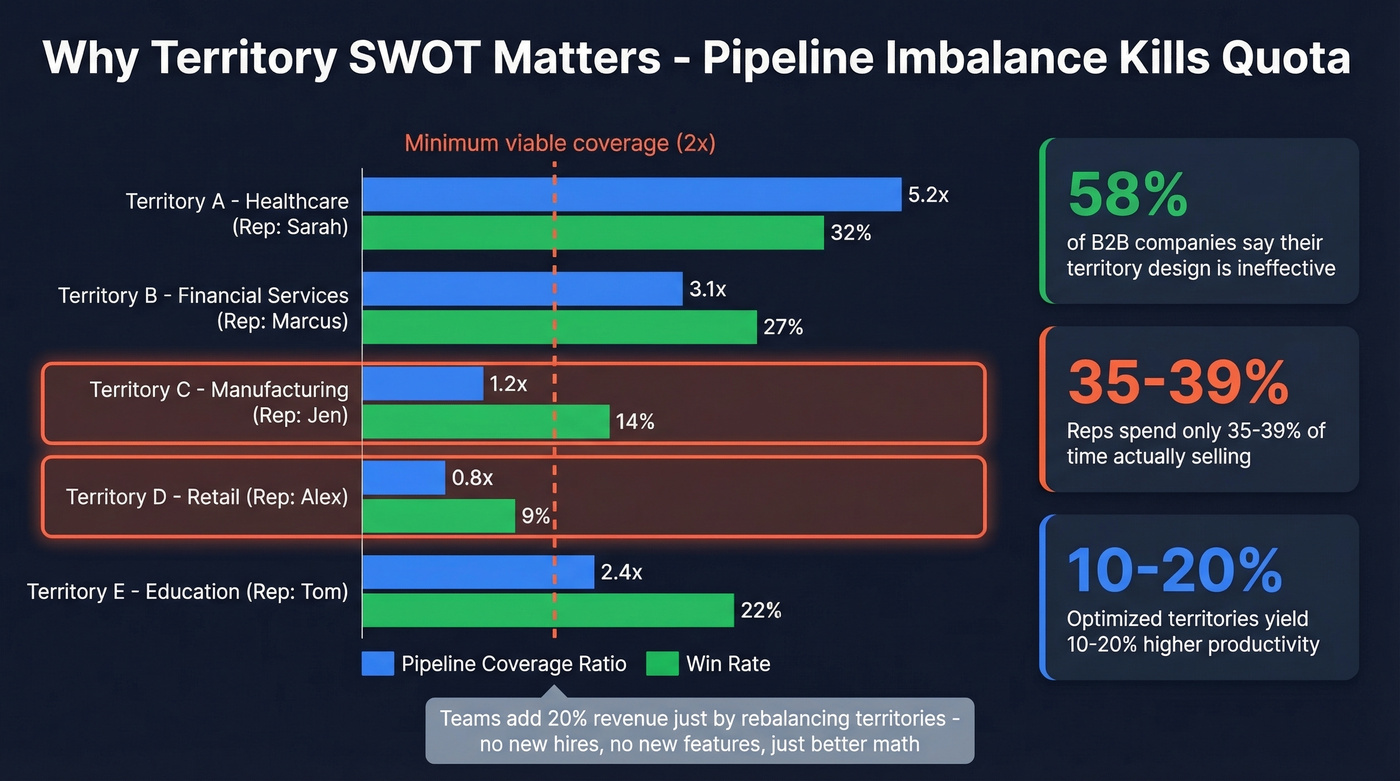
If you only run SWOT at one level, make it this one. Most sales leaders obsess over team-wide strategy and individual deals while ignoring the structural layer that determines whether reps even have a fair shot at quota. We've watched teams add 20% revenue just by rebalancing territories - no new hires, no new product features, just better math.
Here's a filled-in example for a healthcare vertical territory:
| Helpful | Harmful | |
|---|---|---|
| Internal | 8 healthcare case studies; HIPAA-compliant infrastructure; dedicated healthcare SE | No Epic EHR integration; limited clinical workflow knowledge; only 2 reps covering 340 target accounts |
| External | Hospitals investing heavily in digital health; 3 inbound inquiries from competitor's churning customers this quarter | Niche competitor with deep clinical expertise gaining share; regulatory changes extending procurement cycles |
Pull revenue per territory, win rate by territory, renewal rate by segment, and pipeline-to-quota ratio per rep. You're looking for imbalances - territories where a rep sits on 5x pipeline while another territory starves at 1.2x. (For a deeper KPI set, use sales operations metrics and sales pipeline benchmarks.)

A 15% bounce rate showed up in your SWOT weakness quadrant - and it's tanking your domain reputation. Prospeo's 98% email accuracy and 7-day data refresh cycle eliminate bad contact data as a variable. Teams using Prospeo cut bounce rates from 35%+ to under 4%.
Turn your biggest outbound weakness into a strength this quarter.
Deal-Level SWOT
Your top rep just lost a deal you were counting on. The post-mortem reveals the competitor had a champion you didn't know about. A deal-level SWOT would've flagged that in Week 2.
| Strengths | Weaknesses |
|---|---|
| Direct access to CFO + VP Ops - 2 of 3 decision-makers | Missing 2 of 5 RFP requirements |
| Proof of concept completed; results exceeded benchmarks | No technical champion identified |
| Opportunities | Threats |
|---|---|
| Incumbent contract expires in 60 days, no auto-renewal | Competitor offering 40% discount to win the logo |
| Budget approved and allocated - no procurement delay expected | Budget freeze rumored in Q3 - "no decision" risk |
This is the most underused application of the framework, and arguably the highest-leverage one for deals above your average contract value. Run it for opportunities above 2x your average deal size, and pressure-test each quadrant with these questions:
- Who have we reached in the buying committee, and who's missing?
- Which requirements do we meet and which do we miss?
- What's our pricing position relative to the incumbent and the challenger?
- Is there a "no decision" risk we're ignoring because the champion sounds enthusiastic?
We've seen teams add deal-level SWOT to their weekly pipeline reviews and catch blind spots that standard opportunity fields completely miss. The rep who "feels good" about a deal often can't articulate why - the matrix forces specificity. In our experience, this practice pays for itself the first time it saves a single six-figure opportunity from a preventable loss. (If you want a complementary qualification lens, pair this with MEDDIC sales qualification.)
How to Run a Sales SWOT Workshop
Who to invite: 8-10 people. Sales leaders, your top 2-3 reps (not just managers), a solutions engineer, RevOps, and someone from marketing who owns competitive intel. Skip the exec who'll dominate the conversation.
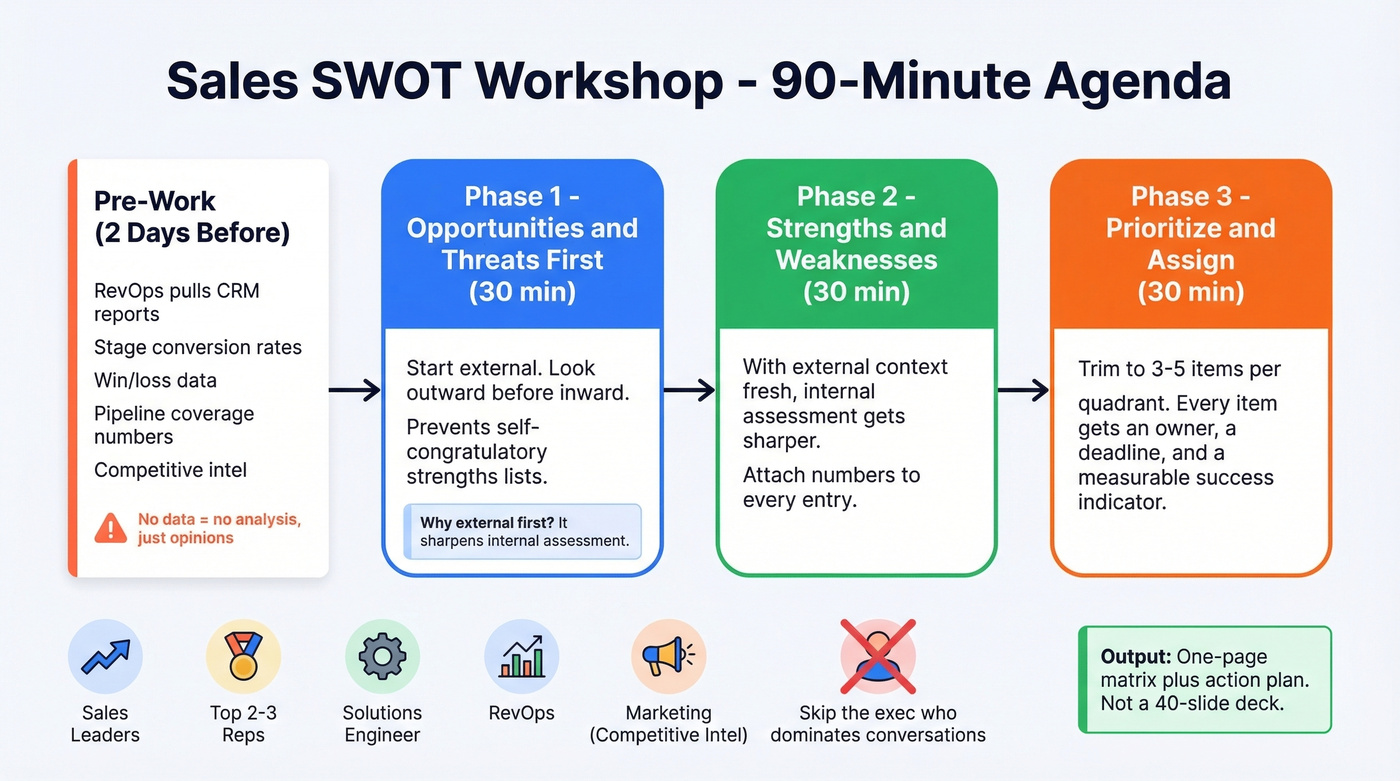
Pre-work is non-negotiable. RevOps pulls the CRM reports listed in the team-wide section above and distributes them 2 days before the session. The single biggest predictor of a useless SWOT is people walking in cold. No data, no analysis - just opinions.
A quick note on AI and CRM tools: modern platforms like Salesforce and HubSpot can pre-populate quadrants with pipeline data, conversion trends, and competitive signals. Use them to save time on data gathering. But the human judgment layer - prioritizing which weaknesses actually matter and assigning owners to fix them - can't be automated.
Agenda structure (90 minutes):
- Opportunities and Threats first (30 min). Starting with Strengths anchors everyone on what they already know and produces a self-congratulatory list. Force the team to look outward first.
- Then Strengths and Weaknesses (30 min). With external context fresh, internal assessment gets sharper. "We're great at closing" hits different when you've just discussed a competitor hiring 30 reps in your segment.
- Prioritize and assign actions (30 min). Each quadrant gets trimmed to 3-5 items max. Every item gets an owner, a deadline, and a measurable success indicator.
The output is a one-page matrix plus an action plan. Not a 40-slide deck. If it doesn't fit on one page, you haven't prioritized.
Common Sales SWOT Mistakes
Long lists that prioritize nothing. If you've got 12 items per quadrant, you've done brainstorming, not analysis. Keep to 3-5 items per quadrant and force-rank them.
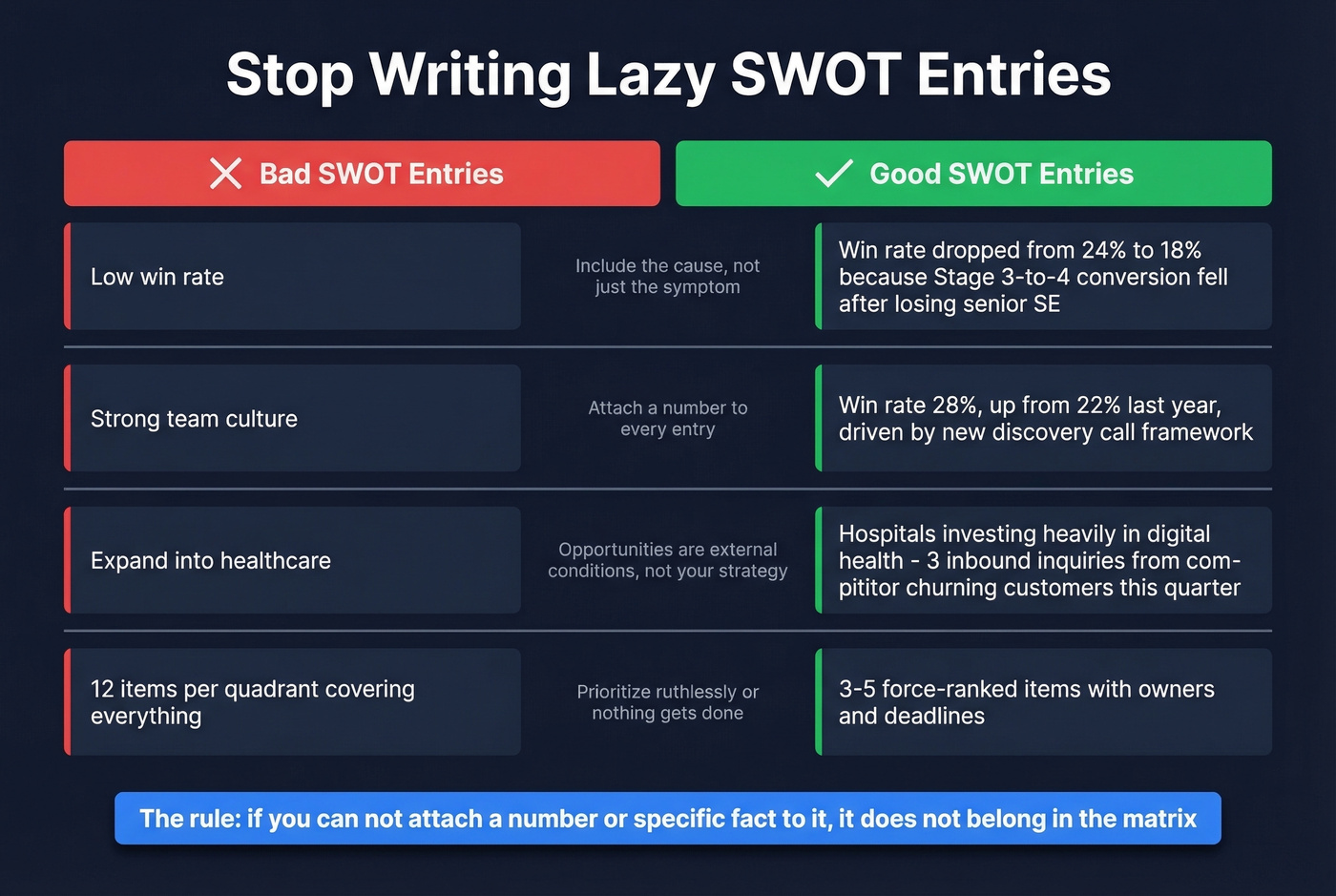
Vague entries without numbers. "Low win rate" isn't a weakness. "Win rate dropped from 24% to 18% because Stage 3-to-4 conversion fell after losing senior SE" is a weakness. Include the cause, not just the symptom.
Confusing actions with opportunities. "Expand into healthcare" is a strategy, not an opportunity. The opportunity is "hospitals investing billions in digital health post-pandemic." Opportunities are external conditions; what you do about them is strategy.
Running SWOT once a year. Sales environments shift quarterly - new competitors, pricing changes, territory dynamics can invalidate your matrix within 90 days. The consensus on r/sales backs this up: annual SWOTs become planning theater that never touches a pipeline number.
No action plan. A SWOT that lives in a slide deck nobody opens is decoration. Every item needs an owner and a deadline, or delete it.
From SWOT to Action Plan
A SWOT without follow-through is a slide deck. The TOWS matrix converts your diagnosis into strategy by crossing internal factors against external ones:
| Opportunities | Threats | |
|---|---|---|
| Strengths | Invest aggressively - highest-ROI quadrant | Defend and position |
| Weaknesses | Develop or partner | Mitigate immediately - highest-risk quadrant |
Let's break this down with the examples from earlier:
Strength + Opportunity: Your 3x faster implementation meets a market where the incumbent just raised prices 25%. Invest in competitive displacement campaigns targeting their renewal cohort. Owner: marketing + sales. Deadline: this quarter.
Strength + Threat: Your high NPS protects against the well-funded competitor hiring 30 reps. Double down on customer advocacy and referral programs to build a moat they can't buy.
Weakness + Opportunity: You're missing Epic EHR integration while hospitals are investing in digital health. Build the integration or partner with an integration vendor. For data quality weaknesses specifically, the fix is immediate: swap your data provider. Prospeo verifies emails in real-time and enriches contacts with 50+ data points via CRM integration, turning a weakness into a strength within a week. (If you’re evaluating vendors, start with data enrichment services.)
Weakness + Threat: Bad contact data combined with a competitor outpacing your outbound volume. This is your highest-risk quadrant. Triage ruthlessly: fix what you can this quarter, accept what you can't, and document the risk for leadership.
Every action item needs three things: an owner, a deadline, and a measurable success indicator. "Improve outbound" isn't an action. "Reduce bounce rate from 15% to under 5% by end of Q2, owned by RevOps" is.
Your territory SWOT revealed 2 reps covering 340 accounts with no way to prioritize. Prospeo's 30+ search filters - buyer intent, technographics, headcount growth, funding - let you score and rank every account so reps work the highest-fit opportunities first.
Stop guessing which accounts deserve your reps' time.
SWOT vs. Other Sales Frameworks
SWOT isn't the only strategic framework, and it's not always the right one:
| Framework | Best For | Sales Use Case | Limitation |
|---|---|---|---|
| SWOT | Internal + external diagnosis | Team, territory, deal assessment | Descriptive, not prescriptive |
| PESTLE | Macro-environment scanning | Feeding better O/T into SWOT | Doesn't address internal factors |
| TOWS | Converting diagnosis to strategy | Action planning from SWOT output | Requires a completed SWOT first |
| SOAR | Strengths-focused planning | Teams demoralized by weakness focus | Ignores threats entirely |
| Porter's Five Forces | Industry competitive dynamics | Market entry decisions | Too broad for deal-level use |
The practical recommendation: use PESTLE to populate your external quadrants, SWOT to diagnose, and TOWS to act. If your team finds SWOT too negative and it's killing morale, SOAR (Strengths, Opportunities, Aspirations, Results) is a better fit - but don't kid yourself that ignoring threats makes them disappear.
FAQ
How often should a sales team run a SWOT analysis?
Quarterly at minimum. Sales environments shift too fast for annual reviews - new competitors, pricing changes, and territory dynamics can invalidate your matrix within 90 days. Tie your refresh to quarterly business reviews for natural accountability.
Can you run a SWOT for a single deal?
Yes, and you should for any opportunity above 2x your average contract value. A deal-level assessment evaluates stakeholder access, requirements fit, competitive threats, and "no decision" risk - surfacing blind spots that standard pipeline fields miss entirely.
What data should you pull before a sales SWOT session?
At minimum: win rate, quota attainment distribution, stage conversion rates, pipeline coverage ratio, and average deal cycle length. For territory-level work, add revenue per territory and renewal rates by segment. For outbound quality, check your bounce rates - anything above 5% signals a data problem that'll skew your entire Weaknesses quadrant.
What's the difference between SWOT and TOWS?
SWOT diagnoses your current position; TOWS converts that diagnosis into strategy by crossing internal factors against external ones. Run SWOT first to identify your top 3-5 items per quadrant, then use the TOWS matrix to generate specific action plans with owners and deadlines.