


Best TagX Alternatives for Data Annotation & Web Scraping
Quick disambiguation: this article covers TagX the AI training data and web scraping company (tagxdata.com) - not Google Tag Manager, not video tagging apps. If you've searched "TagX alternatives" and landed on tag management content, you're not alone. Search results are a mess for this query.
ML engineers and data scientists spend over 80% of their time on data preparation and labeling. Pick the wrong platform and you're burning your most expensive resource on infrastructure friction instead of model improvement. TagX bundles scraping and annotation under one roof, but we've found that best-of-breed tools in each category consistently outperform bundled providers. Here's the breakdown.
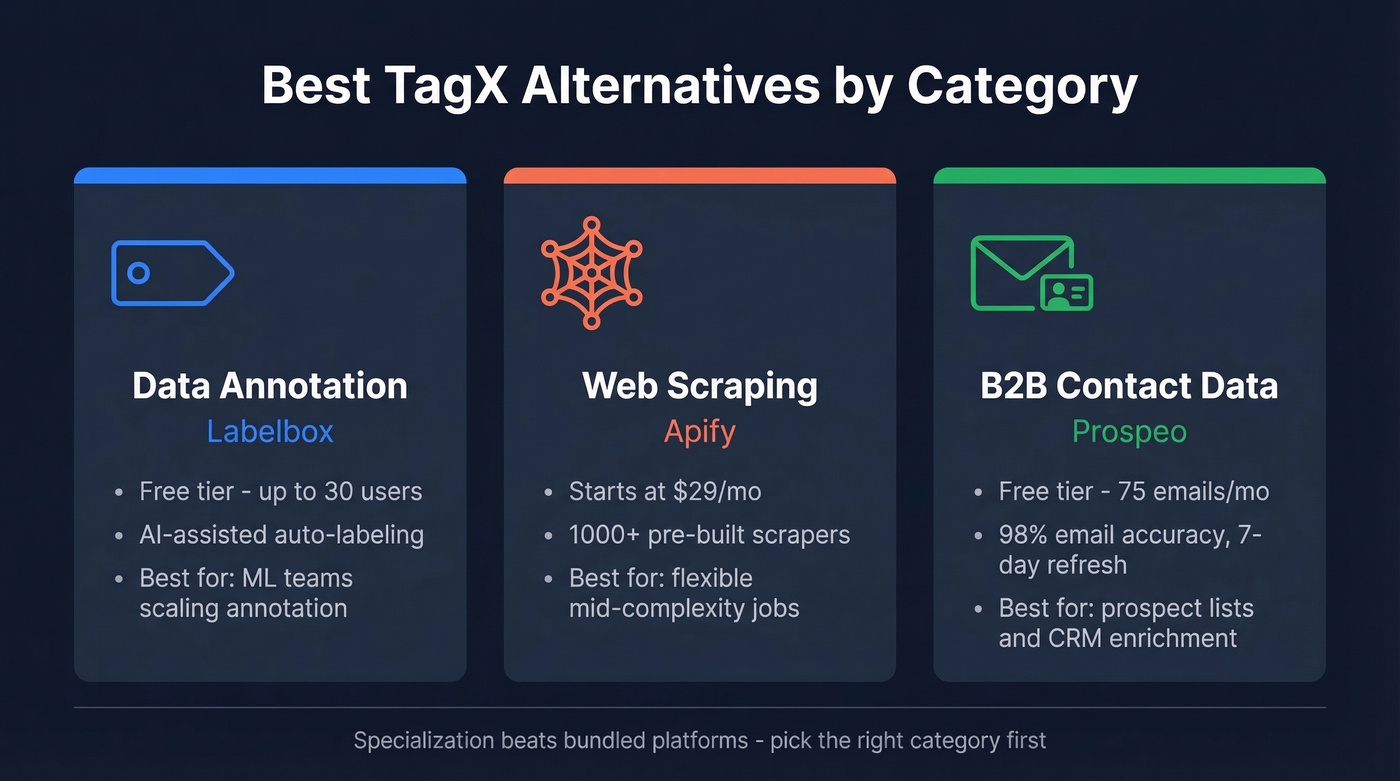
Our Picks at a Glance
| Category | Pick | Best For | Starting Price |
|---|---|---|---|
| Data annotation | Labelbox | Free tier + enterprise scale | Free (up to 30 users) |
| Web scraping | Apify | Flexible pre-built scrapers | $29/mo |
| B2B contact data | Prospeo | 98% email accuracy, no contracts | Free (75 emails/mo) |
Why Teams Switch From TagX
TagX is a roughly 150-person company with solid in-house data collection and annotation capabilities, plus a proprietary synthetic data algorithm. But three things push teams to explore alternatives.
First, pricing is opaque for everything outside the Stock Market API. Web scraping, custom datasets, and annotation services all require a sales conversation with no published benchmarks. Second, TagX's scale is niche - fine for specific projects, but teams needing massive throughput or global coverage often outgrow it. Third, independent review volume is thin. Checking Datarade or SourceForge turns up limited third-party validation compared to established competitors.
Best Alternatives for Data Annotation
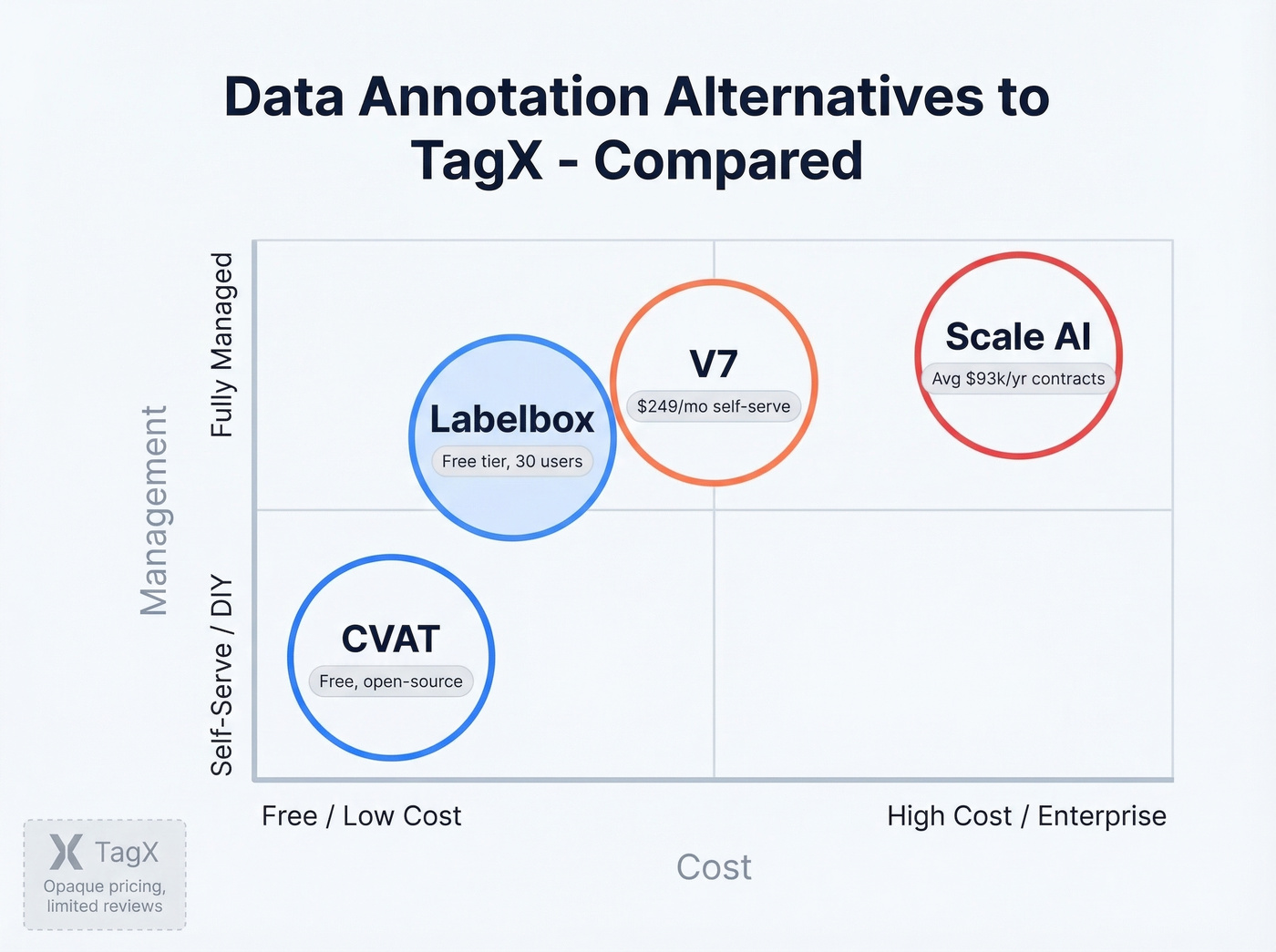
| Tool | Best For | Pricing | Notes |
|---|---|---|---|
| Labelbox | Free tier + scale | Free; paid ~$0.10/LBU | 30 users on free |
| Scale AI | Fully managed | ~$93k/yr avg contract | Sales-led enterprise + self-serve options |
| V7 | Computer vision | Free; self-serve $249/mo | SOC 2 Type II, HIPAA |
| CVAT | Budget / DIY teams | Free | Open-source |
Labelbox
Labelbox's free tier is genuinely generous - 30 users, 50 projects, 25 ontologies, one workspace. That's enough for a mid-size ML team to run real annotation workflows without spending a dollar.
When you outgrow it, paid plans use a Labelbox Unit (LBU) model starting around $0.10 per LBU, with enterprise pricing behind a sales call. The platform shines on AI-assisted labeling: auto-labeling tools, custom model embeddings, and a multimodal chat editor for evals mean your annotators spend less time on repetitive work. If you're evaluating TagX for annotation, Labelbox is the first tool to benchmark against.
If you're also thinking about list building and enrichment, it helps to separate annotation from data enrichment use cases early.
Scale AI
Scale AI is the opposite end of the spectrum: fully managed, fully expensive. There's no public pricing, but Vendr contract data puts the average annual deal around $93,000, with large engagements exceeding $400k. For context, general annotation labor runs $5-$25 per hour - Scale's premium reflects complex data types and quality guarantees. You ship data, they ship labels.
Use this if you're a well-funded ML team needing massive throughput on complex data types (3D/LiDAR, medical imaging, RLHF). Skip this if you're a startup or working with small datasets. The minimum viable spend is simply too high.
V7
V7 Darwin targets computer vision teams specifically. It supports images, video, medical imaging files, and volumetric data with a self-serve plan at $249/month. There's also a free plan with token credits for up to 10 seats - enough to evaluate the platform properly.
Compliance is a strong suit: GDPR, HIPAA, SOC 2 Type II, and ISO 27001. If you're annotating medical or sensitive visual data, V7 checks boxes that many competitors don't. Enterprise pricing is custom and based on platform fees plus user licenses plus data processing volume.
CVAT
CVAT is free, open-source, and maintained by Intel/OpenCV. It's the right pick for engineering-heavy teams who want zero cost and don't mind self-hosting. No managed services, no auto-labeling AI - just a solid annotation interface you run yourself.
In our testing, CVAT handles image and video annotation well but requires real engineering effort to deploy and maintain. You're trading money for time.
Here's the thing: most teams exploring replacements for TagX don't actually need a bundled platform. A free annotation tool like Labelbox or CVAT paired with a dedicated scraping service will outperform any single vendor trying to do both. Specialization wins.
If your end goal is outbound, you may be better served by sales prospecting techniques than more data tooling.

If you're evaluating TagX alternatives for building prospect lists, you're overcomplicating it. Prospeo gives you 300M+ profiles with 98% email accuracy and 125M+ verified mobiles - no scraping, no annotation, no parsing. Data refreshes every 7 days, not every 6 weeks.
Skip the scraping pipeline. Get verified B2B contacts for $0.01 each.
Best Alternatives for Web Scraping
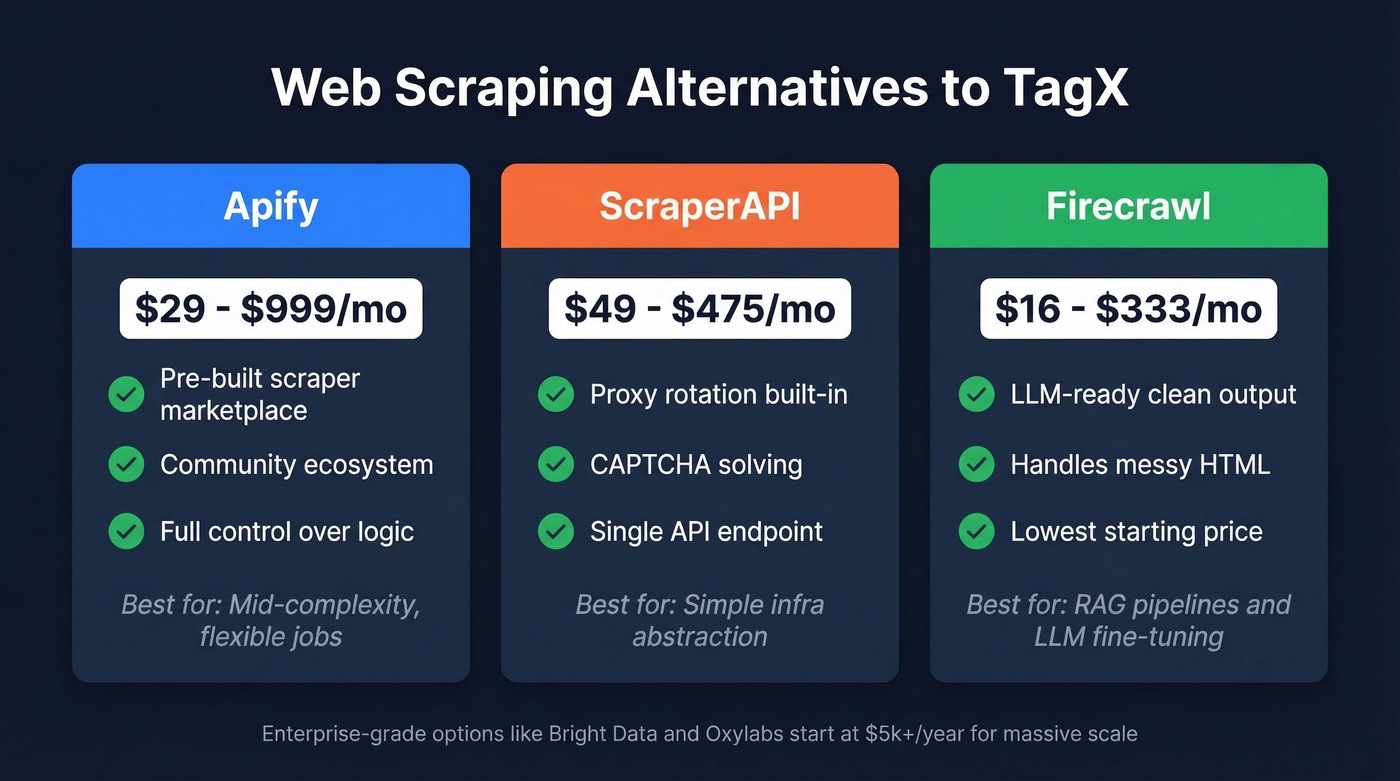
| Tool | Best For | Pricing |
|---|---|---|
| Apify | Flexibility + marketplace | $29-$999/mo |
| ScraperAPI | Simple infra abstraction | $49-$475/mo |
| Firecrawl | LLM-ready clean output | $16-$333/mo |
Apify
Apify's marketplace of pre-built scrapers ("actors") is what sets it apart. Need to scrape a common site? There's often an actor for it already. Plans run $29-$999/mo depending on compute and proxy usage. The consensus on r/webscraping is that Apify's flexibility and community ecosystem make it a strong default choice for mid-complexity jobs. If TagX's scraping services feel like a black box, Apify gives you full control with a lower barrier to entry.
For teams needing enterprise-grade proxy infrastructure at massive scale, Bright Data and Oxylabs are worth evaluating - but expect custom pricing in the $5k-$50k+/year range. Most teams won't need that level of firepower.
If you're scraping specifically to build lists, compare this approach to web scraping lead generation before you commit engineering time.
ScraperAPI
ScraperAPI handles the tedious parts of scraping - proxy rotation, CAPTCHA solving, JavaScript rendering - behind a single API endpoint. Plans range from $49 to $475/month. It's the simplest option for developers who want to write scraping logic without managing infrastructure. Less flexible than Apify, but faster to implement if you're building custom scrapers.
If your target is emails, you may also want to review email crawlers and the tradeoffs vs API-based enrichment.
Firecrawl
Firecrawl converts web pages into clean, structured output ready for language models. Plans start at just $16/month and top out at $333. If you're feeding scraped data directly into LLMs for fine-tuning or RAG pipelines, Firecrawl saves you the parsing step that other scrapers leave to you. We've been impressed by how well it handles messy HTML - the output is LLM-ready with minimal post-processing.
B2B Contact Data: The Category You Might Actually Need
Let's be honest - if your TagX use case is really about building prospect lists or enriching CRM records, you're in the wrong category entirely. You don't need a scraping tool. You need a data platform.

Prospeo covers 300M+ professional profiles, 143M+ verified emails, and 125M+ verified mobile numbers, all on a 7-day data refresh cycle versus the 6-week industry average. Email accuracy sits at 98%, powered by a proprietary 5-step verification process with catch-all handling, spam-trap removal, and honeypot filtering. One of our customers, Snyk, dropped their bounce rate from 35-40% to under 5% after switching - that's the kind of difference fresh, verified data makes.
The free tier gives you 75 email lookups and 100 Chrome extension credits per month, enough to validate the data quality before committing. Paid plans start around $39/month with no contracts and no sales calls required. For teams whose "data problem" is really a "reaching the right people" problem, this solves it cleanly.
If you're comparing vendors in this category, start with B2B company data providers and then narrow down to your workflow.
Also, if deliverability is the real pain, fixing email bounce rate is often higher ROI than collecting more raw data.
Specialization wins - that's the whole thesis of this article. For B2B contact data, Prospeo's proprietary 5-step verification with catch-all handling and spam-trap removal delivers 98% accuracy. No black-box bundling, no sales calls required, no annual contracts.
Start with 75 free verified emails and see the difference yourself.
How to Choose the Right Alternative
We've found that teams searching for TagX alternatives usually fall into one of three buckets. These questions will tell you which one you're in.
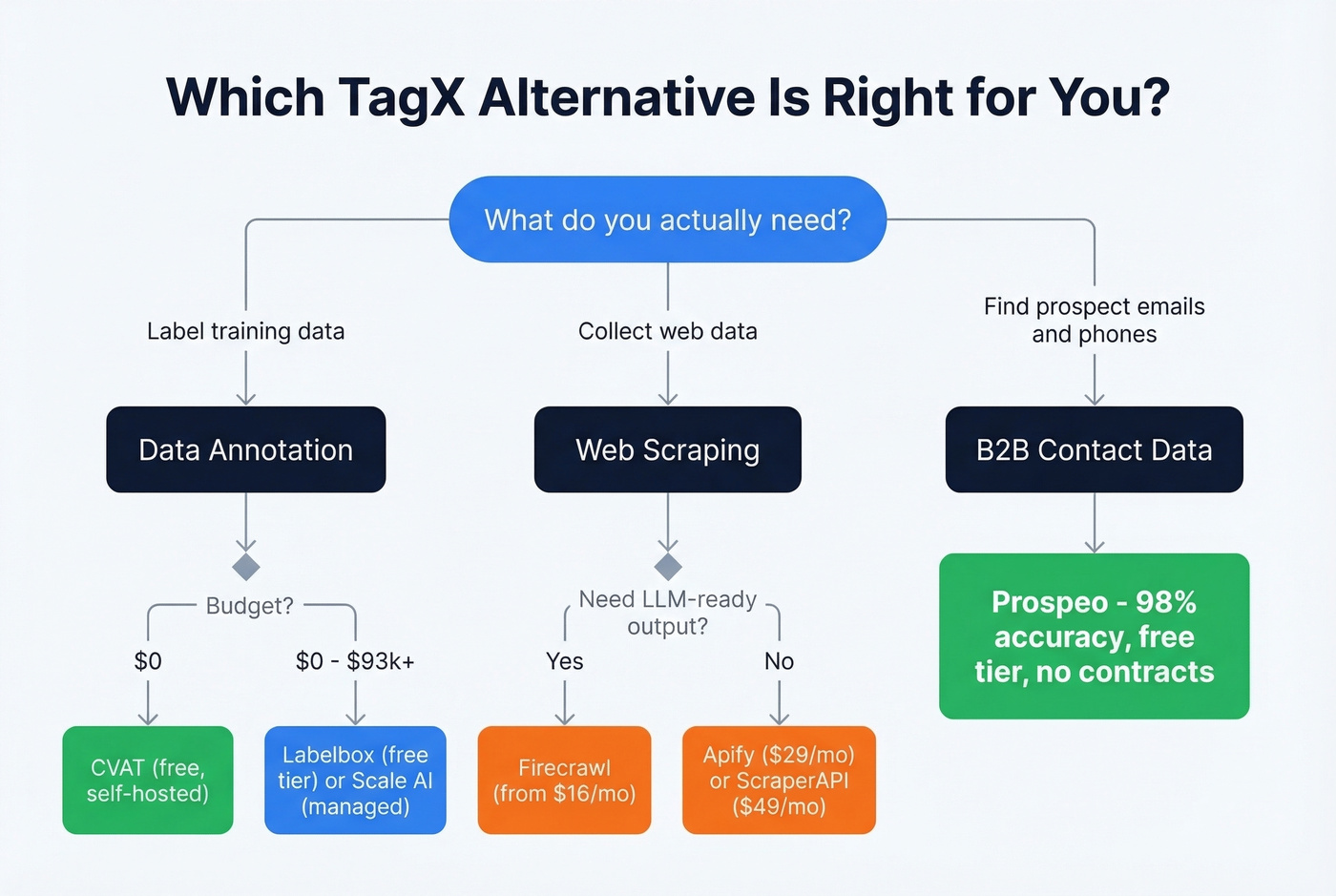
What do you actually need? Annotation, scraping, or contact data - pick the right category first. TagX bundles these, but you'll get better results from a focused tool.
Managed or self-serve? Scale AI manages everything. Labelbox and V7 are platforms you run. CVAT is full DIY. For B2B data, Prospeo is self-serve with zero implementation overhead.
What's your budget? Free options exist in every category - CVAT, Labelbox's free tier, Prospeo's 75 monthly lookups. Mid-range runs $29-$475/month for scraping or $249/month for V7. Enterprise annotation starts around $93k/year with Scale AI.
If you're choosing a tool specifically to support outbound, map the decision back to your lead generation workflow so the data actually gets used.
FAQ
What does TagX actually do?
TagX is an AI training data company offering web scraping, data labeling, and industry-specific APIs (stock market, jobs, e-commerce). It serves ML teams that need collected and labeled datasets for computer vision, NLP, and analytics, delivered via API or flat files.
Are there free alternatives to TagX?
Yes. CVAT is a fully free, open-source annotation tool suitable for self-hosted teams. Labelbox offers a free tier supporting up to 30 users and 50 projects. For B2B contact data, Prospeo provides 75 free email lookups per month with no credit card required.
Is TagX the same as Google Tag Manager?
No - they're completely unrelated products. TagX (tagxdata.com) is an AI training data and web scraping company. Google Tag Manager is a tag management system for website analytics. The naming overlap causes persistent confusion in search results.