

The Take Away Close: A Complete Playbook for Sales Reps and Managers
It's Thursday afternoon. Three deals have been sitting in "verbal interest" for two weeks with zero forward motion. The champion loved the demo, the pricing deck is out, and yet - nothing. No objection, no pushback, just silence. The take away close exists for exactly this moment.
What Is the Take Away Close?
The take away close means withdrawing or pausing an offer to test the buyer's commitment. You're saying, "It sounds like this might not be the right fit," and then watching what happens. If the prospect re-engages, you've got a real deal. If they agree and walk, you just saved yourself weeks of chasing a ghost.
Here's the thing: most reps think this is a pressure move. It's the opposite. You're giving the prospect an easy exit, which is exactly why it works. Sometimes called the takeaway close in shorthand, the technique assumes "no" and waits for the buyer to correct you - a fundamentally different posture than the assumptive close, which assumes "yes" and pushes forward.
Why It Works (The Real Psychology)
You've probably read that this technique works because "losses hurt twice as much as gains." That claim is outdated. A 2025 re-meta-analysis by Yechiam and Zeif - covering 84 papers, 163 estimates, and 149,218 participants - found that in studies with symmetric gains/losses and no ordering effects, the loss-aversion parameter lands around 1.07 and isn't significantly above 1.0. The simplistic "losses are 2x" narrative often disappears once you control for study design.
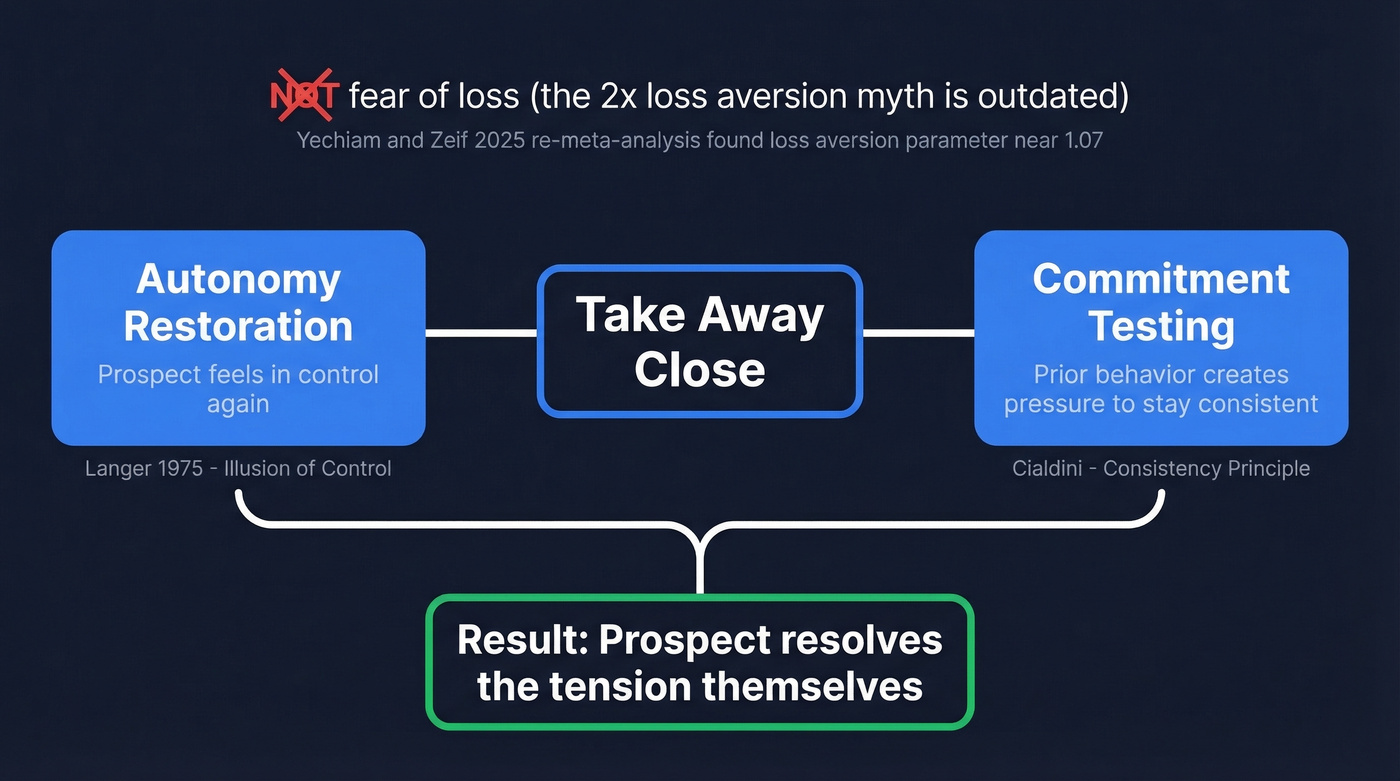
So why does the takeaway sales technique actually work?
Autonomy restoration. When you tell a prospect "this might not be the right fit," you hand them back perceived control - what psychologist Ellen Langer demonstrated in her 1975 research on the illusion of control. People who feel in control make faster, more confident decisions. They stop hedging.
Commitment testing. This is Cialdini's commitment and consistency principle. If a prospect has invested time in demos, internal conversations, and evaluation - and you offer them an exit - their own prior behavior creates internal pressure to stay consistent. The takeaway close surfaces this tension and forces a resolution.
The mechanism isn't fear of loss. It's the collision between autonomy and prior commitment. That's why tone matters so much - a pushy delivery triggers reactance (the prospect digs in against you), while a neutral delivery lets the psychology do the work quietly.
When to Use It (and When Not To)
| Green Lights | Red Flags |
|---|---|
| Momentum has stalled | Decision-maker absent |
| Value/ROI already proven | ROI case hasn't been made |
| Buying signals were present | Prospect actively evaluating alternatives |
| Next step is low-risk (pilot, meeting) | No value summary delivered |
| You'd genuinely accept a "no" | You're bluffing and wouldn't walk away |
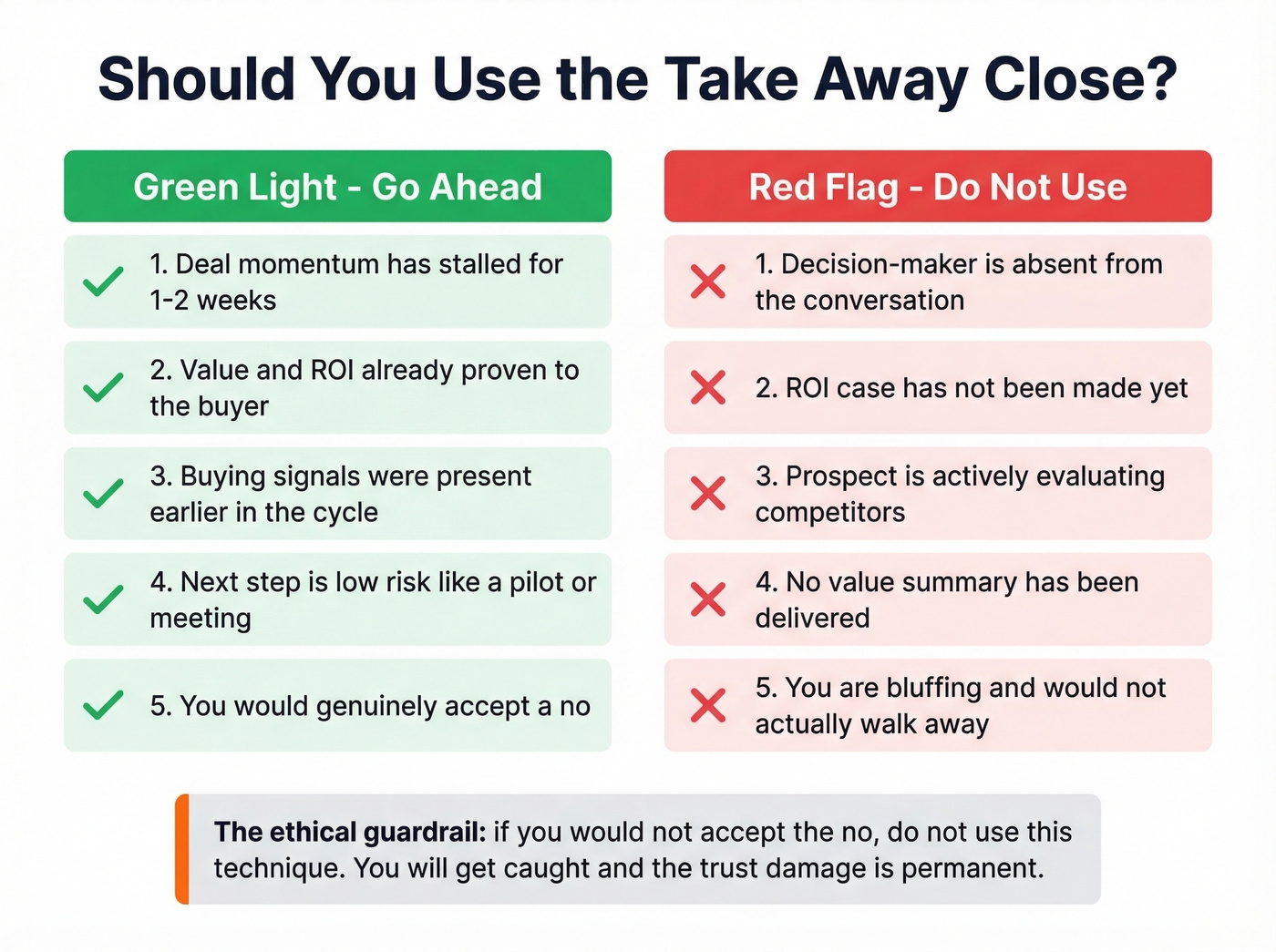
That last row is the ethical guardrail. If you wouldn't accept the "no," don't use this technique. You'll get caught, and the trust damage is permanent. (If you want a deeper framework for this, see ethics in sales.)
Scripts by Channel
Phone / Discovery Call
This is where the technique hits hardest, because silence does the heavy lifting. A practitioner on r/sales shared this verbatim line from a life insurance context that captures the approach perfectly:
"Mr. Prospect, based on your answers it appears you don't need life insurance at this time."
Adapt it to your product: "Based on what you've shared, it sounds like [solution] isn't what you need right now." Then stop talking. Don't fill the silence. The prospect will either argue back and reveal their real objections, or agree - in which case you've qualified out a tire-kicker in 10 seconds instead of 10 weeks.
We've watched reps deliver the line perfectly and then panic-fill the silence three seconds later. That kills it every time. Sit with the discomfort for a full 5-7 seconds. That discomfort is the mechanism working.
Email Follow-Up
Subject: Closing the loop on [Project/Initiative Name]
Hi [First Name],
I haven't heard back since we reviewed the proposal, and I want to be respectful of your time. It sounds like the timing might not be right for [solution], and that's completely fine.
I'll close out this thread on my end. If anything changes on your side, you know where to find me - no hard feelings either way.
Best, [Your name]
The "I'll close this out" statement is what makes this work. The prospect reads it and has to decide whether they're actually done. Threads on r/sales consistently recommend this kind of low-pressure "maybe we're just not a fit" framing for re-engaging stalled prospects - and in our experience, it's the single most effective breakup email format.
Voicemail
"Hey [First Name], it's [Your name] from [Company]. I've been thinking about our conversation, and honestly, it sounds like this might not be the right fit right now. I'm going to take this off my follow-up list - but if I'm wrong, give me a call back at [number]. Either way, I appreciate your time."

You can't deploy a take away close on a bounced email or a disconnected number. Prospeo gives you 98% verified emails and 125M+ direct dials so your breakup emails actually land in real inboxes - and your voicemails reach real decision-makers.
Fix your data problem before you try to fix your closing problem.
Take Away Close vs. Other Techniques
You need three closing techniques max. Everything else is a variation.
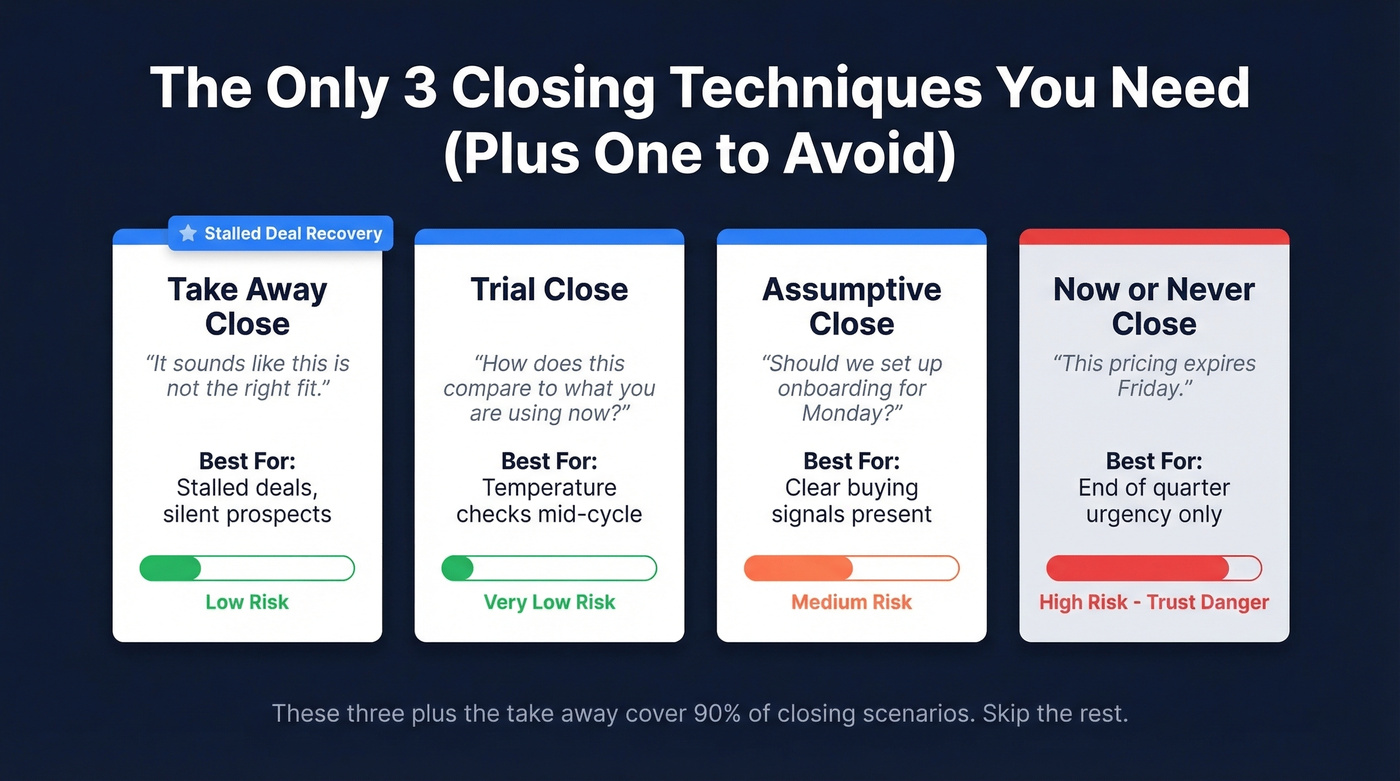
| Technique | Example Line | Best For | Risk Level |
|---|---|---|---|
| Take away close | "It sounds like this isn't the right fit." | Stalled deals, silent prospects | Low (if genuine) |
| Trial close | "How does this compare to what you're using now?" | Temperature checks mid-cycle | Very low |
| Assumptive close | "Should we set up onboarding for Monday?" | Clear buying signals | Medium |
| Now-or-never close | "This pricing expires Friday." | End-of-quarter urgency | High (trust risk) |
Let's be honest: if you're rotating through more than three closing techniques, you're overcomplicating your process. The takeaway handles stalled deals. The trial close gives you temperature reads. The assumptive close converts clear intent. That covers 90% of scenarios. (If you want a full framework, map it to your steps to close a sale.)
Mistakes That Kill It
| Mistake | Why It Kills the Close |
|---|---|
| Fake scarcity | Trust destruction. If you bluff, you deserve the lost deal. |
| Pushy or sarcastic tone | Triggers reactance - prospect digs in against you |
| Using it before value is established | Prospect has no reason to fight for the deal |
| Ignoring other stakeholders | Champion re-engages, but CFO never heard the pitch |
| Deploying on stale contacts | Burning a precision technique on someone who left 6 months ago |
That last mistake is more common than people admit. The take away close works best on real decision-makers with verified contact info. If your emails are bouncing or your direct dials hit disconnected numbers, you never even get to deploy the technique. Skip this approach entirely until you've confirmed you're reaching a live, relevant human. (Related: email bounce rate benchmarks and fixes.)
Here's my frustration with most "closing tips" content: it treats technique as the bottleneck when the real problem is upstream. Most reps don't have a closing problem - they have a data quality problem disguised as a closing problem. You can master every technique in this article and still lose if you're reaching the wrong person, or nobody at all. Tools like Prospeo exist specifically to solve that gap, with 98% email accuracy and a 7-day data refresh cycle that keeps contacts current. If you're evaluating options, start with data enrichment services and a dedicated sales prospecting database.
One more thing worth debunking: you've probably seen the stat that "80% of sales happen after 5-12 follow-ups," attributed to the National Sales Executive Association. That organization doesn't exist, and neither does the study. If you're following up 5+ times without a clear next step, you don't have a pipeline problem - you have a qualification problem. The takeaway close is how you fix it. (For ready-to-send sequences, see sales follow-up templates.)
How to Measure If It's Working
The EarlyToRise team proposed a clean A/B test: take your inbound pipeline and tell half you're available immediately, while telling the other half you're booked until a specific date but could fit them in. Measure close rates over a full quarter.
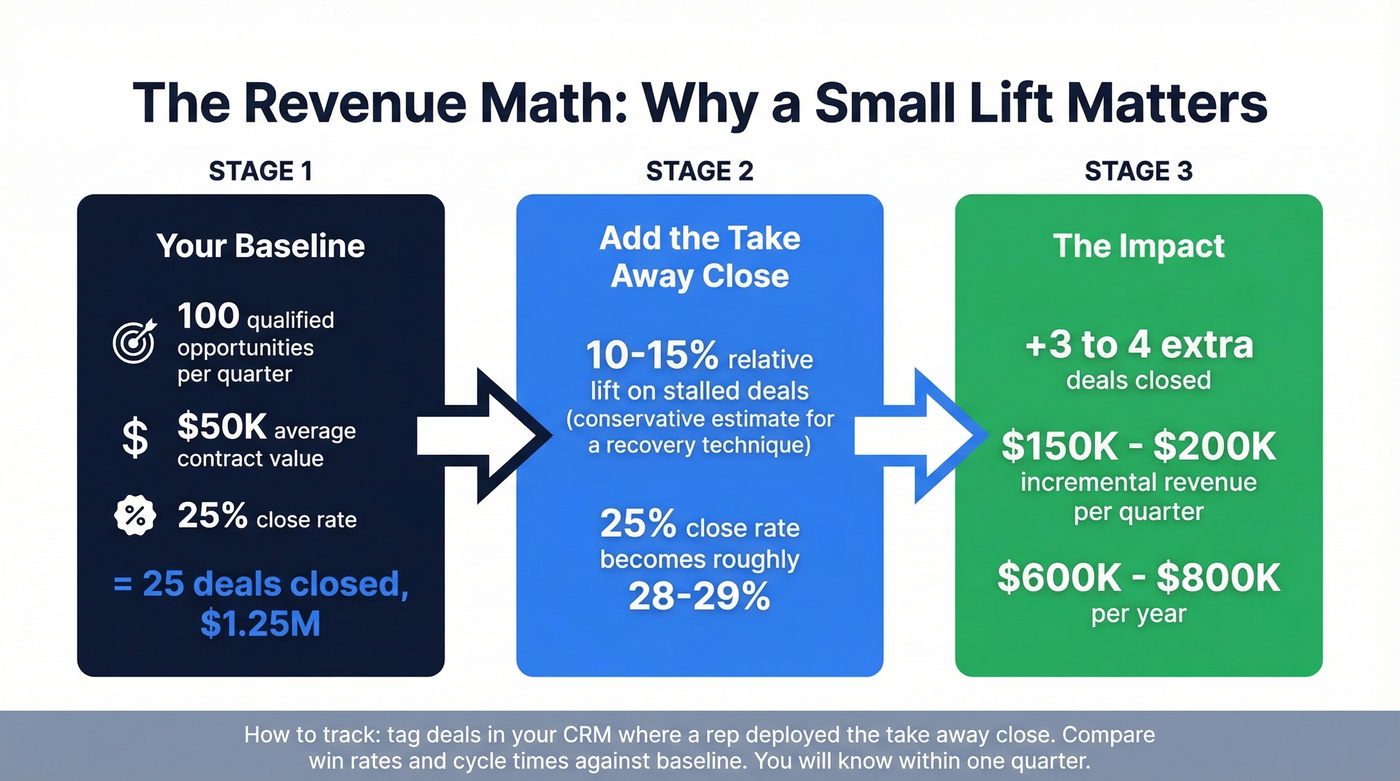
The math on why even a small lift matters: the median B2B conversion rate sits around 2.9%, and opportunity-to-customer conversion runs roughly 25%. (More benchmarks: average B2B lead conversion rate and sales conversion rate.)
Now, a worked example at the opportunity stage. Say you work 100 qualified opportunities per quarter at $50K ACV and close 25% of them - that's 25 closed deals, $1.25M baseline. A 10-15% relative lift, which is conservative for a stalled-deal recovery method, means roughly 3-4 additional closes: $150-200K in incremental revenue per quarter from a technique that costs nothing but a few seconds of silence.
Track it by tagging deals in your CRM where a rep deployed the takeaway. Compare win rates and cycle times against your baseline. You'll know within one quarter whether it's moving the needle. (If you need a KPI set, use a pipeline health scorecard.)
Coaching the Take Away Close
When reviewing calls, listen for three signals. First, neutral tone - the rep sounds genuinely willing to walk away, not passive-aggressive. Second, silence after delivery - at least 5-7 seconds of dead air. Third, graceful handling of "okay, goodbye" - the rep thanks the prospect and moves on without backpedaling. In our experience coaching SDR teams, the silence is what separates reps who use this technique from reps who just read about it.
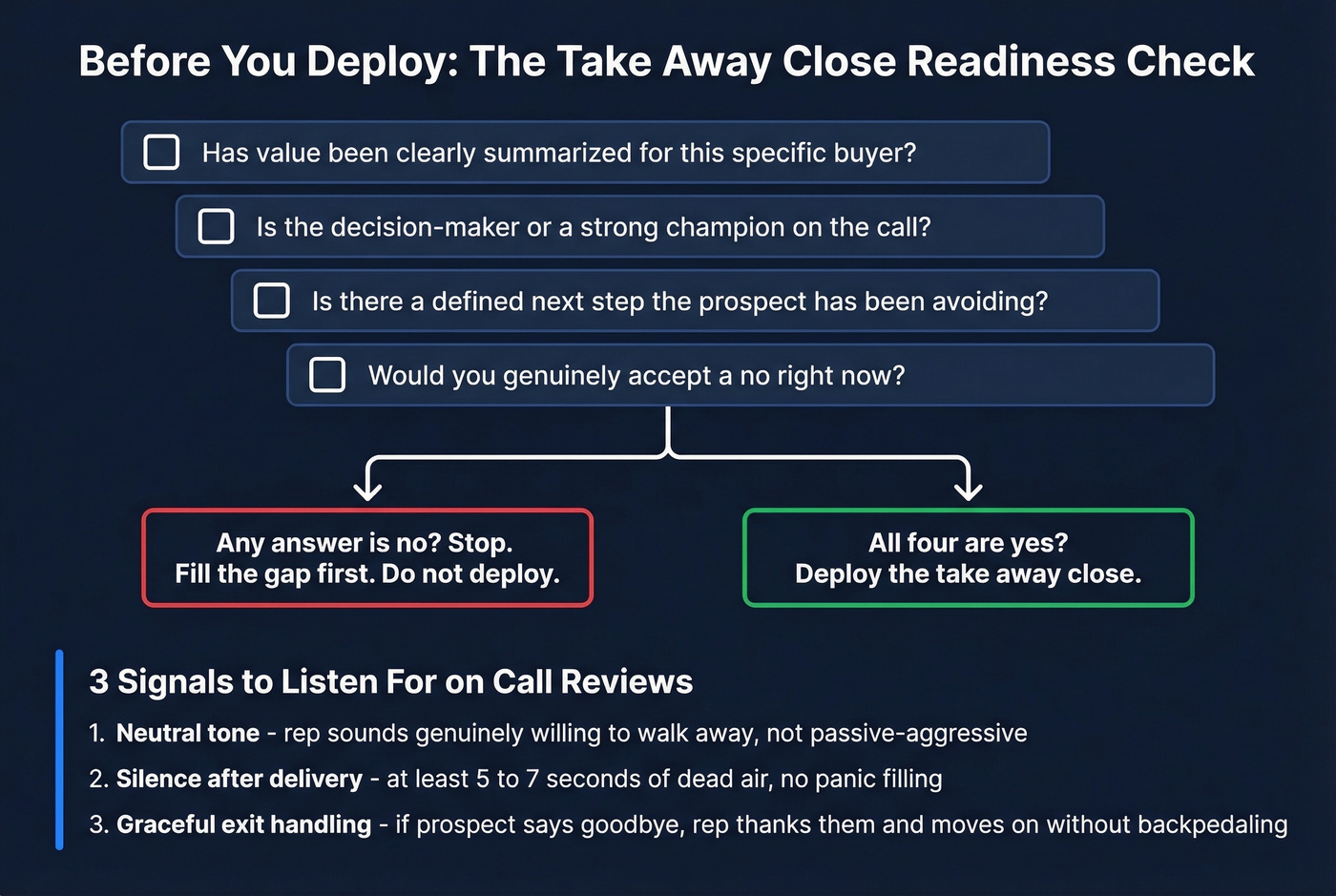
Before a rep deploys the takeaway, run through these deal-inspection prompts:
- Has value been clearly summarized for this specific buyer?
- Is the decision-maker (or a strong champion) on the call?
- Is there a defined next step the prospect has been avoiding?
- Would you genuinely accept a "no" right now?
If any answer is no, the rep isn't ready. Have them fill the gap first. (A structured way to do that: MEDDIC sales qualification.)
The hardest thing to coach is the silence. Run practice sessions where reps deliver the line and sit quietly for a full 10 seconds. It feels like an eternity - and that's exactly the point. The reps who can hold that silence are the ones who close the stalled deals everyone else writes off.
Stalled deals don't need more follow-ups - they need the right technique on the right contact. Prospeo's 7-day data refresh ensures you're never burning a precision close on stale contacts who changed roles six months ago.
Stop deploying closing techniques on dead leads. Start with fresh data.
FAQ
Is the takeaway close manipulative?
No - when used honestly, it's a diagnostic that tests real intent by giving the prospect a genuine exit. Manipulation starts when you bluff about scarcity or deadlines you'd never enforce. If you'd genuinely accept the "no," the technique is ethical and transparent.
Does it work in B2B enterprise sales?
Yes, but only after value is established and you're speaking with someone who has authority. In multi-threaded enterprise deals, deploy it with your champion - never a junior evaluator who can't actually kill or save the deal.
What if the prospect says "okay, goodbye"?
That's a win. You just saved weeks of chasing a dead deal. Mark it closed-lost, reallocate your time to real opportunities, and move on. The take away close's greatest value is often the deals it kills quickly, not the ones it saves.
How many follow-ups before I use the takeaway?
There's no magic number, but if you've had a strong demo, sent a proposal, and followed up twice without a response, you're in takeaway territory. For teams with clean contact data, two unanswered follow-ups after a proposal is usually the right trigger point.