

TAM, SAM, and SOM: The Market Sizing Guide Investors Actually Respect
You're staring at slide 7 of your pitch deck. It's blank. The title says "Market Opportunity" and your cursor's been blinking for twenty minutes. You know you need TAM SAM SOM numbers, but you're not sure whether to start with a Statista report, a spreadsheet, or a prayer.
Here's the thing: roughly 42% of startups fail because they misjudge market demand. The market sizing slide is where that misjudgment starts - and it's also where you can fix it.
We've helped thousands of B2B teams move from market sizing to actual pipeline, and the pattern is always the same: founders who nail their SOM math get funded, and founders who wave around a big TAM number don't. Let's break down the formulas, walk through a full worked example, cover the investor math that actually drives funding decisions, and point you to the free data sources you need to build defensible numbers from scratch.
The quick version:
- TAM (Total Addressable Market) - the total revenue opportunity if you had 100% market share
- SAM (Serviceable Addressable Market) - the portion you can realistically serve given your product, geography, and segment
- SOM (Serviceable Obtainable Market) - the slice you can actually capture in the near term based on your sales capacity and competition
The thesis: You don't need a perfect TAM. You need a defensible SOM. That's what separates funded founders from rejected ones.
What Do TAM, SAM, and SOM Mean?
Think of these three metrics as nested circles. TAM is the outer ring - the entire universe of potential revenue for your category. SAM sits inside it, representing the segment you can actually reach with your current product and go-to-market. SOM is the bullseye: what you'll realistically capture given your team size, budget, and competitive position.
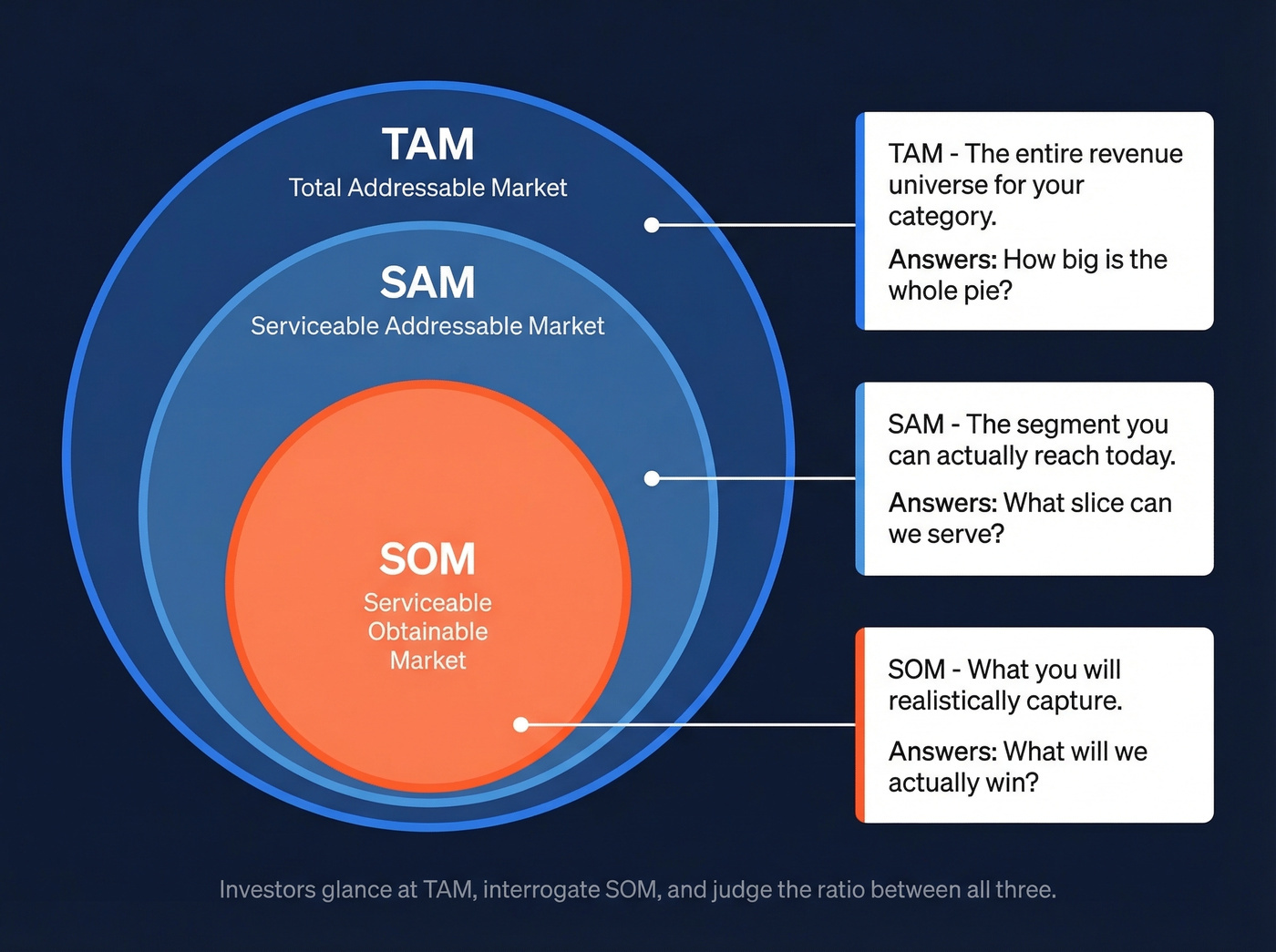
The definitions are straightforward. The hard part is knowing what each one signals to different audiences. A VC partner scanning your deck uses TAM to gauge ambition - is this market big enough to return the fund? SAM tells them whether you understand your constraints. SOM reveals whether you've done the work to connect strategy to execution. As GoingVC frames it, TAM is the boundary of ambition, SAM is where you win today, and SOM is execution clarity.
| Term | Full Name | What It Answers | Who Cares Most |
|---|---|---|---|
| TAM | Total Addressable Market | How big is the whole pie? | VCs (fund math) |
| SAM | Serviceable Addressable Market | What slice can we serve? | Operators, board |
| SOM | Serviceable Obtainable Market | What will we actually win? | Founders, investors |
Most founders spend 80% of their time on TAM - the easiest number to inflate - and 20% on SOM, the hardest number to defend. Investors do the opposite. They glance at TAM, interrogate SOM, and use the ratio between all three to judge your market intelligence.
Why Market Sizing Matters
Market sizing isn't just a fundraising exercise. It's a strategic forcing function.
A review of over 1,000 pitch decks found that the market sizing slide is the most consistently weak element. Not the product demo. Not the team slide. The market slide. That's remarkable when you consider how much weight investors place on it - if your numbers don't hold up, the rest of the deck starts to wobble. Software venture capital globally topped $125B in 2024, up 28.8% over 2023, and that money flows toward founders who can articulate why their market is large enough to matter and specific enough to win.
Beyond fundraising, this analysis drives practical decisions. Your SAM shapes your pricing strategy. Your SOM informs hiring plans - how many reps you need, what quota looks like, when to expand geographically. Even if you never raise a dollar of venture capital, understanding these numbers keeps you from building a product for a market that doesn't exist at the scale you need.
How to Calculate TAM, SAM, and SOM
Calculating TAM
The formula is simple on paper:
TAM = Total Potential Customers x Average Revenue Per Customer
Two primary approaches exist. Top-down starts with industry reports and analyst estimates - you take a published market size and validate whether your product fits within it. Bottom-up starts with your ICP count and multiplies by your price point. The best pitch decks use both: top-down for context, bottom-up for credibility. (If you want a deeper breakdown of the concepts, see our guide to addressable market.)
If your top-down and bottom-up numbers diverge significantly - say, more than 2x - that's not a problem. It's a signal. Either your ICP definition is too narrow, or the industry report is too broad. Investigate the gap before presenting. That investigation often surfaces the most useful strategic insight in your entire deck.
For example, if there are 200,000 mid-market SaaS companies globally and your product costs $18,000/year, your bottom-up TAM is $3.6B. If Gartner says the broader category is $8B, you've got a credible range and a clear explanation for why your number is smaller: you're focused on a specific segment.
A third method - value theory - works for genuinely novel or fragmented markets where no existing category data exists. You estimate the economic value your product creates for customers and price backward from there. This is rare and hard to defend, but it's the right tool when you're creating a category rather than entering one.
Calculating SAM
SAM = TAM filtered by product capability, geography, and segment constraints
SAM is where you get honest about what your product actually does today. If your total addressable market includes every company that could theoretically use your category of software, your SAM narrows to the ones you can actually serve given your language support, integrations, compliance certifications, pricing tier, and go-to-market reach.
Let's say your TAM covers 200,000 global mid-market SaaS companies. But your product only supports English, you only sell in the US, and your onboarding requires a dedicated CSM - so you're limited to companies with 50-500 employees. That narrows your addressable universe to roughly 35,000 companies. SAM = 35,000 x $18,000 = $630M. The narrowing is the point. It shows investors you understand your constraints.
Calculating SOM
SOM is where most founders lose the deal. They guess a market share percentage instead of building it from the ground up.
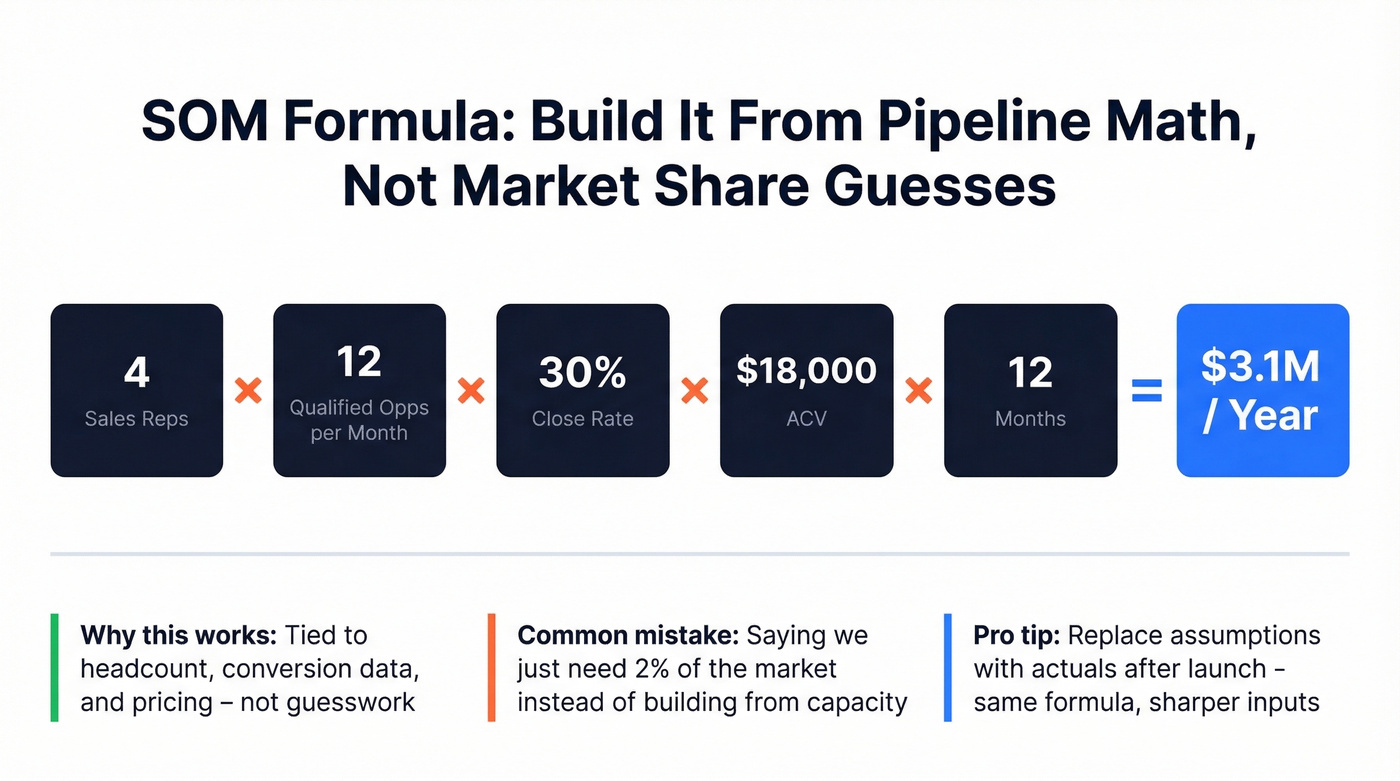
SOM should be grounded in pipeline math, not share assumptions.
Here's the formula that works:
SOM = Reps x Deals per Month x Close Rate x ACV x 12
This is capacity-based logic. If you have 4 reps, each working 12 qualified opportunities per month at a 30% close rate with an $18K ACV, your annual SOM is:
4 x 12 x 0.30 x $18,000 x 12 = $3.1M/year
That's a number you can defend in a board meeting. It's tied to headcount, conversion data, and pricing - not a hand-wavy "we just need 2% of the market." (To pressure-test your assumptions, compare them to sales pipeline benchmarks and your own historical data.)
Pre-launch, this formula uses assumptions. Post-launch, replace assumptions with actuals - real close rates, real pipeline velocity, real ACV. The formula stays the same; the inputs get sharper.
For staged benchmarks, MicroVentures suggests targeting roughly 1% of SAM in year one, 3% in year two, and 5% in year three. These aren't universal rules, but they're a useful sanity check. If your SOM projection implies 15% of SAM in year one with a four-person sales team, something's off.
After launch, SOM becomes a diagnostic tool. If actual revenue exceeds your projection, you're taking share from competitors and your model was conservative. If you're underperforming, investigate: either your assumptions were wrong or a competitor is outmaneuvering you. Most successful SaaS companies capture less than 1% of their total addressable market but 10-30% of a well-defined SOM. That's why the obtainable market definition matters more than the size of the outer circle.
Real talk: If your deal size is under $10K and your sales team is fewer than five people, skip the fancy TAM slide entirely. Lead with your SOM math. Investors at pre-seed and seed are far more impressed by a founder who can walk through pipeline mechanics than one who can cite a Gartner report.
B2B SaaS Worked Example
Let's walk through a complete example. Imagine you're building a compliance automation platform for mid-market SaaS companies in the US.
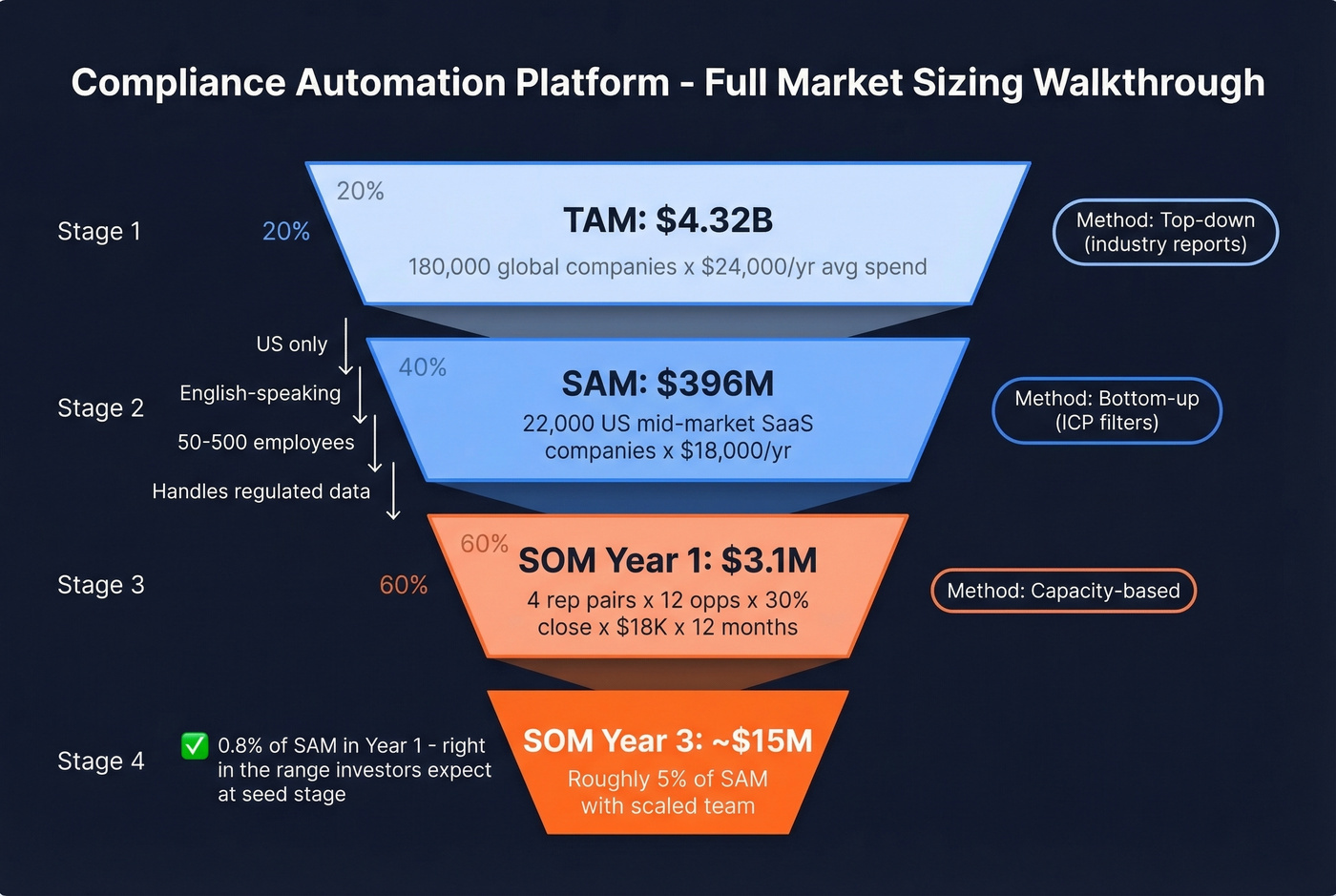
Step 1: Define your ICP. US-based SaaS companies with 50-500 employees that handle customer data and need SOC 2 or ISO 27001 compliance. (If you need a structure for this, use an ideal customer profile template.)
Step 2: Calculate TAM. Industry reports estimate 180,000 SaaS companies globally. Your bottom-up count, using databases, Census data, and industry directories, puts the US mid-market SaaS segment at roughly 40,000 companies. But TAM should capture the full universe - all companies that could theoretically buy compliance software. If the average spend on compliance tooling is $24,000/year and there are 180,000 potential buyers globally:
TAM = 180,000 x $24,000 = $4.32B
Step 3: Narrow to SAM. You only sell in the US, only to companies with 50-500 employees, and only to those handling regulated customer data. That's roughly 22,000 companies. Your product is priced at $18,000/year for this segment.
SAM = 22,000 x $18,000 = $396M
Step 4: Calculate SOM from capacity. You have 4 SDR/AE pairs. Each pair works 12 qualified opportunities per month. Your close rate is 30%. ACV is $18,000.
SOM = 4 x 12 x 0.30 x $18,000 x 12 = $3.11M (Year 1)
That's roughly 0.8% of SAM - right in the range investors expect for a seed-stage company.
| Metric | Amount | Method |
|---|---|---|
| TAM | $4.32B | Top-down (industry) |
| SAM | $396M | Bottom-up (ICP filter) |
| SOM (Year 1) | $3.1M | Capacity-based |
| SOM (Year 3) | ~$15M | Staged growth (5% SAM) |
Once you've defined your SOM - those 22,000 mid-market companies - the next step is building a verified contact list for decision-makers at those companies. Tools like Prospeo let you filter 300M+ professional profiles by company size, industry, headcount growth, technographics, and buyer intent across 15,000 topics, turning your SAM into an actual prospect list. That's the bridge between strategy and execution. (For more ways to turn a defined market into meetings, see these sales prospecting techniques.)

Your SOM formula needs real pipeline math - reps, deals, close rates. Prospeo gives you the verified contacts to fill that pipeline: 300M+ profiles, 30+ filters including intent data, technographics, and headcount growth to match your exact SAM definition.
Turn your market sizing slide into actual revenue. Start free today.
How Investors Evaluate Your Numbers
The Ratio Test
Investors don't just look at the size of each circle. They look at the relationship between all three to assess whether your story holds together.
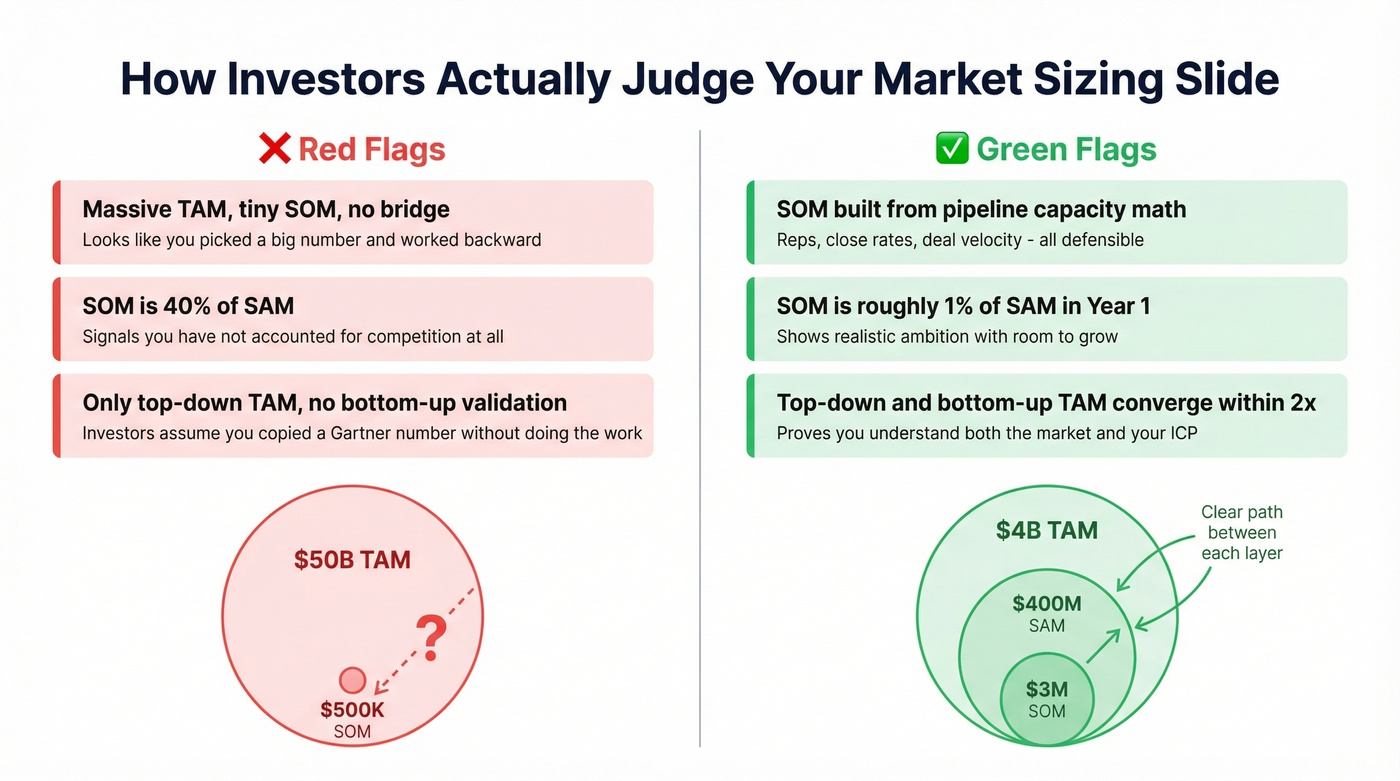
Two red flags come up repeatedly. If your total addressable market is massive but your obtainable market is tiny with no clear path between them, it looks like you picked a big number and worked backward. And if your SOM is 40% of SAM, you're signaling that you haven't accounted for competition at all. The ratio should tell a coherent story: big opportunity, focused approach, realistic near-term capture.
The 1% Fallacy
Never say "we just need 1% of the market."
This is the single most common mistake in pitch decks, and it's an instant credibility killer. It signals lazy thinking - you're starting with a big number and dividing, rather than building up from your actual capacity to acquire customers. What to say instead: "Based on our 4-person sales team, current close rates, and $18K ACV, we'll capture $3.1M in year one. Here's how that scales with headcount." That's defensible. "1% of a $4B market" is not.
Stage-Specific Expectations
Series A investors typically need to see a $1B+ TAM. That's not arbitrary - it's fund math. A $500M fund needs each portfolio company to have a plausible path to a $1B+ outcome, and that requires a large enough market to support it.
At seed and pre-seed, the bar is different. Investors care more about how intelligently you define your market than the raw number. A founder who says "our TAM is $800M - here's exactly why, and here's our bottom-up SOM math" will always beat the one who says "it's a $10B market" with nothing behind it.
SOM-to-Investor-Return Math
Here's the math investors run in their heads, and it happens fast. Say your SOM reaches $5M in revenue within two years. At a 25% EBITDA margin, that's $1.25M in profit. Apply an 8x exit multiple and the company is worth $10M. If an investor put in $1.25M at seed, that's an 8x return. Push SOM to $12M in four years and the company is worth $24M - a 19.2x return. This is the math that makes or breaks a yes.
Common Mistakes That Kill Decks
Copy-pasting analyst numbers without your own math. The consensus on r/startups is blunt: TAM/SAM/SOM with numbers pulled from Statista doesn't impress anyone. Show YOUR math based on YOUR customer segments. Statista circles on a slide are the market-sizing equivalent of clip art.
The 1% fallacy. Already covered, but it bears repeating. Capacity-based SOM beats percentage-based SOM every time. If you can't explain how your team generates the revenue, the number is fiction.
Absurdly broad TAMs. Claiming "The Global Internet" or "All SMBs" as your total addressable market signals you don't know your customer. Niche down. A $500M TAM you can defend is worth more than a $50B TAM you can't.
Stale data. Update your market sizing annually. Markets shift. Competitors enter and exit. If your TAM slide cites a 2022 report in a 2026 deck, investors notice.
No bottom-up SOM. Top-down only means you have no execution plan. If every number on your market slide comes from industry reports and none come from your own pipeline data, you're telling investors you haven't done the work. Skip this mistake and you're already ahead of most founders in the room. (If you want to operationalize the handoff from model to execution, build a simple lead generation workflow that matches your SOM assumptions.)
Free Data Sources for Market Sizing
Most guides skip the part where you actually find the data. You can't build bottom-up numbers from vibes. In our experience, these are the sources that consistently deliver.
| Source | What It's For | Access |
|---|---|---|
| Data.gov | 300,000+ datasets - macro, industry | Free |
| Census Bureau | Demographics, business patterns | Free |
| BLS | Labor, employment, wage data | Free |
| BEA | GDP, industry output | Free |
| FRED | Economic time series | Free |
| World Bank | Global development indicators | Free |
| IMF | International macro data | Free |
| OECD | Cross-country comparisons | Free |
| SEC EDGAR | Public company filings (revenue) | Free |
| Google Trends | Demand signals, search volume | Free |
| Pew Research | Consumer behavior, demographics | Free |
| AWS Open Data | 348+ public datasets | Free |
For B2B market sizing specifically, SEC EDGAR is underrated. You can pull revenue figures from public companies in your category to benchmark ACV assumptions. Census Bureau's County Business Patterns dataset gives you establishment counts by industry and employee size - exactly what you need for bottom-up TAM calculations.
Google Trends won't give you a dollar figure, but it's useful for validating demand trajectory. If search interest in your category is flat or declining, that's a signal worth addressing in your deck before an investor brings it up.
Templates and Next Steps
You don't need to build your market sizing spreadsheet from scratch. TheoryTwenty7 offers a free TAM/SAM/SOM template that works in Google Sheets and Excel, with a companion slide template for your pitch deck. It includes a SaaS example walkthrough that mirrors the structure we've covered here.
Our recommendation: use Google Sheets for the calculations so you can link assumptions to source data and update them easily, then Slides or PowerPoint for the pitch deck version. The spreadsheet is your working model. The slide is the story you tell with it.
Market sizing is strategy. What comes next is execution - turning those 22,000 companies in your SAM into qualified pipeline. That's where the real work begins. (To tighten the loop between assumptions and reality, track funnel metrics from first touch to closed-won.)
You just calculated how many reps and deals you need to hit your SOM. Now you need data that actually connects those reps to buyers. Prospeo delivers 98% email accuracy and 125M+ verified mobiles - so your capacity math translates to real conversations, not bounced emails.
Stop guessing at 2% market share. Start closing with verified contacts.
FAQ
What's the difference between TAM, SAM, and SOM?
TAM is total market revenue assuming 100% share. SAM is the portion you can realistically serve given your product, geography, and segment. SOM is the slice you'll actually capture based on sales capacity and competition. Investors use the ratio between all three to judge whether your go-to-market story is coherent - the cascade should flow logically from opportunity to execution.
How do you calculate TAM for a startup?
Multiply total potential customers by average annual revenue per customer. Use top-down (industry reports) for context and bottom-up (ICP count x ACV) for credibility. Present both methods - investors prefer seeing the bottom-up number anchor your story, with the top-down figure providing market-level validation.
What's a realistic SOM percentage?
Most early-stage startups target 1-5% of SAM over the first three years. Justify SOM with your sales team size, conversion rates, and deal value - not a market share guess. For example, 4 reps closing 30% of 12 monthly opportunities at $18K ACV yields $3.1M annually, roughly 0.8% of a $396M SAM.
Do I need market sizing for a pre-seed pitch?
Yes, but pre-seed investors care more about how intelligently you define your market than the raw number. For emerging categories where no clean industry data exists, use value theory - estimate the economic value your product creates and price backward. A thoughtful $500M TAM with bottom-up SOM math beats a hand-wavy $10B claim every time.
What tools help turn market sizing into prospecting?
Start with free data sources like Data.gov, Census Bureau, and BLS for sizing. To convert your SAM into a contact list, tools like Prospeo cover 300M+ professional profiles with 30+ filters - company size, industry, intent signals, technographics - and deliver 98% email accuracy on a 7-day refresh cycle, bridging the gap between market analysis and actual outreach.