

Target Customer Profile Examples (Copy-Paste Ready)
Every "target customer profile examples" article gives you the same thing: a blank template with placeholder text like "[Insert Industry Here]." That's not an example. That's homework. Meanwhile, 81% of customers prefer companies that offer personalized experiences - and you can't personalize anything if your profile is a half-finished Google Doc.
Below you'll find three filled-out profiles you can copy today, a 100-point scoring rubric to prioritize accounts, and the data workflow to populate every field.
Jump to what you need: B2B example · B2C example · SaaS example · How to build your own · AI prompt to draft one in 5 minutes
Profile vs. ICP vs. Buyer Persona
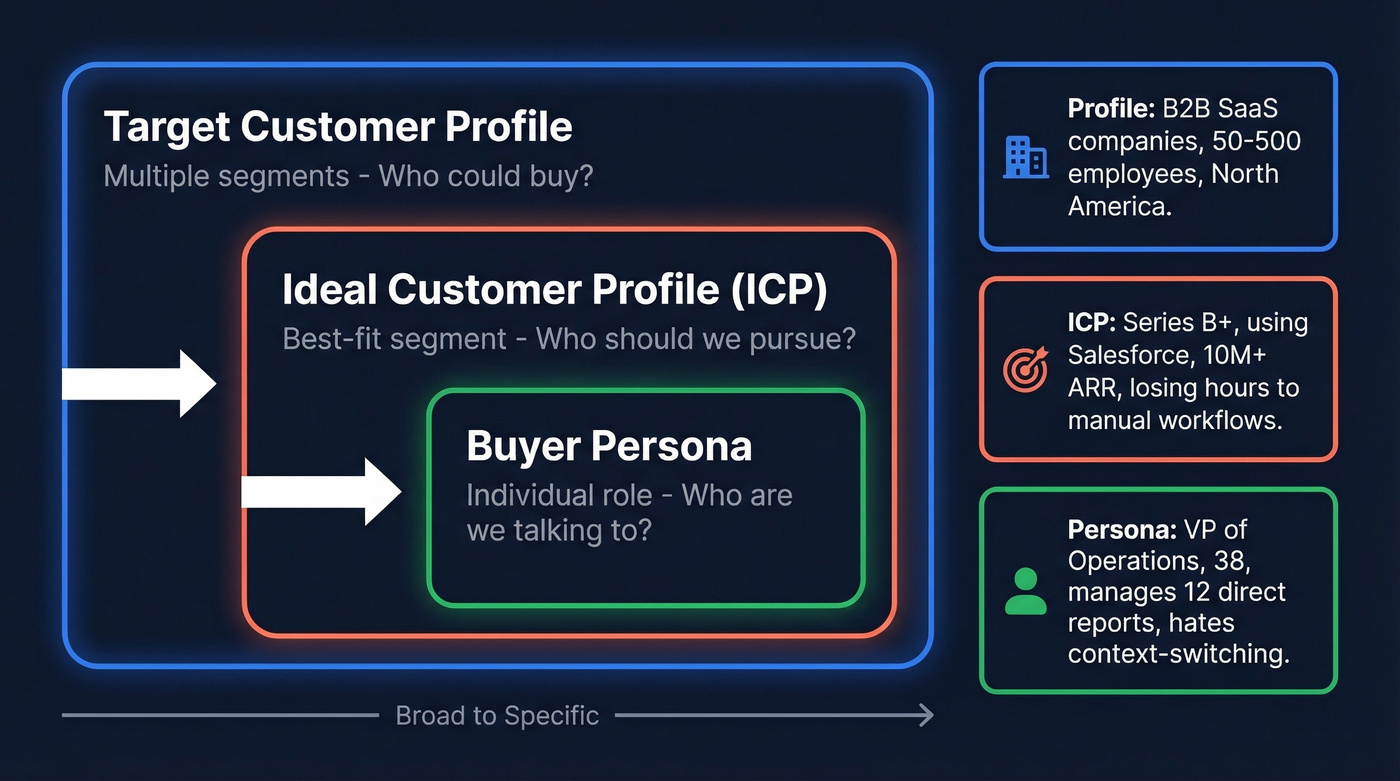
These three terms get used interchangeably, and it causes real confusion in pipeline reviews. Here's the hierarchy, borrowed from ProductLed's framework:
| Concept | Level | What It Answers |
|---|---|---|
| Target customer profile | Multiple segments | "Who could buy?" |
| Ideal customer profile | Best-fit segment | "Who should we pursue?" |
| Buyer persona | Individual role | "Who are we talking to?" |
HubSpot puts it well: "Personas tell you who you're speaking to. ICPs tell you which companies are worth speaking to in the first place." Think of Zapier's ICP as a concrete example - fast-growing companies with 50-500 employees, using 5+ disconnected tools, losing 10+ hours a week to manual data entry. That's specific enough to act on. Your profile should be too.
Filled-Out Customer Profile Examples
B2B Target Customer Profile Example
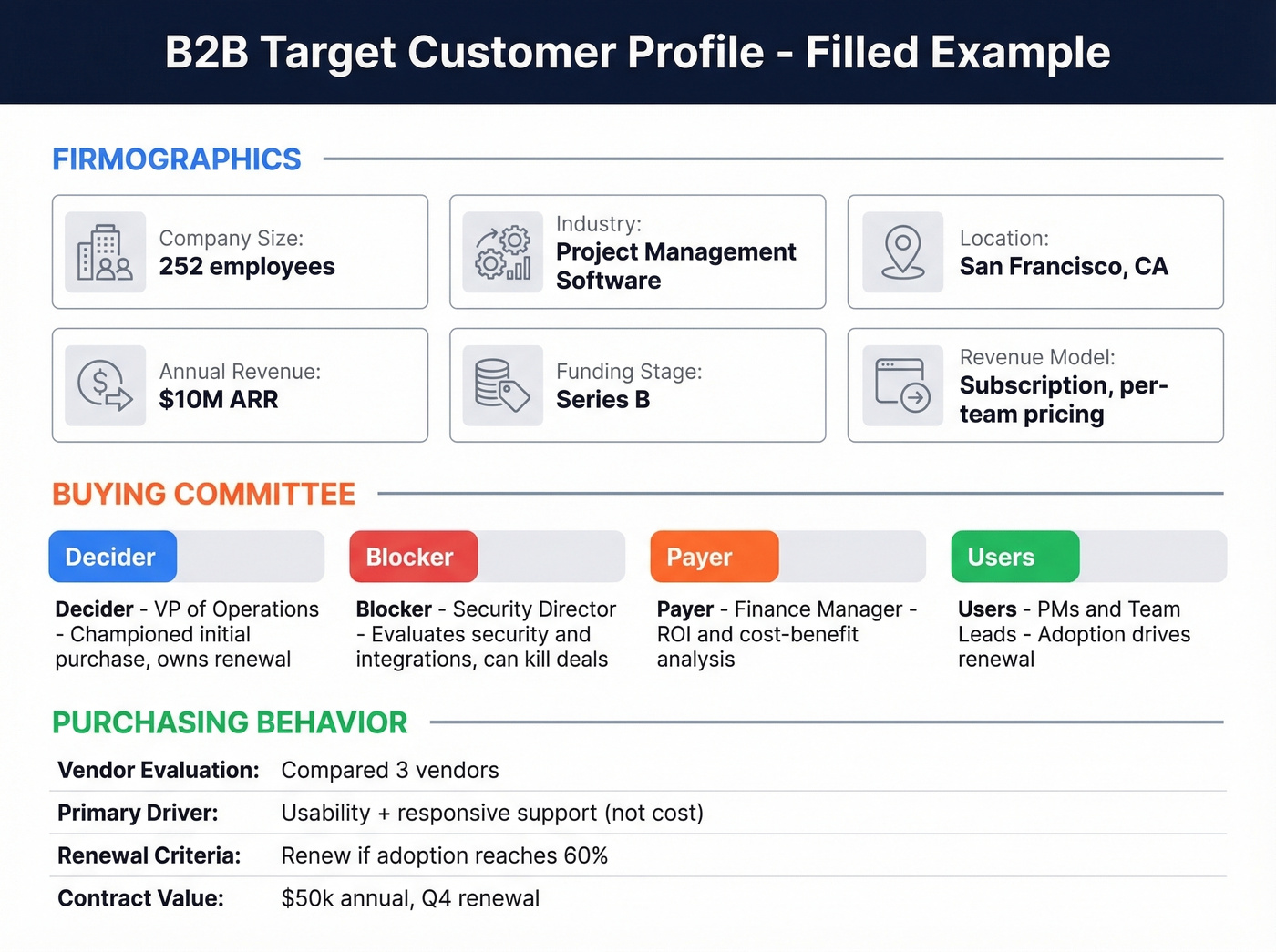
This is the profile most people are actually looking for. It's modeled on a real B2B SaaS account, with every field filled in.
| Field | Value |
|---|---|
| Company size | 252 employees |
| Industry | Project management software |
| Location | San Francisco, CA |
| Annual revenue | $10M ARR |
| Funding stage | Series B |
| Revenue model | Subscription, per-team pricing |
That's the easy part. Where most profiles fall short is the buying committee. In B2B, it's increasingly rare for one person to be the decider, payer, and user - MarTech.org breaks the "customer" into these roles explicitly, and you should too.
Buying Committee
| Role | Title | Influence |
|---|---|---|
| Decider | VP of Operations | Championed initial purchase; owns renewal |
| Blocker | Security Director | Evaluates security and integrations; can kill deals |
| Payer | Finance Manager | ROI and cost-benefit analysis; influences expansion |
| Users | PMs and team leads | Adoption drives renewal; end-user champions |
Purchasing Behavior & Renewal Criteria
| Field | Value |
|---|---|
| Vendor evaluation | Compared 3 vendors |
| Primary driver | Usability + responsive support (not cost) |
| Renewal criteria | Renew if adoption reaches 60% |
| Expansion criteria | Add 3 more teams if time savings improve |
| Contract timing | Annual, Q4 renewal |
| Contract value | $50k |
Here's the thing: the firmographic table takes five minutes to fill out. The buying committee and renewal criteria are what separate a useful profile from a decorative one. If your profile doesn't tell a rep who blocks deals and what triggers expansion, it isn't doing its job.
B2C Target Customer Profile Example
B2C profiles shift the weight from firmographics to psychographics and behavior . You're profiling a person, not a company.
| Field | Value |
|---|---|
| Age range | 25-40 |
| Lifestyle | Fitness-focused, eco-conscious |
| Tech comfort | Tech-savvy, mobile-first |
| Pain point | Lack of affordable healthy meals |
| Preferred channels | Instagram, YouTube, WhatsApp |
| Purchase behavior | Shops online monthly, prefers mobile apps |
| Values | Sustainability, convenience |
The biggest difference from B2B: psychographic and behavioral fields carry more weight than company data. You're not mapping a buying committee - you're mapping motivations, habits, and the channels where this person actually spends time. If your B2C profile doesn't include where they shop and what they care about beyond your product, it's incomplete.
SaaS Target Customer Profile Example
SaaS profiles blend B2B firmographics with technographic and economic fit data that's unique to software businesses.
| Field | Value |
|---|---|
| Industry | B2B SaaS |
| Geography | North America |
| Headcount | 50+ employees |
| ARR | $30M+ |
| Customer base | SMBs |
| CRM used | Salesforce or HubSpot |
| Complementary tools | Outreach, Gong, Slack |
| Competitor products | Legacy on-prem solution |
| Buying trigger | New VP of Sales hire or CRM migration |
| LTV:CAC target | 3:1 or better |
One-sentence ICP statement: "B2B SaaS companies in North America, 50+ employees, $30M+ ARR, selling to SMBs." That's the format your sales team can actually memorize - and the one we've seen adopted fastest in onboarding.
The technographic fields are what make SaaS profiles practical. Knowing a prospect runs Salesforce plus Outreach tells you more about their readiness to buy than their headcount does.
Skip the 40-field profile if your deal size is under $10k annually. A one-sentence ICP statement plus a buying trigger is enough. Over-engineering the profile is just procrastination dressed up as strategy.
How to Create a Target Customer Profile
Analyze 50-100 Closed-Won Deals
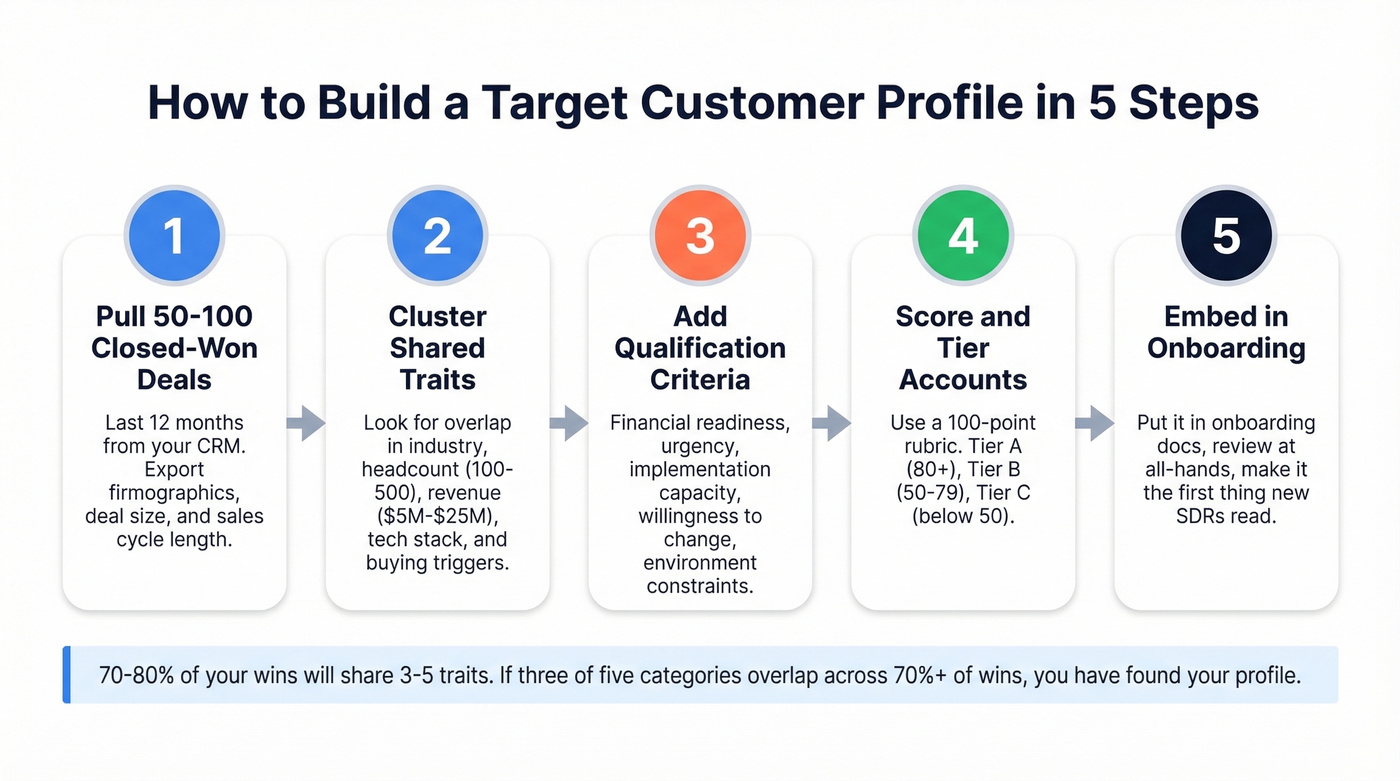
Start in your CRM. Pull the last 12 months of closed-won deals and look for patterns - 70-80% of your wins will share 3-5 traits like industry, headcount range, tech stack, or buying trigger.
The hard part isn't the analysis. It's getting the data to populate profile fields beyond what your CRM captures. You need firmographics, technographics, and contact-level data for the buying committee. Prospeo's B2B database covers this with 30+ search filters including buyer intent, technographics via Wappalyzer, job changes, headcount growth, department headcount, funding, and revenue - all on a 7-day data refresh cycle versus a 6-week industry average.

Identify Shared Traits
Once you've got your deal data, cluster it. The trait categories that matter most:
- Industry or vertical - the obvious one, but don't stop here
- Headcount range - 100-500 employees hits differently than "mid-market"
- Revenue band - $5M-$25M ARR narrows the field fast
- Tech stack - CRM, marketing automation, complementary tools
- Buying trigger - new hire, funding round, migration, compliance deadline
If three of these five overlap across 70%+ of your wins, you've found your profile.
Define Qualification Criteria
Not every company that fits the firmographic profile is actually ready to buy. Adele Revella's "mandatory checks" framework adds the qualification layer most profiles skip: financial readiness, urgency and awareness of the problem, effort and time capacity to implement, readiness to change, and systems or environment constraints.
Let's be honest - a prospect can be the right size, in the right industry, using the right tech stack, and still be a terrible fit because they're mid-migration and can't onboard anything new for six months. Your profile should also define who you're not selling to: the segments that look right on paper but consistently churn or drain support resources.
Build and Score Profiles
Once you've defined the traits and qualification criteria, assign point values and tier your accounts. The scoring rubric in the next section gives you a ready-made framework for lead scoring.
Embed in Onboarding
The most common ICP mistake, per AdRoll's research: building a profile and never using it. Your customer profile should live in your onboarding docs, get reviewed at all-hands, and be the first thing a new SDR reads. When marketing, sales, and CS aren't aligned on who you're targeting, the profile is just a PDF gathering dust.

You just built a target customer profile with firmographics, technographics, and buying committee roles. Now you need data to populate every field. Prospeo's B2B database has 30+ filters - buyer intent, tech stack, headcount growth, funding, job changes - refreshed every 7 days, not 6 weeks.
Turn that profile into a live prospect list in under five minutes.
A profile with a buying committee mapped means nothing if you can't reach the decider, blocker, and payer. Prospeo delivers 143M+ verified emails at 98% accuracy and 125M+ verified mobiles with a 30% pickup rate - for roughly $0.01 per email.
Stop profiling. Start connecting with every stakeholder on the committee.
How to Score and Tier Accounts
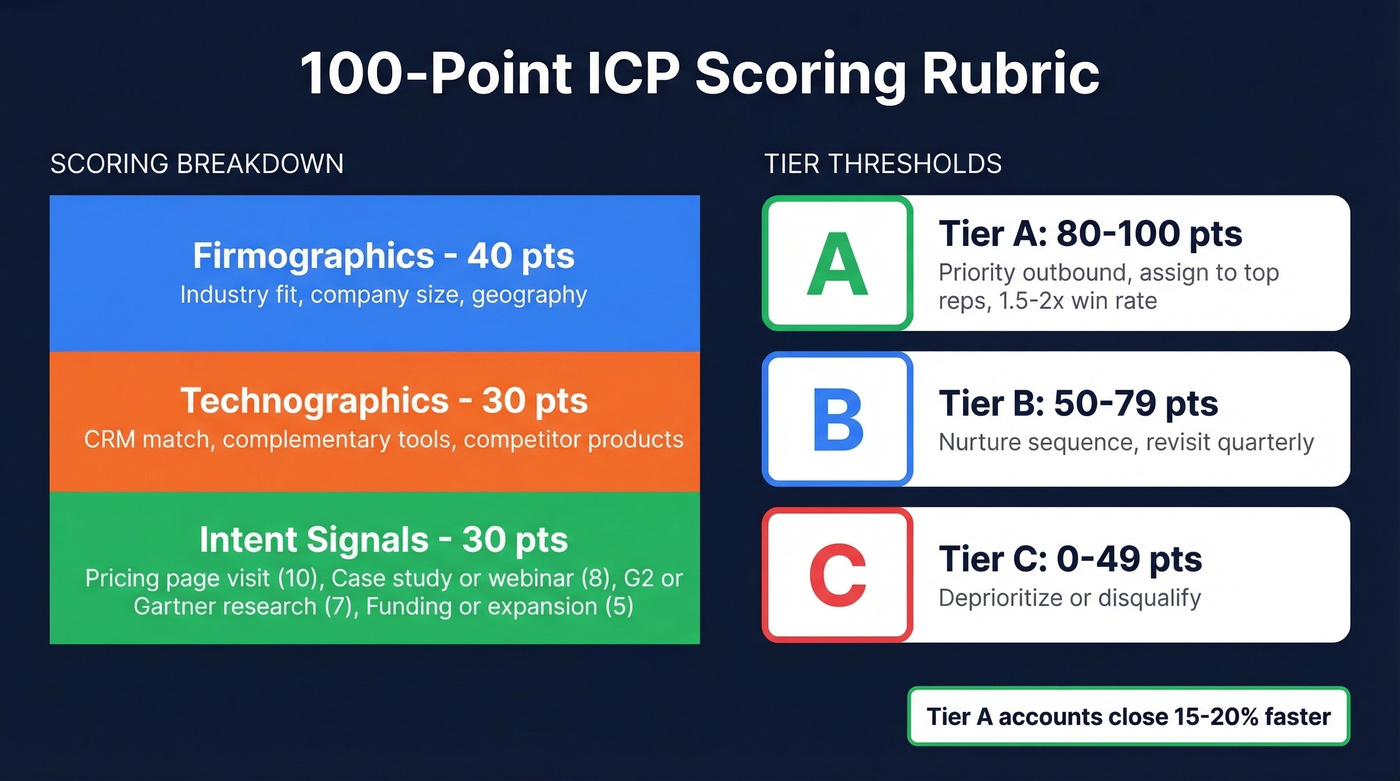
A profile without a scoring system is just a description. Here's a 100-point rubric that turns your profile into a prioritization engine (and pairs well with an ideal customer profile template).
100-Point ICP Scoring Rubric
| Category | Points | Criteria |
|---|---|---|
| Firmographics | 40 | Industry fit, company size, geography |
| Technographics | 30 | CRM match, complementary tools, competitor products |
| Intent Signals | 30 | Pricing page visit (10), case study/webinar (8), G2/Gartner research (7), funding/expansion (5) |
Tier Thresholds
| Tier | Score | Action |
|---|---|---|
| Tier A | 80-100 | Priority outbound; assign to top reps |
| Tier B | 50-79 | Nurture sequence; revisit quarterly |
| Tier C | 0-49 | Deprioritize or disqualify |
In our experience, Tier A accounts convert at 1.5-2x the win rate of Tier B, with 15-20% shorter sales cycles. That's the difference between a 90-day deal and a 110-day deal - real pipeline velocity, not a rounding error.
Layer in buyer intent data to score accounts on in-market signals, not just static firmographics. Prospeo tracks 15,000 intent topics via Bombora, so you can weight the intent signals column with actual behavioral data rather than guessing (more on identifying buying signals).

Use AI to Draft a Profile in 5 Minutes
You don't need to start from scratch. Here's a prompt template adapted from what practitioners on r/sales are actually using (and it fits neatly into generative AI sales tools workflows):
You are a B2B sales strategist. I need a target customer profile for [my product/service].

Before generating, ask me:
1. B2B or B2C?
2. What role/title am I selling to?
3. What's my product and price point?

Then output a profile with these sections:
- Name/role/background (fictional composite)
- Top 3-4 pain points
- Fears (what keeps them from buying)
- Needs, wants, and desires
- Buying decision process
- Ideal future state after purchase
Example output: "Alex Carter, Head of Product Development at a 200-person SaaS company. Pain points: fragmented tooling, slow release cycles, no visibility into team capacity. Fears: picking the wrong vendor and wasting a quarter on implementation. Buying criteria: ROI within 6 months, integrations with Jira and Slack, preference for trials over demos."
The AI draft gets you 70% there. The last 30% - the buying committee, the renewal triggers, the scoring - comes from your CRM data and the frameworks above. Don't skip that step. We've watched teams ship AI-generated profiles straight to their CRM and wonder why reps ignore them. The AI gives you structure; your closed-won data gives you truth.
Mistakes That Ruin Your Profile
Too broad. "All mid-market companies" isn't a profile. Neither is "SaaS companies in North America." You need at least 3-5 defining traits to make it actionable. One r/LeadGeneration poster learned this the hard way after targeting "Indie Hackers" and getting flooded with prospects who had $0 budgets.
Aspirational ICP. Chasing enterprise logos when your product, pricing, and support team are built for SMB. We've seen teams waste entire quarters pursuing accounts they were never going to close because the profile reflected ambition, not reality.
Ignoring churn. A segment that closes fast but cancels within a year isn't your ideal customer - it's your most expensive one. Use LTV, CAC, and repeat purchase rates to assess profitability, not just conversion rates (see churn analysis).
Relying only on firmographics. Industry and headcount are table stakes. Without technographics showing what tools they use and intent signals revealing whether they're actively researching solutions, you're guessing. The best profiles layer all three (and it helps to understand firmographic and technographic data).
Building and never using it. Real talk: most profiles die not because they're wrong, but because nobody looks at them after the initial Notion page gets published. If your profile isn't embedded in onboarding, referenced in pipeline reviews, and updated at least every six months, it's dead on arrival (tie it to sales enablement so it actually gets used).
FAQ
How often should you update a customer profile?
Every six months at minimum - sooner when closed-won patterns shift, you enter a new market, or churn spikes in a previously strong segment. The profile that worked in Q1 might be wrong by Q3.
What's the difference between a target customer profile and an ICP?
A target customer profile describes multiple viable segments your business could serve. An ICP narrows to the single best-fit segment - the companies that get the most value, close fastest, and churn least. The profile is the universe; the ICP is the bullseye.
Can you share a quick profile example for a startup?
Strip it to essentials. A seed-stage startup selling dev tools might use: "Engineering teams of 10-50 at Series A B2B SaaS companies, currently using open-source CI/CD pipelines, hitting reliability issues at scale." That single sentence is enough to align founders, first sales hires, and early marketing before you have enough data for a full scoring rubric.
What tools help you build a target customer profile?
At minimum you need your CRM for closed-won deal analysis and a B2B data platform for firmographic, technographic, and intent enrichment. Tools like Prospeo cover all three - 300M+ profiles, 30+ filters, and 15,000 intent topics - with a free tier of 75 verified emails per month. The CRM tells you who bought; the data platform tells you why they fit and who else looks like them.