

Targeted Outreach: A Data-Backed Playbook for 2026
Your SDR sent 500 emails this week. 47 bounced. 12 hit spam traps. Your domain reputation dropped, and now even the good emails land in promotions tabs. You don't have a messaging problem - you have a data problem.
The average cold email reply rate in 2026 is 3.43%. Top performers hit 10.7%+. The gap isn't copywriting talent or a secret subject line - it's infrastructure, data quality, and a system that compounds across channels. We've spent months testing these variables, and the patterns are consistent: fix the data first, and everything else follows.
What You Need (Quick Version)
Targeted outreach comes down to four variables: right person, right message, right channel, right time. Most teams obsess over messaging and ignore the first variable entirely. Here's the minimum viable stack:
- Verified data source - 98% email accuracy, short refresh cycle
- Sending tool - Instantly or Smartlead for inbox rotation and warmup
- CRM - HubSpot free CRM or Salesforce
Keep emails under 80 words, sequence 4-7 touches across channels, and never send more than 30 emails per domain per day. The top 10% of senders clear a 10.7% reply rate. Here's how to get there.
2026 Benchmarks You're Competing Against
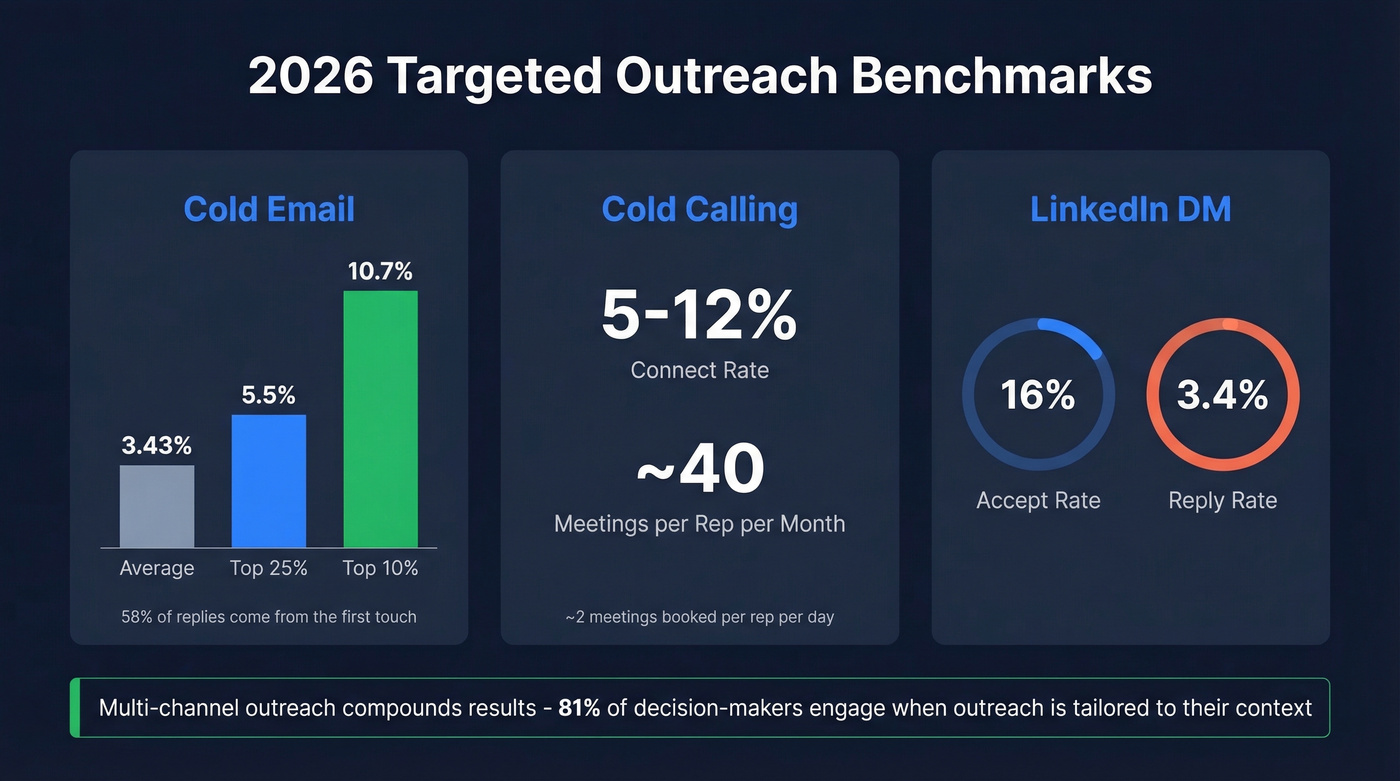
Before building anything, know what "good" looks like. These numbers come from platform-level data across billions of sends.
| Channel | Key Metric | Benchmark |
|---|---|---|
| Cold email | Avg reply rate | 3.43% |
| Cold email | Top quartile | 5.5%+ |
| Cold email | Top 10% | 10.7%+ |
| Cold call | Connect rate | 5-12% |
| Cold call | Meetings/rep/month | ~40 |
| LinkedIn DM | Accept rate | ~16% |
| LinkedIn DM | Overall reply | ~3.4% |
Here's the math that matters: 58% of all email replies come from the first touch. The other 42% come from follow-ups. Teams that stop after two emails leave almost half their replies on the table.
No single channel wins outright. Email scales best. Social builds trust before your email lands. Phone converts fastest once you get someone talking - cold calling produces roughly 2 booked meetings per rep per day at scale. The compounding effect of all three is what separates top performers from everyone else, and 81% of decision-makers engage when outreach is tailored to their company and context.
Here's the thing: if you're running LinkedIn-only outreach, you're capping yourself at a 16% acceptance rate. That's a ceiling, not a strategy. A coordinated multi-channel approach will always outperform a single-channel play because you're meeting prospects wherever they're most responsive.

The gap between 3.43% and 10.7% reply rates isn't copywriting - it's data quality. Prospeo's 300M+ profiles with 98% email accuracy and 30+ filters for intent, technographics, and job changes let you build lists that actually convert. At $0.01 per email with a 7-day refresh cycle, stale data stops being your problem.
Fix the data first. Everything else follows.
How to Build a Data-Driven Outreach System
Define a Data-Backed ICP
Most ICPs are aspirational wishlists. "We sell to VP-level buyers at mid-market SaaS companies" isn't an ICP - it's a guess dressed up as strategy.
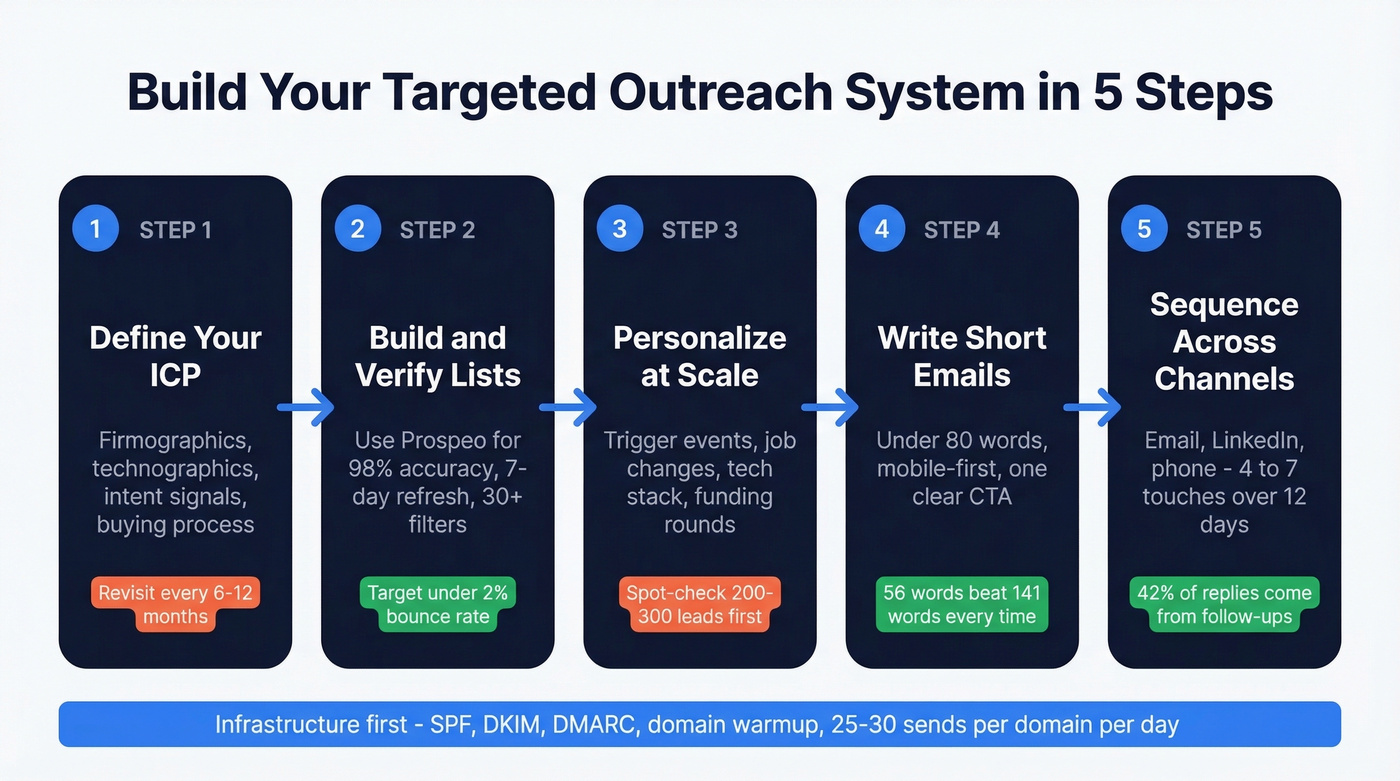
A real ICP includes firmographics like industry, headcount, and revenue, plus pain points your product actually solves, technographics showing what they already use, intent signals indicating they're actively looking, and buying process details covering who signs off and what the typical cycle looks like. Pull these from sales call transcripts, won-deal patterns, and lost-deal reviews - not from a brainstorming session.
The most common mistake? Building an ICP that's too broad, never validating it against real pipeline data, and treating it as a one-time exercise. Revisit every 6-12 months, or sooner if win rates shift. Every downstream decision about messaging, channels, and timing depends on getting this right.
Build and Verify Your List
Contact data decays at 2.1% per month. A list you built in January is 12%+ stale by July. Stale data doesn't just mean missed opportunities - it means bounces, spam traps, and domain reputation damage that tanks deliverability for your entire team.
One practitioner on r/Entrepreneur documented their journey from an 11% bounce rate to under 2% by switching to verified lists. Their reply rate doubled from 3% to 6%. The single biggest variable wasn't copy or timing - it was list quality.
Prospeo runs a 5-step verification process that catches catch-all domains, removes spam traps, and filters honeypots - the invisible landmines that silently destroy sender reputation. With 300M+ professional profiles, 143M+ verified emails, and a 7-day data refresh cycle versus the 6-week industry average, you're working with data that's actually current. Use the 30+ search filters to build lists by intent signals, technographics, job changes, or funding events, then export knowing 98% of those emails will land.

Your target: bounce rate under 2%. Anything above that and you're actively hurting your domain.
Contact data decays 2.1% per month. That means bounces, spam traps, and wrecked domain reputation. Prospeo's 5-step verification with catch-all handling, spam-trap removal, and honeypot filtering keeps your bounce rate under 2% - where it needs to be for targeted outreach that scales.
Stop burning your domain on bad data. Start with 75 free verified emails.
Personalize Beyond {First_Name}
Merge tags aren't personalization. Every SDR on the planet uses {first_name} and {company_name}. That's table stakes.
Real personalization means referencing something specific - a recent funding round, a job change, a technology they're using, a post they published. The best workflow we've seen uses Clay to pull these signals at scale: import leads from your data source, enrich with relevant variables like funding data and tech stack, and export back to your sending tool. Let enrichment data do the heavy lifting so your reps focus on conversations, not research.
One operational guardrail: focus on 1-2 personalization angles per campaign. Spot-check 200-300 leads before scaling any enrichment workflow, and always build fallback copy for when a field comes back empty. A generic but clean email beats a personalized email with a broken merge tag every time.
Write Emails That Get Replies
The practitioner who doubled their reply rate did one thing that mattered more than any template: they cut email length from 141 words to under 56. Shorter emails get more replies because 81% of emails are opened on mobile, and nobody reads a three-paragraph pitch on their phone.
Subject lines matter more than most teams realize. "Quick question" pulled 39% opens in one practitioner's testing. Company-name subject lines hit 33%. Anything that sounded like marketing dropped below 19%. If you need a swipe file, start with these subject lines.
Cold intro: "Hey {first_name} - saw {company} just {trigger event}. We help teams like yours {one-line value prop}. Worth a quick call this week?"
Follow-up (Day 5): "Bumping this up. {One new angle or proof point}. Open to 15 minutes?"
Breakup (Day 12): "Last note from me. If {pain point} isn't a priority right now, no worries. If it is - happy to share how {similar company} handled it."
Sequence Across Channels
The sweet spot is 4-7 touchpoints. Reaching executives often requires around 9 touches, while mid-level contacts typically respond within 4. Follow-ups nearly double reply rates - yet most reps quit after two emails. If you want plug-and-play copy, use these follow-up templates.
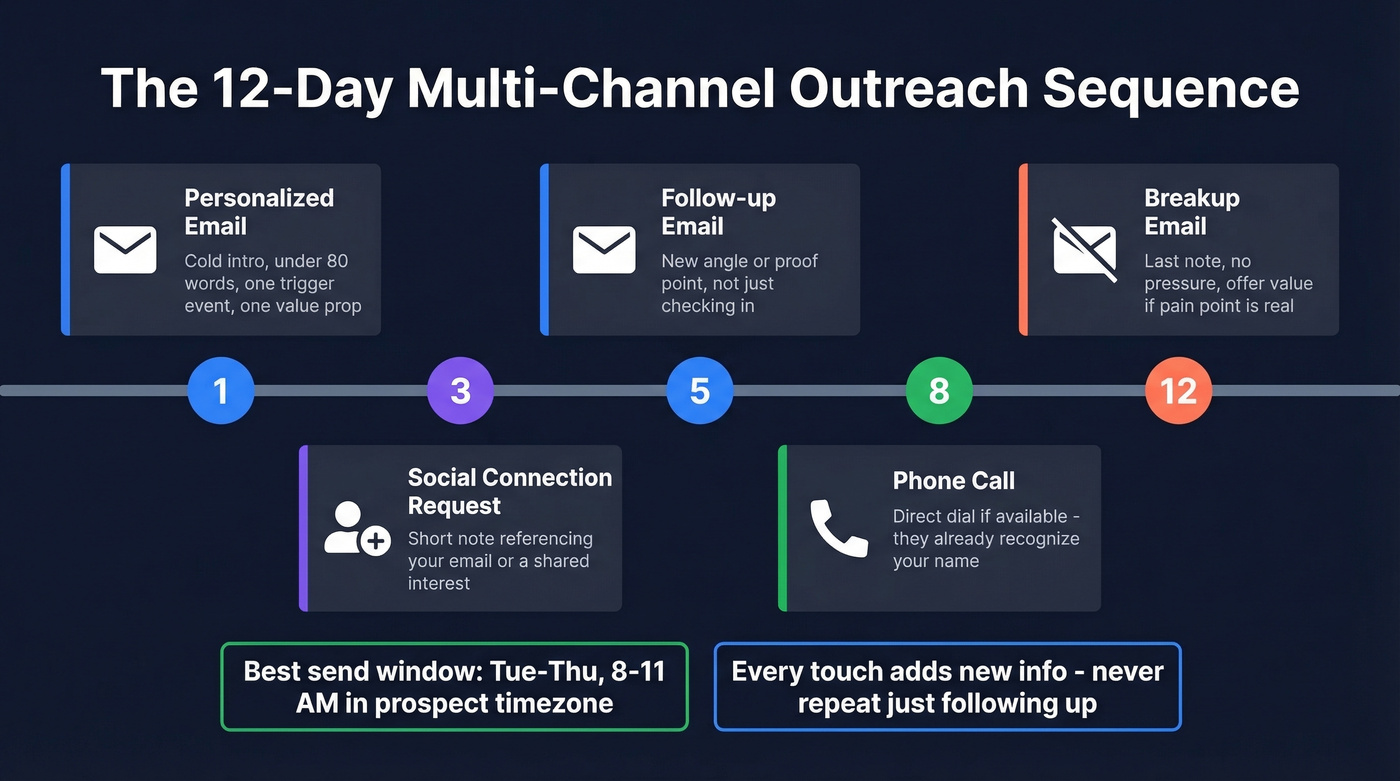
Here's a multi-channel sequence that works:
- Day 1: Personalized email - cold intro, under 80 words
- Day 3: Social connection request with a short note
- Day 5: Follow-up email with a new angle, not "just checking in"
- Day 8: Phone call with direct dial if you have it
- Day 12: Breakup email
Send Tuesday through Thursday, 8-11 AM in the prospect's timezone. Every touch should add new information or a new angle. Repeating "just following up" trains prospects to ignore you. A phone call on Day 8 is especially effective when preceded by email and social touches - the prospect already recognizes your name, and that familiarity dramatically increases connect rates. For timing benchmarks, see the best time to send cold emails.
Fix Your Infrastructure
None of this matters if your emails land in spam. Almost 20% of cold emails get flagged - and most senders don't know it's happening.
The practitioner playbook: scale from 3 domains to 7, cap sends at 26 emails per day per domain, and set up SPF, DKIM, and DMARC on every single one. Warm each domain for 2-3 weeks before sending cold email. Total stack cost ran about $420/month, generating 16 qualified leads per month from email alone.
The infrastructure checklist:
- Domains: 5-7 sending domains minimum, rotating across campaigns
- Daily cap: 25-30 emails per domain, no more (use email velocity rules)
- Authentication: SPF, DKIM, DMARC configured and passing (check DMARC alignment)
- Warmup: 2-3 weeks of gradual volume increase before cold sends
- Bounce target: Under 2%, always (track email bounce rate)
Skip this step and you'll undo every other optimization in this playbook. One bad list can set your deliverability back weeks.
Why Your Outreach Strategy Is Failing
If your reply rate is below 2%, the problem is almost always one of these:
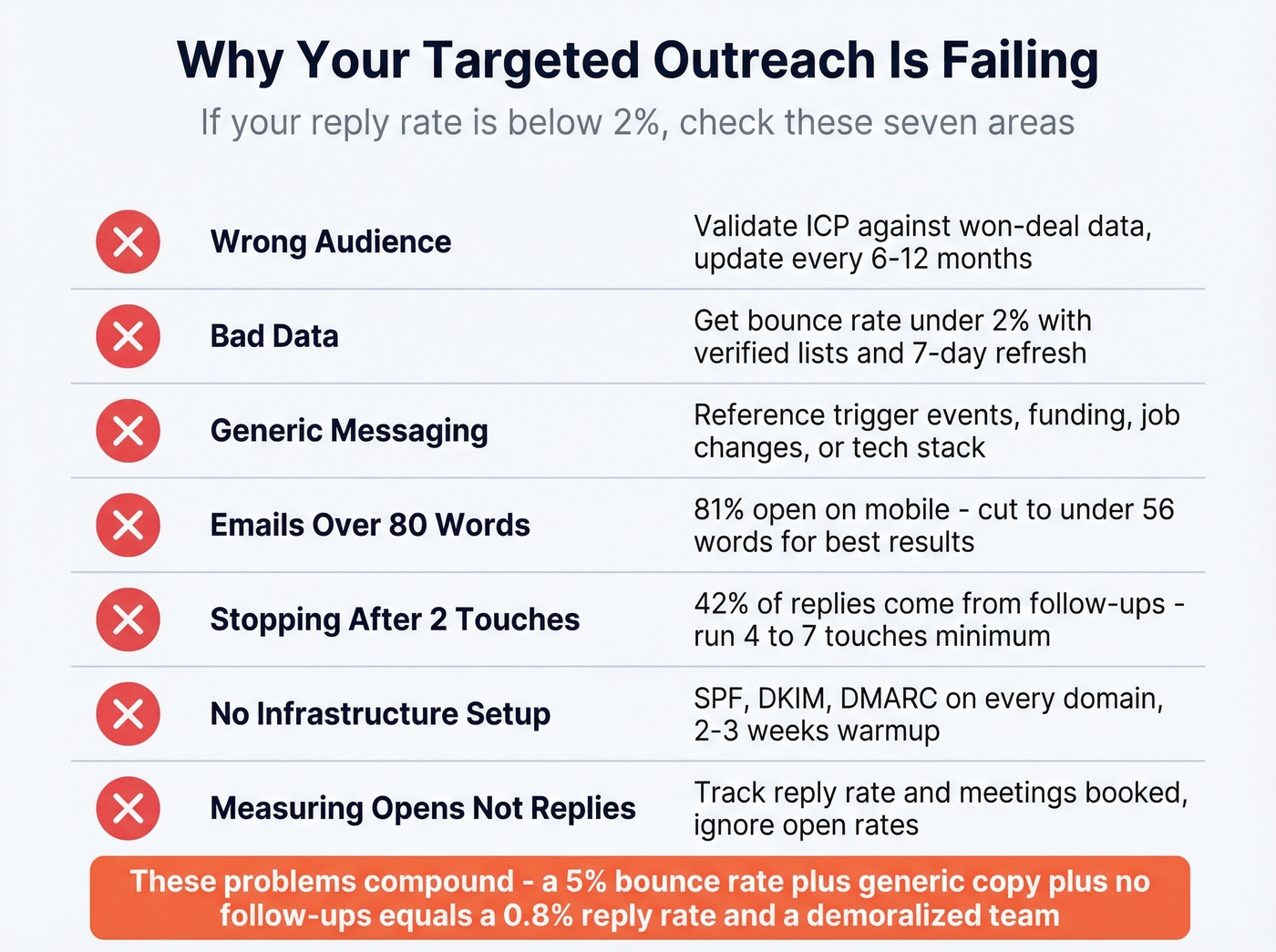
- Wrong audience. Your ICP is too broad or hasn't been updated in over a year.
- Bad data. Bounce rate above 2% means your list is damaging your domain with every send.
- Generic messaging. If you could swap in any company name and the email still makes sense, it's not personalized.
- Emails over 80 words. Mobile readers won't scroll. Cut ruthlessly.
- Stopping after 2 touches. 42% of replies come from follow-ups. You're quitting at halftime.
- No infrastructure setup. Missing SPF/DKIM/DMARC, no warmup, too many sends per domain.
- Measuring opens instead of replies. Open rates are vanity metrics. Track replies and meetings booked.
Look - most campaigns don't fail because of one catastrophic mistake. They fail because three or four "small" problems compound. A 5% bounce rate plus generic copy plus no follow-ups equals a 0.8% reply rate and a demoralized SDR team. In our experience, fixing all of these variables simultaneously is what separates real results from busywork. One at a time doesn't cut it.
The Essential Tool Stack
You need 3-4 tools, not 10. The consensus on r/salesdevelopment is clear: teams that stack too many tools spend more time managing integrations than prospecting. If you're auditing your stack, start with this list of SDR tools.
| Category | Tool | Starting Price | Key Stat |
|---|---|---|---|
| Data & Verification | Apollo | From $49/mo | Strong free tier |
| Data & Verification | ZoomInfo | ~$15-40K/yr | 600M+ contacts |
| Data & Verification | Lusha | From $29/mo | Quick lookups |
| Enrichment | Clay | From $149/mo | Best enrichment workflows |
| Sending | Instantly | From ~$37/mo | Inbox rotation + warmup |
| Sending | Smartlead | From ~$39/mo | Multi-inbox management |
| CRM | HubSpot | From $45/mo | Free CRM available |
| Intent | Bombora / 6sense | Custom ($30K+/yr typical) | In-market buyer signals |
For enrichment workflows, Clay is the clear winner - it's the glue connecting your data source to your personalization layer. If you're a founder or small team that doesn't need a $30K intent data contract, Prospeo's built-in intent tracking covers 15,000 topics via Bombora at a fraction of the cost. Reddit threads on r/salesdevelopment also mention ReachInbox, ManyReach, and ListKit as emerging alternatives for inbox rotation and multi-channel consolidation.
Let's be honest: if your budget is under $500/month, a stack of Prospeo + Instantly + HubSpot free CRM gets you 90% of the way there. You can always add Clay and intent tools as you scale.
FAQ
What is targeted outreach?
It's the practice of reaching specific prospects who match your ideal customer profile with personalized messaging across email, social, and phone. Every touch is tailored to the recipient's role, company, and situation - that precision is what separates 10%+ reply rates from sub-2%.
What's a good cold email reply rate in 2026?
The average is 3.43%. Top quartile hits 5.5%+, and the top 10% clears 10.7%. If you're consistently below 2%, fix your data quality and sending infrastructure before touching your messaging.
How many touches does it take to get a reply?
About 5 on average. Executives often need around 9 touchpoints, while mid-level contacts respond within 4. The sweet spot for email sequences is 4-7 touches spread across multiple channels.
What's the best free tool for verified prospect data?
Prospeo offers 75 free email credits plus 100 Chrome extension credits per month - enough to test campaigns with 98% verified accuracy. Apollo also has a generous free tier but lower verification rates.
How do I keep my prospect data accurate?
Contact data decays at roughly 2.1% per month. Use a provider with a short refresh cycle and multi-step verification. Target a bounce rate under 2%; anything higher actively damages your domain reputation and tanks deliverability for your entire team.