

The Best Territory Planning Software for Every Team Size
You're staring at a spreadsheet with 200 accounts, 14 reps, and a color-coded map that stopped making sense three quarters ago. The rep in Phoenix is swamped. The rep in Denver has half the pipeline and twice the excuses. And the "territory plan" lives in someone's head - or worse, in a massive Excel sheet held together by tribal knowledge and VLOOKUP prayers.
You're not alone. A recent r/SalesOperations thread captured this perfectly: one ops leader described splitting territories by "eyeballing it," trying to factor in TAM, lead flow, and realistic opportunity count - and calling the whole exercise a "nightmare." The right territory planning software kills that guesswork.
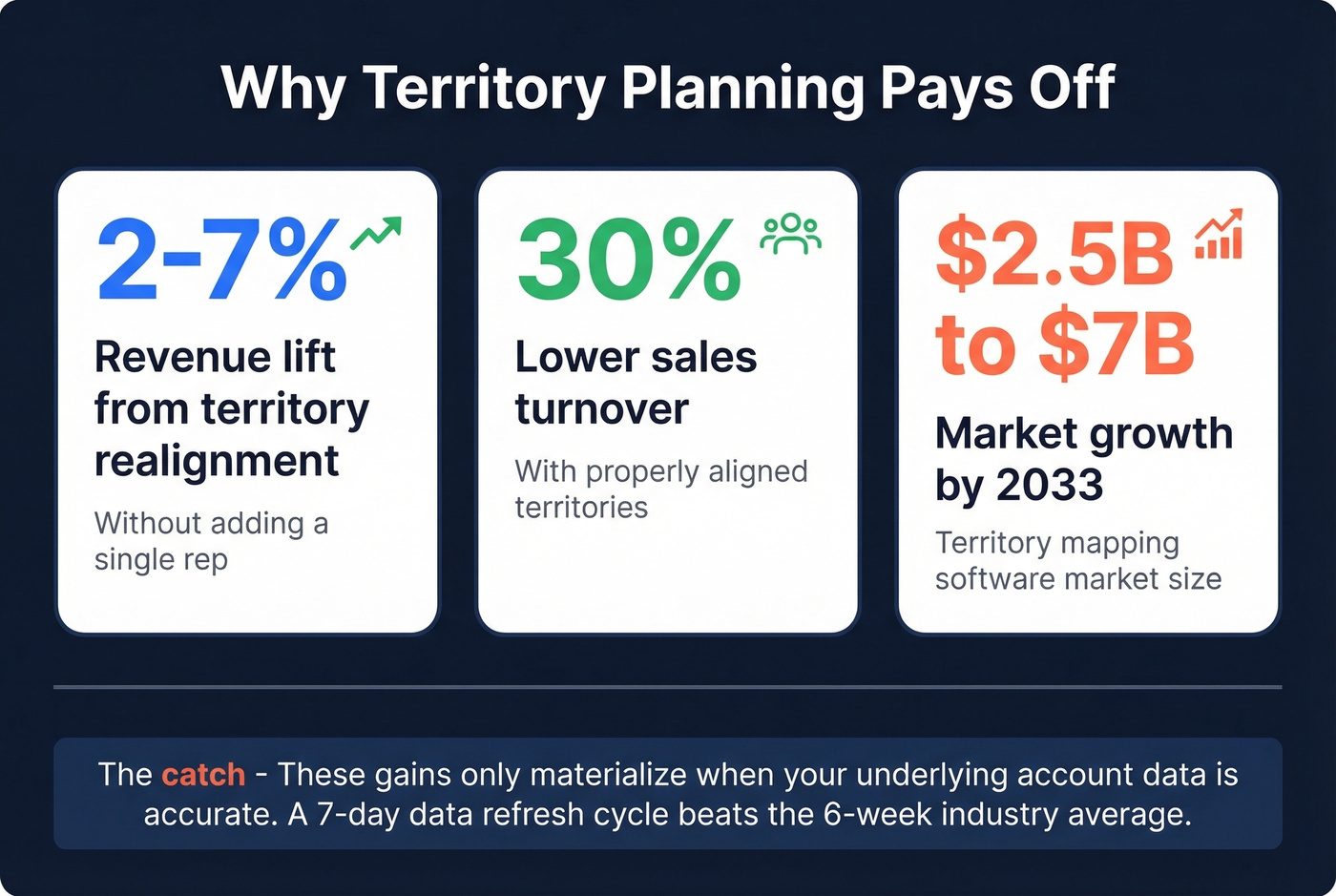
The money behind fixing this problem tells the story. The sales territory mapping software market was valued at roughly $2.5B in 2025 and is projected to hit $7B by 2033. Effective territory realignment can lift revenue 2-7% without adding a single rep, and a widely cited benchmark in a territory mapping buyer's guide pegs properly aligned territories at 30% lower sales turnover.
But "territory planning" means wildly different things depending on who's selling it. Some tools design territories. Some just draw maps. Some manage field routes. And almost none of them address the real upstream problem: whether the account data feeding your territories is any good.
Here's the thing: most teams don't need a $60K planning platform. They need clean data and a $1,250 mapping tool. The planning software only earns its price tag once you're past 50 reps and running multiple territory scenarios per quarter. Let's sort through what actually matters.
Our Picks
| Use Case | Tool | Starting Price | Why |
|---|---|---|---|
| Data accuracy layer | Prospeo | Free (75 emails/mo) | 98% email accuracy, 7-day refresh. Territories built on stale data produce stale results. |
| Mid-market RevOps (20-100 reps) | Fullcast | ~$20K-$60K/yr | 4.6/5 on G2 (449 reviews), 2-month implementation, covers territories + quotas + capacity. |
| Enterprise alignment (100+ reps) | Xactly AlignStar | ~$30K-$80K+/yr | Interactive maps, drag-and-drop territory design, deep scenario modeling. |
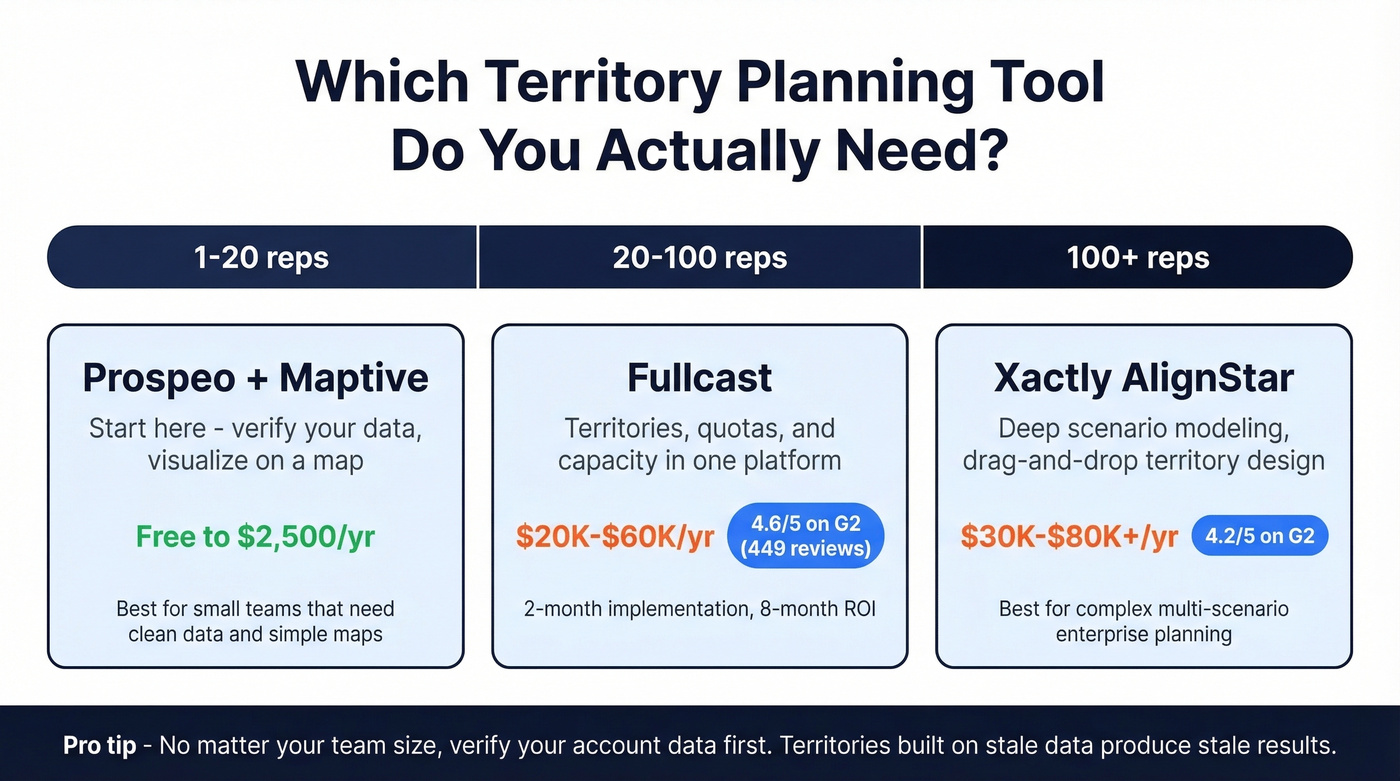
If you're a 5-person team that just needs to see accounts on a map, skip to the mapping section. Running 50+ reps and need quota-balanced territories synced to your CRM? Start with Fullcast or Xactly. Either way, verify your data first.
What These Tools Actually Do
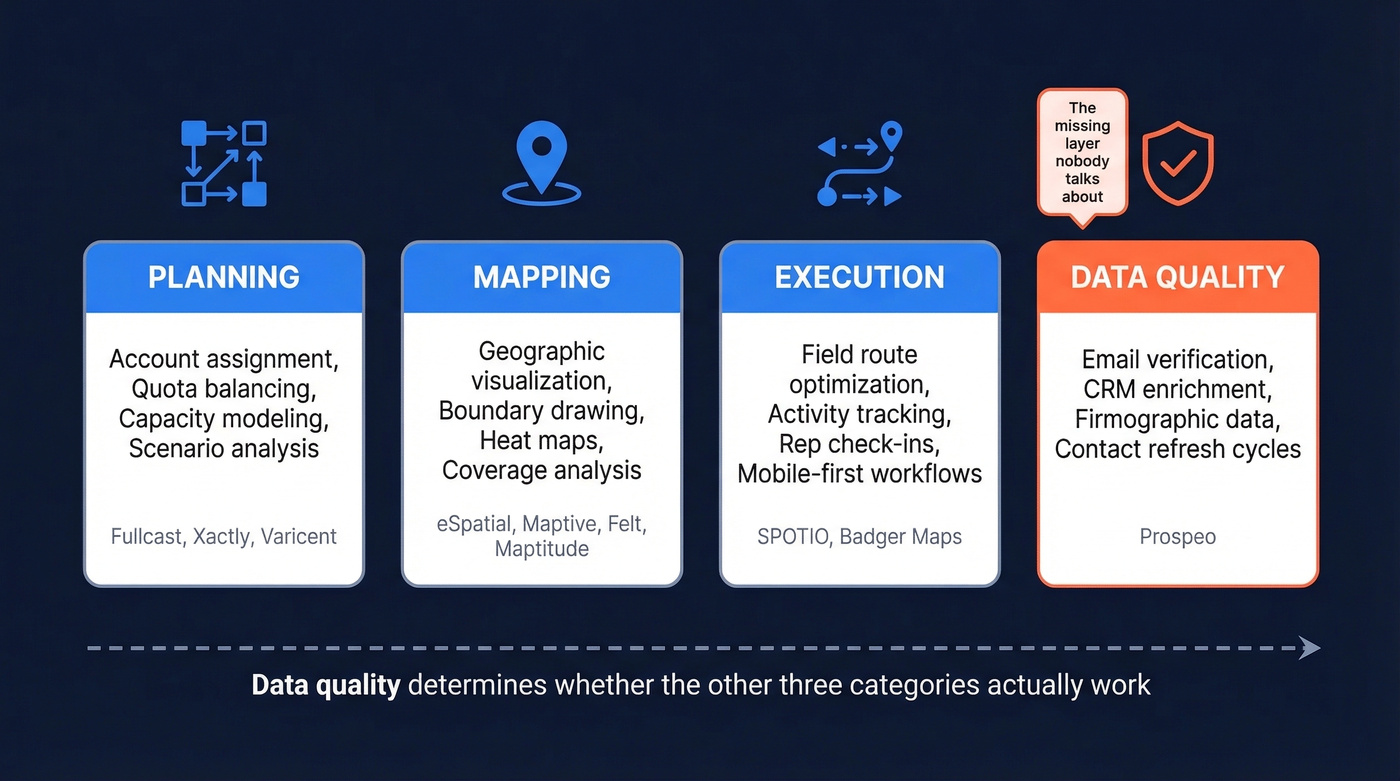
Most "best sales territory planning software" lists lump everything together - desktop GIS tools next to enterprise SPM platforms next to field sales route optimizers. Here's how the category actually breaks down:
| Category | What It Does | Examples |
|---|---|---|
| Planning | Account assignment, quota balancing, capacity modeling, scenario analysis | Fullcast, Xactly, Varicent |
| Mapping | Geographic visualization, boundary drawing, heat maps | eSpatial, Maptive, Maptitude, Felt |
| Execution | Field route optimization, activity tracking, rep check-ins | SPOTIO, Badger Maps |
| Data Quality | Verifying and enriching the account/contact data that feeds everything above | Prospeo |
That fourth category is the one nobody puts on the list. But it determines whether the other three actually work.
Planning tools are where the real money goes. They're solving the hard problem: how do you assign 5,000 accounts across 80 reps so that workload is balanced, quota is achievable, and nobody's driving three states to visit a single customer? Mapping tools solve a simpler but still valuable problem - making geographic data visual so humans can spot patterns. Execution tools help field reps actually work their territories day-to-day.
Best Sales Territory Planning Tools for 2026
Data Quality & Verification
Prospeo - Verify the Data Before You Plan
You can spend $60K on Fullcast and $50K on Xactly, but if 20% of your account records have outdated contacts, wrong headcounts, or dead email addresses, your territory model is garbage in, garbage out.
Prospeo solves this upstream. Its database covers 300M+ professional profiles with 98% email accuracy and a 7-day data refresh cycle. The industry average refresh is six weeks, which means most account data is already stale by the time you load it into a planning tool. CRM enrichment returns 50+ data points per contact at an 83% match rate, including firmographics like headcount, revenue, and industry - exactly the signals you need for intelligent territory segmentation.

The workflow is straightforward: before you load your account list into any planning platform, run it through Prospeo. Verify emails, enrich company data, flag accounts that have changed. Pricing starts free at 75 emails/month and scales to roughly $0.01/email with no contracts. It integrates natively with Salesforce and HubSpot, so enriched data flows directly into whatever planning tools sit downstream.
If you want to compare options, start with data enrichment and B2B company data providers.
Territory Planning Platforms
Fullcast - The RevOps Workhorse
Use this if you're a mid-market RevOps team running 20-100 reps and you need territories, quotas, and capacity planning in one platform. Fullcast's "Plan to Pay" suite covers the full lifecycle: Fullcast Plan for territory management, quotas, and capacity planning; Perform for routing and policies; and Pay for commissions. It's the most complete RevOps planning tool that's absent from most competing listicles - a genuine blind spot in the market.
If you're building the function, this is also a good time to align on what a RevOps manager owns vs Sales Ops.
The G2 numbers are strong: 4.6/5 across 449 reviews, with an average 2-month implementation and 8-month ROI. That's fast for this category. Pricing runs ~$20K-$60K/year depending on team size and modules.
Skip this if you only need geographic visualization or you're a 5-rep team. It's overkill for simple mapping needs.
Xactly AlignStar - Enterprise Alignment
Xactly AlignStar is the sales territory alignment software large orgs reach for when they need to model territory scenarios across hundreds of reps. The interactive maps and drag-and-drop territory adjustments get consistent praise on G2 (4.2/5, 10 reviews). Users highlight the ability to visually rebalance workloads and immediately see the downstream impact on quota distribution.
The scenario modeling is deep - balancing algorithms factor TAM, rep capacity, and historical deal data. On the downside, integration with non-Salesforce CRMs draws complaints on G2, and some users report slowness with large datasets. At ~$30K-$80K+/year on enterprise contracts, it's a serious commitment. The right tool for 100+ rep orgs that need sophisticated what-if modeling; more firepower than smaller teams need.
Varicent - Full SPM Stack
Varicent is rated 5.0/5 on Capterra based on 6 reviews. The platform handles territory design by industry, geography, product, and customer segment, plus quota planning, forecasting, and compensation management. It's a full SPM suite that happens to include territory planning, not a territory-first tool. Real-world enterprise SPM contracts typically run ~$30K-$80K+/year depending on modules and headcount.
Pigment - FP&A With Territory Modules
Pigment is the Swiss Army knife in this list - fundamentally an FP&A and business planning platform with AI-driven scenario modeling. Territory design is one of many things it can handle, alongside headcount planning, revenue forecasting, and capacity allocation. If your finance and RevOps teams both need a shared planning layer, Pigment makes sense. For teams that just need territory management, you're paying for a lot of capability you won't touch. Expect $50K-$150K+/year for enterprise deployments.
Salesforce Maps - Native but Expensive
Salesforce Maps runs $75/user/month for the base tier and $125/user/month for Advanced with route optimization and geo-analytics.
For a 30-person sales team, that's $27,000/year at base or $45,000/year for Advanced, billed annually - just for the Maps add-on. One Reddit user in r/SalesOperations called the pricing "pretty steep," and they weren't wrong. If you're already deep in the Salesforce ecosystem, it's the path of least resistance. Otherwise, there are better tools at half the cost.
If you're evaluating the broader stack, it helps to understand Salesforce pricing and where mapping fits.
Territory Mapping Tools
eSpatial - Mid-Market Mapping
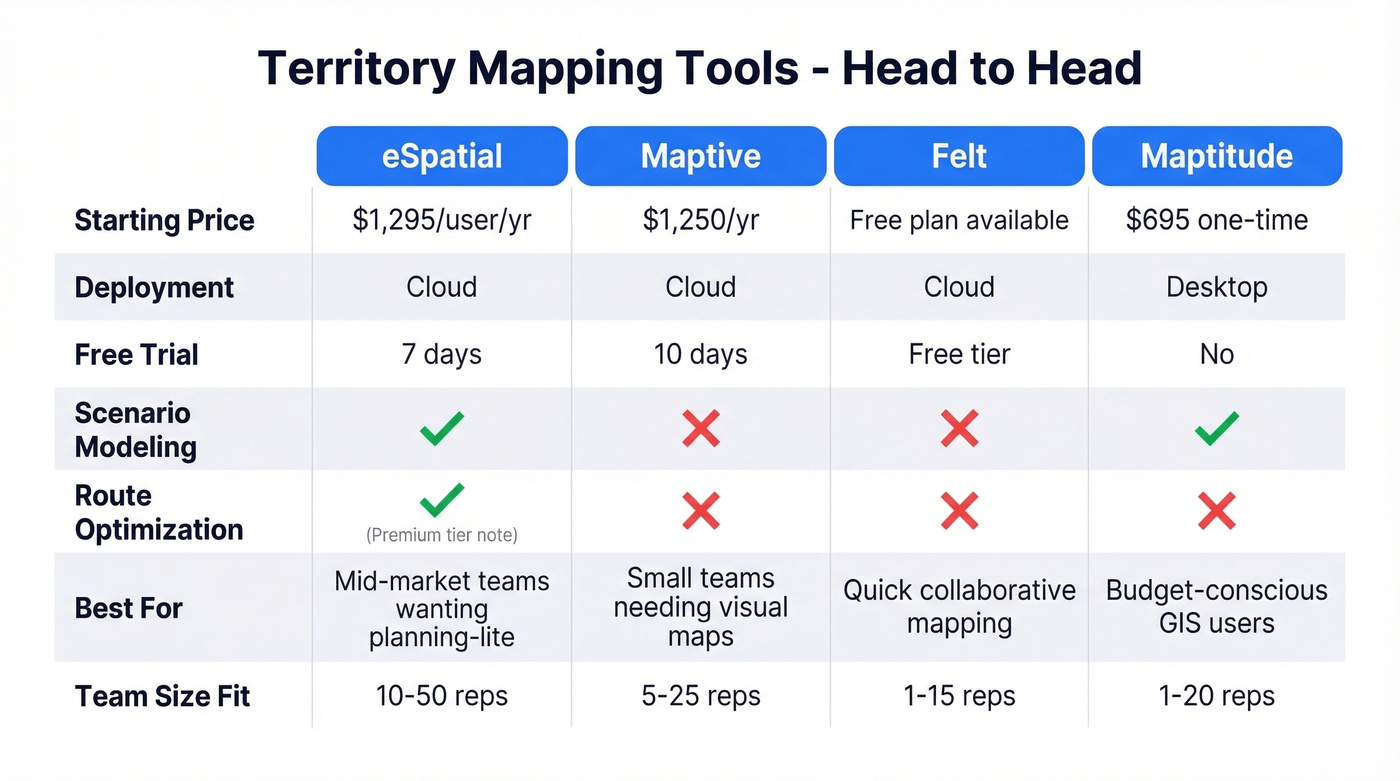
eSpatial hits the sweet spot for teams that need visual territory design with scenario planning and route optimization but don't need a full SPM platform. The Pro tier starts at $1,295/user/year, with optimization features in the Premium tier. What-if scenario modeling lets you test territory splits before committing, and the 7-day free trial means you can validate the fit before spending. Best for mid-market teams of 10-50 reps.
If you want more options in this category, see our guide to sales mapping software.
Maptive - Affordable Visual Mapping
Maptive is the accessible entry point for teams that need geographic visualization without enterprise overhead. A 10-day free trial, a 45-day pass for $250, or annual Pro plans from $1,250-$2,500/year. Heat maps, boundary tools, and territory coloring make it easy to visualize account distribution and spot coverage gaps. It won't balance quotas or model capacity, but for smaller teams that just need to see their territories on a map, it does the job cleanly.
Felt - Free Cloud-Native Mapping
Felt is worth knowing about because it's the simplest on-ramp in this category. Cloud-native, free plan, collaborative editing, and a modern interface that makes legacy GIS tools feel ancient. Paid plans include a Team plan at $200/month, with enterprise pricing available via custom quote.
Maptitude - One-Time Purchase GIS
Maptitude is a desktop GIS tool with a $695 one-time purchase price - no subscription, no recurring fees. It ships with extensive demographic and Census data. Best for budget-conscious teams comfortable with desktop software who need geographic analysis without SaaS overhead.
Field Sales Execution
SPOTIO - Field Sales Territory Management
SPOTIO starts at $39/user/month and is built specifically for outside/field sales teams. Territory assignment, route planning, and activity tracking in one mobile-first package. If your reps are knocking doors, not sending emails, this is their tool.
If you're standardizing rep activity, you may also want a baseline list of sales activities to track consistently.
Badger Maps - Route-First Territory Tool
Badger Maps runs $58/user/month on annual plans ($69 monthly), with Enterprise at $95/user/month annually ($109 monthly) and a 14-day free trial. It's a route optimization tool first and a territory tool second - best for field reps who need to minimize windshield time, not for ops teams designing territory boundaries.
If your team is also tightening outbound, pair territory work with better sales prospecting techniques.

Territory models built on stale CRM data produce stale results. Prospeo enriches your account list with 50+ data points per contact - headcount, revenue, industry - at an 83% match rate, refreshed every 7 days. That's the segmentation data your planning tool actually needs.
Fix the data layer before you spend $60K on a planning platform.
Pricing Comparison
Here's every tool side by side.
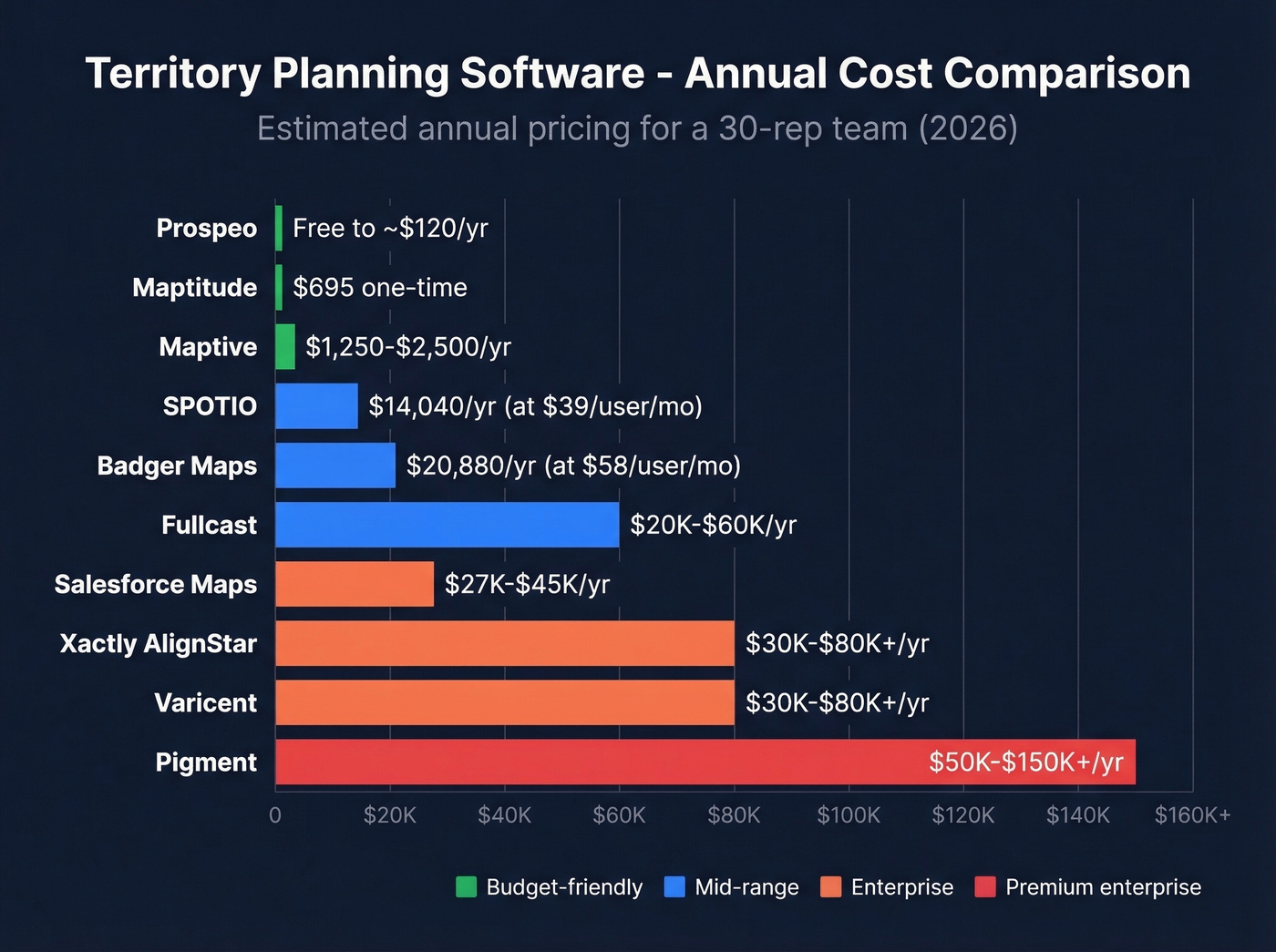
| Tool | Category | Starting Price | G2 Rating | Best For |
|---|---|---|---|---|
| Prospeo | Data Quality | Free (75/mo) | - | Data verification layer |
| Fullcast | Planning | ~$20K-$60K/yr | 4.6/5 (449) | Mid-market RevOps |
| Xactly AlignStar | Planning | ~$30K-$80K+/yr | 4.2/5 (10) | Enterprise 100+ reps |
| Varicent | Planning | ~$30K-$80K+/yr | 5.0/5 (6) | Full SPM stack |
| Pigment | Planning | ~$50K-$150K+/yr | - | FP&A + RevOps combined |
| Salesforce Maps | Mapping | $75/user/mo | - | Salesforce-native teams |
| eSpatial | Mapping | $1,295/user/yr | - | Mid-market visual design |
| Maptive | Mapping | $1,250/yr | - | Budget visual mapping |
| Felt | Mapping | Free | - | Collaborative map editing |
| Maptitude | Mapping | $695 one-time | - | Desktop GIS on a budget |
| SPOTIO | Execution | $39/user/mo | - | Field/outside sales |
| Badger Maps | Execution | $58/user/mo | - | Route optimization |
How to Evaluate the Right Tool
Not every tool on this list is right for your team. Before you start demos, run through these criteria.
Everstage's framework nails the four principles that matter: Fairness - reps believe their territories are equitable. Focus - territories align to revenue goals, not just geography. Flexibility - you can adjust as markets shift mid-year. Transparency - reps understand why they got what they got.
Beyond those principles, we've found five areas worth pressure-testing during evaluation:
CRM integration depth. Does it sync bidirectionally with your CRM, or export a CSV you manually import? Salesforce-native tools win for Salesforce shops; HubSpot teams should verify compatibility carefully.
Scenario modeling. Can you test three different territory splits side by side and compare projected outcomes? This is what separates planning tools from mapping tools.
Balancing algorithms. Does the tool balance by geography only, or can it factor TAM, pipeline, rep capacity, and historical conversion rates? Geography-only balancing is how you end up with one rep covering Montana and another covering Manhattan - technically equal in square miles, absurdly unequal in revenue potential.
Implementation timeline. Territory realignment projects have a 20% failure rate, and 52% face major challenges. A tool that takes 6 months to implement might never launch.
Data quality dependency. If your account data is stale, incomplete, or duplicated, no planning algorithm will save you. Verify and enrich before you plan.
If you're trying to quantify impact, tie territory changes back to pipeline health and your sales operations metrics.
The Data Quality Problem Nobody Talks About
Every territory planning article focuses on the planning layer and ignores what's underneath it.
Think about what a planning tool actually needs to work: accurate account counts per geography, correct industry classifications, up-to-date headcount and revenue figures, and valid contact information for the people reps will actually reach out to. If 15-20% of that data is wrong - and after six weeks without a refresh, it usually is - your "optimized" territory model is optimizing around fiction.
That 20% territory project failure rate from the evaluation section? Data quality is the common thread. Teams invest $50K in planning platforms, load in stale CRM data, and wonder why the output doesn't match reality. Alexander Group research shows properly planned territories drive 10-20% productivity gains, but only when the underlying data is accurate enough to trust. We've seen this firsthand with teams who came to us after a failed territory rollout - the planning tool worked fine, the data didn't.
The fix is simple: verify before you plan. Run your account list through an enrichment tool, update firmographics, flag companies that have grown or shrunk since your last territory review. At ~$0.01/email with a free tier to start, it's the cheapest insurance policy in your planning stack.
If you're also tightening your ICP inputs, use an ideal customer profile template to standardize segmentation rules.
Every misassigned account starts with a bad record. Prospeo verifies emails at 98% accuracy and enriches firmographics across 300M+ profiles - for roughly $0.01 per email. No contracts. Native Salesforce and HubSpot integrations push clean data straight into your territory workflows.
Stop planning territories on data that's already six weeks old.
FAQ
What's the difference between territory planning and territory mapping software?
Planning tools like Fullcast and Xactly handle account assignment, quota balancing, and capacity modeling. Mapping tools like eSpatial, Maptive, and Felt focus on geographic visualization - drawing boundaries and seeing accounts on a map. Most mid-market and enterprise teams need planning; smaller teams often only need mapping.
How much does sales territory planning software cost?
Mapping tools run $695-$2,500/year, while full planning platforms range from $20K (Fullcast) to $150K+ (Pigment enterprise). Salesforce Maps costs $75-$125/user/month billed annually. Always calculate total cost of ownership including implementation time and data cleanup.
Can I use these tools with HubSpot?
Many enterprise platforms are Salesforce-first. Xactly AlignStar users have flagged HubSpot integration challenges on G2. Fullcast supports broader CRM connectivity. Always confirm compatibility during your trial - and verify your CRM data before importing it into any platform.
How do I make sure my territory data is accurate?
Run your account and contact lists through a verification platform before loading them into any planning tool. With the industry-average data refresh cycle at six weeks, records go stale fast - wrong headcounts, outdated contacts, acquired companies. A 7-day refresh cycle catches these issues before they corrupt your territory model.
How long does implementation typically take?
Fullcast reports a 2-month average implementation on G2, which is fast for this category. Enterprise platforms like Xactly and Varicent typically take 3-6 months. Mapping tools like eSpatial and Maptive can be set up in days. The biggest delay isn't the software - it's the data cleanup required before you can trust the output.