

How to Write a Thank You Email After a Meeting (Templates That Actually Work)
The meeting ended 20 minutes ago. You're staring at a blank compose window, cursor blinking, while a voice in the back of your head whispers: I'll write it later tonight. You won't.
Three rules cover most of what makes a post-meeting follow-up work:
- Keep it under 150 words. If you're scrolling to re-read your own draft, it's too long.
- Reference one specific detail from the meeting. Not "great conversation" - the actual thing you discussed.
- Include a clear next step with a date. "I'll send the proposal by Thursday" beats "let's stay in touch."
Send it within 24 hours. That's the whole framework.
Does a Post-Meeting Thank You Actually Matter?
One Reddit user posted in r/interviews asking whether thank-you emails make any difference. The update: "GOT THE JOB!" - with the interviewer specifically telling them they loved the thank-you email.
Personalized follow-ups are 26% more likely to be opened than generic ones. In warm contexts - where someone already knows your name and face - a concise, specific note improves reply and next-step rates by 5-15%. That's not a magic bullet. It's a compounding advantage that costs you five minutes. In our experience, the emails that get replies aren't the longest - they're the most specific.
When to Send and How Long
Send within 24 hours. After that, momentum dies and memory fades. If the meeting was late in the day, write the email while it's fresh but schedule it for 9-10 AM the next morning so it lands at the top of their inbox when they're actually reading.
Draft the skeleton before the meeting. Write the greeting, sign-off, and next-step placeholder ahead of time. After the meeting, you're just filling in one or two details. This pre-drafting hack kills the blank-screen problem entirely.
Hard word count target: 80-150 words. One to three short paragraphs. No more.
The 3-Part Framework
Every effective follow-up has three parts. Not five. Three.
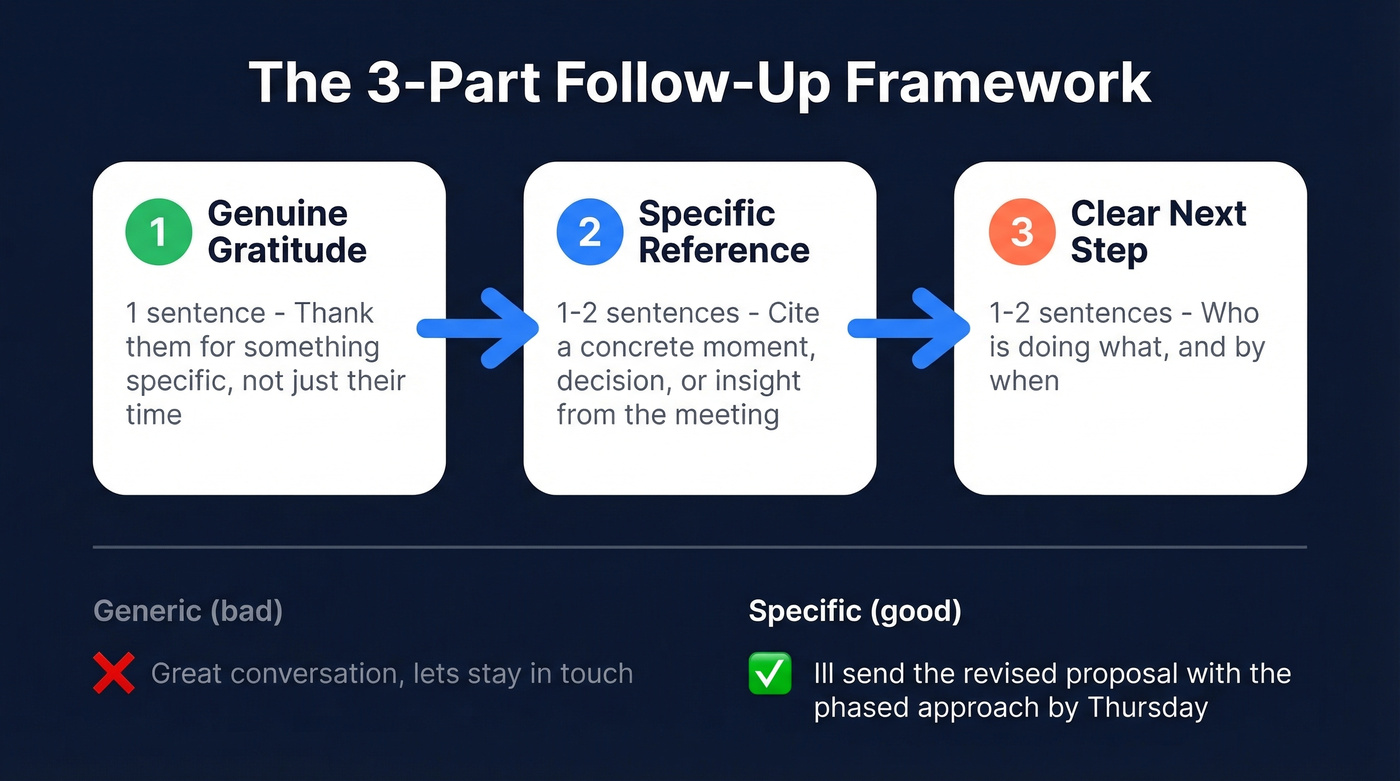
Part 1 - Genuine gratitude (1 sentence). Thank them for something specific: their time, their insight, the introduction they offered. A simple "thank you for your time" note goes further when it names what that time was spent on.
Part 2 - Specific reference (1-2 sentences). Cite a concrete moment, decision, or insight from the meeting. This is what separates your email from the 50 generic ones they've received this month.
Part 3 - Clear next step with owner and date (1-2 sentences). Who's doing what, and by when. Gratitude, a specific detail from the conversation, and proof you'll act on what you discussed - that's the whole formula.
Before (generic):
Hi Sarah, thank you so much for taking the time to meet with me today. I really enjoyed our conversation and learning more about your company. I look forward to staying in touch. Best regards, Alex
After (specific):
Hi Sarah, thanks for walking me through the Q3 migration timeline today. Your point about staging the rollout by region instead of all-at-once changes how I'll scope the proposal - I'll send a revised version by Thursday with the phased approach. Let me know if anything shifts on your end before then.
Same length. Completely different impact.

A perfect thank-you email means nothing if it bounces. Prospeo gives you 98% verified email addresses so your follow-ups actually reach the people you just met - not a dead inbox.
Stop crafting great follow-ups that land in the void.
Subject Lines That Get Opened
An analysis of 85M+ cold emails found that 1-4 words is the ideal subject line length. All-lowercase subject lines have the highest open rates (except proper nouns). Salesy phrasing - exclamation marks, "quick question," anything that smells like a pitch - reduces open rates by up to 17.9%.
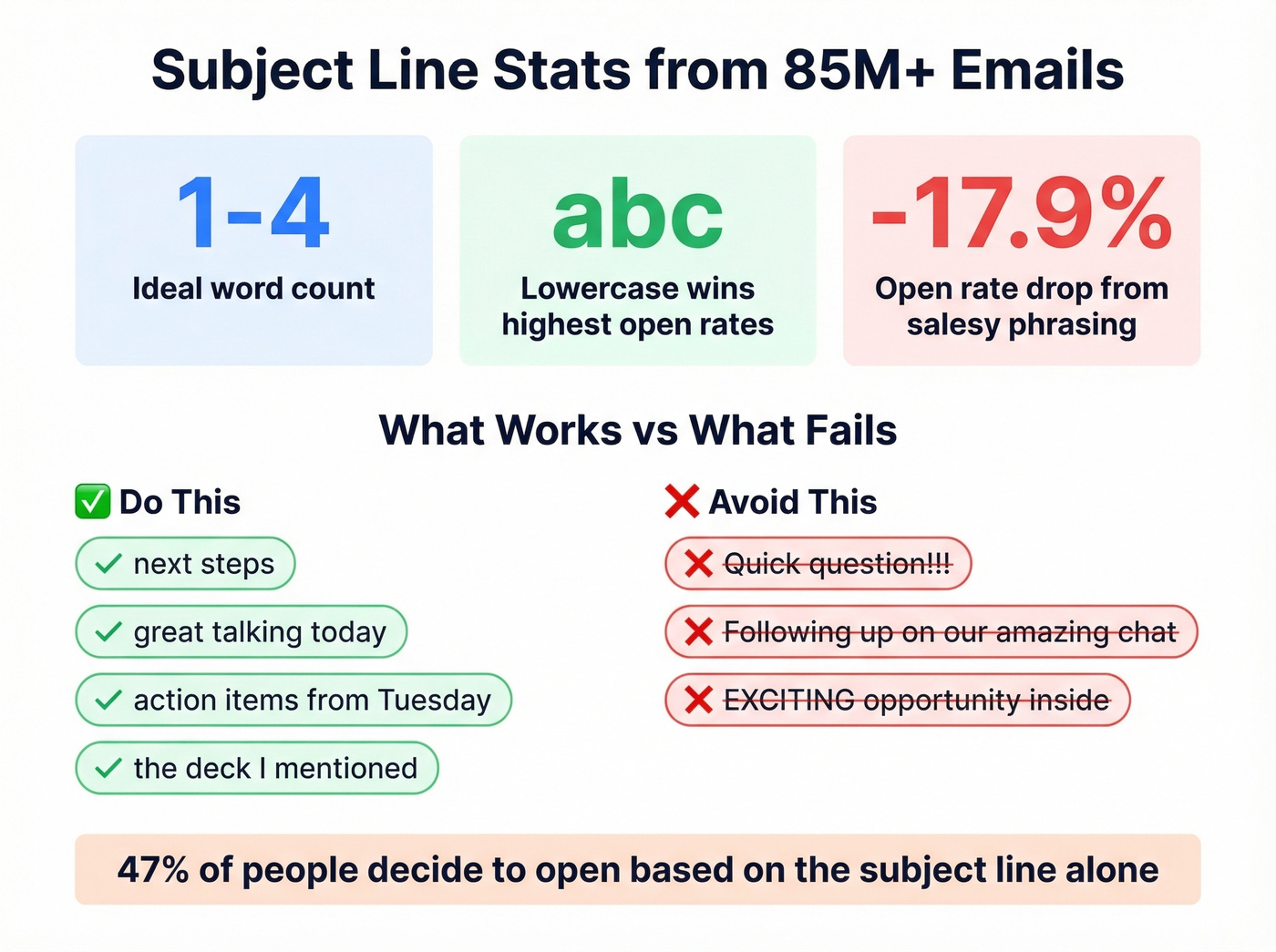
47% of people decide whether to open an email based on the subject line alone. Your beautifully crafted follow-up is worthless if the subject reads like spam.
Subject lines that work:
- Job interview:
great talking today - Sales / discovery call:
next stepsorthe deck I mentioned - Client meeting:
action items from Tuesday - Networking:
loved your take on [topic] - Internal:
decisions from standup - Conference:
the conversation about [topic] - Executive:
follow-up from [day] - Panel:
your point about [specific thing]
Short. Lowercase. Specific. If you want more options, pull from these subject lines and adapt them to the meeting context.
Templates for Every Meeting Type
Job Interview
The interview thank-you is the one everyone overthinks. Reddit threads are full of people convinced their long email "hurt" their chances. They're probably right - not because the email was bad, but because it was too long.
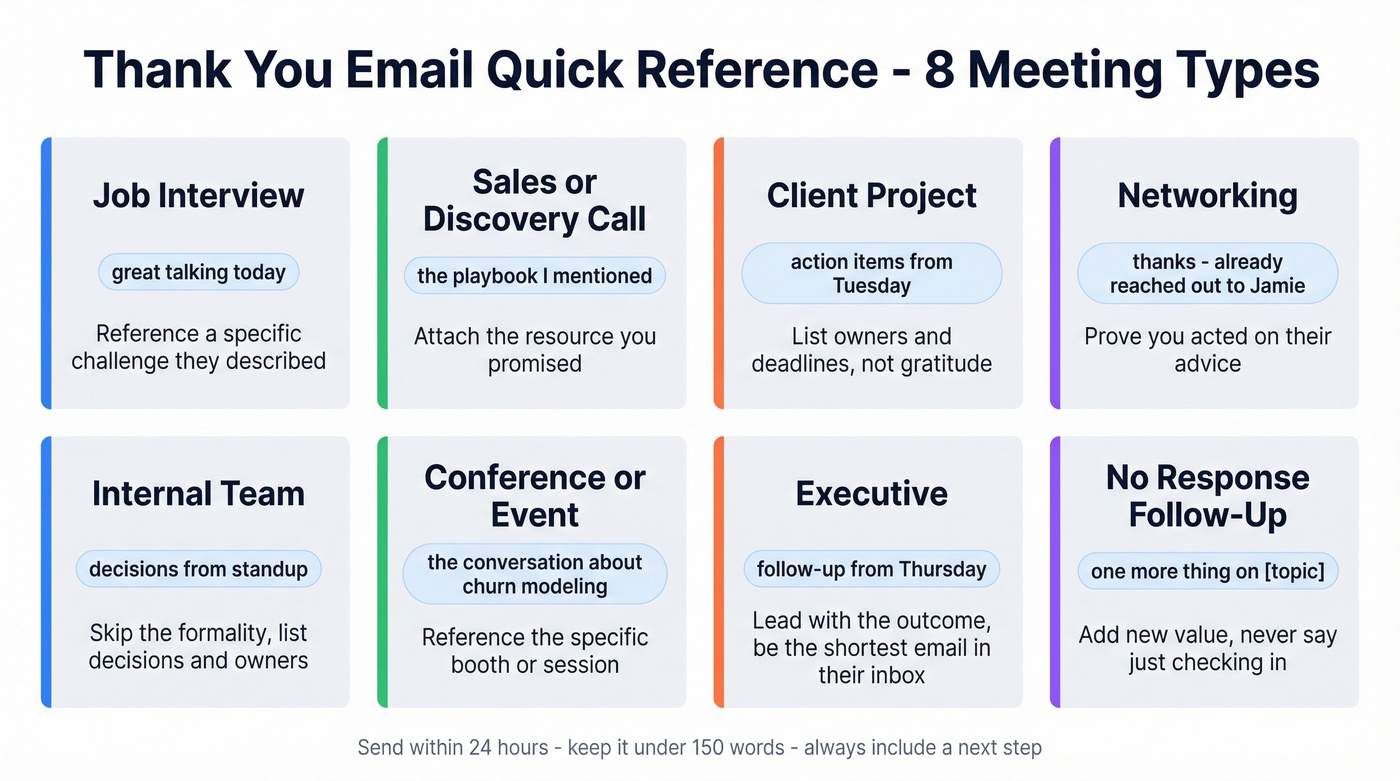
Subject: great talking today
Hi [Name], thanks for the conversation about the [role]. Your breakdown of how the team handles [specific challenge] was really helpful - it's exactly the kind of problem I've spent the last two years solving at [current company].
Looking forward to the next steps. I'm available anytime this week if anything else would be useful.
For virtual interviews, reference something you saw on screen - a demo, a shared doc, a slide. "The dashboard walkthrough made the data pipeline challenge much clearer" works better than pretending it was in-person.
Sales / Discovery Call
The follow-up is part two of the pitch. Include the resource you promised, and make the next step impossible to miss. If you want more variations, use these follow-up templates as a starting point.
Subject: the playbook I mentioned
Hi [Name], thanks for walking me through your outbound workflow today. Attached is the benchmarking playbook I referenced - page 12 has the deliverability data most relevant to what you described.
I'll send over a scoped proposal by Friday. If the timeline shifts, just let me know.
Client Project Meeting
Client follow-ups aren't about gratitude - they're about accountability. This is where your email becomes a lightweight project management tool.
- Sarah: Finalize budget proposal - due EOD Friday
- Marcus: Share updated wireframes with dev - due Wednesday
- You: Send revised timeline with phased rollout - due Thursday
Subject line: action items from Tuesday. Flag anything that needs to shift. Include the next check-in date.
Networking
The Harvard Law OPIA framework nails this: gratitude, a specific detail, and proof you're acting on their advice. That last part is what most people skip.
Subject: thanks - already reached out to Jamie
Hi [Name], thank you for making time yesterday. Your perspective on how [industry trend] is reshaping the [function] role was genuinely eye-opening.
At your suggestion, I reached out to Jamie Chen at [Company] - we're connecting next week. I'll keep you posted.
Internal Team Meeting
Nobody wants a formal thank-you from a colleague they sit next to. Keep it to decisions and owners.
Hey team - quick recap: We're going with Option B for the launch timeline. [Name] owns vendor outreach by Thursday; I'll update the roadmap by EOD tomorrow. Anything I missed, flag it in Slack.
Conference or Event
Here's the thing: the challenge isn't writing the email. It's getting the email address. You met a dozen people, collected business cards or jotted down names and companies, and now you realize you don't have verified contact info for half of them. Reference the specific booth, session, or conversation that made them memorable - and make sure you can actually reach them.
Subject: the conversation about churn modeling
Hi [Name], great meeting you at [Event] - your take on using churn signals to prioritize renewal outreach stuck with me. We're dealing with something similar on our CS team. Free for 20 minutes next week?
Executive
Executives scan. They don't read. Lead with the outcome, not the pleasantries, and be the shortest email in their inbox.
Subject: follow-up from Thursday
Hi [Name], thanks for the 30 minutes today. Based on your priority around [specific goal], I'll have a scoped recommendation to your team by [date]. One question: should I loop in [person] on the technical side, or route everything through you?
No-Response Follow-Up
Wait 3-5 business days. Then add new value - a resource, an article, an idea. Never write "just checking in" or "circling back." Those phrases signal you've got nothing new to offer. We've seen this pattern over and over: 80% of prospects say "no" four times before saying yes. A follow-up shouldn't repeat your first message - it should give them a new reason to reply. If you're unsure on timing, use this guide on when to follow up.
Subject: one more thing on [topic]
Hi [Name], came across [specific resource] and thought of our conversation about [topic]. The section on [detail] is especially relevant to what you mentioned about [their challenge]. Happy to pick this up whenever timing works.
Mistakes That Kill Your Email
Let's be honest: we've all agonized over a thank-you email for way too long. The irony is that the best ones take five minutes. Here are the mistakes that actually matter.
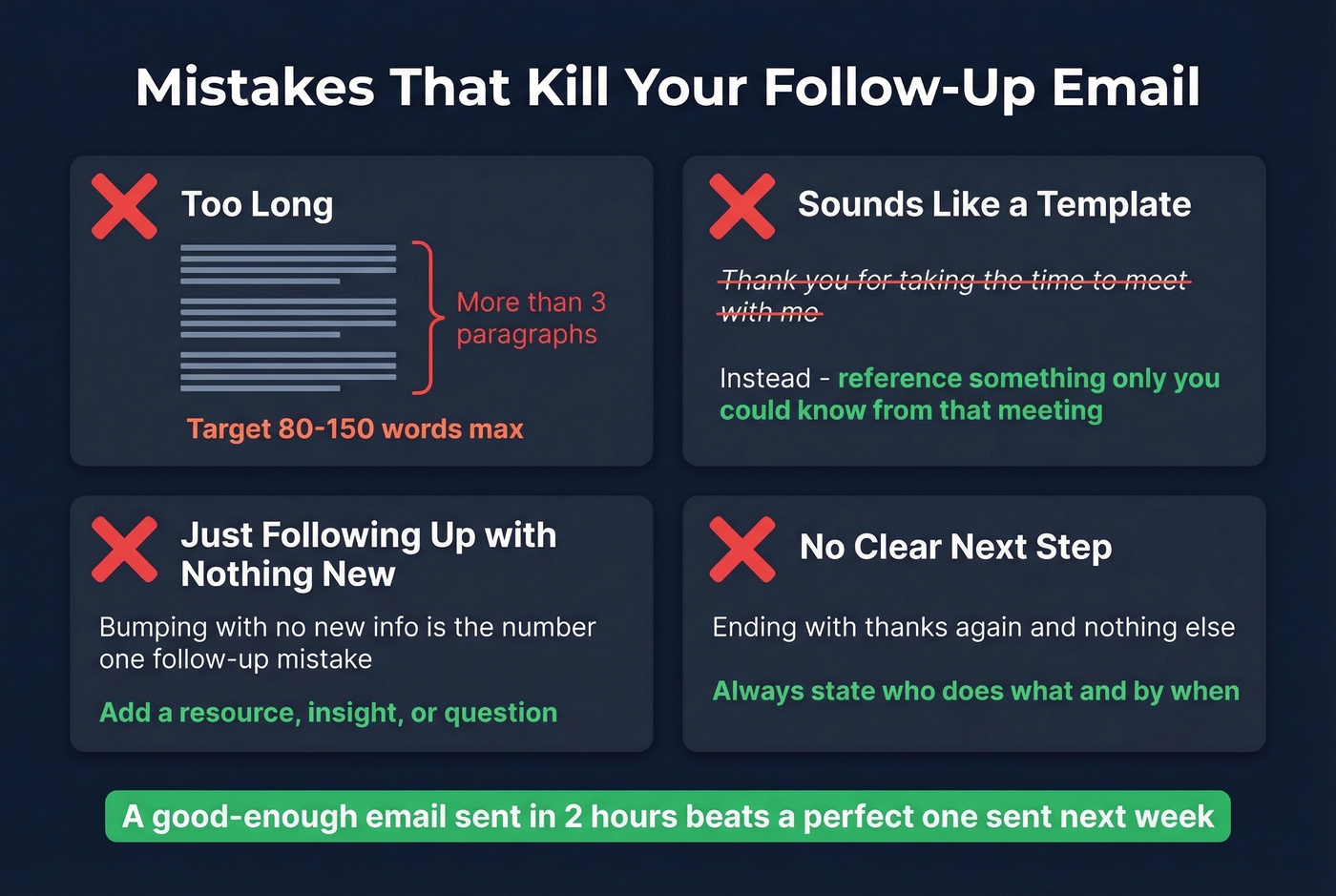
It's too long. If your email goes past three short paragraphs, you've lost them.
It sounds like a template. "Thank you for taking the time to meet with me" is the worst opening sentence on the internet. Everyone writes it. Nobody remembers it. Replace it with something only you could write about that specific meeting.
"Just following up" with no new value. A GMass analysis flags bumping an email with no new info as a top mistake. Add a resource, an insight, a question - anything that earns the reader's attention a second time. If you need alternatives to that phrase, see how to say just checking in professionally.
No clear next step. The email ends with "thanks again" and nothing happens. Every follow-up should answer: what happens next, and who's responsible?
Stop overthinking. A good-enough email sent within two hours beats a perfect email sent next week. The bar is shockingly low because most people send nothing at all.
From Thank-You to Pipeline
The thank you email after meeting someone is step one. Step two is making sure you can actually reach them again.
The follow-up opens the door. Having the right contact data keeps it open. If you’re building a repeatable process, pair this with a simple contact management setup and a lightweight follow up email software tool.
If you’re missing addresses, start with name to email workflows and sanity-check deliverability basics like email bounce rate.
You nailed the meeting and wrote the perfect follow-up. But did you grab the right contact? Prospeo's Chrome extension lets 40,000+ users pull verified emails and direct dials from any profile in one click - so your thank-you lands where it should.
Get the real email before you hit send.
FAQ
How long should a thank you email after meeting be?
80-150 words - that's 1-3 short paragraphs. If you're scrolling to re-read your own draft, cut it in half. Include one specific reference from the conversation plus one clear next step with a date.
Should I send one after a Zoom call?
Yes, the same 3-part framework applies. Reference something specific from the call - a shared screen, a demo, a slide deck. "The dashboard walkthrough made the data pipeline challenge much clearer" works better than generic gratitude.
What if I met multiple people?
Send individual emails personalized with something each person specifically said or contributed. Group messages feel lazy and get ignored. If you need verified emails for everyone you met, tools like Prospeo's free tier cover 75 lookups per month - enough for most conferences.
What subject line works best?
Keep it to 1-4 words, all lowercase (except proper nouns). Data from 85M+ emails shows short, specific subjects like "next steps" or "great talking today" outperform longer alternatives by double-digit percentages.