

Third-Party Data: What It Actually Is, Why Most of It Is Inaccurate, and What to Do About It
You toggled on a third-party audience segment in your DSP last quarter - "in-market IT buyers, director+" - and performance got worse. CPAs climbed. Conversion rates dipped. Nobody could explain why. You're not alone. Independent benchmarks show up to 51% of ad targeting data is inaccurate, with provider accuracy ranging from 32% to 69%. That's the current reality of third party data, and it deserves a harder look than most guides give it.
What It Actually Means - and Why the Label Is Too Broad
Third party data is information collected by an entity that has no direct relationship with the people it describes. You didn't collect it. Your customer didn't hand it to you. A separate company gathered it through surveys, public records, publisher networks, data cooperatives, web scraping, or behavioral tracking, then packaged it for sale. In the broadest sense, any data sourced outside your organization qualifies as external data, but the term specifically implies that arm's-length collection and resale relationship.
The category is enormous: demographic segments sold through DSPs, behavioral interest profiles, B2B firmographic databases, intent signals, location data, and technographic records. In 2018, IAB and Winterberry estimated marketers spent $19.2B on third-party audience data and related activation tech. Today it's still a tens-of-billions-per-year market.
Here's the thing: stop treating this as one category. A modeled DSP segment built from cookie-based inference and a B2B enrichment database with individually verified email addresses are both technically external data. They behave completely differently - one is opaque and probabilistic, the other is verifiable and refreshable. Lumping them together leads to bad purchasing decisions.
First vs. Second vs. Third vs. Zero-Party Data
The taxonomy matters because it determines how much control and accuracy you get.
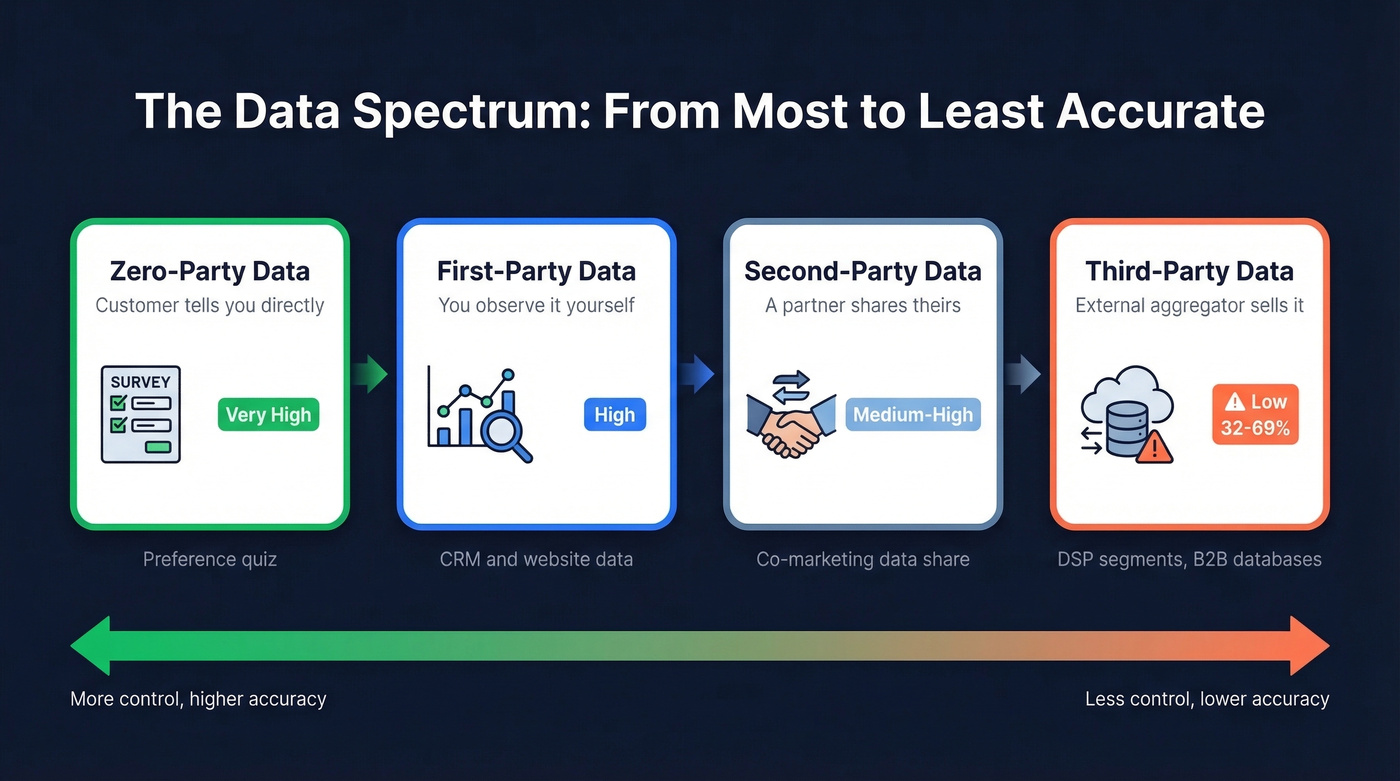
| Type | Who Collects It | Example | Accuracy | Primary Use Case |
|---|---|---|---|---|
| Zero-party data | Customer, voluntarily | Preference survey, quiz | Very high | Personalization, segmentation |
| First-party | Your company | Website analytics, CRM | High | Retargeting, lifecycle marketing |
| Second-party | A trusted partner | Co-marketing data share | Medium-high | Audience expansion with trust |
| Third-party | External aggregator | DSP segments, B2B databases | 32%-69% | Prospecting, broad targeting |
Zero-party data is what customers explicitly tell you - preferences, purchase intent, survey responses. First-party is what you observe directly through your own properties. Second-party is essentially someone else's first-party data, shared through a partnership.
Third-party is the wild card: collected at arm's length, often modeled or inferred, and sold at scale. The accuracy column tells the story. The further you get from the source, the more the data degrades.
Cookies vs. External Data Sources
These get conflated constantly, and the confusion costs teams real money. Third-party cookies are a tracking mechanism - small files placed by domains other than the one you're visiting. Third party data is the information itself, which can come from cookies, surveys, public records, publisher networks, or enrichment databases. Killing the cookie doesn't kill the data. It just changes how it gets collected.
Google announced in April 2025 that Chrome will retain third-party cookies and won't roll out a standalone opt-out prompt. Privacy Sandbox APIs continue, but the hard deprecation deadline that dominated marketing conferences for three years is gone.
That doesn't mean signal is healthy. Consent banners strip around 25% of trackable information. Ad blockers remove another 25%. Safari and Firefox - which block third-party cookies by default - account for roughly 30% of internet traffic. So even with Chrome cookies alive, you're operating with significantly less signal than you had in 2020. The cookie survived, but the ecosystem around it didn't.

You just read that third-party data accuracy ranges from 32-69%. Prospeo's 5-step verification delivers 98% email accuracy across 300M+ profiles - refreshed every 7 days, not every 6 weeks. That's external data you can actually trust.
Stop paying for segments that are wrong half the time.
The Accuracy Problem No One Wants to Quantify
Let's be honest about the number that should make every media buyer uncomfortable. Truthset's independent benchmarks show accuracy rates across providers ranging from 32% to 69%, with up to 51% of ad targeting data being flat-out wrong. When you activate a "CFOs at mid-market SaaS companies" segment, somewhere between a third and two-thirds of those records actually match that description. For B2B advertising, mistargeted impressions don't just waste budget - they burn credibility with accounts you're trying to land.
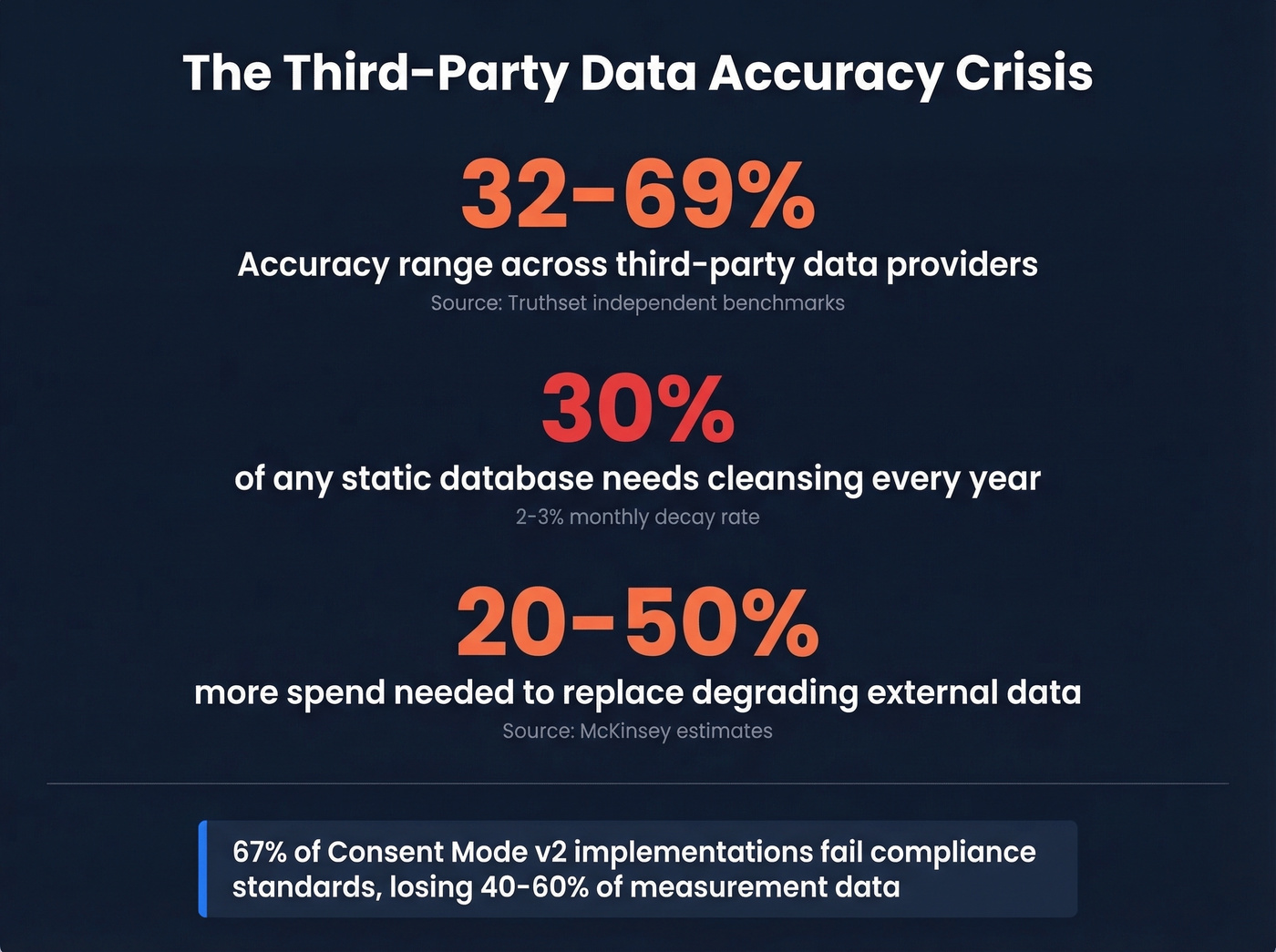
Data decay compounds the problem. Contact records degrade at roughly 2-3% per month, meaning about 30% of any static database needs cleansing annually. If your provider refreshes quarterly, you're already behind.
The compliance layer makes it worse. 67% of Consent Mode v2 implementations fail to meet compliance standards, and poor consent setups lose 40-60% of advertising measurement data. You're not just targeting inaccurate audiences - you can't even measure the results properly.
McKinsey estimates that companies unable to replace degrading external data may need to spend up to 20% more to generate the same revenue. Some forecasts put the revenue impact as high as 50%. That's not a rounding error.
We've watched teams burn through entire quarterly budgets on segments they assumed were accurate, only to discover the segments didn't match reality once performance and downstream conversions were audited. The frustration is real - you're paying premium rates for data that's wrong half the time, and the providers have zero incentive to tell you.
The practitioner consensus on r/programmatic captures this well: third-party segments in DSPs "generally suck," you don't control how they're prepared, and segments are built to be big, not accurate. Providers are incentivized to maximize segment size so they're discoverable in DSP marketplaces - accuracy is a secondary concern.

How to Evaluate a B2B Data Provider
Not all external data is equally bad. The gap between the best and worst providers is massive, and the evaluation criteria are straightforward once you know what to ask.
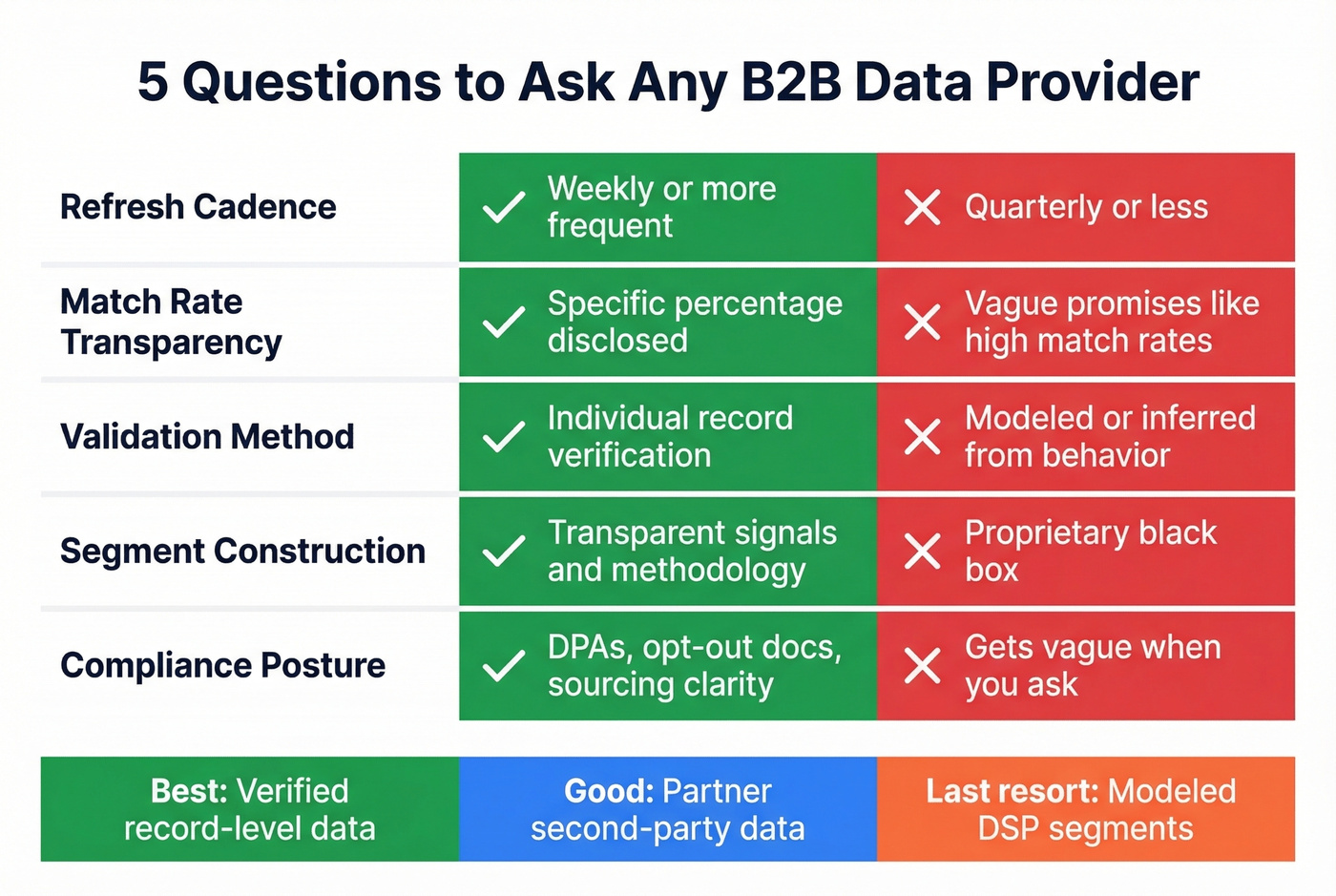
Refresh cadence. How often are records updated? Data decays fast - people change jobs, companies move, emails go stale. A provider refreshing quarterly is selling you records that are already degrading. Look for weekly or better.
Match rate transparency. What percentage of your target list will they actually match? Demand a number, not a vague "high match rates."
Validation method. Are records individually verified, modeled from behavioral inference, or self-reported? The difference is enormous. A 98% verified email accuracy rate and a 60% modeled accuracy rate aren't in the same universe - one protects your sender reputation, the other destroys it. (If you're building outbound, pair this with an email deliverability baseline so verification actually translates into inbox placement.)
Segment construction transparency. Can you see how a segment was built? What signals feed it? If the answer is "proprietary methodology," be skeptical.
Compliance posture. GDPR, CCPA, and 20+ state privacy laws aren't optional. Ask about opt-out enforcement, DPAs, and data sourcing documentation. Skip any provider that gets vague here.
The hierarchy is simple: prioritize record-by-record verifiable data first, partner-shared second-party data second, and modeled DSP segments as a last resort.
Alternatives Worth Investing In for 2026
The move isn't abandoning third party data entirely - it's restructuring how you source and validate external data for business decisions.
First-Party Data Expansion
This remains the highest-ROI move. Every form fill, product usage signal, and website interaction you capture is data you own and trust. One tactic gaining traction: IP-to-company deanonymization tools like Clearbit Reveal, which convert anonymous website traffic into firmographic data. A practical play: route high-fit visitors into chat and fast handoffs - Clearbit cites Intercom data showing visitors who chat are 82% more likely to convert. That's first-party intent data generated from your own traffic, no external segment required. (If you need a system for turning that into pipeline, align it with a lead generation workflow.)
Data Clean Rooms
These aren't a "future trend" anymore - they're default infrastructure for serious advertisers. LiveRamp acquired Habu. WPP acquired InfoSum in 2024. AWS, Snowflake, and Google Cloud all offer out-of-the-box clean room capabilities. Common use cases include audience overlap analysis, frequency management, attribution, and incrementality measurement - all without exposing raw records between parties.
Contextual Targeting
Contextual has made a quiet comeback. Instead of targeting who someone is (often inaccurately), you target what they're reading. It sidesteps the accuracy problem entirely and works well for awareness campaigns where demographic precision matters less than topical relevance.
B2B Intent Data
Providers like Bombora, 6sense, and Demandbase track buying signals across publisher networks and map them to accounts, giving you external data that's at least tied to observable behavior rather than static demographic modeling. If you're operationalizing this, intent based segmentation is the missing layer most teams skip.
Verified B2B Enrichment
This is where externally sourced data actually works well - when providers verify individual records rather than modeling segments. The pricing landscape is accessible: Apollo starts at ~$49/mo, Lusha at ~$22.45/mo, Clay at ~$134/mo, and ZoomInfo runs ~$10k+/year for enterprise contracts. Prospeo sits at roughly $0.01 per email with a free tier of 75 verified emails/month - the most cost-effective option for teams that need verified accuracy over raw database size. (For a broader shortlist, compare data enrichment services and sales prospecting databases.)
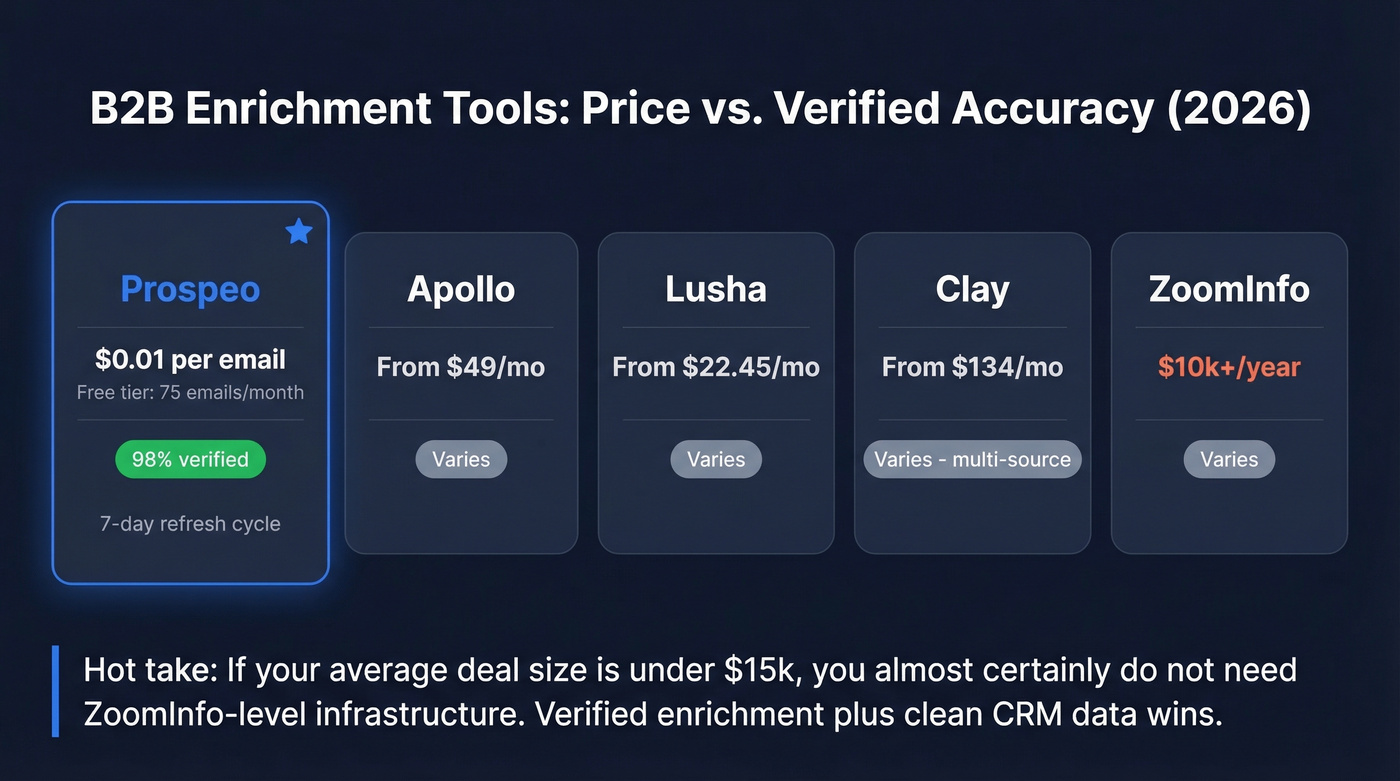
Here's our hot take: if your average deal size is under $15k, you almost certainly don't need ZoomInfo-level infrastructure. A verified enrichment tool paired with strong first-party data will outperform a $10k/year platform that gives you bigger segments with worse accuracy. We've seen lean teams running Prospeo alongside a clean CRM outperform enterprise stacks costing 20x more, because they're reaching real people at real emails instead of spraying into modeled segments. (If you're building the outbound motion around that data, start with sales prospecting techniques and a tight ideal customer profile.)
Data decay hits 2-3% per month, yet most providers refresh quarterly. Prospeo refreshes every 7 days with proprietary email infrastructure - no third-party email providers in the chain. 92% API match rate, 50+ data points per record, at $0.01/email.
Replace decaying data with records verified this week.
FAQ
Is third-party data going away?
No. Chrome kept cookies, and the market remains worth tens of billions annually. But signal loss from consent tools, browser restrictions, and ad blockers continues to erode quality from passive collection methods - expect accuracy to keep declining without active verification.
What's the difference between third-party data and third-party cookies?
Cookies are a browser-based tracking mechanism; third party data is the information itself, sourced from cookies, surveys, public records, or enrichment databases. Eliminating cookies changes how data gets collected, not whether the data category exists.
How accurate is third-party data in 2026?
Truthset benchmarks show 32%-69% accuracy across providers, with up to 51% of ad targeting data inaccurate. Verified B2B enrichment tools with record-level validation significantly outperform modeled audience segments - the gap is 30+ percentage points.
What are data clean rooms?
Data clean rooms are secure environments where multiple parties analyze overlapping datasets without exposing raw records. They're now standard infrastructure at enterprise scale, with native capabilities embedded in AWS, Snowflake, and Google Cloud.
How do I get accurate B2B contact data from external sources?
Use providers that verify records individually and refresh frequently. Look for documented accuracy rates above 95%, refresh cycles measured in days not months, and transparent validation methods. Skip providers that won't disclose how segments are constructed.