

Time to Revenue: The B2B Metric Nobody Measures Correctly
Your CFO just asked how long it takes to turn a lead into a dollar of revenue. You pulled up your CRM, looked at average sales cycle length, and said "about 84 days." You're wrong - and not by a little. Time to revenue in B2B runs 200+ days when you measure from actual first touch. The gap between what you reported and reality is where pipeline leaks, bloated CAC, and missed forecasts live.
That gap matters because equity-backed SaaS companies already spend 107% of ARR on operations. Every invisible day in your pipeline is cash burning while revenue sits at zero.
The Short Version
Time to revenue (TTR) measures elapsed time from a prospect's first interaction with your company to closed-won revenue. Most teams only measure half of it - opportunity creation to close - and miss the entire demand-gen runway that precedes it.
The median B2B SaaS sales cycle sits at 84 days across 939 companies, but true TTR is longer because it includes everything before the opportunity existed. Three levers move the needle fastest: verified contact data to compress time-to-first-meeting, multithreading 3+ stakeholders per deal, and sending proposals within 24 hours of qualification.
What Is Time to Revenue?
TTR answers one question: how long from the moment someone at a target account first touches your brand - a website visit, an ad click, an cold email open - until that account generates closed-won revenue?
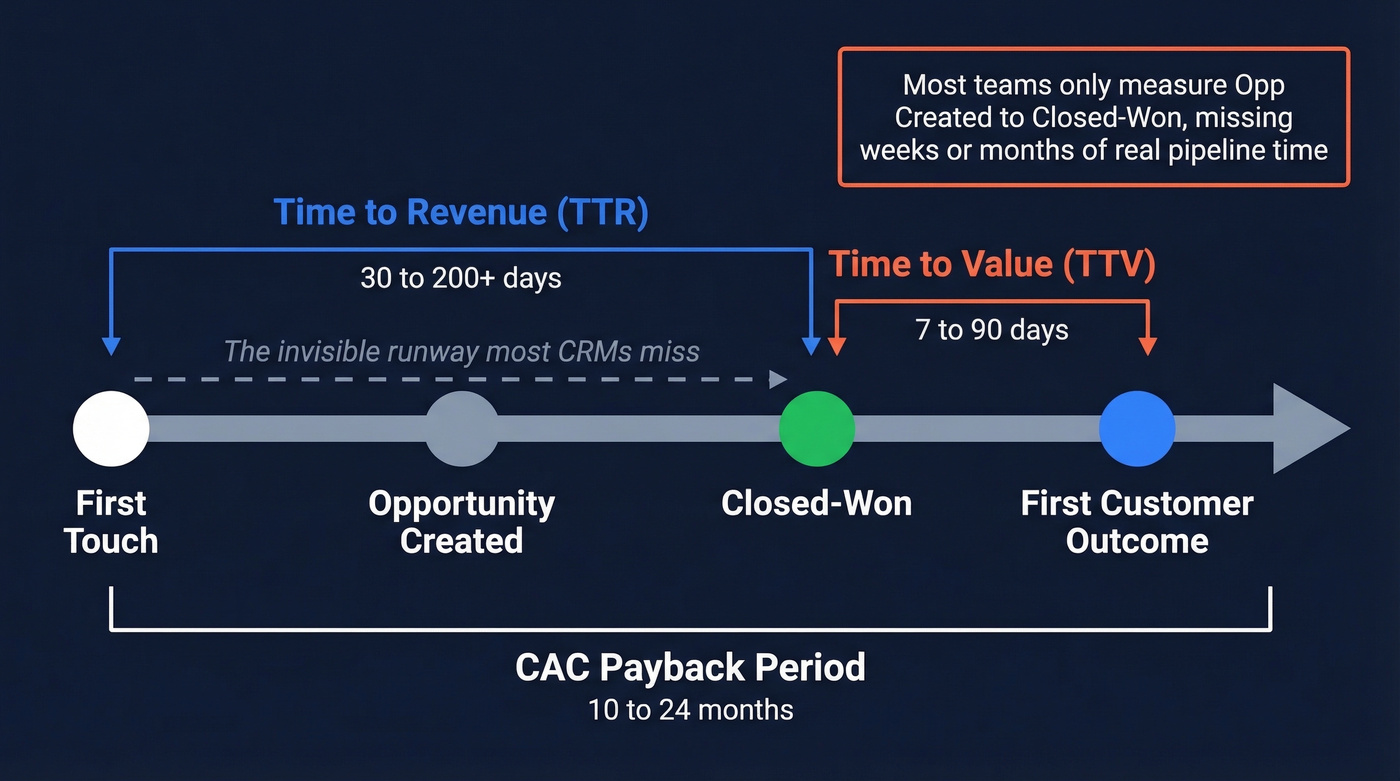
Sounds simple. It isn't. Most CRMs start the clock at opportunity creation, which ignores weeks or months of marketing touches, SDR outreach, and nurture sequences. That's like timing a road trip but only starting the clock when you hit the highway. The 45 minutes of surface streets still happened.
TTR also gets confused with adjacent metrics that measure different things entirely.
| Metric | What It Measures | Who Owns It | Typical Range |
|---|---|---|---|
| Time to Revenue | First touch → closed-won | RevOps | 30-200+ days |
| Time to Market | Idea → product launch | Product | 3-18 months |
| Time to Value | Contract → first outcome | CS/Onboarding | 7-90 days |
| CAC Payback | Months to recoup S&M cost | Finance/RevOps | 10-24 months |
The critical distinction: Time to Value starts after the deal closes. TTR ends when it closes. They're bookends, not synonyms.
One nuance worth flagging - finance "revenue recognized" can lag closed-won because payment terms and recognition rules shift when revenue hits the P&L. For RevOps purposes, closed-won is the clean operational endpoint.
How to Calculate TTR
The simplest version is a straight average.
TTR = Sum of Individual Deal TTRs ÷ Number of Deals
Worked example with three deals:
- Deal A: first touch Jan 1, closed Mar 15 → 74 days
- Deal B: first touch Feb 10, closed Apr 2 → 51 days
- Deal C: first touch Jan 20, closed Jun 8 → 140 days
Average TTR = (74 + 51 + 140) ÷ 3 = 88 days
That's your baseline. But averages hide distribution. If Deal C is an enterprise account and Deals A and B are SMB, you need segment-level TTR to make decisions. Always calculate by ACV band, not just in aggregate.
The operational cousin of TTR is pipeline velocity, which tells you revenue throughput rate rather than time per deal:
Pipeline Velocity = (Opportunities × Win Rate × Avg Deal Size) ÷ Sales Cycle Length
TTR tells you how long each deal takes. Pipeline velocity tells you how much revenue your pipeline produces per period. You need both - TTR for diagnosing bottlenecks, velocity for forecasting.
2026 Benchmarks by Segment
By ACV
| ACV Segment | Typical TTR | Notes |
|---|---|---|
| SMB (<$15K) | 14-30 days | Single buyer, fast procurement |
| Mid-Market ($15K-$100K) | 30-90 days | 3-5 stakeholders typical |
| Enterprise (>$100K) | 90-180+ days | Legal, procurement, and security reviews consume 35-40% of the cycle |
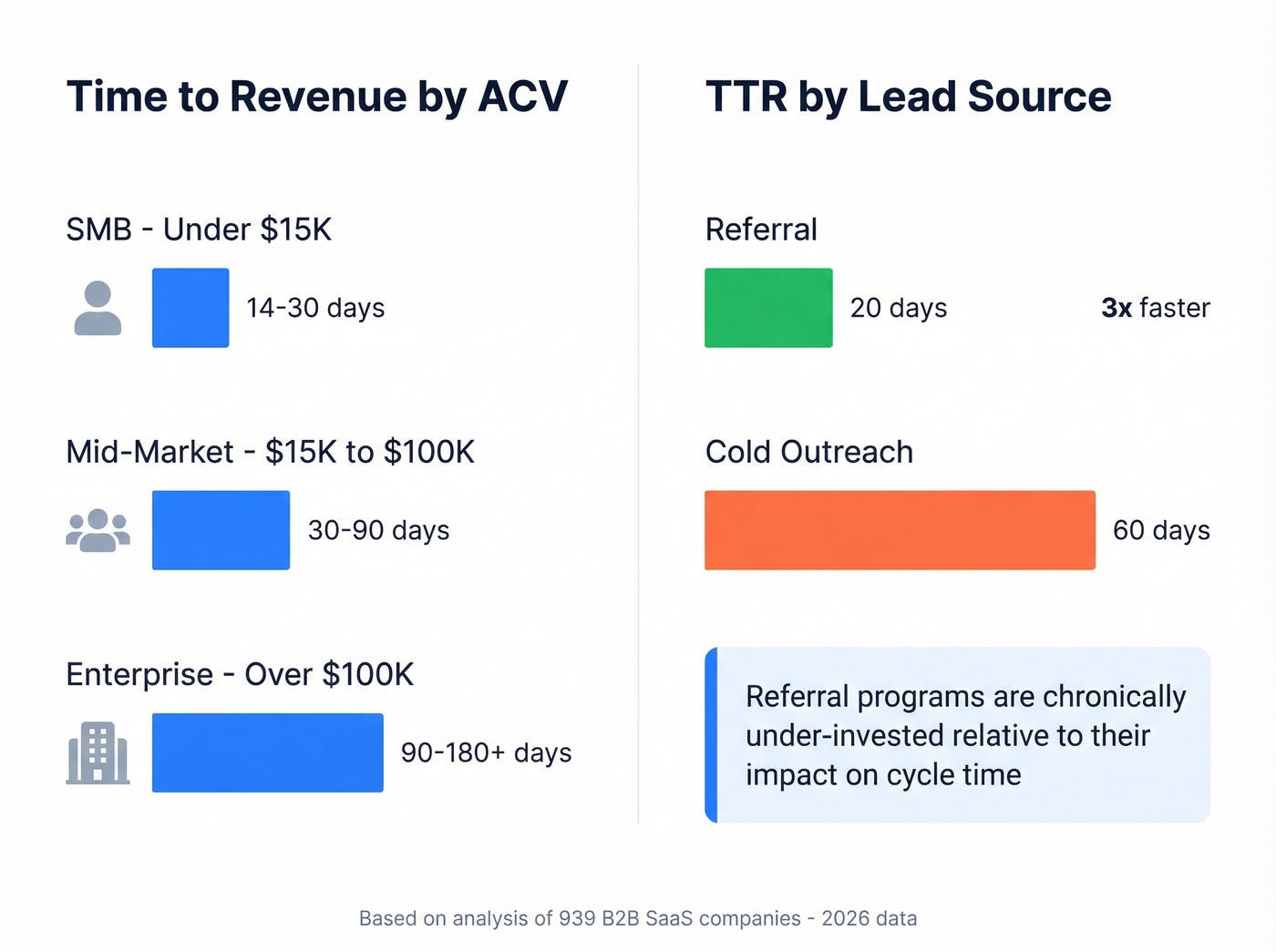
These come from Optifai's analysis of 939 companies with stage-level CRM data. The median across all segments lands at 84 days, but that number is nearly useless without segmentation - a 14-day SMB deal and a 180-day enterprise deal average out to a number that describes neither reality.
By Industry
| Industry | Avg Cycle (Days) |
|---|---|
| Software | 90 |
| Financial Services | 98 |
| Healthcare | 125 |
| Manufacturing | 130 |
| Pharmaceuticals | 138 |
Healthcare and pharma cycles are brutal because regulatory review and compliance sign-offs stack on top of normal procurement. If you're selling into these verticals, build an extra month of non-sales delays into your TTR model.
By Company Size and Channel
| Segment | Avg Cycle (Days) |
|---|---|
| 1-10 employees | 38 |
| 10,001+ employees | 185 |
| Referral-sourced | 20 |
| Cold outreach-sourced | 60 |
That referral vs. cold outreach gap is striking. Twenty days vs. sixty days - 3x faster. Referrals compress the revenue timeline because trust is pre-built, eliminating weeks of credibility-building touches. The consensus on r/sales is that referral programs are chronically under-invested relative to their impact on cycle time, and the data backs that up. If you're not tracking TTR by source channel, you're missing the single biggest variable in your pipeline.

Every day your reps spend hunting for valid contact data is a day added to your time to revenue. Prospeo's 300M+ verified profiles with 98% email accuracy and 125M+ direct dials eliminate the research phase entirely - so your first meeting happens days sooner, not weeks.
Cut the dead time between first touch and first meeting.
Why TTR Keeps Getting Longer
Your sales cycle is closer to 6.5 months, and the trend line isn't reversing. Sales cycles have stretched 22% since 2022 and 38% since 2021. Here's what's driving it.
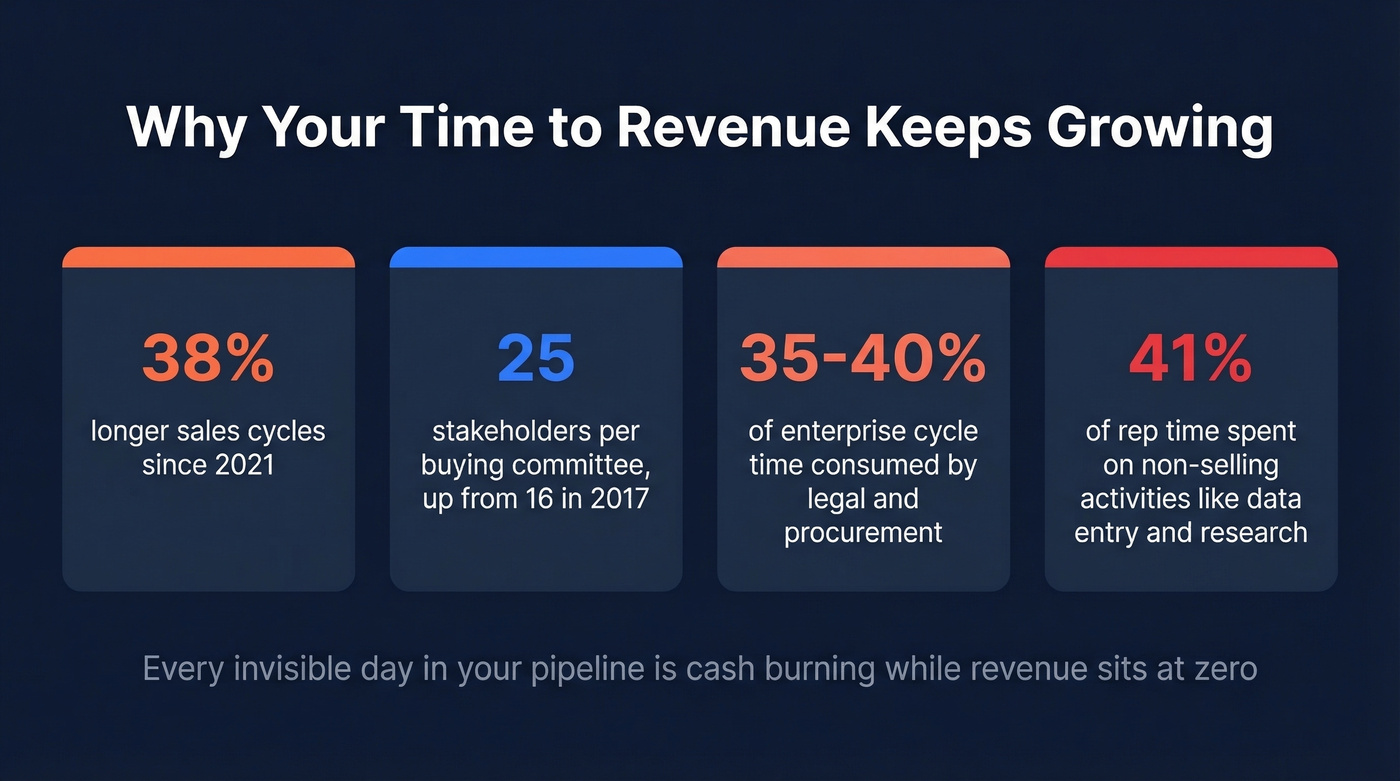
Buying committees keep expanding. They've ballooned from 16 stakeholders in 2017 to 25 today. Twenty-five stakeholders means 25 calendars to align, 25 sets of objections to address, and 25 people who can say no but only one configuration of yeses that closes the deal. We've seen enterprise deals stall for weeks because a single security reviewer was on PTO.
Negotiation and legal eat a disproportionate share of the cycle - 35-40% of total cycle time in enterprise deals. Redlines, procurement reviews, and security questionnaires aren't selling activities. They're administrative drag.
Meanwhile, 80% of the buying journey happens before a prospect ever talks to sales. By the time your SDR gets a meeting, the buyer has already formed opinions from your content, competitors' content, and peer conversations. That pre-pipeline runway is invisible in most CRMs but very real in your TTR.
And reps spend roughly 41% of their time on non-selling activities - data entry, contact research, CRM hygiene, internal meetings. Every hour spent hunting for a correct email address is an hour not spent advancing a deal.
TTR vs. CAC Payback Period
These two metrics get conflated constantly, but they measure fundamentally different things.
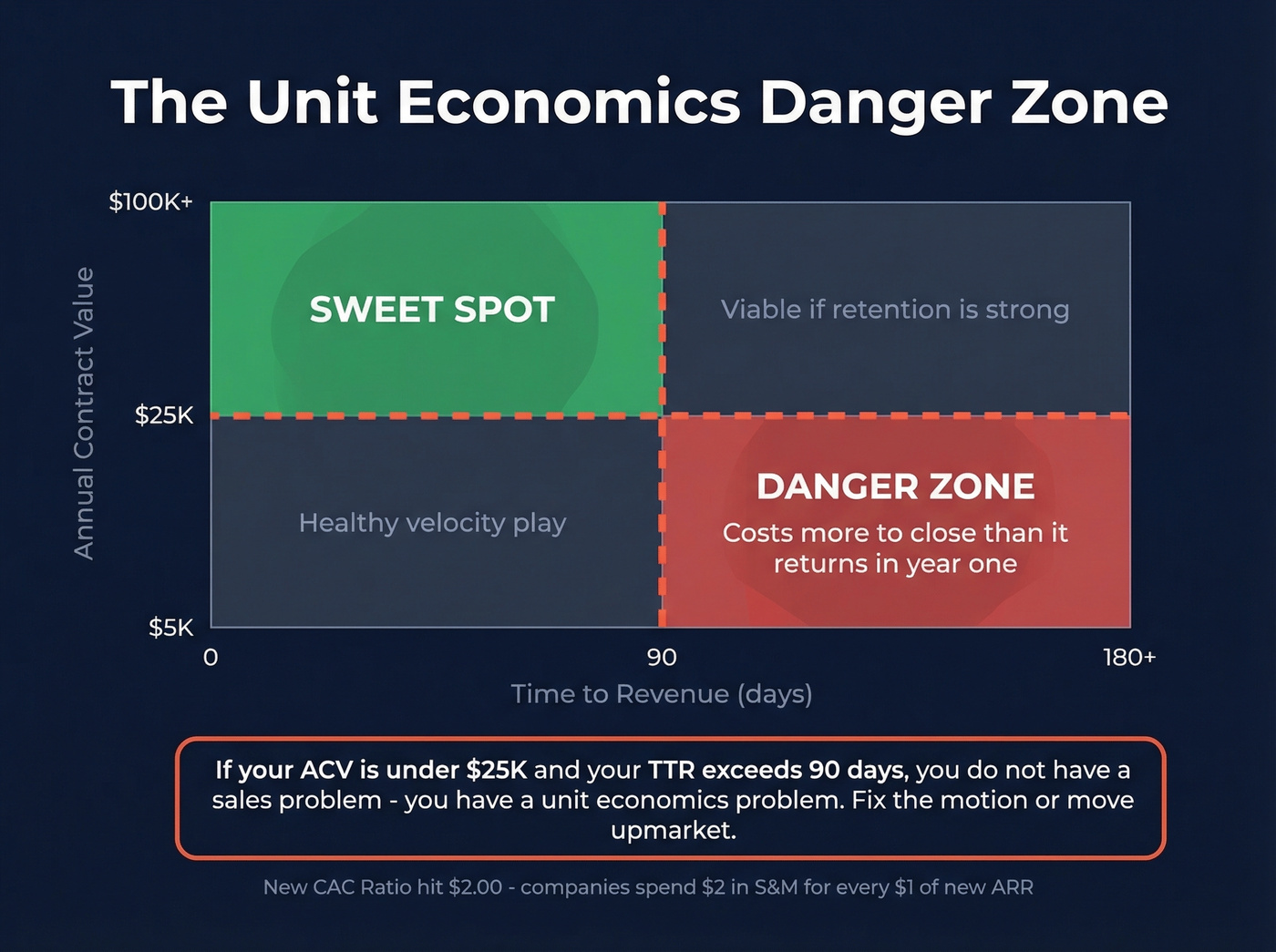
TTR measures time - how many days from first touch to first revenue. CAC Payback measures financial recovery - how many months until you've recouped the sales and marketing cost of acquiring that customer.
Here's where it gets interesting. Say your CAC is $5,000 and the customer pays $500/month. Nominal payback is 10 months. But factor in 3% monthly churn and it's closer to 12 months, because some of those customers won't stick around long enough to pay back their acquisition cost.
The macro picture makes this worse. The New CAC Ratio reached $2.00 based on recent data - meaning companies spend $2 in sales and marketing for every $1 of new customer ARR. That's up from $1.76 the year prior. Net revenue retention declined from 105% to 101%, and expansion ARR now accounts for 40% of total new ARR.
Here's the thing: when acquisition costs rise and retention softens, improving speed to revenue becomes existential, not optional.
If your ACV is under $25K and your TTR exceeds 90 days, you don't have a sales problem - you have a unit economics problem. No amount of pipeline optimization fixes a deal that costs more to close than it returns in year one. Fix the motion or move upmarket.
How to Shorten Time to Revenue
1. Fix Your Prospecting Data
Bad data is the silent TTR killer. Bounced emails mean no first meeting. Wrong phone numbers mean wasted dials. Stale job titles mean pitching someone who left six months ago.
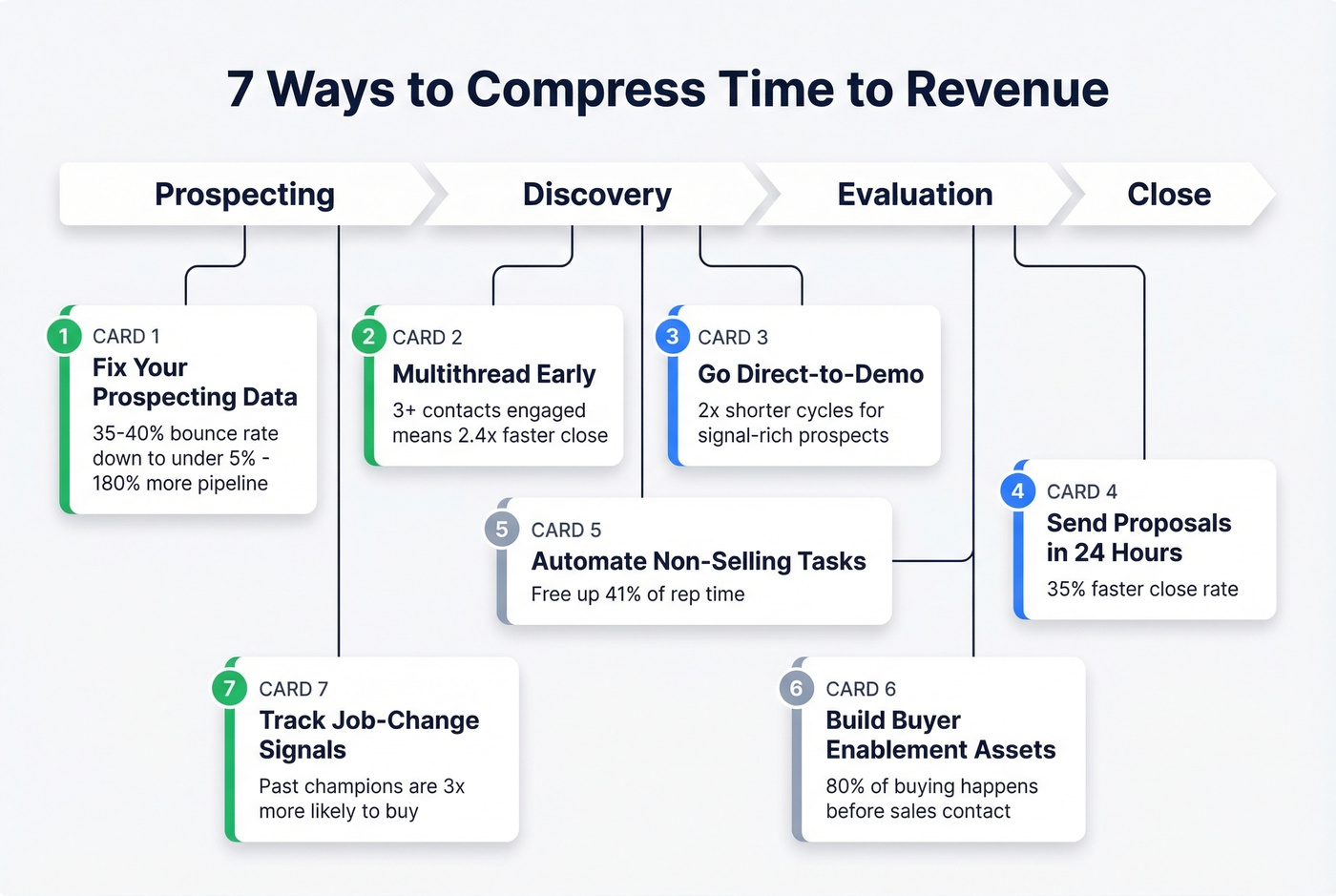
The impact of fixing this is dramatic. Snyk's 50-person AE team saw bounce rates drop from 35-40% to under 5% after switching to verified data - AE-sourced pipeline jumped 180%, generating 200+ new opportunities per month. GreyScout cut rep ramp time from 8-10 weeks to 4 weeks by giving new hires clean, verified contact lists from day one.
In our experience, data quality is the single highest-leverage TTR fix because everything downstream moves faster when the first meeting happens on schedule. Prospeo's 98% email accuracy on a 7-day refresh cycle means reps aren't burning days chasing dead addresses, and the Chrome extension pulls verified emails and direct dials from any professional profile in one click - eliminating the research step entirely. (If you want to compare options, start with data enrichment and email verification.)
2. Multithread Early
Deals with 3+ contacts engaged close 2.4x faster than single-threaded deals. Map the buying committee in week one, not week eight. Get your champion, the economic buyer, and at least one technical evaluator into conversations simultaneously.
Also track job-change signals. Past champions who move to new companies are 3x more likely to buy, and they already trust you. That's free pipeline acceleration most teams ignore.
3. Go Direct-to-Demo
Skip this if your product requires heavy discovery to scope correctly. Use this when qualified accounts show clear buying signals and have already consumed your content.
UserGems reports that fast-tracking these prospects directly to a demo produces 2x shorter sales cycles. The 30-minute "tell me about your challenges" call kills momentum for buyers who already know what they want.
4. Send Proposals Within 24 Hours
Deals where proposals go out within 24 hours of qualification close 35% faster. Every day between "yes, send me a proposal" and the actual proposal is a day for competitors to insert themselves, for priorities to shift, and for urgency to fade. Template your proposals so customization takes an hour, not a week.
5. Automate Non-Selling Tasks
If 41% of your reps' time goes to admin, you're paying senior salespeople to do data entry. Automate CRM logging, meeting scheduling, and follow-up sequences. Every hour freed goes toward pipeline-generating activities that actually compress TTR. (A good starting point is sales funnel automation tools.)
6. Build Buyer Enablement Assets
Since 80% of the buying journey happens before sales engagement, arm your champions with the materials they need to sell internally. One-pagers for the CFO. Security whitepapers for IT. ROI calculators for the business owner. The deals that close fastest are the ones where your champion can answer their colleagues' objections without scheduling another call with your AE. (This is a core part of marketing enablement.)
7. Invest in Post-Sale Velocity
Expansion revenue now accounts for 40% of total new ARR. Customers who don't see results in the first 90 days are 3x more likely to churn. Onboarding speed isn't a CS problem - it's a revenue problem.
How to Track TTR Effectively
Pipeline velocity is your operational dashboard metric: (Opportunities x Win Rate x Avg Deal Size) / Sales Cycle Length. Track it weekly in your RevOps standup - we review ours every Monday alongside stage-conversion rates to catch stalls before they compound.
Pair TTR with these KPIs for a complete picture: pipeline coverage at 3x-4x target, speed-to-lead under 5 minutes for inbound requests, win rate benchmarked against the 15-25% industry average, and lead-to-customer conversion in the 2-5% range for most B2B companies.
The hard part: most CRMs only track from opportunity creation. True TTR requires first-touch attribution. Tools like Bizible or 6sense handle multi-touch attribution, and Segment can stitch identity across anonymous and known touchpoints. I'd argue anonymous first touch is the only honest measurement - anything else flatters your numbers.
RevOps should own this metric. Not marketing, not sales, not product. It spans the entire funnel and needs cross-functional visibility to measure correctly.
TTR Audit Checklist
Run through these five questions to diagnose your TTR health:
- Does your CRM capture first-touch dates, or only opportunity creation dates?
- Can you segment TTR by ACV band, source channel, and industry?
- Do you know which pipeline stage has the longest average dwell time?
- Are your reps spending more than 30% of their time on non-selling activities?
- Is your proposal turnaround time under 24 hours for qualified deals?
If you answered "no" to three or more, your TTR is longer than you think - and you're flying blind on where to fix it.
When TTR Is the Wrong Metric
Jeff Gothelf makes a compelling argument that in complex B2B environments with 2-5 teams touching production, product teams can't meaningfully own TTR. He's right - and the problem goes deeper than ownership.
TTR's definition is genuinely ambiguous. Does it mean launch to first dollar? Launch to first sale? Launch to break-even? Payment terms complicate everything - if your enterprise customer pays net-90, "revenue realized" can happen months after the deal closes.
Look, Gothelf is right that product shouldn't own TTR. But the answer isn't to abandon the metric - it's to assign the right home. RevOps sits at the intersection of marketing, sales, and customer success. They have the data access, the cross-functional visibility, and the operational mandate to measure TTR correctly. The metric is still the right one. It just needs the right owner.
Multithreading 3+ stakeholders per deal is proven to compress TTR - but only if you can actually reach them. Prospeo finds verified emails and mobile numbers for every member of a buying committee, with 30+ filters to pinpoint decision-makers by role, seniority, and department.
Reach all 25 stakeholders before your competitor reaches one.
FAQ
What's a good time to revenue for B2B SaaS?
SMB deals under $15K typically close in 14-30 days, mid-market ($15K-$100K) runs 30-90 days, and enterprise above $100K takes 90-180+ days. The median across 939 companies is 84 days, but always benchmark against your specific ACV band rather than the aggregate number.
How is TTR different from sales cycle length?
Sales cycle length starts at opportunity creation in your CRM. TTR starts at first touch - the website visit, ad click, or cold email that initiated the relationship. TTR is always longer because it includes the entire demand-gen and nurture runway preceding pipeline creation.
What's the fastest way to reduce time to revenue?
Fix your prospecting data first. Teams switching to verified contact sources consistently cut bounce rates below 5% and generate 140-180% more pipeline - compressing the front end of TTR where most invisible time accumulates.
Who should own the TTR metric?
RevOps. TTR spans the entire funnel from first anonymous touch through closed-won revenue and requires cross-functional data access. Product teams can't control sales cycles, and sales teams can't control demand-gen timelines - only RevOps has the visibility to measure and improve it.
What's the pipeline velocity formula?
Pipeline Velocity = (Number of Opportunities x Win Rate x Average Deal Size) / Sales Cycle Length. It measures revenue throughput per period - how much your pipeline generates per day or week - rather than how long any individual deal takes to close.