

Tire Kickers: What They Cost You & How to Stop Them
It's Thursday afternoon. You've run six discovery calls since lunch. Four went absolutely nowhere - one prospect couldn't name their budget, another wanted "just a quick overview" for the third time, and two ghosted on the follow-up before you finished typing the recap email. That's not a bad day. That's a pattern. Reps lose an estimated 780 hours per year chasing tire kickers who were never going to buy - about 20 full work weeks burned on prospects with zero purchase intent.
Here's the short version of what we've learned works:
- One direct commitment question filters more time-wasters than any CRM workflow. A contractor doubled his close rate with a single sentence.
- Use BANT for fast deals, MEDDIC for complex ones. Gut feel isn't a qualification strategy.
- Build a lead scoring model so your CRM catches unqualified prospects before they ever reach a rep.
What Is a Tire Kicker?
The term comes from car dealerships. Shoppers would walk the lot, kick a few tires, maybe sit in the driver's seat - and leave without ever talking price. The meaning has since migrated into sales, real estate, freelancing, and marketplace selling to describe anyone who consumes your time with zero intention or ability to buy.
There's a usage wrinkle worth knowing. "Kick the tires" can mean either careful due diligence or superficial browsing, depending on context. But "tire kicker" almost always means the latter - someone going through the motions with no real commitment behind them. In modern B2B sales, it's the prospect who books three demos, asks for a custom proposal, loops in two colleagues, and then vanishes.
What They Actually Cost Your Pipeline
Let's put real numbers on this.
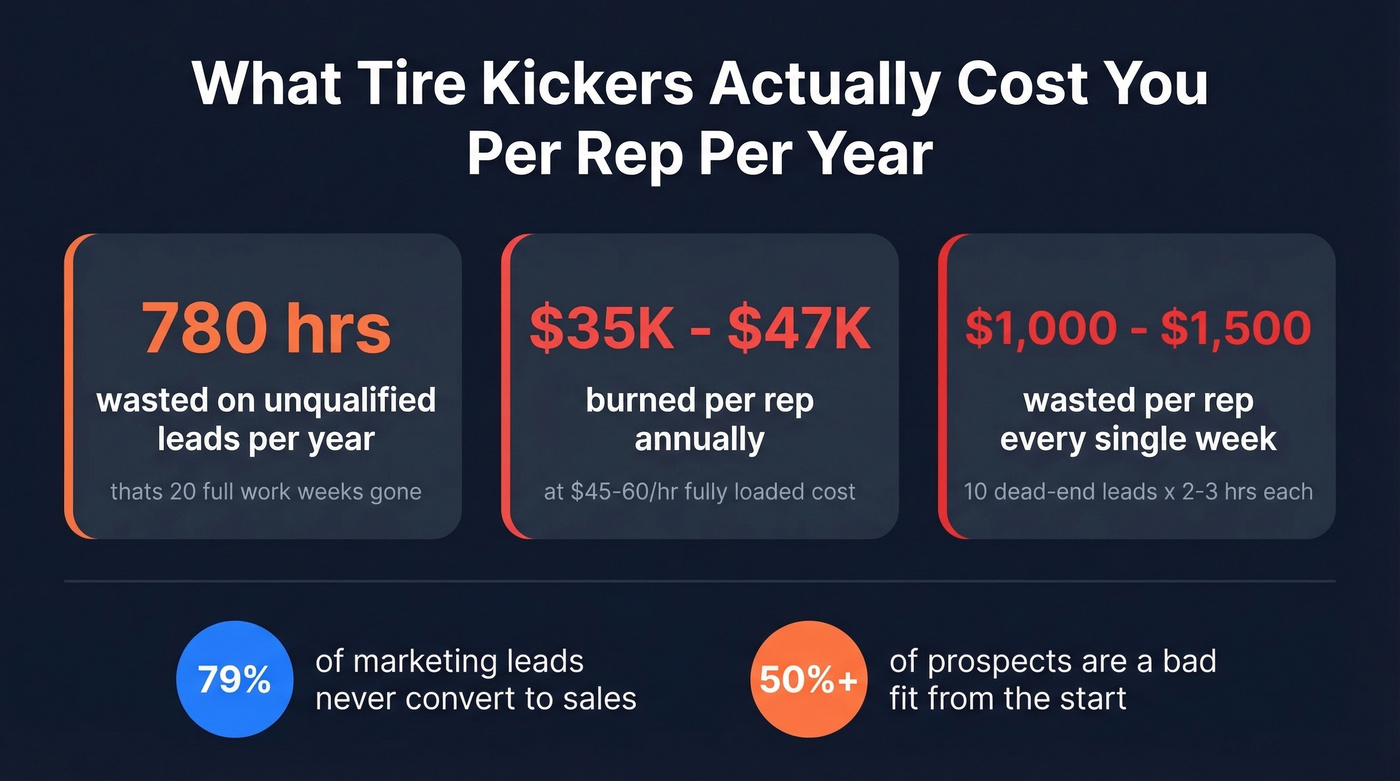
A typical rep wastes roughly 15 hours per week on unqualified leads. That's 780 hours per year - per rep. If you're paying a mid-market SDR $75,000 base, that's about $36/hour on a 2,080-hour year. Once you add benefits, tooling, management, and overhead, fully loaded cost often lands around $45-60/hour. Multiply that by 780 wasted hours and you're looking at $35,100-46,800 per rep per year spent on people who were never going to sign.
It gets worse upstream. 79% of marketing leads never convert into sales, most due to poor qualification or nonexistent nurturing. Marc Wayshak's research is blunt: more than 50% of your prospects are a bad fit from the start and will never be qualified to buy.
Each unqualified lead eats 2-3 hours before you realize it's going nowhere - research, outreach, discovery call, follow-up emails, internal notes. At $50/hour, that's $100-150 per dead-end prospect. If a rep handles 20 new leads per week and half are junk, that's 10 unqualified leads burning 20-30 hours weekly. $1,000-1,500 per week, per rep, on dead-end conversations.
The pipeline damage isn't just financial. Unqualified prospects throw off forecasting, inflate activity metrics, and - worst of all - crowd out the real buyers who actually needed that Thursday afternoon call slot.
Types You'll Encounter
Not all time-wasters look the same. Here are the archetypes we see most often, drawn from patterns across Zendesk, Close's anti-persona framework, and our own pipeline reviews:
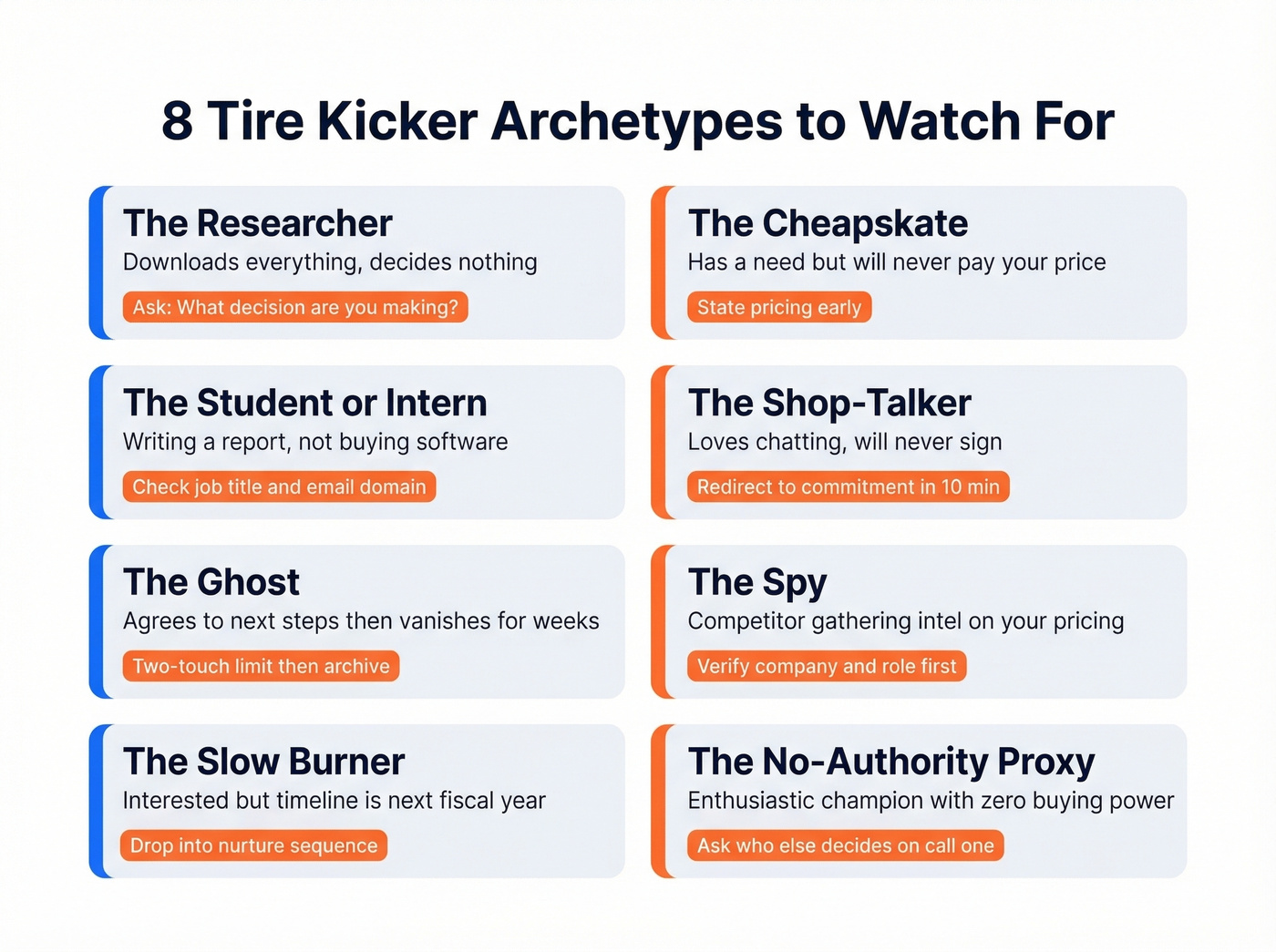
- The Researcher - Genuinely curious, downloads everything, attends every webinar. But they're gathering information, not evaluating vendors. Ask what decision they're trying to make. If there's no decision, there's no deal.
- The Cheapskate - Has a need, might even have authority, but will never pay your price. Every conversation circles back to discounts. State pricing early. Let them self-select out.
- The Student/Intern - Writing a report, completing coursework, or benchmarking for a boss who hasn't approved anything. Add a job title field to your intake form. A .edu email domain is a dead giveaway.
- The Shop-Talker - Loves talking about the industry, your product, their challenges. Could chat for an hour. Will never sign. Redirect to a commitment question within the first 10 minutes.
- The Ghost - You know this person. They agree enthusiastically to next steps, vanish for three weeks, then reappear asking the same questions as if your last call never happened. We've all had the one who confirmed a Tuesday demo at 2 PM, went silent, and resurfaced in August with "Hey, still interested - can you resend that deck?" Set a two-touch follow-up limit. If they ghost twice, archive the lead and move on.
- The Spy - A competitor or their consultant gathering intel on your pricing, positioning, or feature roadmap. Verify their company and role before sharing anything proprietary.
- The Slow Burner - Actually interested, but their timeline is "maybe next fiscal year." They're real, just not ready. Drop into a nurture sequence. Don't waste live rep time.
- The No-Authority Proxy - Enthusiastic champion with zero purchasing power. They'll advocate internally but can't sign anything. Ask "Who else needs to be involved in this decision?" on the first call. If they can't answer, you're talking to the wrong person.
Tire Kicker vs. Genuine Prospect
Print this. Tape it next to your monitor.
| Signal | Tire Kicker | Real Prospect |
|---|---|---|
| ICP fit | Differs from persona | Matches target profile |
| Pain clarity | Vague or absent | Specific, articulated |
| Budget awareness | "We'll figure it out" | Knows range or process |
| Timeline | "Maybe this year" | Defined window |
| Decision-maker access | Gatekeeps or deflects | Names the buyer |
| Research depth | Surface-level browsing | Evaluated competitors |
| Follow-through | Ghosts or stalls | Shows up, responds |
When a "Time-Waster" Is Actually a Modern Buyer
Here's the thing - not every slow-moving prospect is wasting your time. 96% of prospects research before engaging sales, and 71% actively prefer independent research over talking to a rep. Gartner's data shows B2B buyers spend just 17% of their time meeting with suppliers and 45% researching independently. Meanwhile, 81% of revenue leaders say deals are more complex than ever, with complex B2B purchases now involving 6-10 decision-makers across varied roles, teams, and locations.
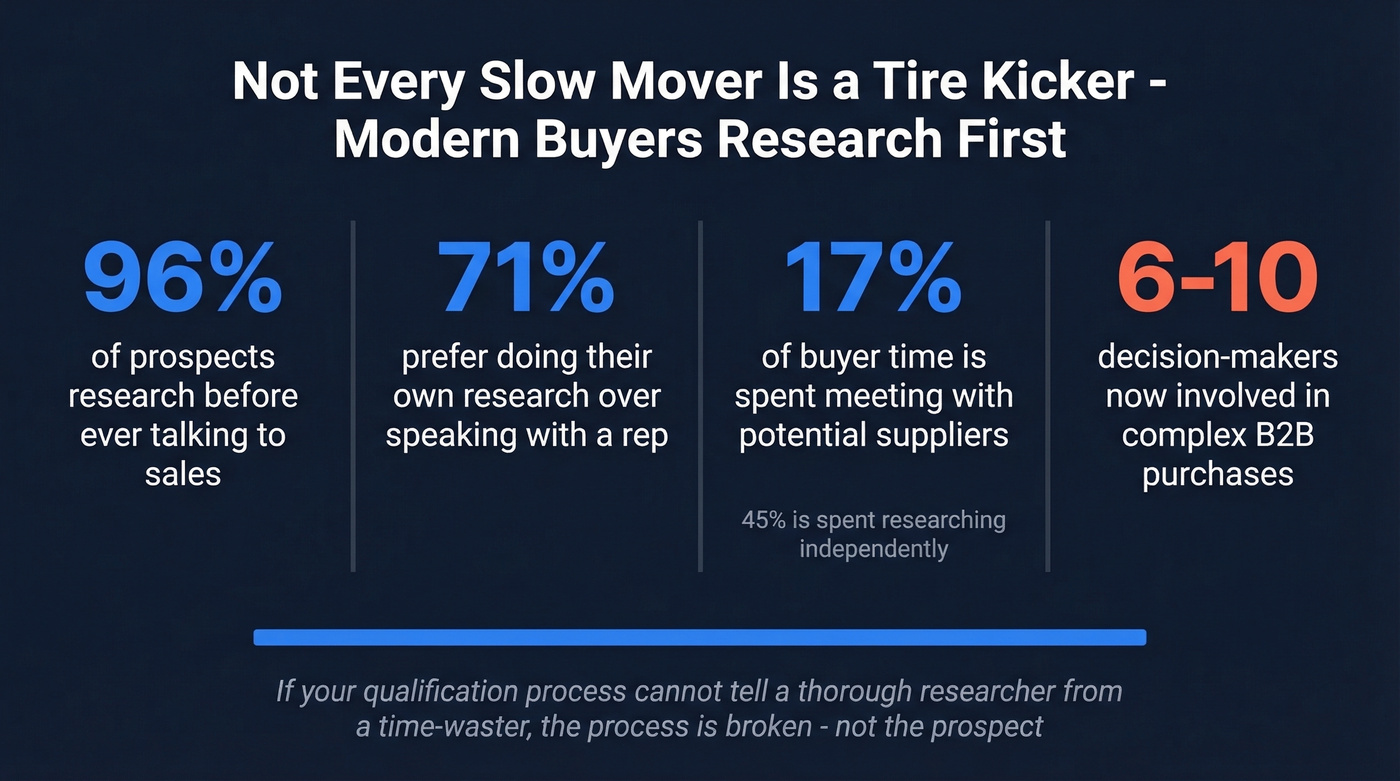
So a prospect who downloads five whitepapers, attends a webinar, and doesn't respond to your first outreach might be doing exactly what modern buyers do. If your qualification process can't distinguish a thorough researcher from a time-waster, the process is broken - not the prospect. The frameworks below help you tell them apart.
Hot take: If your average deal size is under $10K, you probably can't afford to treat every lead like a potential whale. Qualify faster, disqualify harder, and spend your energy on the deals that actually move.

780 hours per rep per year on tire kickers means your team is prospecting blind. Prospeo's intent data tracks 15,000 topics so you know who's actively in-market before you ever book a call. Layer buyer intent with job title, budget signals, and headcount growth across 300M+ profiles to fill your pipeline with qualified buyers - not researchers, ghosts, or no-authority proxies.
Stop qualifying leads your data should have filtered out.
How to Spot Them Early
The fastest filter is a single question: "How will you make a decision on this?"
If they can't answer it - or won't - you've got your signal. Beyond that, watch for behavioral red flags by channel.
On discovery calls, the warning signs stack up fast. Prospects who can't articulate the problem they're solving, stay vague on budget, have no timeline, or deflect when you ask about other stakeholders are waving red flags. The clearest tell: they ask excessive questions but won't commit to a next step, or they request a proposal before you've even completed discovery. (If you need a tighter structure, use a set of discovery questions your whole team follows.)
Inbound leads reveal themselves through patterns. Serial downloaders who never respond to outreach, form fills with generic titles or personal email addresses - these are noise. One practical tactic from Close: add a Job Title field to your intake form. It's a lightweight filter that screens out students, hobbyists, and non-decision-makers before they ever reach a rep.
Outbound prospects who agree to calls then cancel or no-show repeatedly, or who engage on email but dodge calendar invites, are telling you everything you need to know. Believe them.
How to Handle Tire Kickers
The One-Question Filter
This is the single highest-ROI tactic we've seen. A contractor on r/epoxy shared a script that took his close rate from 40% to 78%. After giving a ballpark price on the phone, he asks one question:
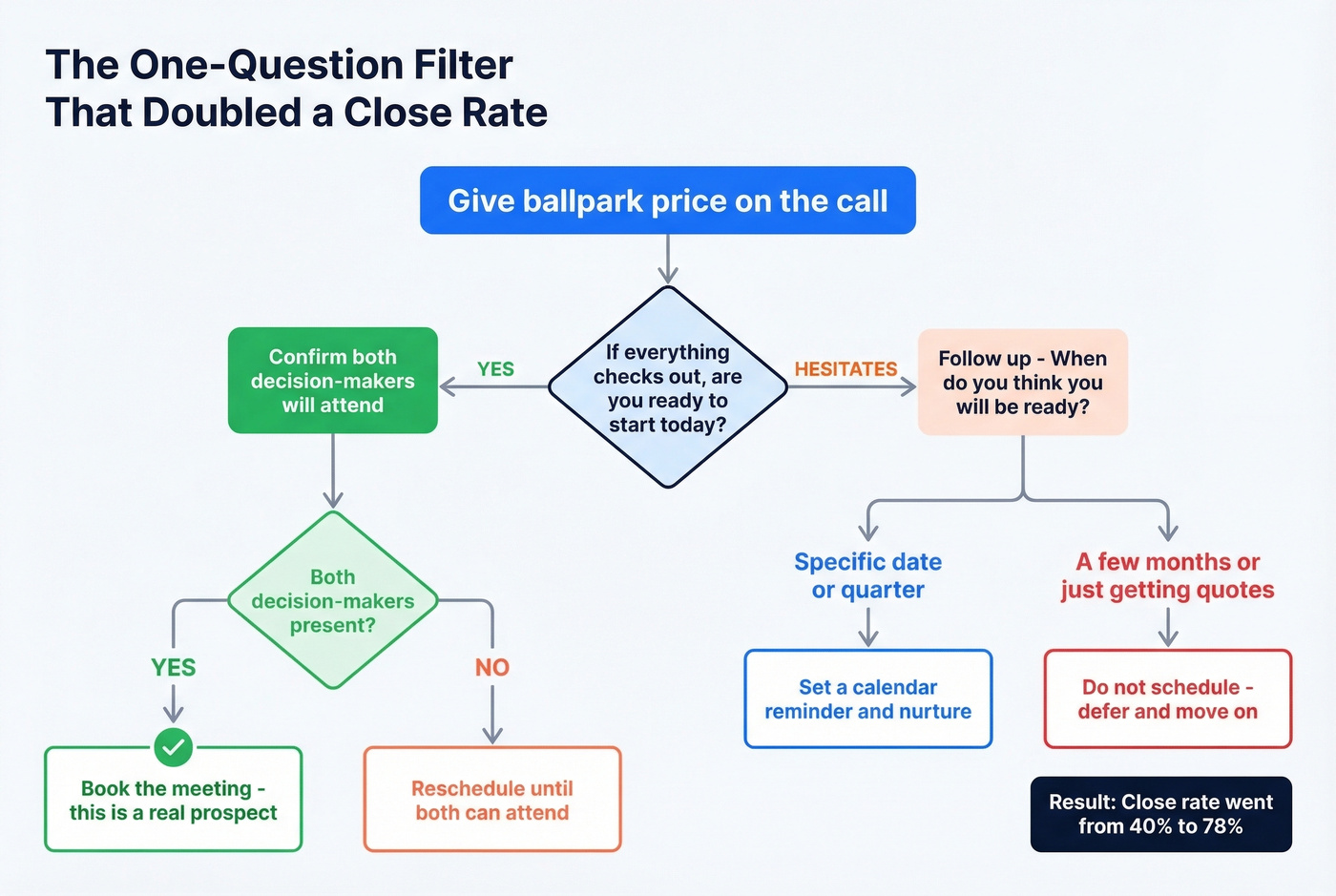
"If everything I say is the same when I come out, ARE YOU READY TO START TODAY?"
If they hesitate, the follow-up is simple: "When do you think you'll be ready?" If the answer is "a few months" or "just getting quotes," he doesn't schedule the on-site estimate. He defers and moves on.
His second rule: require both decision-makers present at the appointment. No "I'll have to run it by my spouse/partner/boss." That alone added 10-15% to his close rate. The principle translates directly to B2B - never run a demo for someone who can't involve the economic buyer. (More on that in our guide to the MEDDPICC economic buyer.)
B2B Disengagement Scripts
When the signals are clear mid-call, exit gracefully: "Based on what you've shared, it sounds like [product] might not be the right fit right now. Can I point you toward [resource] instead?"
This protects your time and theirs. It also leaves the door open - some unqualified prospects become real buyers six months later when their situation changes. The key is speed. The longer you stay in a dead conversation hoping it'll turn, the more real pipeline you're neglecting.
Qualification Frameworks That Work
Most reps identify unqualified prospects by instinct. That's why they waste 780 hours a year. Pick a framework.
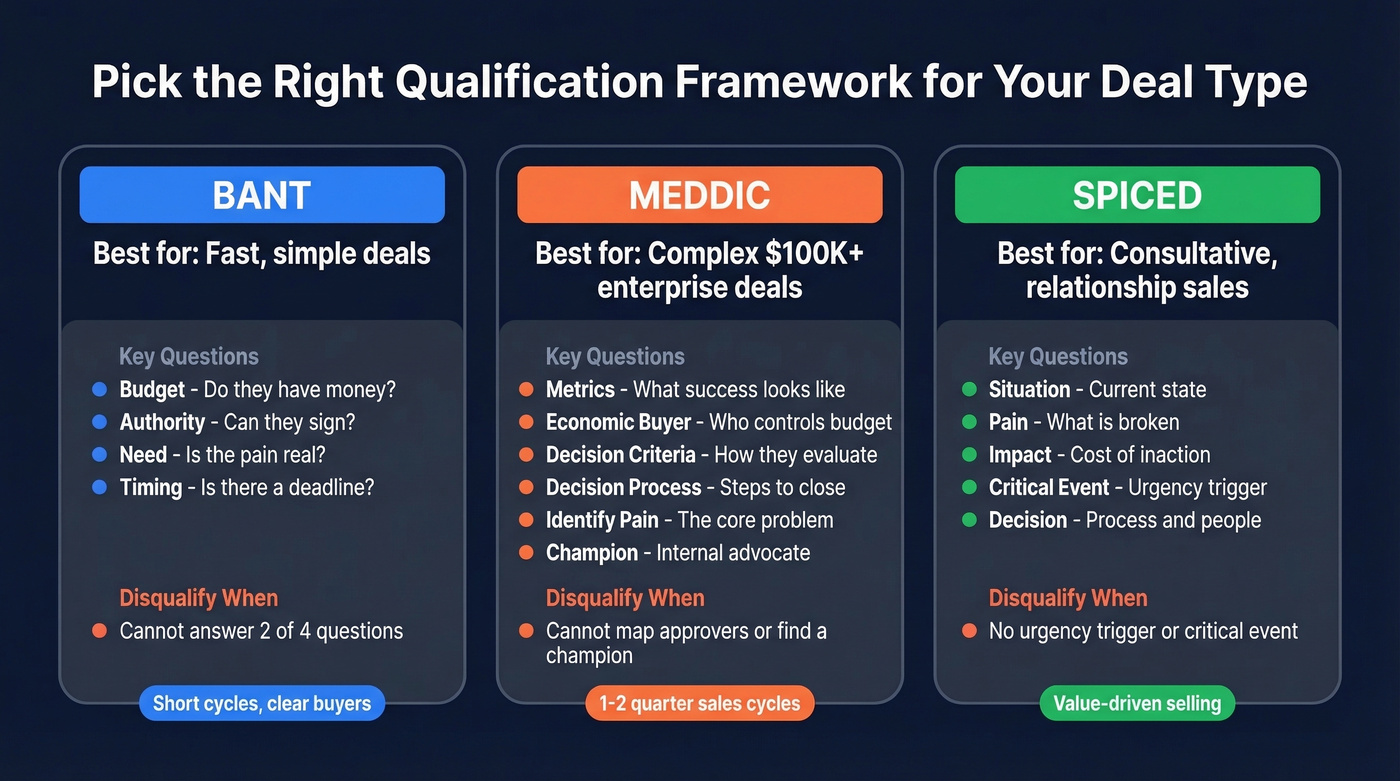
| Framework | Best For | Key Questions | Warning Signs |
|---|---|---|---|
| BANT | Fast, simple deals | Budget? Authority? Need? Timing? | No budget, "maybe this year" |
| MEDDIC | Complex, $100K+ deals | Economic buyer? Decision process? | Can't map approvers |
| SPICED | Consultative sales | Critical event? Impact of inaction? | No urgency trigger |
BANT is the fastest screen. It works for deals with short cycles and clear buyers. If a prospect can't answer two of the four, they're not qualified. Done.
MEDDIC is built for enterprise deals taking 1-2 quarters to close. It forces you to map the decision process - InfoSec to legal to finance to procurement - and identify an internal champion. No champion, no deal. We've watched teams adopt MEDDIC and immediately stop wasting cycles on "interested" prospects who had no internal sponsor to push the deal through procurement, no ability to articulate decision criteria, and no awareness of competing priorities eating their budget.
SPICED shines in consultative and transformation sales where the prospect might not even know they have a problem yet. The "Critical Event" question - What happens if you don't solve this by Q3? - separates real urgency from casual browsing.
In our experience, the hybrid approach works best: BANT screen at the top of funnel, then deepen with MEDDIC or SPICED for leads that pass. Teams often cut unqualified pipeline by around 40% just by adding this two-stage gate.
Lead Scoring: Automate the Filter
Your SDR just handed you a "hot lead" who downloaded three whitepapers. You call them. They're a marketing student writing a thesis. A scoring model with a -20 for .edu domains would've caught that before it reached your calendar.
Here's a ready-to-use scoring template:
Positive signals:
- Demo request: +50
- Pricing page visit: +30
- Case study download: +30
- Decision-maker title: +25
- Target industry: +20
- ICP company size: +15
- Feature page visit: +15
- Target geography: +10
- Multiple blog reads: +5/post
- Email click: +2/click
Negative signals:
- Student/academic domain: -20
- Non-target industry: -20
- Non-decision-maker title: -15
- Company size outside ICP: -15
- Inactivity >90 days: -10
- Personal email address: -10
Set your SQL threshold at 60 points. Anything below stays in marketing nurture. Businesses using lead scoring report a 77% boost in lead gen ROI, and companies that excel at lead nurturing generate 50% more sales-ready leads at 33% lower cost. The gains compound because reps stop wasting cycles on unqualified contacts.
Start rule-based for transparency. Layer AI scoring after you've accumulated enough historical data to train it. Set clear MQL and SQL thresholds, and review them quarterly as your ideal customer profile evolves.
But scoring is only as good as the data feeding it. If 35% of your emails bounce, your scoring model is grading ghosts. Before you label a prospect a tire kicker, check whether your outreach actually reached them. Prospeo verifies emails in real time with 98% accuracy and refreshes data every 7 days, so your lead scores reflect actual reachable prospects rather than stale records from six months ago. (If you’re seeing deliverability issues, start with your email bounce rate.)
Beyond B2B Sales
Real Estate
Real estate agents face some of the most persistent time-wasters because showings eat entire afternoons. The qualifying questions that work: Are you pre-approved by a lender? What's your timeline to buy? Are you working with another agent? What's motivating the move?
The boundary script that saves the most time: "I usually wait until clients are pre-approved before scheduling showings." Use an intake form or consultation call before committing to property tours. Nurture the "not yet" leads with automated market updates - don't burn Saturday mornings on them. (You can also standardize your outreach with real estate phone scripts for internet leads.)
Freelance and Consulting
The freelance tire kicker pattern is painfully consistent: they request an elaborate proposal, drag you through endless Q&A rounds, refuse to get on a call, and eventually ghost - having extracted hours of free consulting.
The fix is structural. Charge for discovery sessions. Never write a detailed proposal before a commitment call. If a prospect won't invest 30 minutes of their time, they won't invest their budget.
Marketplace Selling
The r/Flipping community learned this the hard way - every seller has a story about the buyer who confirmed three times and never showed. Marketplace tire kickers don't read the listing, demand delivery or discounts you've already ruled out, agree to a pickup time, and vanish. The consensus on r/FacebookMarketplace is blunt: never hold items, stay firm on listed prices, and block repeat offenders without hesitation.
Every hour you spend on an unqualified prospect is an hour stolen from a buyer who's ready to sign. Build the filters, trust the frameworks, and protect your pipeline. If you want more ways to tighten top-of-funnel, start with these sales prospecting techniques.
Half your pipeline is a bad fit from the start - and bad data makes it worse. Prospeo delivers 98% email accuracy and 30% mobile pickup rates so every rep hour goes toward real conversations with verified decision-makers. With 30+ search filters including funding, revenue, and department headcount, tire kickers never reach your calendar.
Replace gut-feel qualification with data that actually qualifies for you.
FAQ
What does tire kicker mean?
A tire kicker is someone who appears interested in buying but has no real intention or ability to purchase. The term originated in car dealerships where shoppers would kick tires on the lot without ever negotiating price. In sales today, it describes any prospect who consumes rep time without moving toward a decision.
How do you politely get rid of one?
Ask a direct commitment question early: "Are you ready to move forward this month?" If they hedge, offer a helpful resource and exit gracefully. Don't invest more time hoping they'll convert - redirect that energy toward qualified prospects who've passed your BANT or MEDDIC screen.
What's the difference between a tire kicker and a slow buyer?
Slow buyers have budget, authority, and a defined need - they just move cautiously through a complex process. Tire kickers lack one or more of those fundamentals. Run a quick BANT check: if they can't answer two of the four criteria, they're not a slow buyer. They're unqualified.
Can you convert a tire kicker into a customer?
Researchers and slow burners can convert with nurture sequences once their timing aligns - drop them into automated email cadences rather than burning live rep hours. Cheapskates, students, and no-authority proxies rarely will. Qualify early and cut losses fast.
How do you prevent them from entering your pipeline?
Add qualifying fields to intake forms like job title, budget range, and timeline. Implement lead scoring with negative signals for non-ICP traits. And verify contact data before investing rep time - if a third of your emails are bouncing, you're not dealing with uninterested buyers. You're dealing with bad data.