

The Best Tools for Forecasting in 2026: Sales, FP&A, Demand & the Data Layer That Makes Them Work
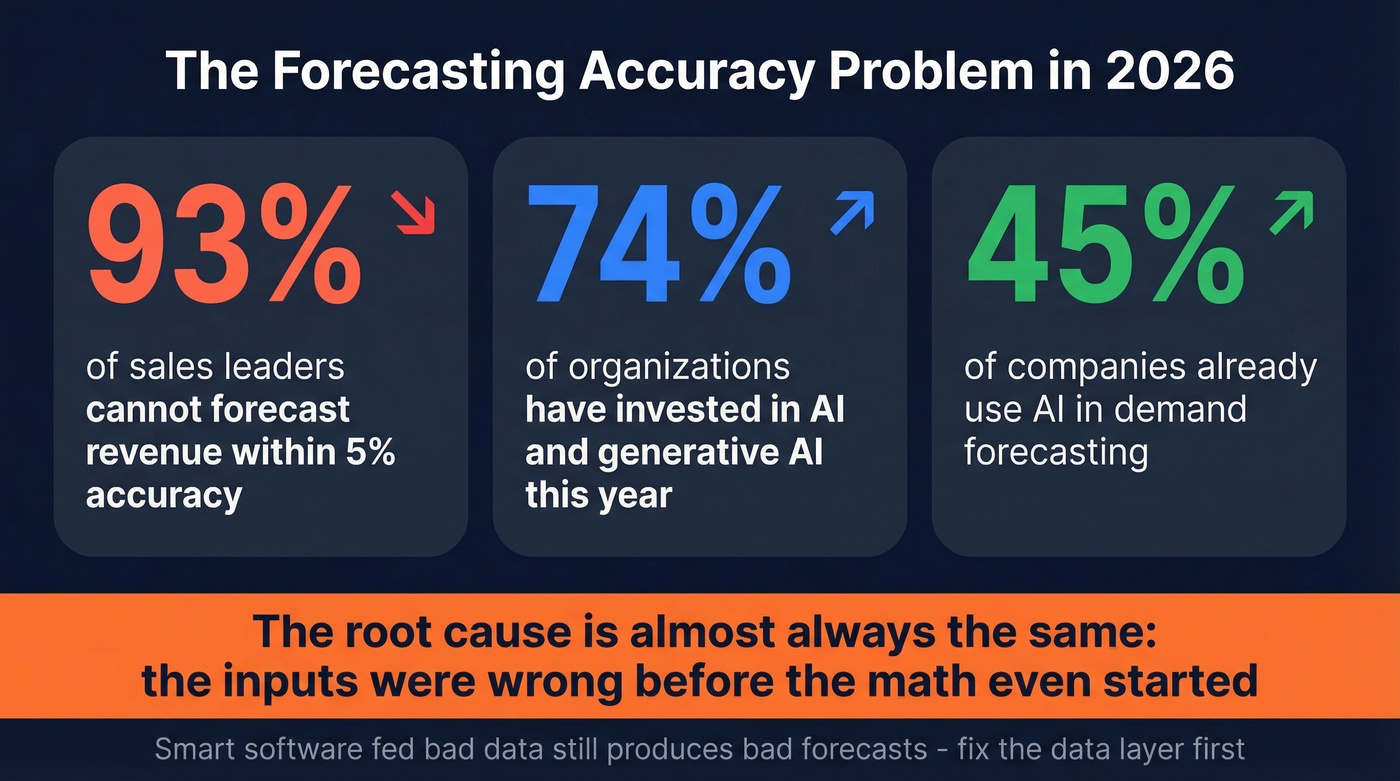
Your CFO just asked why Q3's forecast was off by 18%. You pulled up the pipeline report, and the numbers looked fine - two months ago. The problem wasn't the model. It was the data underneath it. 93% of sales leaders can't forecast revenue within 5% accuracy even with two weeks left in the quarter, and the gap almost always traces back to the same root cause: the inputs were wrong before the math even started.
[74% of organizations have invested](https://www.deloitte.com/az/en/issues/generative-ai/state-of-generative-ai-in-enterprise.html) in AI and generative AI over the past year, and a huge chunk of that spend is flowing into forecasting software. The tools are getting smarter. But smart software fed garbage data still produces garbage forecasts. Here's which options actually deserve your budget - and the upstream data problem most of them can't solve on their own.
Our Picks (TL;DR)
We evaluated each tool on pricing transparency, forecast accuracy claims, implementation burden, and integration depth - weighted toward what mid-market and enterprise buyers actually care about.
| Category | Pick | Starting Price | Best For |
|---|---|---|---|
| Enterprise sales forecasting | Clari | ~$100/user/mo | Revenue teams 50+ reps |
| Pipeline data accuracy | Prospeo | Free (75 emails/mo) / ~$0.01/email | CRM data hygiene |
| FP&A / financial modeling | Anaplan | ~$102K/yr median | Multi-dept planning |
| Spreadsheet-native FP&A | Cube | $1,250/mo | Mid-market finance |
| Conversation-driven forecasting | Gong Forecast | ~$50/user/mo | Teams already on Gong |
| SMBs on a budget | Jirav | $50/mo | Small finance teams |
The rest of this article goes deep on all 17 tools, pricing realities, and the mistakes no software can fix.
Types of Forecasting Tools
Not all forecasting software solves the same problem. Before you shortlist anything, figure out which category you're actually shopping in.
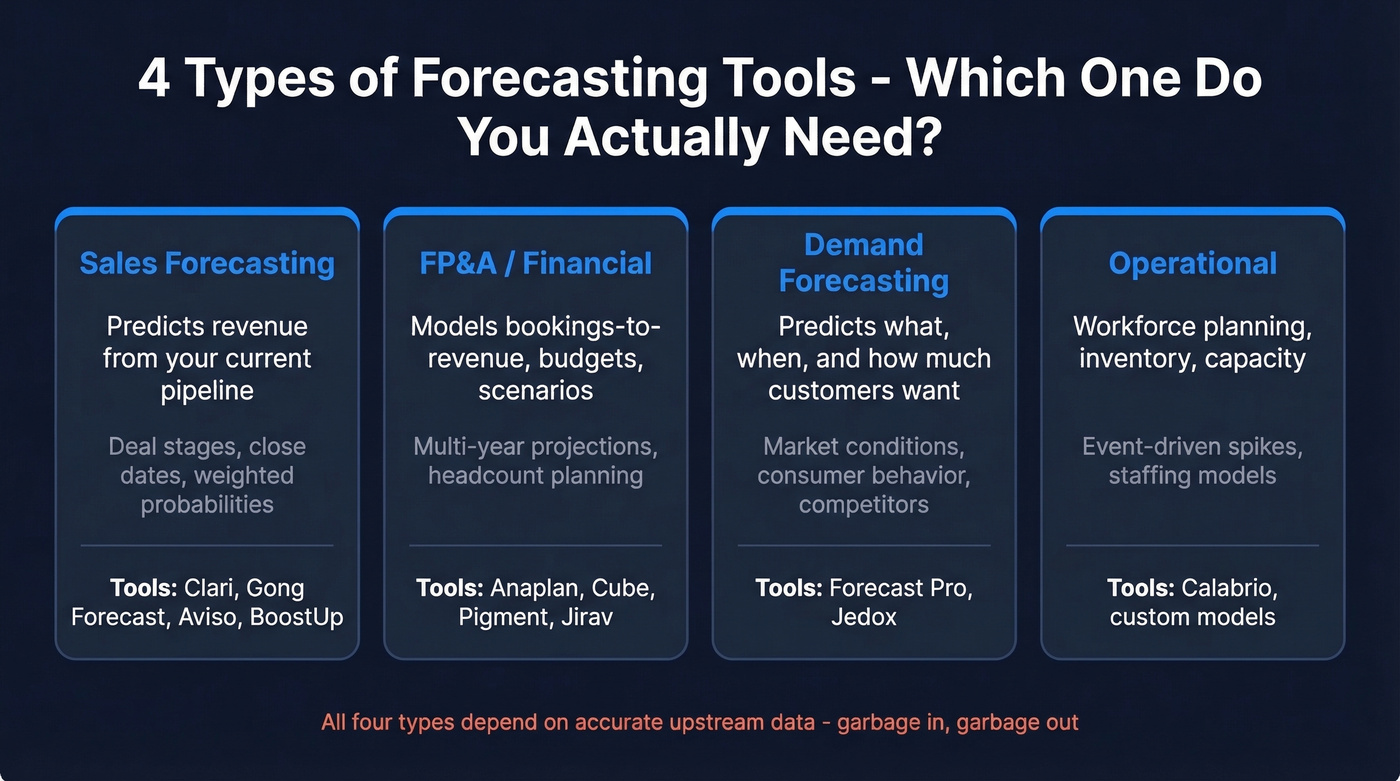
Sales forecasting predicts revenue from your current pipeline - deal stages, close dates, weighted probabilities. It's a snapshot of what your sales team expects to close in a given period. Platforms like Clari or Gong Forecast live here, pulling CRM data and layering AI on top to flag deals at risk.
FP&A / financial forecasting is broader. Finance teams use these to model bookings-to-revenue, budget scenarios, headcount planning, and multi-year projections. The distinction matters: a real FP&A scenario might involve a $25M revenue target with $10M in backlog and a one-month lag from bookings to revenue. As one FP&A practitioner put it on Reddit, the real question is whether to "rely on Salesforce pipeline vs assumption-based modeling." That's not something Clari handles. Anaplan, Cube, and Pigment own this space.
Demand forecasting predicts what, when, and how much customers will want - driven by market conditions, consumer behavior, and competitor activity rather than internal pipeline data. 45% of companies already use AI in demand forecasting, and another 43% plan to implement it soon. Forecast Pro and Jedox are common picks when you need planning across demand and operations, not just pipeline.
Operational forecasting covers workforce planning, inventory, and capacity. Tools like Calabrio handle this, though practitioners on Reddit note that long-term accuracy can be "out by a fair bit" in volatile environments - a reminder that no tool eliminates the need for human judgment on event-driven spikes.
When Do You Actually Need a Dedicated Tool?
Your CRM already has basic forecasting. Salesforce, HubSpot, and Pipedrive all offer weighted pipeline views and simple roll-ups. Salesforce Einstein adds AI forecasting for $50-$100/user/month on top of your existing license - worth considering before jumping to a standalone platform. For many teams, that's enough.
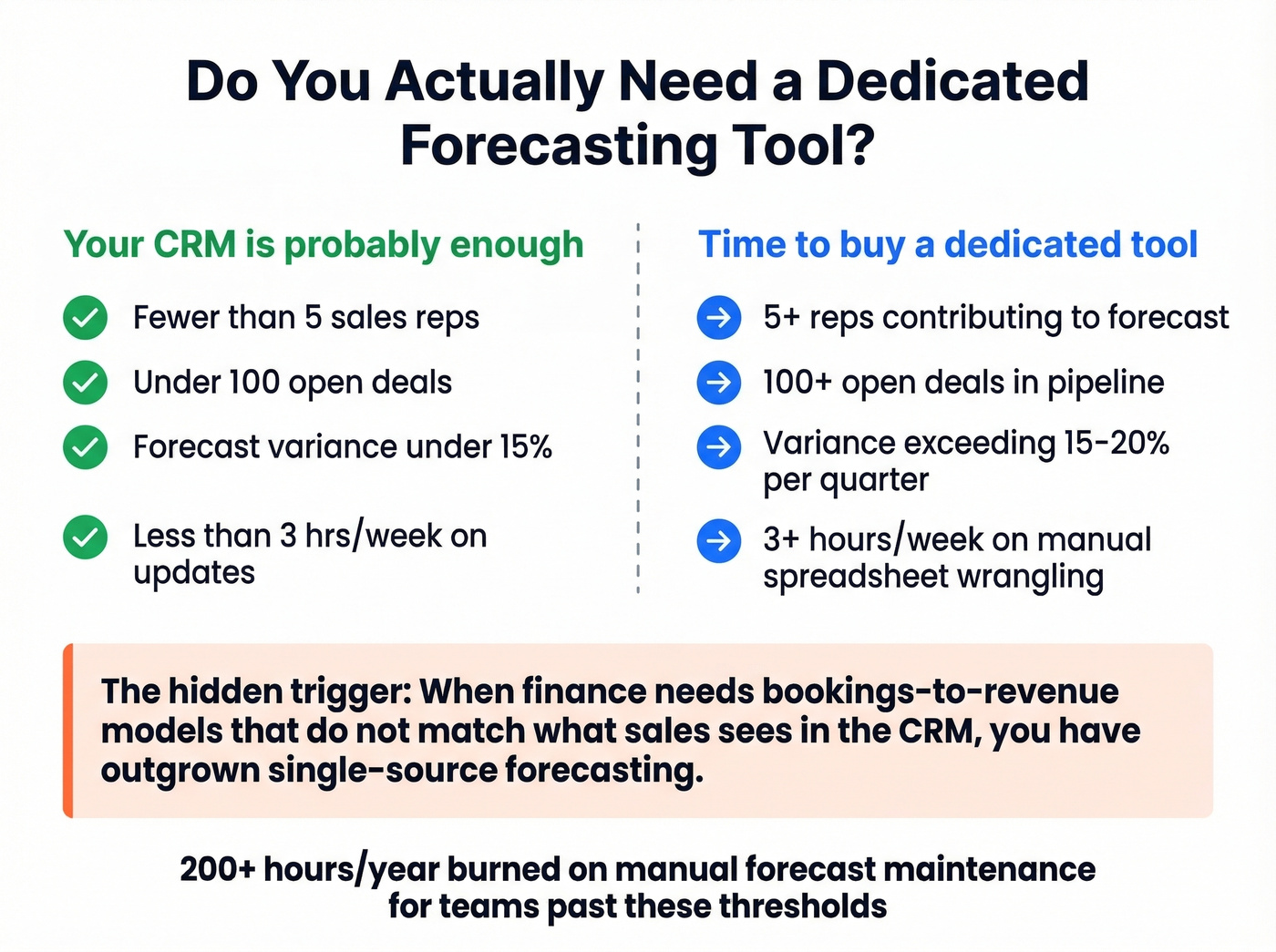
You probably need a dedicated forecasting tool when you hit these thresholds:
- 5+ sales reps contributing to the forecast
- 100+ open deals in the pipeline at any given time
- Forecast variance exceeding 15-20% quarter over quarter
- 3+ hours per week spent on manual forecast updates and spreadsheet wrangling
Below those numbers, your CRM's built-in forecasting is probably sufficient. Above them, the manual overhead and accuracy gaps start costing real money - a team spending 4-5 hours weekly maintaining spreadsheet forecasts is burning 200+ hours a year on a process a tool can automate in minutes. Reddit's workforce management community is full of practitioners who spent years forecasting in Excel before graduating to dedicated solutions, and even then, the transition isn't painless.
The other trigger is cross-functional complexity. If finance needs bookings-to-revenue models that don't match what sales sees in the CRM, you've outgrown single-source forecasting. That's when FP&A platforms start paying for themselves.

Every forecasting tool on this list depends on one thing: accurate pipeline data. When 35% of your CRM contacts bounce, your forecast is broken before the model runs. Prospeo's 7-day data refresh and 98% email accuracy keep your pipeline clean - so your forecast actually reflects reality.
Stop forecasting on stale data. Start with contacts that are real.
The 17 Best Forecasting Tools in 2026
Sales Forecast Tools
Clari
Use this if you're a 50+ rep revenue org that needs a single source of truth across pipeline, forecast, and revenue operations. Clari is the dominant enterprise sales forecasting platform - but the TCO will shock you.
Skip this if you're under 20 reps or don't have a dedicated RevOps team to manage the rollout.
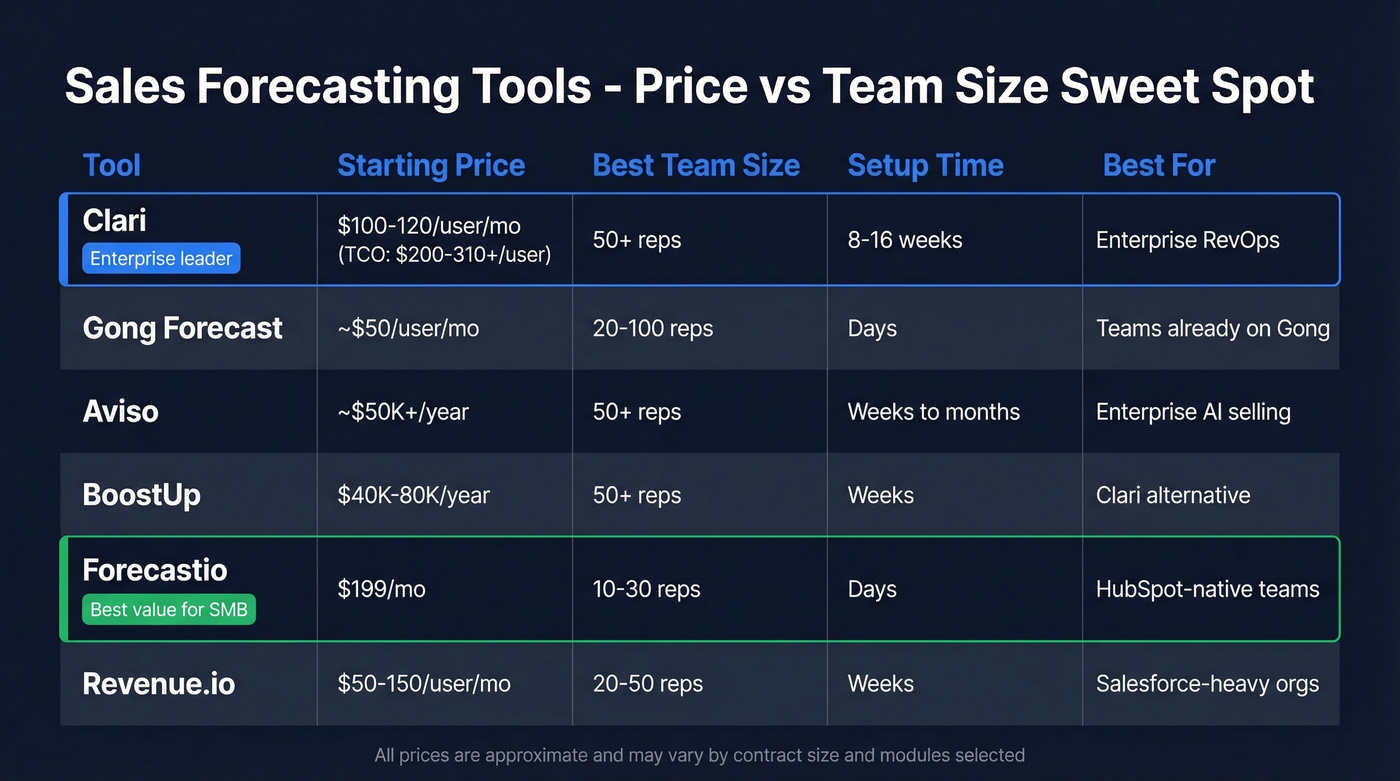
The base module starts at $100-$120/user/month, which sounds reasonable until you add the required modules. Total costs reach $200-$310+ per user when you factor in Copilot tiers at $60-$110/user/month, professional services at $15K-$75K, and an 8-16 week implementation timeline. For a 50-seat team, you're looking at $150K-$200K+ in year one.

A Forrester TEI study commissioned by Clari reported payback in under six months for enterprises adopting its workflows. We've seen that hold true for large orgs with disciplined RevOps - but smaller teams often struggle to extract enough value to justify the spend. The Copilot Accelerator tier at $1,080/user/year is the sweet spot for most mid-enterprise buyers.
Gong Forecast
Gong Forecast makes the most sense if you're already paying for Gong's conversation intelligence platform. Adding forecasting to an existing Gong deployment is a natural extension - it layers deal signals from actual calls and emails on top of CRM data, producing forecasts that are 20% more precise than CRM-only approaches.
Starting at ~$50/user/month, it's significantly cheaper than Clari. The tradeoff is scope: Gong Forecast excels at call-driven pipeline analysis but doesn't offer the same depth of revenue waterfall modeling or multi-team roll-ups. Implementation takes days rather than months, which alone makes it worth evaluating.
For teams under 100 reps where conversation intelligence is already part of the stack, Gong Forecast is the smarter buy. For complex, multi-segment revenue orgs, Clari still wins on breadth.
Aviso
Aviso positions itself as the AI-guided selling platform for enterprise revenue teams. Custom pricing starts around $50K/year minimum, putting it firmly in the enterprise-only category. The AI forecasting engine is genuinely strong - it combines CRM signals, email engagement, and deal progression patterns to surface risk earlier than most competitors. But the sales cycle to buy Aviso is itself enterprise-grade: expect demos, pilots, and procurement cycles. If you're evaluating Clari and want a second option for the bake-off, Aviso belongs on the shortlist.
BoostUp
BoostUp competes directly with Clari on AI-driven revenue forecasting and has gained real traction with enterprise teams frustrated by Clari's pricing. Custom pricing, enterprise-focused - expect $40K-$80K/year. Worth evaluating if Clari's TCO is a dealbreaker, though the product is less mature and the ecosystem of integrations is thinner.
Forecastio
Forecastio is the HubSpot-native option that mid-market sales teams keep discovering. At $199/month on annual billing, it's dramatically cheaper than Clari or Aviso, and the HubSpot integration is tight enough that setup takes days, not months. The forecasting models are simpler - don't expect Clari-level scenario planning - but for a 10-30 rep team running HubSpot, Forecastio covers 80% of what you need at 10% of the cost.
Revenue.io
Salesforce-native forecasting with real-time conversation intelligence baked in. Pricing runs $50-$150/user/month depending on modules. Best for Salesforce-heavy orgs that want forecasting and call analytics in one platform without adding Gong separately.
FP&A / Financial Forecasting Tools
Anaplan
Anaplan is the 800-pound gorilla of connected planning, and the pricing reflects it.
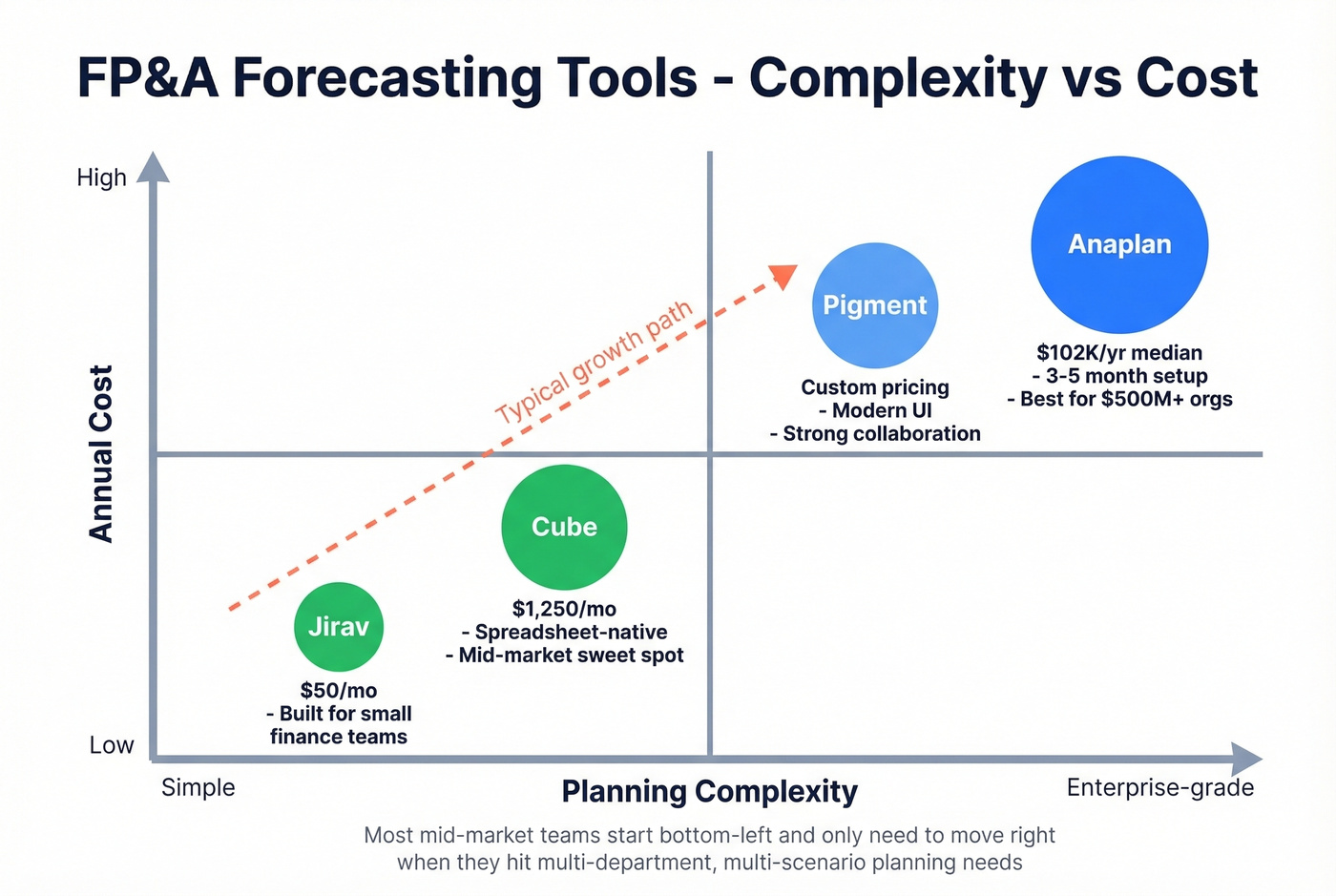
The median buyer pays $102,032 per year based on Vendr's dataset of 59 purchases. Entry-level contracts start around $20K-$50K annually, but implementation and consulting fees can double the total cost. Setup commonly takes 3-5 months, and training can take 60+ hours.
Here's the thing: Anaplan is overkill for 90% of companies evaluating it. It's built for multi-department, multi-scenario planning across finance, supply chain, and workforce - the kind of complexity you find at $500M+ revenue companies. G2 gives it 4.6/5 across 452 reviews, with 54.8% of reviewers coming from enterprise organizations. If you're a mid-market FP&A team with 3-5 analysts, you'll spend more time configuring Anaplan than actually forecasting. Look at Cube or Pigment instead.
Cube
Cube is the anti-Anaplan. It connects directly to Excel and Google Sheets, which means your finance team doesn't have to abandon the spreadsheets they already know. Starting at $1,250/month, it's positioned for mid-market FP&A teams that need real-time data consolidation and scenario modeling without a six-figure platform fee.
The spreadsheet-native approach is Cube's biggest strength and its ceiling. Power users who live in Excel will love it. Teams that need the multi-dimensional modeling depth of Anaplan or Pigment will outgrow it. For a 5-15 person finance team doing budgeting, forecasting, and board reporting, Cube hits a sweet spot that enterprise platforms overshoot.
Pigment
Modern UI, strong collaboration features, and a G2 rating of 4.6/5 across 97 reviews. Pigment is gaining traction with mid-market and growth-stage finance teams who want Anaplan-level flexibility without the Anaplan-level implementation burden. Custom pricing typically runs $20K-$150K/year depending on scale. Worth noting from G2 reviews: users flag data inaccuracy and complexity as recurring themes. Powerful, but not plug-and-play.
Workday Adaptive Planning
The obvious choice for companies already in the Workday ecosystem. G2 rates it 4.3/5 across 303 reviews, with 58.5% of reviewers coming from mid-market organizations - a useful signal about where it fits best. Custom pricing runs $30K-$150K/year. The recurring G2 complaint is "complex setup," which tracks with what we've heard from finance teams who underestimated the configuration effort. If you're on Workday HCM and Financials, Adaptive Planning is the natural fit. Otherwise, evaluate Pigment or Cube first.
Vena
Excel-native FP&A that competes with Cube on the "don't make me leave my spreadsheet" premise. Typical pricing runs $2K-$5K/month. Vena's strength is the budgeting-plus-forecasting combo - it handles both workflows in a single platform, which reduces the tool sprawl that hits mid-market finance teams. Less flashy than Pigment, more practical than Anaplan for teams under 20 analysts.
Planful
Mid-market FP&A platform with custom pricing typically in the $1,500-$5K/month range. Solid for budgeting and financial close workflows alongside forecasting. Not differentiated enough to be a first choice, but worth evaluating if Cube or Vena don't fit your reporting needs.
Demand & Operational Forecasting
Forecast Pro
The statistical and time-series forecasting specialist. If you're doing demand planning with ARIMA models, exponential smoothing, or regression-based approaches, Forecast Pro is purpose-built for that work. Pricing runs in the $20K-$80K/year range for enterprise licenses.
Jedox
Enterprise demand and operational planning platform with custom pricing typically running $30K-$100K/year. Jedox handles the intersection of financial and operational forecasting - supply chain, workforce, and capacity planning alongside traditional FP&A. Best for manufacturing and distribution companies with complex planning needs.
Pipeline Data Quality - The Upstream Problem
Let's be honest about this entire category: if your average deal size exceeds $5K, you probably don't need a better forecasting model. You need better data.
Even the best pipeline forecasting software can only analyze what's in your CRM. If 20% of your contacts have bad emails or outdated titles, your pipeline is inflated and your forecast is structurally wrong. This is the problem nobody talks about in forecasting conversations, and it's the one that silently kills accuracy.
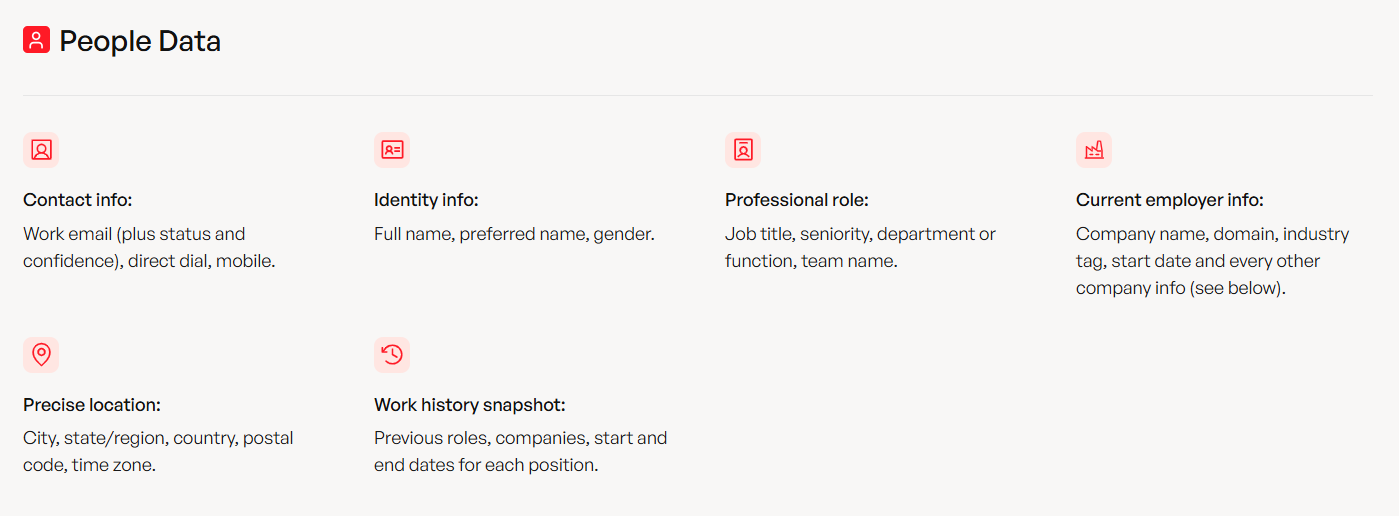
Prospeo sits upstream of your forecasting stack. Its database covers 300M+ professional profiles with 98% email accuracy and a 7-day data refresh cycle - compared to the 6-week industry average. The CRM enrichment API delivers a 92% match rate and returns 50+ data points per contact, so the pipeline data feeding Clari, Gong, or whatever forecasting tool you choose is actually current and accurate. If you're comparing vendors, start with a quick scan of data enrichment services and how they impact downstream reporting.
The proof point that matters: Snyk deployed Prospeo across 50 AEs. Their email bounce rate dropped from 35-40% to under 5%, and AE-sourced pipeline increased 180%. When a third of your outbound emails are bouncing, your pipeline numbers are fiction - and your forecast inherits that fiction. (If you want benchmarks and fixes, see our guide to email bounce rate.)
Pricing starts free with 75 emails/month plus 100 Chrome extension credits/month, and paid plans run ~$0.01 per email. No contracts, no annual commitments.
SMB / Lightweight Options
Jirav
From $50/month, Jirav gives small finance teams basic FP&A - budgeting, forecasting, and financial dashboards - without enterprise complexity or enterprise pricing. Best for companies under $10M revenue that need to graduate from spreadsheets but aren't ready for Cube or Pigment.
LivePlan
From $15/month on annual billing with a 35-day money-back guarantee. LivePlan is built for startups and small businesses doing business plan forecasting and financial projections. It's not a sales forecasting tool - it's where founders model their first three years of revenue before they have a pipeline to forecast.
Pricing Comparison
| Tool | Category | Starting Price | Enterprise Cost |
|---|---|---|---|
| Prospeo | Data quality | Free (75/mo) | ~$0.01/email |
| Clari | Sales | ~$100/user/mo | $200-$310/user/mo |
| Gong Forecast | Sales | ~$50/user/mo | Custom |
| Aviso | Sales | ~$50K/yr | Custom |
| BoostUp | Sales | ~$40K/yr | ~$80K/yr |
| Forecastio | Sales | $199/mo | Custom |
| Revenue.io | Sales | ~$50/user/mo | ~$150/user/mo |
| Anaplan | FP&A | ~$20K/yr | ~$102K/yr median |
| Cube | FP&A | $1,250/mo | Custom |
| Pigment | FP&A | ~$20K/yr | ~$150K/yr |
| Workday Adaptive | FP&A | ~$30K/yr | ~$150K/yr |
| Vena | FP&A | ~$2K/mo | ~$5K/mo |
| Planful | FP&A | ~$1,500/mo | ~$5K/mo |
| Forecast Pro | Demand | ~$20K/yr | ~$80K/yr |
| Jedox | Demand/Ops | ~$30K/yr | ~$100K/yr |
| Jirav | SMB FP&A | $50/mo | N/A |
| LivePlan | SMB/Startup | $15/mo | N/A |
The pricing transparency gap in this market is frustrating. Most enterprise sales forecasting platforms hide behind "contact sales" pages, which makes budgeting for a forecasting solution its own forecasting exercise. Free trials are rare at the enterprise tier - Clari, Gong, Aviso, Anaplan, Pigment, and Workday all require demos. Forecastio, Cube, Jirav, and LivePlan offer self-serve trials.
Forecasting Mistakes No Tool Can Fix
Before you buy anything, fix these first. No amount of AI can compensate for broken fundamentals.
Over-reliance on historical data. Last year's numbers are a starting point, not a forecast. Combine them with market conditions, competitive shifts, and customer signals.
Ignoring external factors. Macro conditions, regulatory changes, and competitor moves all impact demand. If your model doesn't account for them, it's a spreadsheet exercise.
Overcomplicating the model. More variables don't mean more accuracy. We've seen teams build 40-variable models that perform worse than simple weighted pipelines. Prioritize the 5-7 factors that materially impact outcomes.
Neglecting to review and adjust. A forecast isn't a document you file quarterly. Treat it as a living process with weekly check-ins against actuals.
Confirmation bias. Reps and managers both weight data that supports the number they want to hit and discount signals that don't. Build in assumption-challenging rituals - even a simple "what would have to be true for this deal to slip?" question in your weekly pipeline review goes a long way.
Ignoring seasonality. Every business has cyclical patterns. If your model treats January the same as June, it's wrong by default.

- Data integrity issues. Stale contacts, duplicate records, outdated job titles - these inflate your pipeline and distort every downstream calculation. Validation and cleansing aren't glamorous, but they're the foundation every pipeline prediction depends on. (If you're building a process around this, start with lead enrichment and pipeline health metrics.)
How to Choose the Right Tool
Start with budget, then narrow by type. And regardless of which forecasting platform you pick, audit your CRM data quality first. A $100K solution built on 30% stale contacts is a $100K mistake. If you need a framework for what to measure, use funnel metrics to tie forecast inputs to outcomes.
$50K+ per year: You're in enterprise territory. For sales forecasting, evaluate Clari and Aviso head-to-head. For FP&A, run Anaplan against Pigment - and seriously consider whether you need Anaplan's depth or whether Pigment's lighter implementation is the better fit. Expect 2-4 months for enterprise sales tools and 3-9 months for connected planning platforms.
$1K-$5K/month: Mid-market territory. Sales teams should look at Gong Forecast if they're already on Gong, or Forecastio if they're on HubSpot. FP&A teams should compare Cube, Vena, and Planful based on whether they want spreadsheet-native or platform-native workflows. Implementation runs 2-8 weeks for spreadsheet-native tools.
Under $500/month? Jirav for basic FP&A, LivePlan for startup projections, or your CRM's built-in forecasting. At this budget, the highest-ROI move is often cleaning up the data you already have rather than adding another tool on top. If you're stuck with messy records, a solid contact management software setup can reduce duplicates before you enrich.
Look, the tool that improves your variance the most wins - not the one with the best demo. Shortlist 2-3 options, run a 2-week pilot with real data, and measure against your current forecast accuracy. In our experience, teams that skip the pilot phase regret it within one quarter. If you want a sales-only shortlist, compare these sales forecasting solutions before you commit.
You can spend $200K/year on Clari and still miss your number if 1 in 3 contacts in your CRM are outdated. Prospeo enriches your pipeline with 50+ verified data points per contact at $0.01/email - giving your forecasting tool inputs it can actually trust.
The cheapest way to improve forecast accuracy is better data underneath it.
FAQ
What's the difference between sales forecasting and demand forecasting?
Sales forecasting predicts revenue from your current pipeline - deals weighted by stage and close probability - while demand forecasting predicts customer buying volume based on market conditions, consumer behavior, and external signals. Sales tools like Clari look inward at your pipeline; demand platforms like Forecast Pro and Jedox look outward at the market.
How much do enterprise forecasting tools cost?
Expect $20K-$150K per year for serious enterprise deployments. Jirav starts at $50/month for SMB FP&A, while Anaplan's median contract runs $102K/year based on Vendr's aggregated purchase data. Clari's total cost with modules and services can reach $200-$310 per user per month.
Can AI really improve forecast accuracy?
Yes - companies using AI-powered forecasting see an average 25% increase in accuracy. 45% of companies already use AI in demand forecasting, and 95% of revenue organizations now rely on AI-driven tools. The catch: AI needs 6-12 months of clean CRM data to train on. Garbage inputs still produce garbage outputs, just faster.
Do I need a separate tool or can my CRM handle forecasting?
Your CRM's built-in forecasting works fine with fewer than 5 reps, under 100 open deals, and forecast variance below 15-20%. Once you cross those thresholds - or finance needs models that don't match what sales sees - a dedicated platform pays for itself in time savings alone.
How does bad CRM data affect forecast accuracy?
Stale contacts, bounced emails, and outdated titles inflate pipeline value and distort every downstream calculation. Snyk saw a 180% increase in AE-sourced pipeline after cleaning their data - their bounce rate dropped from 35-40% to under 5%. Pairing a data enrichment layer with your forecasting stack is often the highest-ROI fix available.