

Top Email List Providers for B2B Sales in 2026
30% of yesterday's batch bounced. Your domain reputation just took a hit, your sequences are paused, and the "verified" list you paid for is full of generic info@ addresses and people who changed jobs eight months ago. Global inbox placement sits around 84% - roughly one in six emails never reach the inbox even under ideal conditions. When your contact data is stale, that number craters.
The consensus on r/b2bmarketing is blunt: big databases are overused and outdated, and your competitors are emailing the same people from the same lists.
We reviewed nine tools head to head. Here are the top email list providers worth evaluating in 2026, sorted by what actually matters - accuracy, freshness, and what you'll pay.
Quick Picks
| Use Case | Pick | Why |
|---|---|---|
| Email accuracy & self-serve | Prospeo | 98% email accuracy, 7-day refresh, ~$0.01/email |
| All-in-one for startups | Apollo.io | Free plan + built-in sequencing |
| Pay-as-you-go simplicity | UpLead | 95% accuracy guarantee, credit-back policy |
Pricing Compared
Pricing is the single biggest question when evaluating email list providers. Here's what you'll actually pay.
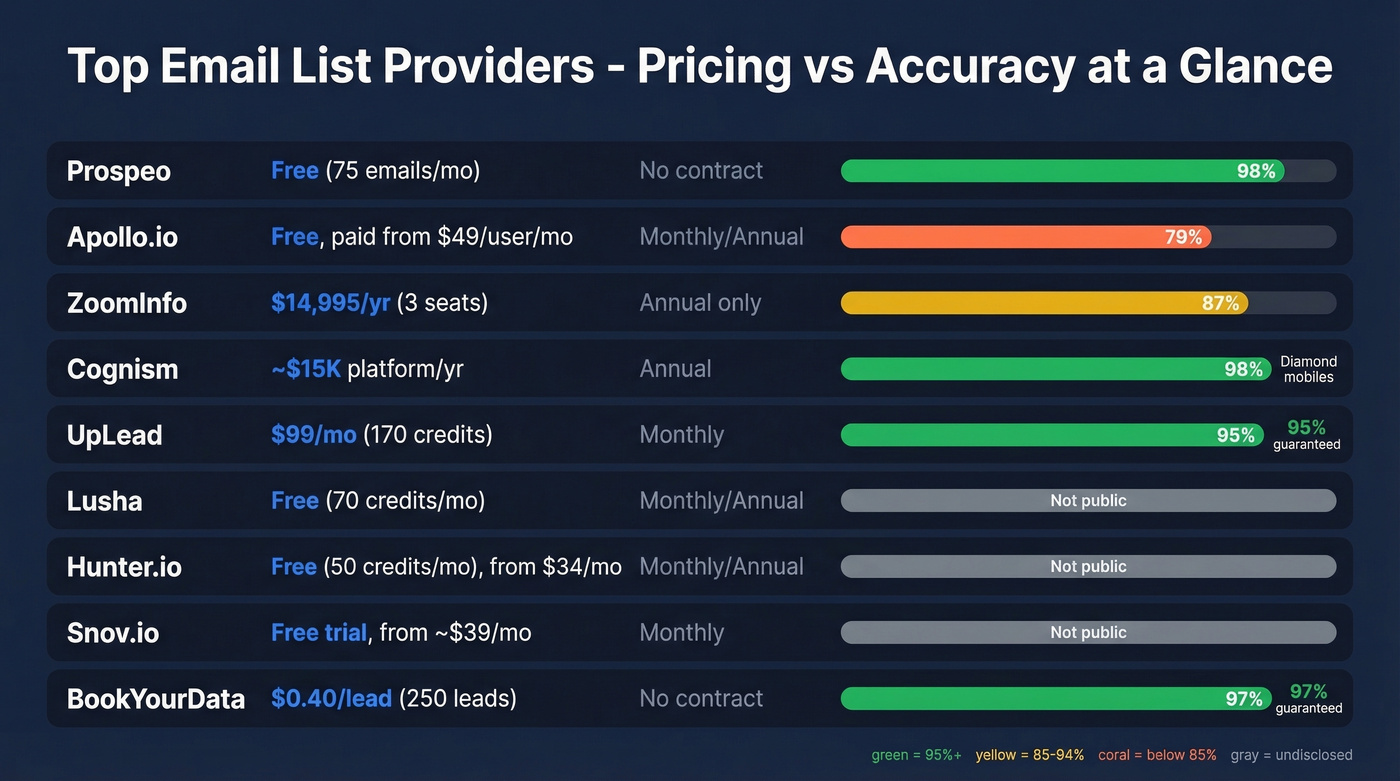
| Provider | Starting Price | Credit Model | Contract | Accuracy |
|---|---|---|---|---|
| Prospeo | Free (75 emails/mo) | ~$0.01/email | None | 98% |
| Apollo.io | Free; paid from $49/user/mo | Per-action credits | Monthly/annual | 79% |
| ZoomInfo | $14,995/yr (3 seats) | Bulk credits (tiered) | Annual | 87% |
| Cognism | ~$15K platform/yr | Per-user + platform | Annual | 98% (Diamond mobiles) |
| UpLead | $99/mo (170 credits) | 1 credit = 1 contact | Monthly | 95% guaranteed |
| Lusha | Free (70 credits/mo) | 1 cr/email; 10 cr/phone | Monthly/annual | Not public |
| Hunter.io | Free (50 credits/mo); from $34/mo | Per-action credits | Monthly/annual | Not public |
| Snov.io | Free trial; from ~$39/mo | Tiered credits | Monthly | Not public |
| BookYourData | $0.40/lead (250 leads) | Pay-as-you-go | No contract | 97% guaranteed |
9 Best Email List Providers
Prospeo
Use this if you care about deliverability above everything else and want self-serve pricing with no sales calls.
Prospeo's database covers 300M+ professional profiles with 143M+ verified emails and 125M+ verified mobile numbers. That 98% email accuracy comes from a proprietary 5-step verification process - catch-all handling, spam-trap removal, honeypot filtering - built on infrastructure Prospeo owns rather than relying on third-party providers.

The 7-day data refresh cycle is the stat that matters most here. Industry average is six weeks. That gap is why Meritt saw their bounce rate drop from 35% to under 4% after switching - their pipeline tripled to $300K/week. Snyk's 50-person AE team saw similar results: bounce rates fell from 35-40% to under 5%, and AE-sourced pipeline jumped 180%. The platform includes 30+ search filters covering buyer intent across 15,000 Bombora topics, technographics, job changes, and funding signals, with native pushes into Salesforce, HubSpot, Smartlead, Instantly, Lemlist, and Clay.
Pricing starts free (75 emails/month) and scales at roughly $0.01 per email. No contracts, no annual lock-in, no "talk to sales" gate. The Chrome extension has 40K+ users for prospecting directly from company websites and professional profiles.
Apollo.io
Apollo is the obvious starting point for startup teams running outbound on a budget. A genuinely useful free plan, built-in email sequencing (rare for a data provider), and paid tiers from $49/user/month make it the lowest-friction option to get campaigns running.
Here's the thing: Apollo's data quality doesn't match its feature set. Reddit threads consistently flag stale contacts and overused emails - when everyone's pulling from the same 270M+ contact database, your prospects are getting hammered by competitors running identical lists. Credits don't roll over between billing cycles, which catches teams who buy more than they use. The Organization plan ($119/mo) requires a minimum of three seats.
Verdict: Best all-in-one for startups, but verify your exports before sending. Pair with a dedicated verification tool if bounce rates creep above 5% (see email bounce rate benchmarks and fixes).
ZoomInfo
ZoomInfo is enterprise infrastructure at enterprise prices. Professional+ starts at $14,995/year for three seats, but most teams pay $30K-$75K+ annually once you add users ($2,500 each), intent data modules, and global data ($9,995 add-on). Vendr benchmarks tell the real story: a 200-person company typically pays $24,800-$44,200; at 1,000+ headcount, you're looking at $83,200-$161,900. Discounts of 30-65% are common if you negotiate, but you'll still land well above $15K.
Annual contracts only. No monthly option.
The database is massive, but practitioners report the same problems as Apollo - generic emails, outdated titles, contacts who left the company months ago. Where ZoomInfo still wins: workflow breadth, ABM orchestration, and deep US coverage. Where it doesn't: cost efficiency for teams under 50 reps, and data freshness compared to providers running weekly refresh cycles.
Skip this if you're a Series A company with fewer than 10 reps. The ROI math doesn't work until you have the headcount to justify the spend.
Cognism
Cognism's Diamond Data offers phone-verified mobiles at 98% accuracy, plus Bombora intent data baked into the Elevate tier. Grow runs ~$15,000 platform + ~$1,500/user/year; Elevate jumps to ~$25,000 + ~$2,500/user. For five users, that's $22,500-$37,500 annually. The "unlimited" access is governed by fair use - roughly 2,000 records per user per month.
It's data-only, so you'll still need Outreach or Salesloft for sequencing (or follow a B2B cold email sequence framework).
Skip this if you're US-focused and budget-conscious. Cognism's European coverage is its edge; stateside, other providers offer stronger depth at lower cost.
UpLead
UpLead runs the cleanest pay-as-you-go model in this space. Essentials at $99/mo gets you 170 credits, Plus at $199/mo gets 400. One credit equals one contact - email and mobile included, no separate phone charges. The 95% accuracy guarantee with credit replacement is what sets it apart: if a contact bounces, you get the credit back. A seven-day free trial with five credits lets you test before committing.
For small teams doing targeted outbound rather than high-volume spray, UpLead's economics are hard to beat. No annual contract, no sales call required.
Lusha
Lusha's free tier - 70 credits per month - is generous enough for individual prospectors. But the credit economics get punishing fast: emails cost 1 credit, phone numbers cost 10. If you're phone-heavy, you'll burn through credits in days.
Monthly rollover caps at 2x your plan limit, and annual credits reset entirely at cycle end. One Reddit user selling into seed-Series B SaaS said they "haven't been too impressed" with data freshness. Decent entry point, but the value erodes as you scale.
Hunter.io
Hunter is a domain-level email discovery tool, not a full prospecting database. Free tier gives you 50 credits/month; paid plans start at $34/mo. One find costs 1 credit, one verify costs 0.5. Best for finding emails at a specific company when you already know who you're targeting - not for building lists from scratch (compare options in our Hunter alternatives guide).
Snov.io
Snov.io combines email finding with built-in drip campaigns, making it a budget alternative to Apollo's all-in-one approach. Solid for small outbound teams who want one tool for discovery and sequencing without paying $49/user/month.
BookYourData
BookYourData operates as a straightforward list seller with pay-as-you-go purchasing, a 97% accuracy guarantee, and 250M+ contacts. Pricing scales from $0.40/lead at 250 leads down to $0.03/contact at 250K credits. Best for one-time list purchases - not ongoing prospecting workflows.

You just read that the industry average data refresh is 6 weeks. That's why your "verified" lists bounce. Prospeo refreshes every 7 days across 300M+ profiles - delivering 98% email accuracy that took Snyk's bounce rate from 35-40% to under 5%.
Stop paying for stale emails. Start with 75 free credits today.
Red Flags When Evaluating Providers
Walk away from any provider that checks these boxes:
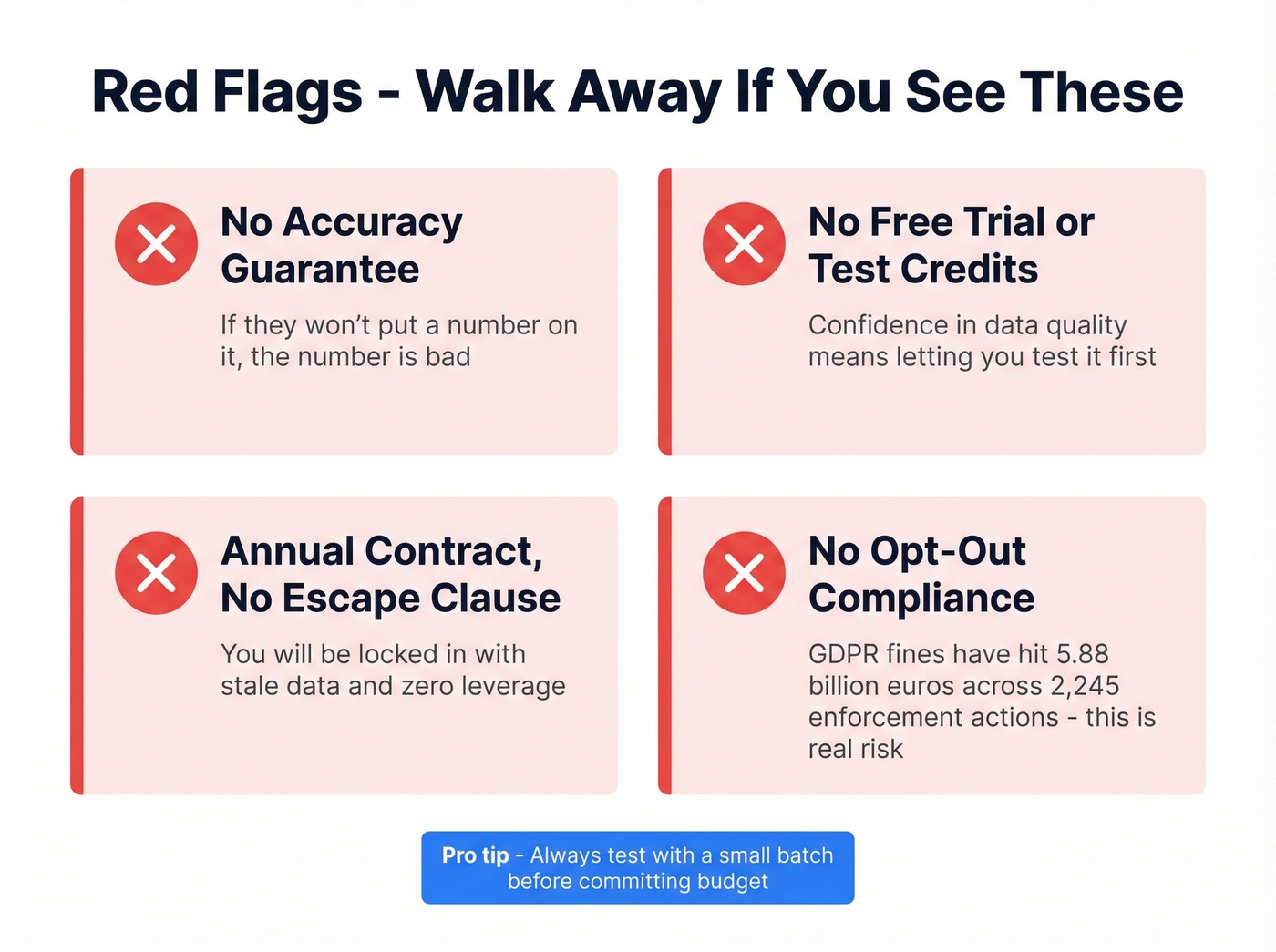
- No accuracy guarantee. If they won't put a number on it, the number is bad.
- No free trial or test credits. Confidence in data quality means letting you test it.
- Annual contract with no escape clause. You'll be locked in with stale data and no leverage.
- No opt-out compliance. GDPR enforcement has hit ~EUR5.88B across 2,245 actions - this isn't theoretical risk (see is it illegal to buy email lists for guardrails).
Why Data Freshness Beats Database Size
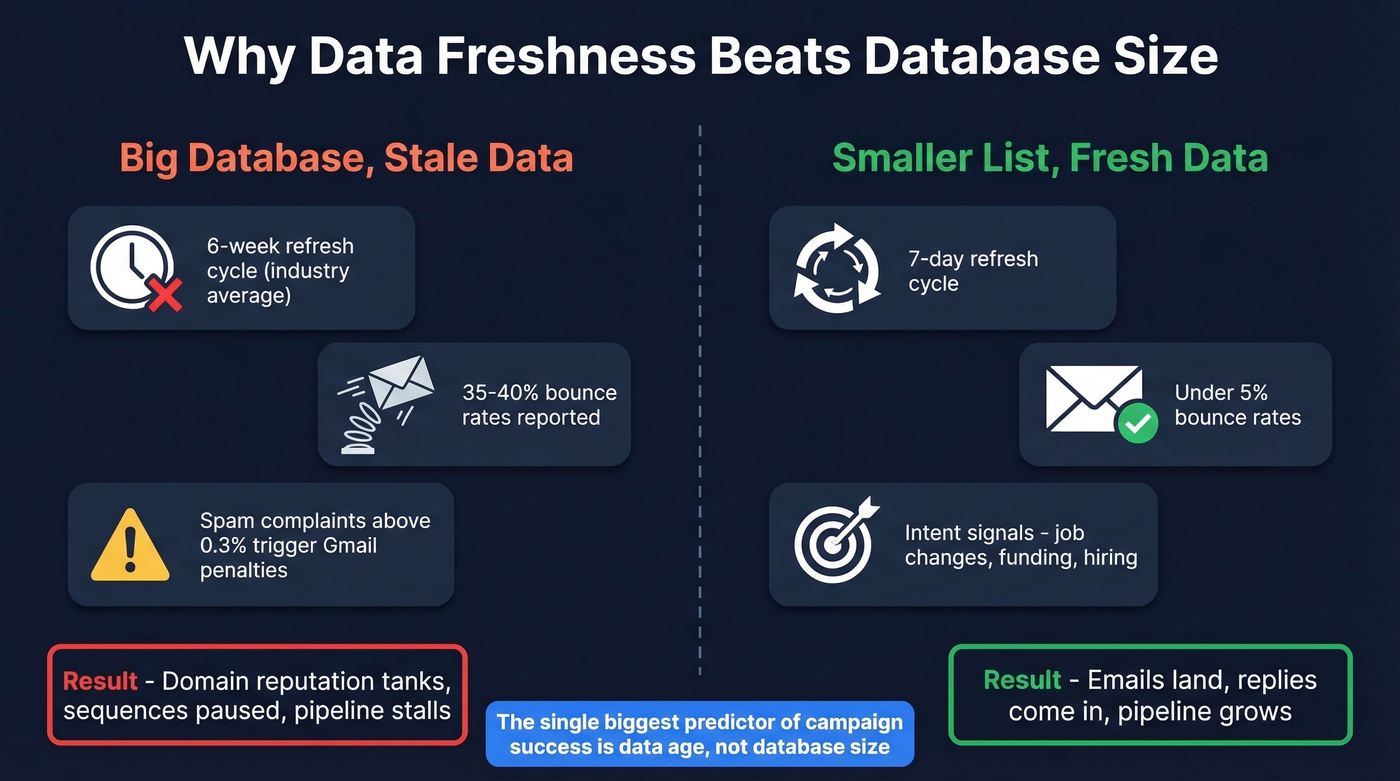
Look, the r/b2bmarketing argument against big databases is simple: 300 million contacts mean nothing if 70% of the phone numbers are wrong and your competitors are emailing the same people. In our experience, the single biggest predictor of campaign success is data age, not database size. The shift toward intent-based prospecting - job changes, funding rounds, hiring signals - matters more than raw record count (more on intent based segmentation).

Spam complaint rates above 0.3% trigger Gmail penalties. One bad batch can tank your domain for weeks. A 7-day refresh cycle versus the six-week industry average is the difference between reaching someone at their current job and bouncing off a dead address (see the full email deliverability guide).
Let's be honest: if your average deal size is under $10K, you probably don't need a $15K+ data platform. A self-serve tool with high accuracy and a verification step will outperform a bloated enterprise database that your team barely uses.
Building Targeted Contact Lists
Even the best provider won't save a campaign built on a poorly defined audience. Before you pull a single record, nail your ICP filters: industry, headcount, tech stack, funding stage, and buyer intent signals. Segmentation before scale - always (use an ideal customer profile template if you need one).
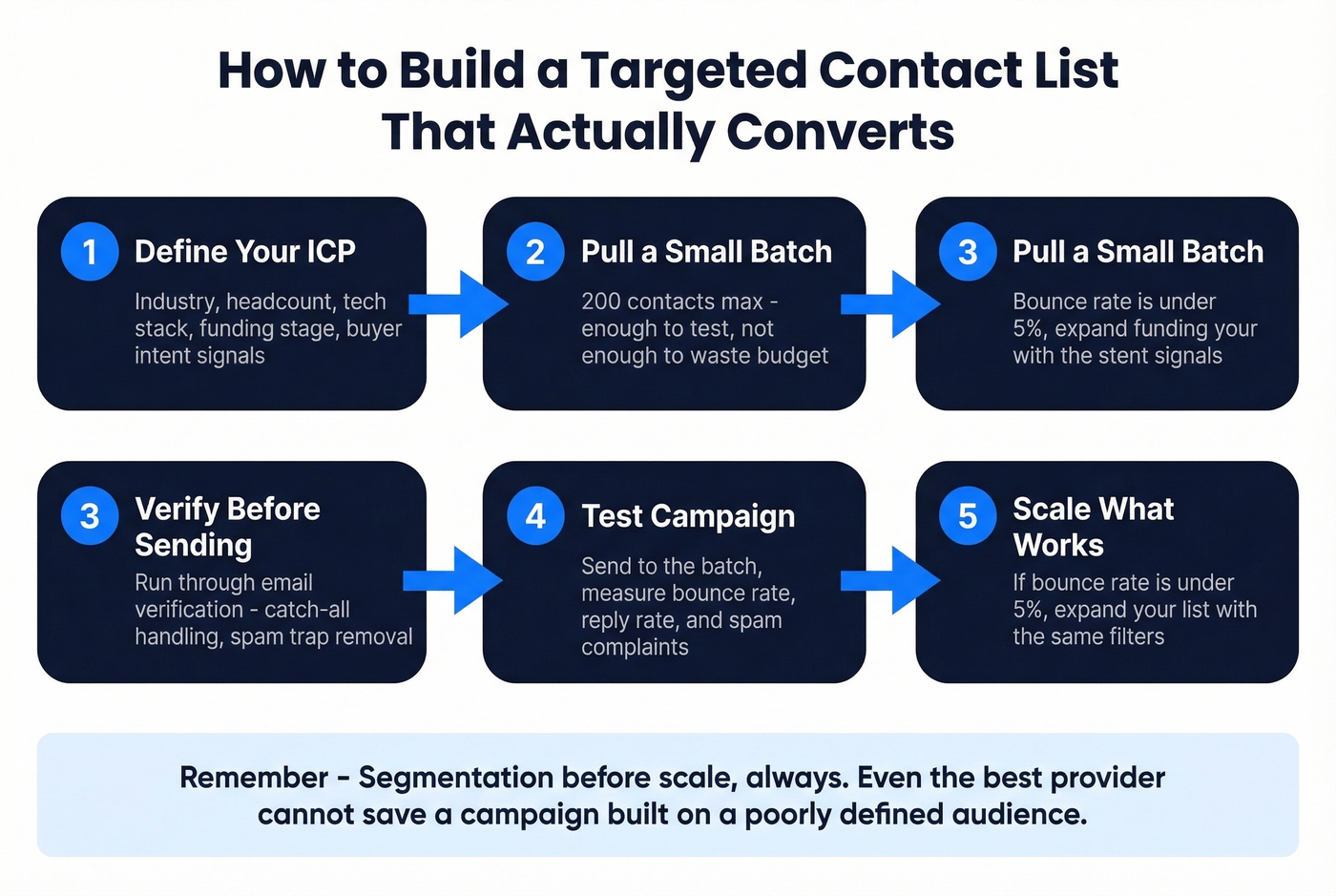
We've found the best approach is to pull 200 contacts, run a test campaign, and measure bounce rate and reply rate before committing budget to a full build. All nine providers above support filtering by these dimensions, but the quality of your list depends entirely on how tightly you define your criteria upfront (see sales prospecting techniques that pair well with intent filters).
Compliance in 30 Seconds
GDPR fines have hit ~EUR5.88B across 2,245 enforcement actions. CAN-SPAM penalties run up to $53,088 per violation. CCPA gives California residents the right to opt out of data sales.
GDPR can allow B2B outreach under legitimate interest, and CAN-SPAM governs U.S. commercial email - but buying static CSVs from unvetted brokers is risky. Use providers with opt-out enforcement and compliance built in.
At $0.01 per email with no contracts, Prospeo costs 90% less than ZoomInfo and outperforms Apollo on accuracy (98% vs 79%). 15,000+ companies already made the switch - including teams that tripled pipeline in weeks.
Every provider on this list charges more for worse data.
FAQ
Is it legal to buy B2B email lists?
GDPR allows B2B outreach under legitimate interest, and CAN-SPAM governs U.S. commercial email - so yes, with guardrails. Buying static CSVs from unvetted brokers is risky. Use providers with opt-out enforcement, GDPR compliance, and real-time verification to stay safe.
How many contacts bounce from a typical provider?
Expect 5-15% invalid records from most providers unless they verify in real time. Always run a 200-contact test campaign before committing budget - if bounce rates exceed 5%, switch providers immediately.
What's the difference between an email list provider and an ESP?
Email list providers supply contact data for outbound prospecting. ESPs like Mailchimp and MailerLite send marketing emails to existing subscribers - opt-in campaigns average 43.46% open rates, a completely different game from cold outbound.
How much does a B2B email list cost?
From free (Apollo and Lusha free tiers) to $75,000+/year for ZoomInfo Enterprise. Most mid-market teams spend $1,200-$5,000/year on self-serve tools, or $15,000-$40,000 on enterprise platforms with annual contracts.
How do I choose among the top email list providers?
Start with a free tier or trial. Pull 200 contacts matching your ICP, send a test campaign, and measure bounce rate. If it's above 5%, move on. Prioritize accuracy guarantees and data refresh frequency over raw database size - a provider with verified, fresh data will always outperform a cheaper option with a larger but stale database.