

The 3 Types of ABM: Which One Fits Your Budget?
A thread on r/DigitalMarketing put it bluntly: "Isn't ABM just detailed, data-driven demand gen?" Fair question. The types of ABM you choose - and how you allocate budget, personalization, and headcount across them - are what separate a real program from rebranded demand gen with a fancier name. Account-based marketing delivers a 137% average ROI according to a 771-marketer survey, and roughly half of teams plan to increase ABM budgets this year. But get the tier wrong and you'll either burn $80K marketing to a single account that was never going to close, or spray generic ads at 1,000 companies and wonder why nothing converts.
Most teams overthink ABM tier selection. If your average deal size sits below $100K, start with programmatic. You can always move up.
The 3 Core Account-Based Marketing Types
1:1 Strategic ABM
This is the heavy artillery. You're selling $500K+ deals into enterprise accounts where a single closed-won opportunity moves the revenue needle for the entire quarter.
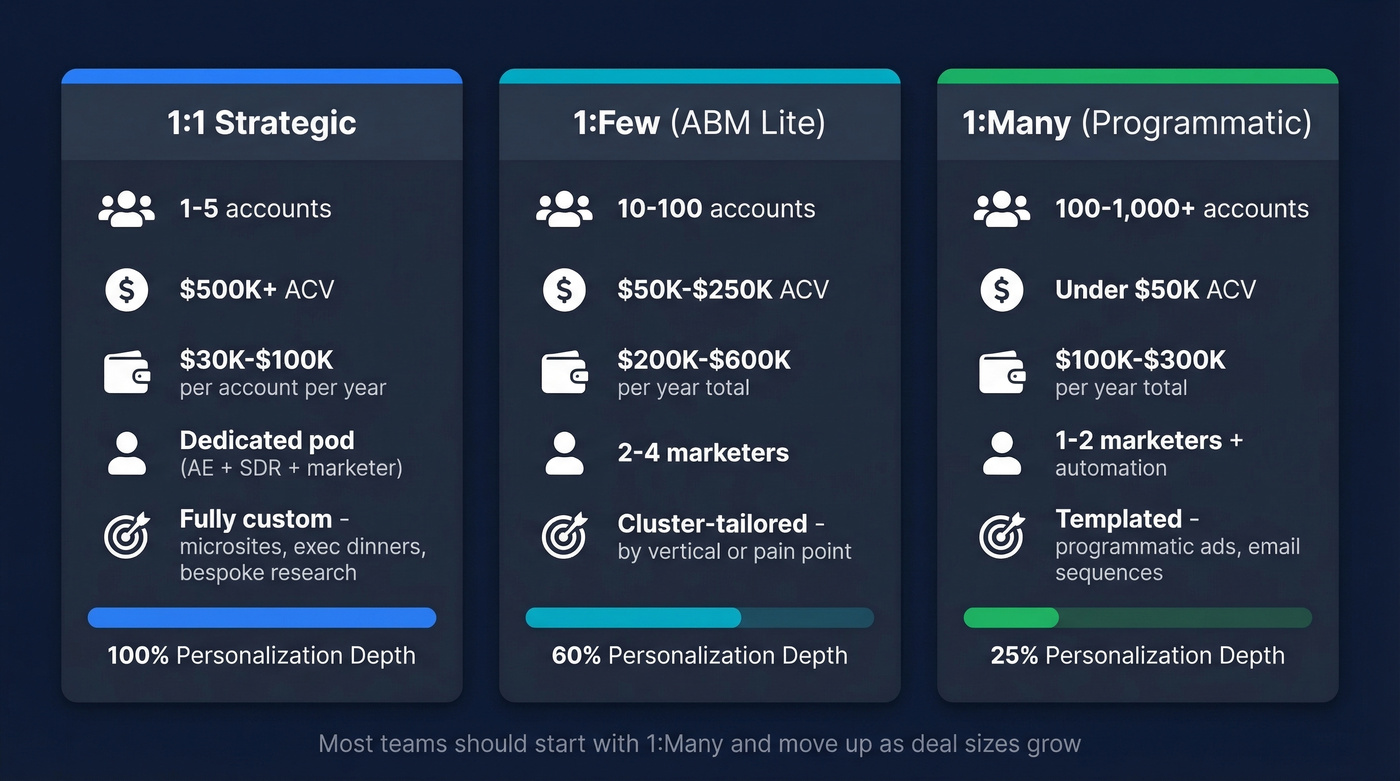
Strategic ABM is built around a single named account - or a very small set of named accounts. A dedicated marketer works alongside an AE and SDR, running plays like custom microsites, executive dinners, and bespoke research reports. Every touchpoint is tailored to specific stakeholders, their org chart, and their strategic priorities. That kind of personalization costs $30K-$100K+ per account per year, which is why the deal size has to justify it.
Skip this if your average deal is under $500K. We've seen teams try 1:1 ABM on mid-market deals and end up spending more on the campaign than the contract was worth.
One-to-Few ABM (ABM Lite)
A common complaint on B2B marketing forums is that strategic ABM sounds great until you see the headcount requirements. ABM Lite solves that problem by clustering 10-100 accounts by industry vertical, pain point, or tech stack, then personalizing by segment rather than by individual account. Budget runs $200K-$600K/year total with a small team of 2-4 marketers.
The trap here is vague clustering. If your ICP is too broad to group meaningfully, you'll produce generic content with a "personalized" label slapped on it - which is actually worse than honest programmatic, because you've spent more money to achieve the same result.
One-to-Many (Programmatic) ABM
This is where most teams start, and where most teams should start. You're targeting 100-1,000+ accounts with automation-heavy campaigns: programmatic ads, templated email sequences, intent-triggered workflows. A team of 1-2 marketers can manage it with the right tooling, and budgets sit at $100K-$300K/year. Email drives 92% of successful ABM programs, with in-person events (72%) as the second-highest performing channel.
Don't expect 1:1 results. One-to-many ABM is a volume play with light personalization - the best starting point, not the endgame.
| 1:1 Strategic | 1:Few (Lite) | 1:Many | |
|---|---|---|---|
| Accounts | 1-5 | 10-100 | 100-1,000+ |
| ACV | >$500K | $50K-$250K | Typically <$50K |
| Budget | $30K-$100K/acct | $200K-$600K/yr | $100K-$300K/yr |
| Team | Dedicated pod | 2-4 marketers | 1-2 + automation |
| Personalization | Fully custom | Cluster-tailored | Templated |
Channel and timeline notes: 1:1 programs lean heavily on events and executive outreach and usually take the longest to show meaningful pipeline impact - sometimes 6-12 months before you see real movement. 1:Few programs tend to land in the middle, often driven by targeted ads plus email. 1:Many programs are the fastest to launch because they're built on automation and repeatable plays.
How to Pick Your ABM Tier
Understanding the differences between 1:1 vs 1:Few vs 1:Many comes down to three variables. Use this as a quick gut-check:
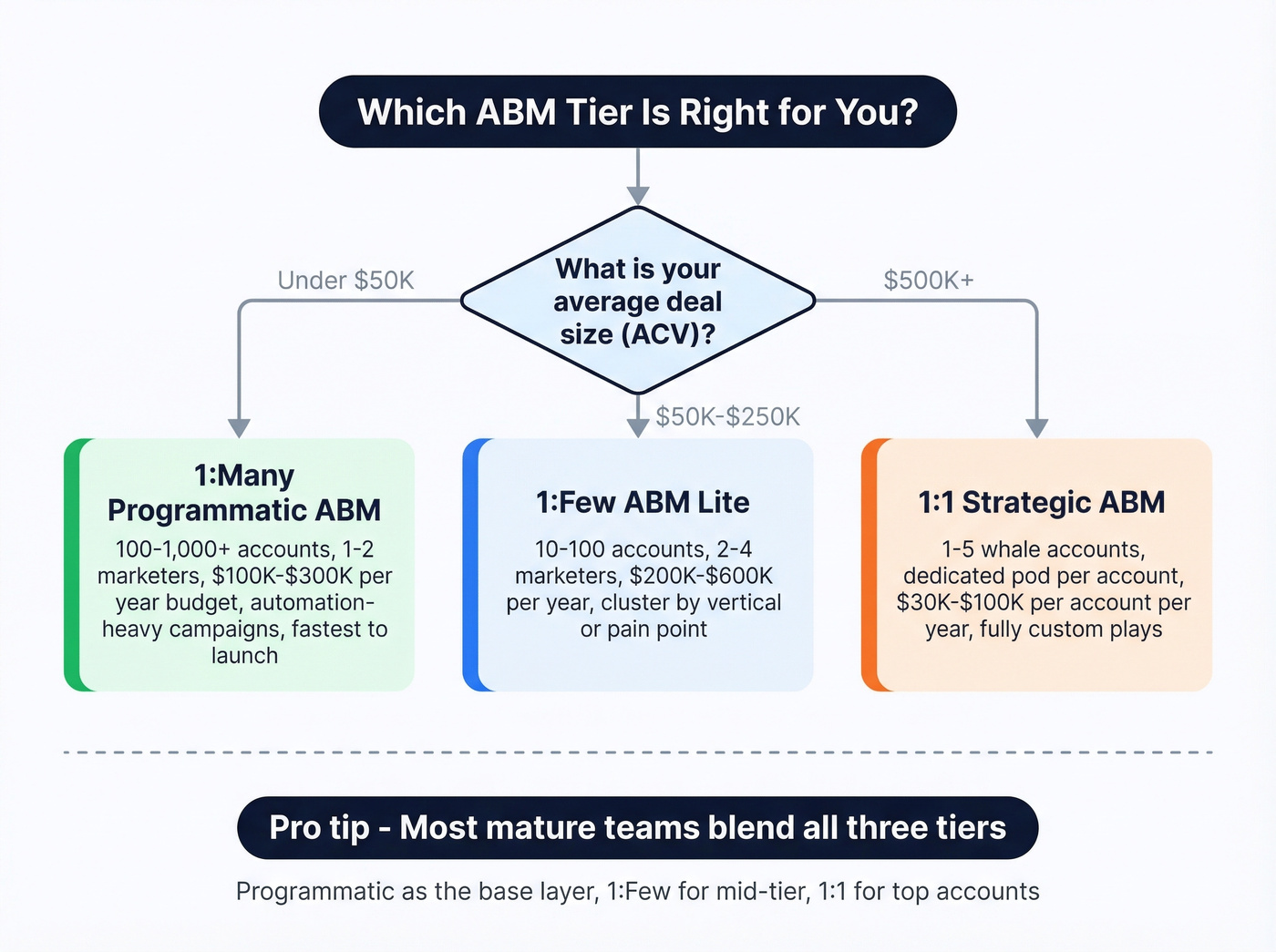
- ACV under $50K - Start with 1:Many. Prove your messaging and ICP targeting before spending more.
- ACV $50K-$250K with clear account clusters - Move to one-to-few ABM. You need 2-4 marketers and segment-level content.
- ACV $500K+ with a short list of named whale accounts - Invest in 1:1. The deal size justifies the spend.
Here's the thing most ABM content won't tell you: the biggest challenge isn't picking a tier. It's proving ROI (47% of teams struggle with this), aligning sales and marketing (43%), and scaling the program (40%). Solve those three problems and the tier almost picks itself.
Most mature programs run a blended model - programmatic as the base layer, 1:Few for mid-tier targets, 1:1 for the top accounts. You don't pick one type forever. You build a stack.
To keep the base layer efficient, it helps to standardize your lead scoring and lead generation metrics before you scale spend.

Every ABM tier - strategic, lite, or programmatic - depends on reaching the 6-10 decision-makers in each target account. Prospeo gives you 98% verified emails and 125M+ direct dials across 300M+ profiles, refreshed every 7 days. At $0.01 per email with no contracts, even a $100K programmatic program can afford enterprise-grade contact data.
Build your ABM target lists with data that actually connects.
Emerging ABM Motions Beyond the Classic 3
The three-tier framework covers 90% of teams, but a few newer motions are worth knowing about.
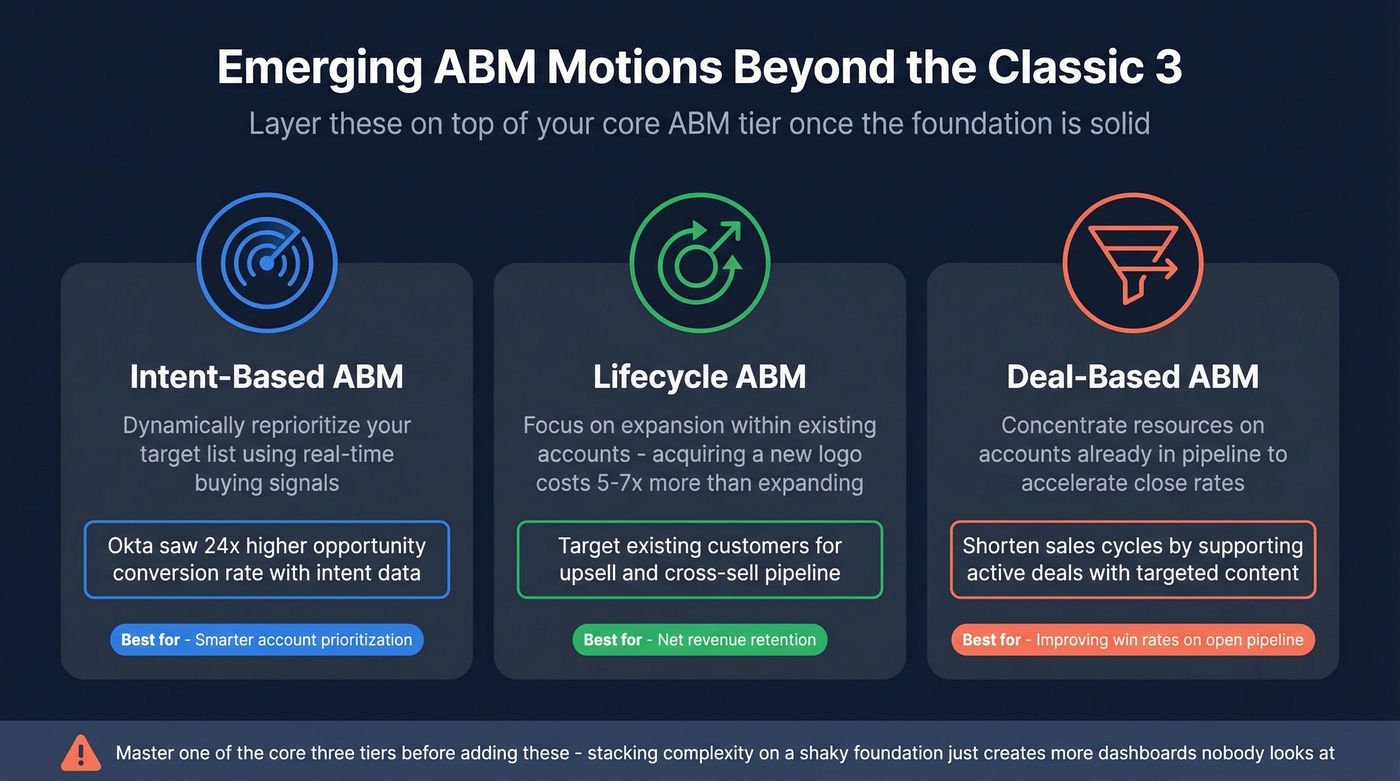
Intent-based ABM dynamically reprioritizes your target list based on real-time buying signals - Okta reported a 24x higher opportunity conversion rate after layering intent data into account selection. Lifecycle ABM focuses on expansion within existing accounts, which makes sense given that acquiring a new logo costs 5-7x more than expanding an existing one. Deal-based ABM concentrates resources on in-pipeline accounts to accelerate close rates rather than generate new pipeline.
Our advice: master one of the core three before bolting on advanced motions. Stacking complexity on a shaky foundation just creates more dashboards nobody looks at.
Data Quality Makes or Breaks Every ABM Type
Every ABM tier depends on reaching the buying committee at each target account - typically 6-10 decision-makers. If you can't get verified emails and direct dials for those people, your beautifully segmented campaign dies in the inbox.
This is where we've seen teams waste the most money. They'll spend $200K on a 1:Few program with gorgeous content, then send it to outdated email addresses and wonder why engagement is flat. Snyk's team saw bounce rates drop from 35-40% to under 5% after switching to Prospeo for contact data, with AE-sourced pipeline up 180% and 200+ new opportunities per month. That's the difference accurate data makes at scale.

Snyk ran ABM with 50 AEs and saw bounce rates drop from 35% to under 5% after switching to Prospeo - pipeline up 180%, 200+ new opportunities per month. Whether you're running 1:1 plays on whale accounts or programmatic campaigns across 1,000 targets, bad data kills ROI faster than picking the wrong tier.
Stop wasting ABM budget on emails that bounce.
ABM Tools and What They Cost
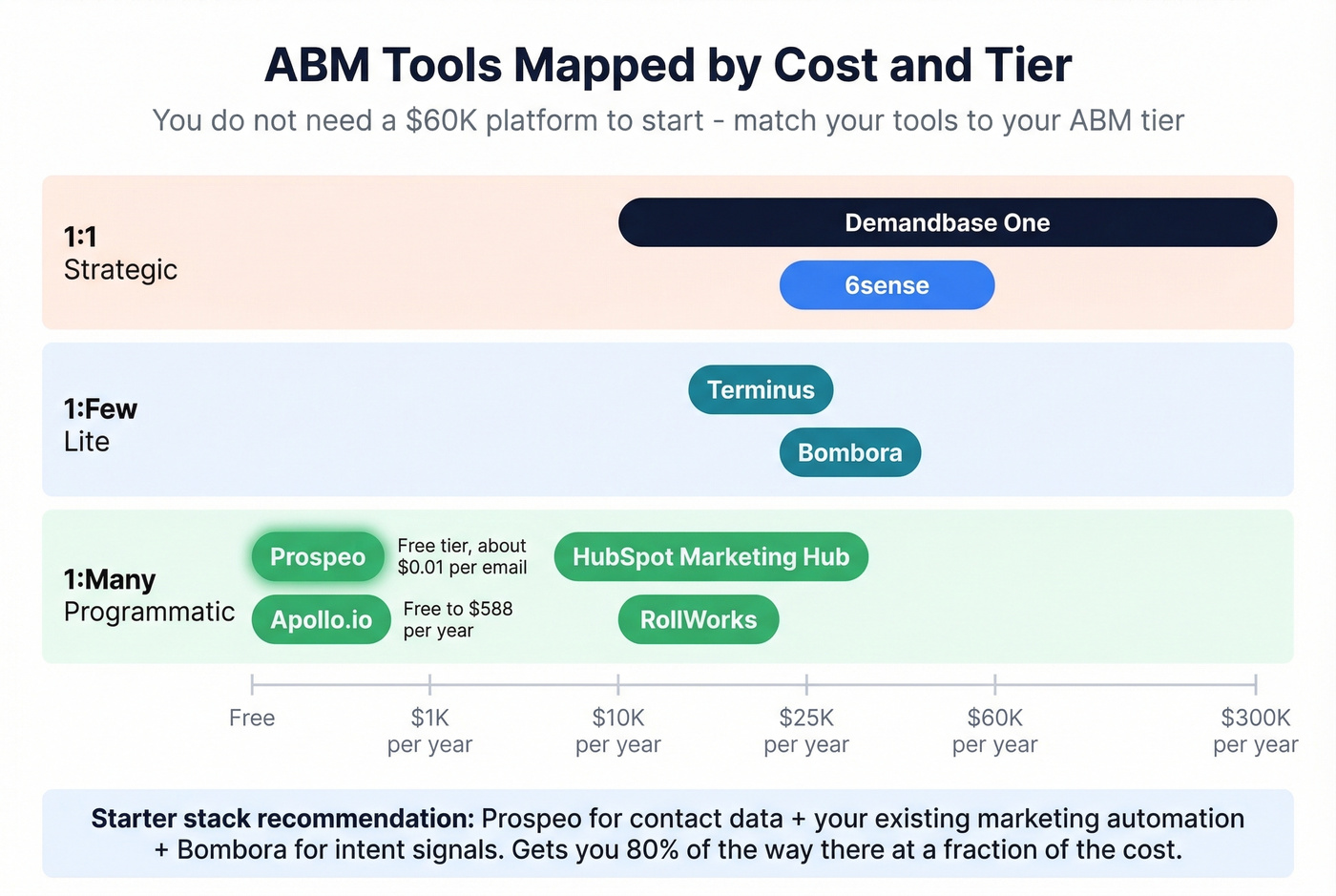
The tool you need depends on which ABM approach you're running. Enterprise platforms handle orchestration, intent, and advertising for 1:Few and 1:1 programs. For programmatic ABM, lighter tools paired with strong contact data get the job done at a fraction of the cost.
If you're evaluating vendors, start with a shortlist of SDR tools and outbound lead generation tools that match your tier and team size.
| Tool | Category | Starting Price |
|---|---|---|
| Demandbase One | Full ABM platform | ~$18K-$300K/yr |
| 6sense | Intent + orchestration | ~$30K-$60K/yr |
| Prospeo | Contact data + intent | Free tier / ~$0.01 per email |
| Bombora | Intent data | ~$25K/yr |
| Terminus | ABM ads + orchestration | ~$2K/mo |
| RollWorks | ABM ads | ~$1K/mo |
| HubSpot Marketing Hub | Marketing automation | $800/mo |
| Apollo.io | Prospecting + data | Free / $49/mo |
Let's be honest: if you're launching your first programmatic ABM program, you don't need a $60K/year platform. We've built successful programs using Prospeo for contact data, an existing marketing automation tool for sequences, and a Bombora subscription for intent signals. That stack gets you 80% of the way there for a fraction of the cost. Save the big platform spend for when you've proven the motion works.
If email is your primary channel, it’s also worth tightening up email deliverability and monitoring email bounce rate as you scale.
FAQ
What's the most common type of ABM?
One-to-many (programmatic) ABM is the most widely adopted tier. It has the lowest barrier to entry at $100K-$300K/year and works with just 1-2 marketers plus automation. Most organizations start here before graduating to more personalized approaches.
Can you run multiple ABM tiers at once?
Yes. Most mature organizations run a blended model: 1:Many as the base, 1:Few for mid-tier clusters, and 1:1 for the highest-value accounts. Layering all three lets you match spend to deal size and avoid over-investing on low-ACV targets.
What data do you need before launching ABM?
Verified emails and direct dials for 6-10 decision-makers at each target account. Without accurate contact data, no ABM tier will perform - your campaigns simply won't reach the buying committee.
How do you measure ABM ROI across different tiers?
Track pipeline influenced, deal velocity, and win rate per target account - not just MQLs. For 1:1 programs, measure revenue per account against campaign cost. For programmatic, track engagement-to-opportunity conversion across your full target list.