


Uberflip Pricing, Reviews, Pros and Cons: The 2026 Buyer's Brief
Your renewal is coming up, and the platform you've been using has changed hands twice in under two years. PathFactory acquired Uberflip in July 2024. Now Kaltura is acquiring PathFactory for roughly $22M, expected to close Q2 2026. That's two ownership changes and a product positioned for maintenance and bug fixes - not new development. This breakdown covers what that means for your stack and your budget.
The Short Version
- Existing customer? Negotiate hard - flat pricing, no uplift. Start planning a migration on a 12-18 month horizon.
- Net-new buyer? Skip Uberflip. Evaluate PathFactory or Folloze instead.
- Small team under $20K? You don't need a dedicated content experience platform. Period.
What Uberflip Actually Costs
Uberflip doesn't publish pricing. It's custom and sales-led. But Vendr's benchmark data gives us real contract numbers to work with.
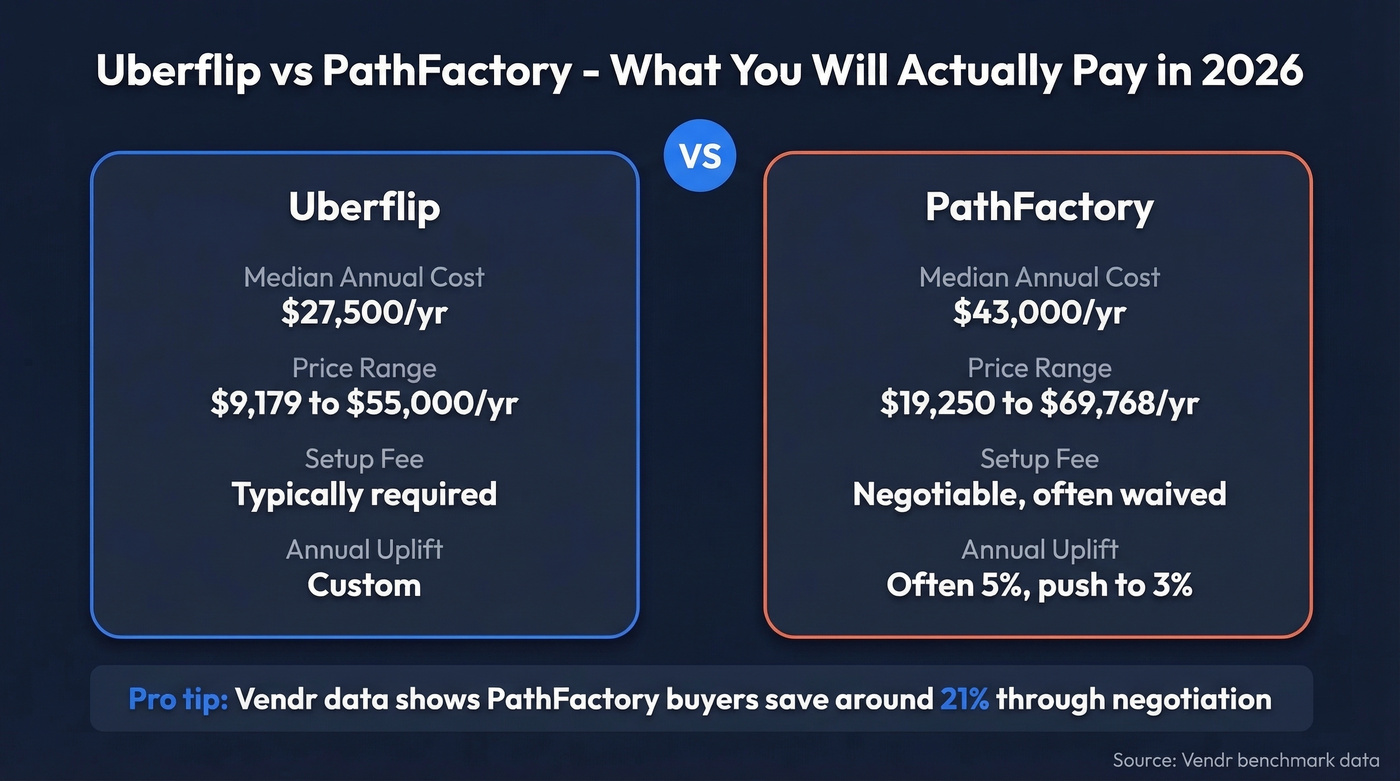
| Uberflip | PathFactory | |
|---|---|---|
| Median annual cost | $27,500/yr | $43,000/yr |
| Range | $9,179-$55,000/yr | $19,250-$69,768/yr |
| Setup fee | Typically required | Negotiable, often waived |
| Annual uplift | Custom | Often 5%, some buyers push to 3% |
PathFactory costs more - $43,000/year median - but comes with stronger analytics and better product direction. Vendr data shows PathFactory buyers save around 21% through negotiation, so don't accept the first quote.
Reddit threads regularly ask how Uberflip justifies premium pricing against lighter alternatives. Fair question. If you're renewing, your strongest levers are flat renewals with no uplift, implementation fee waivers, and quarterly account reviews baked into the contract. The product is in maintenance mode, which means you have more leverage than usual.
If you want a deeper list of options before you renew, start with our breakdown of Uberflip alternatives.
Pros and Cons from Real Users
Uberflip carries a 4.2/5 on G2 across 341 reviews and a 4.4/5 on Capterra from 170 reviews. Here's what patterns emerge when you read beyond the star ratings.
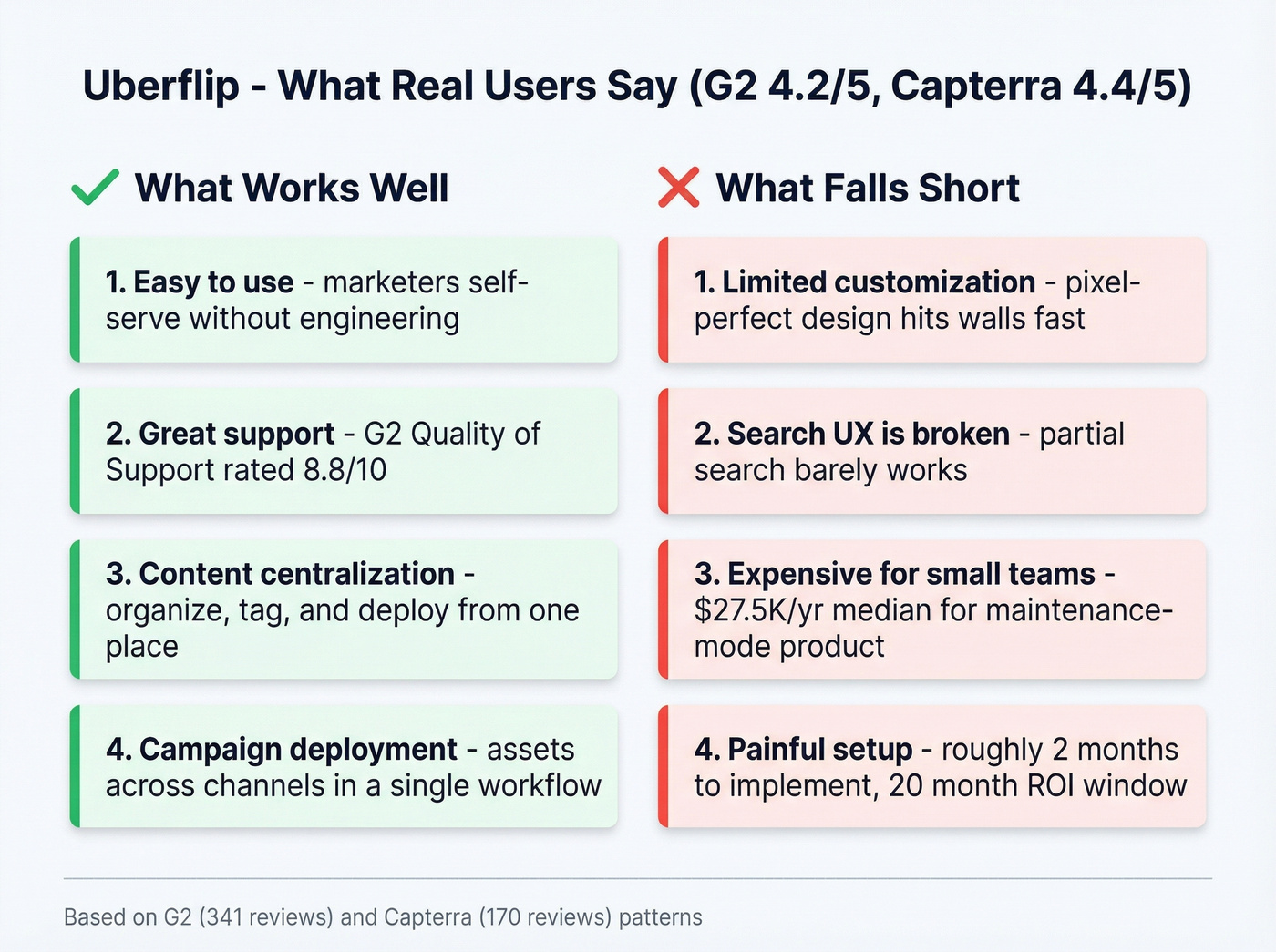
What works well:
- Genuinely easy to use once set up. Marketers self-serve content hubs without engineering help.
- Support scores high - G2 Quality of Support sits at 8.8 - even post-acquisition.
- Content centralization remains the core strength: organizing, tagging, and deploying assets across campaigns in one place.
What doesn't:
- Limited customization. If you need pixel-perfect design control, you'll hit walls fast.
- Search UX frustrates users. TrustRadius reviewers flag that partial search barely works unless you type the full item name.
- Expensive for small teams. A $27,500/year median is hard to justify for a lean marketing org running a product that's no longer being actively developed.
- Setup is painful. G2 benchmarks show roughly two months to implement and a 20-month ROI window - optimistic for teams without a mature content library already in place.
Some directories list a "Basic" plan starting at $0.01/month, but there's no feature or limit detail alongside that number. We wouldn't put stock in it.
If you're trying to connect content engagement to outreach, you’ll also want a clean contact layer - see our guide to data enrichment services.

Uberflip costs $27K+/yr to organize content. But content engagement without contact data is just a dashboard. Prospeo gives you 98% accurate emails and 125M+ verified mobiles for the people actually consuming your content - starting at $0.01/email with no contract.
Stop paying $27K to watch people read. Start reaching them.
The Roadmap Problem
Let's be honest about the pattern here. Uberflip acquired SnapApp in December 2019. By the end of July 2022, SnapApp was discontinued - roughly 2.5 years from acquisition to end-of-life. There's no guarantee Uberflip follows the same timeline, but the precedent is hard to ignore.
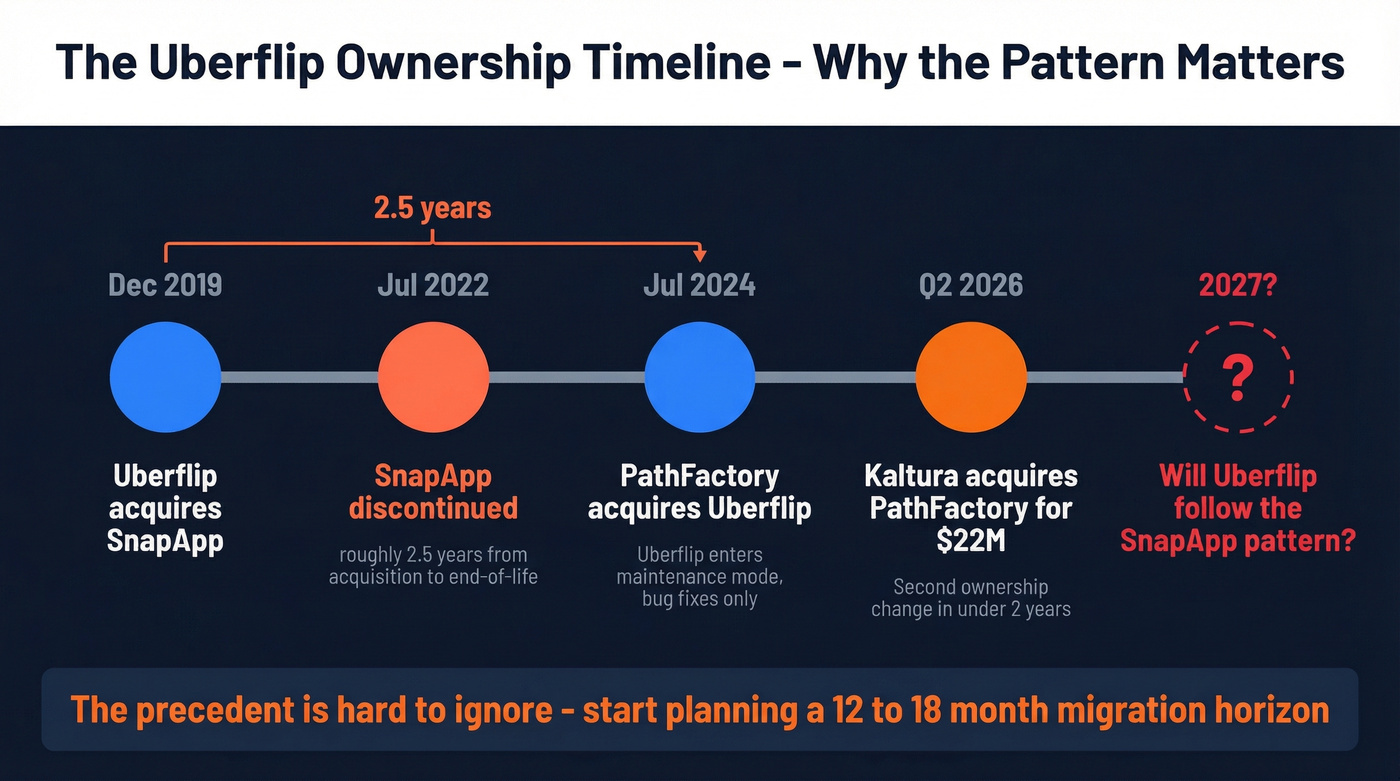
Diginomica reported that Uberflip would receive basic maintenance and bug fixes only - no new development, no platform merge. Then Kaltura entered the picture. Star ratings from 2019 aren't useful for a 2026 purchasing decision. The acquisition context is the review.
Forrester notes that 33% of B2B orgs already use 7-10 tools just for personalization. Adding a maintenance-mode platform to that stack isn't consolidation - it's technical debt.
If you're negotiating renewal terms, it helps to understand the anchor in negotiation and set a clear walk away point before procurement gets involved.
Uberflip vs. PathFactory
The head-to-head comparison makes this straightforward.
| Metric | Uberflip | PathFactory (201 reviews) |
|---|---|---|
| Overall rating | 4.2/5 | 4.4/5 |
| Product direction | 8.1 | 9.1 |
| Quality of support | 8.8 | 9.4 |
Reviewers on G2 rate PathFactory higher on product direction, support, ease of use, setup, and administration. For net-new buyers, PathFactory is the stronger choice.
But the Kaltura acquisition adds uncertainty there too. If you go PathFactory, negotiate contractual protections: price locks, support SLAs, and migration assistance clauses. Don't assume the product roadmap survives the transition intact.
If your team is already overloaded with tools, it’s worth auditing your marketing enablement stack before adding another platform.
What to Do Instead
Analytics-first teams: PathFactory at around $43K/yr median. Best content intelligence in the category, but watch the Kaltura transition closely.
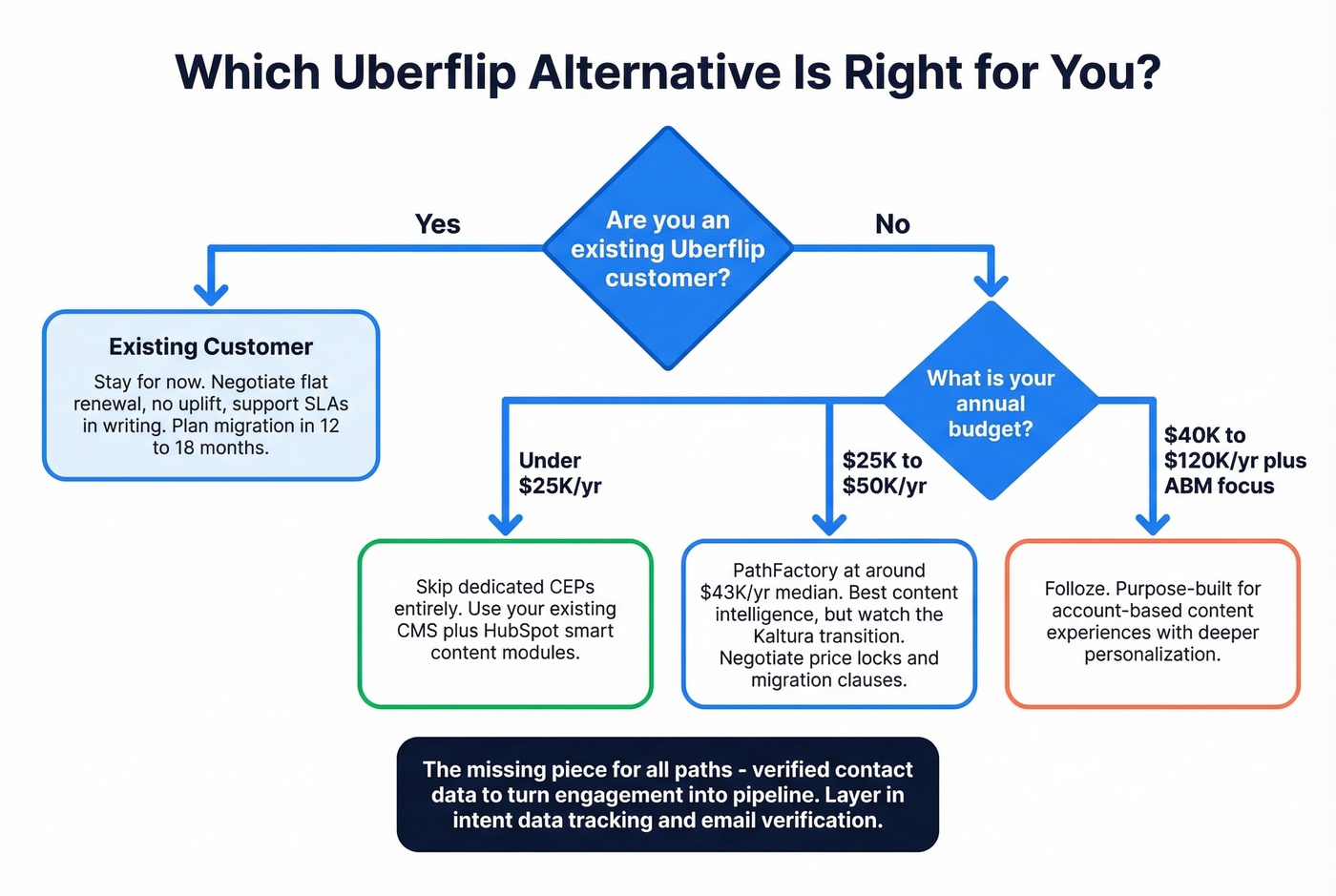
ABM-first teams: Folloze, roughly $40K-$120K/yr. Purpose-built for account-based content experiences with deeper personalization controls.
If you're in the HubSpot ecosystem, Marketing Hub ($15K-$60K/yr) isn't a dedicated content experience platform, but smart content modules and landing pages cover 80% of what most teams actually use Uberflip for. Teams spending under $25K annually should skip dedicated CEPs entirely and use their existing CMS.
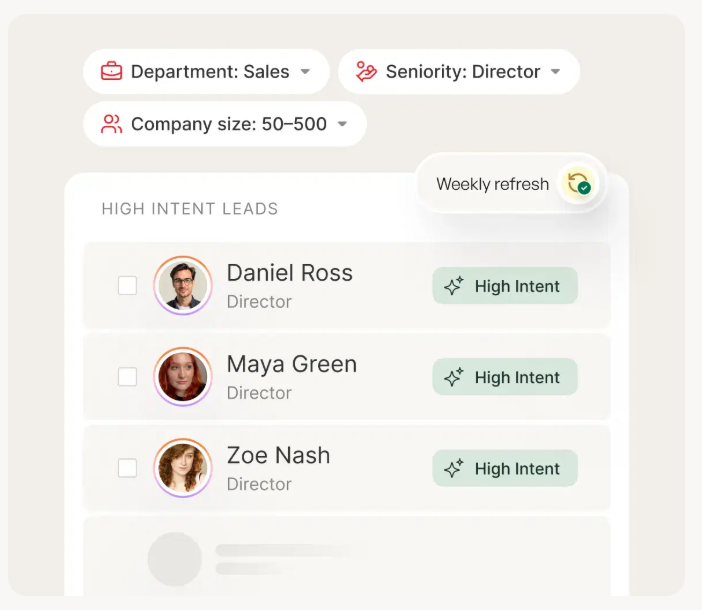
Here's the thing content experience reviews always skip: the gap between "someone read your whitepaper" and "someone booked a meeting" is contact data. Knowing an account is engaged means nothing if you can't reach the right person. Prospeo bridges that gap - 98% email accuracy, a 7-day data refresh cycle, and a free tier that requires no contract. Layer in intent data tracking 15,000 topics via Bombora, and you're turning content engagement into pipeline, not just dashboards.
If you’re building outbound around those engagement signals, pair it with proven sales prospecting techniques and a reliable sales prospecting database.
Bottom Line
Existing Uberflip customers should stay for now. Negotiate aggressively - flat renewal, no uplift, support SLAs in writing. Start evaluating alternatives on a 12-18 month migration horizon.
Net-new buyers: don't buy Uberflip. Full stop. Evaluate PathFactory if you need a dedicated CEP, or pair HubSpot with a verified contact data provider for content delivery and outbound. A maintenance-mode product that still hides pricing behind "contact sales" - buyers deserve better than that in 2026.
If you need help turning engagement into meetings, keep a set of sales follow-up templates ready for the handoff.
Evaluating CEP alternatives? The real gap isn't content delivery - it's connecting engagement signals to real buyers. Prospeo tracks 15,000 intent topics via Bombora and pairs them with verified contact data refreshed every 7 days, not every 6 weeks.
Turn content engagement into pipeline with data you can trust.