

Best Unlimited Email Trackers in 2026 (Free & Paid)
You sent 50 cold emails yesterday. Your unlimited email tracker says 35 were opened. Feels great - until you check replies and clicks: seven. That's a 14% engagement rate wearing a 70% costume. Apple Mail accounts for 46% of email clients, and its Mail Privacy Protection pre-fetches tracking pixels before anyone reads a thing, generating phantom opens that inflate your dashboard. The tracker isn't broken. It's measuring something that stopped meaning what you think it means.
The real question isn't which tool gives you unlimited opens. It's which tools give you data you can actually trust - starting before you hit send.
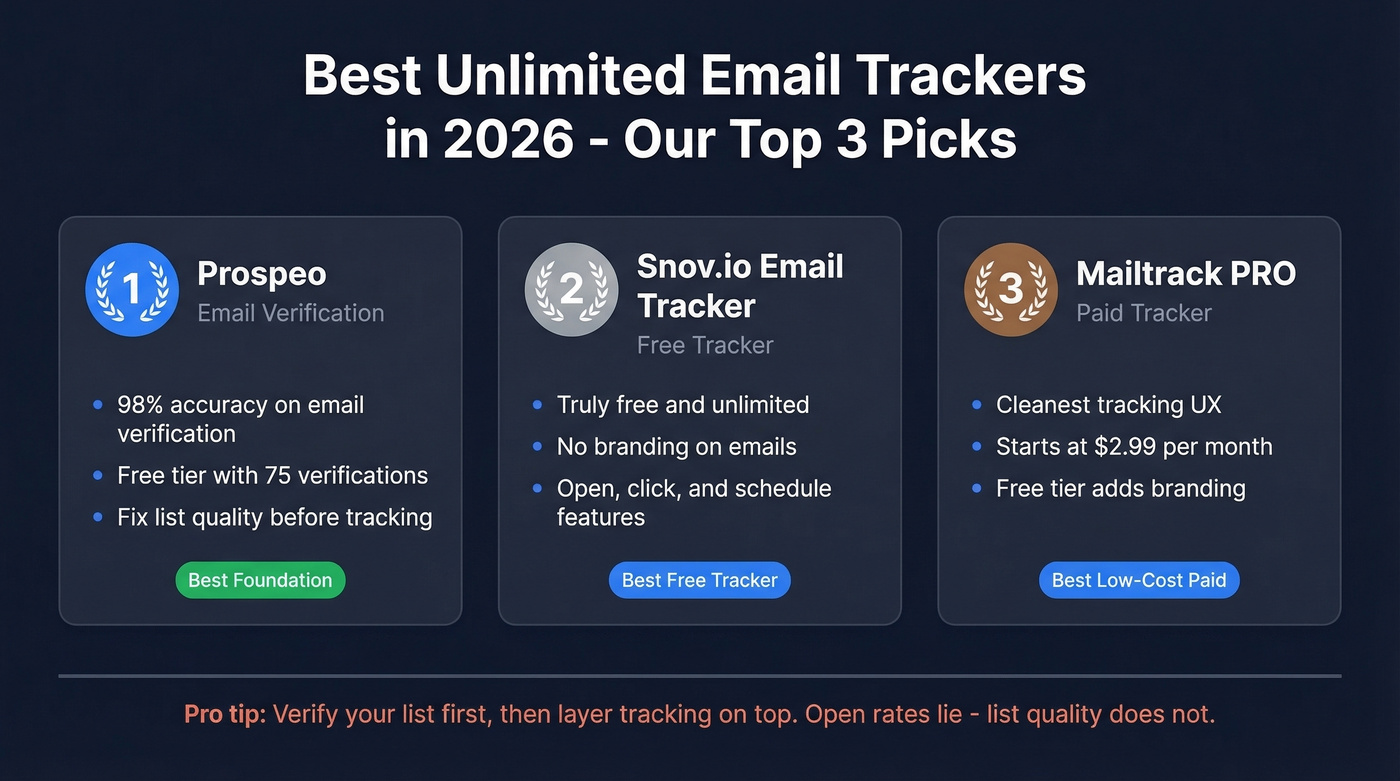
Our Picks (TL;DR)
| Pick | Tool | Why |
|---|---|---|
| #1 | Prospeo | Verify every email before you track it. 98% accuracy, free tier. |
| #2 | Snov.io Email Tracker | The only truly free and unlimited Gmail tracker - no branding, no caps. |
| #3 | Mailtrack PRO | Cleanest tracking UX at a low monthly price. Free tier adds branding. |
Here's the thing: most teams obsess over open tracking when their real problem is list quality. If 10-15% of your addresses are invalid, your bounce rate tanks sender reputation, your tracking data fills with noise, and deliverability spirals. Fix the inputs first. Layer tracking on top.
What "Free and Unlimited" Actually Gets You
Most "free unlimited email trackers" aren't free, aren't unlimited, or aren't both. The marketing language is deliberately misleading, so let's break down what you actually get.
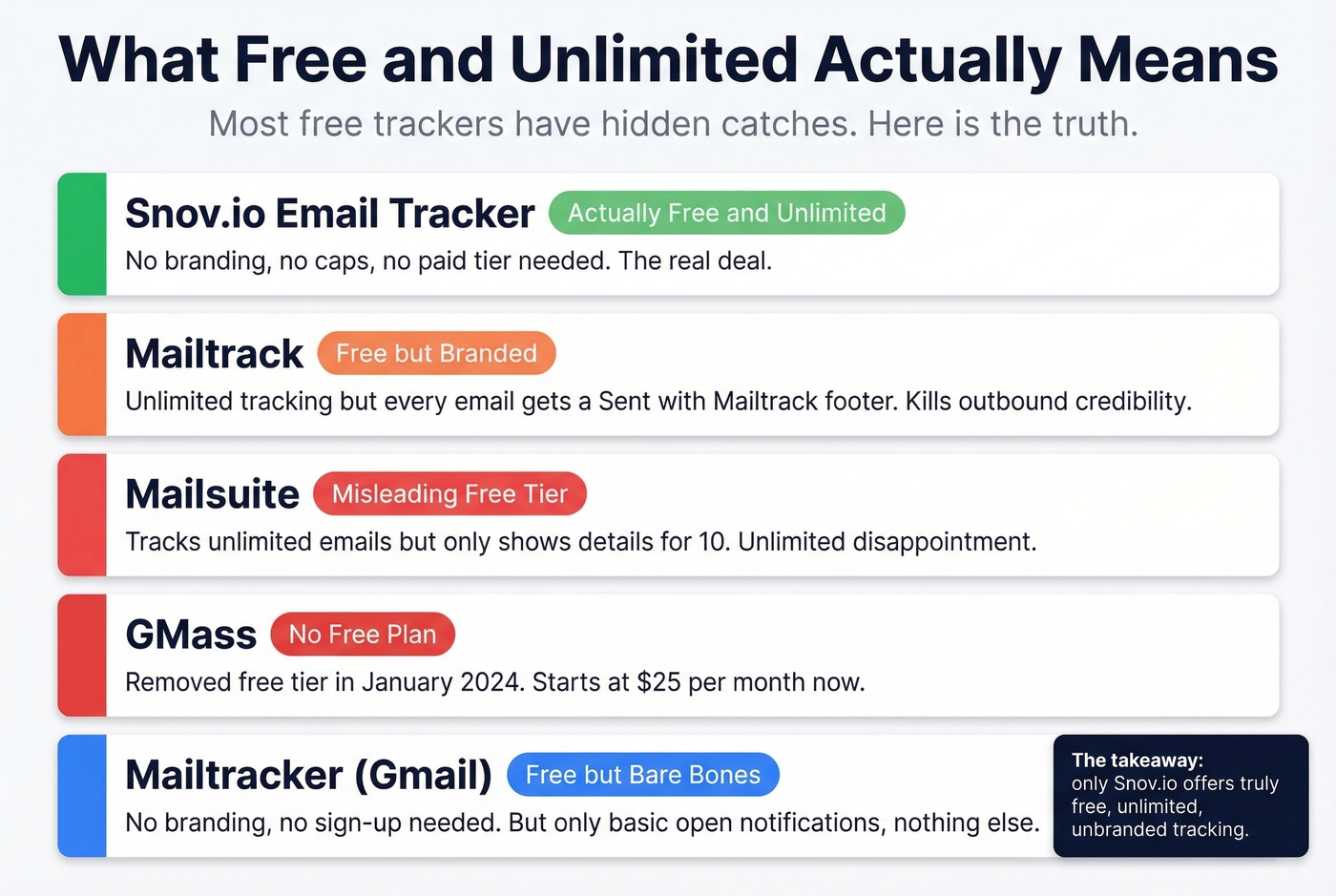
Mailsuite is the worst offender. Its free tier technically tracks "unlimited" emails - but caps open and click details to just 10 emails. You can track a thousand emails. You just can't see open/click analytics beyond the first ten. That's not unlimited tracking; it's unlimited disappointment. The ADV plan at $11.99/user/month unlocks full analytics, but by then you're paying more than simpler paid trackers like Mailtrack.
Mailtrack offers a genuinely functional free tier, but it appends branding to every tracked email. If you're doing outbound sales, a "Sent with Mailtrack" signature tells your prospect you're tracking them. Dealbreaker for most sales teams.
Mailtracker (Gmail) is a separate tool from Mailtrack that Reddit users occasionally praise for offering no branding and unlimited tracking without requiring sign-up. It's fine if you literally just want basic open notifications and nothing else.
GMass removed its free plan entirely in January 2024. It's $25/mo minimum now - positioned as a mail merge tool with tracking bolted on, not a standalone tracker.
That leaves Snov.io Email Tracker as the only genuinely free and unlimited option with a real feature set. No branding, no caps on tracked emails, no paid tier required for the tracker itself. Salesflare's independent comparison confirms this, though their testing flagged weaker deliverability results compared to paid alternatives. Free comes with tradeoffs.
Why Open Tracking Is Broken
Apple's Mail Privacy Protection launched in September 2021 and fundamentally changed what open tracking can tell you. MPP pre-fetches tracking pixels on Apple's servers before the recipient ever sees the email, generating a "machine open" that looks identical to a real one in your tracker.
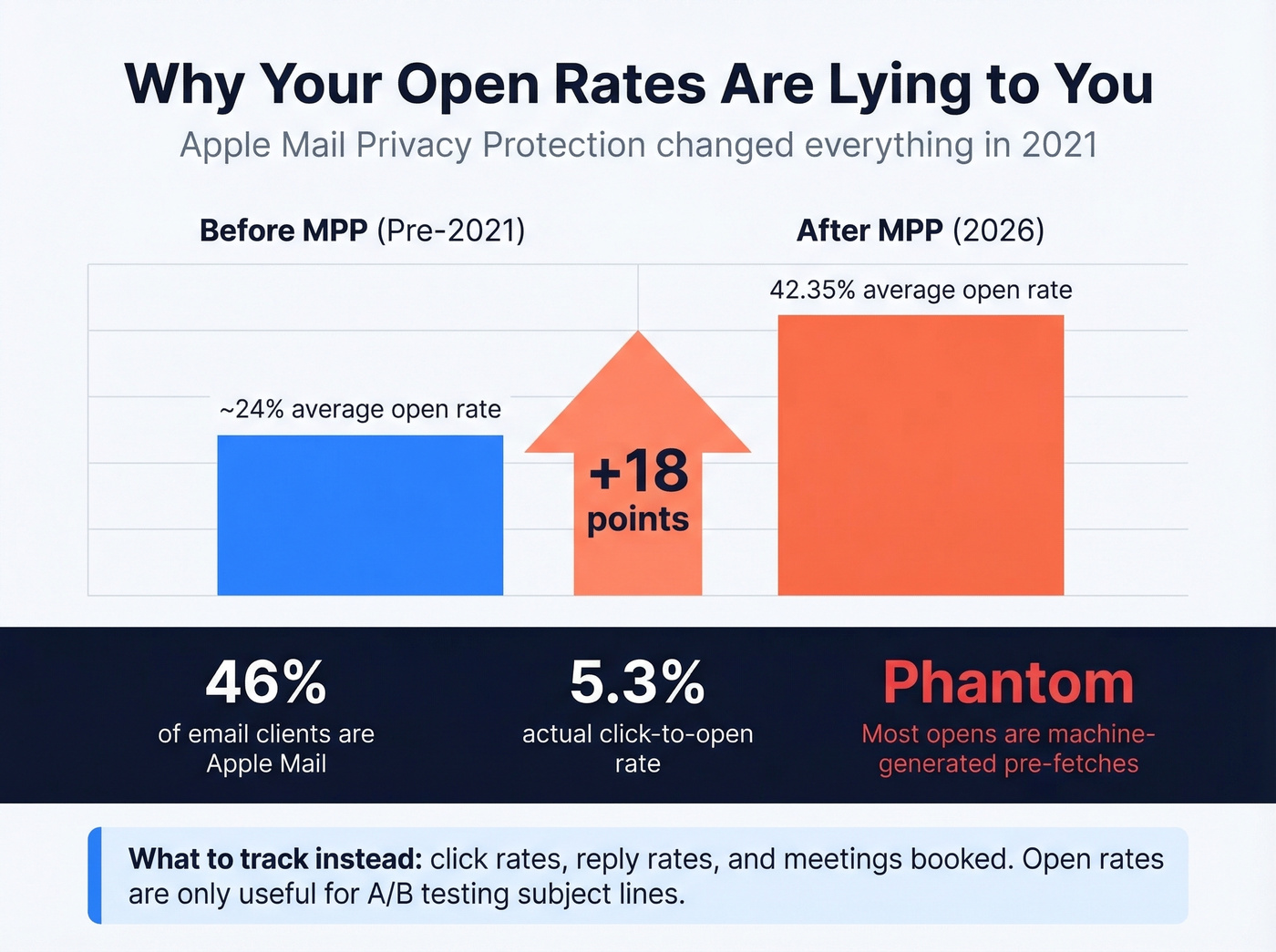
The numbers are stark. A study of 80,000+ email marketing accounts found open rates jumped 18 points in the six months after MPP launched, settling above 40%. The current average open rate across industries sits at 42.35%, but the average click-to-open rate is just 5.3%. That gap tells you most of those "opens" aren't humans reading your email.
And it's getting worse. iOS 18 introduced Link Tracking Protection, which strips tracking parameters like UTMs from links in Mail and Safari. Even click tracking - the more reliable signal - is losing fidelity for Apple users.
We'll say it plainly: if you're an SDR manager making decisions based on open rates in 2026, you're flying blind for around half your recipients. We've watched teams restructure entire sequences around "high open" subject lines that were really just Apple Mail phantom data. Prioritize click rates, reply rates, and meetings booked. Open tracking is directionally useful for A/B testing subject lines, but it's not a reliable engagement metric anymore.

Open tracking is broken - but bounces are preventable. Prospeo verifies emails at 98% accuracy before you send, so your tracker measures real engagement instead of phantom opens stacked on top of invalid addresses. At $0.01 per email, cleaning your list costs less than one wasted follow-up.
Fix your inputs first. Verify 75 emails free - no credit card required.
Full Comparison Table
| Tool | Free Tier | Paid Price | Gmail / Outlook | Best For |
|---|---|---|---|---|
| Snov.io Tracker | Unlimited, no branding | Free forever | Gmail only | Best free tracker, period |
| Mailtrack | Unlimited, with branding | $2.99/mo (annual) | Gmail only | Best low-cost paid tracker |
| Mailsuite | 10 email details | $11.99/mo ADV | Gmail only | Tracking a handful of VIP emails |
| Streak | Basic tracking | $15-$59/mo | Gmail only | Solo founders who need CRM + tracking |
| Mixmax | With branding | $29/mo | Gmail only | Sequences + tracking in one tool |
| Yesware | Trial only | $15-$65/mo | Gmail + Outlook | Sales teams needing Outlook support |
| GMass | None (removed) | $25/mo | Gmail only | Bulk mail merge campaigns |
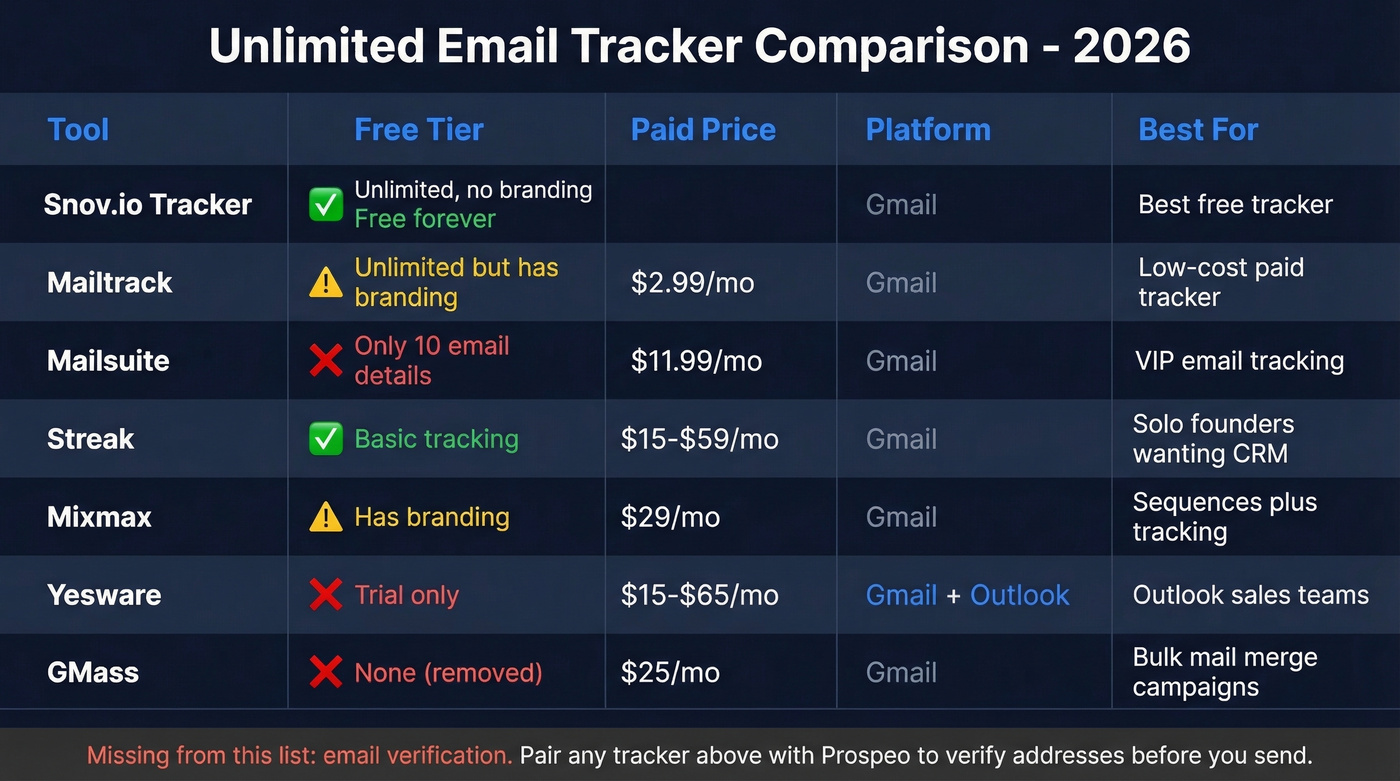
Note: Prospeo is an email verification tool, not a tracker. It pairs with any tracker above to ensure you're sending to valid addresses before tracking begins. If you want the mechanics behind pixels and how they’re detected, see our guide to email tracking.
The Best Trackers, Reviewed
Snov.io - Best Free Tracker
4.9 stars, 100K+ users, 8,000+ five-star reviews on the Chrome Web Store. Those numbers aren't inflated - Snov.io's tracker is the rare tool that's genuinely free with no asterisks. No branding appended to emails, no cap on tracked emails, no paid tier required.
You get open and click tracking, real-time desktop notifications, full open history, follow-up reminders, and email scheduling up to three months out. The invisible tracking pixel works like any other - recipients won't see it unless they inspect the HTML source.
The tradeoff is deliverability. Independent testing flags weaker results compared to paid alternatives, and practitioners echo this for high-volume senders. If you're sending 20-50 emails a day as an individual rep, it's hard to beat free. But if you're running tracking at scale, the shared infrastructure risk becomes real - more on that in the deliverability section below. If you’re scaling outreach, pair tracking with an email deliverability checklist.
Mailtrack - Simplest Paid Tracker
Reddit's cold email communities have a soft spot for Mailtrack, and we get why. The paid experience is genuinely clean - it removes the branding signature and adds link click tracking. It stays out of your way, which is exactly what a tracker should do.
The free tier is functional but comes with that "Sent with Mailtrack" footer on every email. For internal communication or personal use, that's fine. For outbound sales, it's a non-starter. Mailtrack is also CASA-compliant with yearly security reviews, which matters when your IT team starts asking questions.
Pros: Dead-simple UX, low-cost paid plan removes friction, CASA-compliant security. Cons: Free tier branding kills it for sales, Gmail-only, no sequences or automation.
Mailsuite - "Unlimited" with a Catch
Mailsuite markets "unlimited tracking" on its free tier, and technically that's true - you can track as many emails as you want. But open and click details are capped at 10 emails. After that, you know emails are being tracked, but you can't access full analytics.
The ADV plan at $11.99/user/month removes the cap and unlocks 60K emails/month for campaigns. At that price, you're paying more than Mailtrack for a worse pure-tracking experience. Skip this unless you specifically need Mailsuite's campaign features.
Streak - CRM + Tracking Combo
Streak lives inside Gmail as a lightweight CRM with tracking bundled in. The free tier includes basic email tracking alongside pipeline management, which makes it uniquely useful for solo founders or small teams who want deal tracking and email tracking in one place without switching tabs.
Paid plans run $15-$59/mo and add mail merge, shared pipelines, and advanced reporting. Gmail-only, no Outlook support. If you already have a CRM, Streak's tracking alone doesn't justify the install - grab Snov.io's free tracker instead. If you’re comparing CRMs, start with these examples of a CRM.
Mixmax - Tracking + Sequences
Mixmax bundles tracking with email sequences, templates, and scheduling - it's more of a productivity layer than a pure tracker. Free tier includes tracking but adds branding. Paid plans start around $29/mo and unlock sequences. The consensus on r/sales is that Mixmax is the go-to when you want tracking plus basic automation without jumping to a full outbound platform like Outreach or Salesloft. But if you only need tracking, $29/mo is steep for open notifications. If you want more options in this category, see our Mixmax alternatives.
Yesware - For Outlook Teams
Yesware runs $15-$65/mo per user and is built for sales teams that need CRM integrations alongside tracking. It's a common choice for Microsoft-shop sales teams that need Outlook support. Reddit users describe it as "heavy" if all you need is open tracking - it's designed for full sales workflows, not individuals who want a lightweight extension.
GMass - Bulk Campaign Tracking
GMass starts at $25/mo with no free plan. It's a mail merge tool first and a tracker second - best for bulk campaigns sent directly from Gmail with built-in tracking, not for one-to-one sales emails. For teams that need to send tracked emails to multiple recipients in a single campaign, GMass handles it well with native mail merge and group email tracking. For everything else, it's overpriced as a tracker. If GMass is on your shortlist, read our breakdown of GMass email deliverability.
Tracking Across Multiple Inboxes
Most trackers on this list are Chrome extensions tied to a single Gmail account. That's fine for individual reps, but sales teams running outreach across several senders need multi-provider tracking - the ability to monitor opens and clicks from Gmail, Outlook, and custom SMTP accounts in one dashboard.
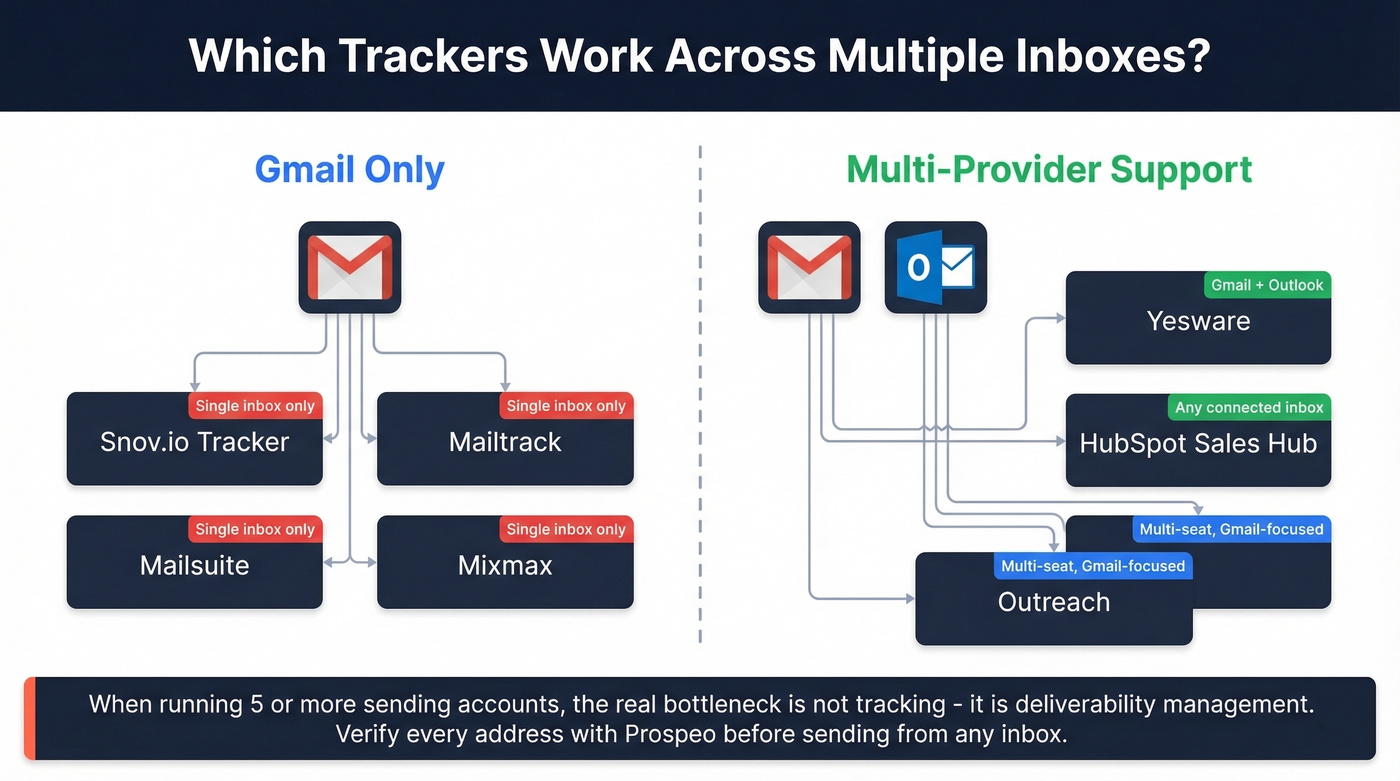
Here's where options thin out fast. Lightweight extensions like Snov.io and Mailtrack don't support tracking across providers. For multi-inbox coverage, you'll need a platform-level tool:
- Yesware supports both Gmail and Outlook, making it the simplest option for teams split across providers.
- HubSpot Sales Hub tracks emails from any connected inbox and rolls data into its CRM - ideal for teams already in the HubSpot ecosystem.
- Mixmax and Outreach offer tracking across multiple seats, though they're Gmail-focused.
When your team runs five or more sending accounts, the real bottleneck isn't tracking - it's deliverability management across all those inboxes. Verify every address before sending from any account, and you'll get cleaner data from whichever tracker you choose. For safe scaling, follow an email velocity plan.
Does Tracking Hurt Deliverability?
This is the question nobody asks until it's too late.
Tracking pixels can trigger spam filters, especially on shared infrastructure where thousands of users send through the same tracking domains. Salesflare's comparison methodology specifically flags tracking domain setup and shared infrastructure as real deliverability risks at lower price tiers. And practitioners echo this concern - if your tracker's domains are already flagged, you can do everything else right and still land in spam.
The fix is straightforward: use a dedicated tracking subdomain if your tool supports it, avoid shared infrastructure at free tiers for high-volume sending, and verify addresses before sending. Prospeo's 5-step verification catches invalid emails, spam traps, and catch-all domains with 98% accuracy, which reduces the bounces that compound deliverability damage from tracking pixels. A 5% bounce rate plus a flagged tracking domain is a recipe for the spam folder. Eliminate the bounces first, then worry about tracking. If you’re troubleshooting, start with email bounce rate benchmarks and fixes.

Every tracker on this list measures what happens after you send. None of them can tell you whether the address is real. Prospeo's 5-step verification catches invalid emails, spam traps, and honeypots before they tank your sender reputation and fill your dashboard with noise.
Stop tracking emails that never land. Start with verified data.
FAQ
Is there a truly free unlimited email tracker?
Yes - Snov.io Email Tracker is genuinely free with no caps, no branding, and no paid tier required. Mailtrack and Mailsuite offer free tiers but add branding or cap analytics to 10 emails respectively. GMass no longer has a free plan.
Can recipients tell I'm tracking their email?
Most trackers use an invisible 1x1 pixel embedded in the email HTML. Recipients won't see it unless they inspect the source code. Some email clients like Apple Mail pre-fetch these pixels automatically, generating false opens rather than blocking them.
Does email tracking work with Outlook?
Most popular trackers - Mailtrack, Snov.io, Streak - are Gmail-only Chrome extensions. For Gmail + Outlook tracking in one tool, Yesware, HubSpot Sales Hub, and Mailbutler support both providers. Teams needing multi-provider coverage should prioritize these platform-level tools over browser extensions.
Why do my open rates seem inflated?
Apple Mail Privacy Protection covers 46% of email clients and pre-fetches tracking pixels, generating fake opens. Open rates jumped 18 points after MPP launched. Prioritize click rates and reply rates - they're the only reliable engagement signals in 2026.
Should I verify emails before tracking them?
Absolutely. Sending to invalid addresses increases bounces, damages sender reputation, and corrupts tracking data. Prospeo's free tier lets you verify 75 emails per month at 98% accuracy - enough to clean a weekly outbound list and ensure your tracker reports real engagement, not noise from dead addresses.