

The Sandler Up-Front Contract: Scripts, Framework, and When It Backfires
It's Tuesday morning. You just wrapped a 45-minute discovery call - great rapport, solid pain uncovering, the prospect even laughed at your joke about their legacy CRM. Then the call ends with "This is really interesting. Let me think it over and circle back next quarter." You hang up knowing that deal is dead. It just doesn't know it yet.
This is the problem the up-front contract in the Sandler methodology was built to kill. 50% more salespeople hit quotas when using the Sandler method compared to those without it, and the UFC is the mechanism that makes the rest of the system work. We've watched reps lose six-figure deals to "let me think about it" - and every single time, there was no upfront contract at the top of the call.
What Is a Sandler Up-Front Contract?
David Sandler created his selling methodology in 1967, and the up-front contract has been its backbone ever since. The formal definition: "two or more people meeting together agree on precisely what will occur" during the meeting - aligning on behavior and expectations before anyone opens a slide deck.
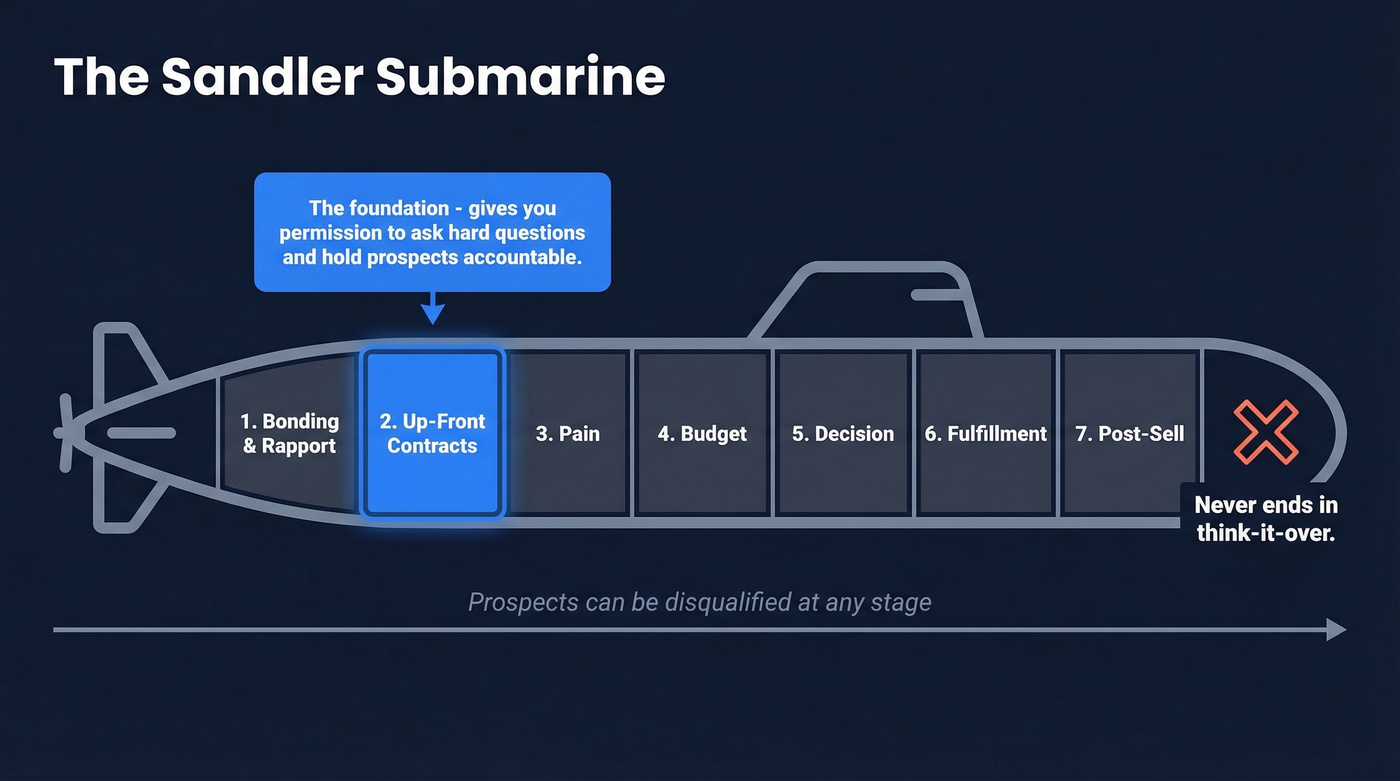
To understand where it fits, picture the Sandler Submarine. The methodology has seven compartments: Bonding & Rapport, Up-Front Contracts, Pain, Budget, Decision, Fulfillment, and Post-Sell. The UFC sits in compartment two, right after rapport and before any qualifying begins. That placement isn't accidental. Without the UFC, the qualifying compartments - Pain, Budget, Decision - collapse into vague conversations that end in "send me some info." The UFC is the foundation that gives you permission to ask hard questions and hold the prospect accountable for a clear answer. Prospects can be disqualified at any compartment, and the process should never end in a "think-it-over."
That's the whole point.
The 5 Elements + ANOT Framework
Every up-front contract covers five elements. Start with Time - it's the easiest agreement and builds momentum before you ask for anything harder.
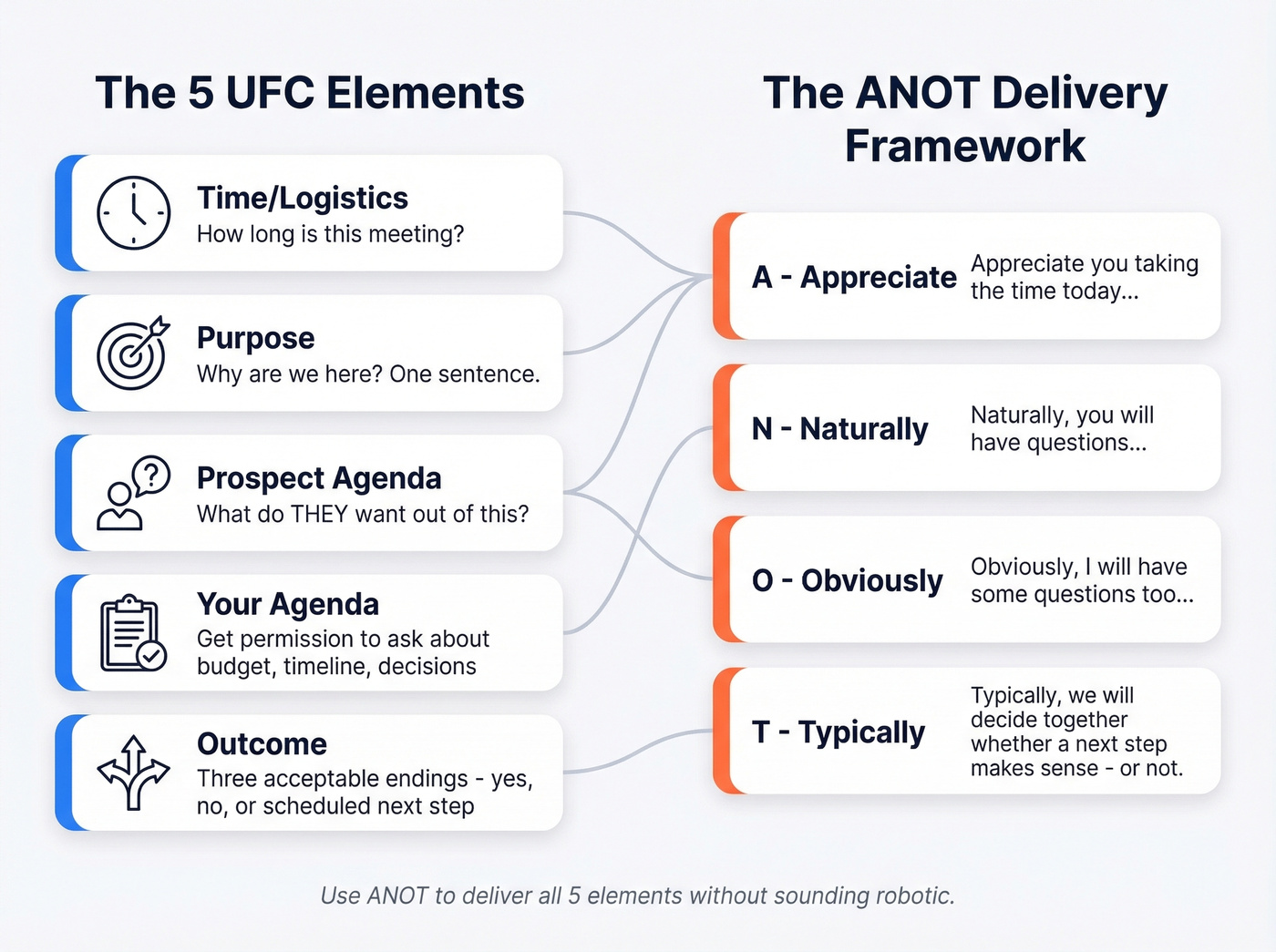
- Time/Logistics: How long is this meeting? "I've got us down for 30 minutes - does that still work for you?"
- Purpose: Why are we here? One sentence that frames the conversation.
- Prospect's Agenda: What do they want out of this? Ask explicitly - don't assume.
- Your Agenda: What will you need to ask about? Get permission upfront to dig into budget, timeline, decision process (and your discovery questions).
- Outcome: What happens at the end? This is where you establish the three acceptable endings.
The ANOT framework is a common structure for delivering UFCs without sounding stiff:
- Appreciate: "Appreciate you taking the time today..."
- Naturally: "Naturally, you'll have questions about how this works..."
- Obviously: "Obviously, I'll have some questions too - about your current process, budget, timeline..."
- Typically: "Typically, at the end of a conversation like this, we'll decide together whether it makes sense to take a next step - or not."
UFCs aren't just for meeting openers. You can drop them in the calendar invite, at the start of a call, or when transitioning to a new topic mid-conversation. Any time expectations need resetting, a mini-UFC works.
Three Acceptable Outcomes
Here's where the UFC earns its keep. There are only three acceptable outcomes from any sales conversation:
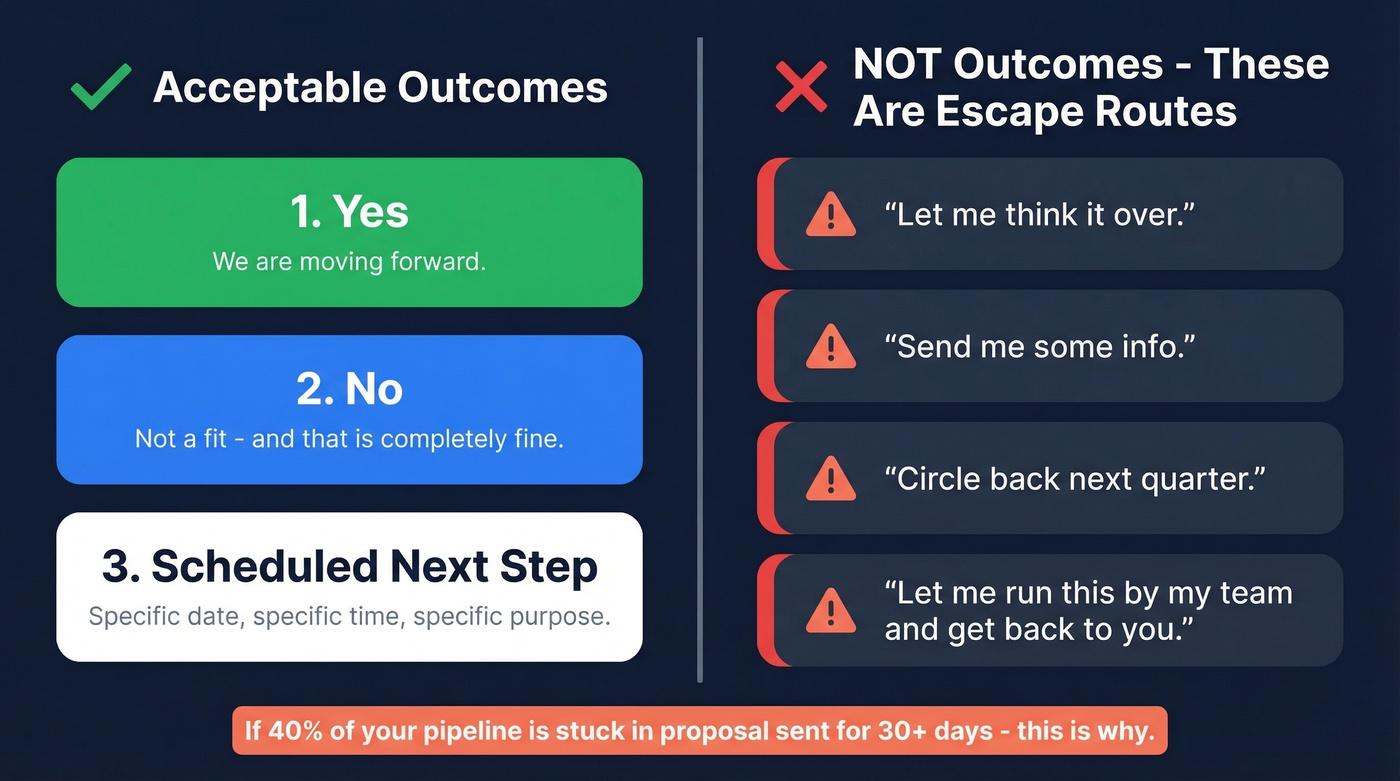
- Yes - we're moving forward.
- No - this isn't a fit, and that's fine.
- A scheduled next step - with a specific date, time, and purpose.
"Let me think about it" isn't on that list. Neither is "send me some info," "circle back next quarter," or "let me run this by my team and get back to you." Those aren't outcomes. They're escape routes.
Here's the thing: if you're a VP of Sales wondering why 40% of your pipeline has been sitting in "proposal sent" for 30+ days, this is probably why. Your reps aren't getting explicit commitments because they never established that explicit commitments were expected. That's not a coaching problem - it's a process problem (and a sales pipeline challenges problem).
Scripts for Every Deal Stage
Cold Call UFC
Keep this to 15-20 seconds. You haven't earned more than that.
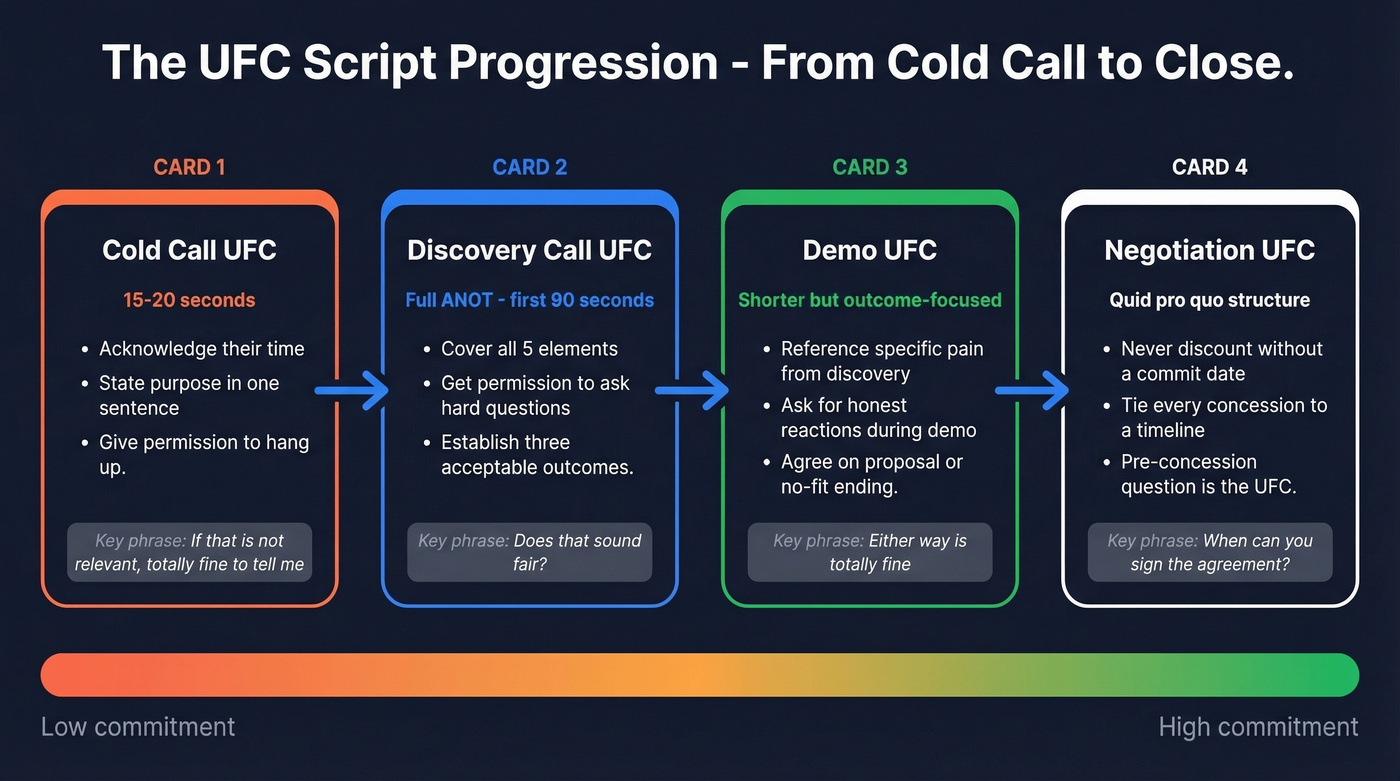
"Hey [Name], this is [You] from [Company]. I know I'm catching you out of the blue - I'll be quick. We help [specific outcome] for [specific persona]. If that's not relevant, totally fine to tell me and I'll let you go. But if it is, can I get 60 seconds to explain why I'm calling?"
Lead with time acknowledgment. State purpose in one sentence. Give them explicit permission to hang up. That permission is what buys you the next minute (and helps reduce cold call rejection).
Discovery Call UFC
This is the full ANOT-based version. Deliver it in the first 90 seconds after small talk.
"Appreciate you taking the time today. Here's what I was thinking for our 30 minutes - and tell me if this works for you. Naturally, you'll have questions about what we do and how it might help with [their stated problem]. Obviously, I'll have some questions too - about your current setup, what's working, what isn't, timeline, and how decisions like this typically get made on your end. By the end of our 30 minutes, we'll decide together whether it makes sense to take a next step - or not. And if at any point you feel this isn't a good fit, feel free to let me know. Does that sound fair?"
The "does that sound fair?" at the end is critical. It's a micro-commitment that locks in the framework.
Demo UFC
Shorter than discovery, but the outcome agreement matters even more here.
"Before we jump in - I want to make sure we're aligned. You mentioned [specific pain from discovery]. I've built this demo around that. I'll walk through [2-3 specific things], and I'd love your honest reaction as we go. At the end, we'll decide together whether a proposal makes sense or whether this isn't the right fit. Either way is totally fine. Sound good?"
Negotiation UFC
Never give a discount without getting a commitment date first. Full stop. If your sales org allows unconditional discounting, the UFC can't save you - your pricing process is broken. The quid pro quo structure is everything here, and the principle comes before the script.
The rule: Every concession you make must be tied to a specific close date. No date, no discount. No exceptions (see anchor in negotiation).
The script:
"I appreciate you working through the details with us. Before we discuss pricing adjustments - if we're able to meet your ask on [specific concession], when can you sign the agreement? I want to make sure any flexibility we offer is tied to a real timeline."
That pre-concession question is the UFC that prevents you from discounting into a void.
Email Follow-Up (Mini-UFC)
Not every UFC happens live. For async settings, a one-liner in writing creates a paper trail that makes ghosting harder.
Weak: "Great chatting today! Let me know if you have any questions. Happy to hop on another call whenever works."
UFC-powered: "Based on our conversation, here's what I'm thinking for next steps: [specific action] by [specific date]. If that doesn't work or you've decided to go a different direction, just let me know - no hard feelings. Does [date/time] work for a 20-minute call to finalize?"
The difference is accountability. The first email gives the prospect infinite room to disappear. The second establishes a clear expectation with a deadline (and pairs well with sales follow-up templates).

An up-front contract only works if you're talking to the right person. Prospeo gives you 98% accurate emails and 125M+ verified mobile numbers so your cold call UFCs actually reach decision-makers - not gatekeepers or dead inboxes.
Stop perfecting your UFC script for prospects you'll never reach.
Why "No Is Fine" Actually Works
Look, telling a prospect "no is fine" feels wrong the first time you do it. Every instinct says you should be pushing toward yes. But the psychology is straightforward - when people feel pressured, they activate defense mechanisms and disengage. When they feel safe to say no, they paradoxically become more willing to say yes. The framework creates what practitioners call "subconscious comfort".
Giving permission to say no eliminates the need for vague brush-offs. A prospect who knows they can say "this isn't for us" without an awkward confrontation doesn't need to hide behind "let me think about it." They either engage honestly or exit cleanly. Both outcomes beat a zombie deal clogging your pipeline for three months (and improve overall pipeline health).
One critical delivery note: you have to genuinely mean it. If "no is fine" comes across as a reverse-psychology trick to pressure a yes, prospects feel it immediately and the trust evaporates.
When the UFC Backfires
The UFC isn't magic, and there's real academic research on why it can go sideways.
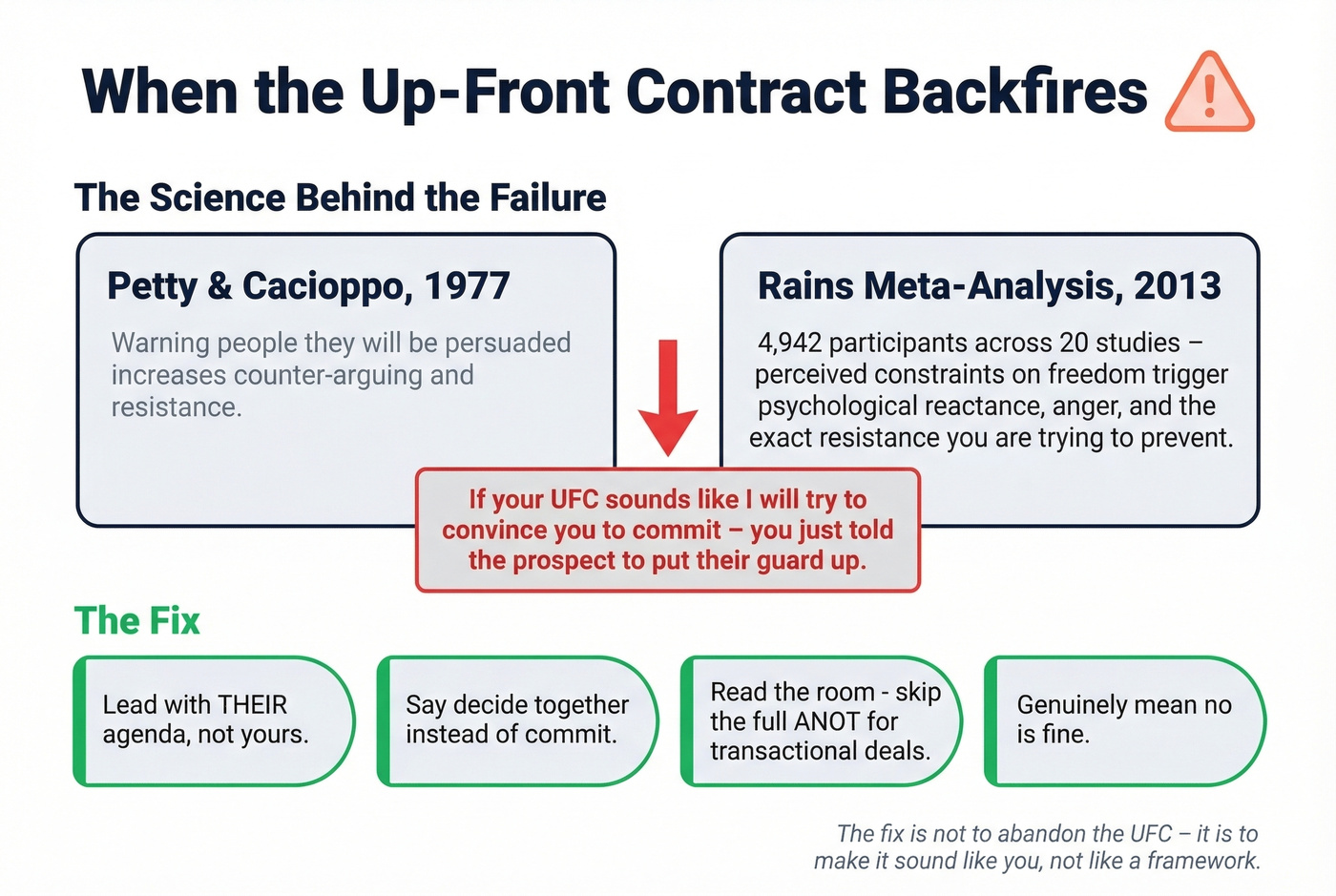
Petty and Cacioppo's 1977 forewarning research showed that warning people they'll be persuaded increases counter-arguing and resistance. A 2013 meta-analysis by Rains covering 4,942 participants across 20 studies found that perceived constraints on freedom trigger psychological reactance - anger, counter-argumentation, and the exact resistance you're trying to prevent.
The specific failure mode: if your UFC sounds like "I will try to convince you to commit by the end of this call," you've just told the prospect to put their guard up. You've framed yourself as a persuader, not a collaborator. In our experience, the UFC fails most often with C-suite buyers who've sat through thousands of sales pitches. They recognize the pattern before you finish your second sentence.
The fix isn't to abandon the UFC. It's to make it sound like you, not like a framework.
Let's be honest - if you're in a transactional motion with a short sales cycle, you probably don't need the full five-element UFC on every call. A 10-second time check and outcome agreement will do. The full ANOT production is built for complex, multi-stakeholder deals where ambiguity kills. For transactional sales, it can feel like bringing a submarine to a kiddie pool.
For complex deals, the mitigation isn't complicated either. Lead with the prospect's agenda, not yours. Soften the outcome language - "decide together" instead of "commit." Read the room. And genuinely mean "no is fine."
UFC by Buyer Persona
Not every buyer responds to the same UFC.
| Buyer Type | UFC Tone | Outcome Language | Watch Out For |
|---|---|---|---|
| Startup Founder | Casual, fast. Skip formalities. | "Want to keep going or kill this?" | They'll say yes to everything and ghost later. Pin down a specific next action. |
| Enterprise Procurement | Formal, process-aware. Acknowledge their buying process. | "Decide on a next step in your evaluation process." | Never ask them to "sign today." Their process won't allow it, and you'll lose credibility. |
| Mid-Market VP | Direct, peer-to-peer. Show you respect their time. | "Figure out together if this is worth a deeper look." | They're evaluating 3-4 vendors simultaneously. Your UFC needs to differentiate, not just structure. |
| Technical Evaluator | Detail-oriented. Let them set the agenda. | "Decide if this warrants a technical deep-dive." | They don't have buying authority. Match your outcome to what they can commit to. |
Enforcing the Outcome Agreement
We've seen teams nail the UFC delivery and then completely fold when the prospect tests it. The prospect says "let me think about it" at the end of the call, and the rep just... lets it happen. That's not a UFC failure. It's an enforcement failure.
Practitioners who stand firm estimate they win 80-90% of those moments. The redirect is straightforward: "Earlier we agreed we'd decide on a next step by the end of this call - are we still on track for that?" Most prospects respect the callback to the agreement they made 25 minutes ago.
The "competency mismatch" mistake kills enforcement too. Asking an enterprise prospect to "sign today" when there's a 0% chance their procurement process allows it - the prospect goes radio silent, and you've lost the deal. Match your UFC outcome to what's actually achievable for the buyer (especially in enterprise B2B sales).
Mistakes That Kill the UFC
Sounding scripted. ANOT is a framework, not a teleprompter. If you're reciting it word-for-word, prospects hear a template, not a person. Internalize the structure, then deliver it in your own voice.
Skipping the UFC when you're excited about a deal. The bigger the opportunity, the more you need the UFC. Excitement makes reps sloppy - they skip the outcome agreement because they don't want to "risk" the deal. That's exactly when zombie pipelines are born.
Using the same UFC for a cold call and a negotiation. A cold-call UFC is 15 seconds. A negotiation UFC involves pre-concession questions and explicit timelines. The buyer persona table above is your cheat sheet.
Not enforcing the outcome agreement. Delivering the UFC and then letting the prospect leave without a clear yes, no, or next step is worse than not using one at all. You set an expectation and then showed the prospect you don't hold people to it. That's a credibility hit you won't recover from.
FAQ
Does the up-front contract sound scripted to prospects?
Only if you deliver it like a script. The ANOT framework gives you structure, not a word-for-word monologue. Adapt the language to your audience - a startup founder and a Fortune 500 procurement lead need completely different tones. After a few dozen calls, it becomes second nature.
Can I use an up-front contract on a cold call?
Yes, but keep it to 15-20 seconds. Acknowledge their time, state your purpose in one sentence, and give them permission to hang up. The full five-element UFC is for scheduled conversations where both sides have committed time.
What if the prospect ignores the agreed outcome?
Redirect them: "Earlier we agreed we'd decide on a next step - are we still on track?" If they dodge again, the deal isn't real. Disqualify and move on. Refilling your pipeline with verified contacts from a tool like Prospeo's database means one lost deal doesn't crater your quarter.
How is the Sandler upfront contract different from other frameworks?
Sandler treats the upfront contract as a mutual agreement, not a closing trick. Other methodologies front-load discovery questions or push for commitment at the end. The Sandler approach establishes rules of engagement before the conversation starts - both sides know what to expect and what's off the table.
Your reps lose deals to "let me think about it" because they're chasing unqualified contacts. Prospeo's 30+ filters - buyer intent, job changes, funding signals - let you build lists of in-market buyers before you ever deliver that opening UFC.
Nail the up-front contract with prospects who are already buying.