

UpLead vs Apollo.io: Which B2B Data Tool Wins in 2026?
Nearly 45% of B2B marketing data is inaccurate. That single stat explains why the accuracy gap in the UpLead vs Apollo.io debate matters more than the feature gap. One tool obsesses over data quality; the other tries to be your entire sales stack. Here's how to pick the right one for your team.
30-Second Verdict
- Pick UpLead if you need verified emails with a 95%+ accuracy guarantee and already run a sending tool like Outreach or Smartlead.
- Pick Apollo if you want prospecting, sequences, a dialer, and Bombora-powered intent data in one platform - and you'll tolerate lower accuracy as the trade-off.
- Skip both if you need 98% email accuracy without credit complexity. Prospeo covers 300M+ profiles on a 7-day refresh cycle and starts free.
Quick Feature Comparison
| Apollo.io | UpLead | Winner | |
|---|---|---|---|
| Database | 275M+ contacts | 160M contacts | Apollo |
| G2 Rating | 4.7/5 (9,514 reviews) | 4.7/5 (824 reviews) | Tie |
| Email Accuracy | ~65-70% (community-reported) | 95%+ guaranteed | UpLead |
| Starting Price | Free / $49/mo | Free trial / $99/mo | Apollo |
| Credit Model | Email/mobile/export metered separately | 1 credit = full contact | UpLead |
| Best For | All-in-one prospecting | Clean, verified data | Depends on stack |
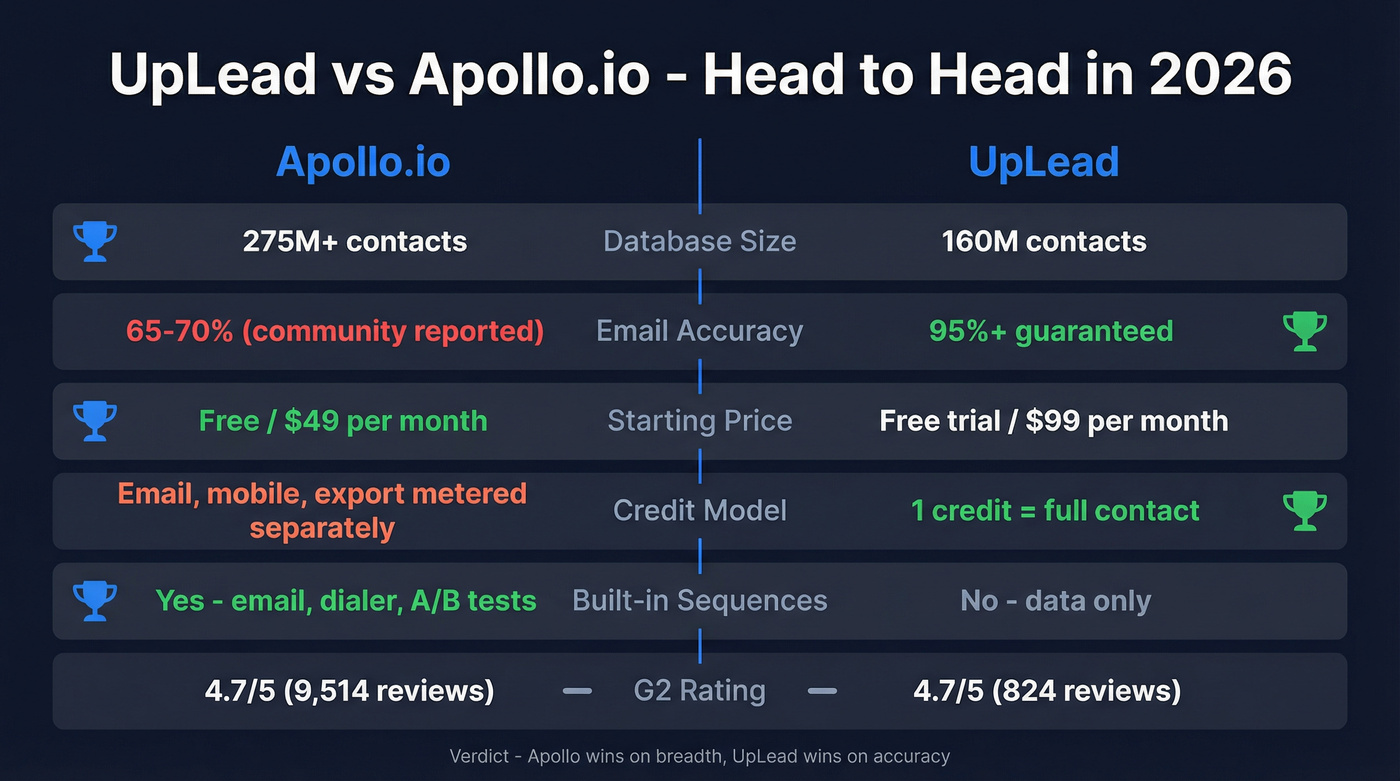
Apollo has 11x the review volume - a reflection of its broader user base, not necessarily better satisfaction.
Data Quality and Accuracy
UpLead verifies emails in real time when you unlock a contact. If an email bounces, you get the credit back. The 95%+ accuracy guarantee is baked into the billing model, not just the marketing page.
Apollo's accuracy is murkier. Community numbers on r/SalesOperations put unfiltered email accuracy around 65-70%. Filter to "verified only" and you'll see 80-91%, but that burns extra credits and shrinks your usable database. The gap between those two numbers is the distance between Apollo's raw database and its verification layer.

Apollo's waterfall enrichment, default since December 2025, checks Apollo's own data first, then pulls from third-party sources - delivering roughly 5% more emails, ~7% more phone numbers, and 45% fewer bounces. Admins pick from three modes: maximize accuracy, maximize coverage, or cost-efficient. Each trades credits for quality differently.
Here's the thing about international data. For teams prospecting outside the US, expect 20-50% bounce rates in some EMEA segments through Apollo. We've seen this firsthand with client campaigns targeting Western Europe. UpLead covers 160M business contacts across 200+ countries, but the accuracy outside North America still varies.
Our take: If your average deal size is under $15k, you probably don't need to agonize over this choice. Export from whichever tool you prefer and run everything through a verification layer before sequencing. At $0.01/email, the verification cost is trivial compared to a torched sending domain.
To protect deliverability, it also helps to track your email bounce rate and keep a close eye on sender reputation as you scale.

You're comparing 95% accuracy against 65-70%. Prospeo hits 98% across 300M+ profiles with a 7-day data refresh - no credit gymnastics, no filtering to "verified only" to get usable data. At $0.01 per email, verification costs less than a single bounced reply costs your domain.
Stop debating accuracy tiers. Start with data that actually lands.
Pricing Breakdown
| Apollo Basic | Apollo Pro | UpLead Essentials | |
|---|---|---|---|
| Monthly | $49/user | $79/user | $99/mo |
| Annual | ~$39/user | ~$66/user | $74/mo (2,040 credits/yr) |
| Credits | 1,000 email + 75 mobile + 10 export | 2,000 email + 100 mobile + 25 export | 170 full contacts |
Apollo also offers an Organization tier at $119/user/mo with a 3-seat minimum, which is where API access lives. UpLead unlocks API access on Professional.
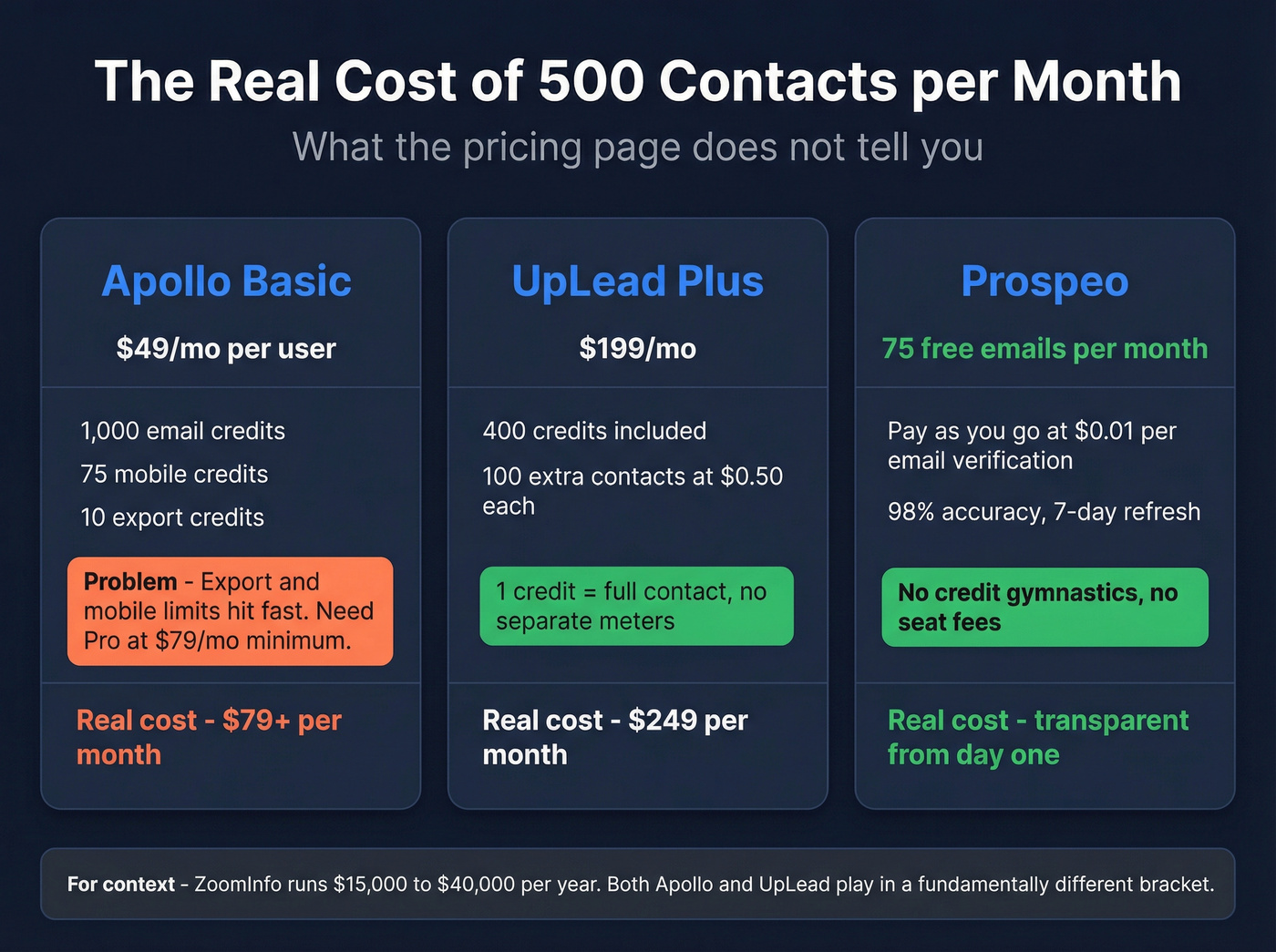
The real math for 500 contacts: On Apollo Basic, you'll exhaust your mobile and export limits fast - you need Professional at minimum. On UpLead Plus ($199/mo for 400 credits), the remaining 100 contacts cost $0.50 each in overage credits, bringing you to $249/mo total. In our testing, Apollo's credit consumption runs higher than the plan page suggests once you factor in mobile and export credits burning separately.
Apollo added per-run and lifetime credit caps for workflows in December 2025. That's a necessary guardrail if you're automating at scale, but it also means your sequences can stall mid-run if you haven't budgeted credits carefully.
For context, ZoomInfo runs $15-40k/year. Both Apollo and UpLead play in a fundamentally different price bracket.
Features That Matter
Where Apollo Wins
Apollo is an all-in-one GTM platform with email sequences, A/B testing, a built-in dialer, Bombora-powered intent data, and an inbound add-on with website visitor identification for up to 50,000 visitors/month - something UpLead doesn't touch.
If you're evaluating broader stacks beyond these two, compare options in our guide to outbound lead generation tools and the best SDR tools for 2026.
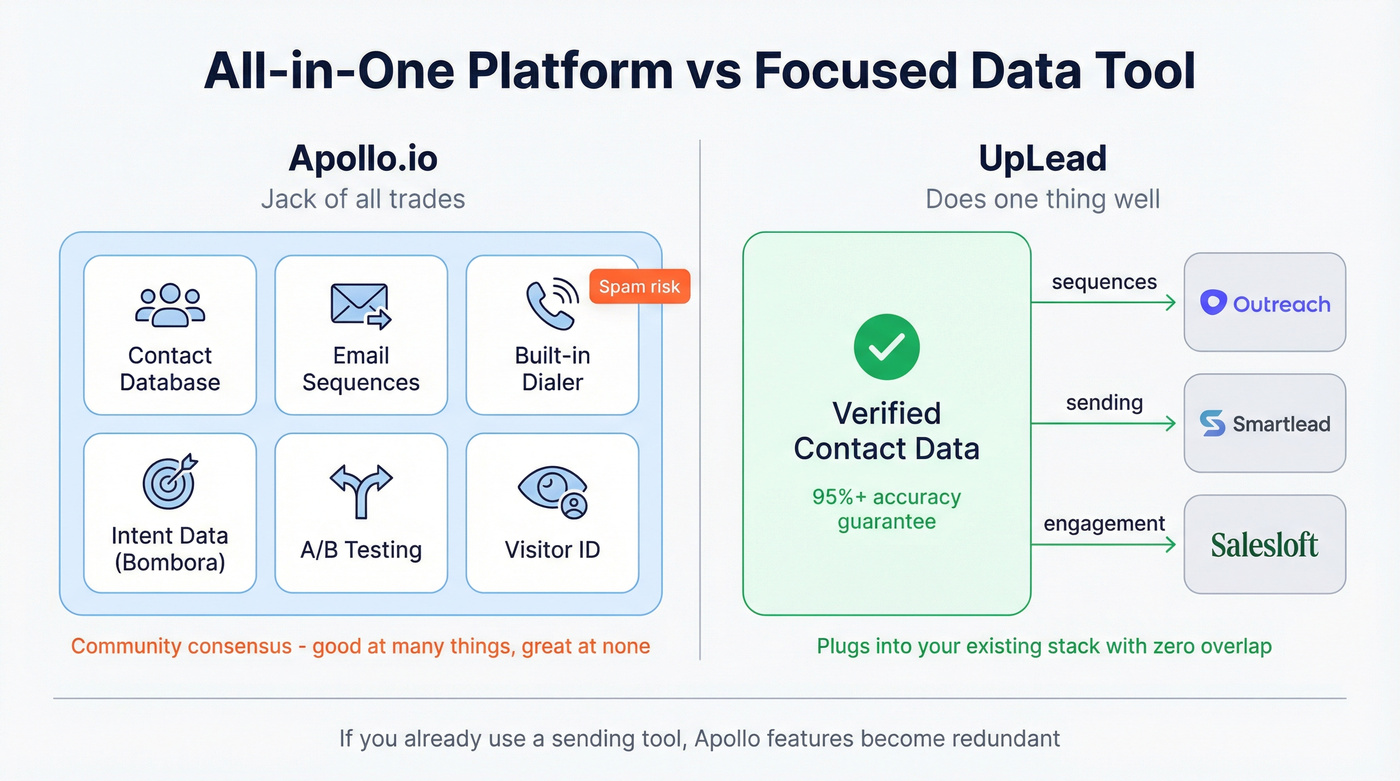
But the consensus on r/sales is that Apollo is a "jack of all trades, master of none." The dialer runs on Twilio VoIP numbers that get flagged as spam constantly. We've seen teams get noticeably better deliverability by exporting Apollo data and sending through Smartlead or Instantly instead.
Where UpLead Wins
UpLead is a focused data provider, and that focus shows. G2 category ratings tell the story: UpLead scores 9.4 vs Apollo's 9.0 on ease of use, 9.5 vs 8.9 on setup, and 9.3 vs 8.8 on support. Both tools offer technographic filters for ICP targeting, but UpLead's interface makes building those filters noticeably faster.
If you already run Outreach or Salesloft for sequencing, UpLead slots in without overlap. Apollo's built-in sequences become redundant - and you're paying for features you won't use.
When Neither Tool Is Enough
Let's be honest: both tools leave accuracy on the table. On a 10,000-contact campaign, even UpLead's 95% guarantee means 500 potential bounces. That's enough to damage a sending domain if you're running high-volume outbound.
If you're scaling outbound, it’s worth tightening your cold email marketing process and setting safe email velocity limits.
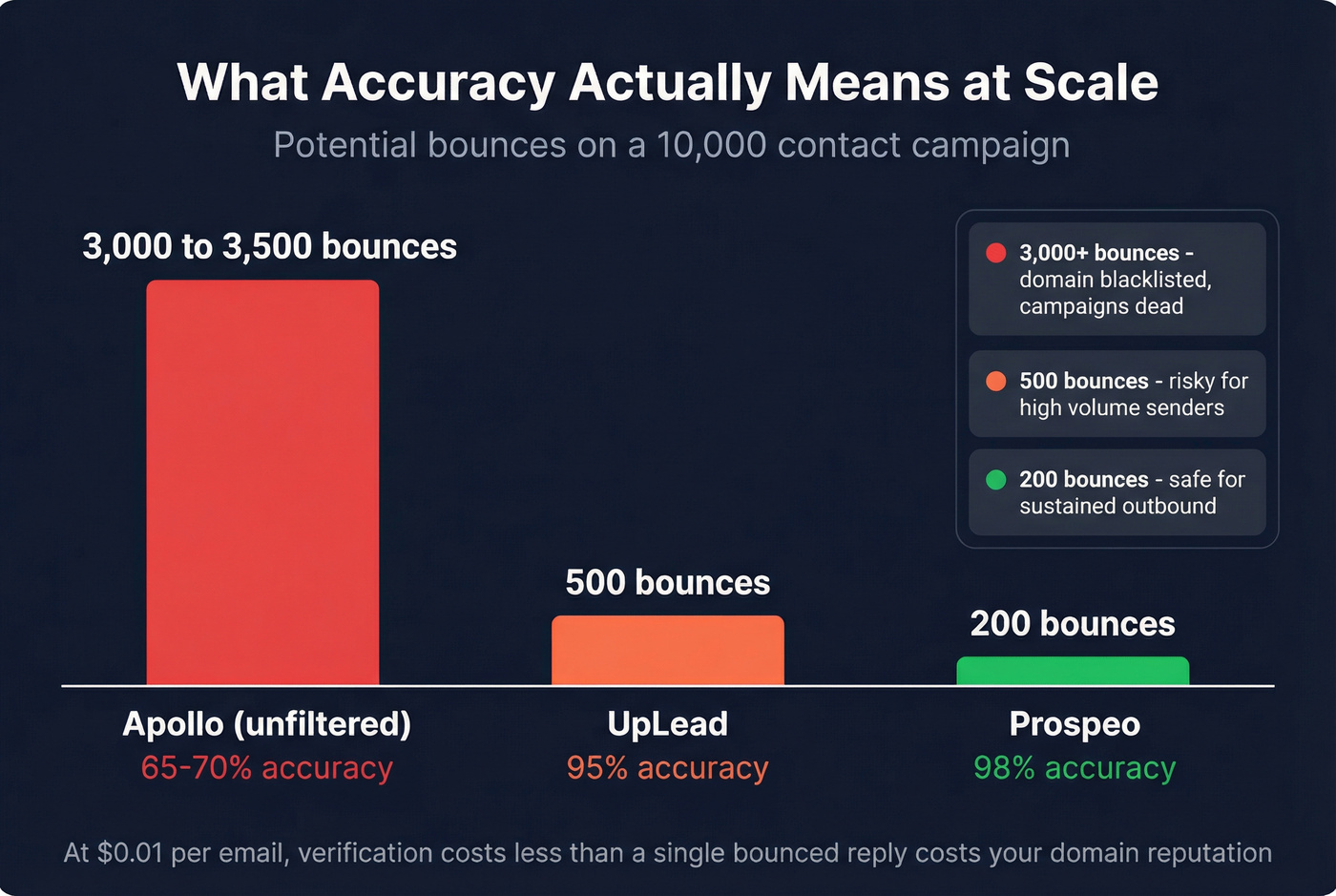
Prospeo pushes email accuracy to 98% across 300M+ profiles and 125M+ verified mobile numbers, with data refreshing every 7 days versus the six-week industry average. The free tier starts at 75 emails per month - enough to validate whether the accuracy claims hold before you commit a dollar.
Other names worth knowing: Hunter.io is strong for domain-based email lookup at lower volumes, starting free with 25 searches/month and paid plans from $34/mo. Lusha is popular for quick phone number grabs with a free tier of 50 credits/month and paid plans from $36/user/mo. You can also pipe data through Clay workflows for multi-source enrichment if you want to build a custom waterfall.
Apollo splits credits across emails, mobiles, and exports. UpLead charges per contact but caps at 170/mo on Essentials. Prospeo gives you 75 free verified emails monthly, 125M+ verified mobiles, and transparent credit pricing - no separate meters, no mid-run stalls.
One credit model. 98% accuracy. Zero contracts. See why 15,000+ teams switched.
FAQ
Is UpLead more accurate than Apollo.io?
Yes. UpLead's 95%+ accuracy guarantee beats Apollo's 65-70% community-reported range, and UpLead refunds credits for bounces. Apollo improves to 80-91% when filtered to "verified only" contacts, but that shrinks your usable pool and burns extra credits.
Does Apollo's free plan replace UpLead?
Not for real prospecting. Apollo's free tier caps exports at 10 export credits/month and limits you to two active sequences. UpLead's 7-day free trial with 5 credits is similarly limited. Both are test drives, not production tools.
What's a good alternative if neither tool hits 98% accuracy?
Prospeo delivers 98% email accuracy with a 7-day refresh cycle and works as a standalone source or as a verification layer on top of Apollo and UpLead exports. The free tier includes 75 verified emails per month - enough to test before committing.