

Valid Email ID Checker: How to Verify Any Email in 2026
Your last campaign bounced at 6%. The sequencing tool flagged your domain. Now you're staring at a list of 5,000 contacts wondering how many are actually real - and a valid email ID checker would have caught every dead address before you hit send.
Here's the ugly truth: an analysis of nearly 1 billion email addresses across 23 industries found that only 80.94% were valid. Roughly 1 in 5 emails on any given list won't reach a human. That's not a rounding error. That's a deliverability crisis hiding in your CRM, and we've watched it tank sender reputations for teams that should know better.
The fix isn't complicated, but it does require understanding what verification actually does, which tools are worth your money, and where the "99% accuracy" marketing claims fall apart.
What You Need (Quick Version)
- Check one email right now? Use Hunter's verifier or Verifalia - both handle single checks fast.
- Clean an existing list? ZeroBounce delivers 99.25% accuracy on non-catch-all domains and starts around $18/mo.
What Does a Valid Email ID Checker Actually Do?
A valid email ID checker - also called an email verifier or email tester - confirms whether an address can receive mail without sending a message. It pings the recipient's mail server, checks whether the mailbox exists, and returns a verdict: valid, invalid, catch-all, or unknown.
Why bother? Bounce rates above 5% trigger alarm bells with email service providers. Anything above ~2% should worry you. Top performers target hard bounces under 1%. (If you want the full breakdown, see our email bounce rate guide.)

A hard bounce (SMTP code 550) means permanent failure - the address doesn't exist, the domain is dead, or the account was closed. Your ESP counts these against you immediately. Soft bounces (SMTP 421 or 451) are temporary - full inbox, server timeout, message too large - and usually resolve themselves, though too many still hurt your sender score.
Let's do the math. If 1 in 5 emails on an average list is invalid and you're sending 5,000 cold emails without verification, that's ~1,000 bounces. A 20% bounce rate. Your domain reputation won't survive that. If you're already seeing issues, use email reputation tools to diagnose the damage.
How Email Verification Works
Every verification tool follows the same five-step process. The quality of execution is where they diverge.
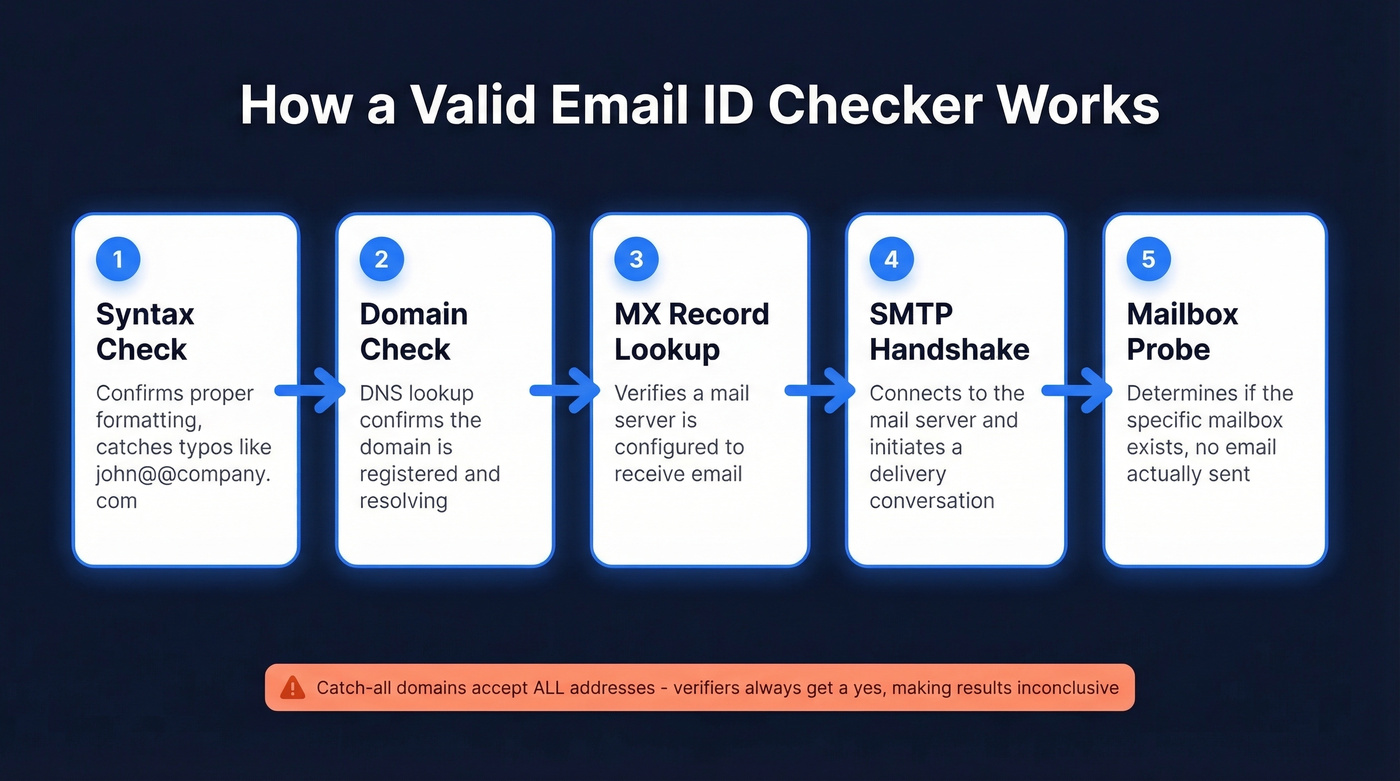
Step 1: Syntax check. Confirms the email follows proper formatting - an @ symbol, a valid domain structure, no illegal characters. Catches typos like "john@@company.com" instantly.
Step 2: Domain check. Does the domain actually exist? A DNS lookup confirms the domain is registered and resolving.
Step 3: MX record lookup. Even if a domain exists, it needs mail exchange records to receive email. This step confirms a mail server is configured. (MX record lookup explained.)
Step 4: SMTP handshake. The tool connects to the mail server and initiates a conversation - the same way a real email would start delivery. It says "I want to send to john@company.com" and waits for the server's response.
Step 5: Mailbox existence probe. Based on the server's response, the tool determines whether the specific mailbox exists. No email is actually sent - the connection closes before delivery.
Catch-all domains are where things get tricky. These servers accept email sent to any address at that domain, whether the mailbox exists or not. The verifier always gets a "yes," making the result inconclusive. Some tools claim 30+ verification steps, but the core process always follows these five stages - additional steps are sub-checks within each stage. In cold email communities on Reddit, catch-all domains are consistently cited as the single biggest verification headache, and it's where tools truly differentiate themselves. (For a practical walkthrough, see how to check valid email id.)
What the Accuracy Benchmarks Show
Most verification tools advertise 99%+ accuracy. The benchmarks tell a different story.
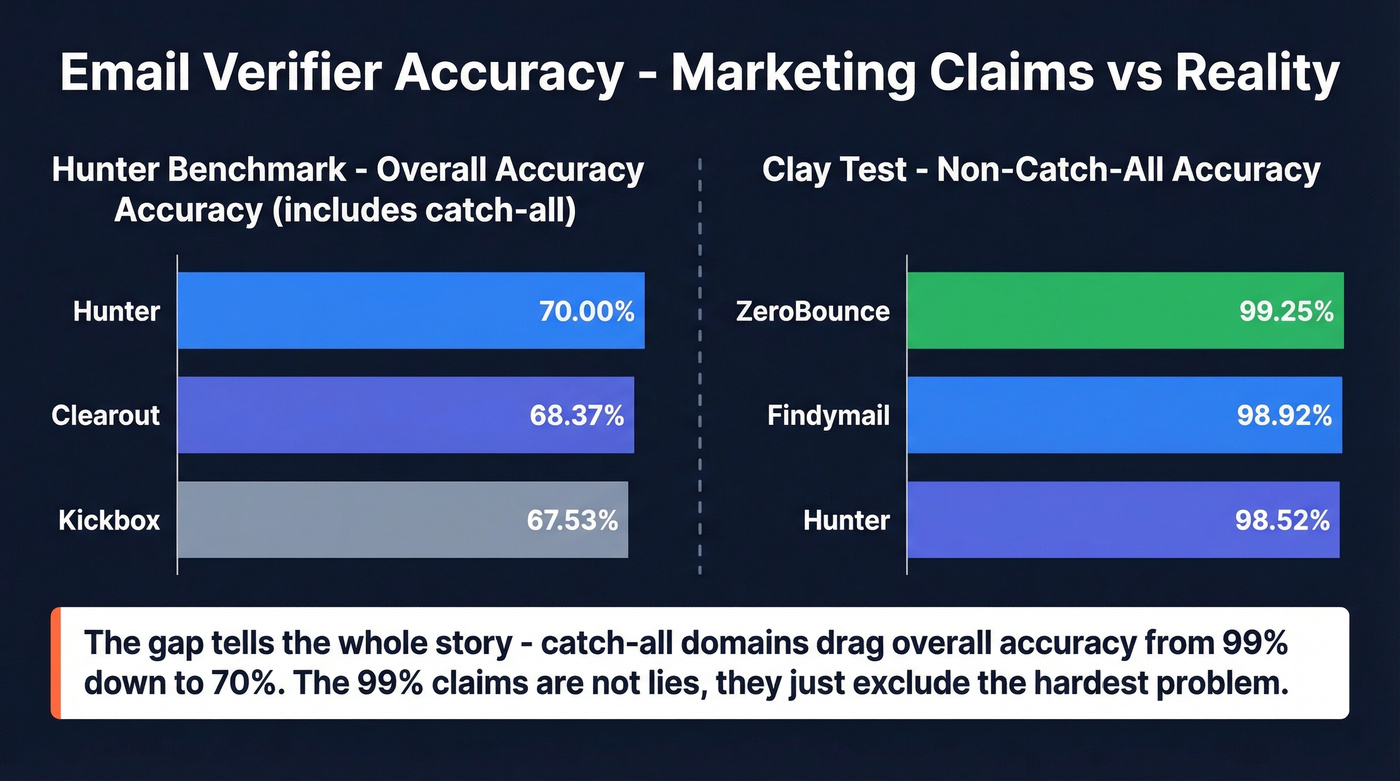
Hunter ran a benchmark of 15 email verification tools using ~3,000 real business emails segmented by company size:
| Tool | Overall Accuracy (Hunter Benchmark) | Non-Catch-All Accuracy (Clay Test) |
|---|---|---|
| Hunter | 70.00% | 98.52% |
| Clearout | 68.37% | - |
| Kickbox | 67.53% | - |
| ZeroBounce | - | 99.25% |
| Findymail | - | 98.92% |
Overall accuracy across all email types - including catch-all domains - tops out around 70%. That's a far cry from 99%.
Clay's separate test focused on non-catch-all domains and painted a much better picture: ZeroBounce hit 99.25%, Findymail 98.92%, Hunter 98.52%. Remove the catch-all ambiguity and top tools perform excellently.
Here's the thing: the vendor accuracy claims aren't lies, but they're measured under ideal conditions that don't reflect real-world lists full of catch-all domains. If more than 30% of your list sits on catch-all domains, no verification tool will save you. You need a data source that resolves catch-all ambiguity before the email ever reaches your list. If you're building lists in the first place, start with email list providers that prioritize verification and freshness.

Catch-all domains break every verifier on this list. Prospeo solves this upstream - every email in our 143M+ database passes 5-step verification with catch-all handling, spam-trap removal, and honeypot filtering before you ever see it. 98% accuracy, refreshed every 7 days.
Stop verifying bad data. Start with clean data.
Best Email Verification Tools in 2026
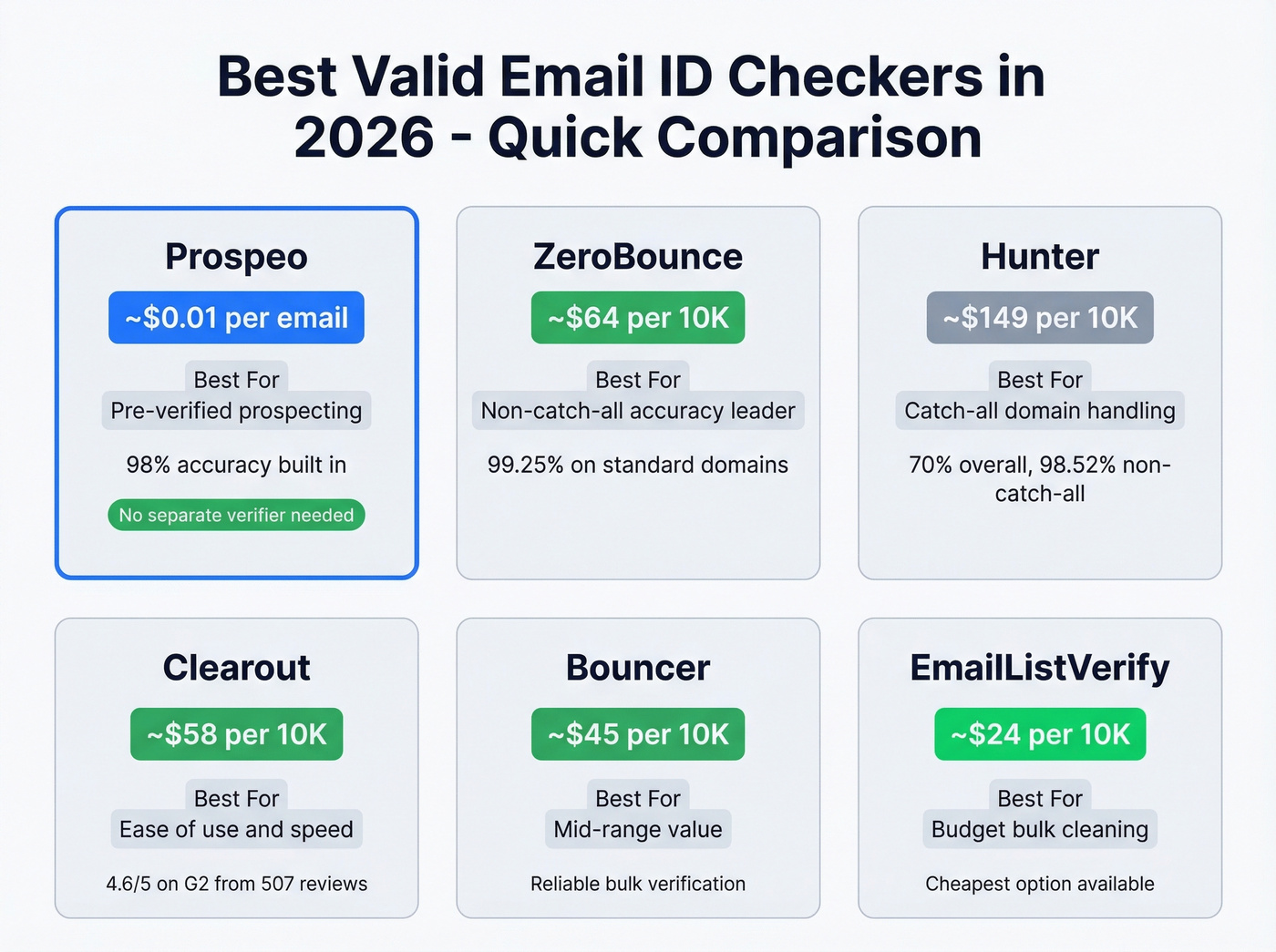
| Tool | Free Tier | Cost per 10K | Best For |
|---|---|---|---|
| Prospeo | 75 emails + 100 credits/mo | ~$100 | Pre-verified prospecting |
| ZeroBounce | 100/mo (business email required) | ~$64 | Non-catch-all accuracy |
| Hunter | 100 verifications/mo | ~$149 | Catch-all handling |
| Clearout | - | ~$58 | Ease of use + speed |
| Bouncer | - | ~$45 | Mid-range value |
| EmailListVerify | 3 free checks | ~$24 | Budget bulk cleaning |
| Kickbox | - | ~$80 | API-based verification |
| NeverBounce | - | ~$50 | Pay-as-you-go |
| Email Hippo | 100/day | ~$40-80 (varies by tier) | Legacy brand |
| Verifalia | Free single checks | ~$50-100 (estimated) | Quick one-off checks |
Prospeo
Prospeo isn't a verification tool in the traditional sense - it's a B2B data platform where verification is baked into the data sourcing process. Every email in its 143M+ database goes through a 5-step verification pipeline with catch-all handling, spam-trap removal, and honeypot filtering before it's ever available to you.
The result is 98% email accuracy without a separate verification step. Data refreshes every 7 days, compared to the 6-week industry average, which means the addresses you pull today are still accurate next week. In our experience, this eliminates the biggest source of list decay: stale data sitting in a database nobody bothered to re-verify. Meritt dropped their bounce rate from 35% to under 4% after switching, and Stack Optimize maintains 94%+ deliverability across all clients. You search across 300M+ profiles with 30+ filters, export verified contacts, and push them straight to your outreach tool via native integrations with Salesforce, HubSpot, Smartlead, Instantly, and others. Starts free with 75 emails per month, paid plans from ~$39/mo with no contracts. (If you're comparing options, see our best sales prospecting databases roundup.)

ZeroBounce
Use this if you already have a list and need the highest possible accuracy on non-catch-all domains. ZeroBounce hit 99.25% data quality in Clay's test - the best score in that benchmark. It starts around $18/mo with 100 free verifications monthly (business email required), and 10K verifications run about $64.
Skip this if you're looking for a prospecting database. ZeroBounce is a pure verification play - it cleans what you give it but doesn't help you find contacts. For standalone list hygiene, it's the accuracy leader. Validate a few emails free to see the result detail yourself.
Hunter
Hunter's real differentiator isn't raw accuracy - it's catch-all handling. Most tools return "unknown" for accept-all domains and shrug. Hunter uses a proprietary solution that cross-references its B2B database to make a call on catch-all addresses. That's genuinely useful when 30-40% of your list sits on catch-all domains.
In their own benchmark, Hunter scored 70% overall accuracy - the highest score when catch-all domains are included. On non-catch-all domains, Clay's test showed 98.52%. The free tier gives you 100 verifications/month, and 10K verifications cost ~$149. The catch-all handling is worth the premium if that's your primary pain point. If you're shopping around, compare against other options in our Hunter alternatives guide.
Clearout
Clearout earns its 4.6/5 on G2 across 507 reviews mostly on ease of use and speed. At ~$58 per 10K verifications, it's competitively priced. The recurring complaint? The credit system feels restrictive - 25 G2 reviewers flagged it specifically. Great UX, but the credit model punishes growth.
Bouncer
Solid mid-range option at ~$45 per 10K. Reliable bulk verification at a fair price without enterprise pricing or complex credit systems. Nothing flashy, nothing broken. If you want more tools in this lane, see Bouncer alternatives.
EmailListVerify
At ~$24 per 10K, EmailListVerify is the cheapest option by a wide margin. If cost is your primary constraint and you need a budget-friendly alternative for small batches, this is the answer. Don't expect sophisticated catch-all handling, but for straightforward valid/invalid sorting, it gets the job done.
Kickbox
Scored 67.53% in Hunter's benchmark. At ~$80 per 10K, it's positioned as an API-based verification option. The accuracy numbers don't justify the premium over cheaper alternatives unless you specifically need their API infrastructure.
NeverBounce
Pay-as-you-go at around $0.008 per email, roughly $50 per 10K. Simple, no-commitment pricing for teams with irregular verification needs.
Email Hippo
Operating since 2009 with 100 free verifications per day. Product tiers span Core, More, Insight, and Assess, with pricing in the $40-80 per 10K range depending on tier. A legacy player that's still functional for basic verification and signup risk checks.
Verifalia
The free validator handles one-off verifications well. Bulk and API pricing isn't public - expect around $50-100 per 10K for production volumes based on market positioning. Best for quick spot-checks, not production workflows.
Meritt cut their bounce rate from 35% to under 4%. Stack Optimize holds 94%+ deliverability across every client. The difference? They stopped buying lists and running them through checkers. Prospeo delivers verified contacts at ~$0.01 per email - no separate verification tool needed.
Ditch the checker. Pull emails that are already valid.
Handling Verification Results
Verification doesn't end with a green checkmark. How you handle each result category determines whether your deliverability actually improves.
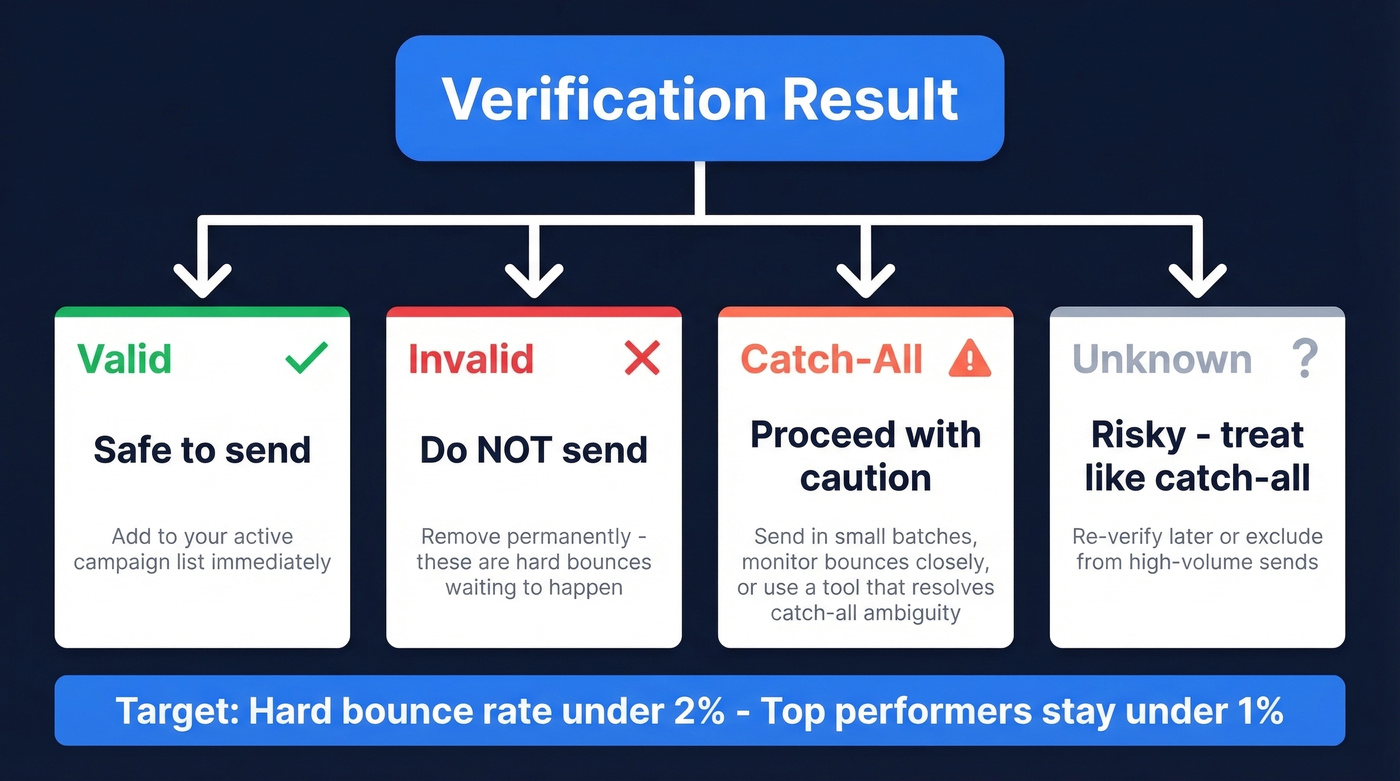
| Status | What It Means | Action |
|---|---|---|
| Valid | Mailbox confirmed | Send with confidence |
| Invalid | Permanent failure | Remove immediately |
| Catch-all | Server accepts all | Risk-score or discard |
| Unknown | Inconclusive | Re-verify in 24-48 hrs |
| Disposable | Throwaway address | Remove |
The hard decision is catch-all and unknown results. If you verify 5,000 emails and 800 come back ambiguous, you're facing a real dilemma - send to all and risk a bounce spike, or discard all and lose 16% of your list.
We've found the best approach is to throttle sends to catch-all addresses at lower daily volumes and monitor bounce rates in real time. If bounces stay under 2%, keep going. If they spike, pull back. For unknowns, re-verify after 24-48 hours - server timeouts and greylisting often resolve themselves. If you're scaling cold outreach, pair this with a safe email velocity plan.
Five Mistakes That Kill Deliverability
1. Verify once and forget. Lists decay fast. Average professional turnover runs around 41% annually, and 38% of employees leave within their first year. A list verified in January is significantly degraded by June.
2. Blast catch-all results without throttling. Just because a catch-all server says "yes" doesn't mean the mailbox exists. Sending 2,000 catch-all addresses in one batch is a fast path to the spam folder.
3. Skip real-time verification at capture. Inbound forms collect typos, disposable addresses, and outright fakes. Verifying at the point of entry prevents garbage from ever entering your CRM.
4. Trust vendor accuracy claims blindly. The gap between "99% accuracy" marketing and 67-70% real-world performance is enormous. Run your own test with a known sample before committing to any tool. We test every provider we recommend with a control list of 500 addresses where we already know the ground truth - you should do the same.
5. Use a tool that doesn't refresh data. A weekly refresh cycle catches addresses that went invalid days ago. Most providers refresh around every 6 weeks. That gap is where bounces come from - even a perfect verification tool can't save you from stale source data. For the bigger picture, read our email deliverability guide.
How Often to Re-Verify
| List Type | Frequency | Why |
|---|---|---|
| Cold outreach | Every 60-90 days | Highest decay rate |
| Inbound leads | Real-time at capture | Catch typos and fakes |
| Marketing/newsletter | Every 90-120 days | Slower but still significant |
| Purchased/scraped | Before every send | Unknown age and quality |
The 41% annual turnover stat means roughly 3-4% of your list goes stale every month. A 5,000-contact list verified 90 days ago likely has 150-200 newly invalid addresses - enough to push you past the 2% bounce threshold.
Real talk: if you haven't verified a list in 3+ months, assume at least 5-10% has gone stale. Re-verify before you send. The cost of a verification pass is a fraction of what it costs to rebuild a burned domain's reputation. If you're in that situation, follow our playbook on how to improve sender reputation.
FAQ
Is email verification legal?
Yes. Verification checks whether a mailbox exists via server queries - no email is sent, no data is accessed. It's standard practice and GDPR-compliant when used with lawfully obtained contact data. Reputable tools provide DPAs on request.
Can I use a valid email ID checker for free?
Hunter offers 100 free verifications/month, Email Hippo gives 100/day, and Prospeo includes 75 free emails plus 100 Chrome extension credits monthly. For lists over a few hundred contacts, you'll need a paid plan - but these free tiers handle spot-checking and small campaigns without issue.
What's a catch-all domain?
A catch-all domain accepts email to any address at that domain, whether the mailbox exists or not. The server always responds "yes," making verification inconclusive. This is the single biggest source of "unknown" results and the reason overall accuracy benchmarks top out around 70%.
How accurate are email verification tools really?
Independent benchmarks show 67-70% overall accuracy when catch-all domains are included. Remove catch-all ambiguity and top tools hit 98-99%. Vendor claims of 99%+ are measured under ideal conditions that exclude mixed domain types. The honest providers acknowledge these limitations upfront.
Should I verify emails before every send?
For cold outreach, yes - or at minimum every 60-90 days. With 41% average annual job turnover, lists decay fast. The cost of running a verification pass is trivial compared to the cost of a damaged sender reputation, which can take weeks or months to recover.