

Value-Based Selling: Scripts, Formulas, and Hard Truths From the Field
A rep on r/sales described using the classic discovery opener - "What's keeping you up at night?" - and the prospect fired back, "Are you reading from a script?" Then hung up. That's the state of value-based selling in many organizations: the theory is sound, the execution is cringe. The problem isn't the methodology. It's that most training programs hand reps a set of principles and zero tactical assets, then wonder why everyone reverts to discounting by Q3.
What You Actually Need
Value-based selling works best when you stop memorizing principles and start using three tactical assets: a discovery question framework that surfaces financial impact, an ROI formula you can calculate on a napkin, and a stakeholder map for every deal with more than one decision-maker. The rest of this guide gives you all three - plus the uncomfortable reasons most value-selling programs fail within two quarters.
Why Most Value-Selling Training Fails
85% of sales professionals say their biggest challenge is getting prospects to engage in discovery. That's not a skills gap - it's a design flaw. Most value-selling training gives reps a philosophy ("focus on outcomes, not features") and maybe a two-day workshop, then sends them into live calls with nothing but a laminated card of open-ended questions.
The result is predictable. Reps either sound robotic, reciting canned openers that prospects see through in seconds, or they abandon the framework entirely because it doesn't feel natural. We've watched teams invest heavily in these programs and still find reps drifting back to feature-dumping within 90 days. The training isn't wrong. It just isn't tactical enough to survive contact with reality.
What Is Value-Based Selling?
Value-based selling is a sales approach where every conversation, proposal, and negotiation centers on the quantified business outcomes your buyer will achieve - not the features in your product. It's the difference between "our platform processes 10,000 records per second" and "your team will reclaim 14 hours per week of manual data work, which at your blended labor cost saves roughly $180,000 a year."
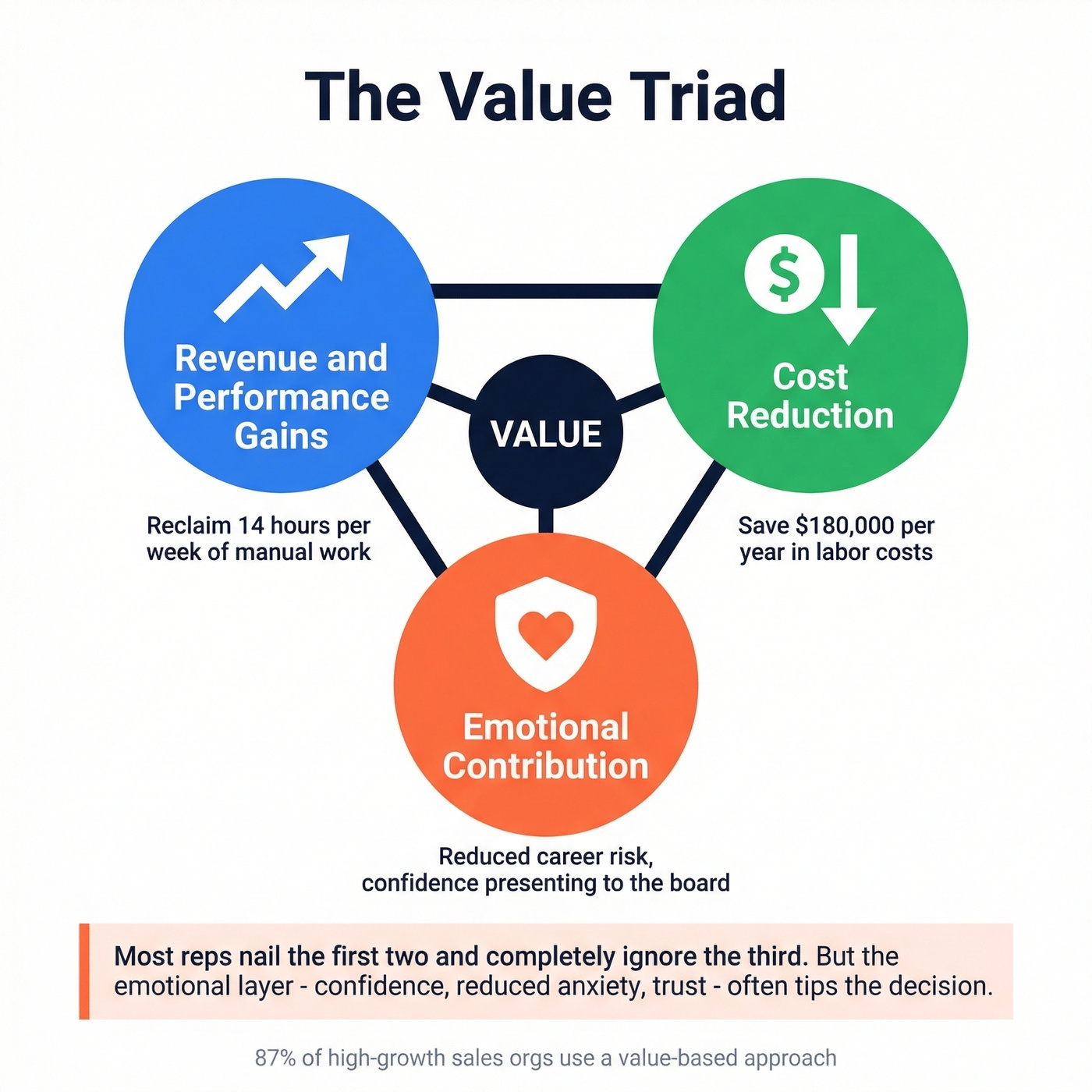
The framework rests on a value triad: revenue or performance gains, cost reduction, and emotional contribution. Most reps nail the first two and completely ignore the third. But the emotional layer - the confidence a VP feels presenting a vetted vendor to the board, the reduced career risk of choosing a proven solution - often tips the decision. Trust, credibility, and reduced anxiety aren't soft factors. They're deal-closers.
87% of high-growth sales organizations now use a value-based approach. That stat isn't surprising. What's surprising is how few of them equip reps with the tools to actually execute it.
Why It Matters More in 2026
The B2B buying environment has shifted in ways that make this methodology non-optional.
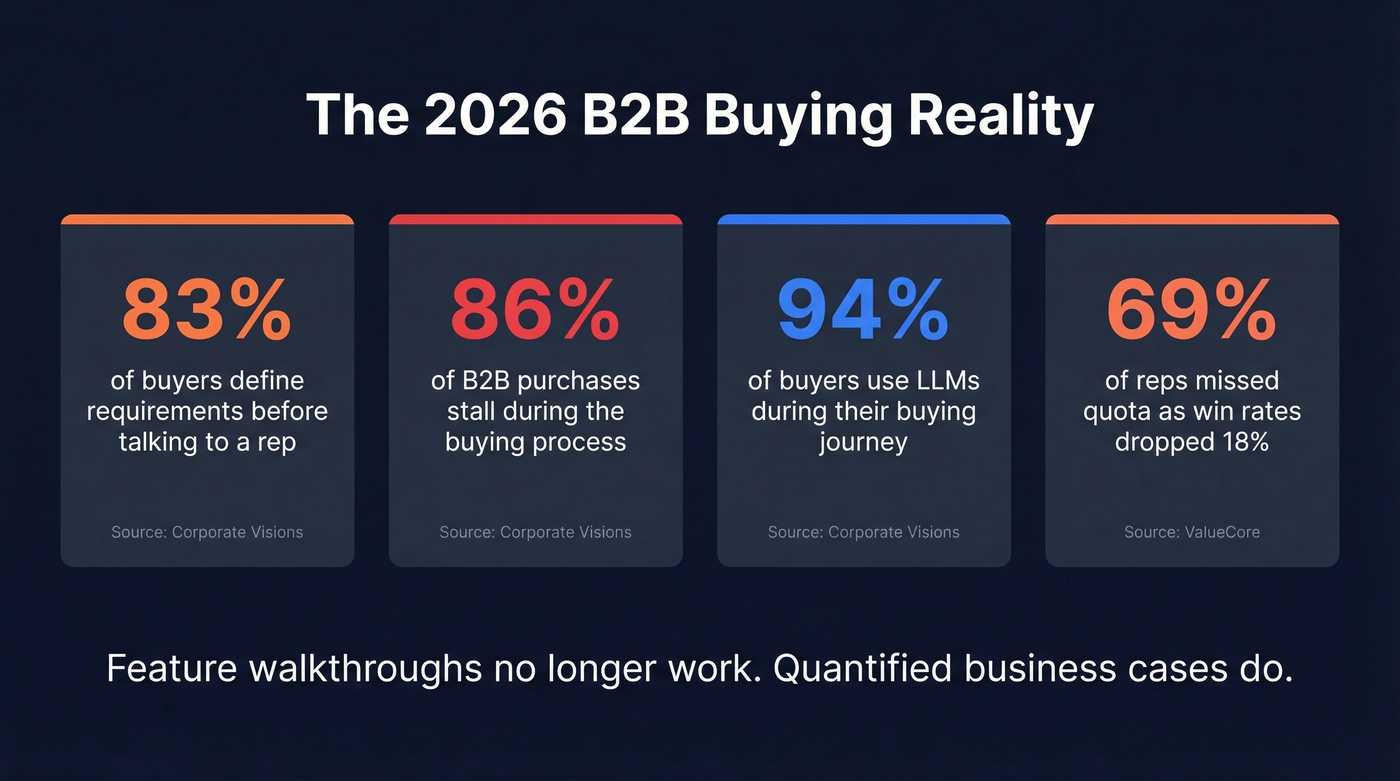
Buyers now define purchase requirements 83% of the time before speaking with a single rep. 94% use LLMs during their buying process. By the time you get a discovery call, the prospect has already built a shortlist, compared pricing pages, and read three Reddit threads about your competitors. Showing up with a feature walkthrough is bringing a knife to a gunfight.
Meanwhile, 86% of B2B purchases stall during the buying process, and 81% of buyers end up dissatisfied with the provider they chose. That's a staggering failure rate, and it points to a gap between what sellers communicate and what buyers actually need to make a confident decision. The missing piece is almost always a quantified business case that survives internal scrutiny.
On the seller side, B2B win rates declined 18% year-over-year, and 69% of reps missed quota. Buyers are moving quicker, with less patience, and higher expectations for ROI justification.
Here's the thing: if your average deal size is under $10K annually, you probably don't need a formal value-selling program. A solid demo and a clear pricing page will close those deals. But the moment you're selling anything that requires a second meeting, a business case, or a committee - and that's most B2B software - selling on quantified outcomes stops being optional and starts being the entire game.
The Value-Selling Framework
Before getting into scripts and formulas, you need a mental model. The one that holds up best in practice is Resonate, Differentiate, Substantiate.
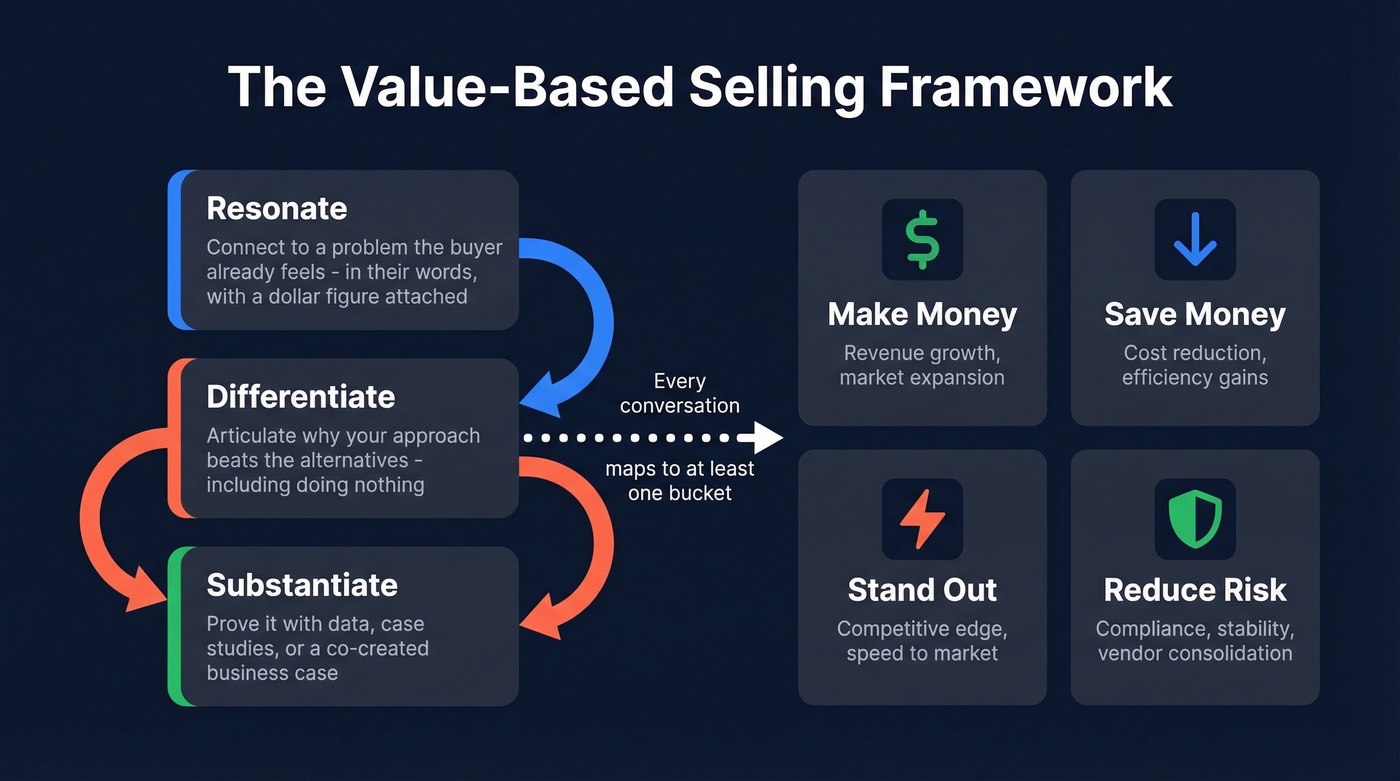
Resonate means connecting your solution to a problem the buyer already feels - not a problem you've invented for them, but one they've described in their own words, ideally with a dollar figure attached. Differentiate means articulating why your approach solves it better than the alternative, including doing nothing. Substantiate means proving it with data, case studies, or a co-created business case.
Within that model, every value conversation maps to four buckets: make money through revenue growth and market expansion, save money through cost reduction and efficiency, stand out through competitive differentiation and speed to market, and reduce risk through compliance, stability, and vendor consolidation. If your pitch doesn't clearly land in at least one of these buckets, you're selling features.
The old line still holds: "prescription before diagnosis is malpractice." You can't resonate if you haven't done discovery. You can't differentiate if you don't know what else the buyer is evaluating. And you can't substantiate if you haven't gathered the financial inputs to build a case.
This approach isn't competing with SPIN Selling, Challenger, or MEDDIC - it's compatible with all of them. SPIN gives you the questioning technique. Challenger gives you the teaching framework. MEDDIC gives you the qualification rigor. Value-based selling is the throughline: the insistence that every interaction quantifies outcomes rather than describes features.

You can't build a quantified business case if you're pitching the wrong person. Prospeo gives you 30+ filters - buyer intent, job changes, headcount growth - so your discovery calls happen with decision-makers who actually feel the problem. 98% email accuracy means your outreach lands, not bounces.
Stop selling value to people who can't sign the check.
Discovery Questions That Work
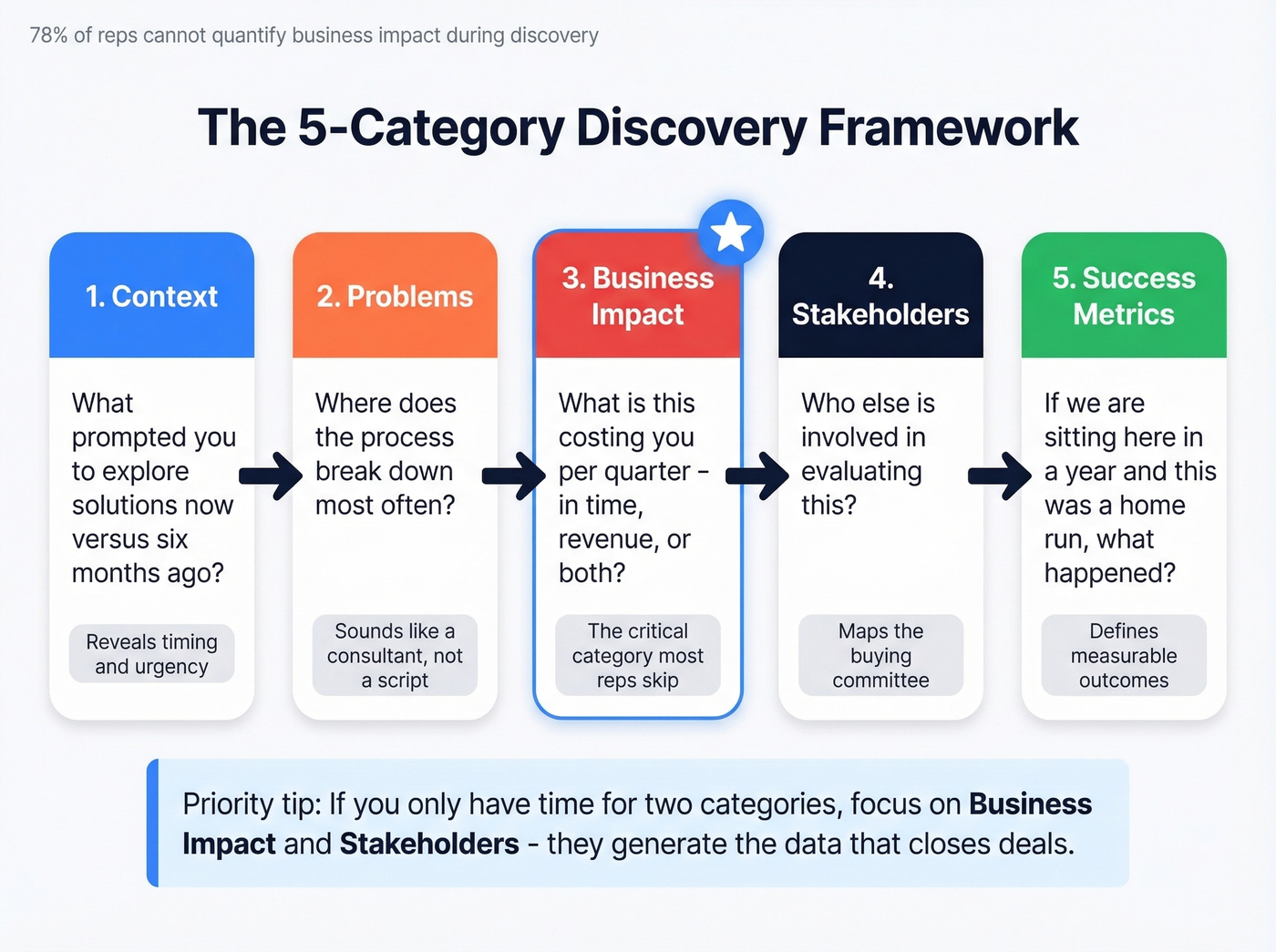
This is where most guides fail you. They say "ask open-ended questions" and leave it at that. Here's a five-category framework with specific questions you can use on your next call. 78% of reps can't quantify the business impact of a problem during discovery - these categories fix that.
Set the frame first. Before you ask anything: "I'd like to spend the first 15 minutes understanding your current situation and what's driving this evaluation. Then we can talk about whether there's a fit. Does that work?" This isn't a script - it's a contract that gives you permission to ask harder questions later.
Context and Background
Instead of the generic "Tell me about your business," try questions that reveal timing and urgency:
- "What prompted you to explore solutions now versus six months ago?"
- "Walk me through how your team handles [process] today."
- "What's changed in the last quarter that made this a priority?"
Problem Identification
Bad question: "What are your pain points?" Good question: "Where does the process break down most often?" The first sounds like a sales script. The second sounds like a consultant.
- "What's not working about the current approach?"
- "If you could fix one thing about [workflow], what would it be?"
Business Impact
This is the critical category - and where most reps choke. They're comfortable asking about pain but uncomfortable asking about money.
- "What is this challenge costing you per quarter - in time, revenue, or both?"
- "What happens if nothing changes in 12 months?"
- "When deals slip because of [problem], what's the average revenue impact?"
Practice these until they feel natural. The financial answers you get here become the inputs for your business case.
Stakeholders and Decision Dynamics
- "Who else is involved in evaluating this?"
- "What does your typical buying process look like for a decision this size?"
- "Is there anyone who might push back on this change? What would their concern be?"
Success Metrics
Instead of "What does success look like?" - which gets vague answers - try: "If we're sitting here in a year and this was a home run, what happened?" Or: "What metrics will you use to justify the investment internally?"
You won't get through all five categories in every call. Prioritize business impact and stakeholders - those two categories generate the data that closes deals.
The Napkin Business Case
Every competitor article tells you to "quantify value." Here's the formula, the inputs, and a worked example.
The formula: ROI = (Return - Price) / Price
The Product Marketing Alliance breaks this down clearly: "Return" is the total financial benefit - cost savings plus revenue gains - over a defined period. "Price" is total cost of ownership including subscription, implementation, and onboarding.
Worked Example
Your prospect's team spends 20 hours per week on manual data entry at a blended cost of $50/hour. That's $52,000/year in labor on a task your platform automates. Your solution costs $15,250/year all-in.
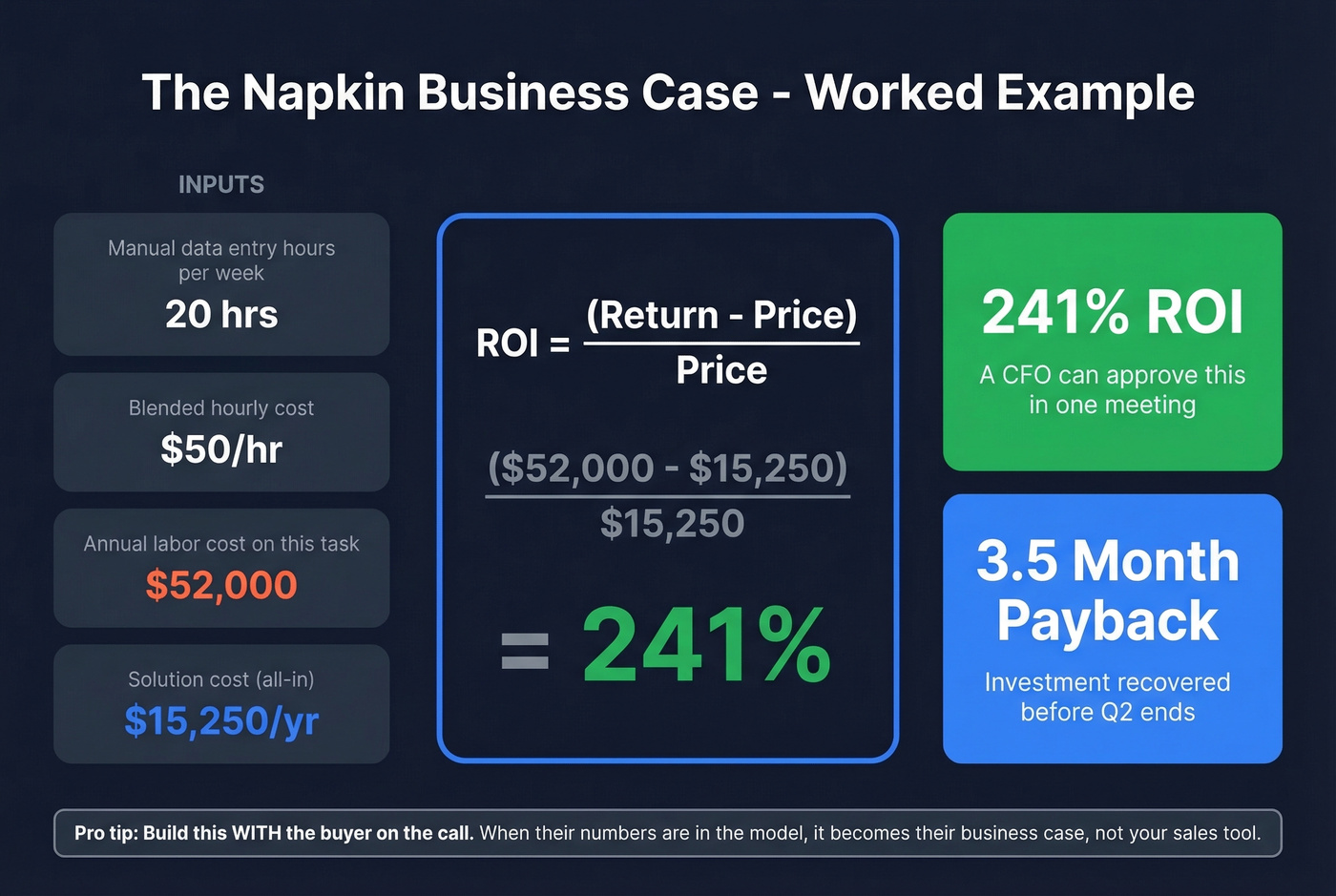
ROI = ($52,000 - $15,250) / $15,250 = 241%
Payback period: roughly 3.5 months. That's a business case a CFO can approve in one meeting.
What to Include in Your Calculator
Build a simple spreadsheet with these variables: operational category, monthly usage volume, current unit cost, projected savings per unit, monthly and annual savings, and payback time. The outputs that matter most are annual savings, ROI percentage, and payback period in months.
Here's what separates good reps from great ones: MIT Sloan research found that ROI calculators often get dismissed internally as "theoretical and complex." The fix is co-creation. Don't hand the prospect a finished calculator - build it with them during the call. When the buyer's own numbers are in the model, it becomes their business case, not your sales tool. That shift in ownership is everything.
Selling to Buying Committees
If you're selling deals above roughly $50K in annual contract value, you're selling to a committee. Enterprise deals often involve 6-10 stakeholders, and engaging just one no longer moves deals forward.
Map the Stakeholders
Before your second meeting, build a working map of five roles: the economic buyer who signs the check, the champion who sells internally for you, the technical evaluator who validates feasibility, the end users who live with the product daily, and procurement who negotiates terms and protects budget.
Each role cares about different value buckets. The economic buyer wants ROI and risk reduction. The champion wants to look smart for bringing you in. The technical evaluator wants integration ease and security. End users want less friction. Procurement wants leverage on price. One question that unlocks political dynamics every time: "Who might not like this change, and why?" The answer tells you where the deal will stall.
Multi-Thread Every Deal
Multi-threading means building relationships with multiple stakeholders simultaneously, not sequentially. If your champion goes on vacation, gets promoted, or loses internal influence, a single-threaded deal dies. We've seen it happen on deals that looked like sure things.
The practical move: equip your champion with short, shareable assets - a one-page business case, a 90-second video summary, a comparison table. These are the artifacts that get forwarded in internal Slack channels and attached to budget requests. The most advanced version is co-creating the business case with the economic buyer directly. When the buyer's fingerprints are on the ROI model, internal approval becomes a formality.
Value-Based vs. Solution vs. Consultative Selling
These three approaches get conflated constantly. Let's break down how they actually differ.
| Dimension | Value-Based Selling | Solution Selling | Consultative Selling |
|---|---|---|---|
| Core focus | Quantified outcomes | Product-to-problem fit | Deep business context |
| Best for | Committee-driven deals | Shorter cycles | Complex, custom solutions |
| Discovery depth | Financial impact + stakeholders | Problem identification | Root cause analysis |
| Key skill | ROI quantification | Product knowledge | Strategic questioning |
| Pairs with | MEDDIC, Challenger | SPIN | SPIN, Challenger |
| When to use | Buyer needs internal justification | Buyer knows the problem | Buyer doesn't know the root cause |
71% of buyers research everything before contacting sales. Solution selling - where you identify the problem and map your product to it - works best when the buyer already knows what's broken. Consultative selling goes deeper, uncovering root causes the buyer hasn't articulated. A value-based approach adds the financial layer that gets deals approved.
In practice, most experienced reps blend all three. The question is which lens dominates. For deals requiring a business case or committee approval, value-based selling is the primary frame. MEDDIC or MEDDPICC layers on as the qualification backbone - Metrics, Economic Buyer, Decision Criteria, Decision Process, Identify Pain, and Champion. Skip the formal value-selling program for transactional deals under $10K ACV; it'll slow your team down more than it helps.
Why Value-Selling Programs Die
MIT Sloan documented the pattern: a company launches a value-selling initiative, sees early gains in margin and win rates, then watches those gains erode over two to three quarters as value arguments go stale and reps revert to discounting under pressure. A recurring theme on r/sales echoes this - reps describe value-selling training as "great in theory, gone by month three" once quota pressure mounts and managers stop reinforcing the framework.
The failure modes are predictable.
Scripted delivery backlash. Reps memorize talk tracks instead of internalizing principles. Prospects smell it immediately. The Reddit hangup story from the intro isn't an outlier - it's common when training prioritizes scripts over judgment.
Discount default. Procurement pushes back on price. The rep panics and offers a discount instead of reinforcing the business case. Every discount trains the buyer to ask for a bigger one next time.
Overpromising. Reps inflate ROI projections to close the deal, then customer success inherits impossible expectations. The post-sale value gap destroys renewal rates.
No post-sale tracking. If you don't measure whether the promised value actually materialized, you lose the proof points that fuel future deals. The best value-selling organizations tie implementation outcomes back to the original business case and use those results to sharpen the next pitch.
Treating it as a sales-only initiative. This is an organizational commitment. Marketing, product, customer success, and sales all need to speak the same value language. When it's siloed in the sales team, it dies with the next VP of Sales.
The uncomfortable truth: a two-day workshop doesn't create a value-selling culture. Ongoing coaching, refreshed business cases with current customer data, and manager reinforcement on every deal review - that's what makes it stick.
How to Make It Stick
Three things separate teams that sustain value-based selling from teams that abandon it.
First, build a coaching cadence around deal reviews, not just pipeline reviews. Every deal above a certain threshold should have a visible business case and stakeholder map. If the rep can't articulate the buyer's ROI in one sentence, the deal isn't qualified - full stop.
Second, track value post-sale. When a customer achieves the outcomes you projected, document it. Those proof points become the substantiation layer for your next 50 deals. In our experience, teams that close this loop see their win rates climb quarter over quarter because their case studies carry real numbers, not hypotheticals.
Third - and this is the one nobody talks about - get your contact data right. The best discovery framework in the world is useless if your emails bounce or you're calling a dead number. Prospeo addresses this at the foundation level with 98% email accuracy across 143M+ verified emails and 125M+ verified mobile numbers, all on a 7-day refresh cycle. The free tier gives you 75 verified emails per month plus 100 Chrome extension credits to test - no contracts, no sales calls required.
If you're tightening the rest of your outbound system too, pair this with better sales prospecting, cleaner lead scoring, and a repeatable lead generation workflow.
Value-based selling is a system, not a skill. The methodology gives you the framework. The scripts give you the words. The formula gives you the math. But none of it works if you can't reach the right person at the right time with accurate data.
If you want more tactical assets, steal a few talk tracks and keep a set of sales follow-up templates ready for multi-stakeholder deals.
86% of B2B deals stall because reps can't reach every stakeholder on the buying committee. Prospeo's 300M+ profiles and 125M+ verified mobiles give you direct access to champions, budget holders, and blockers - without waiting for a warm intro that never comes.
Map the full committee. Reach them all. Close faster.
FAQ
What is value-based selling?
Value-based selling is a methodology where every interaction - discovery, proposal, negotiation - centers on quantified business outcomes rather than product features. Reps use ROI calculations, co-created business cases, and stakeholder mapping to help buyers justify the purchase internally. It's most effective for B2B deals requiring committee approval.
How does it differ from solution selling?
Solution selling maps your product to a recognized problem. Value-based selling quantifies the financial outcome - ROI, cost savings, revenue gain - and ties it to specific business metrics. Use solution selling for shorter-cycle deals; use a value-based approach when committee approval or a formal business case is required.
How do you quantify value for a prospect?
Use ROI = (Return - Price) / Price. Gather inputs during discovery - current costs, time spent on manual processes, revenue impact - then build a one-page before/after comparison. Co-create it with the buyer so the numbers carry internal credibility.
What are the best discovery questions?
Focus on business impact: "What is this challenge costing you per quarter?" "What happens if nothing changes in 12 months?" "What metrics will you use to justify the investment internally?" These surface the financial data you need for an ROI case that survives CFO scrutiny.