

The Best Verify Email Tools in 2026, Ranked by Real Accuracy Data
Every verify email tool claims 97-99% accuracy. It's right there on the landing page, in bold, next to a checkmark icon. Then you upload a real list, send your campaign, and watch 8% of it bounce.
The gap between claimed and tested accuracy is the dirty secret of this market. Independent tests from lemlist and CampaignKit tell a different story - NeverBounce tested at 93%, Hunter at 90-95%, while tools like Bouncer, Emailable, ZeroBounce, and Kickbox hit ~99% in those benchmarks. We've tested most of these tools on real outbound lists. Here's what holds up.
Our Picks (TL;DR)
| Use Case | Pick | Why | 10K Price |
|---|---|---|---|
| Best for B2B outbound | Prospeo | 98% accuracy, verification at data collection, 7-day refresh | ~$100* |
| Best standalone verifier | Bouncer | 99% tested accuracy, SOC 2/GDPR compliant | $45 |
| Best for speed | Emailable | 2M emails/hour, 10K in under 3 min | $50 |
| Best budget option | EmailListVerify | Cheapest on the market | $24 |
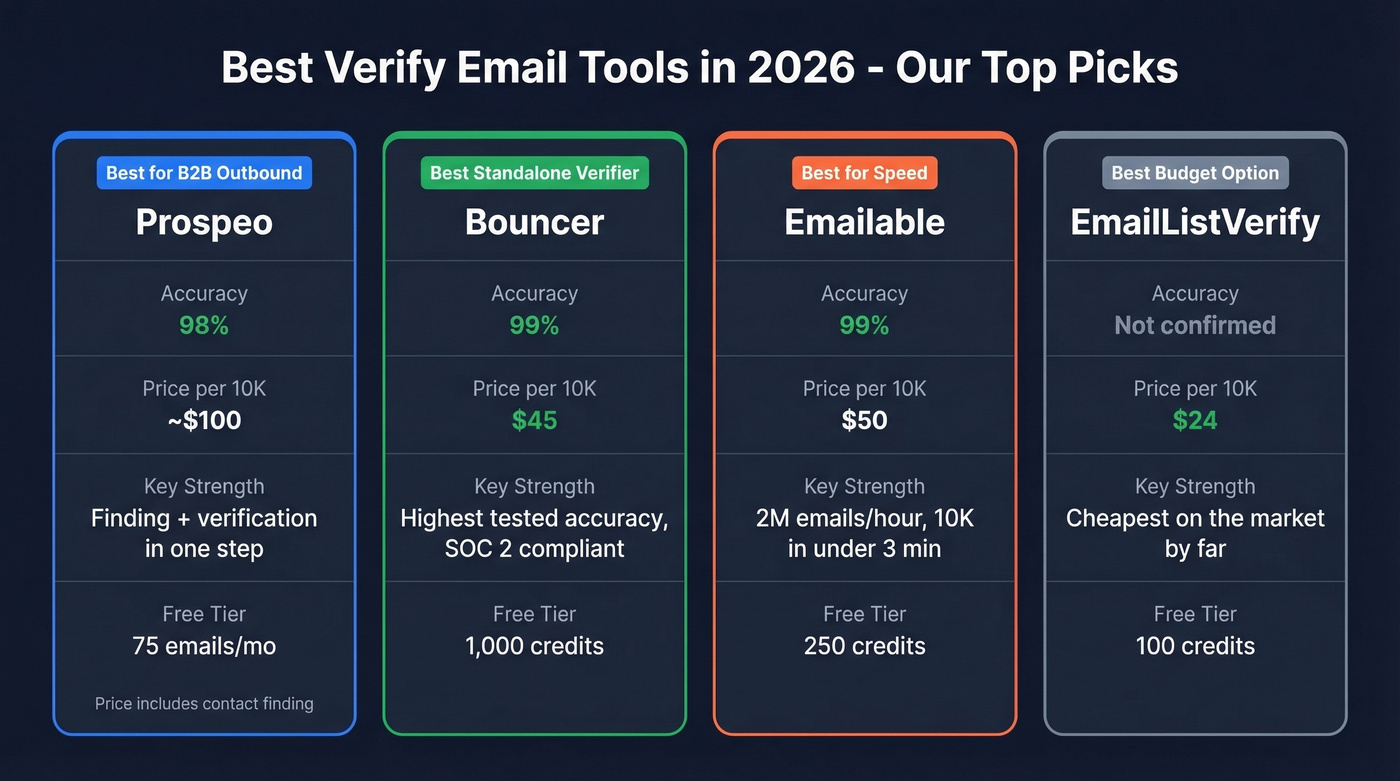
*Prospeo's pricing includes finding + verification, not just verification alone. At ~$0.01/email, you get the contact and the verification in one step.
How Email Verification Works
Before comparing tools, here's what happens when you hit "verify." Every tool runs some version of a four-step pipeline:
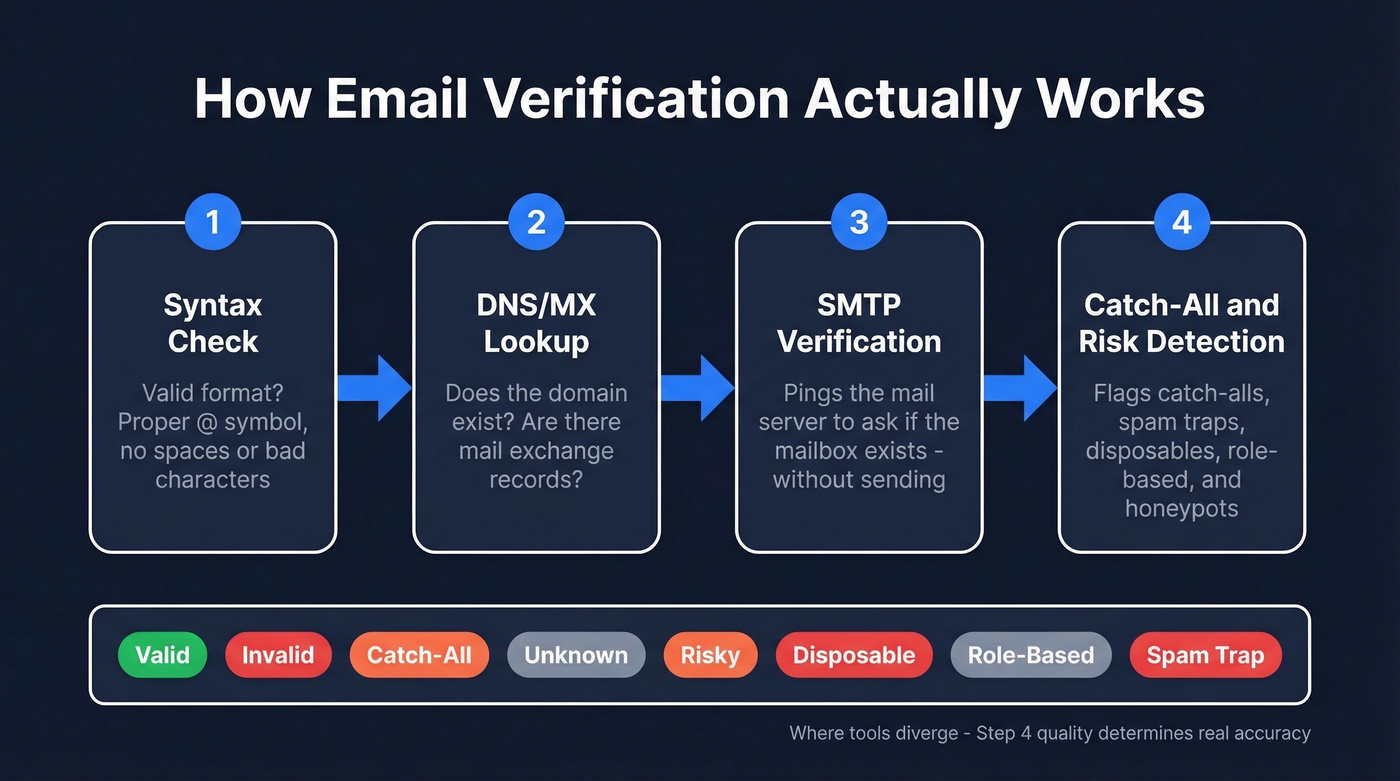
- Syntax check - Does the email follow a valid format? No spaces, proper @ symbol, valid characters. This catches typos and garbage entries.
- DNS/MX lookup - Does the domain exist, and does it have mail exchange records? No MX record means nobody's receiving mail there.
- SMTP verification - The tool pings the mail server and asks "does this mailbox exist?" without actually sending an email. This is where most invalid addresses get caught.
- Catch-all and risk detection - Is the domain a catch-all? Is the address a known spam trap, honeypot, disposable, or role-based account?
Results come back as valid, invalid, catch-all, unknown, risky, disposable, role-based, or spam trap. The quality of that fourth step is where tools diverge dramatically. Some tools advertise 30+ verification sub-steps. Whether that granularity translates to better outcomes depends on your workflow - most teams just need a clean valid/invalid split, not a taxonomy lesson.
If you're also trying to protect deliverability (not just reduce bounces), pair verification with an email deliverability checklist.
Best Email Verification Tools Compared
Prospeo
Prospeo isn't a standalone verifier - it's a B2B data platform where verification happens at the point of data collection. Instead of finding contacts in one tool and verifying them in another, Prospeo's 5-step verification runs automatically across its 143M+ verified email database. The result is 98% email accuracy with catch-all handling, spam-trap removal, and honeypot filtering built in.
The data freshness angle is what separates this from pure verifiers. Records refresh every 7 days versus the 6-week industry average, so you're working with contacts that were already re-verified this week. Real results back this up: Snyk's team dropped bounce rates from 35-40% to under 5% after switching, and Stack Optimize runs under 3% bounce with zero domain flags across all clients.
Use this if: You're running B2B outbound and want finding + verification in one workflow. At ~$0.01/email with 75 free emails/month, it eliminates the need for a separate verifier entirely. (If you're building lists from scratch, see our guide to how to generate an email list.)
Skip this if: You only need to clean an existing marketing list of 500K consumer emails - that's a different job.
Bouncer
Bouncer is the best pure standalone verifier on the market right now. Independent tests confirmed 99% accuracy, and it earned G2's "Easiest to Use" badge in the email verification category. At $45 per 10K, it's competitively priced for the accuracy you're getting. SOC 2 and GDPR compliant, which matters if your compliance team has opinions.
The tradeoff is workflow friction. Bouncer's UI feels sluggish during bulk processing, and you have to download results after the bulk check to view them - a small annoyance that adds up over time. Processing speed runs about 180K emails/hour, fine for most use cases but noticeably slower than Emailable. You get 1,000 free credits to test, and 16 native integrations cover the basics.
Use this if: You need a reliable, compliance-friendly email checker and accuracy is your top priority. If you want more options in the same category, compare Bouncer alternatives.
Skip this if: You're verifying millions of records monthly and need sub-minute turnaround times.
Emailable
Emailable is the speed king. Processing 2M emails per hour, it'll chew through a 10K list in under 3 minutes. Independent benchmarks put it at 99% accuracy - matching Bouncer's results while being dramatically faster. Pricing lands at $50 per 10K, with per-email costs dropping to $0.00135 at scale. You get 250 free credits and 22 native integrations.
The weakness is specific but worth knowing: Emailable struggles with @yahoo domains. Independent testing flagged this explicitly, and we've seen similar patterns in our own runs. If your list is heavy on consumer Yahoo addresses, run a secondary check on those. For B2B lists where Yahoo is rare, this barely matters.
Use this if: You're cleaning large lists regularly and turnaround time is critical - marketing teams running weekly sends, for example. If you're sending at scale, also watch your email velocity.
Skip this if: Your list skews heavily toward consumer email providers like Yahoo or AOL.
ZeroBounce
ZeroBounce is an integration powerhouse - 45+ native integrations, one of the highest counts among verifiers. Tested accuracy hits ~99% in independent benchmarks. Pricing is tiered: free at 100 validations/month, the ONE plan at $99/mo for 25K validations, and custom plans starting at $274/mo. Pay-as-you-go runs $64 per 10K. Processing speed clocks 133K emails/hour. If you need real-time API validation on signup forms, ZeroBounce's endpoint response times are competitive.
If you're specifically trying to reduce bounces, use a bounce-focused workflow like this email bounce rate guide.
NeverBounce
Here's the thing about NeverBounce - it's widely recommended, but the accuracy doesn't hold up under testing. NeverBounce self-reports 99.9% accuracy. Independent benchmarks measured it at 93%. That's a meaningful gap, and it's the kind of discrepancy that erodes trust in the whole category. At $50 per 10K with 100K emails/hour processing and 22 integrations, it looks solid on paper. But Bouncer and Emailable beat it for similar money on actual verified accuracy.
EmailListVerify
The budget pick, no contest. At $24 per 10K, EmailListVerify costs less than half of most competitors. You get 100 free credits to test. The tradeoffs are real - only 11 integrations, and the interface won't win any design awards. For one-off list cleans where you need to scrub a big file before a campaign, the price is hard to beat.
Clearout
The Honda Accord of email verifiers - 98% tested accuracy, $58 per 10K, 160K emails/hour, and 38 integrations. Plans start at $14/mo. No standout feature, no glaring weakness. It just works.
Hunter
Overpriced as a standalone verifier. $149 per 10K is nearly 3x what Bouncer charges, and Hunter tested at just 90-95% accuracy. Only worth it if you're already deep in Hunter's prospecting suite and don't want to add another tool to the stack. (If you're evaluating the broader ecosystem, see Hunter alternatives.)
Kickbox
Reliable but expensive. $80 per 10K with 99% tested accuracy and 27 integrations. Hard to justify the premium over Bouncer or Emailable when accuracy is comparable.
MillionVerifier
Budget option with caveats. ~$37 per 10K is attractive, and independent testing measured 99% accuracy on standard domains. Results on catch-all addresses were mixed, though. If your list is mostly corporate domains with catch-all configurations, proceed carefully.
Snov.io
Sales platform with verification bundled in. At $189 per 10K, it's the most expensive tool on this list. The 46 integrations are impressive, but you're paying for Snov.io's full outreach suite, not just verification. Only makes sense if you're already running campaigns through Snov.io.
Other tools worth knowing: BriteVerify (around $100 per 10K, 97% accuracy, no free trial), Xverify ($92 per 10K, 98% accuracy), and Email Hippo all have their niches but don't crack the top tier on price-to-accuracy ratio.
If you're building a full outbound stack (not just verification), start with a ranked list of SDR tools.

Every standalone verifier adds a step - and a failure point - to your workflow. Prospeo's 5-step verification runs at data collection, not after. 143M+ emails verified on a 7-day refresh cycle. 98% accuracy tested on real outbound lists.
Stop paying twice for finding and verifying. Get both for $0.01/email.
Pricing and Accuracy at a Glance
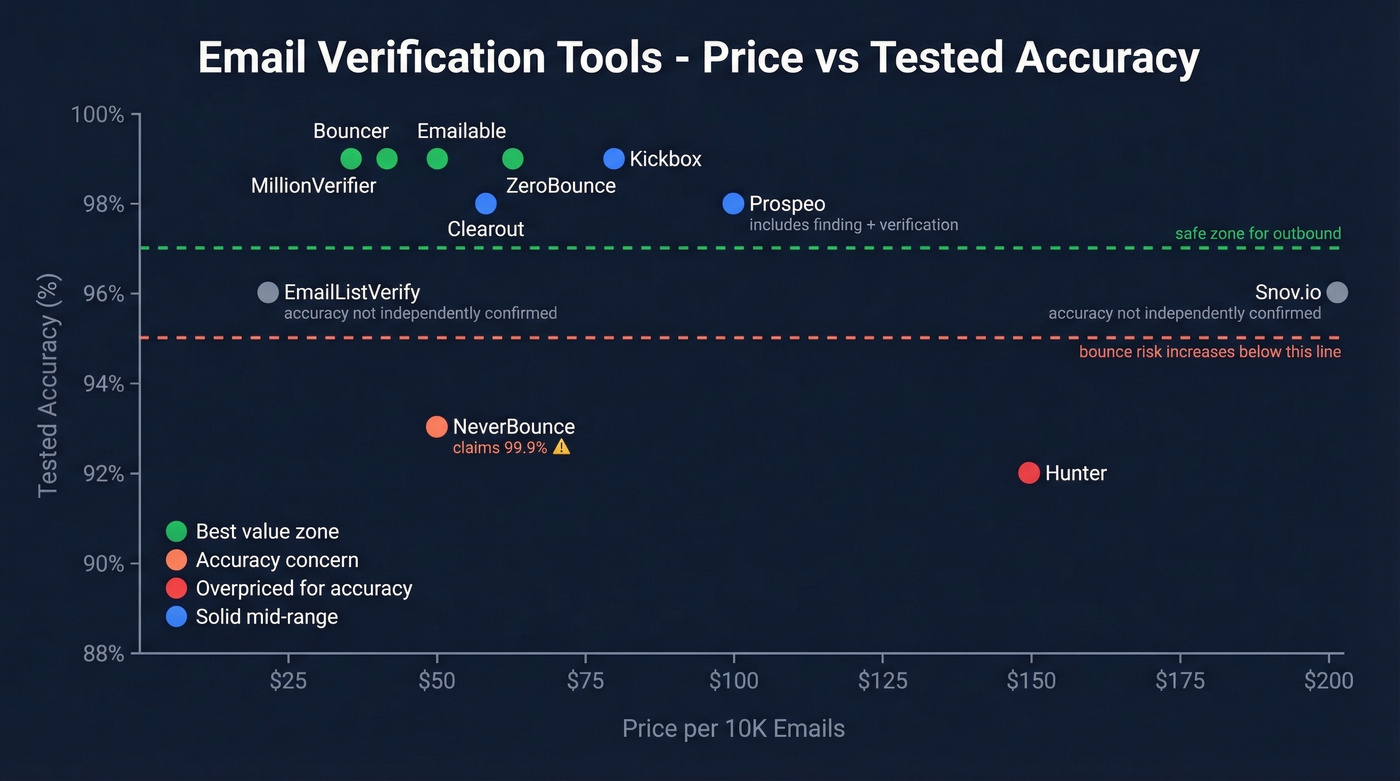
The pricing spread across email verification tools is wider than most people expect - the cheapest option costs about 7.9x less than the most expensive, yet accuracy clusters tightly between 96-99% for most tools. The outlier is NeverBounce, where the gap between claimed and tested accuracy should give you pause.
Pricing & Accuracy
| Tool | 10K Price | Free Credits | Tested Accuracy |
|---|---|---|---|
| Prospeo | ~$100* | 75/mo | 98% |
| Bouncer | $45 | 1,000 | 99% |
| Emailable | $50 | 250 | 99% |
| ZeroBounce | $64 | 100/mo | 99% |
| NeverBounce | $50 | 1,000 | 93%† |
| EmailListVerify | $24 | 100 | - |
| Clearout | $58 | 100 | 98% |
| Hunter | $149 | - | 90-95%† |
| Kickbox | $80 | 100 | 99% |
| MillionVerifier | ~$37 | - | 99% |
| Snov.io | $189 | - | - |
Speed & Integrations
| Tool | Speed (emails/hr) | Integrations |
|---|---|---|
| Prospeo | Verified at collection | 10+ |
| Bouncer | 180K | 16 |
| Emailable | 2M | 22 |
| ZeroBounce | 133K | 45+ |
| NeverBounce | 100K | 22 |
| EmailListVerify | Not public | 11 |
| Clearout | 160K | 38 |
| Hunter | Not public | 24 |
| Kickbox | Not public | 27 |
| MillionVerifier | Not public | - |
| Snov.io | Not public | 46 |
Prospeo price includes contact finding + verification. †Independent benchmark figures - self-reported numbers are higher.
The Catch-All Problem
Catch-all domains accept email for any address and route everything to a central inbox. In B2B, they're everywhere - especially at mid-market companies. Most verification tools return "unknown" or "risky" for catch-all addresses, which is essentially useless. You still don't know if the person exists.
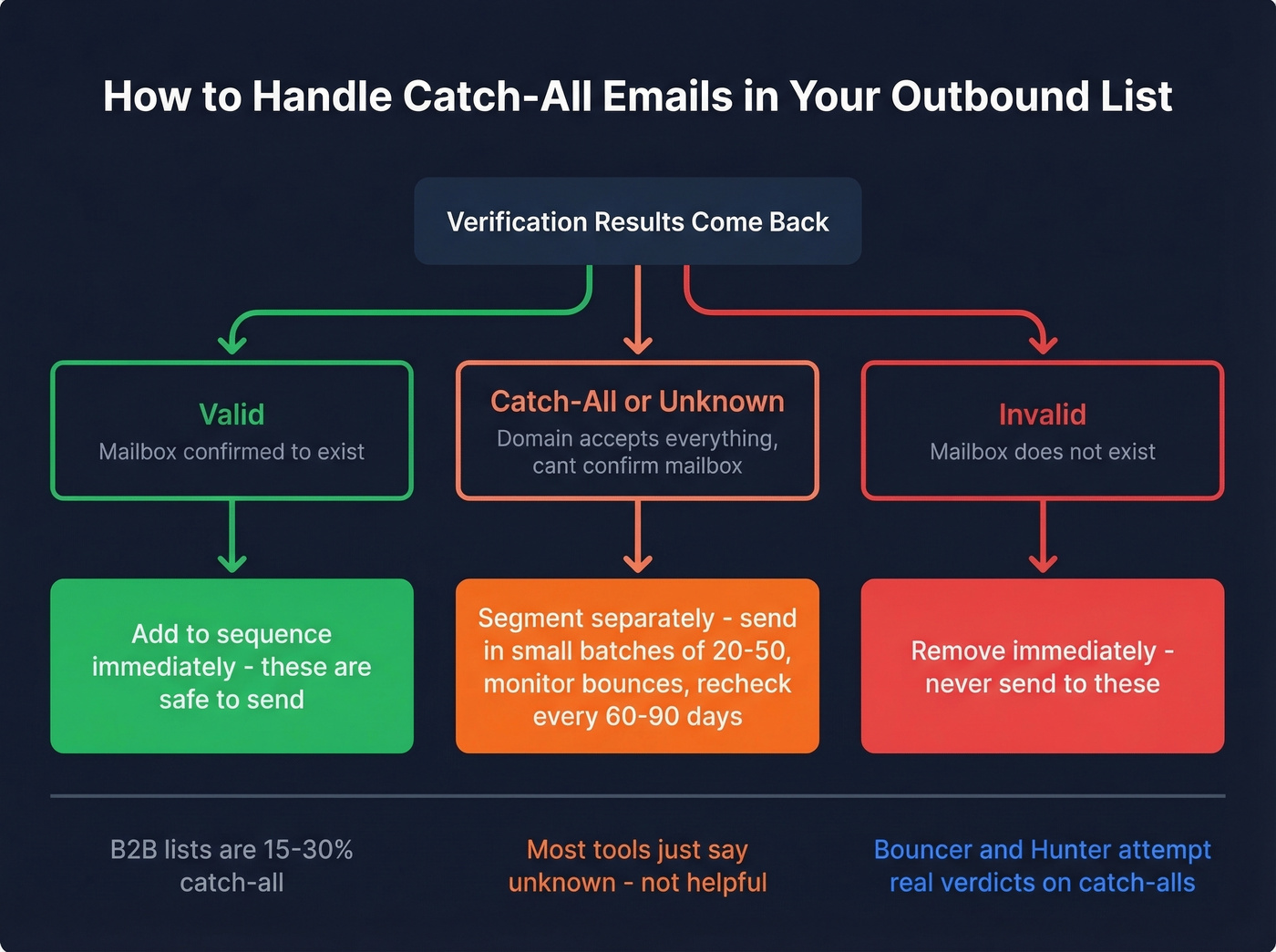
This is where tool selection actually matters for outbound teams. Tools with advanced catch-all resolution - Bouncer and Hunter both attempt actionable verdicts - give you a real valid/invalid answer instead of a shrug. The practical segmentation model: valid emails go straight to your sequence, catch-all addresses get segmented for small-batch testing, and invalid addresses get removed immediately.
Catch-all statuses change. A domain that's catch-all today might not be next quarter. Recheck your catch-all segments every 60-90 days.
If you're seeing deliverability issues beyond bounces, you may need spam trap removal rather than just verification.
Should You Stack Multiple Verifiers?
An approach that keeps surfacing on r/sales and outbound communities: run your list through multiple verifiers sequentially. One practitioner's ranking was Instantly.ai, then NeverBounce, then MillionVerifier. The logic is sound - each tool has blind spots, especially on catch-all domains, and stacking catches what individual tools miss.
When does stacking make sense? Large lists (50K+) going into high-stakes campaigns where every bounce hurts your domain reputation. When doesn't it? When your source data is already verified at collection - you're not cleaning dirty data, you're starting with clean data.
Let's be honest: most teams overthink this. If your deal sizes are under five figures, one good verifier is enough. Stacking is insurance for enterprise outbound, not a default workflow.
How to Choose the Right Tool
The decision comes down to your use case, volume, and whether you need an API for real-time verification or bulk upload for periodic list cleaning.
For B2B outbound teams, catch-all handling, data freshness, and workflow integration are non-negotiable. A platform that verifies emails at the point of data collection, or a high-accuracy standalone verifier like Bouncer or Emailable paired with your prospecting tool, is the right setup. Too many B2B domains are catch-all to ignore that capability. (If you're improving the rest of your outbound motion too, start with these sales prospecting techniques.)
For email marketing teams, bulk speed and ESP integrations matter more. Emailable's 2M emails/hour or ZeroBounce's 45+ integrations make more sense here. Catch-all handling is less critical when you're sending newsletters to opted-in subscribers.
For budget-conscious teams, start with EmailListVerify at $24/10K for one-off cleans. If accuracy matters more than price, Bouncer at $45/10K is the sweet spot - we've found it to be the best value per verified email on the market.
Three questions before you pick: How often do you verify - one-off or ongoing? Do you need an API for real-time form validation or bulk upload for list cleaning? And how important is catch-all resolution for your specific list composition? The right verify email tool depends entirely on your answers.
Snyk dropped bounce rates from 35-40% to under 5%. Stack Optimize runs under 3% bounce with zero domain flags. The difference isn't a better verifier - it's data that's already verified this week, not six weeks ago.
Verification built into the data beats verification bolted on after.
FAQ
What's a good email bounce rate?
Under 2% is acceptable; under 1% is ideal. Industry averages range from 0.33% in beauty/personal care to 1.28% in construction. A good deliverability rate is above 89%; excellent is above 95%. Consistently above 2% means your sender reputation is taking damage.
How often should I re-verify my email list?
Every 60-90 days for most lists. B2B outbound lists over 10,000 contacts should be rechecked every 2-4 weeks, since job changes happen constantly.
Can email verification tools catch spam traps?
Some can. Tools with advanced filtering like Bouncer and ZeroBounce flag spam traps and honeypots proactively. Basic verifiers running only syntax and SMTP checks often miss them, putting your sender domain at risk.
What's the difference between email verification and validation?
The terms are used interchangeably. Technically, validation checks format and syntax, while verification confirms the mailbox exists via SMTP. Every tool on this list does both, so the distinction rarely matters when choosing software.
Is there a free verify email tool worth using?
Most tools offer free credits ranging from 75 to 1,000. For bulk cleaning, EmailListVerify's paid plans start at just $24 per 10K. True "free forever" verification at scale doesn't exist - the infrastructure costs too much.