


Verimail Review 2026: Pricing, Pros, Cons, and Whether It's Worth It
You're cleaning a 10,000-row CSV before a campaign launch, and you need a verifier that won't eat your budget or tank your sender reputation. Verimail is one of the cheapest options on every comparison list. But cheap and good aren't always the same thing - and the user reviews tell a more complicated story than the pricing page does.
30-Second Verdict
Verimail costs roughly $15/month for 10,000 verifications. It's fast, simple, and developer-friendly. But the G2 profile has been inactive for over a year, native integrations are basically nonexistent, and bulk verification accuracy complaints keep popping up. If you need a bare-bones CSV cleaner or a fast API endpoint, it works. If you need CRM integrations, phone numbers, or prospecting capabilities, skip it.
The stakes here are real: the industry benchmark is to keep total bounces below 2%, with top performers targeting hard bounces under 1% (see Email Bounce Rate and our Email Deliverability Guide).
Verimail Pricing Breakdown
Monthly Plans
Verimail's pricing page lists four tiers:
| Plan | Monthly Cost | Verifications | Per-Email Cost |
|---|---|---|---|
| Free | $0 | 100/mo | $0.00 |
| Starter | $15 | 10,000/mo | $0.0015 |
| Professional | $79 | 100,000/mo | $0.00079 |
| Enterprise | $299 | 1,000,000/mo | $0.000299 |
At the Starter tier, $0.0015 per email is about 5-7x cheaper than the typical $0.007-$0.01 most verifiers charge. Pay-as-you-go credits are also available as never-expiring top-ups. If you have both a monthly plan and PAYG credits, the monthly allocation gets consumed first. Hit your cap and the API returns a 402 status code - no silent failures, which developers will appreciate (especially if you're building anything around a Cold Email API).
A note on G2's numbers: G2's pricing page shows different figures - $0/$10/$25/$125 across the four tiers, and it even lists 1,000 requests/month on the Free tier. The numbers don't match. Whether Verimail raised prices or G2 captured them wrong, treat the official site as your source of truth.
AppSumo Lifetime Deal
Verimail ran a lifetime deal on AppSumo - pick your tier, no codes needed. Typical AppSumo LTDs in this category run ~$49-$199 one-time. If you grabbed one, you're locked into Professional Plan updates for life. That's solid if the tool meets your needs, though the AppSumo review base skews toward bargain hunters with different expectations than monthly subscribers.
How Verimail Compares on Price
| Tool | 10K Email Cost | Per-Email | Credits Expire? |
|---|---|---|---|
| Verimail (Starter) | $15/mo | $0.0015 | Monthly reset |
| NeverBounce (PAYG) | $80 | $0.008 | 12 months |
| NeverBounce (Growth) | $49/mo | $0.0049 | Monthly reset |
| ZeroBounce | ~$70-$100 | ~$0.007-$0.01 | Never |
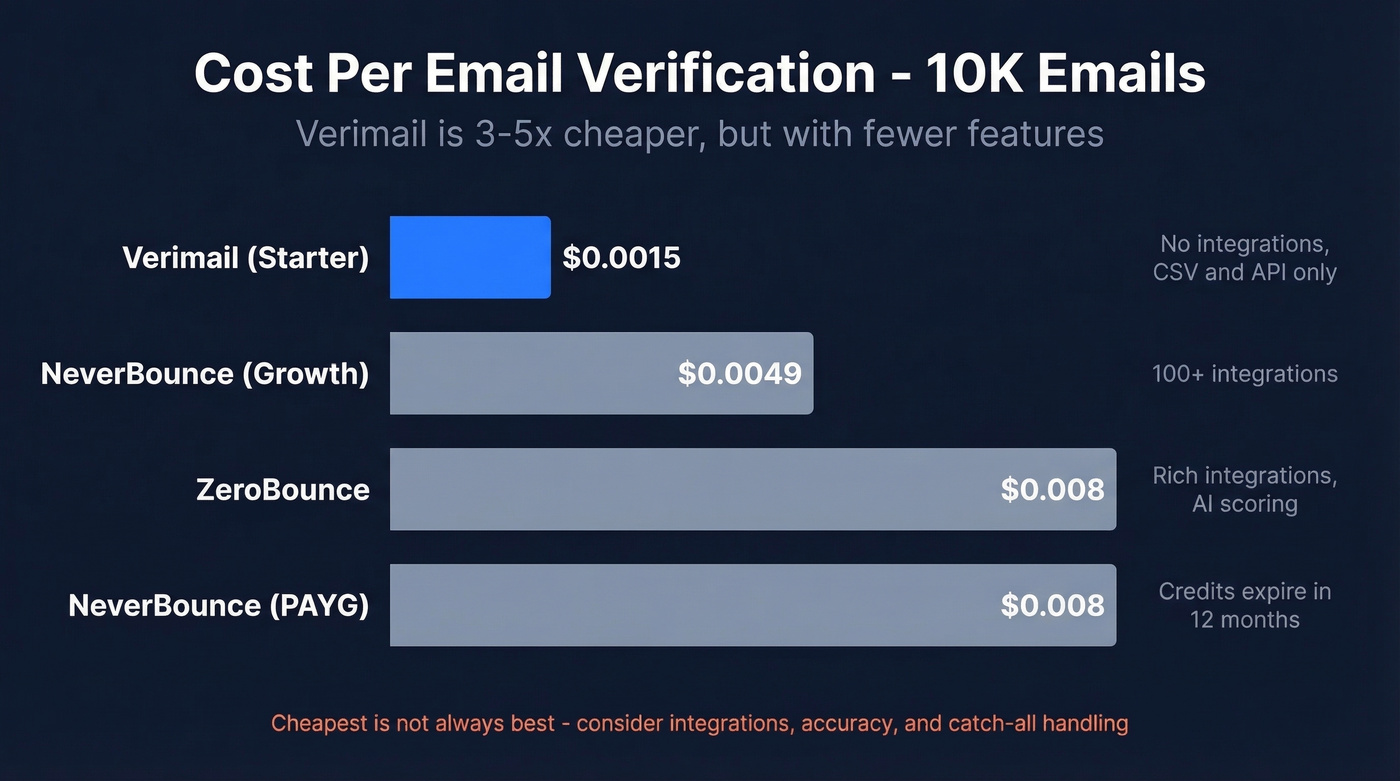
Verimail is the cheapest pure verifier on this list by a wide margin. NeverBounce and ZeroBounce offer richer integrations and more mature platforms, but you're paying 3-5x more per email for those extras. Prospeo costs more per verification but includes prospecting, 143M+ pre-verified emails, and native CRM integrations - a fundamentally different value proposition than standalone verification (more on sales prospecting databases and data enrichment services).

Verimail costs $15/mo to clean 10K emails. Prospeo gives you 143M+ emails already verified at 98% accuracy - so there's nothing to clean. Skip the CSV upload, the catch-all headaches, and the bulk verification inconsistencies. Start with data that's verified before it reaches your inbox.
Why verify emails after the fact when you can start with verified ones?
Verimail Reviews: What Users Actually Say
Verimail holds a 3.8 out of 5 on G2 from just 3 reviews. The profile hasn't been active in over a year, which tells you how much attention the vendor pays to its public presence. Positive feedback mentions an "easy to use" interface that's "quick with feedback." The negatives: "Only accepted csv file," complaints about "fighting with protection systems for security," and a reviewer who said the subscription model didn't suit their business at all.
Three reviews isn't enough to draw conclusions. It's enough to notice that nobody's raving.
The AppSumo reviews are more detailed - 9 ratings averaging 4.2/5. API users love it: "API is FAST," "working flawlessly" for real-time form validation. One reviewer called it their "new default replacing Bounceless." But the bulk verification complaints are hard to ignore. One user reported that bulk verification flagged emails as undeliverable while single verification on the same addresses showed deliverable. Another described "like 90% of emails flagged" as undeliverable during a CSV upload. We've seen this pattern across multiple verifiers, but the consistency of these reports is a red flag.
The split is clear: API users are happy, bulk CSV users hit inconsistencies (if you're troubleshooting this at scale, it often ties back to sender reputation and list quality).
Why Some Emails Get Flagged
Before you blame Verimail specifically, it helps to understand what's actually happening under the hood. Verimail returns 8 result categories: deliverable, inbox_full, hardbounce, softbounce, catch_all, disposable, undeliverable, and unknown. The complaints about "good emails flagged as undeliverable" almost certainly involve catch-alls and unknowns - categories where no verifier gives you a definitive answer.
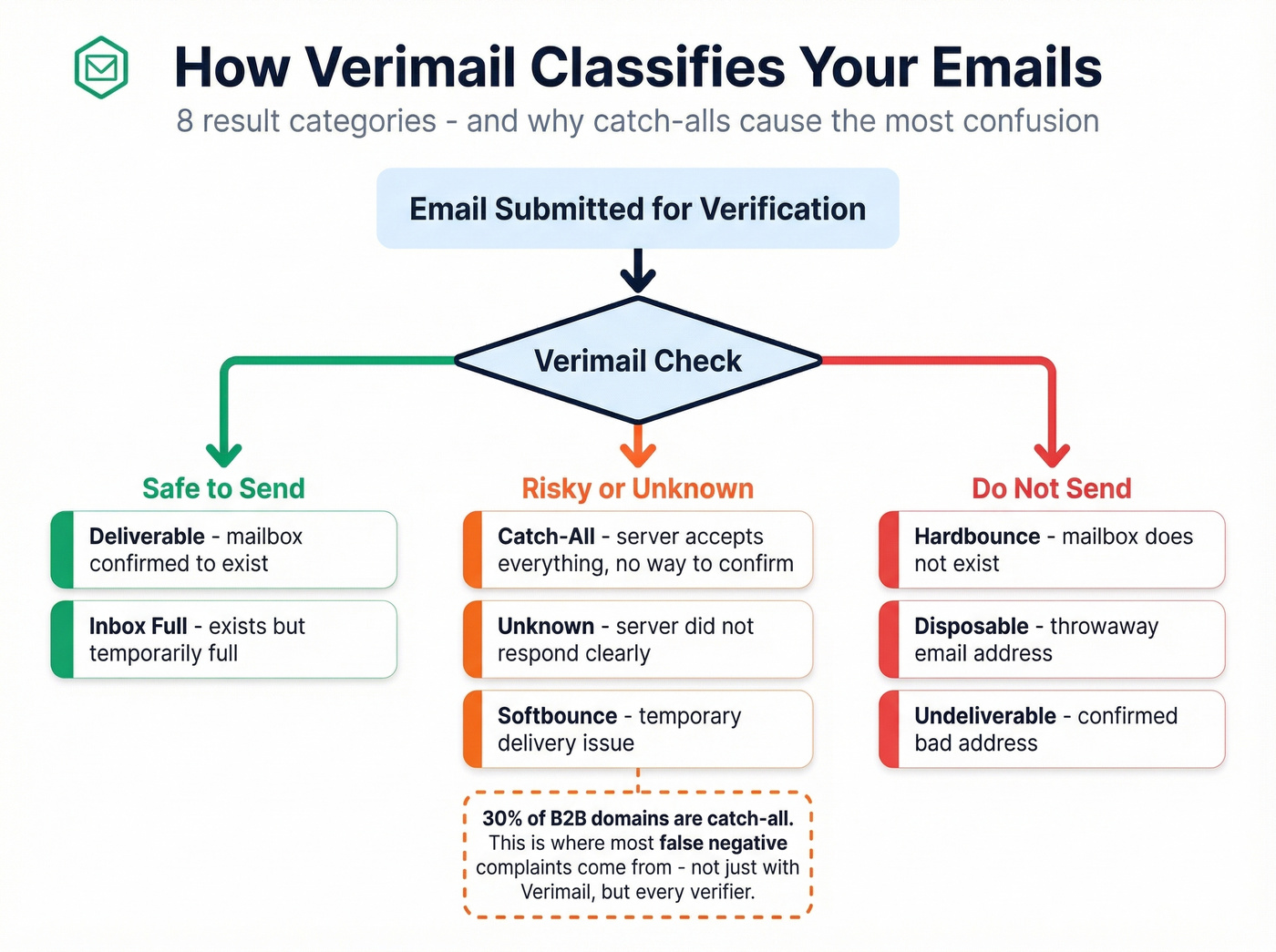
Here's why: roughly 30% of B2B domains use catch-all configurations. The mail server accepts everything without confirming whether a specific mailbox exists. A thread on r/coldemail captured this well - one user tested the same email across multiple validators and got conflicting results, despite the company responding to a test email sent manually. In our experience, this is the single biggest source of "false negative" complaints across the entire verification industry, not just Verimail.
Let's be honest: if more than 40% of your verified list comes back as catch-all or unknown, your problem isn't the verifier. It's your data source. Starting with pre-verified emails eliminates most of this pain before you ever upload a CSV.
The Verdict: Pros and Cons
Use Verimail if you're a developer needing a fast API endpoint for real-time form validation, a solopreneur cleaning small CSVs on a tight budget, or an AppSumo LTD holder who already owns it. Verimail uses end-to-end encryption and automatically removes verified email addresses from its servers after each verification - a privacy detail worth noting.
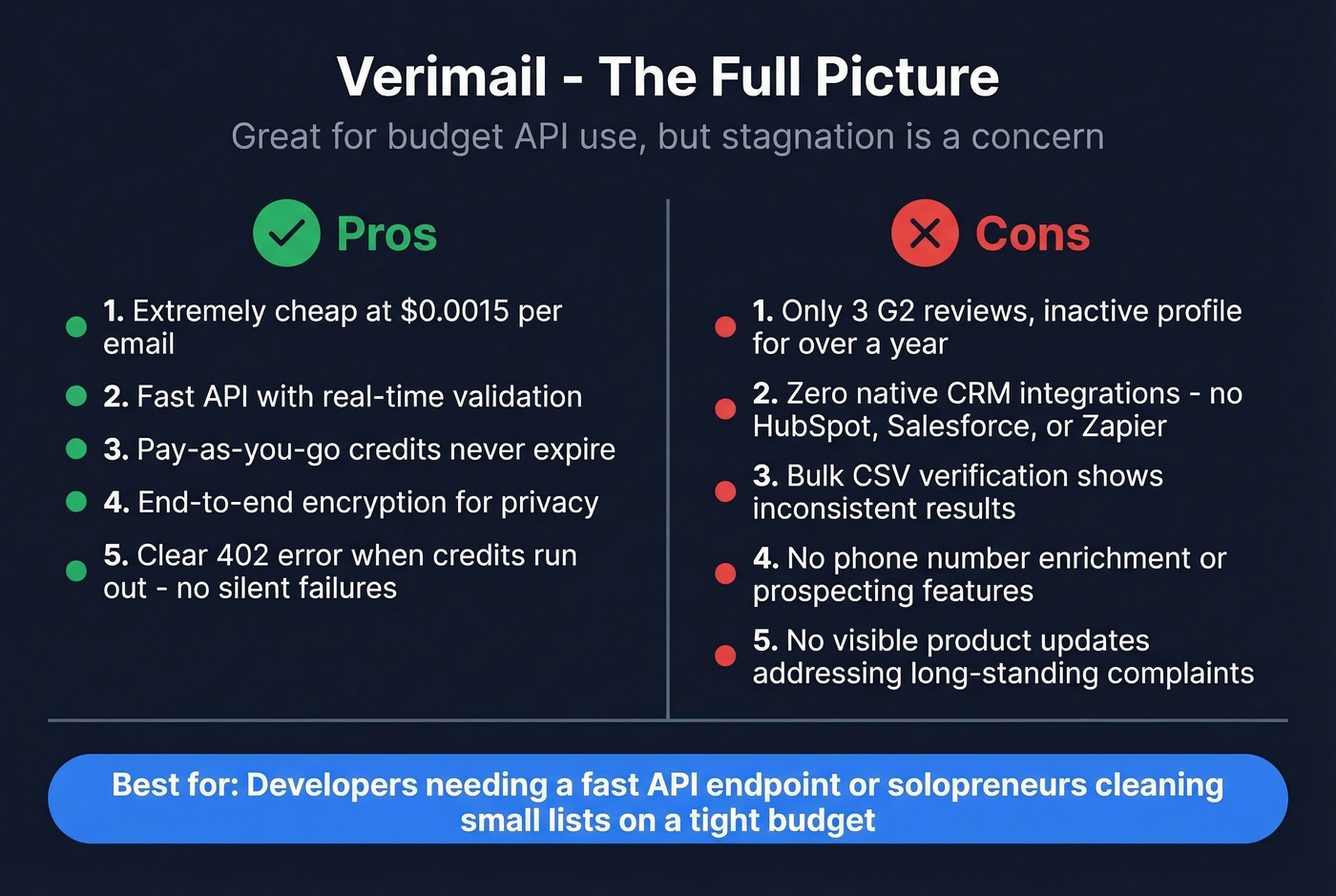
Skip Verimail if you need native CRM/automation integrations like HubSpot, Salesforce, or Zapier. Same goes for teams doing high-volume sends who need reliable catch-all handling, or anyone who needs phone numbers alongside emails (see connect outreach tool to CRM and best contact management software).
Verimail's biggest problem isn't accuracy - it's that the product hasn't evolved. Inactive G2 profile, limited integrations, no feature updates addressing complaints from years ago. For a tool you're trusting with your sender reputation, that stagnation is concerning.
Catch-all domains, unknown statuses, and bulk flagging issues aren't just a Verimail problem - they're a verification-after-the-fact problem. Prospeo's 5-step verification with catch-all handling and spam-trap removal happens before emails enter the database. 98% accuracy, 7-day refresh cycle, zero CSV uploads required.
Get 75 free verified emails this month - no credit card, no cleaning needed.
FAQ
Is Verimail accurate for email verification?
Reasonably accurate for standard mailboxes - API users consistently report good results for real-time validation. Inconsistencies mostly stem from catch-all domains, which make up 30% of B2B addresses and challenge every verifier on the market. If emails get flagged during bulk upload, retry them via single verification before discarding.
Does Verimail integrate with CRMs?
No. Verimail doesn't have native integrations with HubSpot, Salesforce, Zapier, or any major CRM/automation platform. You're limited to CSV uploads and direct API calls. For teams that need CRM connectivity, Prospeo or ZeroBounce offer native integrations out of the box.
Is Verimail worth it at $15/month?
For solopreneurs or developers verifying under 10,000 emails monthly, $0.0015/email is genuinely hard to beat. The tradeoff is limited features, no integrations, and thin support. For teams running campaigns above 25K contacts or needing phone numbers alongside emails, a platform with richer data will save more money long-term than cheap verification alone.