

Virtual Sales: What It Is, How to Do It Well, and What Most Reps Get Wrong
A prospect booked a virtual sales appointment with a tax company. No reminder email. No join instructions. When they logged on, the link didn't work. They called the office. The staff said only one person "knows how it works," and that person wasn't available. The prospect spent 30 minutes trying to connect, gave up, and never came back.
That story, documented by IMPACT, is what happens when selling online gets treated as an afterthought instead of the primary channel it's become.
The Short Version
- Virtual sales means selling entirely online - video, phone, email, chat. It's the default now, not a pandemic workaround.
- 70-80% of B2B buyers prefer virtual interaction. Only 33% of salespeople are effective in virtual environments. That gap is your opportunity.
- Your tech stack matters less than your data quality. Bad emails and dead phone numbers kill more deals than bad lighting ever will.
- The biggest mistakes aren't tactical - they're structural: no meeting prep, no agenda, no follow-up, no verified prospect data.
What Is Virtual Selling?
The answer is straightforward: it's conducting the entire sales process online - prospecting, discovery, demos, negotiation, close - using video calls, phone, email, and chat instead of face-to-face meetings. The complicated part is how it overlaps with terms like "inside sales," remote sales, and digital selling.
Here's the practical distinction. Field sales involves high-ticket products with long cycles, often six months or more, where reps get 1.5-5 hours of face time per visit. Think pharma reps or custom industrial machinery. Virtual selling typically handles shorter cycles of one to two months where the buyer arrives with baseline knowledge and the seller provides differentiation and further explanation. A remote rep might need 7-10 separate calls to match the face time of a single field visit.
There's a great thread on r/sales where a rep got reclassified from "outside sales" to "inside sales" during a PE restructuring - while doing the exact same job, traveling the same amount, calling the same accounts. The title changed. The work didn't.
Look: the label debate is pointless. Whether your org calls it virtual, inside, remote, or digital selling, what matters is whether you've optimized the process for a screen-first buyer. Most teams haven't.
Why Remote Selling Is the Default in 2026
The numbers aren't ambiguous. 70-80% of B2B buyers prefer virtual interaction over face-to-face, per McKinsey research. Decision-makers now consider remote selling as effective as in-person engagement. Only 15-25% of B2B buyers want to interact with a rep in person at all during their purchase decision.
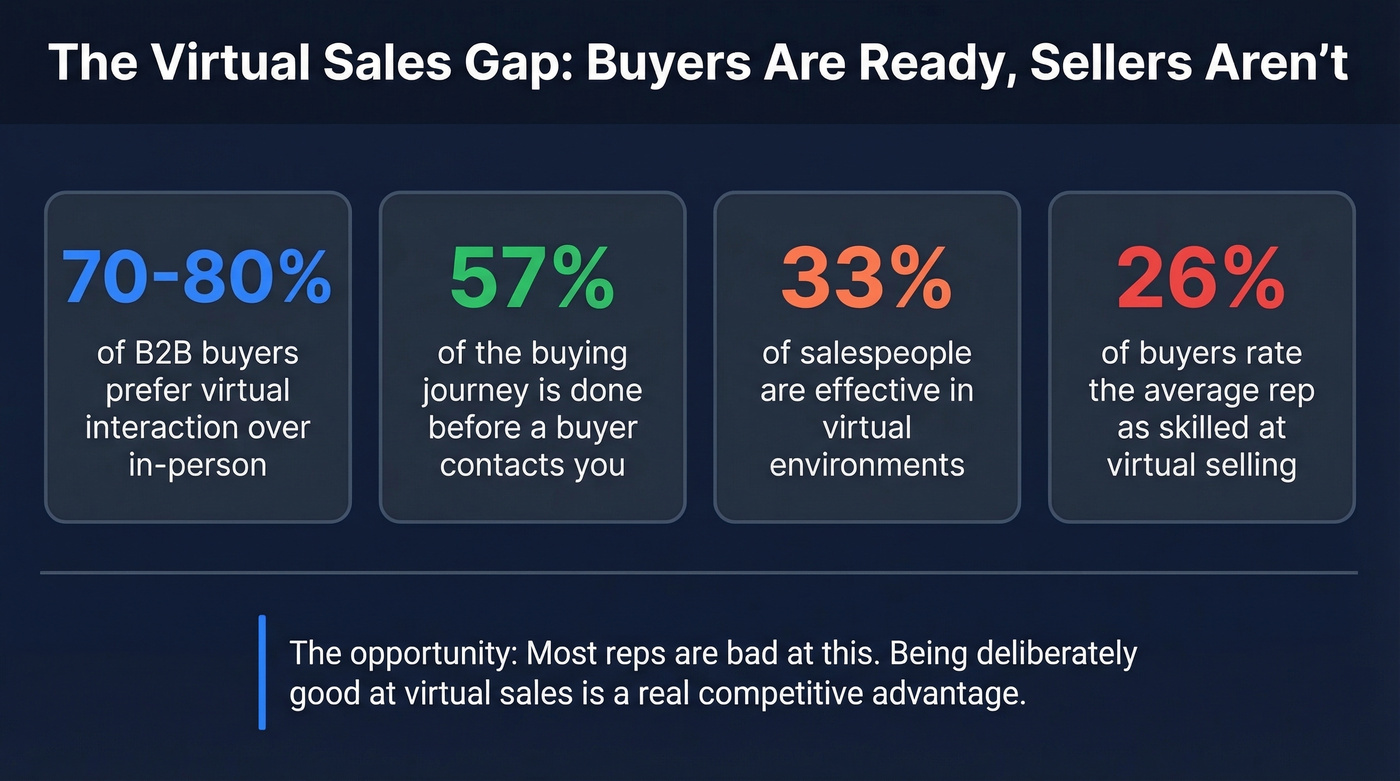
Buyers are also further along before they ever talk to you. The established CEB benchmark - still widely cited - puts the modern B2B buyer at 57% through their decision-making process before contacting a vendor. By the time they book a call, they've already done the research. Your job isn't to educate from scratch. It's to differentiate and close.
The supply side hasn't caught up. Around 80% of buyers and sellers favor digital and remote engagement, but only 33% of salespeople are effective in virtual environments. Buyers notice: just 26% rate the average sales professional as skilled at selling virtually. That's a brutal gap, and it's where deliberate teams pull ahead.
The AI layer is accelerating this shift. 45% of teams already run a hybrid AI-SDR model, using AI for research, personalization, and initial outreach while human reps handle live conversations. Virtual selling isn't just the default channel - it's the channel that AI augments best.
Our take: If your average deal size is under $10K, you almost certainly don't need field sales at all. The ROI on a plane ticket to close a $7K deal is negative. Put that budget into better data and a tighter virtual process, and you'll close more deals at a fraction of the cost.

You just read that reps spend 70% of their time not selling. Bad data makes it worse - bounced emails, disconnected numbers, wasted sequences. Prospeo gives you 143M+ verified emails at 98% accuracy and 125M+ mobile numbers with a 30% pickup rate, refreshed every 7 days. At $0.01 per email, you reclaim selling hours instead of burning them on dead leads.
Fix your data before your next virtual sales call.
The Essential Tech Stack
Reps spend only 30% of their working hours actually selling. The rest goes to CRM entry, scheduling, follow-ups, and admin. The right stack doesn't just add features - it buys back selling time.
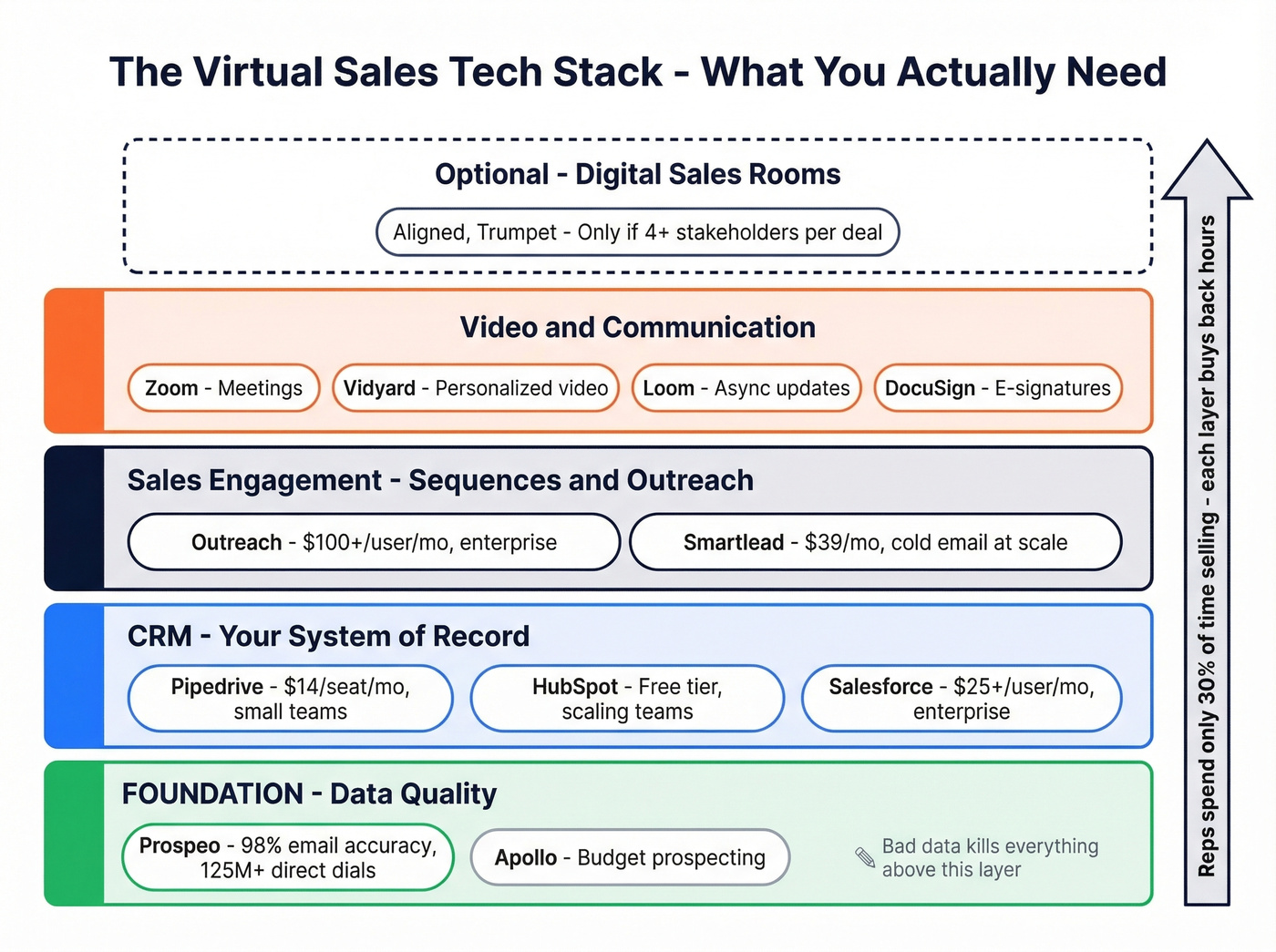
| Category | Tool | Starting Price | Best For |
|---|---|---|---|
| CRM | Pipedrive | $14/seat/mo | Small teams |
| CRM | HubSpot | Free tier; paid from ~$20/seat/mo | Scaling teams |
| CRM | Salesforce | From ~$25/user/mo | Enterprise |
| B2B Data | Prospeo | Free - 75 emails/mo | Verified emails + direct dials |
| B2B Data | Apollo | Free tier; paid from ~$49/mo | Budget prospecting |
| Video Conferencing | Zoom | Free tier; paid from ~$13/user/mo | Default for most |
| Video Messaging | Vidyard | Free plan; paid from ~$19/mo | Personalized outreach |
| Video Messaging | Loom | Free plan; paid from ~$12/mo | Quick async updates |
| E-Signature | DocuSign | From ~$10/mo | Closing contracts |
| Sales Engagement | Outreach | ~$100+/user/mo | Enterprise sequences |
| Sales Engagement | Smartlead | From ~$39/mo | Cold email at scale |
Data Quality Is the Foundation
Virtual selling only works if you're reaching real people at valid contact details. We've seen teams burn entire sequences because 20%+ of their list bounced on the first send - torching domain reputation in the process.
Prospeo addresses this at the foundation: 98% email accuracy across 143M+ verified emails, 125M+ verified mobile numbers with a 30% pickup rate, and a 7-day data refresh cycle versus the six-week industry average. The database covers 300M+ professional profiles with 30+ search filters, including buyer intent, technographics, job changes, headcount growth, funding, and revenue. There's a free tier with 75 verified emails per month plus 100 Chrome extension credits, and paid plans run about $0.01 per email.
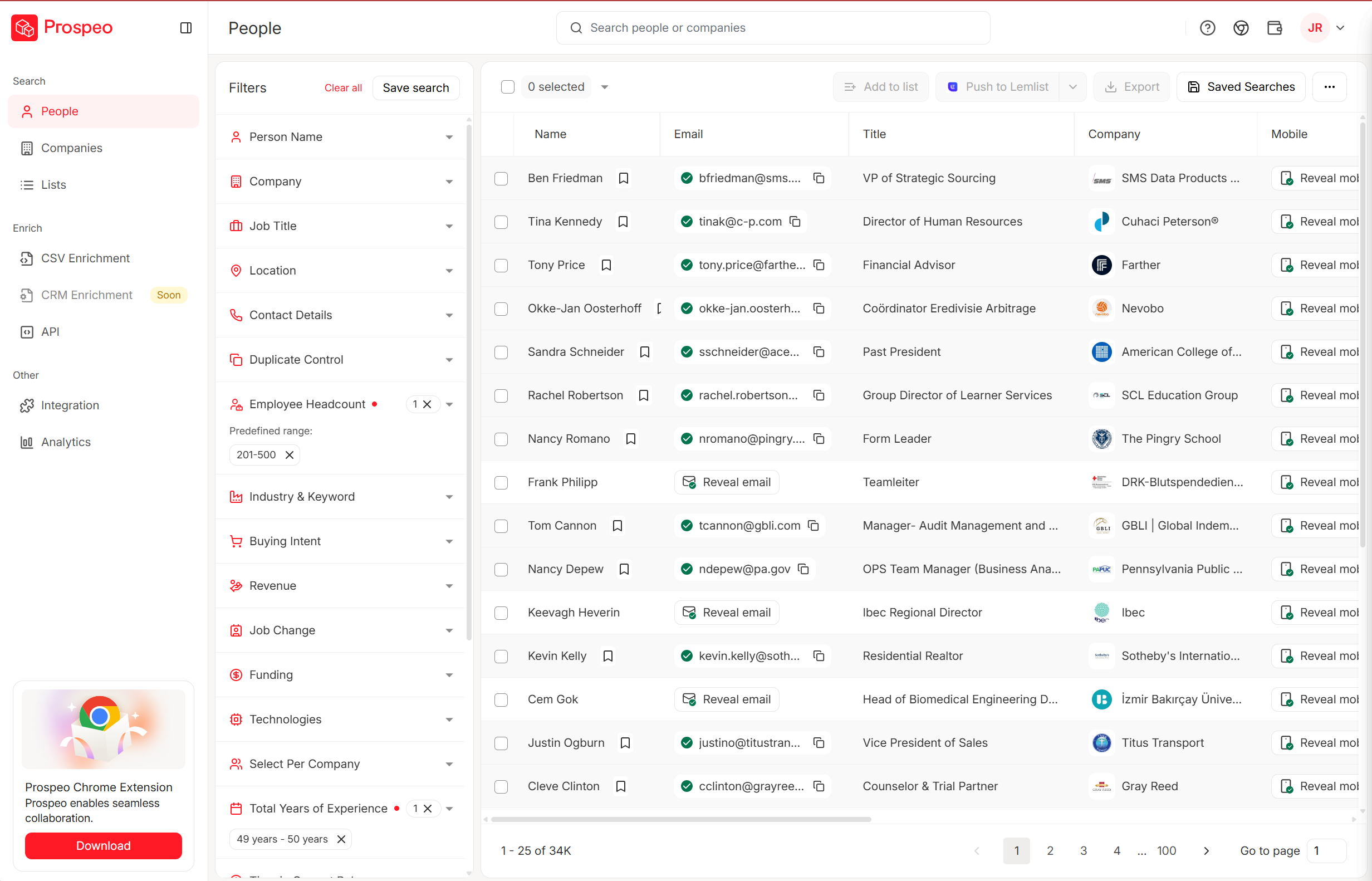
Virtual sales lives or dies on reaching the right person at a working contact. Teams using Prospeo book 35% more meetings than Apollo users and 26% more than ZoomInfo - because 98% email accuracy and verified direct dials mean your sequences actually land. Layer in buyer intent across 15,000 topics and 30+ filters to find prospects already in-market.
Stop selling into the void. Start reaching verified buyers.
Digital Sales Rooms - Worth Watching
For multi-stakeholder enterprise deals, digital sales rooms are gaining traction fast. Tools like Aligned and Trumpet let you create a shared workspace where every stakeholder - champion, CFO, legal - can access proposals, recordings, and timelines in one place. If your deals regularly involve 4+ decision-makers, a DSR cuts the "can you resend that deck?" cycle and keeps momentum between calls. Skip this if your average deal involves fewer than three stakeholders - it'll add complexity without payoff.
Mistakes That Kill Deals
91% of virtual sellers struggle to keep buyers engaged. 88% find it challenging to build relationships through a screen. Those numbers aren't surprising when you look at what most reps actually do wrong.
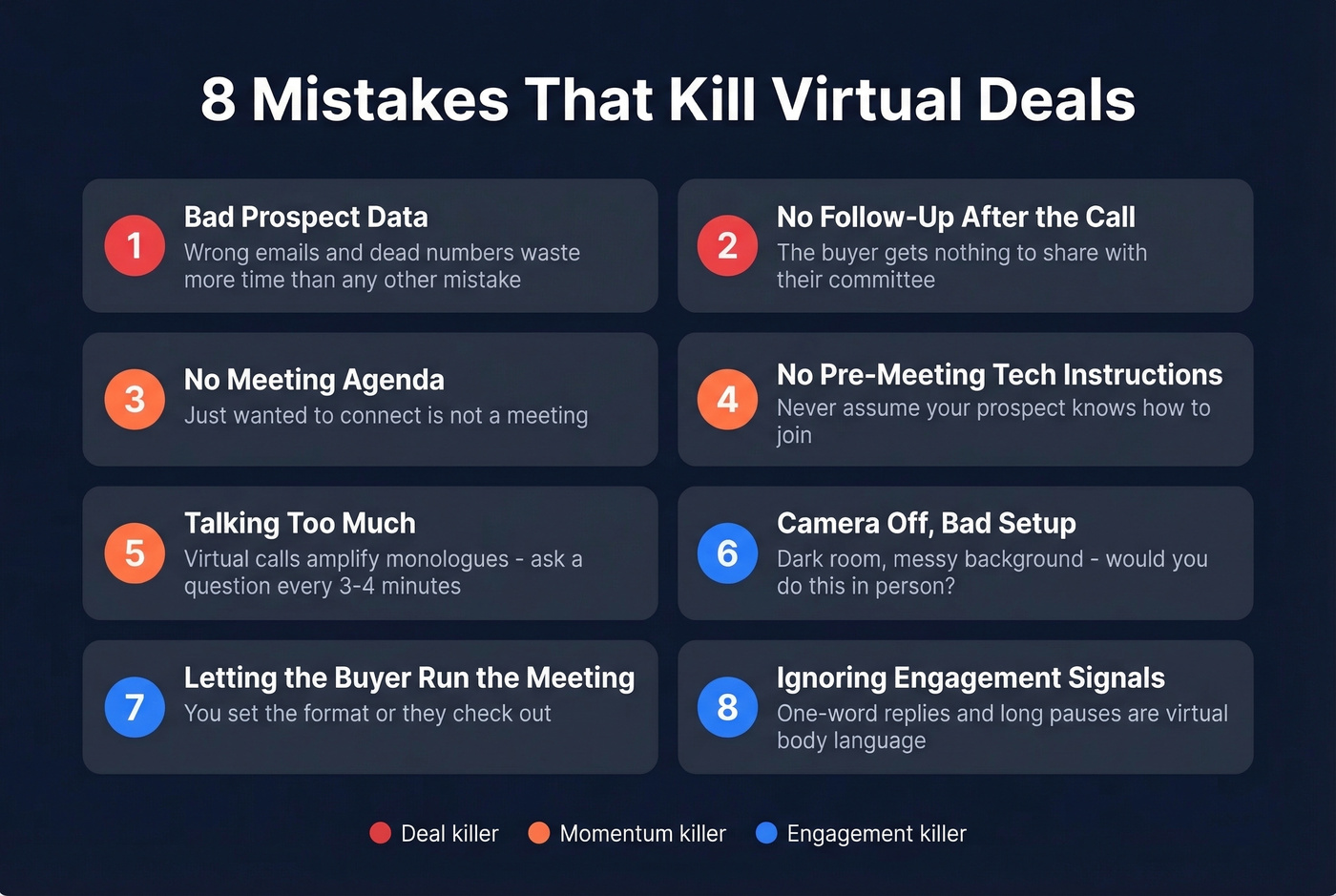
1. Camera off, bad lighting, unprofessional background. If you wouldn't show up to a client meeting in a dark room wearing pajamas, don't do it on Zoom. Table stakes. Too many reps still fail here.
2. No pre-meeting tech instructions. Remember the tax company story? Don't assume your prospect knows how to join. Send a reminder with the link, any required downloads, and a backup phone number. Every time.
3. Talking too much. Virtual calls amplify monologues. Without physical cues, reps default to presenting instead of conversing. The fix: ask a question every 3-4 minutes and pause for response.
4. No meeting agenda. "Just wanted to connect" isn't a meeting. Send a 3-bullet agenda 24 hours before. It signals professionalism and gives the buyer a reason to show up prepared.
5. Bad prospect data. This one drives us crazy because it's so preventable. Wrong emails, dead phone numbers, outdated titles - these waste more selling time than any tactical mistake on this list. A 98% email accuracy standard means fewer bounces and more conversations that actually happen.

6. No follow-up video or summary. The call ends and the buyer gets... nothing. A 90-second Loom or Vidyard recap keeps momentum and gives the buyer something to share with their committee. (If you need a starting point, use these sales follow-up templates.)
7. Letting the buyer run the meeting. The Reddit complaint about "webinar mode" - Lunch n Learns devolving into muted-mic, camera-off sessions - is a symptom of this. You set the format. Try this script at the start of every call: "Before we dive in, I find these conversations work best when we can see each other. Would you mind turning your camera on? I'll have mine on too." Use polls or screen-share to keep the energy interactive. If you don't control the format, the buyer checks out.
8. Ignoring engagement signals. One-word replies. Long pauses. The prospect clearly typing something else. These are virtual body language, and they're screaming at you. When you sense disengagement, stop and ask: "Does this track with what you're seeing on your end?"
Pre-Meeting Checklist
Run through this before every call:
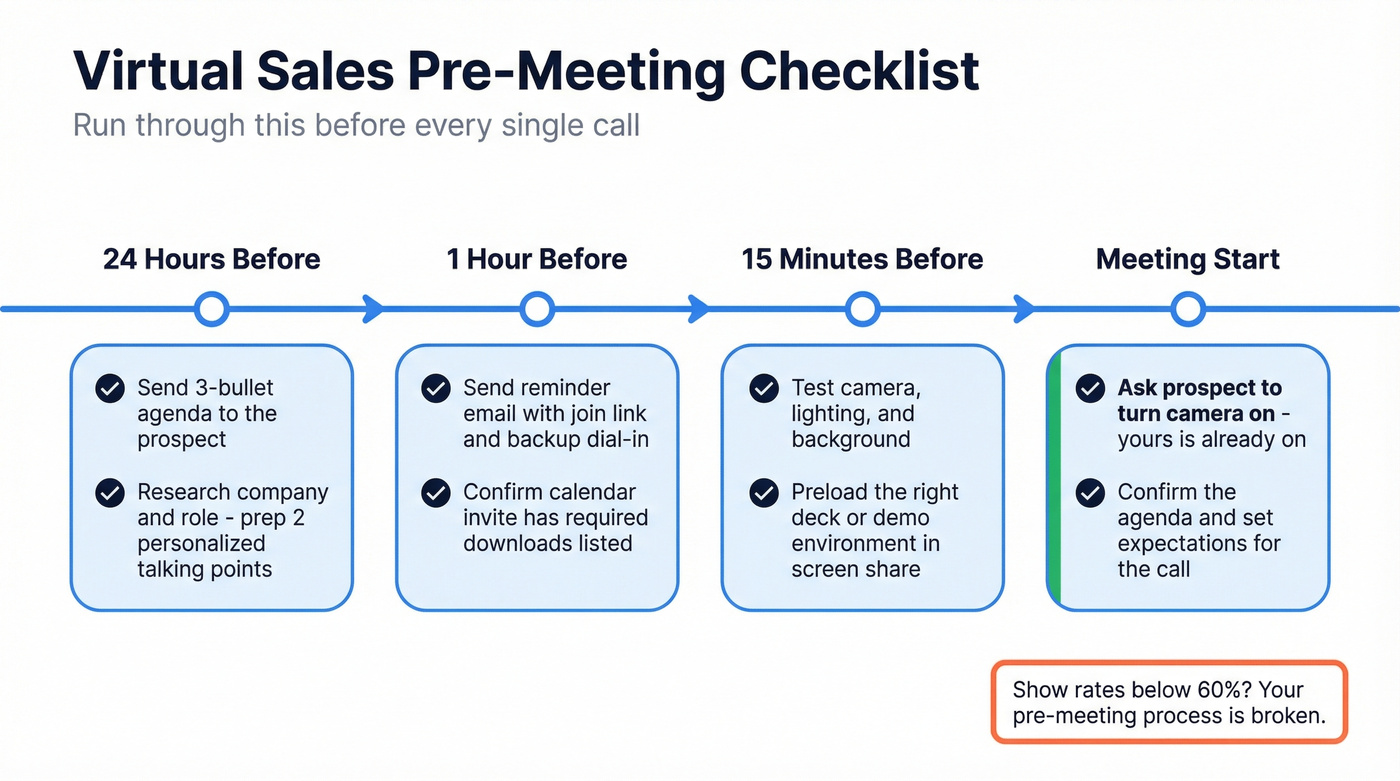
- Agenda sent 24 hours in advance - 3 bullets max
- Calendar invite includes join link, backup dial-in, and any required downloads
- Reminder email sent 1 hour before the meeting
- Prospect's company and role researched - at least 2 personalized talking points ready
- Camera on, lighting tested, background clean
- Screen share preloaded with the right deck or demo environment
KPIs That Actually Matter
If you're not measuring virtual sales differently than field sales, you're missing the signal.
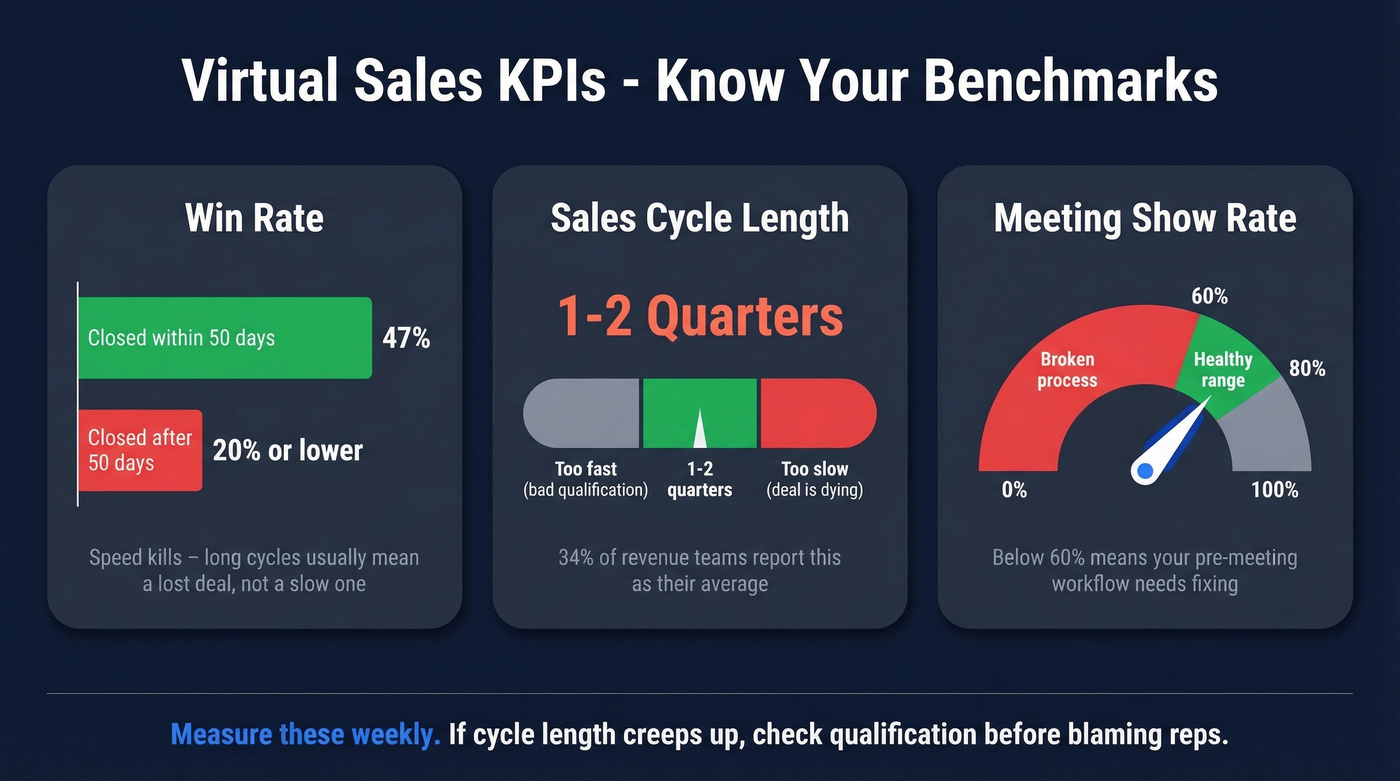
Win rate: Opportunities closed within 50 days hit a 47% win rate. After 50 days, it drops to 20% or lower. Speed kills - long cycles usually mean a lost deal, not a slow one.
Sales cycle length: 34% of revenue teams report average cycles of 1-2 full quarters. If you're consistently exceeding that, look at your qualification process before blaming reps.
Meeting show rate: Expect 60-80% with proper confirmation workflows - reminder email, calendar invite, and join instructions. Below 60% means your pre-meeting process is broken, full stop.
Email and call connect rates: Track these weekly. A sudden drop in email deliverability usually means your data source is degrading. A drop in call connects means your phone numbers are stale. (If bounces are creeping up, start with email bounce rate benchmarks and fixes.)
Pipeline velocity: Deals x win rate x average deal size / cycle length. This single number tells you if your selling motion is actually accelerating or just busy. (More on this in pipeline health.)
Video engagement: If you're using async video for prospecting or follow-ups, track view rate and watch-through rate. A 40%+ view rate on prospecting videos is strong.
In-House vs. Outsourced Teams
Not every virtual sales team needs to be built internally. Let's break down the tradeoffs.
| Factor | In-House | Outsourced |
|---|---|---|
| Product knowledge | Deep | Requires ramp-up |
| Cost | Higher - salary + tools | Lower upfront, variable |
| Scalability | Slower | Faster |
| Control | Full | Partial |
| Cultural alignment | Strong | Weaker |
| Ramp time | 2-3 months typical | ~45 days |
Build in-house for your core product and ICP. Outsource for new market testing, geographic expansion, or overflow capacity when pipeline demand spikes.
We've seen teams try to outsource their entire sales motion and lose the product knowledge that makes virtual conversations credible. The hybrid approach - in-house closers fed by outsourced top-of-funnel - works best for companies in the $5M-$50M revenue range. Once you cross $50M, the economics almost always favor bringing the full motion in-house.
FAQ
What's the difference between virtual sales and inside sales?
Functionally, almost nothing. Both sell remotely via phone, email, and video. "Virtual sales" emphasizes video-first selling and modern digital tools; "inside sales" is the older term. The job is the same - don't overthink the labels.
What skills do virtual reps need most?
Video presence, active listening, written communication, CRM fluency, and the ability to read engagement signals through a screen. Only 33% of salespeople are effective virtually - deliberate practice on camera presence and question-driven conversations matters more than any single tool.
How much do virtual sales reps earn?
In the US, base salary typically ranges from $45K-$75K depending on industry and experience. OTE runs $70K-$120K+ for quota-carrying roles. Enterprise sellers with strong track records push well above that.
What tools do remote selling teams need?
At minimum: a CRM like Pipedrive or HubSpot, video conferencing via Zoom or Teams, a B2B data tool for verified contact data, and an e-signature tool like DocuSign. Add a sales engagement platform once your team exceeds 3-5 reps.
Is virtual selling as effective as in-person?
McKinsey data shows 70-80% of B2B buyers prefer virtual interaction, and decision-makers consider remote selling equally effective. The bottleneck isn't the channel - it's rep skill. Teams that invest in training consistently outperform those that treat virtual selling as "just phone sales with video."