

Virtual Sales Enablement: Framework, Stack, and Benchmarks for 2026
Up to 70% of reps miss quota. Average attainment sits around 43%. Meanwhile, 80% of B2B interactions now happen in digital channels. Virtual sales enablement exists to close that gap - and most teams are still doing it wrong.
The Short Version
Enablement in 2026 means friction removal in live deals. Not content libraries. Not training calendars. It means removing the specific blockers that stall deals mid-funnel.
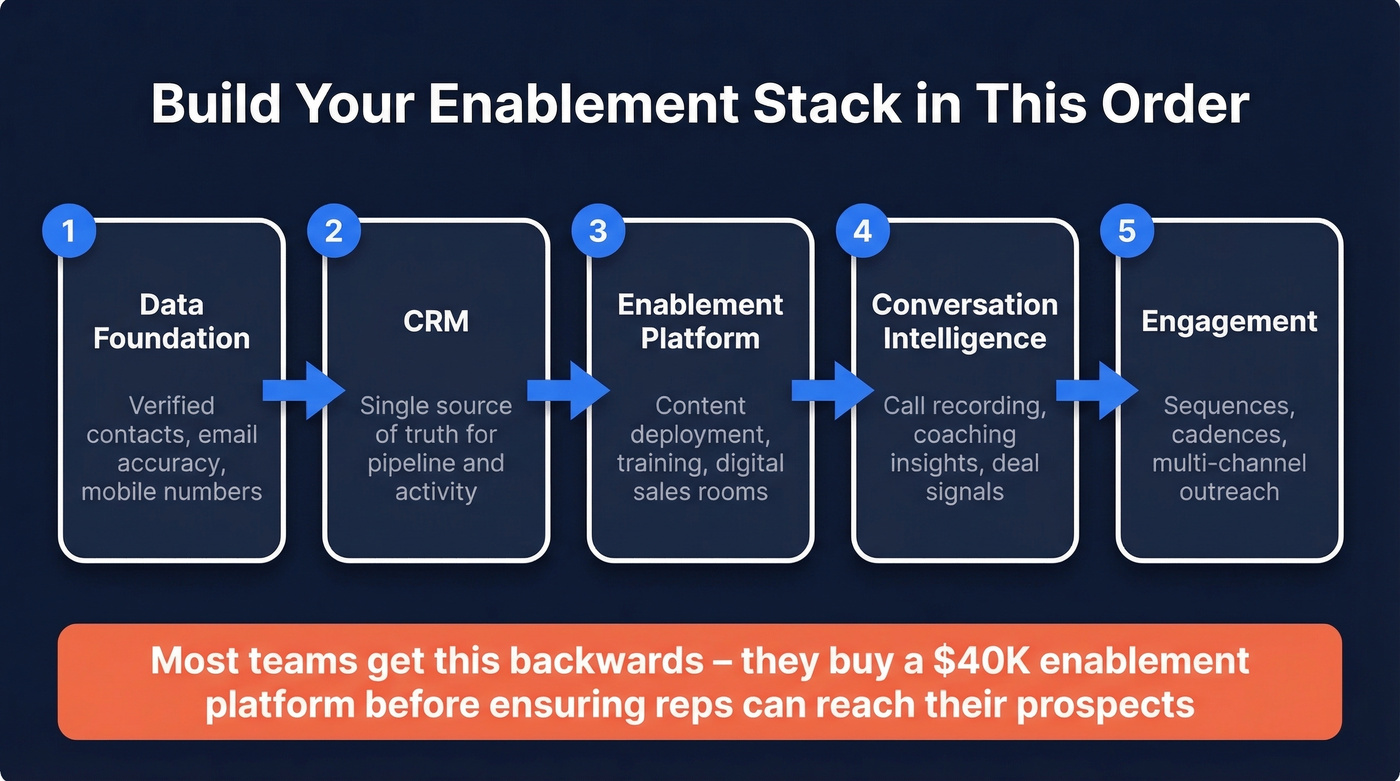
Build your stack in this order: data foundation, then CRM, then enablement platform, then conversation intelligence, then engagement. Most teams get this backwards - they buy a $40K enablement platform before ensuring reps can actually reach their prospects.
Measure daily behaviors, not just quarterly outcomes. Content usage, coaching cadence, and multi-threading activity are leading indicators. Win rate and quota attainment are lagging ones.
What Virtual Sales Enablement Actually Means Now
The pandemic-era definition - digitize your content, train reps on Zoom, buy a platform - is dead. Fluint's 2026 framework reframes enablement as the "systematic removal of friction from live deals." Enablement programs break at two predictable points: discovery gaps early in the deal, and mid-funnel execution failures around proposals and business cases. If your enablement team isn't diagnosing those specific friction points, they're running a training department, not an enablement function.
The market validates this shift. The enablement industry is projected to grow from $2.4B to $11B by 2032, and 92% of sales executives report that enablement investments boosted sales performance. Yet only 10% of large-scale B2B orgs rate themselves "very effective" at driving GTM initiatives. The opportunity is enormous - and largely unrealized.

You read it above: 65% of sales content goes unused - and it's a data problem, not a content problem. Prospeo gives your reps 300M+ verified profiles with 98% email accuracy and 125M+ mobile numbers, refreshed every 7 days. No enablement platform fixes a pipeline built on bad contact data.
Build your enablement stack on data that actually connects reps to buyers.
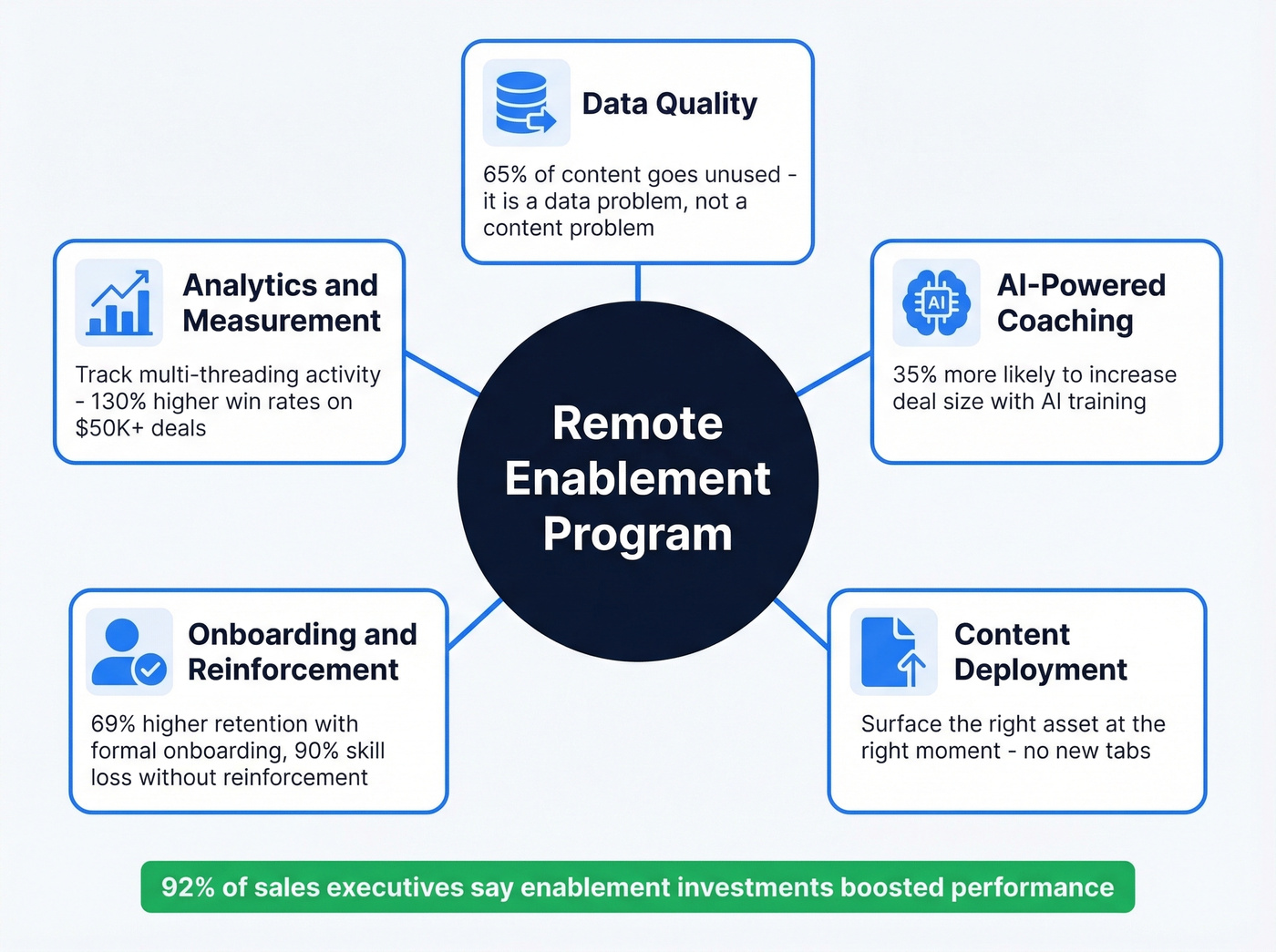
Five Pillars of a Remote Enablement Program
Data Quality: The Foundation Nobody Wants to Talk About
65% of marketing content goes unused by sales. Most people frame that as a content problem. It's not. It's a data problem.
AI-Powered Coaching
90% of companies have implemented AI in enablement or plan to this year. The use cases delivering real results: AI role-play simulations, real-time objection handling copilots on live calls, and automated content recommendations by deal stage. Companies using AI for sales training are 35% more likely to increase average deal size, and those using AI in coaching are 20% more likely to improve revenue outcomes.
Skip this if you're a team of five. The ROI on AI coaching tools kicks in around 15-20 reps, where managers physically can't review enough calls to move the needle.
Content Deployment, Not Content Creation
The problem was never creating enough content - it's getting the right asset to reps at the right moment. Fluint's "flow of work" principle is blunt: if reps have to open a new tab or navigate to a separate portal, adoption fails. That 65% waste shrinks when content surfaces automatically based on deal stage, persona, and objection patterns. Nearly 50% of high-performing orgs now invest in digital sales rooms to solve exactly this.
Onboarding and Reinforcement
Companies with formal onboarding see 69% higher retention rates. But 90% of new skills are lost within a year without reinforcement. Short daily exercises repeated over weeks, combined with regular manager check-ins, prevent skill decay far better than any two-week boot camp.
This matters even more for remote teams. New hires lack the ambient learning that comes from sitting next to experienced reps, overhearing objection handling in real time, absorbing the rhythm of a good discovery call through osmosis. You have to engineer those moments deliberately - starting with a clear 30-60-90 day plan.
Analytics and Measurement
Average B2B buying committees now include 6-10+ stakeholders. Multi-threading - engaging multiple contacts within an account - boosts win rates by 130% on deals over $50K. Your analytics layer needs to track whether reps are actually multi-threading, not just whether they closed.
The 2026 Enablement Stack
Companies with well-integrated enablement tech stacks are 42% more likely to increase sales productivity. Integration matters more than any individual tool.
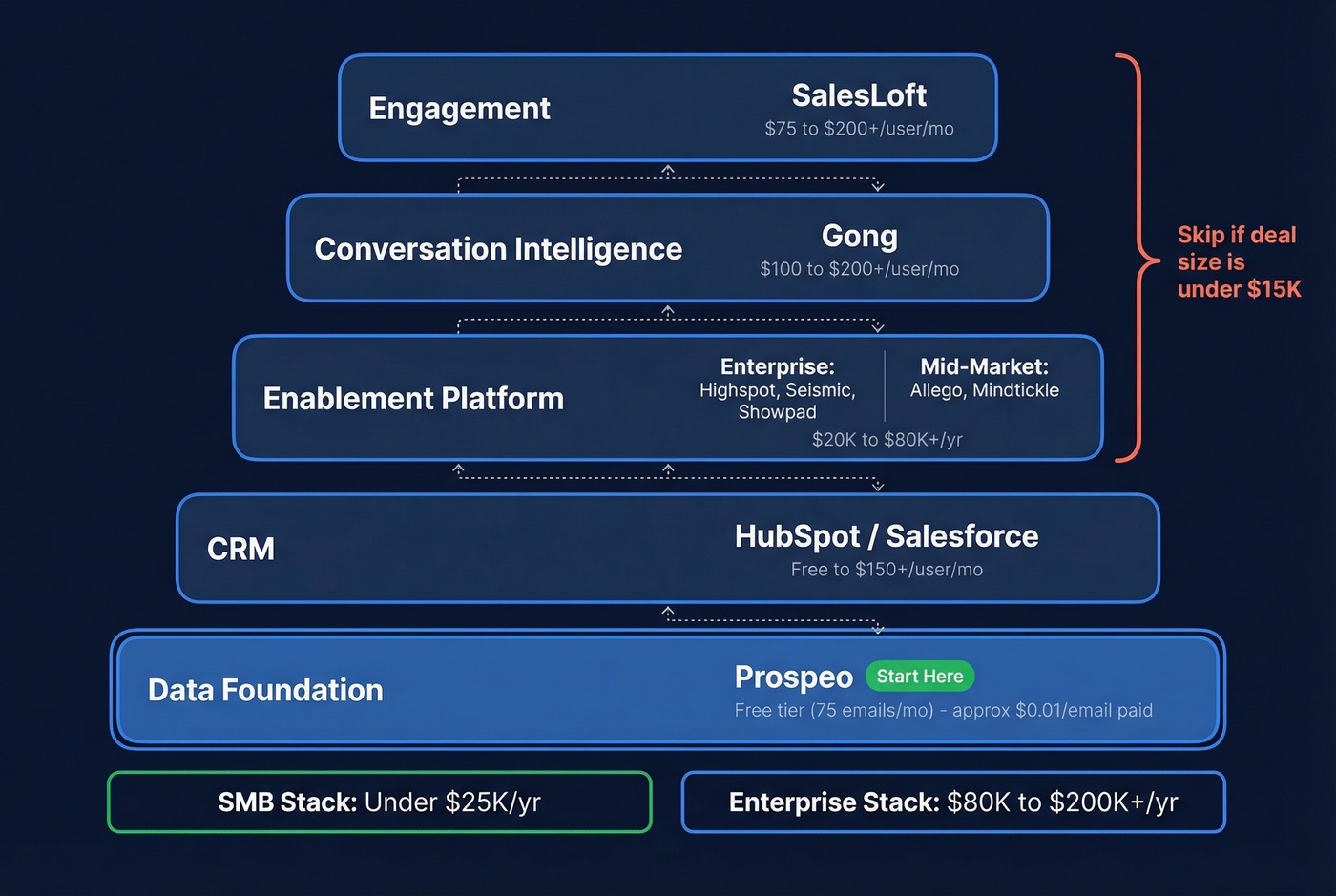
| Layer | Tool(s) | Approx. Pricing |
|---|---|---|
| Data Foundation | Prospeo | Free tier (75 emails/mo); ~$0.01/email paid |
| CRM | HubSpot / Salesforce | Free-$150+/user/mo |
| Enablement Platform | Highspot, Seismic, Showpad (enterprise); Allego, Mindtickle (mid-market) | ~$20K-$80K+/yr |
| Conversation Intel | Gong | ~$100-$200+/user/mo |
| Engagement | SalesLoft | ~$75-$200+/user/mo |
On Gartner Peer Insights, Seismic, Showpad, Highspot, and Allego all sit at 4.7 ratings. Mindtickle comes in at 4.5. In our experience, the real differentiator isn't which enablement platform you pick - it's how well it integrates with your CRM and data layer.
Let's be honest about something: if your average deal size is under $15K, you probably don't need a dedicated enablement platform at all. A CRM, verified contact data, and a well-organized shared drive will outperform a $40K platform that nobody logs into. The most common complaint from enablement practitioners on Reddit and in Slack communities isn't "we need more tools" - it's that reps won't use the ones they have.
If you're evaluating the engagement layer, treat it like a rollout project - not a purchase. (We break the setup down in Implementing a Sales Engagement Platform.)
An SMB stack with HubSpot's free CRM and Allego can start under $25K/year for small teams. Enterprise stacks with Highspot, Gong, and SalesLoft typically run $80K-$200K+ depending on seats.
Measuring Enablement Success
The biggest mistake we see: teams measure enablement by quota attainment alone. By the time that number moves, you've already burned a quarter.
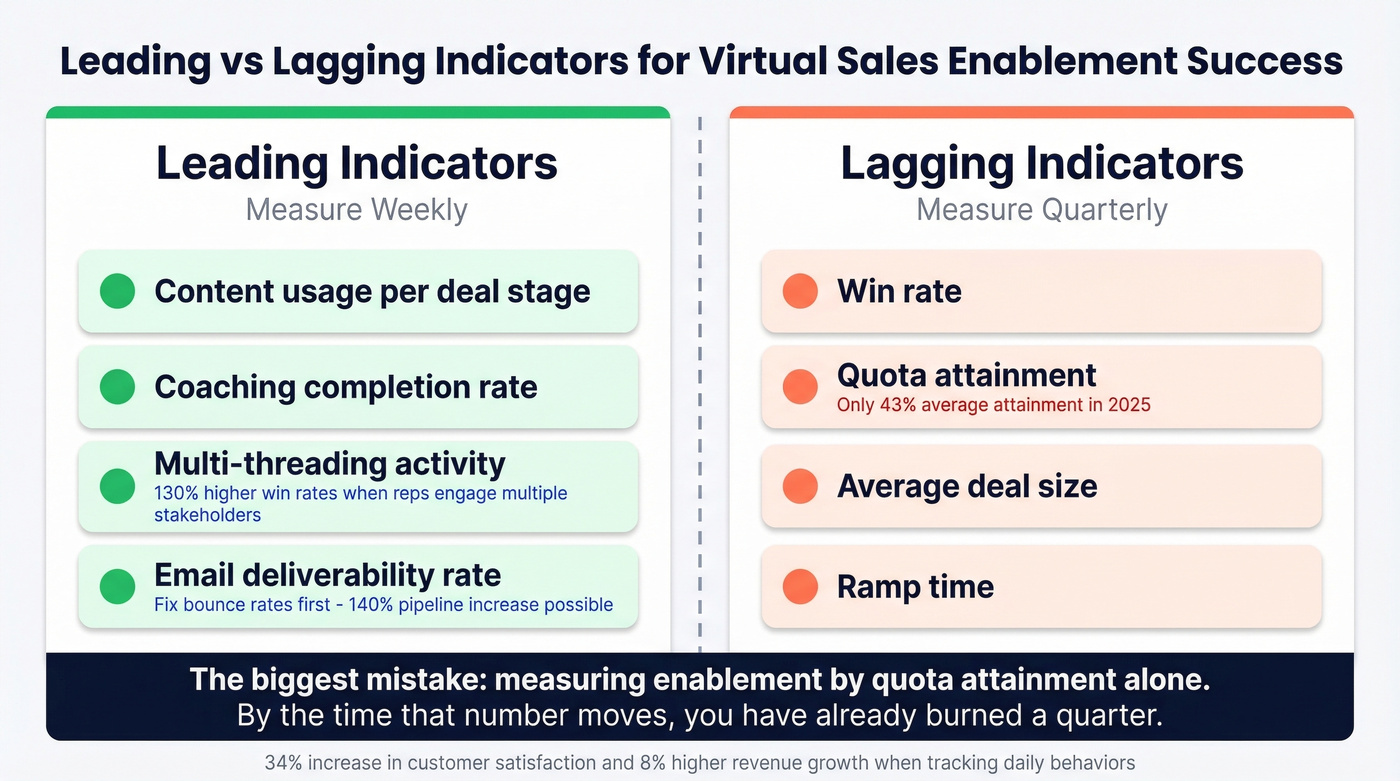
Leading indicators to measure weekly: content usage per deal stage, coaching completion rate, multi-threading activity, email deliverability rate.
Lagging indicators to measure quarterly: win rate, quota attainment, average deal size, ramp time.
Companies implementing digital enablement see a 34% increase in customer satisfaction and 8% higher revenue growth on average - but only when they're tracking the daily behaviors that drive those outcomes. I've watched teams pour six figures into enablement platforms and then measure success by whether reps "felt more prepared" in a quarterly survey. That's not measurement. That's a participation trophy.
If you want a cleaner way to connect behaviors to outcomes, start by standardizing your sales activities and monitoring pipeline health weekly.
Multi-threading boosts win rates by 130% - but only if reps can find multiple stakeholders in the first place. Prospeo's 30+ search filters let you target by department, seniority, intent signals, and headcount growth so every rep can engage the full buying committee.
Stop losing deals because reps can only reach one contact per account.
FAQ
What's the difference between sales enablement and revenue enablement?
Revenue enablement extends beyond sales to include customer success, partners, and presales. Gartner's 2026 Magic Quadrant uses "revenue enablement platforms" as the official category. Virtual sales enablement is the seller-facing subset of that broader function.
How much does a virtual enablement stack cost?
An SMB stack - Prospeo for verified contact data, HubSpot's free CRM, and a mid-market platform like Allego - starts under $25K/year. Enterprise stacks with Highspot, Gong, and SalesLoft run $80K-$200K+ annually depending on team size.
Can small teams run enablement without a platform?
Yes. Start with verified contact data, a CRM, and a shared content folder with clear naming conventions. Add a dedicated platform once you have 10+ reps. Accurate data and a repeatable process matter more than the tool.
What's the fastest way to improve enablement ROI?
Fix your data first. Teams that eliminate high bounce rates consistently see pipeline increases of 140-180%. No enablement investment delivers ROI if reps can't reach the right contacts - GreyScout saw pipeline jump 140% after dropping bounce rates from 38% to under 4%.