

The Virtual Sales Pitch Playbook: Before, During, and After
A seller on r/sales described presenting to three decision-makers who all had their webcams off. "It's like doing a pitch in a darkened room," they wrote. That's the reality now. A McKinsey B2B Pulse survey of nearly 4,000 decision-makers found the "rule of thirds" holds firm: one-third of buyers prefer in-person, one-third remote, one-third digital self-serve. Yet 72% of B2B buyers still complete transactions through a rep-led channel.
The virtual sales pitch isn't optional. It's where most deals get won or lost.
| Factor | In-Person | Virtual |
|---|---|---|
| Body language | Full visibility | Limited (cameras off) |
| Cost per meeting | High (travel, time) | Near-zero |
| Stakeholder access | Hard to assemble | One link away |
| Follow-up speed | Delayed | Immediate |
What Actually Matters
Stop obsessing over ring lights and virtual backgrounds. Your pitch fails because of three missing systems, not bad lighting: a research step before the call so you earn attention in the first 30 seconds, a slide framework during the call so you don't ramble through a screen share, and a follow-up cadence after the call so the deal doesn't die in someone's inbox. Fix those three, and everything else is noise.
Before the Pitch
81% of sales reps say buyers increasingly conduct research before they reach out. If they're doing homework on you, you'd better be doing homework on them. Your pre-pitch checklist should take 15 minutes, not 15 seconds:
- Test audio and video. Join your own meeting link. Check your mic, camera angle, and lighting. Have a backup device ready.
- Kill notifications. Slack pings during a demo are an instant credibility hit.
- Know the prospect. Name, role, reporting structure, recent company news, and the specific pain you're solving.
- Verify your contact data. If your follow-up email bounces or you're dialing a disconnected number, the pitch never happened. Tools like Prospeo let you verify emails and direct dials before the call so your prep time isn't wasted.
Here's the thing: every "virtual pitch tips" article skips the upstream data quality step. But we've watched reps nail a demo, send a killer recap, and get a hard bounce. That's not a pitch problem - it's a data problem, and it kills momentum faster than a bad slide deck.
The 7-Slide Pitch Framework
You've got about 30 seconds before your audience starts checking email on their second monitor. Most reps open with their solution. Start with the problem instead. Keep the whole thing to 20-30 minutes - anything longer and you're fighting attention spans, not objections.
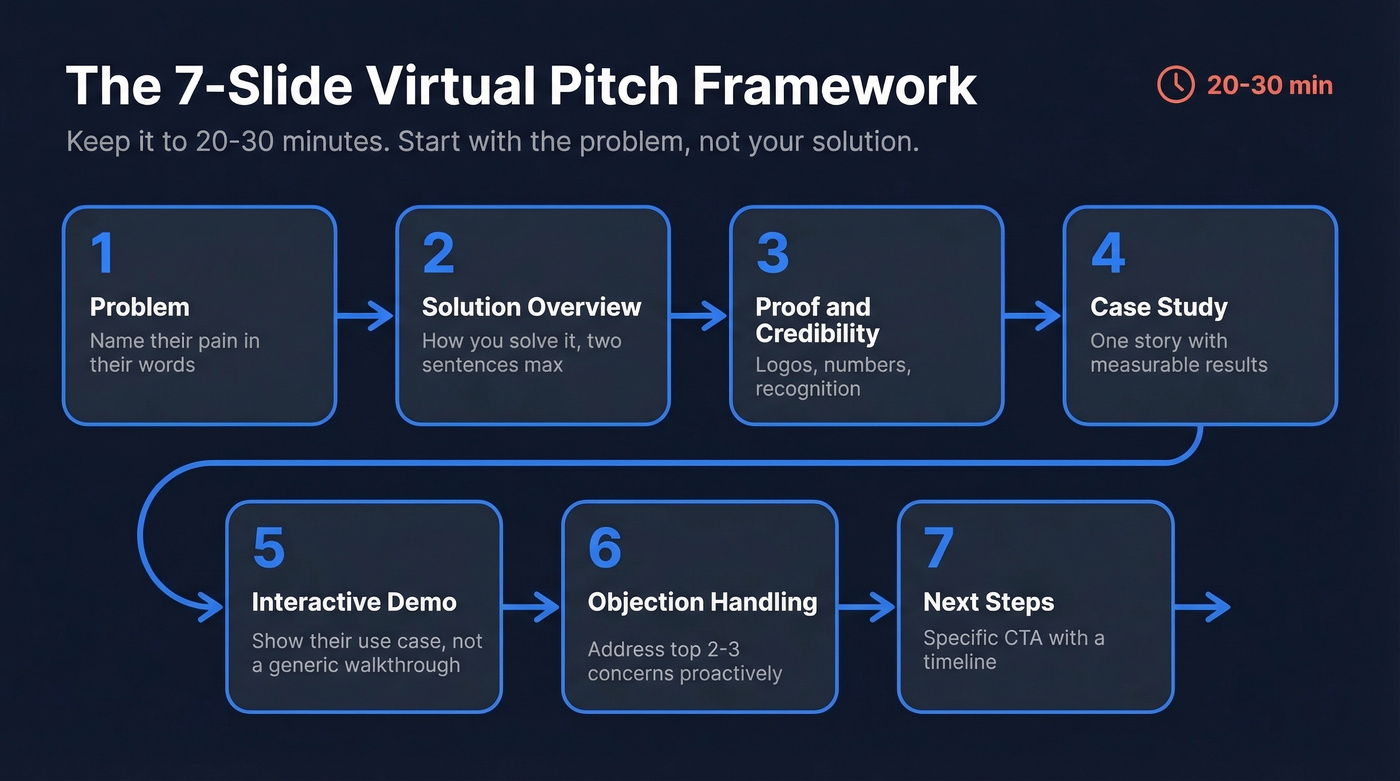
- Problem. Name their pain in their language - their words from discovery, not your marketing copy.
- Solution overview. How you solve it, in two sentences. No feature dumps.
- Proof and credibility. Logos, numbers, industry recognition. Keep it visual - a wall of text on a virtual screen is death.
- Case study. One customer story with measurable results. "Saved 40 hours/month" beats "improved efficiency."
- Interactive demo. Show the product solving their use case, not a generic walkthrough.
- Objection handling. Proactively address the top two or three concerns - budget, timeline, switching costs. Name them before they do. (If you need a tighter discovery foundation, start with better discovery questions.)
- Next steps. A specific CTA with a timeline. "I'll send the proposal by Thursday and we'll reconvene Monday with your VP" is far stronger than "let me know what you think."
Two design rules for virtual presentations: minimum 24pt body text, and high-contrast colors. Half your audience is watching on a laptop in a bright room. Record every pitch with permission - reviewing your own demos is the fastest way to improve.

You just nailed the 7-slide framework. Now imagine the recap email bounces. Prospeo verifies emails with 98% accuracy and finds direct dials from 125M+ verified mobiles - so your follow-up actually lands.
Don't let bad data kill the deal after a perfect pitch.
Keeping Them Engaged
Build in an interaction every 3-5 minutes. A question, a poll, a "does this match what you're seeing?" check-in. Silence on a virtual call means you've lost them.
If you want more scripts and frameworks, borrow a few remote sales meeting tips and adapt them to your product.
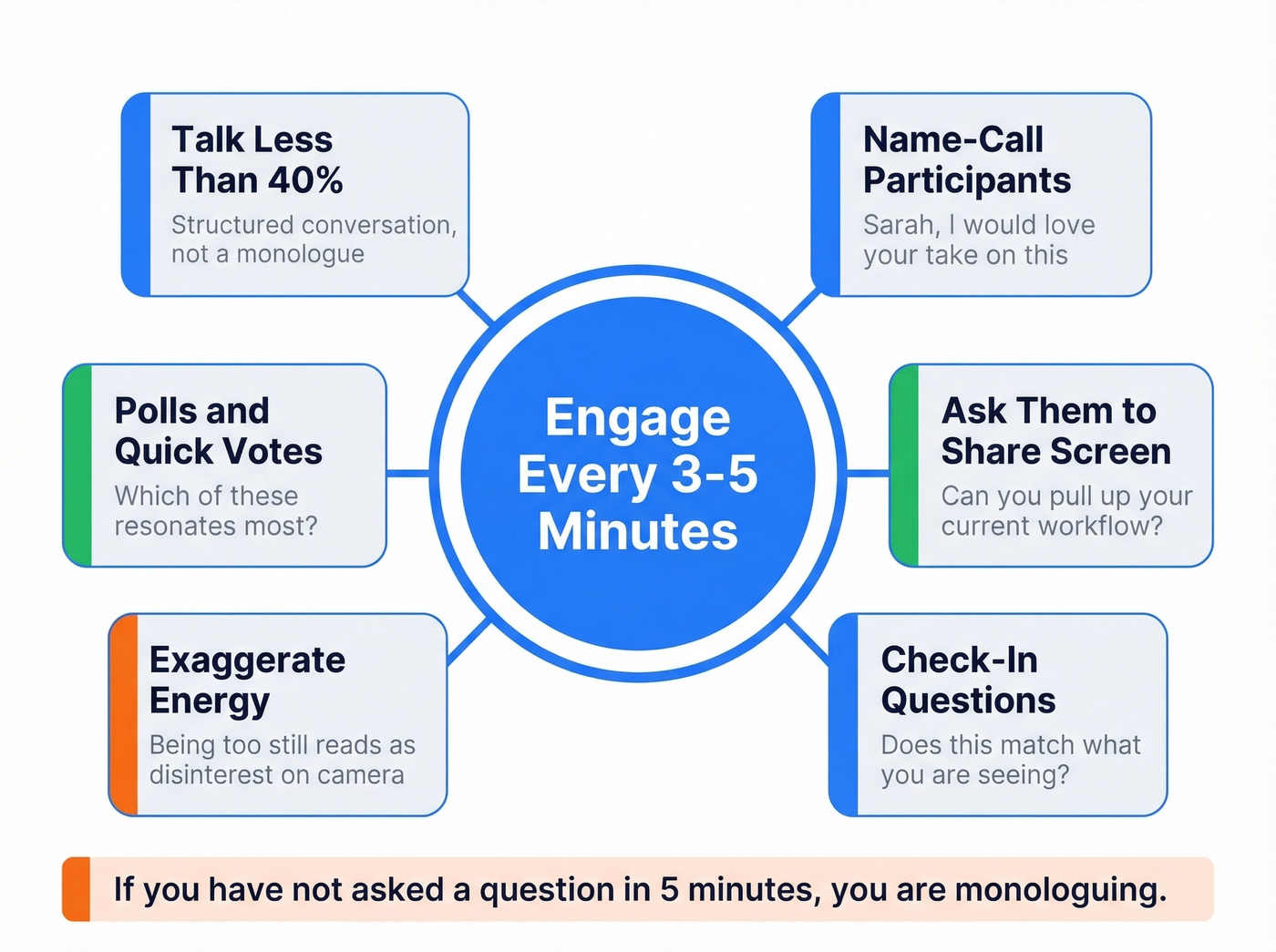
Name-call constantly - "Sarah, I'd love your take on this" works even when cameras are off. In our experience, it's the single most effective re-engagement tactic on a cameras-off call. Ask prospects to share their screen. "Can you pull up your current workflow?" flips the dynamic from presentation to collaboration, and suddenly they're invested in the outcome, not just watching a show.
What feels natural in person reads as flat on video. RAIN Group's research flags being "too still" as one of the most common virtual selling mistakes, so exaggerate your vocal energy and gestures slightly. A Reddit thread on r/sales captured it well: reps try funky shirts and background tweaks, but the demos still feel "dry" because the structure is the problem, not the aesthetics. If you haven't asked a question in five minutes, you're monologuing.
Let's be honest: the best remote pitches we've seen aren't polished performances. They're structured conversations where the rep talks less than 40% of the time. If your "pitch" is a 25-minute monologue with a Q&A tacked on, you're doing a webinar, not selling.
Mistakes That Kill Deals
A condensed hit list drawn from RAIN Group's 17-mistake framework and patterns we've seen repeatedly:
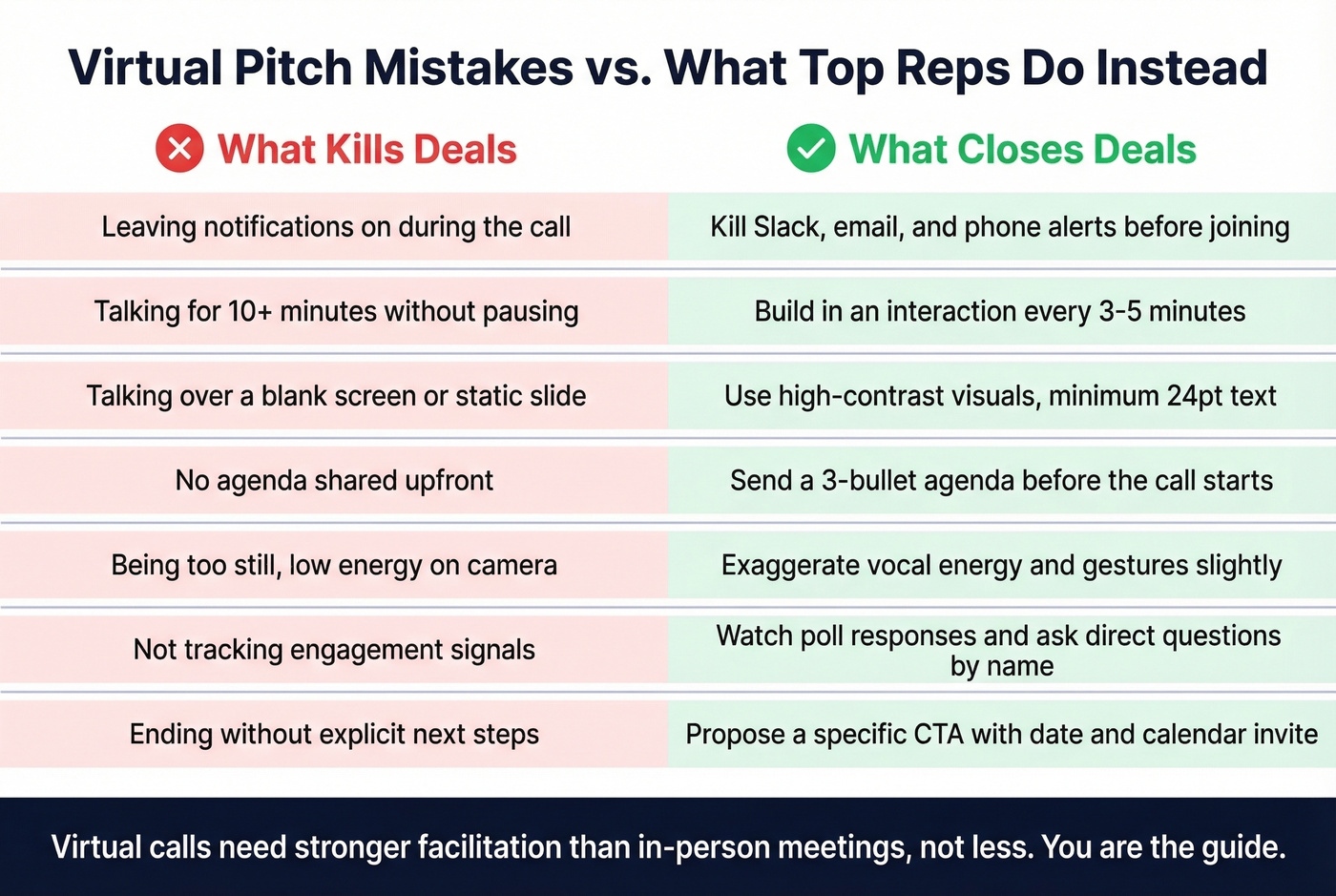
- ❌ Leaving Slack, email, or phone notifications on
- ❌ Talking too much without pausing for input
- ❌ No visuals - just talking over a blank screen or static slide
- ❌ No agenda shared upfront (virtual buyers have less tolerance for aimlessness)
- ❌ Being too still - low energy reads as disinterest on camera
- ❌ Not tracking engagement signals like poll responses or slide-by-slide attention
- ❌ Ending without explicit next steps and a calendar invite
Skip the "letting the buyer take the lead" advice you'll see elsewhere. Virtual calls require stronger facilitation than in-person meetings, not less. You're the guide. Act like it.
After the Pitch
You crushed the demo. Then you sent a generic "great chatting!" email and never heard back. Sound familiar? Structured follow-up sequences close 30-50% more deals than ad hoc check-ins.
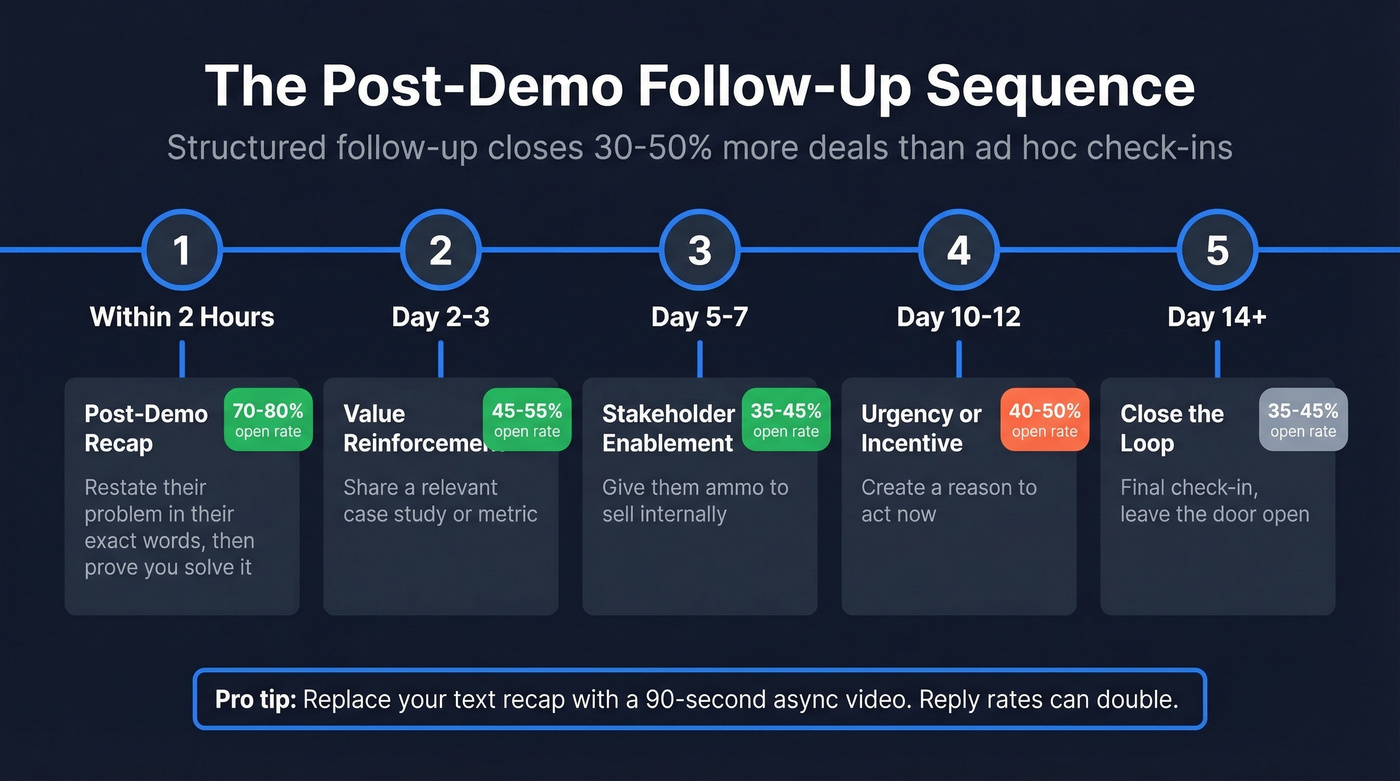
| Timing | Purpose | Expected Open Rate |
|---|---|---|
| Within 2 hours | Post-demo recap | 70-80% |
| Day 2-3 | Value reinforcement | 45-55% |
| Day 5-7 | Stakeholder enablement | 35-45% |
| Day 10-12 | Urgency / incentive | 40-50% |
| Day 14+ | Final close-the-loop | 35-45% |
Think of your pitch as two stages: frontstage (the live call) and backstage (every async touchpoint after). The recap email is the most important backstage move. Use the Say It and Prove It framework: restate the prospect's problem using their exact words from the call, state how you uniquely solve it in one sentence, then validate with proof - a customer story plus a concrete metric like "reduced onboarding time by 60%."
If you need copy you can paste, keep a few sales follow-up templates on hand.
One more move that consistently outperforms plain text: async video. 82% of customers say video has convinced them to buy a product or service. A 90-second Loom walking through the three key takeaways from your demo is more memorable than a five-paragraph email. I've personally seen reply rates double when reps swap their text recap for a short video walkthrough - it just feels more human. (If you're leaning into this, a dedicated Loom video cold email workflow helps.)
Systems Beat Scripts
Gartner predicts that by 2030, 80% of CSOs will require AI-augmented plans to navigate sales disruptions. The tools will keep evolving. But a virtual sales pitch doesn't fail because of missing charisma or bad Wi-Fi. It fails because of missing systems - no research, no structure, no follow-up.
Fix your research. Tighten your framework. Build a real post-call cadence. The rest is window dressing. If you want to operationalize it, start with sales process optimization and a simple sequence management standard.
Your post-demo sequence only works if every email hits a real inbox. Prospeo's 5-step verification and 7-day data refresh ensure the contacts you pitched are the contacts you reach - at $0.01 per email.
Stop losing closed-won deals to bounced follow-ups.