

How to Build a Virtual Sales Team That Actually Hits Quota
Your top AE just told you she's taking another offer - fully remote, 20% higher OTE, and they're giving her a data tool that actually has working phone numbers. You're not losing her to a competitor's product. You're losing her to a competitor's operating model. 61% of sellers say selling virtually is harder, and nearly 40% say they lack the training to do it well. The virtual sales teams that figure this out win talent and pipeline. The ones that don't keep writing LinkedIn posts about "the war for talent" while their best reps walk.
Here's the short version: building a remote sales team that performs comes down to four things - hiring for self-direction, setting compensation with real benchmarks, investing in a lean tech stack, and establishing a coaching cadence that doesn't devolve into micromanagement.
What Is a Virtual Sales Team?
A virtual sales team isn't a squad of overseas virtual assistants booking your calendar, and it isn't an outsourced call center reading scripts. It's a team of quota-carrying sales reps - SDRs, AEs, account managers - selling through digital channels from distributed locations. They're your employees, running your process, hitting your numbers.
The "virtual" part isn't a pandemic workaround anymore. More than half of sellers expect to primarily sell virtually moving forward. And here's the stat that should shape every decision you make about your remote team: 71% of reps say building personal rapport has a substantial impact on converting a prospect. Rapport is harder to build through a screen, which means every system you design needs to account for that gap.
Build vs. Outsource
Before you hire a single rep, decide whether to build in-house or outsource.
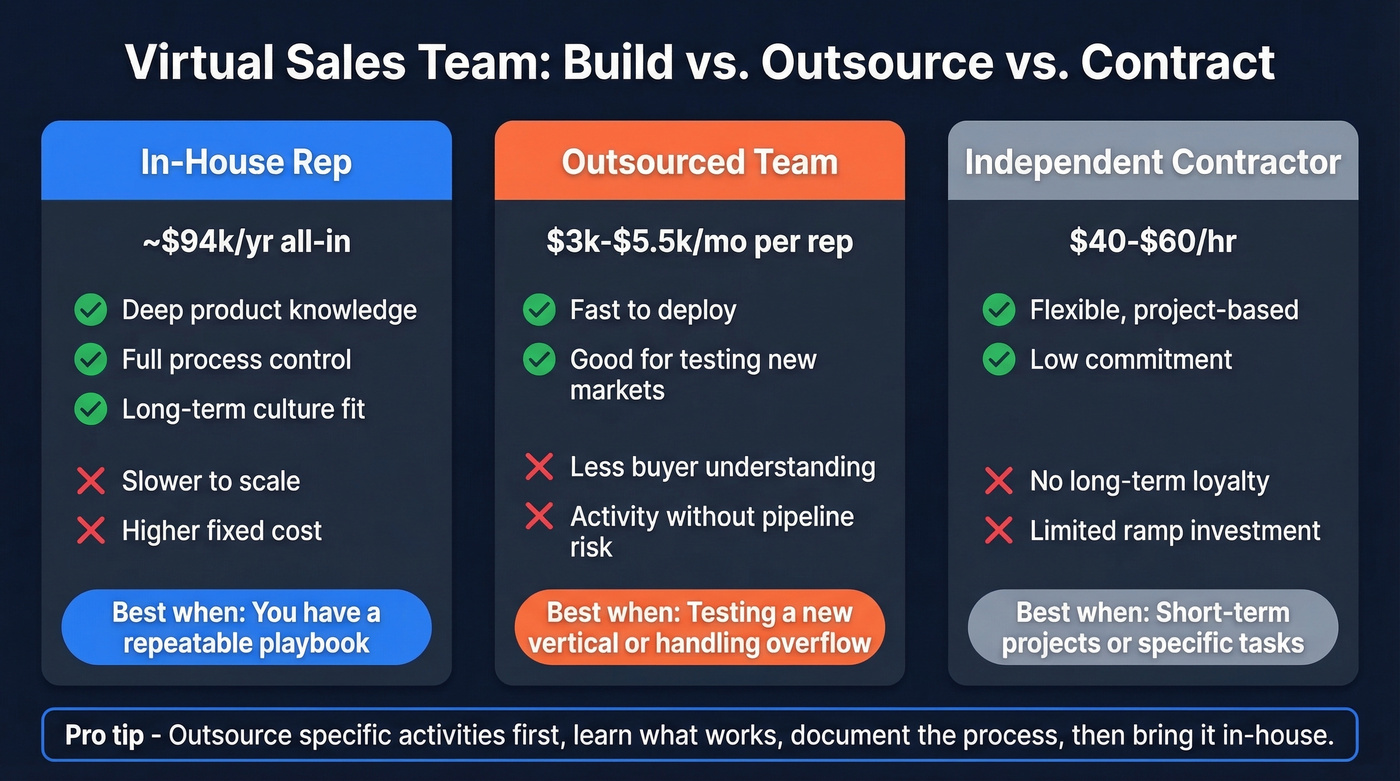
| Model | Typical Cost | Best For |
|---|---|---|
| In-house rep | ~$94k/yr all-in | Established ICP, repeatable process |
| Outsourced team | $3k-$5.5k/mo per rep | Testing new markets, overflow |
| Independent contractor | $40-$60/hr | Specific projects, short-term |
The contrarian take nobody wants to hear: outsourcing before you have a sales process is like hiring a contractor before you have blueprints. You'll spend $4,000/month and get activity reports that look great but produce zero qualified pipeline, because the outsourced team doesn't understand your buyer.
Start by outsourcing specific activities - appointment setting for a new vertical, list building for an ABM campaign. Learn what works. Document the process. Then bring it in-house once you know your ICP cold and have a playbook worth handing someone. The Zendesk team-building framework lays out a similar phased approach worth reading.
Hiring for Remote Sales
The hardest part of building a distributed sales org isn't finding people who can sell. It's finding people who can sell without someone watching.
We've seen this pattern repeatedly: a new hire seems sharp in training, asks great questions, appears to understand everything - then you check Salesforce two weeks later and there's almost nothing logged. The execution gap between "understands the concept" and "does the work independently" is massive in remote environments, and it's the single biggest reason early virtual sales teams underperform.
Screen for three things above all else: self-direction, written communication skills, and CRM discipline. If a rep won't log activity, you're flying blind. For onboarding, structure the first 30 days with daily CRM check-ins - not to micromanage, but to catch gaps before they become habits. GreyScout cut rep ramp time from 8-10 weeks to 4 weeks by pairing structured onboarding with better contact data. When new reps aren't wasting their first month dialing dead numbers, they build confidence and deal flow faster.
Compensation & Commission Structures
Compensation is where you win or lose the talent war. Remember that AE who left for a better offer? This is why.
OTE by Role
| Role | OTE Range | Base Salary Range |
|---|---|---|
| SDR | $70k-$90k | $35k-$45k |
| Inside Sales Rep | $90k-$110k | $38k-$72k |
| Mid-Market AE | $120k-$160k | $60k-$80k |
| Enterprise AE | $180k-$250k+ | $90k-$125k |
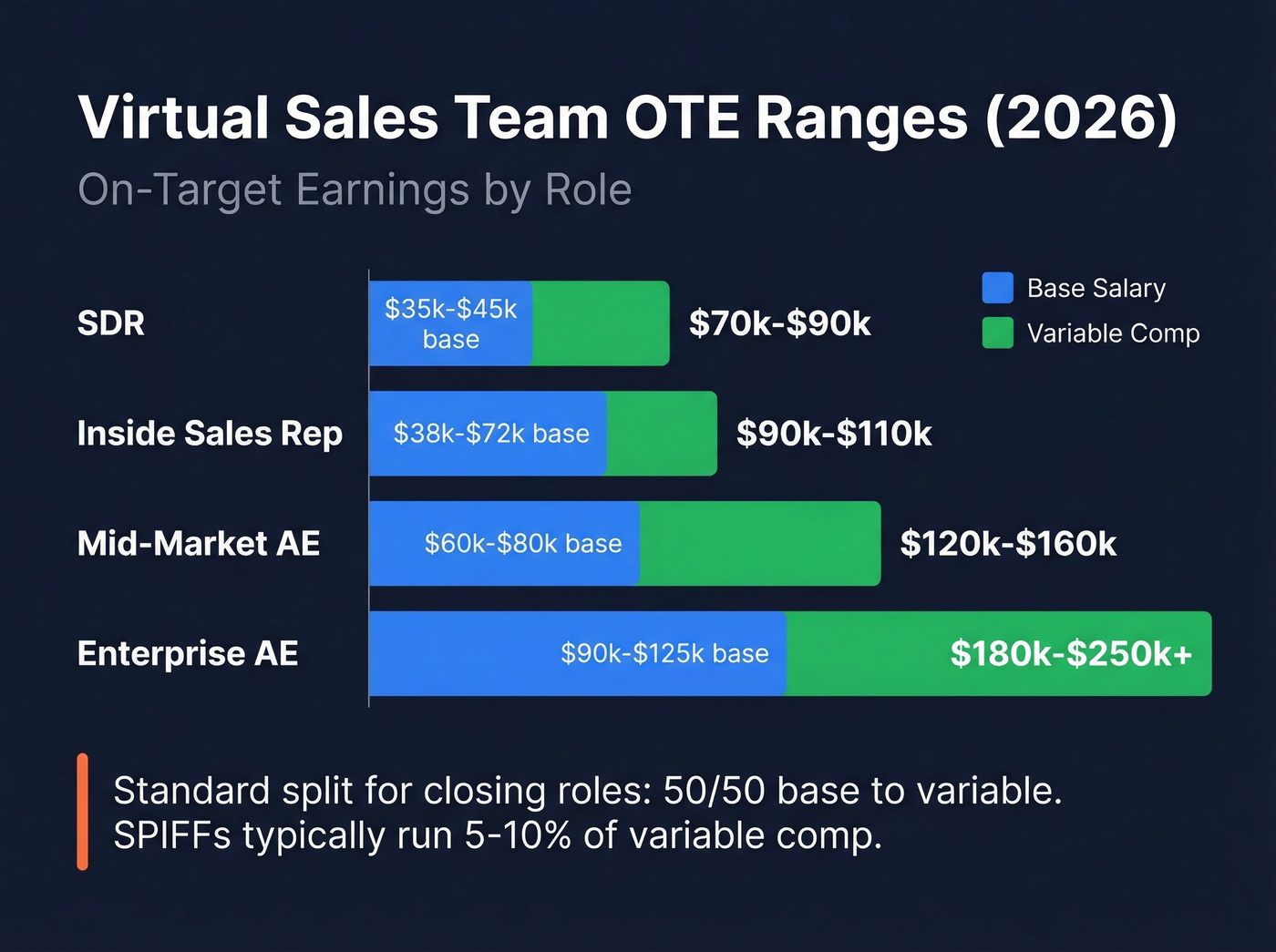
The average inside sales rep base sits around $52,040 per Payscale data, with a typical range of $38,000-$72,000. For closing roles, a 50/50 base-to-variable split is standard. SPIFFs typically run 5-10% of variable comp - useful for driving specific behaviors like multi-threading or booking demos in a new segment.
Commission Rates by Industry
| Industry | Typical Commission |
|---|---|
| SaaS/Software | 10-12% of ACV |
| Retail/Consumer | 1-5% |
| Manufacturing | 2-10% |
| Financial Services | 5-20% |
| Real Estate | 5-6% of sale price |
Draw against commission is common for new hires ramping in remote roles - it gives them a safety net while they build pipeline. If your comp plan isn't competitive with what fully remote companies are offering, your best reps will find out. They're already in Slack communities comparing notes.

Your remote reps can't build rapport if they're dialing dead numbers. Prospeo gives virtual sales teams 300M+ profiles with 98% verified emails and 125M+ mobile numbers at a 30% pickup rate - refreshed every 7 days so your distributed reps always reach real buyers.
Cut ramp time and start connecting your virtual team to qualified prospects today.
Essential Tech Stack for Remote Selling
You need four tools: a CRM, a data provider, a dialer, and a communication platform. Everything else is optimization - and optimization before you have qualified opportunities is procrastination.

CRM
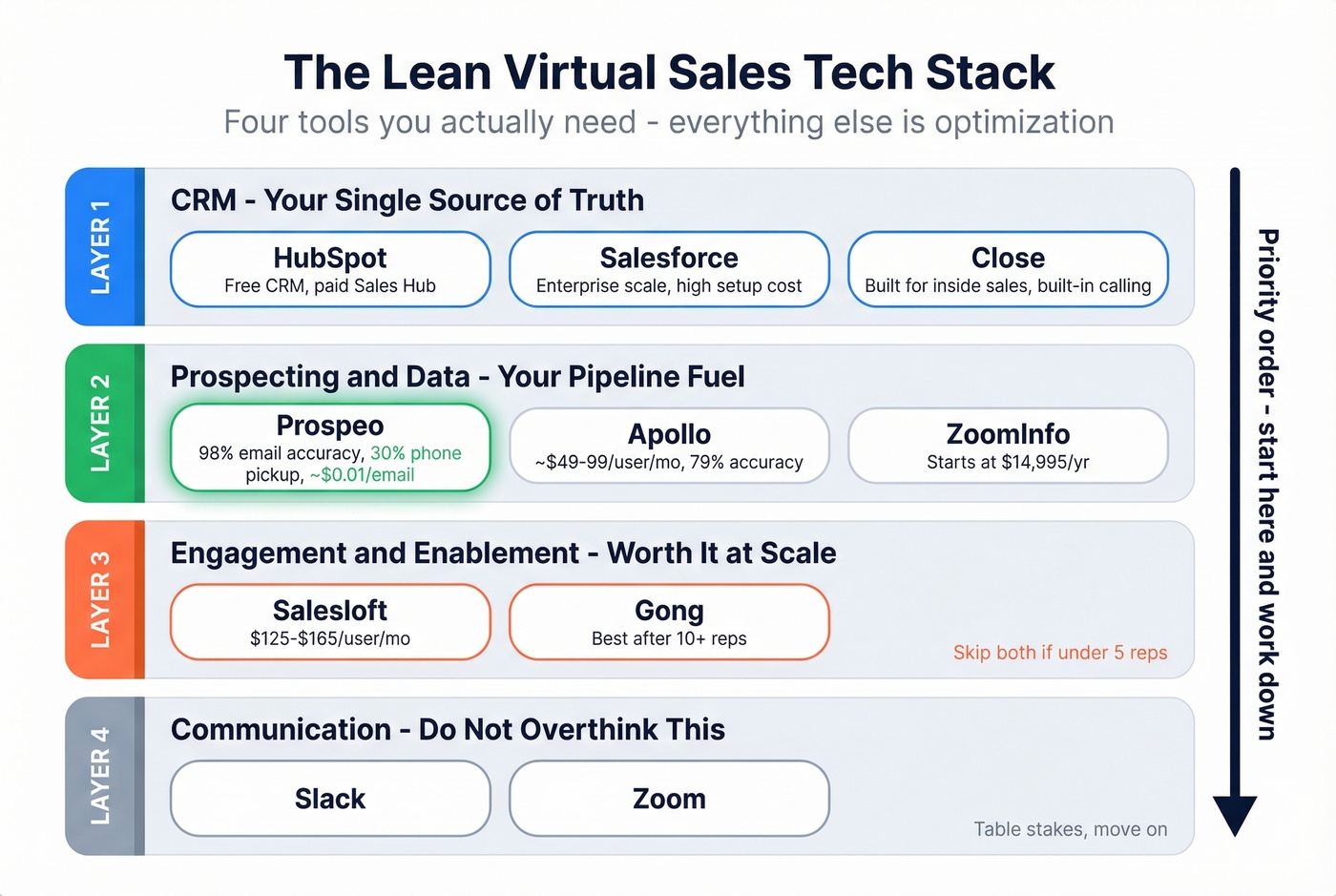
HubSpot offers a free CRM and paid Sales Hub plans for teams that want pipelines, sequences, and reporting without heavy admin overhead. Salesforce scales to enterprise complexity, but expect implementation costs to dwarf the license fee. Close is purpose-built for inside sales teams, with built-in calling and a clean UI; it offers a free 14-day trial.
Prospecting & Data
Prospeo is our pick for distributed sales teams, and the data quality numbers back that up. The database covers 300M+ professional profiles with 143M+ verified emails at 98% accuracy and 125M+ verified mobile numbers hitting a 30% pickup rate. A 7-day data refresh cycle means your reps aren't calling people who changed jobs six weeks ago. At roughly $0.01 per email with a free tier of 75 emails/month and no contracts, it runs about 90% cheaper than ZoomInfo while delivering higher accuracy. Native integrations with HubSpot, Salesforce, Lemlist, Instantly, and Outreach slot it into any virtual workflow without friction.
Apollo has a generous free tier and paid plans from ~$49-99/user/mo. Good for teams that want an all-in-one prospecting and sequencing tool, though email accuracy is around 79%. ZoomInfo starts around $14,995/year and goes up fast with add-ons - a fit for teams that want a broader platform and have the budget to match.
Engagement & Enablement
Salesloft runs $125-$165/user/mo for sequencing and call recording. Gong is a leading conversation intelligence platform - worth it once you're past 10 reps and need coaching at scale. Skip both if you're under five reps; the ROI doesn't justify the spend at that size.
Communication
Slack and Zoom are table stakes. Don't overthink this category.
Managing Remote Reps
Communication Cadence
The best remote sales management tactic we've encountered comes from a manager who's been running distributed teams since 2014: a 3-hour open video call every Friday - virtual office hours where anyone can pop in. The result? Fewer ad-hoc interruptions during the week because people save their questions for Friday.
Pair that with biweekly async video updates - 6-10 minutes, recorded from a running notes doc. Takes about 20 minutes to produce and gets consistently positive feedback. The key is consistency. If you commit to weekly office hours, you show up every week. Miss two in a row and the ritual dies.
Daily standups round out the cadence. Keep them to 15 minutes. Activity numbers, blockers, one win. Done.
One tactical detail most teams overlook: keep virtual sales calls to ~30 minutes and add interactive elements like Q&A, live whiteboarding, or polls. Attention drops off a cliff after the half-hour mark on video, and interactivity keeps prospects engaged in ways that a 60-minute slide deck never will.
KPIs and Activity Targets
Work backward from quota. Close.com's framework nails this: start with your quarterly revenue target, divide by average deal size to get required closed deals, then work back through your conversion funnel - deals needed, meetings needed, calls needed, daily activity targets.
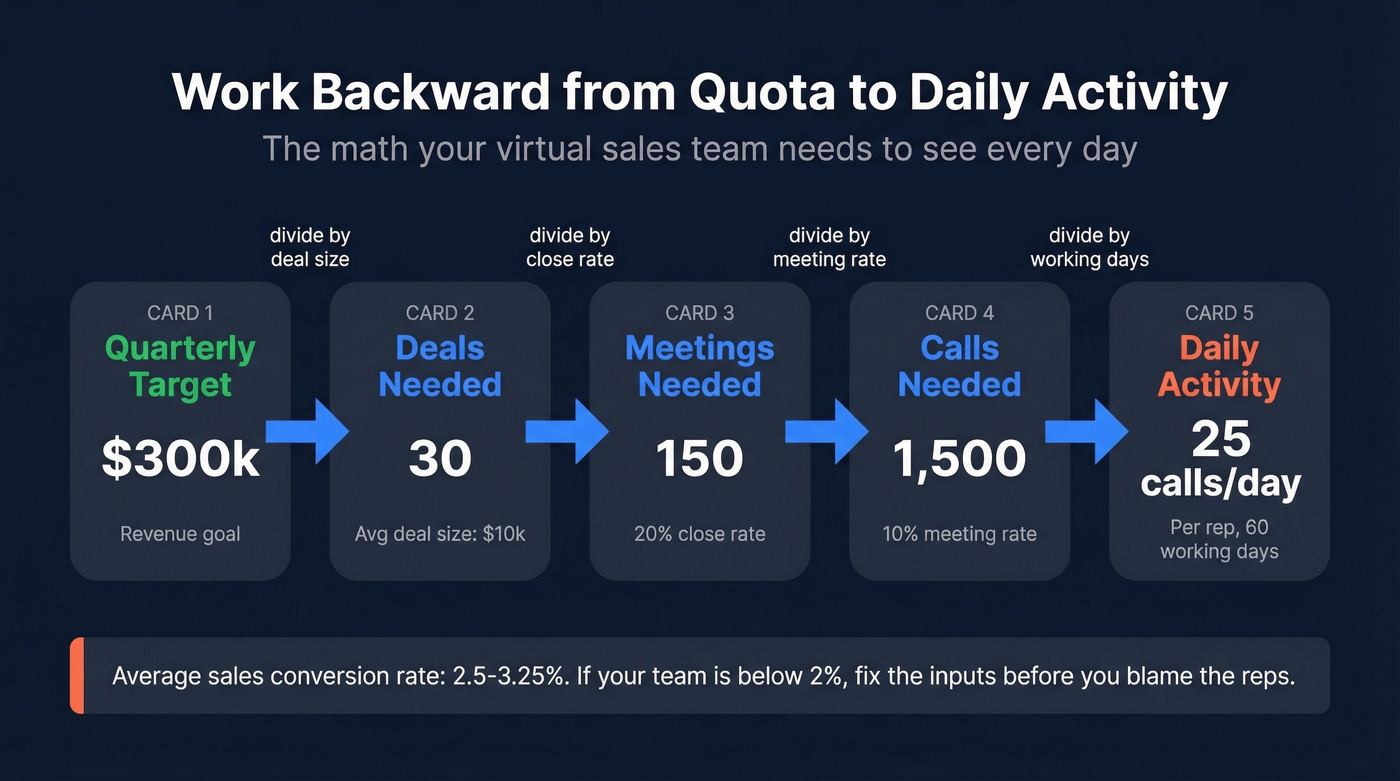
The average sales conversion rate runs 2.5-3.25%. If your team is below 2%, you have a process or data quality problem, not a people problem. Fix the inputs before you blame the reps.
The Micromanagement Trap
67% of remote workers say relationship-building at work is difficult since going remote. The natural managerial instinct is to compensate with more check-ins, more activity monitoring, more "just checking in" Slack messages.
Resist it.
Micromanagement is the fastest way to lose your best remote reps - and it's the single biggest pitfall when managing virtual sales teams. Set clear expectations, measure outcomes, and trust the process. If a rep is hitting their numbers, it doesn't matter if they took a two-hour lunch.
Hot take: If your average deal size is under $10k, you probably don't need ZoomInfo-level data infrastructure or Gong-level coaching tools. A CRM, a solid data provider, and a weekly call review session will get you 80% of the way there at 20% of the cost. Stop overengineering your stack and start coaching your reps.
Coaching Remote Reps
The 60/15/25 Rule
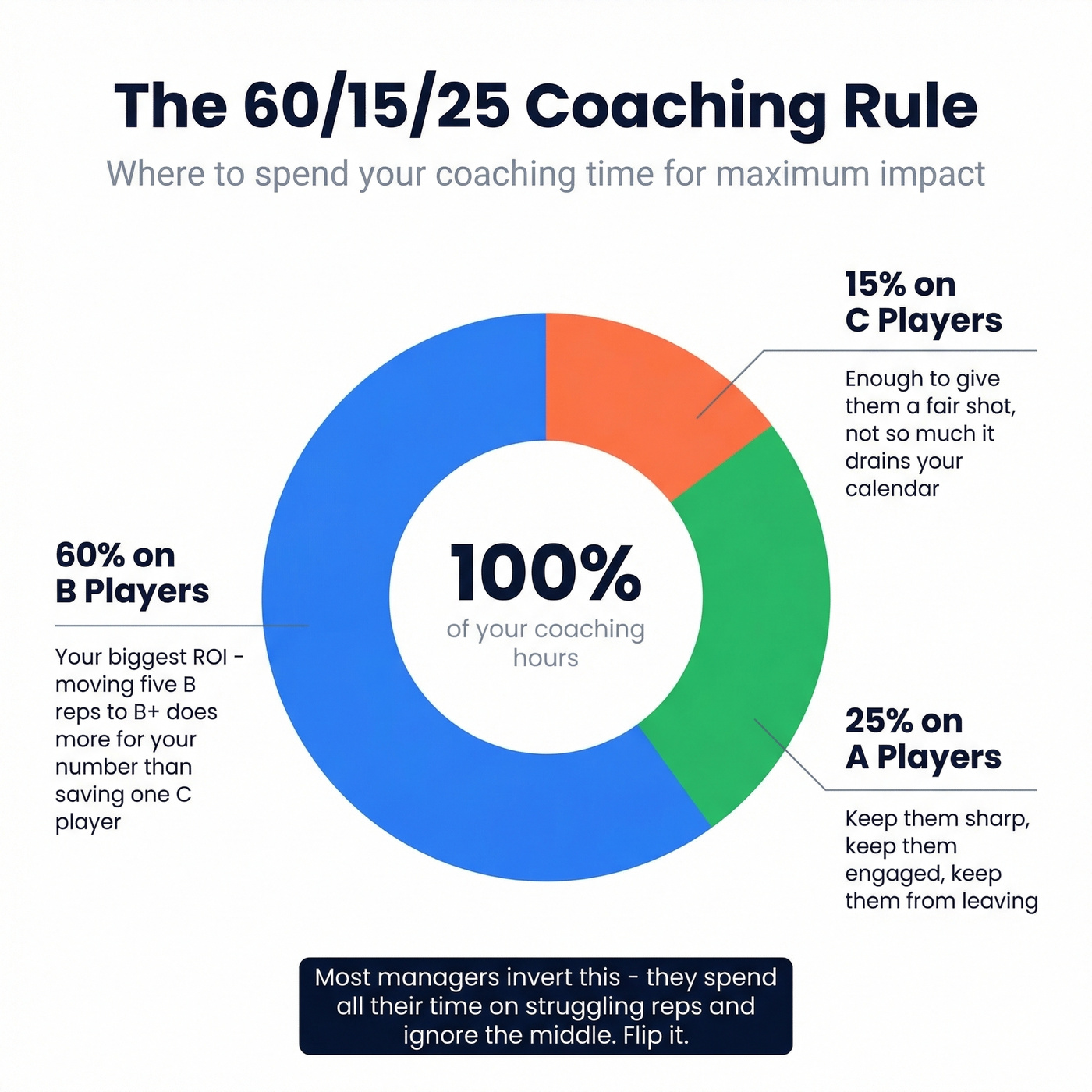
Allocate your coaching time deliberately: 60% on B reps, 25% on A reps, 15% on C reps. Most managers invert this - they spend all their time on struggling reps and ignore the middle. Your B players are where the real gains live. Moving five B reps to B+ performance does more for your number than saving one C player from a PIP.
Avoid Sales Take-Over Syndrome
Janek's research flags a pattern every sales leader should recognize: the manager who jumps in on calls and takes over the conversation. It feels helpful in the moment. It creates learned helplessness over time. In a remote environment, this is even more tempting because you're already on the Zoom call - one click to unmute and "help." Don't. Let the rep struggle, debrief after, coach the gap.
Async Coaching Methods
Recorded call reviews are the backbone of remote coaching. Have reps flag their best and worst calls each week, then provide video feedback - a 3-minute Loom is worth more than a 30-minute live debrief because the rep can rewatch it.
Let's be honest about something: the demand for virtual sales floors is real. Reddit threads consistently show remote reps wanting to cold call together and listen to each other's calls in real time. Even a simple open Zoom room during call blocks creates energy and peer learning that isolated reps desperately need. It costs nothing and it works.
Mistakes That Kill Remote Sales Orgs
Treating remote like in-office with a webcam. Requiring cameras-on for 8 hours isn't remote management - it's surveillance. Design for outcomes, not presence.
Ignoring mental health. One in three reps report their mental health has declined since going virtual. Check in on people, not just pipelines.
Skipping structured onboarding. If your onboarding plan is "shadow some calls on Zoom and figure it out," expect 3 months of missed quota. Build a 30-60-90 plan with daily milestones.
Using bad data. A remote rep who dials 50 wrong numbers in a day has zero recourse - they can't walk to a colleague's desk and ask for a backup contact. Verified emails and phone numbers matter more when every call block is unsupervised. (If you need a quick shortlist, start with these data enrichment services.)
No feedback loops. If reps only hear from you when something's wrong, you'll lose them. Async wins, shoutouts in Slack, recorded coaching - build the positive feedback muscle before you need the corrective one.
GreyScout cut rep ramp time from 8-10 weeks to 4 by pairing structured onboarding with Prospeo's verified contact data. At $0.01/email with native HubSpot, Salesforce, and sequencer integrations, your virtual sales stack stays lean and your pipeline stays full.
Stop paying enterprise prices for data that bounces - switch to 98% accuracy.
FAQ
What's the difference between a virtual sales team and an inside sales team?
They're functionally the same - reps selling remotely via phone, email, and video. "Virtual sales team" emphasizes distributed structure and location independence; "inside sales" emphasizes the selling method over field sales. Most companies use the terms interchangeably in 2026.
How much does it cost to build a virtual sales team?
A single in-house SDR costs $70k-$90k OTE plus $200-$500/month in tools. Outsourced reps run $3k-$5.5k/month. A three-person team commonly lands in the ~$18k-$25k/month range before management overhead, depending on role mix and tool stack.
What tools do virtual sales teams need?
Four essentials: a CRM like HubSpot or Salesforce, a data provider for verified emails and direct dials, a dialer, and a communication platform. Add engagement and coaching tools as you scale past 10 reps.
How long does it take to ramp a remote sales rep?
Typical ramp is 2-3 months for SDRs, 4-6 months for AEs. Structured onboarding paired with quality contact data can cut this significantly - GreyScout went from 8-10 weeks to 4 weeks by fixing their data and process simultaneously.
What are the biggest challenges of managing a remote sales org?
The top three: maintaining rep engagement without micromanaging, building team culture across time zones, and ensuring consistent coaching without a physical sales floor. Solve them with structured communication cadences, outcome-based KPIs, and async coaching methods like recorded call reviews and open virtual call rooms.